A cosmetic bag may look like a simple zippered pouch, but a well-designed cosmetic bag needs to do more than hold makeup.
It may need to organize several small products, protect delicate cosmetics, make spills easier to clean, and remain convenient to carry in a handbag, suitcase, or travel bag.
This raises a practical question:
What actually makes a cosmetic bag good?
The simplest answer is that a good cosmetic bag matches its design to the products it needs to carry.
A small makeup pouch may only need one compartment and a simple zipper. A travel cosmetic bag may need more capacity, internal pockets, padding, and a wipe-clean lining. A premium retail cosmetic bag may place more emphasis on materials, appearance, branding, and finishing.
So there is no single “best” cosmetic bag.
The right choice depends on the products, intended use, size, material, structure, and level of organization.
What Makes a Good Cosmetic Bag at a Glance?
| Feature |
What to Look For |
| Main purpose |
Makeup, beauty products, travel, daily use, or gift sets |
| Size |
Enough capacity without unnecessary bulk |
| Shape |
Flat, gusseted, box-shaped, or structured |
| Opening |
Easy access to the contents |
| Compartments |
Suitable for the products being carried |
| Material |
Matches durability, appearance, and cleaning requirements |
| Lining |
Smooth, durable, and easy to clean |
| Closure |
Secure and easy to operate |
| Protection |
Padding or structure when contents need extra protection |
| Portability |
Compact, lightweight, or easy to carry |
| Branding |
Suitable surface for logos, printing, labels, or custom details |
These are general guidelines rather than strict rules.
A simple cosmetic pouch can be a good cosmetic bag without having multiple compartments or padding. Likewise, a larger cosmetic organizer does not automatically become better simply because it contains more features.
The important point is whether the design solves the problems created by the products inside.
What Usually Goes in a Cosmetic Bag?
The contents of a cosmetic bag have a direct influence on its design.
Common cosmetic bag contents include:
- Lipstick
- Foundation
- Concealer
- Mascara
- Eyeliner
- Blush
- Compact powder
- Eyeshadow palettes
- Makeup brushes
- Beauty sponges
- Small skincare products
- Mirrors
- Beauty accessories
Many of these products are relatively small, but they come in very different shapes.
A lipstick is long and narrow.
A compact powder is relatively flat.
A makeup brush is long and needs to be kept clean.
An eyeshadow palette may be wider and more vulnerable to impact.
A bottle of foundation may contain liquid and therefore create a different cleaning requirement.
This variety explains why cosmetic bags come in so many different shapes.
A simple pouch may be enough for several everyday makeup products, while a larger organizer may need separate sections for brushes, palettes, bottles, and accessories.
The design should therefore begin with the contents rather than simply choosing a standard bag size.
Does a Cosmetic Bag Need Compartments?
Not always.
This is one of the most important things to understand when designing a cosmetic bag.
A simple cosmetic pouch can work perfectly well with one large compartment.
This type of design is useful for:
- Daily makeup
- Small beauty products
- Touch-up items
- Promotional products
- Gift sets
- Handbag storage
The advantage is simplicity.
There are fewer construction steps, fewer internal components, and more uninterrupted space.
However, compartments become more useful when the number or variety of products increases.
Small Internal Pockets
Small pockets can help separate items such as:
- Lipstick
- Eyeliner
- Mascara
- Small tools
- Beauty accessories
They prevent smaller products from disappearing underneath larger items.
Mesh Pockets
Mesh allows users to see what is inside without opening the pocket.
This can be useful for travel cosmetic bags where quick access is important.
Brush Slots
Makeup brushes have a specific storage problem.
They are relatively long, can become dirty when mixed with other products, and may need to remain in a fixed position.
Brush slots can therefore make sense in a larger cosmetic organizer.
Removable Dividers
Removable dividers provide more flexibility.
Users can change the internal layout depending on the products they carry.
This feature is more appropriate for larger organizers than small everyday pouches.
More Compartments Do Not Always Mean Better Design
Adding compartments increases organization, but it also takes up space.
If a small cosmetic bag has too many pockets, the usable central space may become unnecessarily limited.
For this reason, internal organization should be based on actual product requirements.
The goal is not to add as many compartments as possible. The goal is to make the contents easier to organize.
Is a Flat Cosmetic Bag Better Than a Structured Cosmetic Bag?
Neither is universally better.
The difference is mainly about capacity, portability, and the type of products being carried.
Flat Cosmetic Pouches
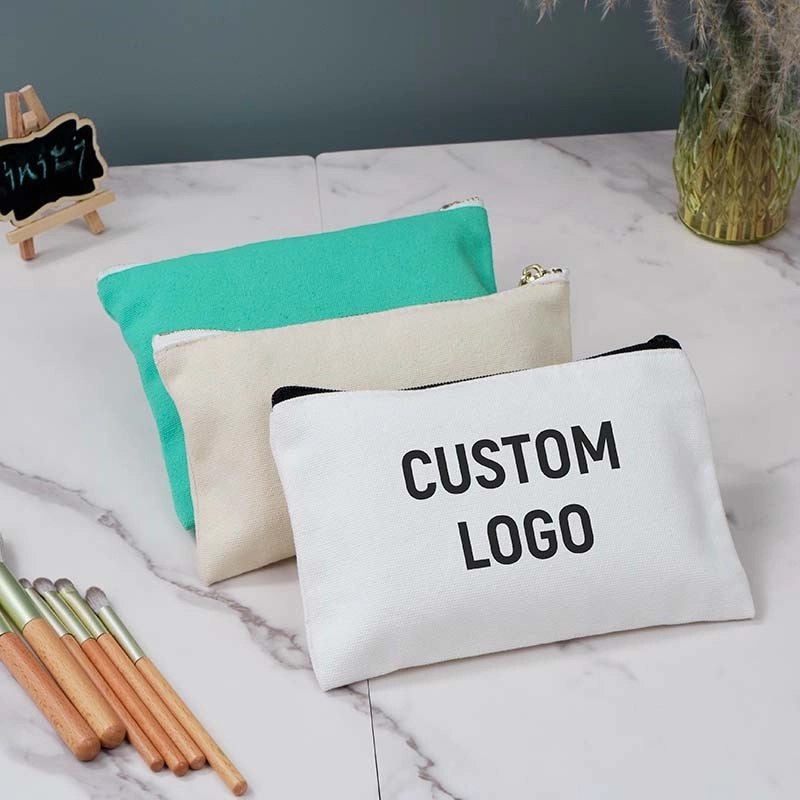
A flat cosmetic pouch has a relatively thin profile.
It works particularly well for:
- Lipstick
- Mascara
- Compact makeup
- Beauty samples
- Small skincare products
- Daily touch-up items
Its biggest advantage is portability.
It can easily fit inside:
- Handbags
- Backpacks
- Totes
- Carry-on luggage
- Larger cosmetic organizers
Flat pouches are also relatively simple to manufacture and customize, making them popular for promotional products and beauty gift sets.
Gusseted Cosmetic Bags
A gusset adds depth to the bag.
This creates more three-dimensional storage space without necessarily making the front panel much larger.
A gusseted cosmetic bag can be useful for:
- Bottles
- Brushes
- Palettes
- Larger cosmetic products
- Multiple product types
It can also make the bag easier to place on a countertop.
For products that need depth, a gusseted construction can be much more practical than simply increasing width or height.
Box-Shaped Cosmetic Bags
A box-shaped cosmetic bag provides even more structure.
It is often suitable for travel or larger collections of products.
The structured base can make it easier for the bag to stand upright, while the wider opening can improve access to the contents.
The trade-off is that a structured bag generally takes up more space than a flat pouch.
So the choice depends on whether the priority is compact storage or usable capacity.
What Opening Is Best for a Cosmetic Bag?
The opening determines how easily users can see and reach the contents.
A basic top zipper is sufficient for many cosmetic pouches.
However, larger cosmetic bags may benefit from wider openings.
Standard Zipper Opening
A standard zipper running along the top is simple and familiar.
It works well for:
- Small cosmetic pouches
- Everyday makeup bags
- Promotional products
- Simple retail accessories
Wide-Mouth Opening
A wide opening allows users to see more of the interior.
This is particularly helpful when the bag contains many small products.
Instead of reaching through a narrow opening, the user can open the bag wider and identify products more easily.
U-Shaped Opening
A U-shaped zipper can create a larger opening while retaining the basic pouch structure.
It is useful when access is more important than maintaining a very simple construction.
Clamshell-Style Opening
A clamshell opening allows the two sides of the bag to open widely.
This type of construction is more suitable for organized cosmetic cases and travel products.
It can provide better visibility but usually requires more construction and hardware.
The best opening is therefore determined by the balance between accessibility, structure, cost, and intended use.
Automatic Magnetic Closure
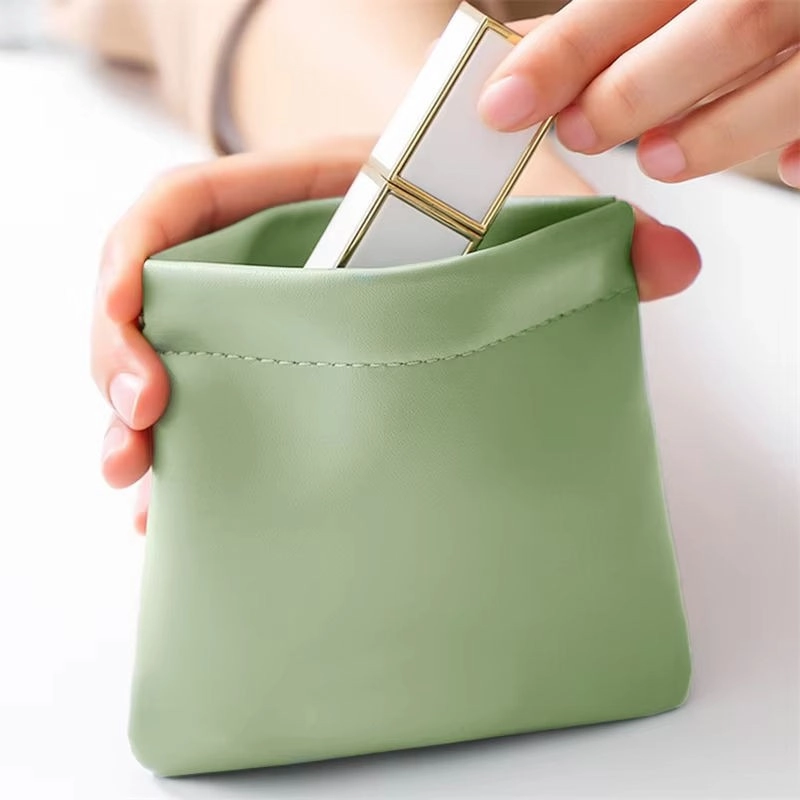
An automatic magnetic closure uses a flexible frame with built-in magnets. When the sides are released, the opening naturally comes back together and closes.
This design is particularly suitable for soft cosmetic bags and pouches where quick access and easy closure are important.
It can offer:
- Automatic closing
- Quick access
- No zipper required
- A distinctive opening shape
- A clean and practical appearance
Drawstring Closure
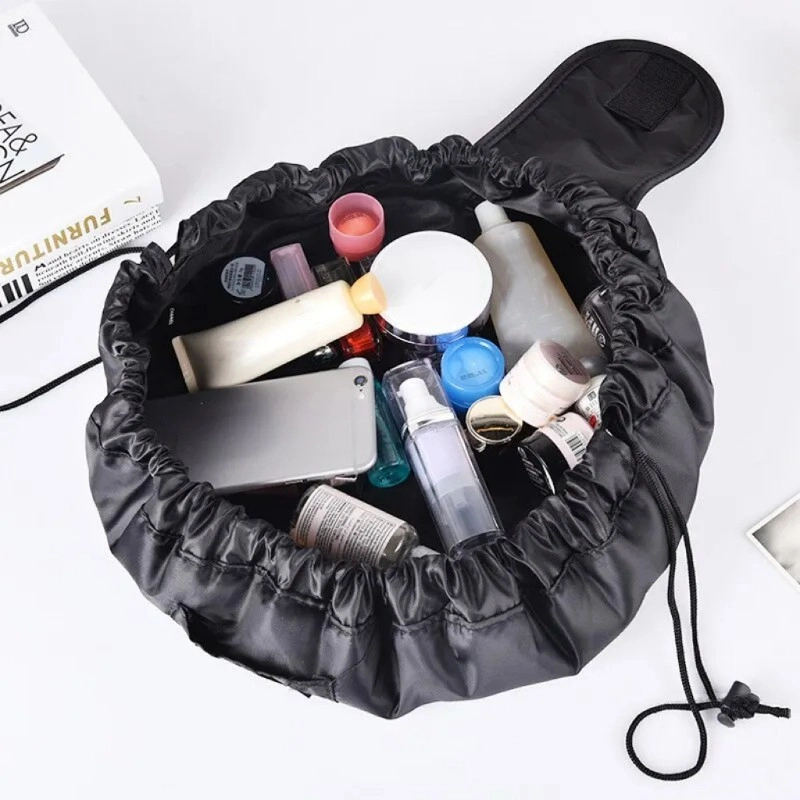
Drawstring closures are increasingly used for soft and flexible cosmetic bags. They are simple, lightweight, and can give the product a relaxed or premium packaging feel.
They can work well for:
- Soft cosmetic pouches
- Small beauty products
- Gift sets
- Reusable packaging
- Lightweight travel bags
How Many Compartments Should a Cosmetic Bag Have?
There is no ideal number of compartments.
The right number depends on what the bag needs to organize.
A small cosmetic pouch may only need one main compartment.
A larger organizer could include:
- Main storage compartment
- Small zipper pocket
- Mesh pocket
- Brush holder
- Elastic loops
- Internal divider
One Main Compartment
A single compartment provides maximum flexibility.
Products can be placed anywhere inside, and there are no fixed restrictions on size.
This works well for simple everyday cosmetic bags.
Multiple Compartments
Multiple sections can make a larger collection easier to organize.
For example, makeup brushes can be separated from palettes, while smaller products can be placed in a zipper pocket.
However, every additional compartment consumes some usable space.
Should Every Cosmetic Bag Have a Brush Holder?
No.
A brush holder makes sense when the bag is specifically designed for makeup collections that include several brushes.
For a small lipstick or touch-up pouch, adding brush storage would make the construction more complicated without providing much benefit.
This is an important principle in cosmetic bag design:
Every feature should have a practical purpose.
Does a Cosmetic Bag Need Padding?
Not every cosmetic bag needs padding.
However, padding can be valuable when the contents are vulnerable to impact.
Consider products such as:
- Pressed powder
- Eyeshadow palettes
- Glass foundation bottles
- Mirrors
- Delicate beauty tools
These products may benefit from additional protection.
Padding can be incorporated through:
- Foam
- Quilted construction
- Padded walls
- Soft inner layers
When Padding Makes Sense
Padding is particularly useful for:
- Travel cosmetic cases
- Premium organizers
- Beauty gift sets
- Professional makeup cases
- Structured cosmetic bags
When Padding May Be Unnecessary
A simple cosmetic pouch for lipstick, mascara, or small everyday products may not need additional padding.
Adding padding increases material use, thickness, and production complexity.
For a low-cost promotional pouch, a simple fabric construction may be more appropriate.
The decision should therefore be based on the contents rather than simply adding padding because it makes the product look more substantial.
What Materials Are Commonly Used for Cosmetic Bags?
Cosmetic bags can be produced from a wide range of materials.
The choice affects:
- Appearance
- Durability
- Weight
- Flexibility
- Cleaning
- Printing
- Cost
- Brand positioning
There is no single best material for every application.
Polyester
Polyester is one of the most versatile choices for cosmetic bags.
It can be produced in different weights and constructions and can be combined with different linings or coatings.
It is commonly considered when the bag needs to balance:
- Durability
- Lightweight construction
- Cost
- Printability
- Customization
Polyester can therefore work for both promotional cosmetic pouches and more structured travel designs.
Nylon
Nylon is useful when lightweight construction and flexibility are important.
It can work particularly well for travel-oriented cosmetic bags because it can provide a relatively low-weight construction while maintaining good strength.
Nylon cosmetic bags often have a practical, modern appearance and can be designed to pack efficiently.
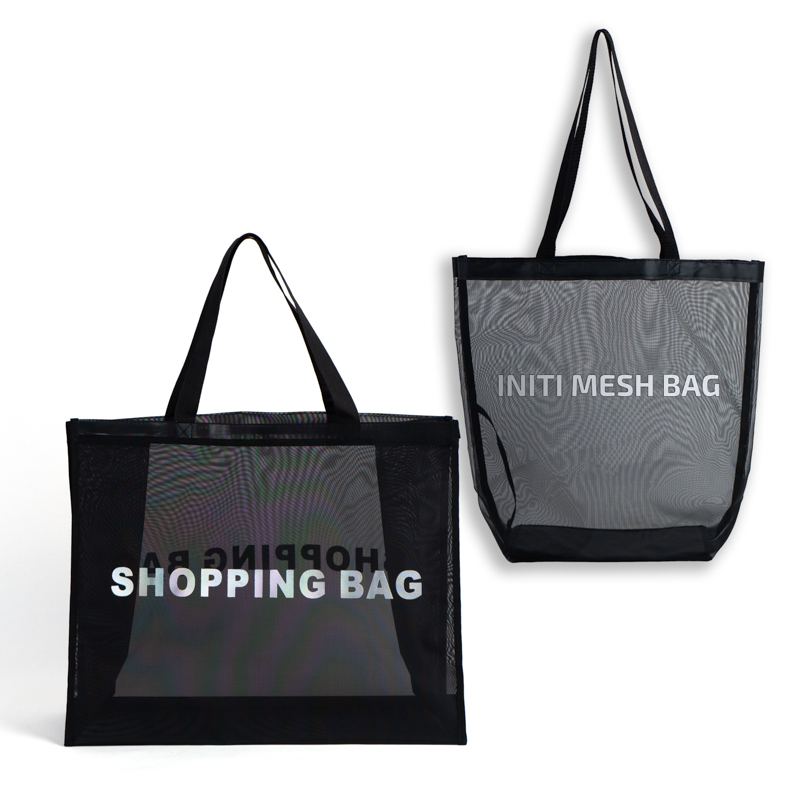
Mesh
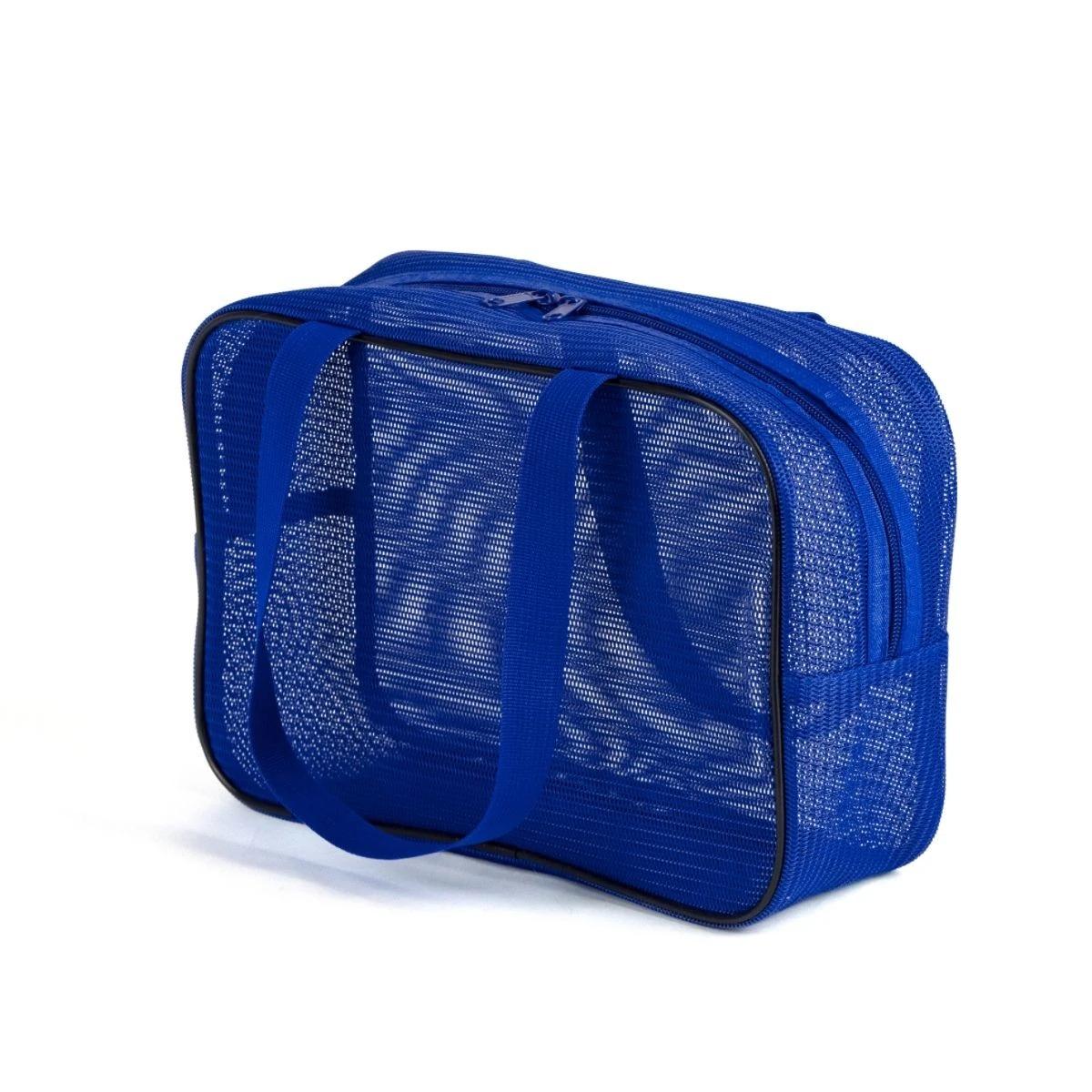
Mesh is a lightweight material that can improve visibility and ventilation.
It offers:
- Lightweight construction
- Breathable structure
- Easy visibility of contents
- Flexible design
- Suitable for compartments and organizer sections
Mesh works well for cosmetic organizers, travel pouches, internal pockets, and cosmetic bags designed for quick product identification.
Canvas
Canvas creates a very different appearance.
Instead of a technical or smooth synthetic look, canvas provides a more natural fabric texture.
It can be suitable for:
- Lifestyle brands
- Promotional products
- Natural or casual branding
- Reusable packaging
- Beauty gift sets
Canvas also provides a good surface for certain printing and branding techniques.
However, untreated cotton canvas can absorb liquids, so the interior construction becomes particularly important when the bag will carry liquid cosmetics.
Cotton
Cotton provides a soft, natural textile option for cosmetic bags and pouches.
It offers:
- Soft hand feel
- Natural appearance
- Good printability
- Reusable potential
- Suitable for simple pouch designs
Cotton is often chosen for brands looking for a more natural or understated aesthetic.
Corduroy
Corduroy adds a distinctive textured appearance and soft hand feel to cosmetic bags.
It offers:
- Ribbed textured surface
- Soft hand feel
- Distinctive visual appearance
- Good color options
- Suitable for fashion-oriented designs
It works well for casual, seasonal, and fashion-focused cosmetic bags.
PU

PU provides a smoother, more polished appearance.
It is often used when the cosmetic bag needs a fashion-oriented or premium look.
PU cosmetic bags can work well for:
- Beauty brands
- Retail products
- Gift sets
- Fashion accessories
- Premium promotional products
The smooth surface can also make the exterior relatively easy to wipe clean, depending on the specific material and finish.
PVC

PVC is especially useful when transparency is part of the design.
A clear PVC cosmetic bag allows the user to see the contents without opening it.
This can be useful for:
- Travel
- Beauty kits
- Promotional products
- Retail packaging
- Product visibility
PVC can also be combined with fabric binding, colored trims, or other materials to create a more finished appearance.
TPU
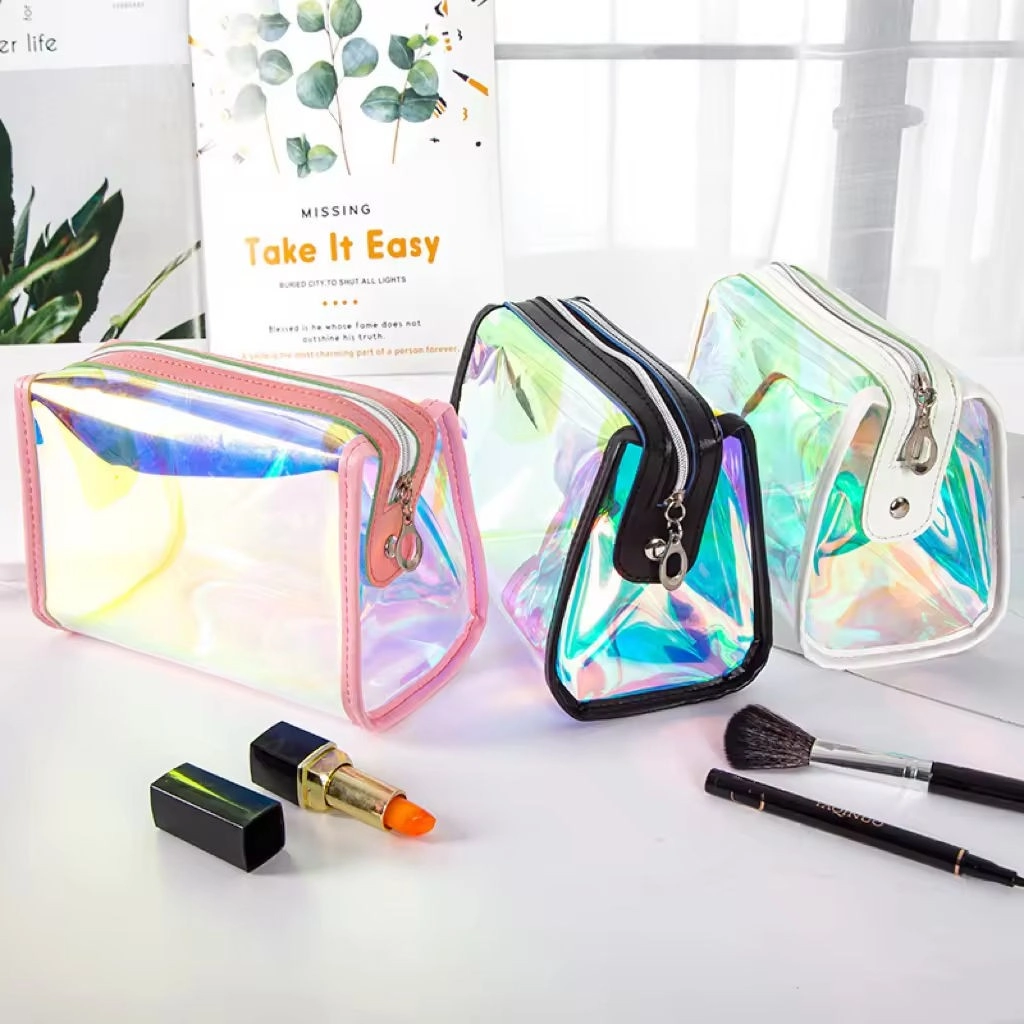
TPU is another transparent and flexible material that can be used when a softer feel and higher flexibility are desired.
It offers:
- Flexible construction
- Transparent options
- Smooth surface
- Good resistance to everyday use
- Modern appearance
It can be used for transparent cosmetic pouches and lightweight beauty organizers.
Neoprene
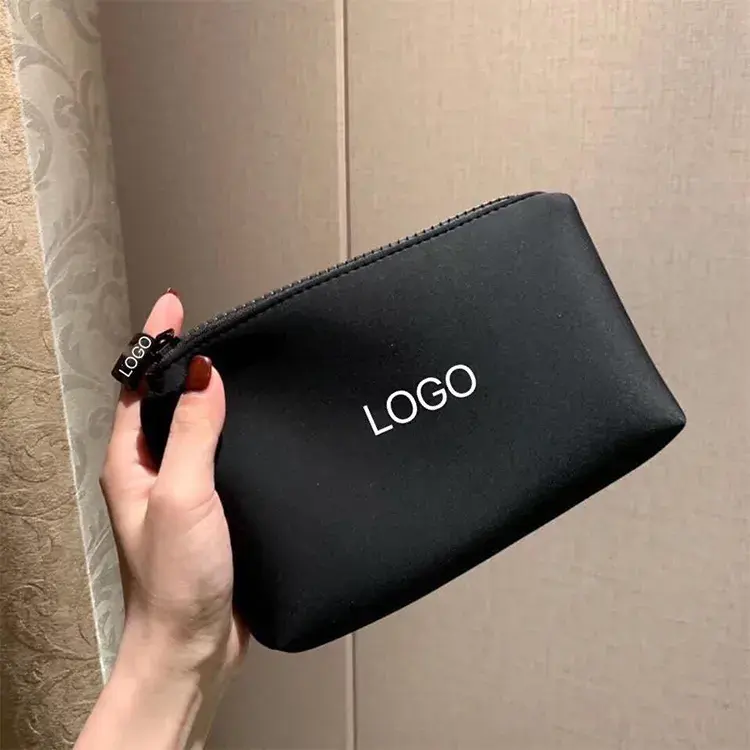
Neoprene provides a soft, flexible, and slightly padded feel.
It offers:
- Soft hand feel
- Flexible construction
- Lightweight cushioning
- Comfortable appearance
- Good suitability for casual designs
It can be used for soft cosmetic pouches and beauty accessories that benefit from a cushioned feel.
Quilted and Puffer Fabrics
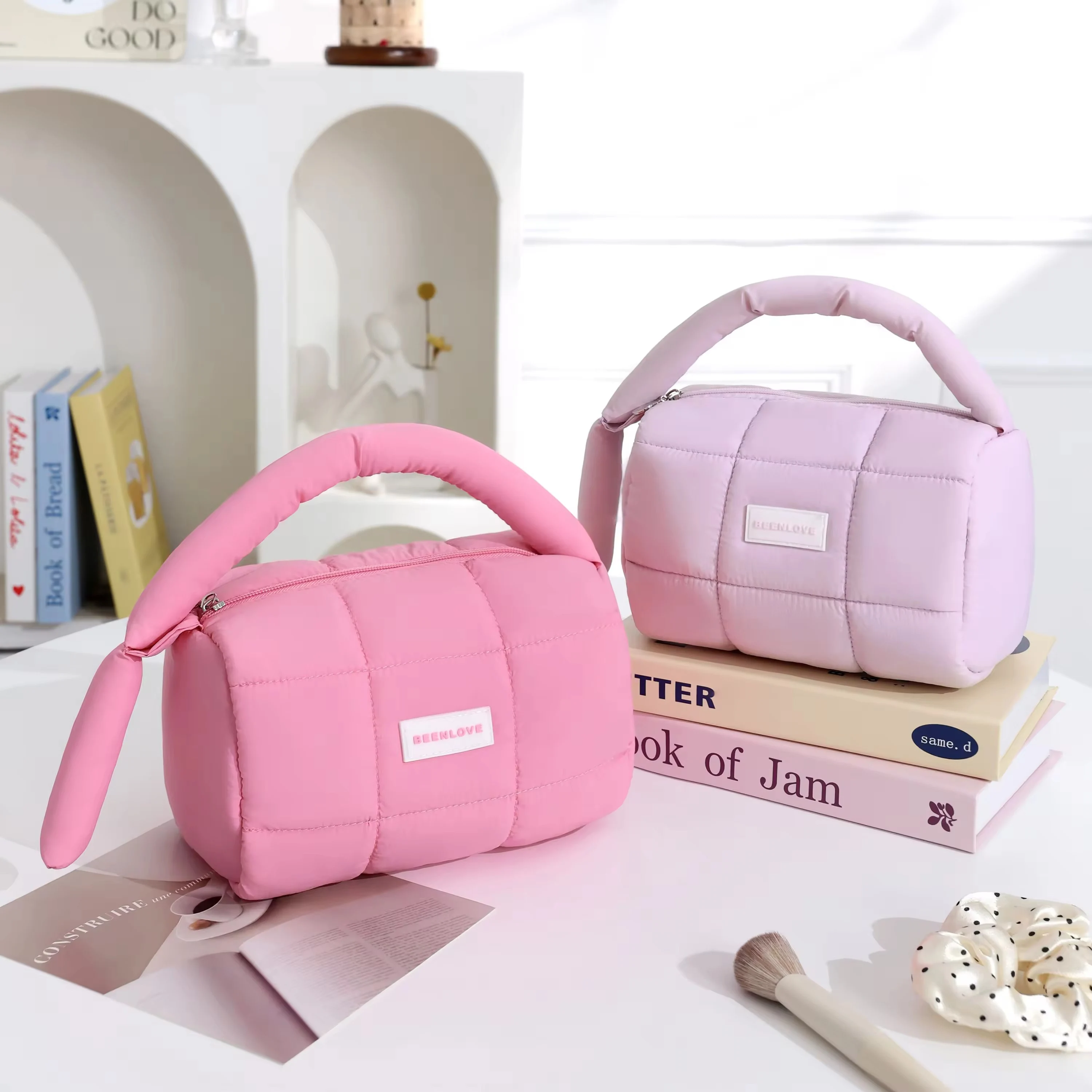
Quilted and puffer fabrics add softness, volume, and visual interest.
They offer:
- Soft and padded feel
- Attractive texture
- Added cushioning
- Fashion-oriented appearance
- Premium design potential
They are often used for premium and fashion-focused cosmetic bags.
Is a Cosmetic Bag Waterproof?
Not necessarily.
This is an important distinction because a cosmetic bag may use a water-resistant material without being a completely waterproof finished product.
For example, a bag may use:
- PVC
- Coated polyester
- PU
- Nylon
- Water-resistant fabric
But the finished bag still contains:
- Seams
- Stitching holes
- Zippers
- Binding
- Corners
- Openings
Water can potentially enter through these construction points.
So there is a difference between:
Water-resistant material
and
Waterproof finished construction.
For most cosmetic bags, complete waterproofing is not necessary.
What users often need instead is protection from everyday spills.
If foundation, lotion, or another liquid leaks inside the bag, a wipeable surface can make cleaning much easier.
What Makes a Cosmetic Bag Easier to Clean?
Several design decisions can help:
- Smooth lining
- Coated interior
- Non-absorbent surfaces
- Easy-access opening
- Reduced exposed seams
- Appropriate exterior material
The practical goal is usually to make small spills manageable rather than turn the bag into a completely waterproof container.
What Is the Best Lining for a Cosmetic Bag?
The best lining depends on the products inside.
A cosmetic bag needs to deal with a different type of mess than many other bags.
The interior may come into contact with:
- Foundation
- Powder
- Lipstick
- Lotion
- Skincare products
- Makeup residue
For this reason, the lining should generally be selected for cleaning and everyday durability rather than appearance alone.
Polyester Lining
Polyester lining is a practical choice for many basic cosmetic bags.
It can provide a smooth interior while keeping the overall construction lightweight.
It works well when the bag does not need a highly specialized moisture-resistant interior.
Coated Polyester
A coated polyester lining can provide additional resistance to spills.
It is useful when the bag needs to be easier to wipe clean.
This can be particularly valuable for travel cosmetic bags.
PEVA
PEVA can be used when a more moisture-resistant interior is required.
However, it is important not to confuse a PEVA lining with a completely leakproof bag.
A sewn bag still contains seams and needle holes, and the zipper area also affects liquid protection.
PVC or TPU-Type Interiors
These materials can provide smooth, wipeable surfaces and may be useful when cleaning is a major priority.
The final choice depends on the desired feel, flexibility, appearance, construction, and target price.
The lining should always be considered together with the exterior material and the intended application.
How Does Size Affect a Cosmetic Bag?
A cosmetic bag's dimensions affect both capacity and portability.
However, size should not be judged only by width and height.
Depth can make a major difference.
For example, a flat pouch measuring 24 × 15 cm may look larger from the front than a 21 × 14 × 9 cm box-shaped bag.
But the second bag has significant usable depth.
This matters when the contents include:
- Bottles
- Brushes
- Palettes
- Tubes
- Larger containers
Therefore, cosmetic bag dimensions should be considered as:
Width × Height × Depth
rather than simply describing the bag as small, medium, or large.
Small Cosmetic Bags
Small cosmetic pouches are suitable for everyday essentials.
They may carry:
- Lipstick
- Mascara
- Powder
- Small mirror
- Touch-up products
Their main advantage is convenience.
They can stay inside a handbag or backpack without taking up much space.
Medium Cosmetic Bags
Medium bags offer more flexibility.
They can hold a wider range of makeup products and may work well for:
- Daily makeup collections
- Weekend travel
- Skincare sets
- Beauty gift sets
This size range is often a useful balance between capacity and portability.
Large Cosmetic Organizers
Large organizers are designed for more extensive collections.
They may include:
- Multiple compartments
- Brush holders
- Dividers
- Padded sections
- Larger main compartments
They are useful for travel, professional makeup users, and larger beauty collections.
However, larger bags also require more material and take up more shipping and storage space.
For B2B products, these factors should be considered during development.
What Makes a Cosmetic Bag Easy to Carry?
Portability depends on more than weight.
The bag's shape, dimensions, handle, and flexibility all influence how convenient it is to carry.
Without a Handle
Small cosmetic pouches often do not need handles.
They are usually placed inside handbags, backpacks, or larger luggage.
Removing unnecessary hardware can help keep the product lightweight and simple.
With a Side Handle
A larger cosmetic organizer may benefit from a side handle.
This allows the bag to be carried separately from the main luggage.
With a Hanging Hook
A hanging cosmetic bag can be useful when counter space is limited.
The bag can be suspended in a bathroom or other temporary space.
This type of design is particularly suitable for travel-oriented products.
The important point is to add carrying features only when they improve the intended user experience
What About a Hanging Cosmetic Bag?

Hanging cosmetic bags combine storage and portability.
When opened, the bag can be suspended from:
- Bathroom hooks
- Towel rails
- Wardrobe rails
- Door hooks
This can be useful when counter space is limited.
A hanging design may include:
- Mesh pockets
- Zipper compartments
- Elastic holders
- Transparent sections
- Multiple internal panels
These designs are particularly suitable for travel.
However, they are more complicated than a basic cosmetic pouch and may not be necessary for everyday handbag use.
What Makes a Cosmetic Bag Good for Travel?
Travel changes the requirements of a cosmetic bag.
A bag used at home can remain in one place.
A travel cosmetic bag may be:
- Packed inside luggage
- Moved repeatedly
- Compressed between other items
- Opened frequently
- Exposed to spills
A good travel cosmetic bag therefore needs a practical balance of portability, organization, protection, and cleaning.
Lightweight Construction
The bag should not add unnecessary weight to luggage.
Lightweight polyester or nylon can be useful when portability is a priority.
Secure Closure
The zipper should keep the contents inside even when the bag is moved around.
This becomes particularly important when carrying small products that can easily fall out.
Easy-Clean Interior
Travel increases the consequences of spills.
A wipeable interior can make it easier to deal with leaking foundation, skincare, or other liquid products.
Efficient Organization
Travel users often need to find products quickly.
Internal pockets, mesh sections, brush slots, and dividers can improve organization when they are designed around the actual contents.
Compact Shape
A good travel cosmetic bag should use available luggage space efficiently.
A flat pouch may be ideal for compact packing.
A deeper structured bag may be better when carrying bottles or larger products.
There is therefore no single ideal travel shape.
What Makes a Cosmetic Bag Different From a Makeup Bag?
In most cases, the terms are used interchangeably.
“Makeup bag” sounds slightly more specific because it directly suggests makeup products.
“Cosmetic bag” can be somewhat broader and may include:
- Makeup
- Beauty tools
- Skincare
- Small personal-care products
The actual product can be identical.
The difference is often more about how the product is marketed than how it is manufactured.
For example, a simple rectangular zipper pouch may be sold as a:
Makeup bag
if it is promoted toward makeup users.
The same product could be sold as a:
Cosmetic bag
if the brand positions it around broader beauty storage.
This is useful for brands because product naming can affect how customers understand the intended use.
What Makes a Cosmetic Bag Good for a Beauty Gift Set?
Cosmetic bags are often used as part of beauty gift sets because they provide value beyond the original product.
A beauty brand may package a cosmetic bag together with:
- Makeup
- Skincare
- Travel-size products
- Brushes
- Beauty tools
- Seasonal collections
In this situation, the bag needs to complement the products inside.
The size should be based on the actual gift-set contents.
The colors and materials should match the brand identity.
The logo should be visible without overwhelming the design.
The packaging should also protect the finished bag and create an appropriate presentation.
A simple cosmetic pouch may be sufficient for a promotional gift, while a premium beauty collection may justify a more structured or padded design.
How Should Brands Design a Custom Cosmetic Bag?
For brands, the process should begin with the product application.
Instead of starting with a standard cosmetic pouch and adding a logo, businesses can define the bag around their actual products and customers.
Define the Intended Use
First determine whether the bag is intended for:
- Daily makeup
- Travel
- Beauty gift sets
- Promotional campaigns
- Retail products
- Professional makeup
- Skincare collections
- Reusable packaging
This decision influences almost every later specification.
Define the Contents
Identify the approximate products that will be stored inside.
Product dimensions can help determine:
- Bag width
- Bag height
- Depth
- Opening size
- Pocket dimensions
- Brush holder length
- Divider placement
Choose the Shape
The basic shape should match the contents.
Flat products may work well in a flat pouch.
Bottles may require a gusset.
Larger collections may benefit from a structured organizer.
Select the Material
The material should support both the brand image and the intended use.
For example:
Canvas can support a natural lifestyle look.
Polyester can offer flexibility and cost efficiency.
Nylon works well for lightweight travel designs.
PU can create a more polished appearance.
PVC can provide transparency and easy visibility.
Quilted or puffer fabrics can create a soft, fashion-oriented appearance.
Design the Interior
Decide which internal features are actually useful.
Possible options include:
- Main compartment
- Mesh pocket
- Zipper pocket
- Brush slots
- Elastic loops
- Dividers
- Padded sections
Avoid adding features simply to make the specification look more complex.
Select the Closure
A zipper is the most common option, but the design can vary.
Consider:
- Standard zipper
- Wide-mouth zipper
- U-shaped zipper
- Double zipper
- Custom zipper puller
- Automatic Magnetic Closure
- Drawstring
The closure should match the size and structure of the bag.
Add Branding
Depending on the material and design, brands can consider:
- Screen printing
- Heat transfer printing
- Embroidery
- Woven labels
- PU labels
- Rubber labels
- Debossing
- Custom zipper pulls
The branding method should be selected together with the material and artwork.
Packaging
For retail products and gift sets, packaging should be considered together with the bag.
Packaging can affect:
- Product presentation
- Carton dimensions
- Shipping efficiency
- Storage
- Retail display
This is especially important for larger B2B orders.
What Should You Check Before Ordering Custom Cosmetic Bags?
Before moving into bulk production, it is useful to check the complete product rather than focusing only on the exterior appearance.
Product Function
Does the bag actually suit the products it is designed to carry?
Dimensions
Are the width, height, and depth appropriate?
Opening
Can users easily reach the contents?
Internal Organization
Are the pockets or compartments useful rather than excessive?
Material
Does the material match the intended appearance and durability?
Lining
Can the interior handle the expected spills and cleaning requirements?
Closure
Does the zipper operate smoothly and securely?
Protection
Do the contents require padding or structural support?
Branding
Is the logo correctly positioned and reproduced?
Sample
Has the physical sample been checked before mass production?
These checks can prevent relatively small design decisions from becoming larger production problems later.
What Are Common Cosmetic Bag Design Mistakes?
Good cosmetic bag design is often about avoiding unnecessary problems.
Making the Bag Too Small
A compact bag is convenient, but insufficient capacity can make organization difficult.
The dimensions should be based on the actual contents.
Making the Bag Too Large
Extra space can increase bulk without providing meaningful benefits.
An oversized bag may also become inconvenient for handbags and travel.
Using Too Many Compartments
Too many fixed compartments can reduce flexible storage space.
Organization should remain practical.
Ignoring the Opening
A narrow opening can make a bag difficult to use even when the overall capacity is sufficient.
Choosing Material Without Considering the Contents
A fabric that looks attractive may not be suitable for liquid cosmetics.
Material should be selected according to both appearance and application.
Treating Water Resistance as Complete Waterproofing
A coated or water-resistant fabric does not automatically make the finished bag waterproof.
The construction must also be considered.
Adding Features That Do Not Improve Function
Handles, padding, pockets, hooks, and hardware can all add cost.
Every feature should have a clear reason for being included.
How Can Cosmetic Bag Design Match Different Brand Positions?
The same basic product can be developed in very different ways depending on the brand.
Promotional Cosmetic Bags
Promotional bags usually prioritize:
- Practicality
- Cost efficiency
- Simple construction
- Visible branding
A simple polyester or canvas pouch may be sufficient.
Retail Cosmetic Bags
Retail products generally require more attention to:
- Material
- Finishing
- Structure
- Branding
- Packaging
The cosmetic bag itself becomes part of the product experience.
Premium Beauty Accessories
Premium designs may use:
- PU
- Quilted fabrics
- Custom hardware
- Padded construction
- More sophisticated internal organization
The goal is to make the bag feel like a finished accessory rather than simple packaging.
Reusable Beauty Packaging
For brands looking to extend the life of their packaging, a reusable cosmetic bag can serve as both packaging and a long-term accessory.
In this case, durability and practical design become especially important.
FAQ
What makes a good cosmetic bag?
A good cosmetic bag should balance size, organization, material, accessibility, and durability.
What is the best shape for a cosmetic bag?
The best shape depends on the contents, with flat, gusseted, and structured designs serving different needs.
How many compartments should a cosmetic bag have?
It depends on the contents and use; everyday pouches may need one compartment, while travel or professional bags may need more.
What material is best for a cosmetic bag?
Polyester, nylon, canvas, PU, and PVC are common choices, depending on the required appearance, durability, and function.
Does a cosmetic bag need to be waterproof?
Not always; water-resistant or wipeable construction is often sufficient for everyday cosmetic storage.
What size should a cosmetic bag be?
The size should match the number, shape, and type of products the bag needs to hold.
Can cosmetic bags be customized?
Yes, brands can customize the size, shape, material, lining, compartments, closure, and branding.
What should brands check before ordering?
Brands should check the dimensions, materials, construction, functionality, branding, and sample before bulk production.
Conclusion
A good cosmetic bag is not simply the one with the most features.
It is the one where the shape, capacity, opening, compartments, materials, lining, and construction work together for a specific purpose.
A small everyday pouch may only need a simple zipper and one main compartment. A travel organizer may require more depth, internal organization, and spill-resistant construction. A premium beauty accessory may benefit from structured construction, padding, upgraded materials, and customized hardware.
For brands, the most effective approach is to design the cosmetic bag around the products it will carry and the experience it should provide.
At INITI, custom cosmetic bags can be developed according to different product types, dimensions, materials, structures, internal layouts, branding requirements, and applications. Whether a business needs a simple promotional pouch, a reusable beauty package, a travel organizer, or a more premium retail cosmetic bag, the specifications can be developed around the actual needs of the product and target market.
The best cosmetic bag is not the one with the most features. It is the one with the right features, in the right places, for the right products.
Related Products




 Hot News