MOQ uitgelegd: wat kopers moeten weten voordat ze aangepaste tassen bestellen
Minimale bestelhoeveelheid, meestal afgekort tot MOQ, is een van de eerste commerciële voorwaarden die kopers tegenkomen bij inkoop op maat gemaakte tassen.
Een leverancier kan offertes uitbrengen voor:
- 500 stuks per ontwerp
- 1.000 stuks per kleur
- 3.000 stuks per materiaal
- 5.000 stuks voor op maat geverfd weefsel
- Een kleinere bestelling met een extra instelkosten
Voor nieuwe kopers kunnen deze vereisten onconsistent lijken. De ene leverancier accepteert enkele honderden tassen, terwijl een andere voor een vergelijkbaar product meerdere duizend stuks vraagt.
Het verschil wordt meestal niet veroorzaakt door één vaste fabrieksregel.
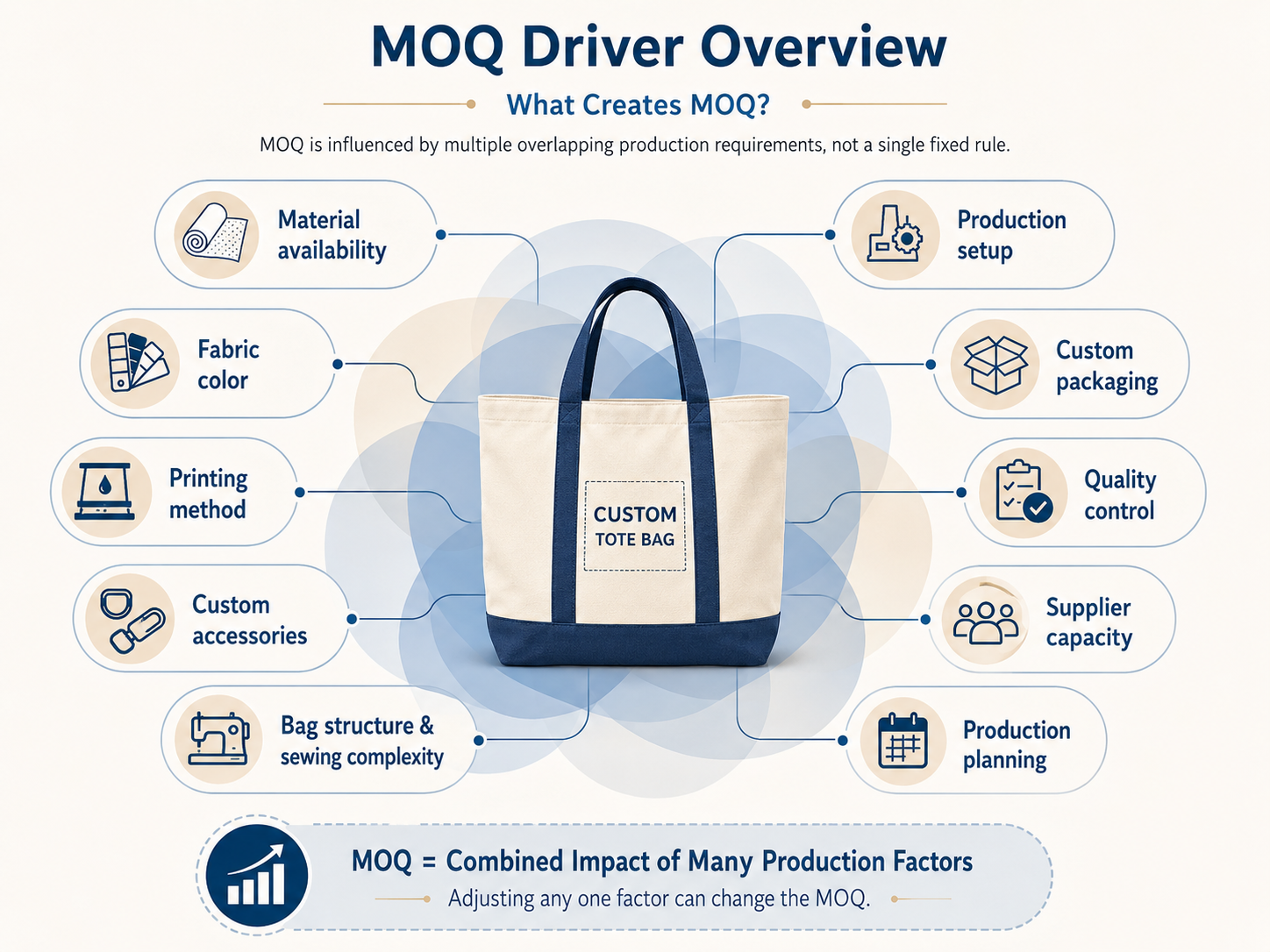
De MOQ wordt beïnvloed door het gehele productiesysteem, inclusief:
- Beschikbaarheid van materialen
- Stofkleur
- Druktechniek
- Aangepaste accessoires
- Efficiëntie van snijden en naaien
- Verpakking
- Kwaliteitscontrole
- Capaciteit van leverancier
- Productieplanning
Om deze reden moeten kopers niet alleen vragen:
Wat is uw MOQ?
Ze zouden ook moeten vragen:
- Welk onderdeel van het product bepaalt de MOQ?
- Geldt de MOQ per bestelling, kleur, maat of ontwerp?
- Kunnen meerdere ontwerpen hetzelfde materiaal delen?
- Kan voorraadstof de benodigde hoeveelheid verlagen?
- Welke extra kosten gelden onder de standaard MOQ?
- Voldoet een kleinere bestelling aan dezelfde kwaliteitseisen?
- Kan het product later opnieuw worden besteld met hetzelfde materiaal?
Begrijpen hoe MOQ werkt, helpt kopers om overtollige voorraden, onnauwkeurige prijsvergelijkingen en specificaties die moeilijk efficiënt te produceren zijn, te voorkomen.
Wat betekent MOQ?
MOQ betekent de minimale hoeveelheid die een leverancier bereid of in staat is te produceren onder een specifieke set technische en commerciële voorwaarden.
De uitdrukking “specifieke voorwaarden” is belangrijk.
Een MOQ geldt normaliter voor een gedefinieerde combinatie van:
- Zaktype
- Afgewerkte afmetingen
- Materiaal
- Stofgewicht
- Carrosseriekleur
- Logo-ontwerp
- Druktechniek
- Voering
- Accessoires
- Verpakking
- Testvereisten
- Leveringsplanning
Wanneer een van deze voorwaarden verandert, kan de MOQ ook wijzigen.
Bijvoorbeeld kan een leverancier aanbieden:
- 300 stuks met beschikbaar voorraadstof
- 1.000 stuks in een aangepaste behuizingkleur
- 3.000 stuks in een speciaal geproduceerd gerecycled materiaal
- 5.000 stuks met op maat gemaakte hardware
Daarom is er zelden één universele MOQ voor alle op maat gemaakte tassen die door dezelfde fabriek worden geproduceerd.
De MOQ is meestal de laagste haalbare hoeveelheid voor een specifiek productieplan.
MOQ is niet hetzelfde als bestelhoeveelheid
MOQ is de minimale aanvaardbare productiehoeveelheid.
De bestelhoeveelheid is het aantal eenheden dat de koper daadwerkelijk koopt.
Een koper kan het volgende bestellen:
- Precies de MOQ
- Meer dan de MOQ
- Een proefhoeveelheid onder de standaard MOQ
- Een grotere jaarlijkse hoeveelheid, verdeeld over meerdere leveringen
- Meerdere ontwerpen die dezelfde materialen en zakstructuur delen
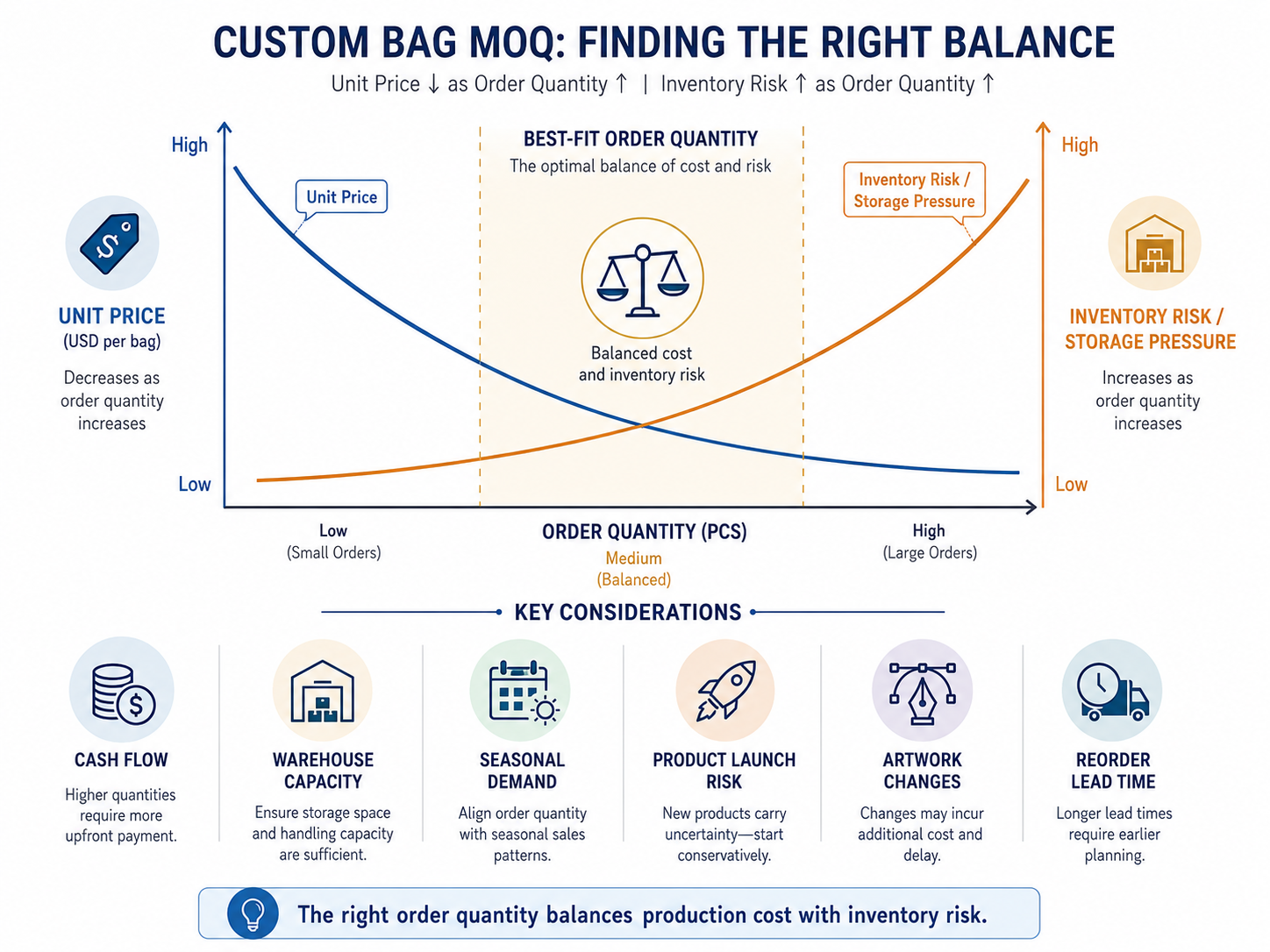
Een hogere bestelhoeveelheid verlaagt vaak de eenheidsprijs, omdat vaste instelkosten worden verdeeld over meer eenheden.
Het bestellen van meer zakken is echter niet automatisch de beste commerciële beslissing.
Kopers moeten ook rekening houden met:
- Verwachte maandelijkse verkoop
- Magazijn capaciteit
- Cashflow
- Seizoensgebonden vraag
- Productlanceringrisico
- Mogelijke wijzigingen in de afbeelding
- Verpakkingupdates
- Onzekerheid op de markt
- Levertijd voor herbestelling
De juiste bestelhoeveelheid is niet altijd de hoeveelheid met de laagste eenheidsprijs. Het is de hoeveelheid die productiekosten in evenwicht brengt met voorraad- en bedrijfsrisico’s.
Wat bepaalt de MOQ voor op maat gemaakte tassen?
De MOQ wordt meestal bepaald door meerdere overlappende productievereisten.
1. Beschikbaarheid van stof
Stof is vaak de belangrijkste MOQ-factor.
Een tasfabrikant kan stof inkopen van:
- Bestaande magazijnvoorraad
- Reguliere molenprogramma’s
- Op maat geverfde stof
- Op maat geweven stof
- Gecertificeerde leveranciers van gerecycleerd materiaal
- Leveranciers van speciale coating of laminering
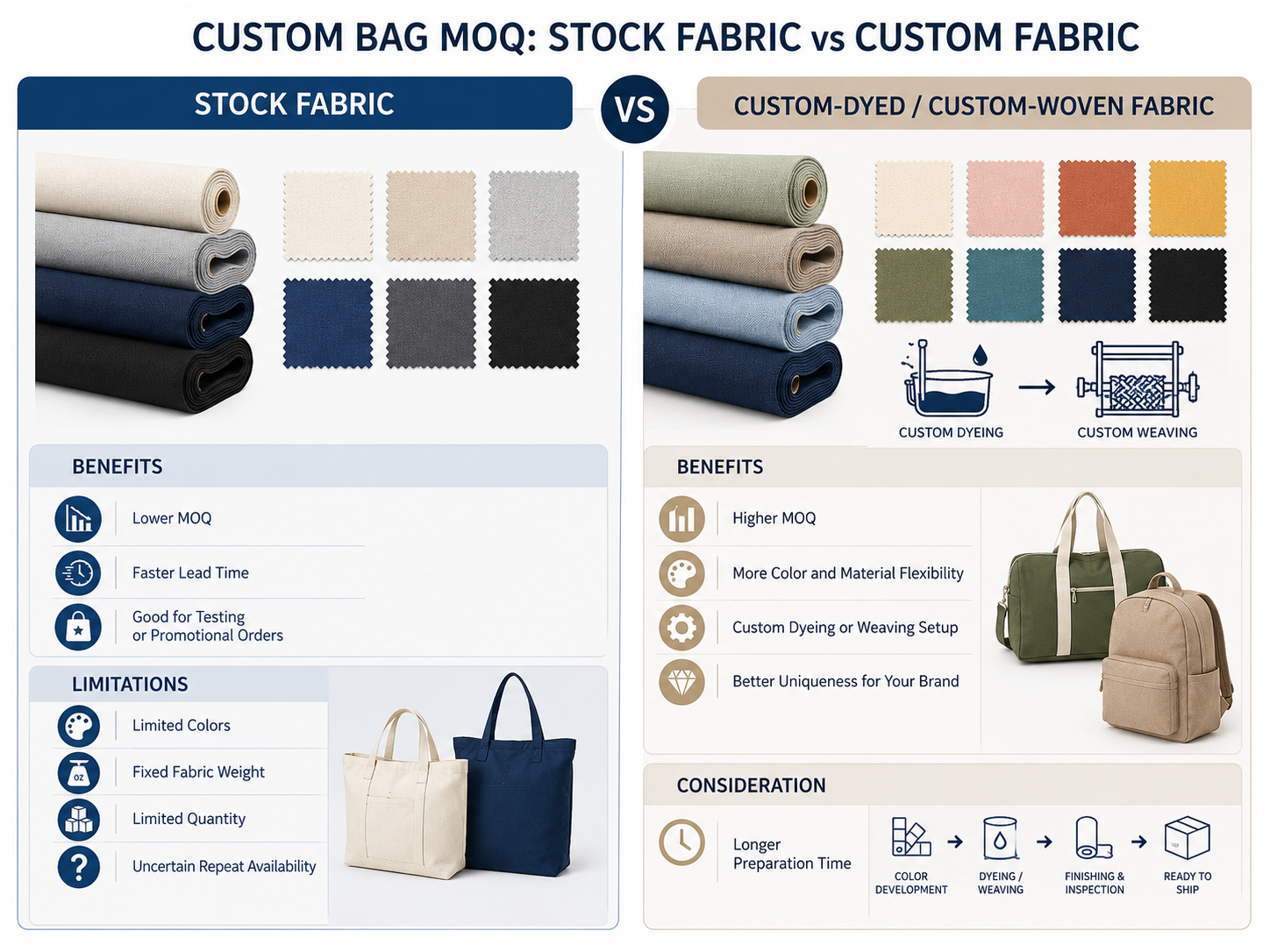
Voorraadstof
Voorraadstof ondersteunt meestal een lagere minimale bestelhoeveelheid, omdat het materiaal al is geproduceerd.
Het kan geschikt zijn voor:
- Producttesten
- Promotiecampagnes
- Startbestellingen
- Eenvoudige boodschappentassen
- Korte productietijden
- Standaardkleurenprogramma's
Voorraadstof kan echter beperkingen met zich meebrengen, zoals:
- Beperkte kleurkeuze
- Vaste stofgewicht
- Beperkte beschikbare hoeveelheid
- Geen exclusieve materiaalspecificatie
- Mogelijke variatie tussen productiepartijen
- Onzekere beschikbaarheid voor herbestellingen
Kopers die voorraadstof gebruiken, moeten bevestigen of er voldoende materiaal beschikbaar is voor de volledige bestelling en of dezelfde specificatie later opnieuw verkrijgbaar is.
Op maat geverfde stof
Op maat geverfd weefsel vereist meestal een grotere minimale hoeveelheid.
De verfstofbedrijf moet voorbereiden:
- Verfformules
- Kleuraanpassing
- Machine-instellingen
- Weefselpartijen
- Wassen en afwerken
- Inspectie
- Toegestane verspilling
Een MOQ kan van toepassing zijn per kleur in plaats van per totale bestelling.
Een bestelling van 3.000 tassen in één kleur is daarom vaak makkelijker te produceren dan 3.000 tassen verdeeld over zes kleuren.
Op maat geweven stof
Een unieke stofconstructie kan vereisen:
- Specifieke garenvoorbereiding
- Minimumaankoop van garen
- Inrichting van de weefmachine
- Minimumweeflengte
- Op maat afgewerkte afwerking
- Gedecideerde inspectie
Dit leidt meestal tot een hogere MOQ dan bij de keuze van een reguliere katoenen, canvas, polyester- of RPET-stof.
2. Stofkleur
De MOQ wordt vaak berekend per stofkleur.
Een offerte met een MOQ van 1.000 stuks kan betekenen:
- 1.000 stuks in één kleur
- 1.000 stuks per aangepaste kleur
- 1.000 stuks per combinatie van kleur en maat
Elke extra kleur kan afzonderlijke vereisen voor:
- Aankoop van stof
- Snijregistraties
- Draadafstemming
- Afdrukinstellingen
- Productie-identificatie
- Kwaliteitscontrole
- Verpakkingsbeheer
Het verminderen van het aantal carrosseriekleuren is een van de eenvoudigste manieren om een kleinere maatopdracht praktischer te maken.
Een koper kan nog steeds productvariatie creëren door gebruik te maken van:
- Verschillende bedrukte logo's
- Verschillende geweven labels
- Verschillende hangtags
- Verschillende verpakkingshulzen
- Verschillende regionale afbeeldingen
terwijl de basiskleuren en constructie van de tas behouden blijven.
3. Bedrukking en logo-aanbrenging
Verschillende merkingsmethoden vereisen verschillende instellingen.
Zeefdruk
Voor zeefdruk zijn mogelijk nodig:
- Één zeef per afdrukkleur
- Inkbereiding
- Kleuraanpassing
- Instellen van de afdrukpuntpositie
- Testafdrukken
- Uitharden
- Schoonmaken
Een klein logo met één kleur is doorgaans makkelijker te produceren in een kleinere hoeveelheid dan een groot ontwerp met meerdere kleuren.
Thermotransferdruk
Thermotransferdruk kan gedetailleerde afbeeldingen en meerdere kleuren weergeven.
De MOQ hangt mogelijk af van:
- Afmeting van de transfer
- Materiaal van de transfer
- Complexiteit van het ontwerp
- Verenigbaarheid met de stof
- Toepassing temperatuur
- Methode voor de productie van overdrachtsvelletjes
Sublimatieprinten
Sublimatie wordt over het algemeen toegepast op geschikte polyesterstoffen.
Kleine digitale oplagen zijn technisch mogelijk, maar volledig-paneelprinten stelt extra eisen aan:
- Voorbereiding van geprinte stof
- Uitlijning van panelen
- Nauwkeurigheid bij het snijden
- Kleurengelijkheid
- Patroonafstemming
Borduurwerk
Borduren omvat:
- Digitalisering van ontwerpen
- Selectie van garen
- Stabilisator
- Machine-instelling
- Aantal steken
- Productietijd
Een kleine bestelling voor borduurwerk is mogelijk, maar de instel- en steekkosten worden verdeeld over minder tassen.
Geweven labels en patches
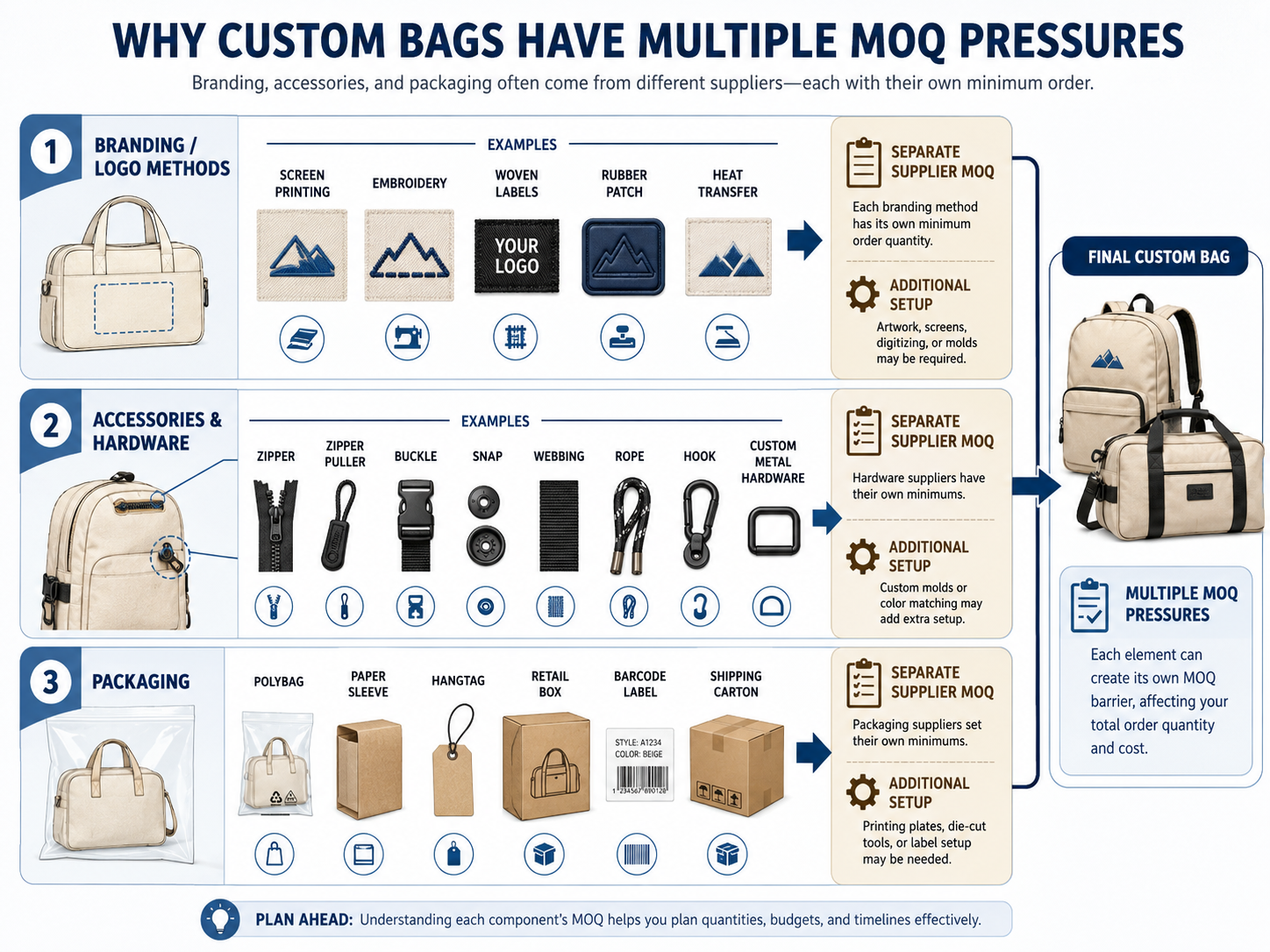
Geweven labels, geborduurde patches, rubberlabels en kunstlederpatches kunnen elk een afzonderlijke MOQ van de leverancier hebben.
Een fabriek kan mogelijk 300 tassen naaien, maar de etiketleverancier vereist mogelijk 1.000 aangepaste etiketten.
De koper moet beslissen of hij of zij:
- De extra etiketten wil kopen
- De resterende etiketten wil gebruiken voor toekomstige productie
- Een standaardbedrukt etiket wil selecteren
- Het onderdeel wil vervangen door directe bedrukking
4. Accessoires en hardware
Aangepaste accessoires kunnen een MOQ opleveren die hoger is dan die van het tassengebeurte zelf.
Voorbeelden zijn:
- Aangepaste ritsen in een specifieke kleur
- Gemerkt ritskoord
- Metalen gespen
- Magnetische knopen
- Op maat gemaakte band
- Bedrukte voering
- Gevormde kunststof onderdelen
- Rubberen logopatches
- Op maat gemaakte haken
- Speciale touwen
- Op maat gemaakte drukknopen
Standaardaccessoires zijn meestal makkelijker te verkrijgen in kleinere hoeveelheden.
Op maat gegoten onderdelen kunnen vereisen:
- Gereedschap
- Molddistributie
- Kleuraanpassing
- Minimale productieruns
- Oppervlakteafwerking
- Aanvullende tests
Voor een eerste bestelling kunnen kopers de MOQ vaak verlagen door standaardonderdelen te gebruiken, terwijl het hoofdlogo en het tassendesign wel op maat blijven.
5. Tasstructuur en naaicomplexiteit
Een eenvoudige platte tote-tas vereist minder bewerkingen dan een rugzak, koeltas of gestructureerde cosmetictas.
Meer complexe tassen kunnen onder meer omvatten:
- Meerdere bodypanelen
- Voering
- Vulling
- Zakken
- Ritsen
- Afwerking
- Versteviging
- Hardware
- Speciale stiksels
- Vormcontrolecomponenten
Fabrieken moeten zich voorbereiden op:
- Patronen
- Snijindelingen
- Naai-instructies
- Productievoorbeelden
- Machine-instellingen
- Werknemersopleiding
- Inspectienormen
Een zeer kleine oplage kan bijna dezelfde voorbereiding vergen als een grotere productieomvang.
Daarom hebben complexe tasconstructies vaak hogere MOQ’s of hogere prijzen voor kleine bestellingen.
6. Productieopzet
Zelfs een kleine op maat gemaakte bestelling vereist productievoorbereiding.
Typische vaste activiteiten zijn:
- Beoordeling van de afbeelding
- Ontwikkeling van het patroon
- Goedkeuring van het materiaal
- Afdrukinstellingen
- Voorbereiding van het snijden
- Aanpassing van de naaibaan
- Inspectie van het eerste stuk
- Productiedocumentatie
- Eindinspectie
- Verpakkingsvoorbereiding
Deze activiteiten nemen niet evenredig af met de bestelhoeveelheid.
Het produceren van 200 stuks kan veel van dezelfde voorbereidingsstappen vereisen als het produceren van 2.000 stuks.
Wanneer vaste kosten over minder eenheden worden verdeeld, stijgt de eenheidsprijs.
7. Aangepaste verpakking
Detailverpakking kan een aparte MOQ veroorzaken.
Voorbeelden zijn:
- Bedrukte polyzakken
- Papieren hulzen
- Koptags
- Hanglabels
- Verkoopdozen
- Instructiekaarten
- Streepjescodelabels
- Bedrukt tissuepapier
- Merkgebonden verzendkartons
Een standaard doorzichtige zak of een bulkverpakkingsmethode kan een lagere initiële hoeveelheid ondersteunen.
Een volledig bedrukte verkoopdoos kan een grotere productierun vereisen dan de zak zelf.
Kopers moeten bevestigen:
- Of de MOQ voor verpakking is opgenomen in de MOQ voor de zak
- Of de verpakking afzonderlijk wordt berekend
- Of meerdere producten dezelfde verpakking kunnen delen
- Of standaardverpakking voor de eerste bestelling kan worden gebruikt
- Hoe overtollige verpakking wordt afgehandeld
8. Certificering en traceerbaarheid
Sommige op maat gemaakte zakprojecten vereisen:
- Certificering van gerecycleerd materiaal
- Documentatie voor biologische vezels
- Testen op beperkte stoffen
- Productspecifieke testrapporten
- Documenten voor marktconformiteit
- Traceerbaarheid van de leveringsketen
- Documentatie van transacties
Gecertificeerd of traceerbaar materiaal moet mogelijk worden aangekocht bij een goedgekeurde leverancier met een eigen minimumbestelhoeveelheid.
Kopers moeten duidelijk onderscheid maken tussen:
- Een gecertificeerde fabriek
- Gecertifield grondstofmateriaal
- Een gecertificeerde productiebatch
- Een testrapport
- Een productspecifiek certificaat
Deze documenten dienen verschillende doeleinden en kunnen op verschillende manieren van invloed zijn op de minimale bestelhoeveelheid (MOQ) en de kosten.
Typische MOQ-druk per zaktype
De volgende tabel beschrijft de algemene aankooplogica in plaats van vaste branche-standaarden.
| Zaktype |
Algemene MOQ-druk |
Belangrijkste MOQ-stuurfactoren |
| Eenvoudige katoenen draagtas |
Laag tot gemiddeld |
Stofkleur, -gewicht en bedrukking |
| Zware canvas draagtas |
Middelmatig |
Stofgewicht, verven en naaitijd |
| RPET-boodschappentas |
Middelmatig |
Beschikbaarheid van materiaal, certificering en bedrukking |
| Trekkoordzak |
Laag tot gemiddeld |
Stof, koord en logo-aanbrengingsmethode |
| Opvouwbare boodschappentas |
Middelmatig |
Pouch-structuur, elastiek en accessoires |
| Schoonheidszak |
Middelmatig |
Rits, voering, vorm en logo-aanbrengingsproces |
| Koeltas |
Middelmatig tot hoog |
Isolatie, voering en meervlaams constructie |
| Rugzak |
Middelmatig tot hoog |
Meerdere panelen, opvulling, voering en hardware |
| Gestikte tas |
Middelmatig tot hoog |
Gestikte stof, opvulling en afwerking |
| Gestructureerde reistas |
Hoog |
Complexe constructie, hardware en versterking |
Een eenvoudige polyester trekkoordtas kan een relatief lage MOQ ondersteunen.
Een rugzak met op maat gemaakte kleur van de stof, bedrukte voering, gevormde ritskoordjes en retailverpakking vereist meestal een hogere hoeveelheid.
Waarom verhoogt een lagere MOQ de eenheidsprijs?
Een vereenvoudigde kostprijsstructuur voor op maat gemaakte tassen kan als volgt worden begrepen:
Eenheidsprijs = Variabele productiekosten + Vaste instelkosten toegewezen per eenheid
Variabele kosten omvatten:
- Stof
- Garen
- Accessoires
- Bedrukking
- Arbeid
- Verpakking
Vaste of semi-vaste kosten omvatten:
- Ontwikkeling van het patroon
- Monsterbereiding
- Drukplaten
- Kleuraanpassing
- Snij-instelling
- Voorbereiding van de naaibaan
- Voorbereiding van de kwaliteitscontrole
- Productieadministratie
Wanneer de hoeveelheid afneemt, stijgt de vaste kostenpost die per tas wordt toegewezen.
Om deze reden kan een leverancier het volgende offreren:
- 500 stuks tegen één prijs
- 1.000 stuks tegen een lagere prijs
- 3.000 stuks tegen een nog verder verlaagde prijs
Een kleinere hoeveelheid kan nog steeds de juiste keuze zijn wanneer de kosten van overtollige voorraad hoger zijn dan de besparing per stuk.
Is een lage MOQ altijd beter voor kopers?
Nr.
Een lagere MOQ biedt verschillende voordelen:
- Lagere initiële investering
- Verminderd voorraadrisk
- Gemakkelijker markttesten
- Minder druk op het magazijn
- Lager risico op verouderde ontwerpen
- Grotere flexibiliteit voor nieuwe producten
Een lagere MOQ kan echter ook gepaard gaan met:
- Hogere stukprijs
- Beperkte materiaalopties
- Alleen standaardkleuren
- Minder accessoires beschikbaar
- Vereenvoudigde verpakking
- Minder efficiënte vrachtkosten per eenheid
- Beperkte prijsonderhandeling
De koper dient de bestelhoeveelheid te kiezen op basis van de projectfase.
Een lagere MOQ kan geschikt zijn wanneer:
- Een nieuw merk wordt gelanceerd
- Een nieuw product wordt getest
- Een nieuwe markt betreden
- Een beperkte evenementcampagne uitvoeren
- Beperkte cashflow beheren
- De vraag van klanten bevestigen
- Een leveranciersrelatie testen
Een hogere MOQ kan geschikt zijn wanneer:
- De verkoopvraag is vastgesteld
- Het product regelmatig opnieuw wordt besteld
- De koper aangepaste materialen vereist
- Meerdere verkoopkanalen dezelfde zak gebruiken
- Controle van de eenheidsprijs is belangrijk
- Consistentie in de productie is vereist
- Langetermijnvoorraadplanning is beschikbaar
De MOQ moet het commerciële plan van de koper ondersteunen, in plaats van een ongeschikte aankoopbeslissing op te leggen.
Wat is een proefbestelling?
Een proefbestelling is een kleinere productierun die wordt gebruikt om het volgende te beoordelen:
- Consistentie van het product
- Communicatie met de leverancier
- Verpakking
- Kwaliteit van de productie
- Prestaties bij verzending
- Presentatie voor de detailhandel
- Reactie van de klant
Een proefbestelling is niet hetzelfde als een productmonster.
Een monster bevestigt het ontwerp en de constructie van één of meerdere eenheden.
Een proefbestelling bevestigt of de leverancier een daadwerkelijke productiebatch consistent kan beheren.
Proefbestellingen kunnen omvatten:
- Hogere stukprijzen
- Voorraadmaterialen
- Standaardaccessoires
- Beperkte kleuren
- Vereenvoudigde verpakking
- Afzonderlijke instelkosten
Kopers moeten de specificaties van de proefbestelling zorgvuldig vastleggen.
Als een latere grootschalige bestelling wordt gewijzigd van voorraadstof naar op maat geverfde stof, kunnen de twee productieruns mogelijk niet volledig identiek zijn.
Hoe kunnen kopers de MOQ verlagen?
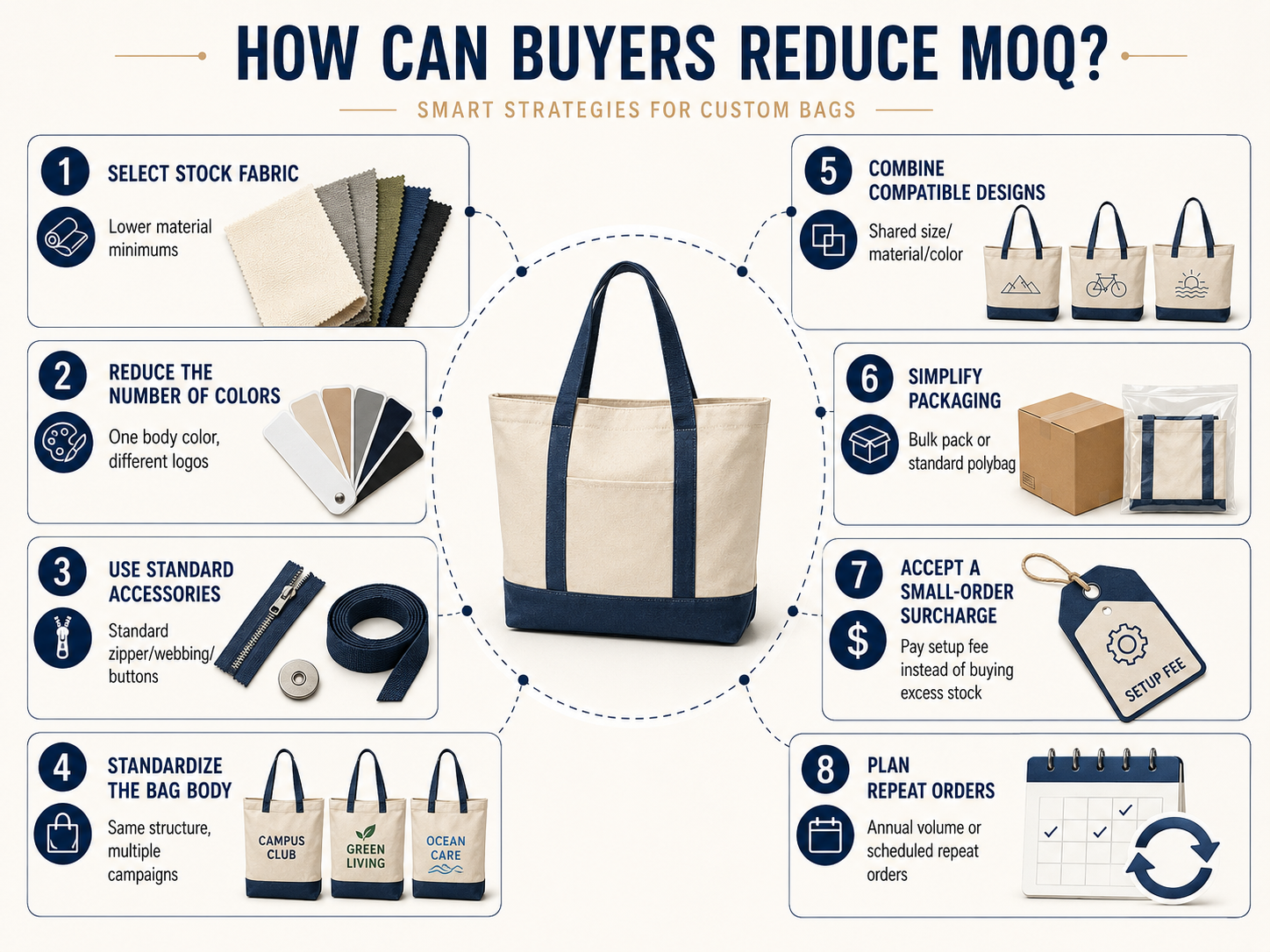
De MOQ kan vaak worden verlaagd door wijzigingen in de specificaties in plaats van via directe onderhandeling.
1. Kies voorraadstof
Het gebruik van beschikbare stof kan aangepaste verven- of weefminimums elimineren.
Voordat kopers voorraadstof bevestigen, moeten zij controleren:
- Beschikbare hoeveelheid
- Stofsamengesteldheid
- Stofgewicht
- Kleurengelijkheid
- Breedte
- Afwerking
- Toekomstige beschikbaarheid
- Of de stof kan worden gereserveerd
2. Verminder het aantal kleuren
Een bestelling in één kleur is eenvoudiger te produceren dan meerdere kleine partijen in verschillende kleuren.
Bijvoorbeeld:
- 1.000 tassen in één kleur
- 500 tassen in twee kleuren
- 250 tassen in vier kleuren
Deze opties hebben dezelfde totale hoeveelheid, maar niet dezelfde productie-efficiëntie.
Een praktische aanpak is om één carrosseriekleur te gebruiken met verschillende logo’s of labels.
3. Gebruik standaardaccessoires
Standaardritssluitingen, banden, gespen en knopen kunnen een lagere minimale bestelhoeveelheid ondersteunen.
Ondanks dit kan een onderscheidend merkbeeld nog steeds worden gecreëerd via:
- Bedrukte logo’s
- Borduurwerk
- Geweven labels
- Hanglabels
- Verpakkingshulzen
- Kleurencombinaties
Het aanpassen van elk klein onderdeel kan de minimale bestelhoeveelheid verhogen zonder voldoende extra waarde voor de koper te creëren.
4. Standaardiseer het taslichaam
Een enkele zakstructuur kan worden gebruikt voor meerdere:
- Campagnes
- Locaties
- Afdelingen
- Productlijnen
- Regionale markten
- Bedrijfsklanten
Alleen de afbeelding of verpakking verandert.
Dit verhoogt de productieomvang van de kernzak, terwijl commerciële variatie behouden blijft.
5. Combineer compatibele ontwerpen
Sommige leveranciers staan mogelijk toe dat verschillende logo's één productierun delen, mits het volgende ongewijzigd blijft:
- Zakafmeting
- Materiaal
- Stofkleur
- Handvatten
- Structuur
- Accessoires
Elk ontwerp kan nog steeds een afzonderlijke drukopstelling, kwaliteitscontrole en verpakking vereisen.
De koper dient de minimale hoeveelheid per ontwerp te bevestigen.
6. Vereenvoudig de verpakking
Voor een eerste bestelling kunnen kopers overwegen:
- Bulkverpakking
- Standaard polyzakken
- Algemene papieren hulzen
- Aangebrachte streepjescodelabels
- Standaard exportkartons
Aangepakte verpakking voor detailhandel kan worden ingevoerd nadat de vraag is bevestigd.
7. Accepteer een toeslag voor kleine bestellingen
Een leverancier kan een bestelling onder de standaard MOQ accepteren met:
- Hogere stukprijzen
- Een instelkosten
- Een materiaaltoeslag
- Een bedrukkosten
- Kosten voor het afhandelen van kleine bestellingen
Het betalen van een hogere eenheidsprijs kan nog steeds voordeliger zijn dan het kopen van overtollige voorraad.
De koper dient te vergelijken:
- Extra productiekosten
- Opslagkosten
- Voorraadrisk
- Impact op de kasstroom
- Kans op onverkochte voorraad
8. Plan herhaalbestellingen
Gevestigde kopers kunnen mogelijk onderhandelen over:
- Jaarlijkse volumeafspraken
- Geplande afroeporders
- Gedeeld materiaalaankoop
- Gedeeltelijke leveringen
- Gereserveerde stof
- Herhaalde productieperiodes
Deze regelingen vereisen duidelijke prognoses, betalingsvoorwaarden en schriftelijke overeenkomsten.
Een geschatte jaarlijkse hoeveelheid mag niet worden beschouwd als een bevestigde MOQ-regeling, tenzij beide partijen het productie- en leveringsplan goedkeuren.
MOQ per ontwerp, kleur, maat en SKU
Eén van de meest voorkomende misverstanden is of de MOQ van toepassing is op de totale bestelling of op elke variant.
Kopers moeten de MOQ op vier niveaus bevestigen.
MOQ per ontwerp
Elk afbeelding of structureel ontwerp kan een apart minimum hebben.
MOQ per kleur
Elke aangepaste stofkleur kan een aparte verfpartij vereisen.
MOQ per maat
Verschillende maten vereisen aparte patronen, snijden en productiecontrole.
MOQ per SKU
Een enkele SKU kan combineren:
- Afmeting
- Kleur
- LOGO
- Verpakking
- Barcode
Voorbeeld
Een koper bestelt:
- Twee zakformaten
- Drie kleuren
- Twee logoontwerpen
Dit kan tot wel 12 SKU-combinaties opleveren.
Zelfs als de totale bestelling 3.000 stuks bedraagt, is de gemiddelde hoeveelheid slechts 250 stuks per SKU.
Het verminderen van het aantal combinaties kan de bestelling praktischer maken, zonder dat de totale aankoopbegroting hoeft te stijgen.
Hoe beïnvloedt de MOQ de monstername?
De MOQ geldt normaliter voor massaproductie, niet voor het aantal monsters.
Een aangepast ontwikkelingsproces kan onder andere omvatten:
- Materiaalkeuze
- Bevestiging van de afbeelding
- Prototypevoorbeeld
- Herziening van het voorbeeld
- Voorbeeld vóór productie
- Grote-productie
- Eindinspectie
- Verzending
Voorbeeldprijzen zijn meestal hoger dan groothandelsprijs per stuk, omdat voorbeelden vereisen:
- Individuele materiaalvoorbereiding
- Handmatig snijden
- Naaien van één stuk
- Afdrukinstellingen
- Ontwikkeling van het patroon
- Revisiewerk
- Koerierbezorging
Een monsterprijs mag niet worden gebruikt als directe indicatie van de uiteindelijke groothandelsprijs.
Wat gebeurt er als een bestelling onder de MOQ ligt?
Er zijn verschillende mogelijke uitkomsten.
De leverancier wijst de bestelling af
Dit kan gebeuren wanneer:
- Het materiaal niet in de vereiste hoeveelheid kan worden aangeschaft
- Accessoires hebben een hogere minimumbestelhoeveelheid
- De structuur is te complex
- De productieopzet kan niet worden hersteld
- De lijn is ongeschikt voor een zeer korte oplage
De leverancier gebruikt voorraadmaterialen
De koper moet mogelijk accepteren:
- Bestaande kleuren
- Standaardweefseldikten
- Gewone ritsen
- Standaardbanden
- Algemene verpakking
De leverancier brengt een toeslag in rekening
De bestelling kan doorgaan tegen een hogere stukprijs of instelkosten.
De koper betaalt voor overtollig materiaal
Een stoffenmolen of leverancier van accessoires kan meer materiaal vereisen dan de productiebestelling verbruikt.
De koper en leverancier moeten overeenkomen over:
- Wie het resterende materiaal eigendom is
- Hoe het wordt opgeslagen
- Hoe lang het wordt bewaard
- Of het kan worden gebruikt voor herhaalde bestellingen
- Wat gebeurt er als het materiaal verslechtert
Productie wordt gecombineerd met een andere bestelling
De leverancier kan wachten op een andere compatibele productierun waarbij hetzelfde materiaal of proces wordt gebruikt.
Dit kan de kosten verlagen, maar kan wel langere of minder voorspelbare levertijden opleveren.
MOQ en levertijd
Een kleinere hoeveelheid betekent niet altijd een kortere productietijd.
Een kleine bestelling kan nog steeds vereisen:
- Aangepast weefsel
- Kleurgoedkeuring
- Monsterontwikkeling
- Afdrukinstellingen
- Accessoireproductie
- Kwaliteitsinspectie
- Exportverpakking
Een kleine bestelling in een aangepaste kleur kan langer duren dan een grotere bestelling met voorraadmateriaal.
Kopers moeten de levertijd opdelen in:
- Materiaalvoorbereiding
- Monsterontwikkeling
- Productie
- Inspectie
- Verpakking
- Vervoer
De leverancier moet uitleggen welke fase het totale tijdschema bepaalt.
Hoe moeten kopers MOQ-offertes vergelijken?
Twee offertes kunnen niet nauwkeurig worden vergeleken tenzij ze dezelfde specificatie gebruiken.
Bevestig dat elke leverancier hetzelfde aanbiedt:
- Afgewerkte afmetingen
- Materiaalsamenstelling
- Stofgewicht
- Carrosseriekleur
- Voering
- Druktechniek
- Logo-afmeting
- Accessoires
- Versteviging
- Verpakking
- Kwaliteitseis
- Leveringsvoorwaarde
Een offerte met een lagere MOQ kan gebruikmaken van voorraadmateriaal, standaardaccessoires of vereenvoudigde verpakking.
Een offerte met een hogere MOQ kan aangepaste kleuren, gecertificeerd materiaal of exclusieve componenten omvatten.
De laagste prijs of de laagste MOQ is niet automatisch het beste aanbod.
De volledige specificatie moet eerst worden afgestemd.
Beïnvloedt de MOQ de kwaliteit?
De MOQ bepaalt de kwaliteit niet direct.
Een kleine productieomvang kan goed worden uitgevoerd, en een grote bestelling kan slecht worden geproduceerd.
Kwaliteit hangt af van:
- Duidelijke specificaties
- Goedgekeurde monsters
- Materiaalbeheer
- Productiebeheer
- Naai-normen
- Bedrukkingscontrole
- Inspectie tijdens de productie
- Eindinspectie
- Leverancierscapaciteit
Kleine bestellingen kunnen echter specifieke risico’s met zich meebrengen:
- Afhankelijkheid van beschikbare voorraadmaterialen
- Beperkte kleurafstemming
- Variatie door handmatige productie
- Vervanging van accessoires
- Moeilijkheid om hetzelfde materiaal later opnieuw te produceren
Kopers moeten bevestigen dat een bestelling met een lage MOQ nog steeds voldoet aan de overeengekomen:
- Materiaal
- Afmetingen
- Stikwerk
- LOGO
- Testen
- Verpakking
- Inspectienorm
Een kleinere hoeveelheid betekent niet automatisch een onduidelijk product.
MOQ en voorraadrisico
De offerte van de leverancier omvat niet alle kosten die voortvloeien uit overtollige voorraad.
Extra voorraadkosten kunnen onder andere omvatten:
- Pakhuispacht
- Afhandeling
- Verzekering
- Productbeschadiging
- Vochtbelasting
- Verpakkingsslechtering
- Verouderde merkidentiteit
- Onverkochte seizoensgebonden voorraad
- Kortingen
- Afvoer
Voordat de bestelhoeveelheid wordt verhoogd, moeten kopers zich afvragen:
| Vraag |
Aankooprelevantie |
| Hoeveel tassen kunnen er per maand worden verkocht of gebruikt? |
Bepaalt de voorraadduur |
| Kan het logo of de verpakking wijzigen? |
Creëert een obsolescentierisico |
| Is de vraag seizoensgebonden? |
Beperkt de verkoopperiode |
| Is er opslagruimte in het magazijn beschikbaar? |
Voegt opslagkosten toe |
| Kan de leverancier snel bijvullen? |
Vermindert de veiligheidsvoorraadvereisten |
| Kan één ontwerp meerdere markten bedienen? |
Verbeterd flexibiliteit van de voorraad |
| Is de kasstroom beperkt? |
Grote orders blokkeren werkkapitaal |
Een kleinere bestelling met een hogere stukprijs kan leiden tot lagere totale bedrijfskosten.
MOQ-strategie voor startups en nieuwe merken
Een gefaseerde aanpak kan het risico verminderen.
Fase 1: Prototype
Bevestig:
- Materiaal
- Afmeting
- Structuur
- LOGO
- Functionaliteit
- Basisuiterlijk
Fase 2: Proefproductie
Beoordeel:
- Productieconsistentie
- Verpakking
- Klantfeedback
- Verzending
- Detailhandelsprijs
- Leveranciersprestaties
Fase 3: Eerste commerciële bestelling
Vergroot de hoeveelheid nadat de vraag duidelijker is geworden.
Fase 4: Specificatieoptimalisatie
Inleiding:
- Aangepaste kleuren
- Aangepaste accessoires
- Premiumverpakking
- Extra afmetingen
- Grotere productieomvang
Deze aanpak voorkomt dat kopers zich vooraf verplichten tot een grote hoeveelheid voordat de productspecificatie en de marktvraag stabiel zijn.
MOQ-strategie voor gevestigde kopers
Grotere kopers kunnen hun geschatte volume gebruiken om de productie-efficiëntie te verbeteren.
Mogelijke strategieën zijn:
- Jaarlijkse vraag bundelen
- Materialen standaardiseren
- Onderdelen delen tussen producten
- Regionale bestellingen coördineren
- Stof reserveren
- Herhaalde productie plannen
- Leveringen verdelen
- Het aantal unieke SKU’s verminderen
Het doel is niet noodzakelijkerwijs om de laagst mogelijke MOQ te verkrijgen.
Het doel is een inkoopstructuur op te bouwen die ondersteunt:
- Stabiele kwaliteit
- Voorspelbare prijzen
- Betrouwbare aanvulling
- Gecontroleerde voorraad
- Efficiënte logistiek
Veelgemaakte MOQ-fouten
Fout 1: MOQ vragen voordat het product is gedefinieerd
Zonder materiaal, afmetingen, kleur en bedrukkingsdetails kan de leverancier slechts een schatting geven.
Fout 2: Aannemen dat de MOQ van toepassing is op de totale bestelling
De MOQ kan per kleur, maat, ontwerp of SKU van toepassing zijn.
Fout 3: Te veel variaties toevoegen
Een kleine bestelling die over veel kleuren en maten is verdeeld, wordt ondoelmatig.
Fout 4: Vergelijken van verschillende specificaties
Een offerte voor voorraadmateriaal met een lage MOQ mag niet direct worden vergeleken met een offerte voor aangepast materiaal.
Fout 5: Te veel voorraad bestellen uitsluitend om de stukprijs te verlagen
Besparingen op de stukprijs kunnen verloren gaan door opslagkosten en onverkochte voorraad.
Fout 6: Elke component aanpassen
Stof, ritsen, labels, hardware en verpakking kunnen elk een aparte MOQ opleggen.
Fout 7: Beschikbaarheid bij herbestelling negeren
Voorraadmateriaal is mogelijk niet beschikbaar voor de volgende productieronde.
Fout 8: Een leverancier kiezen op basis van MOQ alleen
Steekproefneming, communicatie, kwaliteitscontrole, leveringsbetrouwbaarheid en productiecapaciteit zijn even belangrijk.
Vragen die kopers moeten stellen over de MOQ
Voordat u een bestelling bevestigt, vraag dan:
- Geldt de MOQ per bestelling, kleur, maat, ontwerp of SKU?
- Is de voorgestelde stof op voorraad of wordt deze op maat geproduceerd?
- Welke specificatiewijziging zou de MOQ verlagen?
- Heeft afdrukken op maat een apart minimum?
- Hebben etiketten, ritsen of hardware aparte MOQ’s?
- Kunnen meerdere ontwerpen één zakstructuur delen?
- Welke toeslag geldt onder de standaard MOQ?
- Is de geciteerde prijs gebaseerd op de minimale hoeveelheid?
- Heeft de detailverpakkingshoeveelheid een eigen MOQ?
- Mag de eerste bestelling gebruikmaken van standaardverpakking?
- Kan het jaarlijkse volume worden verdeeld over meerdere leveringen?
- Hoe wordt resterend aangepast materiaal afgehandeld?
- Is hetzelfde materiaal beschikbaar voor herhaalbestellingen?
- Voldoet een kleinere bestelling aan dezelfde kwaliteitsnorm?
- Wat is de levertijd voor de voorgestelde hoeveelheid?
Informatie die nodig is voor een nauwkeurige MOQ
Om een realistische MOQ te berekenen, moeten kopers het volgende verstrekken:
- Zaktype
- Referentieafbeelding of -tekening
- Afgewerkte afmetingen
- Materiaal
- Stofgewicht
- Aantal carrosseriekleuren
- Bestelaantal
- Logo-afmeting
- Logo-kleuren
- Druktechniek
- Voering
- Zakken
- Sluiting
- Accessoires
- Verpakking
- Bestemmingsmarkt
- Conformiteitseisen
- Doelbezorgdatum
Wanneer de specificatie nog niet definitief is, vraag dan aan de leverancier om te vergelijken:
- Een optie met lage MOQ en voorraadmateriaal
- Een standaard aangepaste optie
- Een kostengeoptimaliseerde bulkoptie
Dit laat zien hoe materiaal- en ontwerpkeuzes de hoeveelheid en prijs beïnvloeden.
Hoe INITI ondersteuning biedt bij het plannen van aangepaste zakbestellingen
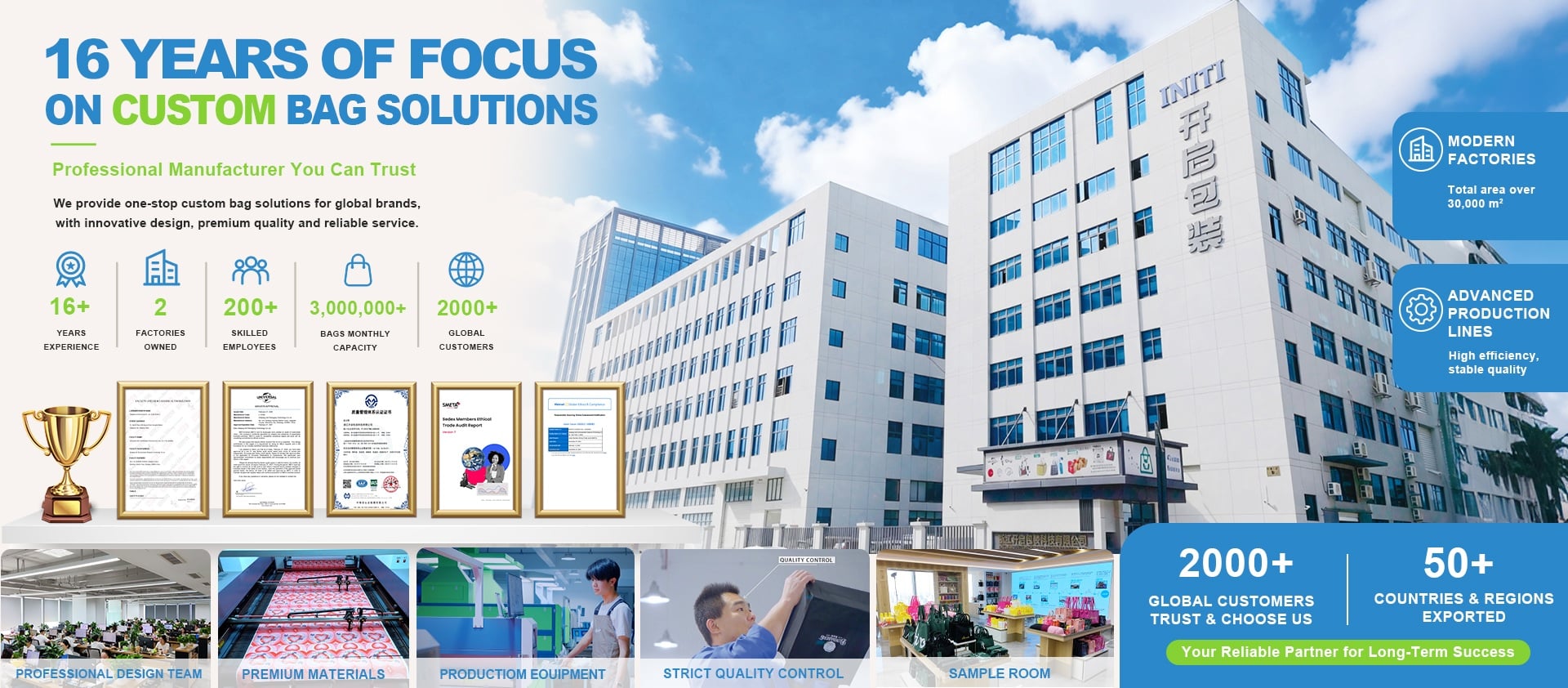
INITI ontwikkelt aangepaste zakken voor merkeigenaren, retailers, supermarkten, cadeausuppliers, promotionele bedrijven, importeurs, distributeurs en private-labelkopers.
Ons OEM- en ODM-ontwikkelingsproces kan ondersteuning bieden bij:
- Materiaalvergelijking
- Voorraad- en aangepaste kleuropties
- Ontwikkeling van aangepaste afmetingen en structuur
- Keuze van logo en bedrukking
- Standaard- en aangepaste accessoires
- Monsterbereiding
- Vergelijking van de minimale bestelhoeveelheid
- Kostenoptimalisatie
- Detailverpakkingsoplossingen
- Grote-productie
- Kwaliteitsinspectie
- Exportverpakking
Voor projecten met lagere volumes kan de specificatie worden beoordeeld om te bepalen welke onderdelen kunnen worden uitgevoerd met beschikbare of standaardopties.
Voor herhaalde of grotere productieprogramma’s kunnen materialen en constructies worden gestandaardiseerd om consistentie, productie-efficiëntie en herbestelplanning te verbeteren.
Veelgestelde vragen
Wat is de normale minimale bestelhoeveelheid voor op maat gemaakte tassen?
Er bestaat geen universele minimale bestelhoeveelheid. Deze hangt af van het tasstype, het materiaal, de kleur, de bedrukking, de accessoires, de verpakking en het productiesysteem van de leverancier.
Wordt de minimale bestelhoeveelheid per kleur berekend?
Vaak wel. Voor speciaal gekleurd weefsel en afzonderlijke productiekleuren kan elk een minimale hoeveelheid vereisen.
Kunnen kopers onder de minimale bestelhoeveelheid bestellen?
Soms. De leverancier kan voorraadmaterialen gebruiken, de specificatie vereenvoudigen of een toeslag voor kleine bestellingen in rekening brengen.
Waarom zijn zakken met een lage MOQ duurder?
De kosten voor patroontekening, opzetten van bedrukking, snijvoorbereiding en inspectie worden verdeeld over minder eenheden.
Gaarneert een hogere MOQ betere kwaliteit?
Nee. Kwaliteit hangt af van de specificatie, materiaalcontrole, goedkeuring van monsters, productiemanagement en inspectie.
Kunnen verschillende logo’s in één bestelling worden gecombineerd?
Soms, vooral wanneer het zakmateriaal, de kleur, de afmeting en de constructie ongewijzigd blijven. Voor elk logo kan nog steeds een aparte opzet- en verpakkingsprocedure vereist zijn.
Heeft verpakking een aparte MOQ?
Aangepaste dozen, hulsjes, labels en bedrukte zakken kunnen hun eigen minimumaantal voor bedrukking hebben.
Kunnen meerdere afmetingen één MOQ delen?
Niet altijd. Verschillende afmetingen vereisen aparte patronen, snijprocessen en productiecontrole.
Worden bestellingen met een lage minimale bestelhoeveelheid (MOQ) gemaakt van minder kwalitatieve materialen?
Niet noodzakelijkerwijs. Kleinere bestellingen zijn echter vaak afhankelijk van beschikbare voorraadmaterialen en standaardaccessoires.
Moet een startup altijd de laagste MOQ kiezen?
De bestelhoeveelheid dient te weerspiegelen de verwachte vraag, de liquiditeit, de opslagcapaciteit, de stukkosten en het risico op productontwikkeling.
Kan een jaarlijkse bestelling worden verdeeld over meerdere zendingen?
Mogelijk, mits overeenstemming met de leverancier, materiaalplanning, betalingsvoorwaarden en opslagregelingen.
Hoe kunnen kopers een nauwkeurigere MOQ ontvangen?
Geef de tasafmeting, het materiaal, het aantal kleuren, het logo, de bedrukmethode, de accessoires, de verpakking en de geschatte bestelhoeveelheid op.
Conclusie
MOQ is niet eenvoudigweg een door de leverancier gekozen getal.
Het weerspiegelt de minimale praktische hoeveelheid die nodig is om te organiseren:
- Materiaalaankoop
- Kleurbereiding
- Bedrukking
- Accessoires
- Snijden
- Naaien
- Kwaliteitscontrole
- Verpakking
Kopers kunnen de MOQ vaak verlagen door:
- Voorraadstof te gebruiken
- Het aantal kleuren te beperken
- Standaardaccessoires te selecteren
- Standaardisatie van het taslichaam
- Vereenvoudiging van de verpakking
- Combinatie van compatibele ontwerpen
- Acceptatie van een redelijke meerprijs voor kleine bestellingen
- Planning van herhaalde productie
Echter mag het verlagen van de MOQ niet leiden tot onduidelijke materialen, inconsistente kwaliteit of ongecontroleerde vervangingen.
De meest geschikte bestelhoeveelheid is een evenwicht tussen:
- Stukprijs
- Voorraadrisk
- Cashflow
- Marktvraag
- Productiebetrouwbaarheid
- Herbestelvereisten
Een zorgvuldig geplande proefbestelling kan meer commerciële waarde genereren dan een grote bestelling die uitsluitend wordt geplaatst om een lagere eenheidsprijs te verkrijgen.
Ondersteuning bij aanvragen
Voor een nauwkeurige beoordeling van de MOQ voor aangepaste tassen, verstrekt u het tastype, de afmetingen, het gewenste materiaal, het weefselgewicht, de kleuren, het logo-ontwerp, de bedrukmethode, de accessoires, de verpakking, de geschatte bestelhoeveelheid, de doelmarkt en de vereiste leverdatum.
INITI kan opties met voorraadmateriaal, standaard-aangepaste productie en grootschalige productie met elkaar vergelijken om kopers te helpen een praktisch evenwicht te vinden tussen MOQ, eenheidsprijs, aanpassingsmogelijkheden en voorraadrisk.
Gerelateerde producten
Gerelateerde blogartikelen


 Actueel nieuws