A clear backpack and a clear tote bag may share the same transparent purpose, but they are not interchangeable products. The difference is not limited to whether the bag has shoulder straps or handles. Carrying position, load distribution, opening design, access speed, security requirements, branding area, storage efficiency, and the end user's daily routine all affect which format will perform better.
For a stadium giveaway, a clear tote may be the most practical choice because it is easy to distribute, stack, inspect, and carry for a short period. For a school, campus, staff, or multi-day event program, a clear backpack may create more value because it leaves both hands free and supports a more organized load.
This guide compares clear backpacks and clear tote bags from a practical product-development and bulk-sourcing perspective. It explains where each design works best, how transparent PVC and related clear materials affect the product, what buyers should check before approving a sample, and how to turn an end-use requirement into a clear specification. It also separates facts that can be confirmed from the chosen product sample from assumptions that should never be made about school or venue policies.
Clear Backpack vs. Clear Tote Bag at a Glance
The table below is a starting point, not a substitute for reviewing a product sample and the destination venue's current requirements. A clear bag's actual performance depends on material grade, dimensions, reinforcement, closures, stitching or welding, and how it is loaded.
| Comparison point |
Clear backpack |
Clear tote bag |
| Primary carry method |
Two shoulder straps, usually with a top handle |
Hand carry or shoulder carry through two handles |
| Best operating advantage |
Hands-free movement and distributed carrying |
Fast access and simple loading |
| Typical user context |
School programs, campus merchandise, staff kits, recurring events, travel or promotional collections |
Stadium entry, registration kits, retail promotions, exhibitions, gifts, short-duration events |
| Organization potential |
Main compartment plus front and side pockets |
Wide central compartment, gussets, optional front or internal storage |
| Access pattern |
Open the bag while wearing or remove it to reach contents |
Place beside the user and reach through the wide opening |
| Load behavior |
Better suited to balanced loads carried on the back |
Better suited to lighter or irregular items that need quick access |
| Branding surfaces |
Front panel, pocket, trim, straps, labels, or inserts |
Broad front and back panels, trim, webbing, labels, or inserts |
| Storage before distribution |
Straps and three-dimensional form may need more careful packing |
Many designs can be stacked or packed relatively efficiently, depending on gusset depth |
| Main buying risk |
Assuming a larger body automatically means comfortable heavy carrying |
Assuming a wide opening automatically means secure or hands-free carrying |
| Policy check |
Confirm dimensions, transparency, pockets, and strap rules |
Confirm dimensions, handle measurement, closure, and transparency rules |
| Strongest B2B value |
Utility and repeat use |
Simplicity, visibility, and high-volume practicality |
What Makes a Clear Backpack Different?
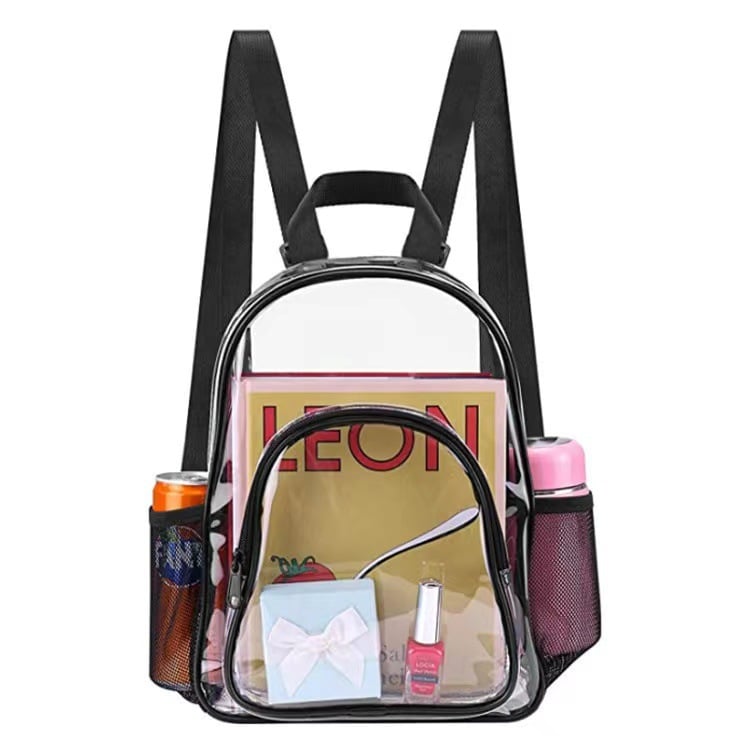
A clear backpack is a backpack with a transparent main body or transparent panels that allow users to identify the contents from outside. Commercial designs commonly combine a clear film body with webbing, fabric trim, mesh pockets, zippers, buckles, and shoulder straps. The exact construction can vary considerably. One design may be almost entirely transparent, while another may use clear front and side panels with opaque reinforcement zones.
The carrying system is the defining functional difference. Two shoulder straps allow the bag to rest against the user's back and keep both hands available. That is valuable when a student is moving between classrooms, when an event participant is carrying a phone and drink, or when staff members are walking across a large site. The advantage is not that a backpack can safely carry any weight. The advantage is that the weight can be positioned closer to the body and managed through two contact points rather than one hand or one shoulder.
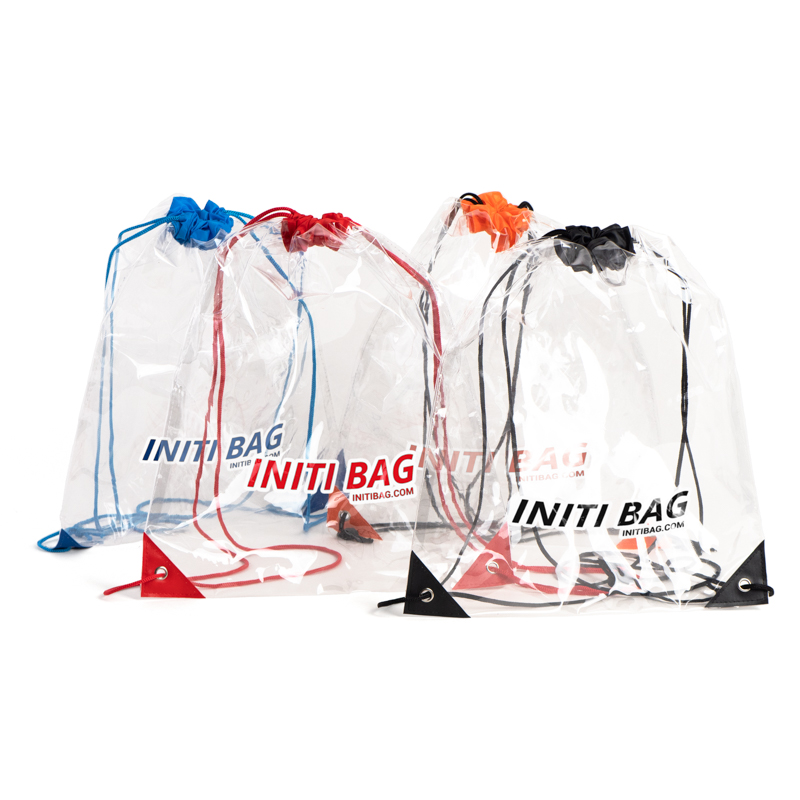
A clear backpack also tends to support a more segmented storage layout. A front zipper pocket can separate small items from the main load, while side mesh pockets can hold appropriately sized bottles or accessories. INITI's reference clear PVC school backpack, for example, is described with a transparent main compartment, a front zipper compartment, two side mesh bottle holders, adjustable nylon webbing straps, plastic adjustment buckles, and a top carry handle. These details are useful as a product-development reference, but they should not be assumed to apply to every clear backpack.
The backpack format is especially useful when the user must carry the product for a meaningful part of the day. It can support school merchandise, campus programs, youth organizations, promotional campaigns, staff equipment, and retail collections. However, the design should be evaluated as a complete carrying system. Buyers need to review strap width, attachment points, load balance, back contact, zipper access, bottom reinforcement, and the relationship between clear film and fabric components.
The Main Benefits of a Clear Backpack
A clear backpack can provide several practical advantages:
- Hands-free movement: The wearer can walk, queue, carry documents, or use both hands without holding the bag.
- Balanced carrying: Two straps can distribute a balanced load more evenly than a single handle, although comfort still depends on fit and construction.
- Repeat-use potential: A useful backpack may be retained after a one-day campaign and used for school, work, sports, or travel.
- Organized storage: Front pockets and side holders can give small items a designated place.
- Mobile brand exposure: When worn, the front panel can keep the logo visible while the user moves through a campus, venue, or event floor.
These benefits have limits. A clear film body may be less breathable than a fabric or mesh body, and transparent construction does not automatically provide padding or impact protection. If a buyer wants to carry a laptop, tablet, camera, or other fragile item, the specification should include a separate protective sleeve or an approved insert rather than relying on the clear panel itself.
What Makes a Clear Tote Bag Different?
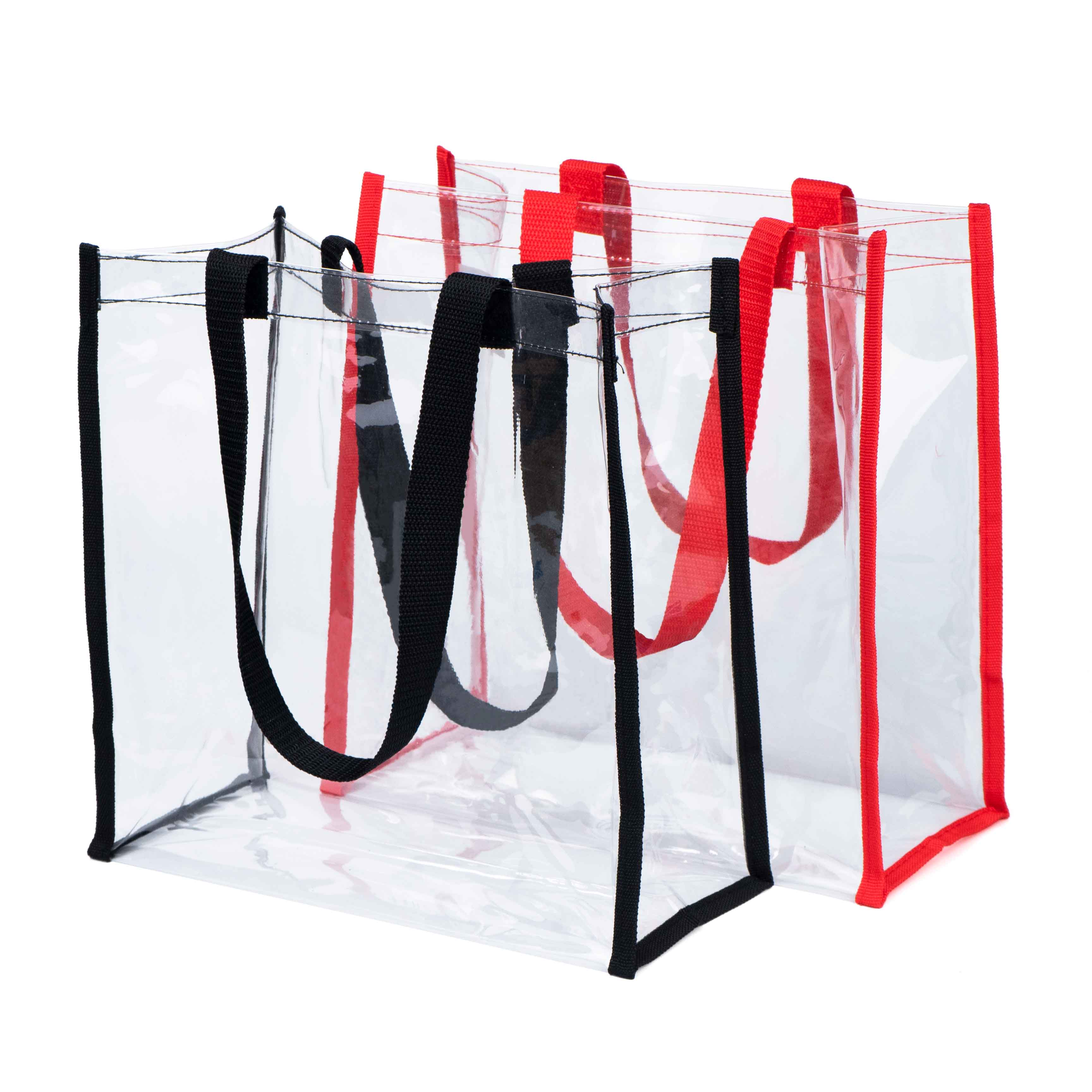
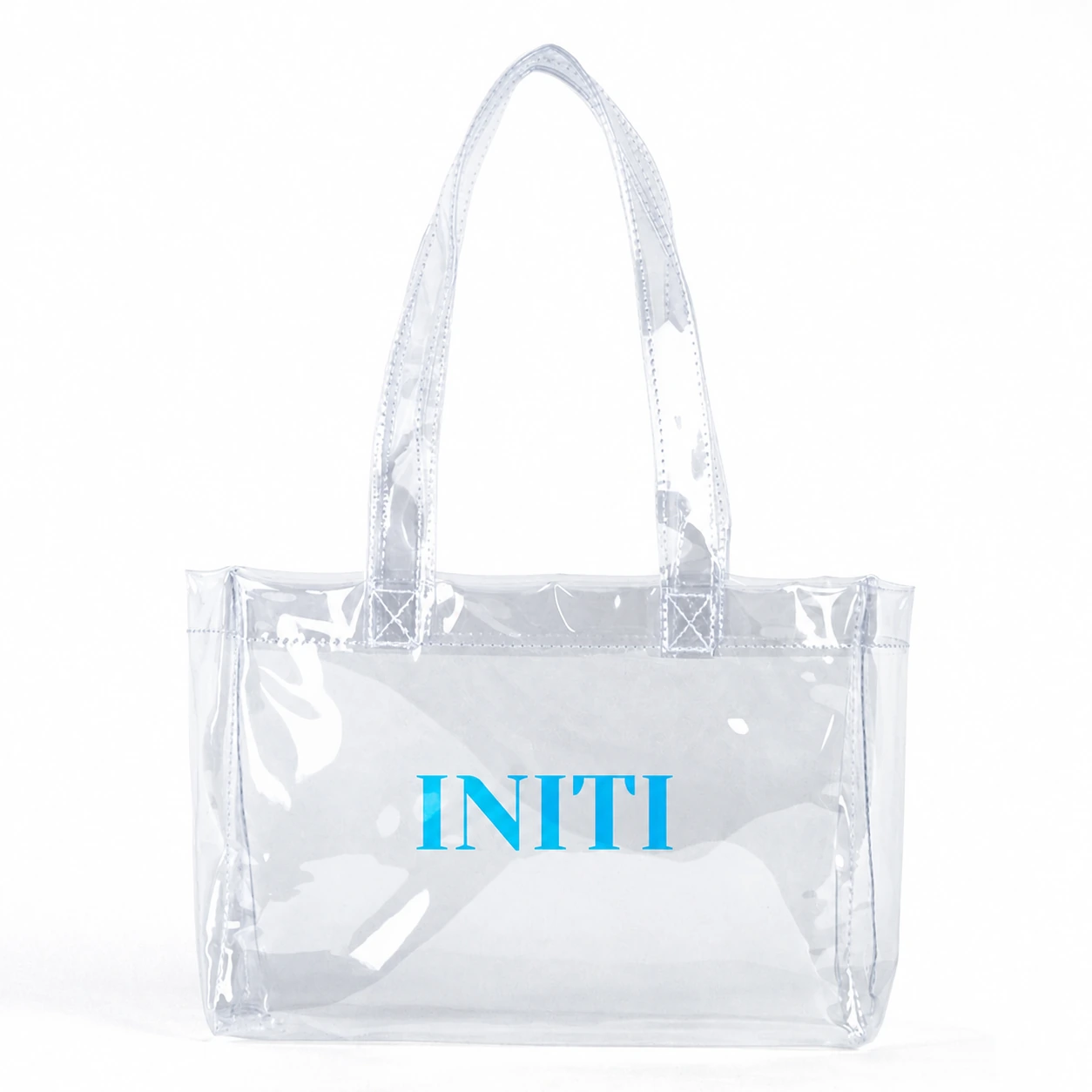
A clear tote bag is a transparent carry bag built around two handles and a wide central compartment. It may have a flat body or side and bottom gussets that create additional usable space. It can be open at the top or fitted with a zipper, snap, magnetic tab, or another closure. The format is simple, but the details strongly influence whether it works as a promotional giveaway, a retail product, a security-compliant event bag, or a reusable packaging item.
A tote's main advantage is access. The user can place items into the opening without navigating several compartments, and event staff can distribute the bag quickly at a registration desk, gate, booth, or retail counter. A clear tote can also be easier to pack into cartons when the body is designed for flat packing. The actual packing efficiency depends on the gusset, handle placement, trim, closure, and whether the supplier ships the bags folded or with inserts.
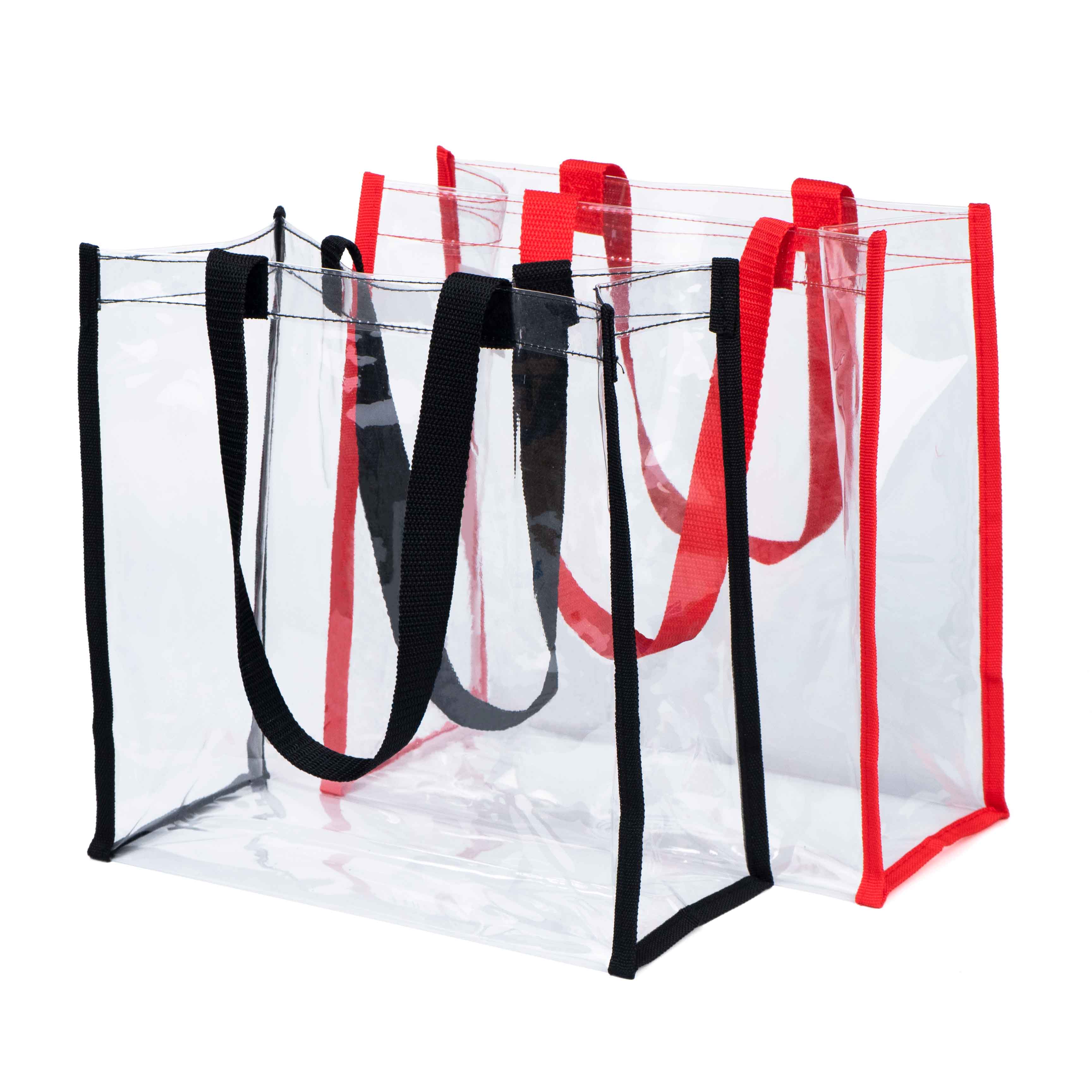
INITI's reference clear PVC tote bag illustrates a common B2B direction: a transparent PVC body, polyester webbing handles, contrast edge binding, side and bottom gussets, and a spacious main compartment. The reference page also lists optional closure structures, custom dimensions, clear or tinted finishes, trim colors, logo methods, labels, inserts, and retail or export packaging.
The Main Benefits of a Clear Tote Bag
Clear totes are often a strong choice when the project needs:
- Fast distribution: A simple handle-and-compartment structure is easy to hand out and explain.
- Quick visual access: Users can see the contents without opening multiple pockets.
- A wide decoration area: The front and back panels can support a logo, sponsor mark, campaign message, or removable insert.
- Flexible packing: A gusseted tote can accept boxed merchandise, brochures, apparel, cosmetics, event materials, or gift items more easily than a narrow flat bag.
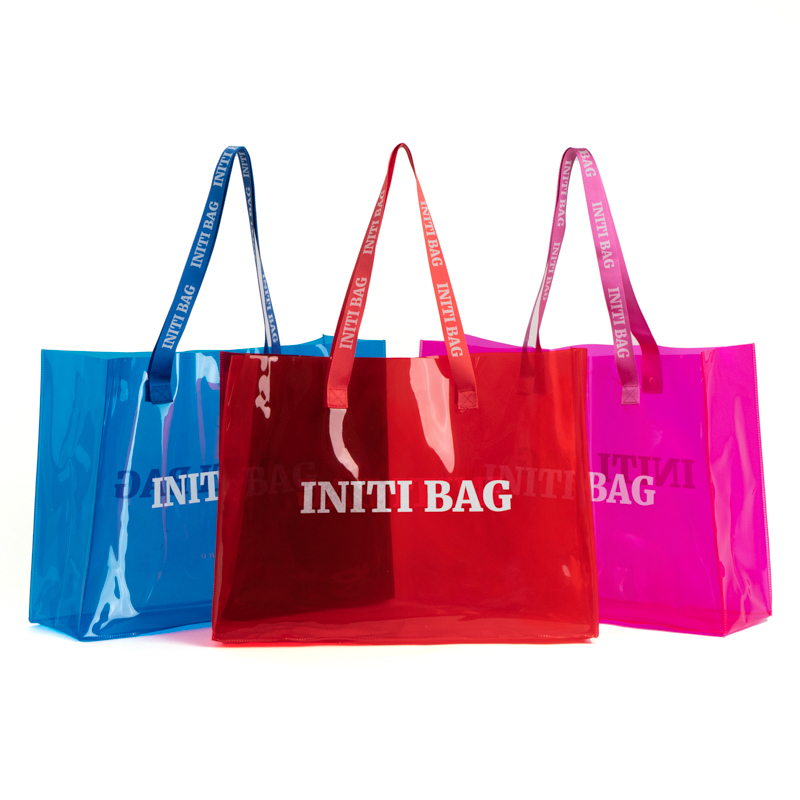
- Simple product assortment: Retailers can offer one main shape with different PVC finishes, handle colors, sizes, or closure options.
The tote format also has limitations. A single handle system may place more pressure on one hand or shoulder when the bag is loaded. An open-top tote can make access easy but may be unsuitable when the buyer needs stronger closure or a controlled entry format. A broad transparent surface is useful for visibility, but it may also expose personal items more directly. If privacy is important, a removable inner pouch or a partially frosted or tinted construction may need to be considered, subject to the end-use rules.
Choosing by Use Case: School, Stadium, Event, Retail, and More
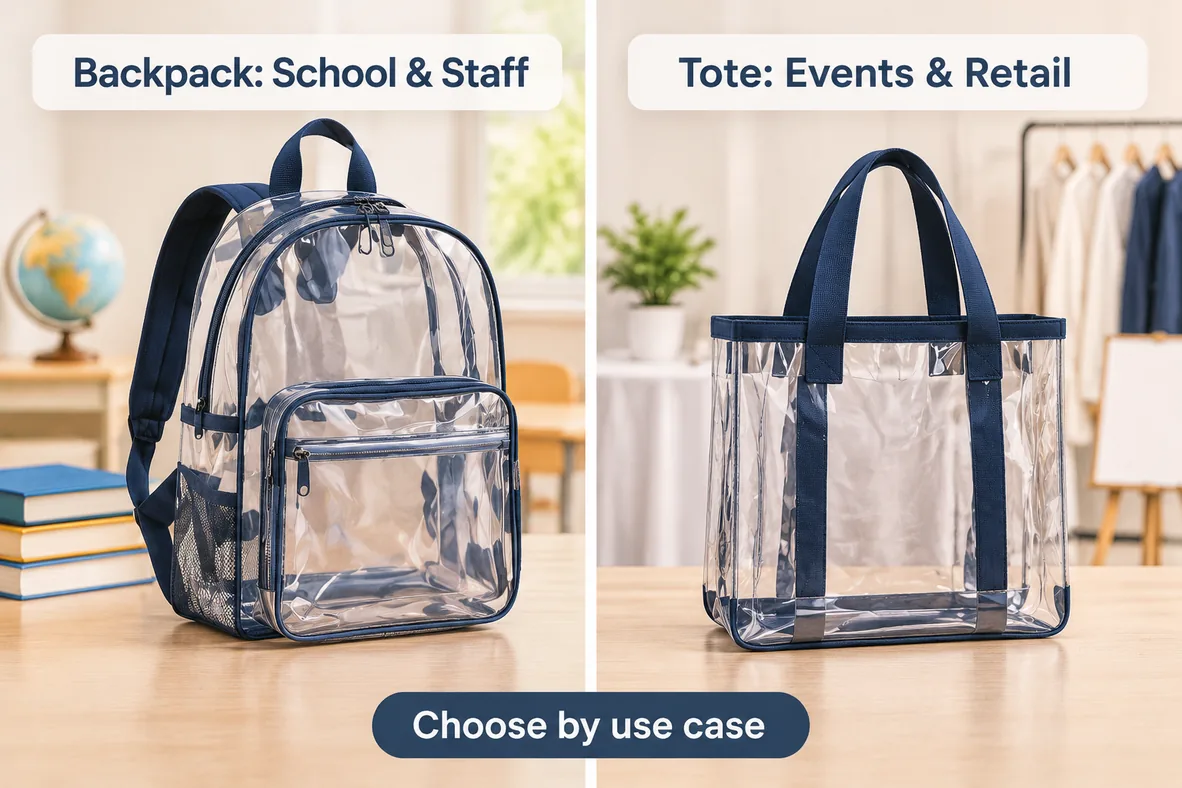
The most reliable way to choose between a clear backpack and a clear tote bag is to begin with the operating environment rather than the product photograph. Ask who will use the bag, for how long, what they will carry, how often they will open it, and who will inspect it. The answer often becomes clearer before price is discussed.
School and Campus Programs
School and campus buyers should begin with the current written policy of the specific school, district, or event organizer. A rule from another district, a product listed as “school safe,” or an older social media post cannot confirm acceptance. Important questions include whether the bag must be fully transparent, whether colored trim and opaque bases are allowed, how pockets are treated, whether size limits apply, and whether a separate personal-care pouch is permitted.
A clear backpack is often the natural starting point when students need hands-free carrying for books, folders, lunch items, or personal accessories. The buyer should still measure the actual load and protective cases.
If a clear tote is being considered for a school program, check whether hand or single-shoulder carrying fits the student's daily route and whether the top opening or handles meet the policy.
Stadiums, Concerts, and Controlled-Entry Events
Venue rules should be treated as a design input, not as a marketing claim. Stadiums and event organizers may set maximum dimensions, acceptable materials, closure rules, and restrictions on pockets or tinted panels. The rules can differ between venues and can change over time.
A clear tote can work well for general attendees when the event needs a lightweight, easy-to-distribute item. A clear backpack may be appropriate for staff, volunteers, or attendees who need hands-free movement, but only if the venue permits that shape and size. QualityImprint's event comparison similarly positions clear totes as a practical format for short events and simple giveaways, while clear backpacks are more useful for campus programs, staff kits, multi-day events, and users carrying more items. That is a use-case distinction, not a universal rule.
Before approving bulk production, confirm whether measurements include handles, straps, gussets, or external pockets. Keep the final proof, written policy, and approved sample together so the production team is working from the same requirement.
Trade Shows and Registration Kits
Trade shows often involve a different priority: the bag must hold brochures, catalogs, samples, badges, water bottles, and small promotional items while keeping the brand visible. A clear tote is usually convenient at the registration desk because it can be filled from the top and placed beside a booth display. A zipper or snap closure can help contain the kit after distribution.
A clear backpack may be more useful for visitors who will spend a full day walking between halls. It leaves the hands free for product samples and conversations, and the front panel can continue to display the brand. However, staff should check whether the backpack's capacity encourages overloading. If the tote or backpack is intended to carry a pre-packed kit, measure the largest insert and test a representative packed sample rather than estimating from the empty bag.
Retail and Promotional Programs
Retail buyers often evaluate a clear bag as both a functional product and a visible brand asset. A tote can be developed as reusable packaging, a seasonal promotion, a beauty or lifestyle accessory, or an event giveaway. A backpack can support a higher-utility merchandise line or a campaign aimed at students, travelers, sports users, or young consumers.
For either format, the decoration method should be selected with the transparent surface in mind. Screen printing, UV printing, heat transfer, woven labels, rubber patches, printed webbing, and removable inserts can produce different visual effects and cost implications. Artwork should be reviewed on the selected material and not only on a digital mock-up. Transparent surfaces change how colors, fine text, and low-contrast logos are perceived when the bag is empty and when it contains dark or colorful items.
Staff, Volunteer, and Field Programs
For staff and volunteers, hands-free movement can be more important than a large logo panel. A clear backpack may suit teams moving between gates, checkpoints, classrooms, or outdoor stations. A clear tote may be useful for a short shift, a welcome kit, or a small set of documents that need frequent access.
The buyer should identify the items that must remain immediately reachable. A front pocket, side holder, or external organizer may reduce searching, but every additional component can affect transparency, policy acceptance, assembly time, and cost. The best configuration is the simplest one that supports the actual task.
Material Selection: PVC, TPU, EVA, and Hybrid Constructions
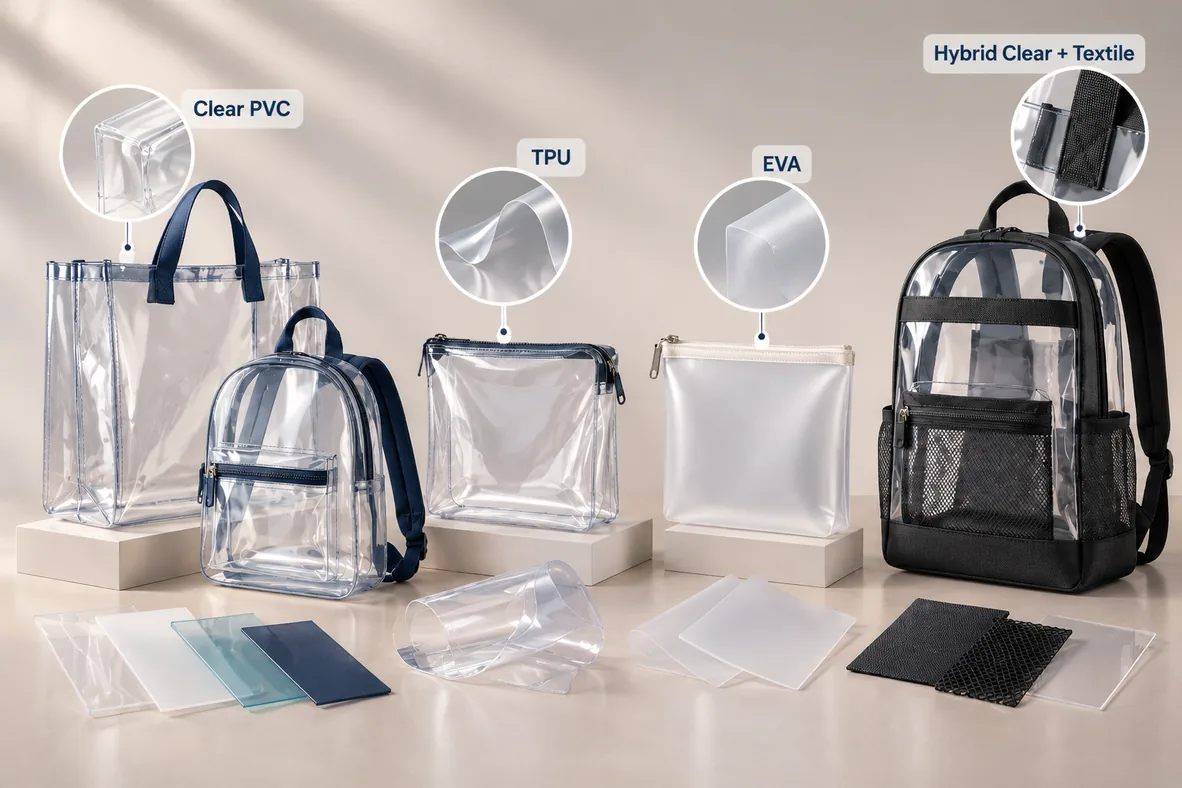
The word “clear” describes appearance, not a complete material specification. Transparent bags can be made with different films and can include textile panels, webbing, mesh, binding, lining, or reinforcement patches. A buyer should select the material according to the required flexibility, structure, surface appearance, cost target, and destination market.
Clear PVC
PVC is widely used for transparent bag bodies because it can provide a smooth, visible surface and can be developed in different thicknesses, finishes, and colors.
The buyer should not evaluate PVC by thickness alone. A thicker film may feel more structured, but the finished bag also depends on seam placement, corner radius, gusset design, handle or strap attachment, and the load applied during use. A large tote with long handles needs a different reinforcement plan from a small pouch. A backpack needs careful attention at the strap anchor points because the load is transferred through a small area of the body.
Clear PVC can also be offered with frosted, tinted, glitter, matte, or other visual finishes. These may support a fashion or branding direction, but they can reduce transparency. If visibility is a functional requirement, the degree of tint or frosting should be approved against the final policy and use case.
TPU
TPU may be considered when the project needs a different balance of flexibility, appearance, or material positioning. The choice should be made through a sample and specification review rather than by assuming that TPU is automatically better than PVC. Film grade, thickness, seam method, surface finish, temperature exposure, decoration process, and cost all need to be assessed together.
If a buyer requests TPU, the supplier should confirm the available grade, transparency target, processing method, and applicable compliance documentation. A material name on a quotation is not enough to verify finished-product performance.
EVA and Other Clear Films
EVA and other clear film options may suit selected packaging, promotional, cosmetic, or flexible bag applications. Their feel, stiffness, surface, odor, print compatibility, and seam behavior can differ from PVC and TPU. The product development team should test the intended closure, handle or strap attachment, and folding method on the actual film.
Hybrid Clear and Textile Designs
A hybrid design combines transparent panels with fabric trim, webbing, mesh, or a structured base. This can provide contrast, reinforcement, and a more distinctive appearance while preserving visibility in the main inspection area.
Hybrid construction is useful when a fully transparent bag would be too plain, too flexible, or difficult to reinforce. It also creates more specification questions: how much of the bag must remain visible, whether opaque sections are allowed, how the trim affects cleaning, and whether the logo can be placed without blocking the required view. For a school or venue project, the hybrid design should be checked against the destination policy before the artwork is finalized.
Geometry and Capacity: Why Exterior Dimensions Are Not Enough
Two bags can have similar exterior measurements and very different usable capacity. The difference comes from opening width, gusset behavior, corner shape, zipper placement, internal dividers, seam allowance, and the shape of the items placed inside. A buyer comparing a backpack and a tote should document the actual load before asking for a quotation.
Measure the Largest Item and the Normal Case
Start with the largest item that must fit, not with the average item. For a school program, measure a binder, textbook, lunch container, and electronic device with its protective case. For a trade-show kit, measure the widest catalog, product sample, water bottle, and gift item. For a retail package, measure the boxed product after it has been sealed and labeled.
Record the length, width, and depth of each item, then identify which item controls the opening. A bag can have enough volume in theory but still reject a wide folder because the zipper opening is narrower than the body. A tote with a gusset may accept a box more easily than a flat tote. A backpack with a rounded top may have less practical space near the corners than its rectangular height suggests.
Use a Load Map Instead of a Capacity Guess
For a serious project, create a simple load map with four fields: item name, outside dimensions, quantity, and location in the bag. Mark which items need protection, which items need quick access, and which items can be packed at the bottom. This map gives the supplier a functional brief and gives the buyer a basis for sample testing.
For example, an event kit may contain a badge holder, folded program, T-shirt, bottle, charger, and small gift. The badge holder may need a front pocket, the bottle may need a side holder, and the T-shirt can fill the main compartment. A tote may handle the kit through one wide opening, while a backpack may need a front pocket and a side pocket to prevent small items from being buried.
Gussets Change Both Use and Logistics
Side and bottom gussets create depth, help a tote stand, and make it easier to carry boxed or irregular items. They also consume material, add corner seams, and increase folded or packed volume. A gusseted tote may be more useful at the event but occupy more carton space than a flat tote. For an importer, the correct comparison includes both user capacity and shipping configuration.
Ask the supplier to state the measurement method clearly: exterior width, height, and depth; whether the measurement is taken empty or filled; whether handles are included; and whether the gusset is measured flat or expanded. Use the same method when comparing quotations from different suppliers.
Pocket and Opening Architecture: Design Each Access Point With a Job
Pocket count is often used as a quick way to signal functionality, but it is a poor substitute for a clear access plan. Every pocket adds material, sewing or assembly operations, inspection points, and sometimes an opaque area that affects visibility. A buyer should specify the task each pocket supports.
Backpack Layout
A practical clear backpack may use one main compartment, a front zipper pocket, and side mesh holders. The main compartment carries the bulk of the load. The front pocket keeps small items such as cards, pens, chargers, or personal accessories accessible. A side holder can keep a bottle upright and reduce the chance that it occupies the center of the main compartment.
The supplier should confirm whether the front pocket is fully clear, partly textile, or mesh. The pocket depth should be related to the items it is meant to hold. A shallow pocket may be visually neat but unusable for the target item. A deep pocket may hold more, but it can also become a heavy external load that pulls the front panel away from the body.
Tote Layout
A clear tote often begins with one wide compartment because quick loading and visibility are its main advantages. A front organizer or internal pouch can be added when the user needs separation, but it should not make the main opening unnecessarily narrow. If the tote is used as reusable retail packaging, an internal pocket may be useful for a receipt, care card, or small accessory. If it is used for stadium entry, the pocket may be restricted by the venue and should not be added without confirmation.
Closure Selection Is a Functional Trade-Off
An open-top tote minimizes access time but gives less containment and privacy. A zipper improves containment and can create a more retail-ready finish, but it adds cost and may slow packing at a distribution point. A snap or magnetic tab can provide a middle position, while a hook-and-loop closure may be suitable for selected promotional applications.
For a backpack, the main zipper should be tested along the full opening radius. A zipper that is too short may make a large body difficult to load. A zipper installed too close to a curved corner may catch or distort the film. The front pocket closure should be evaluated separately because it will be used more frequently than the main compartment.
Carry Comfort: Analyze Contact, Adjustment, and Duration
“Comfortable” is a user outcome, not an automatic feature of either format. A clear backpack can be uncomfortable if the straps are narrow, the load is concentrated, the back contact is stiff, or the body is too deep. A clear tote can be comfortable for a short carry but unpleasant when a heavy or sharp-edged load is held on one shoulder for a long period.
Backpack Comfort Variables
A buyer developing a clear backpack should record:
- strap width and adjustment range;
- distance between upper and lower strap anchors;
- whether the straps are plain webbing, padded, or combined with a textile panel;
- top-handle position and reinforcement;
- back-panel material and contact surface;
- body depth when filled;
- likely load weight and balance;
- intended user age or body-size range.
The sample should be worn with a representative load. Test both straps at different adjustment lengths and observe whether the bag sits close to the back or pulls away. Check whether the transparent film folds into the user's back, whether the bottom corners contact the body, and whether the front pocket becomes a hard protrusion when filled.
Tote Comfort Variables
For a tote, comfort depends on handle length, webbing width, edge softness, attachment position, and load. If the handles are intended for shoulder carrying, test the bag with a shirt, jacket, and the intended packed load. A long handle may provide shoulder clearance but allow the bag to swing. A short handle may be stable in hand but unsuitable for the shoulder.
Handle extensions that continue down the front and back panels can distribute force over a larger area, but they change the visual design and may cover more of the transparent body. The reinforcement should be agreed in the drawing and checked on the sample.
Do Not Confuse Carry Comfort With Load Permission
A padded strap or wide handle can improve contact, but it does not establish a safe maximum load. The appropriate load depends on the construction and end use. A buyer should define a representative load test instead of using terms such as “heavy-duty” as a substitute for evidence.
Seams, Reinforcement, and Processing of Clear Materials
Clear film exposes construction choices that can be hidden by dark fabric. Scratches, wrinkles, misaligned binding, uneven stitch lines, needle marks, adhesive residue, and poor corner matching may be visible in the finished product. That makes process control important for both appearance and service performance.
Sewn Construction
Sewn seams can join film to webbing, mesh, and textile trim in a flexible way. The trade-off is that the needle creates perforations in the film, and the seam area must be designed so repeated stress does not create a tear path. Stitch density, thread selection, seam allowance, binding, and reinforcement patches should be determined through the actual sample and intended load.
For backpacks, inspect the strap anchors, top handle, pocket corners, zipper ends, and bottom corners. For totes, inspect the handle attachment, upper edge, gusset intersection, and base. Do not evaluate the seam only when the bag is empty; inspect it again after the representative load has been carried and removed.
Bound Edges
Binding can cover a raw film edge, improve handling, and create a deliberate contrast color. It also adds another material and another seam line. If the binding is part of a venue-facing product, check whether it reduces the clear area beyond what the policy permits. If the bag is marketed as a premium retail item, check whether the binding remains flat around corners and whether the color is consistent across the production lot.
Heat-Sealed or Welded Construction
Some clear polymers may be suitable for heat sealing or high-frequency welding. These processes can create a clean joint and may reduce needle perforations, but they require compatible material, geometry, tooling, and process control. A buyer should not request “waterproof welding” as a generic feature without confirming the film, the weld design, the closure, and the test method.
A welded body can still have leakage paths at a zipper, open top, handle attachment, or mixed-material seam. Waterproof performance must be assessed on the complete product, not inferred from one seam method.
Reinforcement at Concentrated Loads
Handles and straps are concentrated load points. A reinforcement patch, webbing extension, folded binding, textile panel, or layered film can be used to spread the force. The best solution depends on the material and target appearance. Reinforcement should be visible in the technical drawing, not added informally after a sample fails.
Branding and Visual Merchandising on Transparent Bags
Transparent products create a strong visual relationship between the bag, its contents, and the brand mark. That can be a selling advantage, but it also means the artwork must work in more than one condition. Review the logo on an empty bag, on a light-colored insert, and on a darker packed load.
For a clear backpack, branding may be placed on the front panel, front pocket, shoulder webbing, top handle, trim, hang tag, or a removable insert. A large front print can create strong visibility, but it may cover the very area that needs to remain transparent.
For a clear tote, the front and back panels often provide a larger uninterrupted print area, while webbing and edge binding add opportunities for color coordination.
Printing Method Comparison
| Method |
Most suitable surface |
Main strengths |
Limitations to review |
Typical project direction |
| Screen printing |
PVC film, selected TPU/EVA surfaces, webbing, textile trim |
Strong solid-color appearance, familiar process, efficient for repeat artwork |
Color count and registration affect setup; fine details may need simplification; adhesion must be tested |
Medium to large bulk orders with simple logos or solid graphics |
| UV digital printing |
Selected smooth film, PVC panels, labels, rigid or semi-rigid components |
Can reproduce detailed artwork and multiple colors without traditional screen setup |
Ink adhesion, scratch resistance, flexibility, and curing quality must be tested on the actual film |
Shorter runs, detailed graphics, variable artwork, or premium visual effects |
| Heat transfer |
Selected film or textile areas, webbing, labels, patches |
Useful for multi-color artwork, names, numbers, and controlled placement |
Transfer compatibility, edge lifting, heat exposure, stretch, and peeling must be checked |
Campaigns with detailed graphics or variable personalization |
| Sublimation |
Polyester textile components, some compatible coated fabrics |
Good for all-over or full-color textile graphics |
Not a universal method for clear PVC; it generally belongs on compatible textile surfaces |
Printed polyester trim, fabric panels, or textile inserts |
| Label or sticker application |
Film, packaging, tags, selected smooth surfaces |
Flexible for variable information, small batches, and removable or replaceable branding |
Edge lifting, residue, transparency, water exposure, and long-term appearance need review |
Retail labels, campaign variants, batch information, or removable inserts |
| Woven or printed label |
Webbing, textile trim, sewn-in label area |
Adds a textile brand detail without printing directly on the film |
Requires a suitable attachment area and adds a sewing or application step |
Retail branding, care labels, private-label identity |
| Embroidery |
Webbing, fabric trim, textile pocket, padded section |
Tactile premium effect and strong textile identity |
Not suitable directly on clear film; can add thickness and puncture textile backing |
Textile trims, straps, and hybrid bag panels |
| Deboss or molded detail |
Compatible synthetic or molded components |
Creates a permanent structural mark without surface ink |
Requires suitable material and tooling; not a general clear-film solution |
Selected patches, rubber components, or molded accessories |
The table provides a selection framework, not a promise that every method can be used on every clear material. The supplier should confirm compatibility after reviewing the film grade, surface finish, flexibility, artwork, quantity, and required durability.
Cost and Bulk Purchasing: Which Option Is More Economical?
For B2B buyers, the unit price is important, but it should not be the only factor used to compare clear backpacks and clear tote bags.
A tote bag often has a simpler construction than a backpack. It generally requires fewer structural components, no dual shoulder strap system, and potentially fewer sewing operations.
As a result, a basic clear tote may have a lower manufacturing cost than a comparable clear backpack.
However, this does not mean every tote is cheaper than every backpack. A large tote with thick transparent material, reinforced webbing handles, multiple gussets, a full zipper, and extensive printing may cost more than a relatively simple backpack.
Cost Comparison Between the Two Bag Types
Cost Factor |
Clear Backpack |
Clear Tote Bag |
Main body material |
Depends on dimensions and panel construction |
Depends on dimensions and gusset structure |
Structural components |
Usually more components |
Often fewer components |
Carrying system |
Two shoulder straps and possible padding |
Two handles |
Compartments |
Often multiple pockets |
Usually simpler, with optional pockets |
Closure |
Commonly zipper-based |
Open top or optional closure |
Assembly complexity |
Generally higher for multi-pocket designs |
Generally lower for basic designs |
Branding |
Front panel, pockets, webbing, labels |
Large front panel, handles, labels |
Packaging |
May require shape protection depending on construction |
Often easier to flatten, depending on design |
This comparison reflects common construction patterns, not a fixed price ranking.
The most reliable way to compare costs is to request quotations using equivalent specifications.
For example, comparing a basic open-top tote with a multi-compartment backpack will not provide a meaningful cost comparison.
Instead, buyers should define the required size, material, transparency, closure, branding, and packaging before requesting prices from different suppliers.
Durability and Quality Checks for Bulk Orders
A clear bag can look impressive in a product photograph and still fail at the details that matter in use. Procurement teams should establish a sample approval and inspection plan before mass production. The plan does not need to be complicated, but it should match the risk of the program.
Material and Appearance Inspection
Compare the production material with the approved sample. Check transparency, color, surface marks, film wrinkles, trim color, webbing, mesh, zipper, buckles, labels, and packaging. If the bag uses a tinted or frosted finish, define the acceptable appearance with a physical reference rather than a verbal description.
For transparent film, inspect scratches, cloudy sections, bubbles, severe fold marks, uneven edges, and inconsistent color. Some minor marks may result from packing or handling, but acceptance must be decided before production. A retail program may require a stricter appearance standard than a short-term event giveaway.
Sewing and Seam Inspection
Check for skipped stitches, loose threads, broken stitches, uneven seam allowances, exposed edges, puckering, misaligned panels, and weak corners. On a backpack, pay special attention to the shoulder strap anchors, top handle, front pocket, bottom corners, and zipper ends. On a tote, inspect the handle attachment points, gusset corners, top edge, and any reinforced extension of the webbing down the body.
If the bag is welded, inspect the continuity and appearance of the weld, especially around corners and closure ends. The production method should be consistent with the material approved during sampling.
Functional Testing
Test the zippers, snaps, buckles, closures, handles, strap adjustment, and pocket access. Pack a representative load and open and close the bag repeatedly. Observe whether the zipper catches, whether the bag stays balanced, and whether the contents remain in the intended compartments.
A backpack should be worn with a representative load to evaluate strap adjustment, body contact, and balance. A tote should be carried by hand and over the shoulder if both methods are part of the design. These tests do not replace formal laboratory testing, but they can reveal practical problems that an empty visual inspection misses.
Load and Reinforcement Review
The load test should be agreed between buyer and supplier according to the intended application. A lightweight promotional bag, a school backpack, and a retail tote carrying boxed products do not need the same test scenario. The buyer should define the representative items, load, duration, handling, and pass criteria in writing.
Do not describe a bag as heavy-duty, waterproof, child-safe, or venue-compliant solely because it looks substantial. Those claims require product-specific evidence and, where relevant, destination-market review.
Clear Backpack or Clear Tote Bag: A Decision Framework for Buyers
The following decision sequence helps a buyer move from a broad idea to a product specification.
Step 1: Identify the Main Carrying Behavior
If the user will walk, queue, work, or move hands-free for long periods, begin with a backpack. If the user needs to load and unload items quickly at a booth, gate, counter, or registration point, begin with a tote.
Step 2: Identify the Largest and Most Sensitive Item
Measure the largest object, including its case or packaging. If the item is fragile or electronic, determine whether it needs a protective insert. If the item is wide, confirm the opening width. If the bag will hold bottles or boxed products, evaluate gusset depth and bottom construction.
Step 3: Confirm the Destination Rules
Check current written requirements for transparency, size, pockets, handles, straps, closures, and opaque components. A bag can be technically well made and still be unsuitable for a particular event or school if the format is not permitted.
Step 4: Choose the Simplest Layout That Solves the Problem
Use pockets and accessories only when they support a repeatable routine. A clear backpack may need a front pocket and bottle holders, while a clear tote may only need one wide compartment and a secure closure. Extra features add material, labor, inspection points, and sometimes more opaque area.
Step 5: Approve the Physical Sample
Review the actual material, color, logo, handle or strap placement, opening, closure, packing method, and load behavior. Ask for changes before bulk production if the sample exposes a problem. The approved sample should be linked to the production specification and artwork proof.
Step 6: Plan the After-Use Value
If the bag is a giveaway, consider what happens after the event. A tote may be retained for shopping or storage. A backpack may be reused for school, commuting, or sports. Designing for the second use can improve perceived value, but only if the construction genuinely supports it.
FAQ
Is a clear backpack better than a clear tote bag?
Neither format is universally better. A clear backpack is usually the stronger starting point for hands-free carrying, school or campus movement, staff use, and longer programs. A clear tote is often better for quick access, short events, registration kits, retail packaging, and high-volume distribution. The final choice depends on the end user's load and the destination requirements.
Can a clear tote bag have a zipper?
Yes. A clear tote can be developed with an open top, zipper, snap button, magnetic tab, hook-and-loop closure, or another structure depending on the design. The selected closure should be tested with the intended load and checked against the destination's policy.
What is the best material for a transparent bag?
There is no single best material for every project. Clear PVC is a common starting point for transparent bags, while TPU, EVA, and hybrid constructions may suit other requirements. The decision should consider transparency, flexibility, appearance, seam method, decoration, durability, compliance, and cost.
Can the same logo artwork be used on a clear backpack and tote?
The artwork may be shared, but the placement and size often need adjustment. A tote may provide a broad front panel, while a backpack may use a front pocket, upper panel, trim, or webbing. Review the artwork on the actual material and ensure it does not block a required inspection area.
Which clear bag is more economical for bulk orders?
A basic clear tote bag often has a simpler construction and may have a lower manufacturing cost than a multi-compartment clear backpack. However, actual pricing depends on material thickness, size, handles, straps, closures, printing, and order quantity. Buyers should compare equivalent specifications rather than comparing product categories alone.
Conclusion
For a program built aroundhands-free movement, organized carrying, and repeated daily use, start with a clear backpack. For a program built around fast access, simple packing, visible branding, and efficient distribution, start with a clear tote bag. For mixed audiences, consider using the tote for general attendees and the backpack for staff, students, volunteers, or premium merchandise, provided each format meets the destination rules.
The best purchasing decision is not the one with the most features. It is the one that matches the actual load, carrying behavior, policy, branding plan, and production process. Define those requirements first, approve a physical sample, and then compare quotations on the same specification.
INITI supports OEM and ODM development for custom bags, including clear PVC backpacks and clear PVC tote bags. Buyers can provide product type, target size, material direction, estimated quantity, artwork, packaging needs, and delivery requirements for a product review. For a project that is still at the concept stage, a reference image and intended use can be used as the starting point for a recommendation.
Related Products


 Hot News