When comparing backpacks, one of the first specifications buyers look at is capacity. A backpack labeled 20 liters may appear suitable for daily commuting, while a 30-liter model might seem better for travel or outdoor activities. However, the number printed on a product specification sheet does not always tell the whole story.
Two backpacks with the same stated capacity can have noticeably different storage layouts. One may offer a large main compartment, while another uses more space for padded laptop sleeves, internal dividers, and multiple smaller pockets. Their external dimensions may also be similar even though their usable storage spaces are not.
Understanding how to measure backpack volume helps consumers choose products more confidently. For retailers, promotional product companies, private-label brands, and sourcing teams, it also provides a practical way to evaluate samples, compare suppliers, and establish clear product specifications before bulk production.
This guide explains what backpack volume means, how liters are calculated, which measurement methods are useful, and how to verify capacity accurately. It also covers the factors that influence usable storage space and the questions buyers should ask when developing a custom backpack.
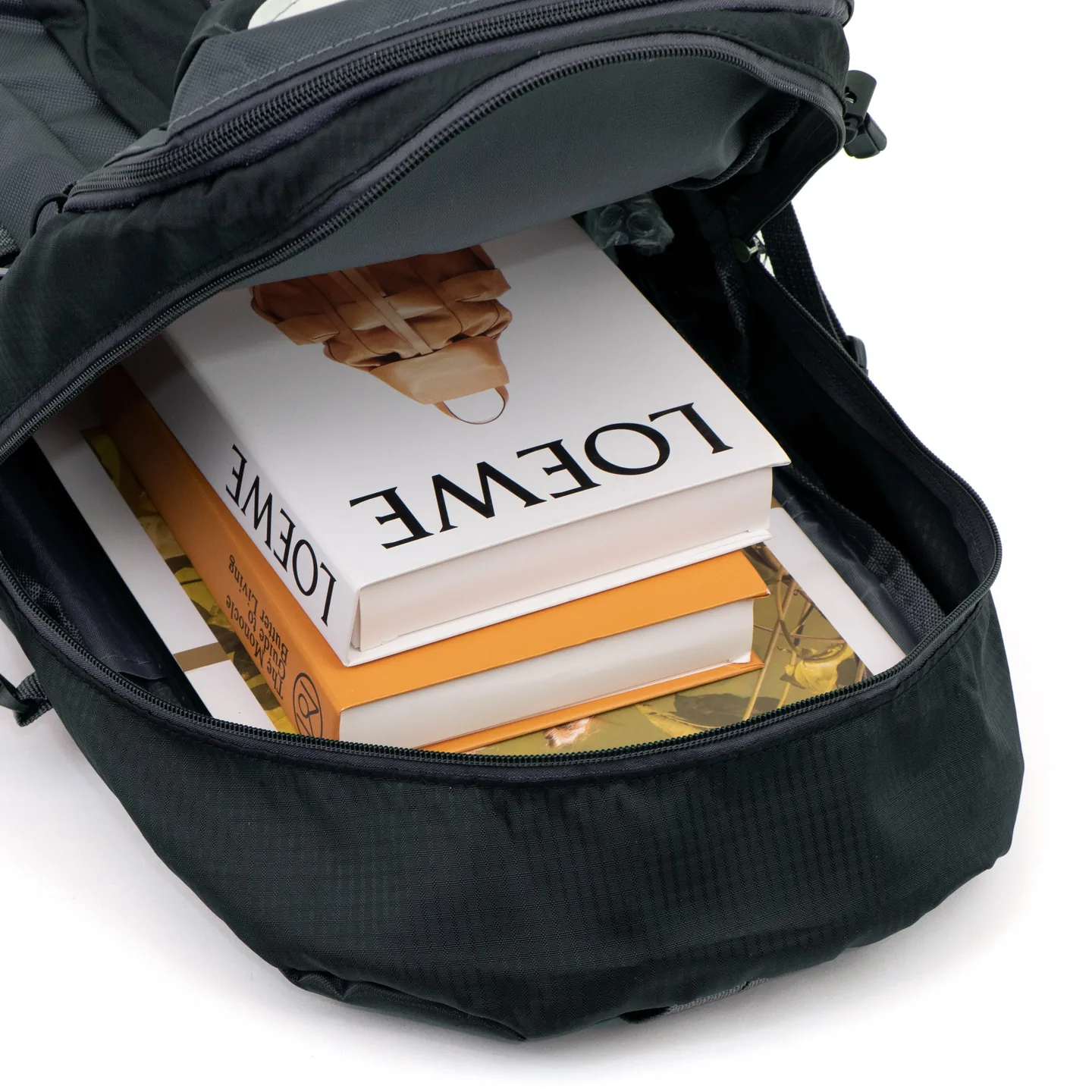
Backpack volume is the amount of three-dimensional space available inside a backpack for storing items. It is commonly expressed in liters (L), although cubic inches may also appear in product specifications, particularly in the US market.
For example, a backpack advertised as 25 liters is intended to provide approximately 25 liters of storage capacity under the manufacturer's stated measurement method.
One liter equals 1,000 cubic centimeters. This means a backpack with a measured internal volume of 25,000 cubic centimeters has a volume of 25 liters.
The basic conversion is:
Volume in liters = Volume in cubic centimeters ÷ 1,000
However, backpack volume is not necessarily calculated by measuring the outside of the bag and multiplying three dimensions. That approach estimates the volume of a rectangular solid, while most backpacks have curved panels, tapered profiles, rounded corners, and compartments that occupy different amounts of space.
For practical purposes, three related concepts should be distinguished.
Backpack Volume
Backpack volume describes the amount of storage space measured using a defined method. Depending on the method and the manufacturer's rules, the result may include the main compartment, fully enclosed secondary compartments, and certain additional pockets.
External Dimensions
External dimensions describe the physical measurements of the finished backpack, usually its height, width, and depth. These measurements help determine whether the backpack will fit inside a locker, under an airline seat, inside a shipping carton, or within a display space.
External dimensions do not directly establish internal capacity because the fabric, padding, lining, structural panels, and compartment construction occupy space.
Usable Storage Capacity
Usable storage capacity describes how much space is practically available for the intended contents. A backpack may have a stated volume of 25 liters, but a bulky laptop sleeve, narrow opening, or thick padding can make certain items more difficult to pack.
This distinction matters when evaluating backpacks for specific purposes. A product intended for books and clothing may use its volume differently from a backpack designed to carry a laptop, camera equipment, or promotional materials.
The key point: volume, external dimensions, and practical usability are related, but they are not interchangeable measurements.
How Is Backpack Volume Measured?
There is no single calculation that produces a universally comparable capacity figure for every backpack. The appropriate method depends on the shape of the bag, the accuracy required, the equipment available, and the measurement rules used.
Three approaches are particularly useful:
- Dimension-based calculation: estimates volume from length, width, and height. It is quick and suitable for preliminary estimates or simple, box-shaped compartments.
- Shape-based calculation: uses a geometric approximation that better reflects the shape of some backpacks. It can improve estimates when the bag resembles a rounded cylinder or an elliptical form.
- Fill-based measurement: measures how much space a backpack holds by filling its compartments with a known quantity of material. It is more suitable for checking irregular shapes and comparing actual storage capacity.
For manufacturers and buyers who need consistent specifications, a documented fill-based method is generally more informative than relying on external dimensions alone.
Three Measurement Methods Compared
No single formula produces a figure that is comparable across every supplier. The right method depends on the body shape, the accuracy the buyer needs, and whether the number will be used for screening or for a purchase order.
| Method |
What it produces |
Best for |
Effort |
Result type |
| Dimension-based (L × W × H) |
An upper-envelope estimate |
Quick screening, carton and freight planning |
Low |
Estimate — overstates curved bodies |
| Geometric approximation |
A shape-corrected estimate |
Rounded, cylindrical, or hybrid bodies |
Medium |
Estimate — accuracy depends on model fit |
| Fill-based test |
Measured capacity of defined compartments |
Supplier comparison, sample approval, production reference |
High |
Measured — reproducible when the method is fixed |
Method 1: Measure Length, Width, and Height
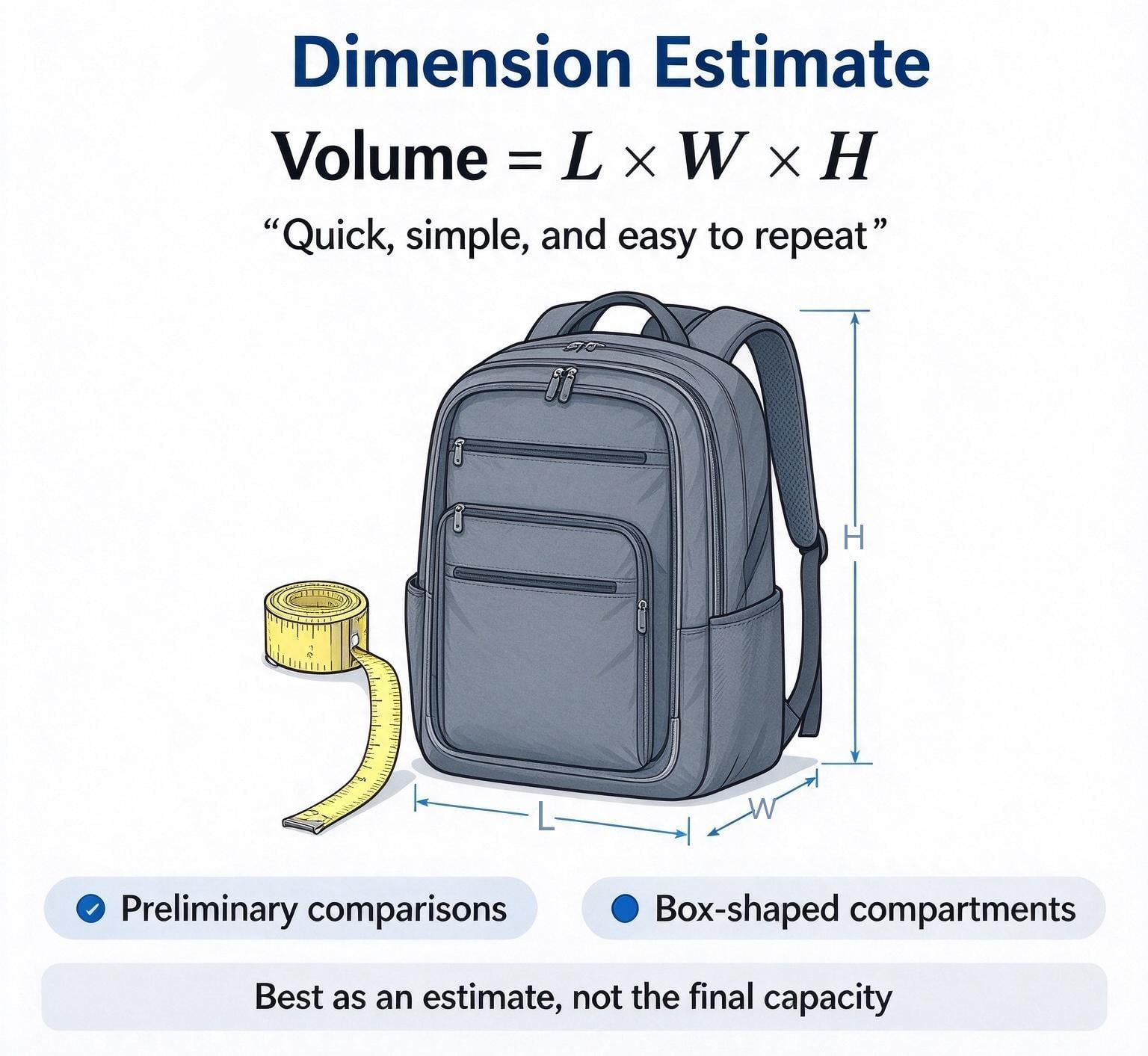
The simplest way to estimate backpack volume is to measure its three principal dimensions and multiply them together.
The formula is:
Volume = Length × Width × Height
If all dimensions are measured in centimeters, the result is in cubic centimeters. Divide the result by 1,000 to convert it to liters.
For example, suppose a backpack has the following external dimensions:
| Measurement |
Dimension |
| Height |
45 cm |
| Width |
30 cm |
| Depth |
18 cm |
The estimated rectangular volume is:
45 × 30 × 18 = 24,300 cm³
Convert this figure into liters:
24,300 ÷ 1,000 = 24.3 L
The result is a rectangular-envelope estimate of 24.3 liters. It does not establish that the backpack has 24.3 liters of actual internal storage capacity.
Step-by-Step Instructions
Step 1: Prepare the backpack.
Empty the bag and close its main zipper or other primary closure. Arrange the shoulder straps and loose fabric so they do not interfere with measurement.
Step 2: Measure the height.
Place the backpack upright in its normal position. Measure from the lowest point of the base to the highest point of the main body. Record the measurement in centimeters or inches.
For a backpack with a roll-top closure, decide whether the measurement represents the closed configuration or the fully extended configuration. Record the chosen condition.
Step 3: Measure the width.
Measure the widest horizontal part of the main body, usually from one side panel to the other. Avoid including shoulder straps, loose webbing, or decorative attachments unless the purpose is to record the overall external envelope.
Step 4: Measure the depth.
Measure the distance from the front panel to the back panel at the deepest part of the main body. A stuffed or expandable backpack may have a different depth depending on how it is positioned, so use a consistent condition.
Step 5: Calculate the estimate.
Multiply the three measurements and convert the result to liters if necessary.
For measurements in inches, the conversion is:
Volume in liters = Length × Width × Height in cubic inches × 0.0163871
For example, a rectangular space measuring 18 × 12 × 7 inches has an estimated volume of 1,512 cubic inches, or approximately 24.8 liters.
When Is This Method Useful?
Dimension-based calculation works best for preliminary comparisons and relatively box-shaped compartments. It can also help buyers check whether a backpack's external dimensions are broadly consistent with its advertised capacity.
However, it should not be used as the sole verification method for a curved or highly compartmentalized backpack. The calculation assumes that the entire rectangular envelope is available for storage, which is rarely true.
A backpack may have sloping side panels, a curved top, a rounded bottom, or a narrow base. Multiplying its maximum dimensions effectively treats the missing corner spaces as if they were filled.
The reverse problem can also occur when a bag has an expandable body or a flexible construction that changes shape under load.
Practical recommendation: record the dimension-based result as an estimate, not as a confirmed internal capacity.
Method 2: Use a Geometric Approximation
A second approach is to approximate the shape of a backpack using a geometric model.
This method can be more realistic than a rectangular calculation when the main compartment resembles a cylinder or an elliptical cylinder. It is still an estimate, but it accounts for the fact that the compartment may not occupy its entire rectangular envelope.
For an elliptical cylinder, the formula is:
V = π × a × b × h
Where:
- V = estimated volume
- π ≈ 3.1416
- a = one horizontal radius
- b = the perpendicular horizontal radius
- h = height
The two radii describe the elliptical cross-section of the modeled compartment. They are not the full width and depth.
For example, suppose a compartment is approximated as an elliptical cylinder with a width of 28 cm, a depth of 16 cm, and a height of 42 cm.
The horizontal radii are:
- a = 28 ÷ 2 = 14 cm
- b = 16 ÷ 2 = 8 cm
The estimated volume is:
3.1416 × 14 × 8 × 42 ≈ 14,777 cm³
Converted into liters, this is approximately 14.8 liters.
This result is lower than the rectangular estimate for a compartment with the same maximum dimensions because the elliptical model does not assume that all four corners contain storage space.
Limitations of Shape-Based Calculations
The formula is only as reliable as the geometric model.
Many backpacks do not resemble uniform elliptical cylinders. They may taper toward the top, curve inward at the base, widen around a laptop compartment, or contain several connected sections with different shapes.
A single geometric approximation also does not account automatically for:
- Internal dividers and padded sleeves.
- Separate compartments that occupy distinct areas.
- Curved panels with irregular cross-sections.
- Expansion zippers and adjustable closures.
- Storage spaces that are inaccessible to larger objects.
- Exterior pockets that may or may not be counted in the stated capacity.
For these reasons, geometric calculations are best used to estimate a compartment's approximate volume or to compare similar designs. They are not a substitute for a defined physical capacity test when exact product specifications matter.
Method 3: Measure Volume Using a Fill-Based Method
A fill-based method measures capacity by determining how much material is required to fill a backpack's designated storage areas.
Instead of assuming that the bag is rectangular or cylindrical, this approach measures the space available within the actual compartment boundaries.
A recognized reference is ASTM F2153, Standard Test Method for Measurement of Backpack Capacity. The standard describes a method intended to provide a consistent basis for measuring backpack capacity. Its published scope includes backpacks and related bags, while its measurement rules address the treatment of storage areas that are not fully enclosed by fabric.
A practical fill-based measurement can use small, uniform plastic spheres and calibrated measuring equipment. The exact procedure should follow the chosen test method rather than an improvised combination of different procedures.
Equipment Needed
| Item |
Specification |
Purpose |
| Fill medium |
20 mm polypropylene balls, or 10 mm beads for small packs |
Repeatable, reusable, low dust |
| Graduated measure |
1 L or 2 L jug with clear markings |
Volume counting |
| Funnel |
Wide mouth, 15 cm minimum |
Controlled pouring |
| Digital scale |
0.01 kg resolution, 30 kg capacity |
Weighing shortcut |
| Recording sheet |
Compartment-by-compartment |
Traceability |
| Second operator |
Optional but recommended |
Consistency on settling |
The procedure, step by step.
- Prepare the bag. Empty it completely. Remove any loose foam insert, removable divider, or display stuffing. Close every zip and buckle. Set the bag down and let it settle for a minute so the fabric finds its natural shape.
- Decide the scope before filling. Under ASTM, only areas completely enclosed by fabric count. Record exactly which compartments are included, because this line decides whether the final number is comparable to anyone else's. A common compromise is to measure the main compartment and each fully zipped pocket separately, report the total, and note the pocket breakdown.
- Fill in measured increments. Pour one liter at a time through the funnel. After each liter, lift the bag 5 to 10 cm and set it down twice to settle the medium. Consistency here matters more than the exact motion; the goal is that every bag in a test series receives the same settling energy.
- Fill to the closure line, not beyond. Stop when the medium is level with the point where the bag closes. Do not compress the fabric to gain space, and do not leave the top third loose to make closing easier.
- Close the bag and check. Zip it shut with the medium inside. If the zip will not close without force, the bag is overfilled; remove medium in 0.2 L increments until it closes cleanly. If the bag closes with obvious slack and the medium is visibly below the top seam, it is underfilled.
- Count or weigh. Either pour the medium back through the measure and count the increments, or weigh the filled bag, subtract the empty bag weight, and divide by the medium's calibrated bulk density.
- Repeat three times. Empty, refill, and recount. Record all three results.
- Report the mean and the range. A result of 21.8 L, 22.1 L, 21.6 L should be reported as 21.8 L with a 0.5 L range, not as 21.8 L flat.
- Photograph the filled bag with the closure visible, and file it with the test record. This single image prevents most later disputes about what was counted.
The weighing shortcut, calibrated properly. Weighing is three to four times faster than counting and is the practical way to test a production lot. The constant must be calibrated for the specific medium, because it depends on ball diameter, wall thickness, and how the medium settles.
Fill a 1 L measure with the medium using the same pouring and settling motion used on bags. Weigh it. Repeat five times and average. If the average is 0.62 kg per liter, a bag that accepts 13.4 kg of medium has a capacity of 13.4 / 0.62 = 21.6 liters. Recalibrate whenever the medium is replaced, and never borrow a constant from another factory, because a different ball or a different settling protocol changes it.
Choosing the medium. The medium is not a neutral choice; it sets the resolution of the test.
| Medium |
Repeatability |
Fills narrow gaps |
Practical issues |
| 20 mm polypropylene balls |
High |
Moderate |
Standard choice; bridges across very narrow openings |
| 10 mm beads |
High |
Good |
Slower to handle; better on small packs and organizer pockets |
| Dried beans |
Medium |
Good |
Dust, breakage, moisture uptake over time |
| Rice |
Medium to low |
Very good |
Absorbs moisture, changes mass, difficult to recover fully |
| Sand |
Low |
Poor |
Compacts under its own weight, scratches coating, avoid |
| Water |
High on sealed cavities |
Excellent |
Requires a liner, damages absorbent materials |
The reason medium size matters is that the test reports the bulk volume of the medium, not the geometric cavity. A 20 mm ball cannot enter a 12 mm gap between a sleeve and a back panel. Smaller media reach spaces that larger media miss, which is why a 10 mm bead test on a heavily compartmented pack can return 1 to 2 liters more than a 20 mm ball test on the same bag. Neither result is wrong; they are measurements at different resolutions, and the resolution must be stated alongside the number.
What the method cannot do. It cannot measure below 4 liters reliably, per the standard's own scope. It cannot capture packability, which is how well a bag accepts awkward shapes; two bags of identical measured capacity can differ by a jacket's worth of usable space depending on opening size and internal geometry. And it cannot correct for a bag that is badly designed internally, because a fill test measures the cavity, not the usefulness of the cavity.
Why Is Fill-Based Measurement More Useful?
The main advantage is that it measures the actual boundaries of the designated storage areas instead of treating the backpack as a solid geometric shape.
It can therefore account for curved panels, tapered compartments, and irregular body shapes more directly than an external-dimension calculation.
However, fill-based measurement does not make every capacity figure automatically comparable. Results can still differ when manufacturers use different filling materials, include different pockets, test different configurations, or apply different closure procedures.
How to Convert Backpack Measurements Into Liters
Capacity figures may appear in liters, cubic centimeters, or cubic inches. Converting between these units is straightforward once the original measurement has been established.
The most common conversions are:
| Unit |
Equivalent volume |
| 1 liter |
1,000 cm³ |
| 1 liter |
Approximately 61.024 cubic inches |
| 1 cubic inch |
Approximately 0.016387 liters |
| 1 cubic foot |
Approximately 28.317 liters |
| 1 US gallon |
Approximately 3.785 liters |
For example, if a measurement produces 1,830 cubic inches:
1,830 × 0.0163871 ≈ 30.0 liters
The backpack's measured volume is approximately 30 liters, subject to the definition and method used to obtain the original figure.
Converting Centimeters to Liters
When dimensions are measured in centimeters, calculate the rectangular volume first:
Volume in liters = Length (cm) × Width (cm) × Height (cm) ÷ 1,000
For example:
- Length: 32 cm
- Width: 20 cm
- Height: 45 cm
32 × 20 × 45 = 28,800 cm³
28,800 ÷ 1,000 = 28.8 liters
Again, 28.8 liters is the rectangular-envelope estimate, not necessarily the backpack's true storage capacity.
Converting Inches to Liters
When dimensions are measured in inches:
Volume in liters = Length (in) × Width (in) × Height (in) × 0.0163871
For example:
18 × 12 × 7 × 0.0163871 ≈ 24.8 liters
This formula is convenient when working with US product specifications, but it does not eliminate the limitations of using three external dimensions.
Why External Dimensions Do Not Equal Backpack Capacity
A backpack's external dimensions describe its overall physical envelope. Capacity describes a defined internal storage space. Several construction features explain why the two measurements can differ.
Curved and Tapered Panels
Many backpacks are designed with curved backs, sloping shoulders, rounded bottoms, or tapered side panels. These features can improve appearance, fit, or carrying comfort, but they mean the body does not occupy a full rectangular volume.
If a backpack measures 45 cm high, 30 cm wide, and 18 cm deep, multiplying those dimensions assumes that the entire 45 × 30 × 18 cm envelope contains storage space.
In reality, the top may be narrower than the base, and the depth may vary throughout the body.
Padding and Structural Components
Backpacks designed for laptops, electronics, cameras, or other sensitive items often include padded compartments and structural reinforcement.
These components occupy space within the external dimensions. A thick back panel can also separate the storage area from the wearer's back, reducing the internal depth available for contents.
The effect depends on the construction. Two backpacks made from similar outer fabrics may have different usable capacities because one uses more extensive padding or reinforcement.
Linings and Internal Organization
A lining adds another layer inside the bag. Internal dividers, document sleeves, organizer panels, and zippered pockets can further divide the available space.
These features may improve organization, but they can change how much space is available for larger items.
For example, a backpack with several narrow pockets may accommodate small accessories efficiently while making it harder to fit a bulky jacket or a large packing cube.
The volume of a compartment and its practical usefulness are therefore related but distinct considerations.
Zippers and Opening Design
The opening affects how easily items can be inserted and removed.
A backpack with a narrow top opening may have substantial internal volume but still be inconvenient for loading a large item. A clamshell design may provide easier access to a similar volume, while a roll-top bag may change its usable configuration depending on how much fabric is rolled down.
Opening size should not be confused with capacity, but it is an important usability specification.
Expandable Sections
Expandable backpacks can offer different capacities in different configurations.
An expansion zipper may increase the depth of the main compartment, while a roll-top design may allow the body to extend upward. A compression system may reduce the external profile when the bag is not fully loaded.
For these designs, a single capacity figure may be incomplete. Buyers should request the standard and expanded measurements separately if both configurations are important to the product.
Compartments That Share Space
A pocket may appear to be a separate storage area while actually using space already occupied by the main compartment.
For example, a slip pocket sewn onto the inside of the front panel may extend into the main compartment. Adding the pocket's apparent dimensions to the main compartment volume would count the same physical space twice.
This is especially important when measuring multi-compartment backpacks. The total must represent distinct storage spaces rather than the sum of overlapping geometric estimates.
What Does a Backpack's Capacity Include?
One reason capacity figures can be difficult to compare is that manufacturers may define the measured areas differently.
Some measurements focus on fully enclosed compartments. Others may also report additional exterior storage. Buyers should not assume that every published capacity includes the same features.
The distinction is especially important for backpacks with multiple pockets, compression systems, and external attachment points.
Main Compartment
The main compartment is the primary storage area of the backpack. It typically holds the largest items, such as books, clothing, folders, or packing cubes.
For many products, this is the most useful starting point for evaluating capacity because it represents the central storage space.
However, buyers should still confirm whether internal dividers and padded sleeves are included in the stated capacity.
Fully Enclosed Secondary Compartments
A backpack may have a separate front compartment, a dedicated laptop compartment, or another enclosed section.
Whether these areas are included depends on the measurement rules. Under a consistent method, distinct enclosed compartments can be measured and reported according to the specified procedure.
For product comparisons, it is useful to know both the total reported capacity and the arrangement of the storage areas.
Exterior Mesh Pockets
Mesh pockets are often used for water bottles, umbrellas, or small accessories. Because they may remain open at the top, they do not necessarily provide the same enclosed storage conditions as the main compartment.
ASTM F2153's published scope identifies areas that are not completely enclosed by fabric, such as mesh pockets and water bottle holders, as areas not taken into account under the referenced method. Buyers should verify the applicable edition and its precise rules rather than assume all manufacturers follow the same convention.
If a supplier reports a capacity figure that includes open exterior pockets, ask for the main-compartment figure and the additional-pocket figure separately.
Compression Pockets and Attachment Areas
Compression pockets, external straps, elastic loops, and attachment points may increase carrying versatility without adding enclosed storage volume.
A stretch pocket may hold an item securely, but its practical capacity can change significantly depending on the item's shape and the elasticity of the material.
For this reason, a capacity report should distinguish enclosed storage from exterior carrying features where the selected measurement method requires that distinction.
Expandable Compartments
An expandable compartment may have one capacity in its standard condition and a larger capacity when opened.
These measurements should be documented as separate configurations. Otherwise, a buyer may receive a product that meets the published capacity only when expanded, even though the standard configuration was the intended specification.
For private-label products, the product description, technical specification, sample approval, and packaging should all refer to the same configuration.
How to Measure Backpack Volume for Different Designs
Standard Daypacks
Daypacks often have one main compartment and a smaller front pocket. Their bodies may be rectangular, rounded, or slightly tapered.
A dimension-based estimate can be useful for an initial comparison, but the actual capacity should be established through the chosen internal measurement method if a precise figure is required.
For daypacks, buyers should pay particular attention to the main compartment, the space occupied by internal organization, and whether the front pocket contributes to the advertised total.
Laptop Backpacks
Laptop backpacks often include padded sleeves, organizer panels, and separate compartments for documents or accessories.
When evaluating a laptop backpack, consider two questions:
What is the total measured capacity?
How much practical space remains for the intended combination of a laptop, charger, notebook, and personal items?
A backpack can have a reasonable total volume yet offer limited space for clothing or larger objects if a significant portion of the interior is divided into narrow sections.
Laptop compatibility should also be verified using the sleeve's internal dimensions rather than inferred from the backpack's total capacity.
Hiking Backpacks
Hiking backpacks may have curved frames, adjustable suspension systems, hip-belt pockets, side pockets, and expandable top sections.
Their shape makes simple external-dimension calculations particularly unreliable as a direct measure of capacity.
For hiking backpacks, the measurement method should specify which compartments are included and how expandable sections are treated. If buyers compare two products, both figures should be based on equivalent rules.
The distribution of storage also matters. A backpack with a large central compartment and limited external pockets may be suited to different equipment than one with more divided storage.
Travel Backpacks
Travel backpacks may use clamshell openings, compression straps, laptop compartments, and expandable panels.
For these products, a capacity figure should be considered alongside the packed dimensions and access design. A bag may offer enough theoretical volume but still be difficult to use if its interior shape does not accommodate the buyer's usual packing arrangement.
Where the backpack is intended for air travel, external dimensions should be verified separately against the applicable airline's current baggage requirements. A stated capacity in liters does not guarantee that the product meets any particular carry-on size limit.
Roll-Top Backpacks
Roll-top backpacks can change shape as the opening is adjusted. Their capacity depends partly on the height at which the top is rolled and secured.
A useful specification may include:
- External dimensions in the standard closed condition.
- Capacity in the standard condition.
- Capacity in the fully extended condition, if measured.
- The closure configuration used for each test.
The fully extended capacity should not be presented as the only figure if most users will carry the bag in its standard configuration.
Drawstring Backpacks
Drawstring backpacks generally have a flexible body with fewer rigid panels. Their shape changes substantially depending on the contents and how tightly the drawcord is closed.
External dimensions alone can be particularly misleading because the bag may flatten when empty and expand when filled.
For a custom drawstring backpack, buyers should define the intended capacity test and distinguish the bag's flat dimensions from its measured storage volume.
Structured and Promotional Backpacks
Promotional backpacks may use reinforced bases, foam padding, internal organizers, or unusual panel shapes to support branding and product presentation.
For these products, the capacity specification should be verified on a production-representative sample. Artwork placement, additional lining, and construction changes may affect the finished design, even when the nominal outer dimensions remain unchanged.
If a buyer needs a specific capacity for a promotional campaign or retail listing, the approved sample should be tested using the same rules intended for production quality control.
Backpack Capacity vs. Dimensions: What Should Buyers Compare?
Capacity is only one part of a backpack specification. A useful comparison considers the storage volume, external dimensions, internal organization, and intended contents together.
| Specification |
What it tells the buyer |
Why it matters |
| Measured capacity |
The volume established by a defined method |
Helps compare storage space |
| External height, width, and depth |
The product's physical envelope |
Important for fit, shipping, and display |
| Main-compartment capacity |
The space available in the primary storage area |
Helps assess large-item storage |
| Secondary-compartment layout |
How storage is divided |
Affects organization and accessibility |
| Laptop sleeve dimensions |
The actual space for a device |
Confirms compatibility with intended equipment |
| Standard and expanded capacity |
How volume changes with configuration |
Prevents confusion about expandable designs |
| Empty product weight |
The weight of the backpack itself |
Helps evaluate portability and shipping |
| Closure and opening design |
How the bag opens and secures its contents |
Influences loading and daily usability |
A capacity figure is most useful when it is supported by these other specifications. Buyers should avoid treating a larger number as proof that a backpack is better suited to a particular application.
For example, a 25-liter backpack with a broad main compartment may be more practical for clothing than a 28-liter model whose space is divided among several smaller sections.
Likewise, a laptop backpack with a dedicated padded sleeve may be more suitable for business use than a larger, less organized model.
The correct choice depends on the intended contents and the way the bag will be used.
How to Choose a Suitable Backpack Capacity
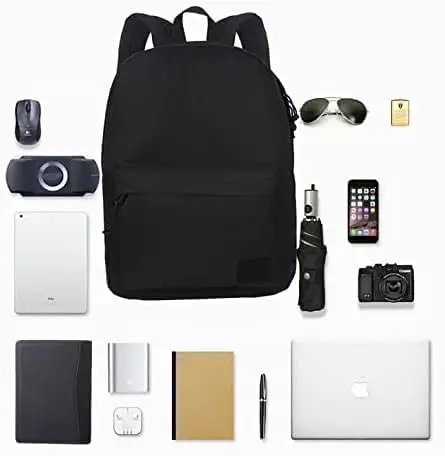
The following ranges are broad starting points, not universal standards. Product design, body shape, compartment layout, and packing habits can change what a given volume accommodates.
| Intended use |
Broad capacity range |
Main considerations |
| Small everyday essentials |
5–15 L |
Compact profile, lightweight construction |
| Daily commuting or school |
15–25 L |
Books, personal items, and possible laptop storage |
| Work and short-day travel |
20–30 L |
Organization, documents, clothing, and electronics |
| Weekend trips |
30–40 L |
Clothing, toiletries, and additional packing space |
| Longer travel or outdoor use |
40–60 L |
Larger loads, compartment access, and carrying support |
| Extended outdoor trips |
60 L and above |
Load distribution, suspension, and specialized storage |
These ranges overlap because backpack categories are not defined by capacity alone. A slim business backpack and a compact hiking backpack may have similar volumes but different internal structures and carrying requirements.
Match Capacity to the Intended Contents
Instead of choosing a backpack based only on a target number of liters, list the items it needs to hold.
For a commuting backpack, these might include a laptop, charger, notebook, water bottle, and lunch container. For a promotional backpack, the contents might be an event program, branded merchandise, a reusable bottle, and a sweatshirt.
Arrange representative items together and consider their dimensions, not just their combined volume. Long, flat, or rigid items may require more usable space than a collection of small objects with the same total volume.
This approach helps identify whether the main compartment needs a wide opening, a flat base, extra depth, or a dedicated sleeve.
Consider the Shape of the Storage Space
A liter measurement does not describe the exact shape of the interior.
A tall, narrow compartment and a short, wide compartment can have the same volume but accommodate different items. The same is true of a compartment with a rounded base compared with one that has a broad rectangular bottom.
For buyers developing a new backpack, internal dimensions and a packing test can be more useful than increasing capacity on paper.
Allow for Practical Access
The backpack must be able to open sufficiently to load the intended items. A product that technically holds a particular volume may still be inconvenient if the opening is too narrow or an internal divider blocks access.
For product development, test both storage capacity and loading behavior. These are related but separate performance characteristics.
How to Verify a Backpack's Capacity Before Purchasing
When evaluating a backpack from a supplier or comparing products from different brands, use a consistent process rather than relying on product titles alone.
Step 1: Check the Published Specification
Find the stated capacity and the external dimensions. If the product listing gives only height, width, and depth, do not assume those dimensions establish the internal volume.
Ask whether the capacity is based on a physical test, a geometric estimate, or another method.
Step 2: Confirm What Is Included
Determine whether the reported figure covers the main compartment alone or includes additional enclosed compartments.
Ask specifically about open mesh pockets, water bottle holders, external compression pockets, and expandable sections. These features can affect the total if the supplier uses a different counting method.
Step 3: Request a Sample
If the capacity is important to the product's performance, request a sample representative of the intended construction.
Measure the external dimensions and examine the internal layout. Check whether the product has the expected depth, opening size, and compartment arrangement.
A sample can also reveal whether padding, lining, and internal dividers take up more space than expected from the specification sheet.
Step 4: Compare Equivalent Conditions
A fair comparison requires equivalent configurations and measurement rules.
Do not compare one backpack's main-compartment capacity with another backpack's total capacity if the second figure includes additional pockets. Similarly, do not compare an expandable backpack in its fully extended state with a non-expandable model without identifying that difference.
Step 5: Document Any Discrepancies
If the stated capacity and the result of your own measurement differ, record the measurement method, the dimensions, the compartments included, and the sample configuration.
The difference may result from distinct test rules rather than an incorrect product. The supplier should explain the basis of the published figure before a buyer concludes that the specification is wrong.
For commercial purchases, this documentation helps establish a common understanding before the product enters mass production.
Common Mistakes When Measuring Backpack Volume
Even a straightforward capacity check can produce misleading results when the measurement conditions are inconsistent.
Mistake 1: Treating External Dimensions as Actual Capacity
Multiplying a backpack's external height, width, and depth is convenient, but it treats the bag as a rectangular block.
This may provide a rough upper-envelope estimate, but it does not establish the volume of the actual storage compartments. The difference can be significant for tapered, padded, or highly structured bags.
Better approach: use external dimensions for size checks and a defined internal measurement method for capacity verification.
Mistake 2: Measuring Different Configurations
An expandable backpack may have different dimensions and capacity depending on whether its expansion zipper is open. A roll-top design can also change volume according to the closure position.
Better approach: record the exact configuration used for each measurement and report standard and expanded figures separately when relevant.
Mistake 3: Counting Open Pockets Without Explaining the Method
Some product descriptions may add the capacity of exterior pockets to the main compartment. Other measurement methods exclude open storage areas.
Neither a bare total nor a large number is enough to establish how the product was measured.
Better approach: request a clear breakdown of the measured compartments and confirm which rules the supplier follows.
Mistake 4: Counting the Same Space Twice
A pocket or sleeve may occupy space inside the main compartment rather than creating an additional independent volume.
Adding the estimated volume of that pocket to the main compartment can overstate the total.
Better approach: use a measurement procedure that accounts for distinct storage areas and does not double-count overlapping spaces.
Mistake 5: Overfilling the Backpack
Forcing filling material into a compartment can stretch the fabric, distort the body, or prevent the closure from operating normally.
This can produce a figure that does not represent the backpack's intended use.
Better approach: follow the selected test method and stop at the prescribed filling and closure condition.
Mistake 6: Using Inconsistent Filling Materials
Different materials have different shapes and packing behavior. Irregular beans, small spheres, and other loose materials may settle differently in the same compartment.
Better approach: use the specified filling material and equipment for the selected method, particularly when comparing samples or verifying production consistency.
Mistake 7: Ignoring the Difference Between Capacity and Usability
A volume figure does not tell a buyer whether a laptop fits, whether a large item can pass through the opening, or whether internal dividers interfere with packing.
Better approach: pair the capacity measurement with a practical loading test using representative items.
Mistake 8: Comparing Supplier Figures Without Checking Their Basis
Two suppliers may use different measurement procedures or include different compartments in their totals. Converting their numbers into liters does not remove these differences.
Better approach: request the method, configuration, and compartment scope before making a direct comparison.
How Backpack Volume Measurement Helps Custom Bag Buyers
For retailers, promotional gift companies, procurement teams, and private-label brands, capacity is not just a product detail. It can affect the product's positioning, usability, specification accuracy, and customer expectations.
A clear measurement process is especially valuable when a backpack is being developed to meet a specific brief.
Establish the Required Capacity Before Sampling
Start by identifying the contents the backpack must accommodate. If the product is intended for a laptop and everyday accessories, define the laptop size and representative accessories. If it is designed for an event kit, list the merchandise and printed materials that need to fit inside.
This information helps the development team determine the internal layout and approximate target capacity.
It is better to define the intended use first than to select an arbitrary capacity and attempt to make every required item fit afterward.
Confirm External Dimensions and Internal Layout Separately
The product brief should specify the required external dimensions and the intended storage arrangement.
For example, a buyer may need a backpack that fits a particular display shelf while also accommodating a laptop and a set of promotional products.
The external size determines the physical envelope. The internal dimensions, dividers, padding, and opening design determine how effectively the bag uses that space.
Both should be reviewed during sample development.
Include Capacity in the Sample Approval Process
A sample approval should cover more than appearance and color.
If capacity is a required specification, document the measurement method and the result for the approved sample. Also record the external dimensions, configuration, and included compartments.
This provides a reference point for subsequent production checks.
If the design changes after approval—for example, through additional padding, a thicker lining, or a new internal divider—the buyer should determine whether another capacity check is necessary.
Keep Product Claims Consistent
A capacity figure used in a product listing should reflect the documented specification and the measurement method used for the product.
If the backpack is expandable, distinguish the standard and expanded configurations. If a capacity figure includes particular secondary compartments, make sure that the definition is clear enough for the intended customer.
Accurate product descriptions reduce confusion during purchasing and make it easier for distributors and retailers to compare specifications across a product range.
Use a Shared Specification Sheet
For a custom backpack project, the buyer and supplier should agree on a written specification that covers:
- Target capacity and the method used to verify it.
- External height, width, and depth.
- Main-compartment layout and any enclosed secondary compartments.
- Padding, lining, and structural features that affect internal space.
- Standard and expanded configurations, where applicable.
- Sample approval criteria and any agreed measurement tolerances.
The exact tolerances should be agreed upon for the product rather than assumed to be universal. A measurement tolerance appropriate for one construction may not be suitable for another.
A shared specification makes it easier for both parties to evaluate samples and determine whether a production change affects the finished product.
A Practical Backpack Capacity Verification Checklist
Use the following checklist when assessing a sample or preparing a custom backpack specification.
| Checkpoint |
What to verify |
| Measurement method |
Is the figure based on external dimensions, a geometric estimate, or a physical capacity test? |
| Unit |
Is capacity reported in liters or cubic inches, and has the conversion been checked? |
| External dimensions |
Are height, width, and depth recorded consistently? |
| Main compartment |
Is the main storage area measured or clearly defined? |
| Secondary compartments |
Are included compartments identified individually? |
| Open exterior pockets |
Are mesh pockets and water bottle holders treated consistently with the chosen method? |
| Expandable design |
Are standard and expanded configurations distinguished? |
| Internal construction |
Do padding, lining, and dividers affect the intended usable space? |
| Closure condition |
Can the bag close normally under the specified measurement conditions? |
| Sample record |
Are the sample identification, configuration, and test result documented? |
| Production consistency |
Is there an agreed method for checking that bulk production matches the approved sample? |
| Product description |
Does the published capacity claim match the documented specification? |
FAQ
1. How do you calculate backpack volume in liters?
For a rectangular space, multiply its length, width, and height in centimeters, then divide by 1,000. This gives the volume in liters. For an irregular backpack, the result from external dimensions is only an estimate. A defined fill-based method is more suitable for verifying actual compartment capacity.
2. What is the most accurate way to measure backpack volume?
A consistent physical capacity test is generally more informative than estimating volume from external dimensions. ASTM F2153 is a recognized reference for backpack capacity measurement. The result depends on following the selected method and applying its rules consistently.
3. Do backpack manufacturers include water bottle pockets in capacity?
Not necessarily. Measurement rules differ, and some recognized methods exclude storage areas that are not completely enclosed by fabric. Buyers should ask which pockets are included and avoid comparing totals that use different definitions.
4. Should I compare backpacks by liters or dimensions?
Use both. Capacity helps compare storage volume when the measurement methods are equivalent. External dimensions help determine whether the bag fits a particular space or meets a physical size requirement. Internal layout and a practical packing test help establish whether the storage space suits the intended contents.
5. How can I check the capacity of a custom backpack before bulk production?
Request a sample made to the intended construction, agree on a measurement method, record the external dimensions, and verify the included compartments. Document the result during sample approval and use the same agreed method for any later checks that are necessary.
Conclusion
Measuring backpack volume is straightforward only when the measurement method and the intended storage space are clearly defined. Multiplying length, width, and height provides a quick estimate, but it should not be mistaken for the actual capacity of an irregular backpack. Geometric approximations can improve some estimates, while a consistent fill-based method is better suited to verifying the volume of designated storage compartments.
For buyers, the most important step is to compare equivalent measurements. Confirm which compartments are included, whether the backpack is tested in its standard or expanded configuration, and how internal construction affects the available space. External dimensions and practical packing tests should complement the capacity figure rather than replace it.
At INITI, custom backpack programs are developed with the capacity specification agreed before sampling, so the measured figure, the approved sample, and the bulk production run describe the same product. Buyers receive internal dimensions, compartment breakdowns, and a packing check against the intended load, which makes supplier comparison a matter of reading specifications rather than guessing at labels.
Related Products




 Hot News