What Is a Clear PVC Bag: Uses, Thickness and Custom Options
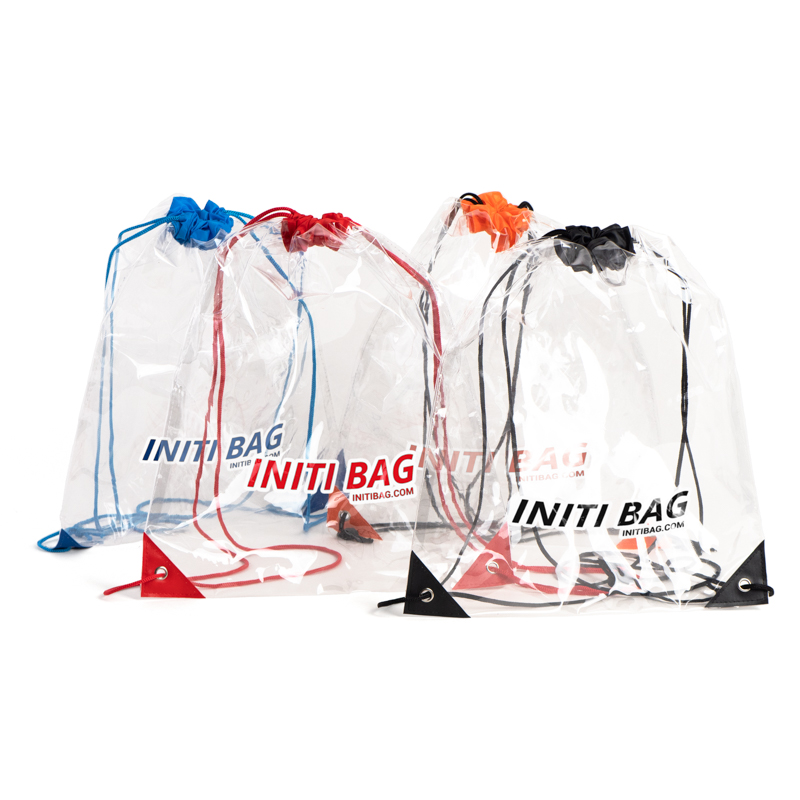
A clear PVC bag is a transparent bag made from flexible polyvinyl chloride (PVC) film or sheeting. Unlike an opaque fabric bag, it allows users to see the contents without opening it.
Clear PVC bags are commonly used for cosmetic packaging, retail shopping totes, travel organizers, promotional merchandise and event accessories. They range from small zippered pouches to larger transparent tote bags with reinforced handles.
Although these bags may look similar, their performance can differ significantly. A flexible cosmetic pouch and a structured shopping tote may require different film thicknesses, softness levels, seams and carrying systems.
For custom bag buyers, choosing the right PVC is not simply a matter of selecting the thickest material.
This guide explains how PVC became a bag-making material, the main uses of clear PVC bags, common film thicknesses, plasticizer specifications, manufacturing methods and custom options.
1. How Did PVC Become a Material for Bags?
PVC was discovered long before it became a practical material for handbags and packaging.
In 1872, German chemist Eugen Baumann documented the polymerization of vinyl chloride into a solid material later recognized as polyvinyl chloride. Earlier investigations of vinyl chloride and related compounds date back to the nineteenth century.
However, early PVC was difficult to process into flexible commercial products.
A major breakthrough occurred in 1926, when American chemist Waldo Semon began researching PVC at BFGoodrich while attempting to develop an adhesive for bonding rubber to metal.
His experiments helped establish methods for plasticizing PVC, transforming it from a difficult-to-process material into a flexible substance suitable for a much wider range of applications.
As PVC formulations and processing methods improved during the following decades, flexible PVC sheets became commercially practical.
Manufacturers could produce films and sheets with different levels of flexibility, thickness and appearance. These materials could then be cut, sewn, sealed or welded into finished products.
Transparent PVC created a particularly useful combination for bag manufacturers: a flexible sheet that could contain items while keeping them visible.
This made it suitable for protective covers, retail packaging, transparent organizers and fashion accessories.
Clear PVC bags were not the result of one identifiable invention. Their development followed advances in PVC formulation, flexible-film production and bag manufacturing.
Historical references:
2. What Is Clear PVC Material?
PVC stands for polyvinyl chloride, a synthetic polymer used in both rigid and flexible products.
Clear bags generally use flexible PVC film or sheeting. The material formulation is selected to provide a combination of transparency, softness, flexibility and processing characteristics.
Flexible PVC commonly contains plasticizers that make the polymer easier to bend and process.
Different formulations may have different surface appearances, hardness levels, temperature performance and chemical compliance requirements.
Therefore, clear PVC is a material category, not one fixed material specification.
Clear, Tinted and Frosted PVC
| Material Finish |
Appearance |
Typical Applications |
| Crystal clear PVC |
High visibility of contents |
Event bags, transparent totes, display packaging |
| Tinted transparent PVC |
Colored film with contents still visible |
Fashion bags, cosmetic packaging |
| Frosted / translucent PVC |
Diffused surface with reduced visual clarity |
Cosmetic pouches, beauty gift sets |
| Glossy clear PVC |
Reflective transparent surface |
Retail bags and promotional packaging |
| Matte translucent PVC |
Softer visual appearance with reduced reflection |
Selected organizers and lifestyle accessories |
Tinted transparent PVC and frosted PVC are not equivalent.
A tinted film may retain relatively clear visibility through the material, whereas a frosted surface reduces the detail visible inside.
For retail orders, the actual film swatch should be approved before production.
Is Clear PVC the Same as Clear Vinyl?
In the bag and packaging industry, clear vinyl commonly refers to flexible transparent PVC.
However, not all transparent plastic bags are made from PVC.
Materials such as TPU, EVA and PEVA can also be used for transparent products.
These materials have different formulations, processing requirements and performance characteristics.
Buyers should confirm the actual polymer rather than using clear plastic as the complete material specification.
3. What Are Clear PVC Bags Used For?
The main advantage of a clear PVC bag is visibility.
Users can identify the contents quickly, while brands can display products through the packaging.
The appropriate bag structure depends on how it will be used.
| Bag Type |
Typical Construction |
Main Applications |
| Clear PVC tote bag |
Transparent body, handles and optional gussets |
Retail, exhibitions and promotions |
| Transparent cosmetic bag |
Zipper opening and flat or gusseted body |
Makeup, skincare and beauty gift sets |
| Clear travel organizer |
Compact pouch with suitable compartments |
Toiletries and personal accessories |
| Clear stadium-style bag |
Transparent body designed for venue-specific requirements |
Sports events and concerts |
| Transparent beach tote |
Wide body and reinforced carrying handles |
Swimming and outdoor accessories |
| Clear gift packaging bag |
Visible contents with decorative details |
Branded product sets and promotional gifts |
| Transparent document pouch |
Flat construction and secure closure |
Documents and stationery |
Clear Cosmetic and Toiletry Bags
Transparent PVC is useful for cosmetic packaging because customers can identify the products inside.
Flat pouches can hold makeup brushes, small accessories and samples.
Gusseted cosmetic bags provide additional space for skincare bottles, tubes and product sets.
The bag's usable dimensions, zipper opening, film flexibility and edge finishing matter more than exterior dimensions alone.
Clear Tote and Shopping Bags
Transparent PVC totes are used for shopping, promotional merchandise, exhibitions and retail product presentation.
Common details include webbing handles, contrast binding, bottom gussets and optional closures.
Larger tote bags need appropriate reinforcement around the handles, seams and bottom.
Increasing PVC film thickness alone does not guarantee higher carrying strength.
Stadium and Event Bags
Some sports venues and event organizers require transparent bags.
For example, the NFL Stadium Clear Bag Policy permits certain clear plastic, vinyl or PVC bags measuring no more than 12 × 6 × 12 inches, approximately 30.5 × 15.2 × 30.5 cm.
However, this is not a universal stadium standard.
Requirements may differ by venue or event and may cover dimensions, opacity, pockets, bag styles and accessories.
A bag should only be advertised as meeting a specific venue's requirements after checking the applicable policy.
Travel and Security-Screening Pouches
Clear PVC pouches make it easier to identify toiletries and travel accessories.
They should not automatically be described as airport-security approved.
For instance, the US TSA liquids rule specifies a quart-sized, clear, resealable bag for applicable carry-on liquids.
A transparent cosmetic bag may be convenient for travel but may not meet that requirement.
Retail and Promotional Packaging
Transparent PVC can also be used when the contents are part of the product presentation.
Examples include skincare kits, branded accessories, promotional gift sets and seasonal retail merchandise.
A small printed logo, colored binding or branded insert may provide visual identity without covering too much of the transparent surface.
4. What Thickness Is Suitable for a Clear PVC Bag?
PVC film thickness affects flexibility, material consumption, finished weight and bag structure.
It is commonly expressed in millimeters (mm), micrometers (μm) or thousandths of an inch (mil).
Common PVC Film Thickness Ranges
The following ranges are practical starting points for discussing flexible PVC bag designs. They are not universal industry standards or guaranteed specifications for every product.
| PVC Thickness |
General Characteristics |
Possible Applications |
| 0.15–0.25 mm |
Relatively thin and flexible |
Small pouches and lightweight packaging |
| 0.25–0.40 mm |
Flexible with more body |
Cosmetic bags and gusseted organizers |
| 0.40–0.60 mm |
More substantial panel construction |
Selected transparent totes and structured accessories |
| Above 0.60 mm |
Thicker and potentially less flexible |
Specialty panels and selected structured designs |
Actual performance depends on PVC formulation, softness, panel dimensions and the overall bag construction.
For example, a soft 0.40 mm film may bend more easily than a firmer film of the same thickness.
A large tote made with 0.50 mm PVC still requires suitable handle attachments and reinforcement.
Millimeters, Microns and Mil
| Thickness |
Micrometers |
Approximate US Mil |
| 0.20 mm |
200 μm |
7.9 mil |
| 0.25 mm |
250 μm |
9.8 mil |
| 0.30 mm |
300 μm |
11.8 mil |
| 0.40 mm |
400 μm |
15.7 mil |
| 0.50 mm |
500 μm |
19.7 mil |
One US mil equals 0.001 inch, or exactly 0.0254 mm.
The term gauge may also appear in supplier specifications, but its meaning should be confirmed rather than assumed.
To avoid purchasing errors, buyers should specify film thickness in millimeters and agree on the acceptable tolerance.
How Does Plasticizer Content Affect PVC Softness?
Thickness and softness are different specifications.
In flexible PVC manufacturing, plasticizer content is often expressed in phr (parts per hundred resin).
For example, 40 phr means 40 parts by weight of plasticizer for every 100 parts of PVC resin.
When other formulation factors are comparable, higher plasticizer content generally produces a softer, more flexible PVC film.
However, plasticizer type, resin formulation and other additives also influence the finished material.
PHR is a formulation ratio, not a finished-film hardness measurement.
A supplier may use phr values alongside film samples, subjective flexibility descriptions or hardness measurements. Some commercial product codes also use a “P” designation, but these should not be treated as a universal hardness scale.
A cosmetic pouch may benefit from softer PVC for folding and zipper operation, while a structured tote may require firmer film or additional reinforcement.
There is no single phr range that guarantees suitability for either bag type.
For more detail, see Mississippi Polymers — What Is Hand?, which explains the distinction between PVC film feel, phr and hardness.
Does Thicker PVC Mean Better Quality?
Not necessarily.
Thicker PVC generally uses more material and can increase stiffness and weight.
It does not automatically improve scratch resistance, tear resistance, low-temperature flexibility or seam strength.
A thinner cosmetic pouch with properly designed seams may be more suitable for its intended use than a thicker bag with poor construction.
Buyers should therefore evaluate thickness, softness, seams, bag dimensions and carrying requirements together.
How Should Thickness Be Verified?
Buyers should specify nominal thickness and acceptable tolerance before production.
For applicable non-embossed film and sheeting, ISO 4593:1993 describes a thickness measurement method using mechanical scanning.
The method is not suitable for embossed film or sheeting.
Measurements should follow an agreed procedure rather than relying on vague descriptions such as heavy-duty clear PVC.
5. How Are Clear PVC Bags Manufactured?
Clear PVC bags can be manufactured using different cutting, joining and finishing processes.
The appropriate method depends on the bag design and material formulation.
Heat Sealing and High-Frequency Welding
Suitable PVC films can be joined using controlled heat-sealing or radio-frequency welding processes.
These methods can connect PVC panels without ordinary exposed stitching.
However, the result depends on film compatibility, processing conditions and seam geometry.
Welded seams should be evaluated against the intended performance requirements.
Welding alone does not establish that the completed bag is leakproof.
Sewn Construction and Edge Binding
Many transparent totes and cosmetic bags combine PVC panels with fabric binding, webbing handles, zippers and conventional stitching.
This supports a wide range of designs and decorative finishes.
However, stitching creates needle holes in the PVC film.
If seam placement or reinforcement is inadequate, stress may concentrate near these perforations.
For sewn PVC bags, seam allowances, stitch patterns, corner construction and handle attachments should be reviewed during sampling.
Gussets, Bases and Reinforcement
Flat pouches use a relatively simple construction and are easy to store.
Adding side or bottom gussets provides additional usable depth.
Larger totes may need bottom reinforcement, wider handles or stronger attachment structures.
The correct construction depends on the intended contents and carrying load rather than material thickness alone.
6. What Affects Transparency and Long-Term Appearance?
Transparent PVC is often selected partly for its appearance.
Visible surface defects can therefore reduce the presentation quality of the finished product even when the bag remains functional.
Clarity and Surface Consistency
Buyers should examine:
- Unwanted haze or cloudiness
- Scratches and pressure marks
- Bubbles or visible inclusions
- Uneven tint or color
- Distortion when viewing items through the film
- Unwanted sticking between contacting surfaces
These details are particularly important for cosmetic and retail packaging.
Material Odor
Flexible PVC may have an odor related to its formulation, processing or storage.
Odor alone cannot identify a restricted substance or establish noncompliance.
However, buyers can agree on an acceptable odor requirement and confirm chemical compliance through suitable documentation or testing.
Temperature and Sunlight Exposure
Some flexible PVC formulations may become stiffer at low temperatures or soften under excessive heat.
Extended heat or light exposure can also affect the appearance of certain materials.
The actual response depends on the selected PVC grade, plasticizer system and stabilizers.
For products intended for outdoor use, cold climates or prolonged retail display, the expected conditions should be defined during material selection.
Preventing Cold Cracking, Yellowing and Film Blocking
For custom clear PVC bags intended for different climates or long-distance shipping, three additional risks deserve attention.
Cold cracking
Flexible PVC can become stiffer or more brittle at low temperatures.
Suitable plasticizer systems can improve low-temperature flexibility, but performance depends on the complete formulation.
Where a specific temperature requirement applies, such as −15°C or −20°C, the target should be agreed upon and tested.
For applicable plastic sheeting no thicker than 1.00 mm, ASTM D1790-21 provides a method for evaluating brittleness temperature under specified impact conditions.
This test result should not be treated as a universal minimum operating temperature for the finished bag.
Yellowing and discoloration
PVC may discolor because of heat, light exposure or changes in its chemical structure.
Appropriate heat and light stabilizers can improve resistance, but they cannot guarantee that a transparent bag will never yellow.
Material grade, additive compatibility and expected exposure conditions should be considered together.
For a technical explanation, see ADEKA — Polymer Additives FAQ.
Film blocking during storage and shipment
Smooth PVC surfaces may cling to one another when exposed to unfavorable combinations of heat, pressure and storage conditions.
This phenomenon is commonly called blocking.
For printed bags, severe sticking may also create risks to the printed appearance when contacting panels are separated.
Compatible anti-blocking formulations, protective tissue or interleaving sheets, appropriate curing of printed surfaces and suitable packing methods can help reduce the risk.
The PVC Tech — Storage and Conditioning Guide discusses film blocking associated with extreme heat and humidity.
For export orders, these requirements should be evaluated using representative samples and practical packing conditions before bulk production.
Packing Marks and Creases
Glossy transparent PVC can show scratches, fingerprints and creases more visibly than many textured fabrics.
Although flat packing can reduce carton volume, excessive pressure or tight folding may damage the finished appearance.
For higher-value retail products, protective sheets, internal supports or alternative packing arrangements may be appropriate.
7. Are Clear PVC Bags Waterproof and Durable?
PVC film itself can resist liquid water, but the complete bag may contain openings, ordinary zippers or sewn seams.
An open-top clear PVC tote is not waterproof.
A cosmetic pouch with a conventional zipper should not be described as leakproof without appropriate construction and testing.
What Determines Durability?
| Performance Area |
What Buyers Should Evaluate |
| PVC film |
Resistance to tearing and puncture under intended use |
| Seams |
Consistency of stitching or welding |
| Handle attachment |
Strength with the expected carrying load |
| Zipper and closure |
Smooth operation and secure installation |
| Flexibility |
Changes after repeated bending or folding |
| Surface appearance |
Scratching, haze and deformation |
| Temperature performance |
Suitability for intended use and storage conditions |
| Packing performance |
Blocking, crease marks and appearance after unpacking |
A promotional gift pouch and a reusable shopping tote should not be assessed against identical load requirements.
For larger custom orders, finished-product acceptance criteria should be established using the approved sample and intended use.
8. What Custom Options Are Available for Clear PVC Bags?
Custom clear PVC bags can be developed through material selection, structural design, accessories and branding.
| Customization Area |
Available Options |
| PVC film |
Thickness, flexibility and formulation |
| Appearance |
Crystal clear, tinted, frosted, glossy or selected matte finishes |
| Bag dimensions |
Width, height, depth and usable opening |
| Structure |
Flat pouch, gusseted organizer, tote or fitted sleeve |
| Handles |
PVC handles, webbing or textile straps |
| Closure |
Zipper, snap, drawstring or open top |
| Edges |
Fabric binding, contrast trim or reinforced panels |
| Branding |
Screen printing, compatible UV printing, labels and patches |
| Packaging |
Flat packing, protective interleaving, individual sleeves or boxes |
Logo Printing on Clear PVC
Screen printing is an option for selected graphics when compatible inks and appropriate processing conditions are used.
UV printing and other decoration methods may also be considered.
Ink adhesion, surface appearance and rubbing resistance should be evaluated using the actual PVC film and production process.
For clear bags, large printed graphics can obscure the contents, making logo placement particularly important.
Choosing Color and Transparency
Crystal-clear PVC is suitable when visibility is the main requirement.
Tinted and frosted materials offer different retail appearances but may not satisfy venues requiring fully transparent bags.
For custom colors, film swatches should be approved under consistent lighting conditions.
Choosing the Right Bag Dimensions
External dimensions do not directly determine usable capacity.
For cosmetic bags, buyers should evaluate the actual dimensions of the products being packed.
For event bags, the venue's permitted external dimensions should guide the design.
For totes, handle drop, opening width and the loaded bag shape also affect usability.
Custom Packing for Wholesale Orders
Some clear PVC bags can be packed flat, but thicker or firmer films may develop creases when tightly compressed.
A practical packing trial should confirm:
- Units per carton and carton dimensions
- Protection between contacting film surfaces
- Printed-panel contact and surface appearance
- Creases or deformation after unpacking
- Bag shape after an appropriate recovery period
Packing efficiency should not come at the expense of unacceptable visual defects.
9. What Compliance Requirements Should Buyers Check?
Flexible PVC compliance depends on the material formulation, intended application and destination market.
A transparent appearance does not establish that the material is phthalate-free, suitable for food contact or compliant with children's product regulations.
Phthalates and EU REACH
Certain phthalate plasticizers are restricted under EU REACH Annex XVII.
Entry 51 addresses DEHP, DBP, BBP and DIBP under specified conditions.
For applicable articles and plasticized materials, the restriction includes a threshold of 0.1% by weight of the plasticized material, calculated for the listed substances individually or in combination, subject to the relevant provisions and exemptions.
For the original legal text, see Commission Regulation (EU) 2018/2005.
A general statement such as REACH compliant should be supported by documentation relevant to the actual product and destination market.
Food Contact and Children's Products
A normal clear PVC cosmetic or shopping bag should not be described as food-contact approved simply because its surface can be wiped clean.
Direct food-contact applications require a separate assessment of the relevant formulation and regulations.
Children's products may also be subject to additional chemical, mechanical and labeling requirements.
Recycled Content and Environmental Claims
PVC can be processed through suitable recycling systems, but not every local collection program accepts PVC bags.
Zippers, textile binding, printed surfaces and mixed materials can complicate recycling.
Claims such as recyclable, made from recycled PVC, phthalate-free or environmentally friendly should be supported by evidence appropriate to the material, finished product and market.
10. Frequently Asked Questions
Q1. What is a clear PVC bag made from?
A clear PVC bag is made from transparent polyvinyl chloride film or sheeting, typically using a flexible formulation. Its exact thickness, softness and chemical composition depend on the selected material grade.
Q2. What thickness should I choose for a clear PVC bag?
There is no universal thickness. Some lightweight pouches may use approximately 0.15–0.25 mm film, while larger or more structured bags may require thicker material. Film softness and the complete bag construction also affect the result.
Q3. Does a higher phr value always mean better flexibility?
Higher plasticizer content generally increases flexibility when other formulation factors are comparable. However, phr is not a universal hardness scale, and plasticizer type and other ingredients also matter.
Q4. Are clear PVC bags waterproof?
The PVC film resists liquid water, but openings, standard zippers and sewn seams can allow water to enter. A finished bag should not be described as waterproof without suitable construction and verification.
Q5. Can clear PVC bags be customized for stadiums, retail and cosmetic packaging?
Yes. Size, thickness, film formulation, transparency, handles, closures, logos and packaging can be customized. Requirements for specific venues or regulated applications must be verified before production.
Conclusion
Clear PVC bags developed through advances in polymer processing rather than a single invention of the transparent handbag.
Today, they are used for cosmetic organizers, retail totes, travel pouches, event accessories and promotional packaging.
Their main advantage is the combination of product visibility and flexible construction.
For buyers, PVC thickness is important, but it should not be selected independently from softness, formulation, seams, handle strength and packing requirements.
Where products are intended for demanding climates or long-distance export, cold flexibility, discoloration and film blocking also deserve attention.
The best clear PVC bag is not necessarily the thickest. It is the one that delivers the required appearance and function consistently under its intended use conditions.
Recommended Products: Clear PVC Bags for Different Applications
1. Clear PVC Tote Bag
A transparent tote with webbing handles, contrast edge binding and a gusseted body.
Suitable for: Retail promotions, exhibitions, events and transparent shopping bags.
Key considerations: Film thickness, handle reinforcement, seam design, gusset dimensions and branding.
View Clear PVC Tote Bag
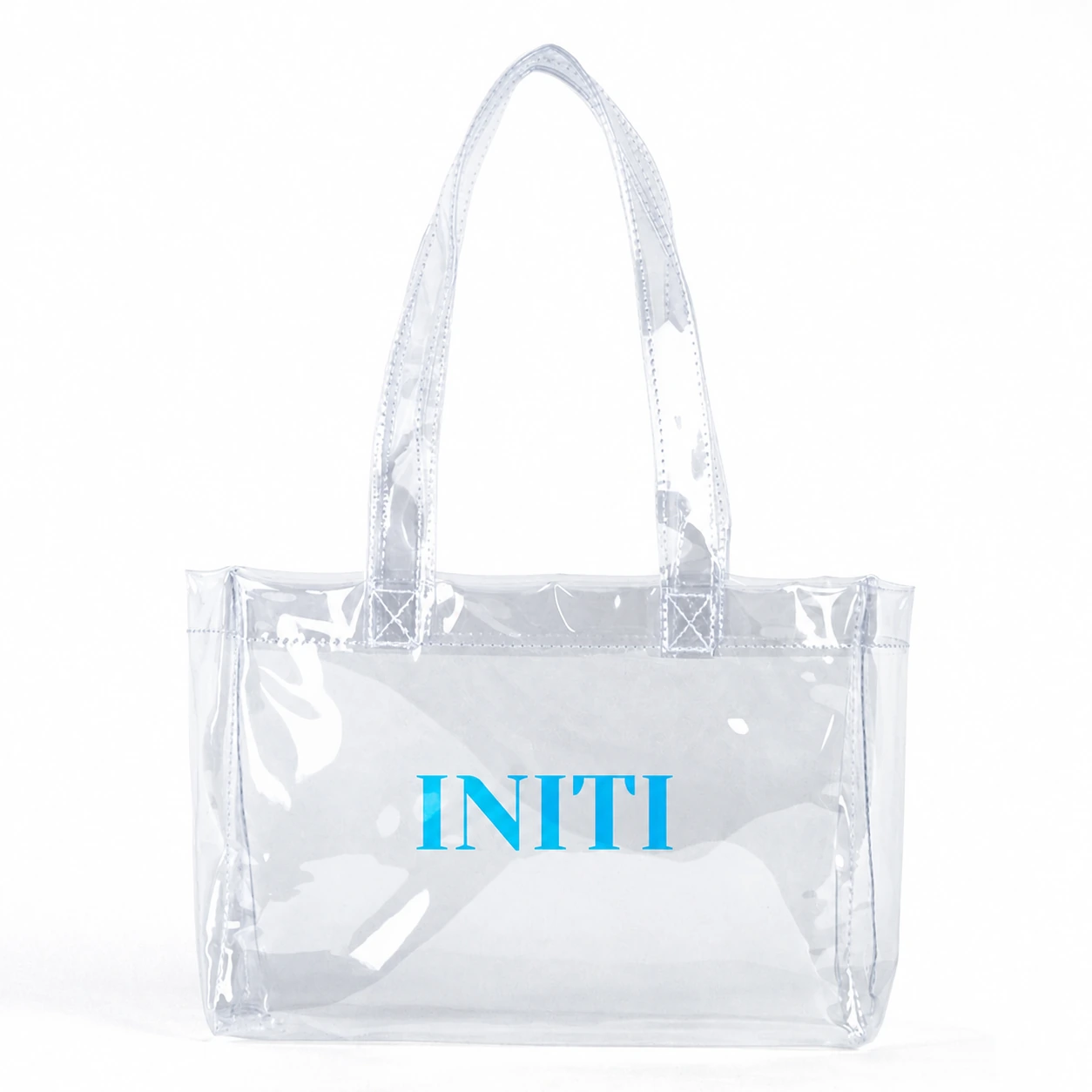
2. Custom Clear PVC Mini Tote Bag
A compact transparent tote with clear handles and side and bottom gussets.
The reference size is approximately 27 × 18 × 6 cm.
Suitable for: Cosmetic gift sets, small retail products, event kits and promotional packaging.
Key considerations: Product fit, film softness, handle construction, logo application and protective packing.
View Custom Clear PVC Mini Tote Bag
3. Tinted Clear PVC Cosmetic Pouch
A tinted transparent cosmetic organizer with a zipper opening, edge binding and gusseted construction.
Suitable for: Skincare sets, toiletries, travel accessories and branded beauty products.
Key considerations: Tint consistency, zipper opening, film flexibility, printing and edge finishing.
View Tinted Clear PVC Cosmetic Pouch
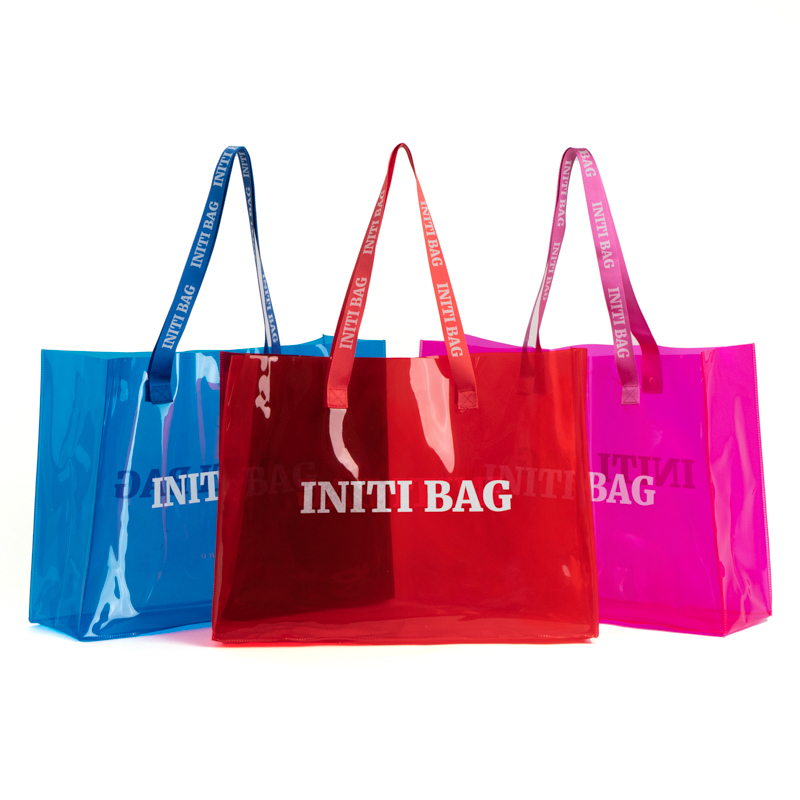
4. Transparent Colored PVC Tote Bag
A glossy translucent tote with colored PVC panels and contrasting webbing handles.
Suitable for: Fashion retail, promotional collections, beach accessories and branded shopping bags.
Key considerations: Transparency, color matching, handle strength, film thickness and surface decoration.
View Transparent Colored PVC Tote Bag
Explore additional designs in the PVC / Plastic Tote Bag Collection.
Inquiry Support
INITI has over 16 years of experience in OEM and ODM custom bag manufacturing, supporting retailers, cosmetic brands, importers and promotional product buyers.
Our team can assist with PVC film selection, thickness and softness options, transparent bag construction, printing, sample development, free design support and bulk production.
For custom projects, the appropriate formulation, compliance documentation and performance requirements can be reviewed according to the intended product and destination market.
For a fast quotation, email [email protected] with your bag type, dimensions, preferred material thickness, transparency requirements, logo artwork, estimated quantity and destination market.
Related Articles
References



 Hot News