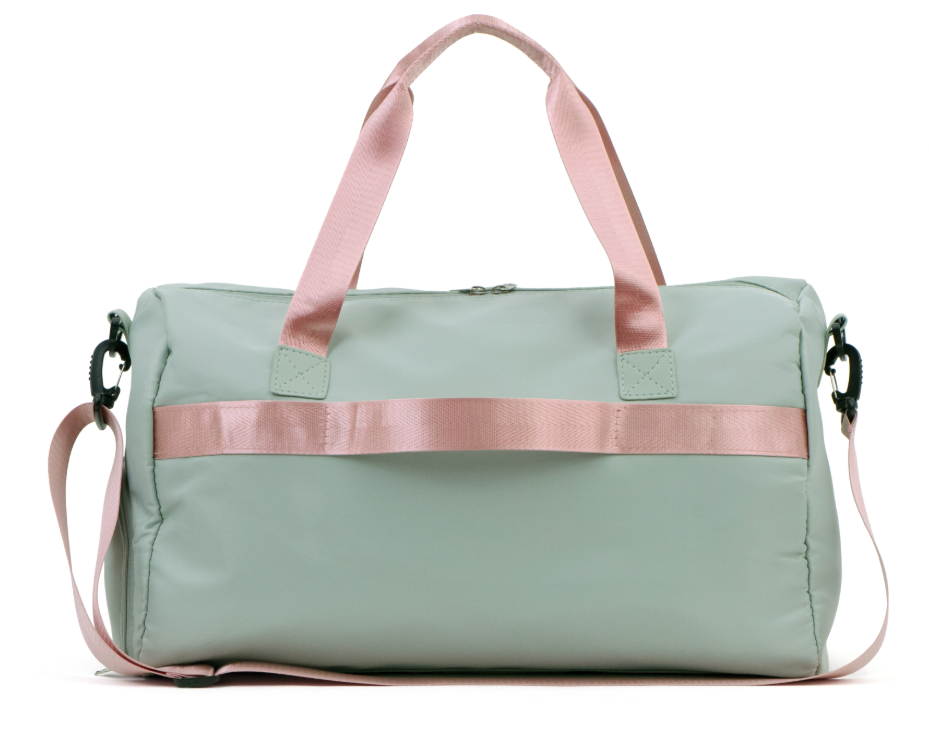
A sports duffel bag may look simple from the outside, but its performance depends heavily on how the internal space and load-bearing structure are designed.
For B2B buyers, four specifications deserve particular attention:
- Capacity
- Compartment layout
- Handle and shoulder strap construction
- Finished-bag load testing
These factors are interconnected. Adding a shoe compartment changes usable capacity. Increasing bag size increases stress on the handles. A wider shoulder strap improves comfort but does not automatically improve attachment strength.
For custom development, the complete structure should therefore be evaluated as one system.
1. How Much Capacity Does a Sports Duffel Bag Need?
Duffel bag capacity is normally expressed in liters, while production specifications are usually based on external dimensions:
Length × Width × Height
The two measurements should be used together.
A bag may have relatively large external dimensions but less usable internal capacity because space is occupied by:
- Shoe compartments
- Thick padding
- Internal dividers
- Side pockets
- Curved panels
- Reinforced bottom construction
General Capacity Reference
These are development references rather than fixed standards.
The correct capacity should be selected according to what the user actually needs to carry.
For example, a fitness bag may need space for:
- Sportswear
- Towel
- Shoes
- Water bottle
- Toiletries
- Small accessories
A team sports bag may need significantly more volume for uniforms, protective gear or multiple sets of clothing.
Do Not Specify Capacity Alone
“40 L sports bag” is not enough information for production.
The specification should also define:
- External dimensions
- Main compartment dimensions
- Shoe compartment dimensions
- Opening size
- Pocket depth
- Maximum intended load
For OEM development, testing the sample with actual target contents is usually more useful than relying on liters alone.
2. Main Compartment Design
The main compartment normally provides most of the usable volume.
For sports bags, buyers should pay attention to three points.
Opening Size
A wide top zipper allows clothing, towels and equipment to be packed more easily.
A bag may technically have enough capacity but still feel inconvenient if the zipper opening is too narrow.
The opening should therefore be evaluated using the largest expected item.
Bag Shape
Common sports duffel structures include:
- Rectangular duffel
- Cylindrical duffel
- Soft barrel shape
- Structured rectangular bag
A rectangular body generally uses internal space efficiently and is easier to divide into additional compartments.
Softer cylindrical designs may provide a more traditional sports appearance but can be harder to organize.
Bottom Structure
When heavier products are carried, the bottom panel becomes an important structural area.
Possible upgrades include:
- Double-layer fabric
- Additional reinforcement fabric
- PE or PP board
- Foam reinforcement
- Protective feet
- Abrasion-resistant base material
The required construction depends on the intended load and target retail positioning.
3. Which Compartments Are Actually Necessary?
Adding more pockets does not automatically create a better sports bag.
Every additional compartment adds:
- Material
- Zippers
- Sewing operations
- Pattern pieces
- Production time
- Potential failure points
The compartment structure should be based on actual use.
Main Compartment
Essential for clothing, towels and general sports equipment.
For most sports duffels, this should remain the largest storage area.
Shoe Compartment
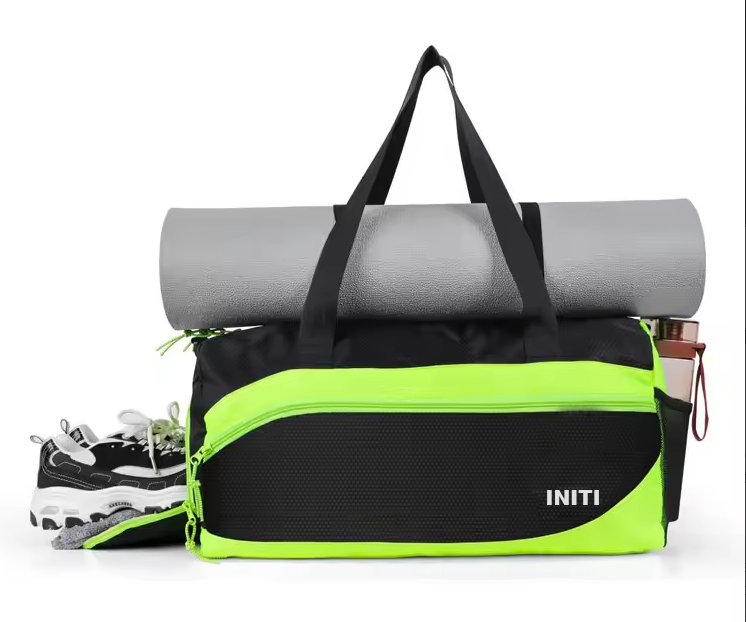
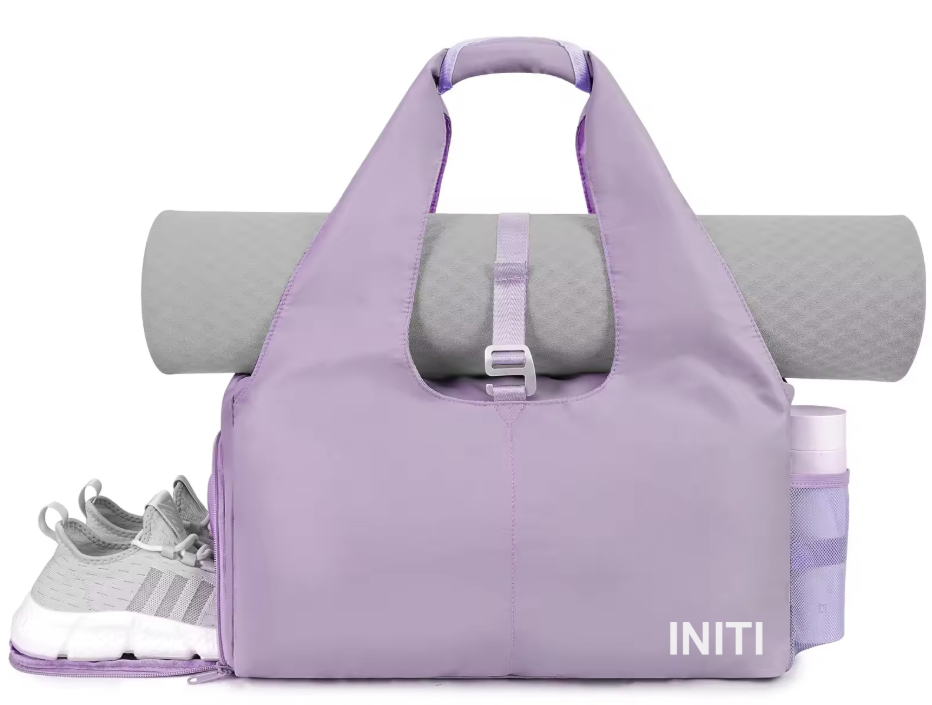
A separate shoe compartment is common in gym and sports bags because it isolates footwear from clean clothing.
Important specifications include:
- Shoe compartment length
- Opening size
- Maximum shoe size
- Ventilation
- Lining material
- Whether the compartment extends into the main storage area
This last point is particularly important.
A shoe compartment may look like an additional storage area from the outside but actually takes volume away from the main compartment when filled.
Buyers should therefore evaluate the bag with shoes inside.
Wet/Dry Compartment
A wet-storage compartment can be useful for:
- Swimming
- Gym towels
- Wet sportswear
- Outdoor training
The structure may use a coated lining or moisture-resistant material.
However, a “wet pocket” should not automatically be described as completely waterproof unless the seams, zipper and full compartment construction are designed and tested for water containment.
Side Zipper Pocket
Useful for:
- Keys
- Cards
- Headphones
- Toiletries
- Small accessories
It adds organization without substantially changing the internal structure.
Internal Pocket
An internal zipper or mesh pocket can help separate smaller valuables from clothing.
For many standard gym bags, one practical internal pocket is sufficient.
4. Compartment Layout Should Follow the User Journey
A useful way to design a sports duffel is to consider when each item is accessed.
For example:
Fast access
Phone, keys and cards should normally be placed in external or easily accessible pockets.
Main storage
Clothing and towels can remain inside the large central compartment.
Separated storage
Shoes and wet clothing may require isolated compartments.
This usually creates a more practical bag than simply adding several small pockets without a clear function.
For B2B buyers, the sample should therefore be evaluated by packing it exactly as the end user would.
5. Handle Construction
Sports duffel bags are frequently carried while heavily loaded, making the handles one of the most important structural components.
Common handle materials include:
- Polyester webbing
- Nylon webbing
- PP webbing
- Fabric-wrapped handles
The handle itself is only one part of the system.
The more important question is:
How is the handle connected to the bag body?
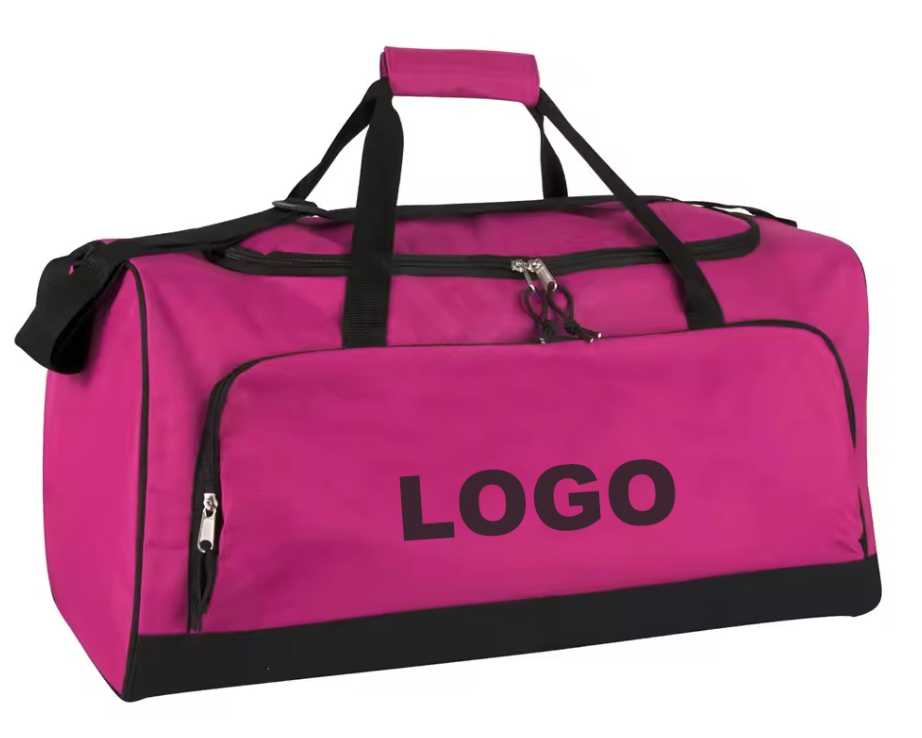
Short Handle Attachment
The webbing ends close to the upper panel.
This can work for lightweight sports bags but concentrates force in a relatively small area.
Extended Webbing
The webbing extends further down the body of the bag.
This distributes the carrying force over a larger area and is commonly used when higher carrying strength is required.
Full Wrap-Around Webbing
For some higher-load structures, webbing can extend around a larger portion of the body or underneath the bag.
This can provide stronger load distribution but increases:
- Webbing consumption
- Sewing time
- Weight
- Production cost
It is not necessary for every sports duffel.
6. Handle Reinforcement
Handle attachment points should normally receive more reinforcement than ordinary decorative seams.
Common methods include:
Bartack Stitching
Dense stitching is applied across a concentrated stress point.
It is commonly used around:
- Handle ends
- Shoulder strap tabs
- D-rings
- Webbing attachment points
Box Stitching
The attachment area is sewn in a rectangular pattern.
Box-X Stitching
A rectangular stitch pattern with diagonal reinforcement increases the stitched attachment area.
Reinforcement Patch
An additional layer of fabric or webbing can be added behind the attachment point.
Which method is appropriate depends on:
- Fabric strength
- Webbing width
- Bag size
- Intended load
- Number of fabric layers
- Target cost
A visually large stitch pattern is not automatically stronger if the base fabric itself tears.
7. Shoulder Strap Construction
A sports duffel shoulder strap normally includes:
- Webbing
- Length adjuster
- Hook
- D-ring or attachment loop
- Optional shoulder pad
All five components should be considered during development.
Strap Width
A wider strap distributes pressure over a larger area and can improve carrying comfort.
For heavier sports bags, buyers may consider:
- Wider webbing
- Thicker webbing
- Padded shoulder sections
Comfort and structural strength should be evaluated separately.
A wide padded strap may feel comfortable while still having weak hooks or weak attachment points.
Adjustable Length
The adjustment range should suit the intended user group.
The sample should be tested at:
- Shortest setting
- Mid setting
- Longest setting
The webbing should not easily slip through the adjuster under load.
Detachable vs Fixed Strap
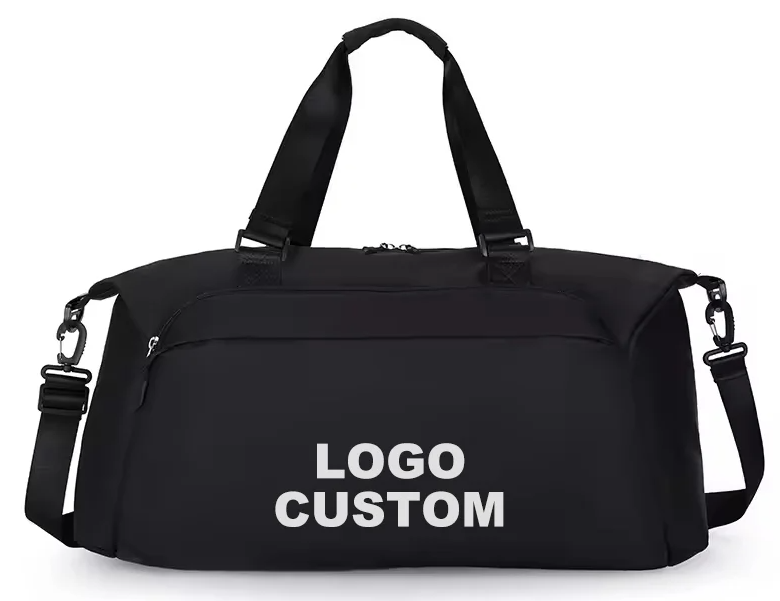
A detachable shoulder strap provides greater flexibility and is common in travel and sports duffels.
However, it introduces additional load-bearing components:
- Hooks
- D-rings
- Attachment tabs
Each component becomes part of the strength requirement.
Shoulder Pad
For medium or high-capacity bags, a shoulder pad can improve comfort.
Buyers should check whether the pad:
- Slides excessively
- Twists during use
- Has sufficient padding
- Remains comfortable under intended load
8. Hardware Must Match the Target Load
A strong shoulder strap is ineffective if the hook, buckle or D-ring fails first.
Common hardware includes:
- Plastic hooks
- Metal swivel hooks
- Plastic adjusters
- Metal adjusters
- Plastic D-rings
- Metal D-rings
Hardware selection should consider:
- Intended load
- Bag size
- Corrosion requirements
- Product positioning
- Weight
- Cost
Metal hardware may improve perceived quality but also increases product weight and cost.
High-quality plastic hardware can be appropriate for lightweight or mid-range sports bags.
The decision should be based on performance requirements rather than appearance alone.
9. Why Finished-Bag Load Testing Matters
Material specifications alone cannot determine whether a sports duffel is strong enough.
A supplier may use:
- Strong fabric
- Wide webbing
- Heavy zipper
- Metal hooks
but the bag can still fail at the seam joining these components together.
This is why load testing should be conducted on the finished bag, not only on individual materials.
10. Static Load Test
A static load test is one of the simplest methods for checking finished-bag construction.
The bag is filled to a defined weight and suspended or carried for a defined period.
The buyer should specify:
- Test weight
- Test duration
- Carrying method
- Handle or shoulder strap being tested
- Acceptable deformation
- Pass/fail criteria
After testing, inspect:
- Handle stitching
- Webbing
- Shoulder strap
- D-rings
- Hooks
- Bottom seams
- Side seams
- Zipper area
- Fabric around attachment points
Do not simply record whether the bag “did not break.”
Permanent stretching, seam opening or fabric distortion can also indicate that the structure needs improvement.
11. Repeated Lift Testing
Sports bags are normally carried repeatedly rather than suspended once.
A repeated lift test better represents this type of use.
The bag is loaded and repeatedly:
- Lifted
- Suspended
- Lowered
The cycle quantity and load should be defined according to the project.
This can reveal problems such as:
- Progressive stitch failure
- Webbing movement
- Strap adjuster slipping
- Hook deformation
- Fabric tearing around handle attachments
These problems may not appear during a short static test.
12. Shoulder Strap Pull Testing
The shoulder strap system should be evaluated separately because it introduces several additional connection points.
The test should include:
- Strap webbing
- Hooks
- D-rings
- Attachment tabs
- Reinforcement stitching
Inspect whether:
- Hooks open or deform
- D-rings rotate excessively
- Webbing slips through adjusters
- Stitching breaks
- Fabric tears around attachment areas
For detachable straps, both ends should be tested.
13. Loaded Drop Testing
For products designed for heavier sports equipment, a loaded drop test can also be useful.
The finished bag is loaded and dropped from a defined height according to the buyer's testing protocol.
Typical inspection areas include:
- Bottom panel
- Bottom corners
- Zipper
- Side seams
- Handle attachments
- Hardware
This type of test helps identify sudden-impact failures that may not appear during static loading.
There is no single load-test value that is correct for every sports duffel.
The test should be developed around the actual intended carrying weight and use scenario.
14. Capacity and Load Rating Are Not the Same Thing
This is an important purchasing distinction.
A 50-liter bag does not automatically carry more weight safely than a 30-liter bag.
Capacity measures space.
Load performance depends on:
- Fabric
- Seam construction
- Webbing
- Reinforcement
- Hardware
- Bottom construction
- Bag geometry
A large lightweight promotional duffel may have high volume but a relatively low intended carrying load.
A smaller technical sports bag may be engineered for heavier equipment.
For this reason, both capacity and intended load should appear in the product development specification.
Recommended Sports Duffel Specification Sheet
| Specification |
Information to Confirm |
| Intended Use |
Gym / training / team sports / travel |
| External Size |
Length × width × height |
| Target Capacity |
Approximate liters |
| Main Compartment |
Size and opening |
| Shoe Compartment |
Yes / no + shoe size |
| Wet/Dry Compartment |
Yes / no |
| External Pockets |
Quantity and location |
| Internal Pockets |
Quantity and structure |
| Carry Handles |
Webbing material, width and length |
| Handle Attachment |
Standard / extended / reinforced |
| Shoulder Strap |
Fixed / detachable / adjustable |
| Shoulder Pad |
Yes / no |
| Hardware |
Plastic / metal |
| Bottom Reinforcement |
Required / not required |
| Intended Load |
Target carrying weight |
| Static Load Test |
Weight + duration |
| Repeated Lift Test |
Load + number of cycles |
| Logo |
Method and position |
| Packaging |
Bulk / individual / retail |
This gives the factory much clearer development information than requesting only a “large durable sports duffel bag.”
Common Specification Mistakes
Choosing Capacity Before Defining Contents
Start with the actual equipment users need to carry, then determine dimensions and capacity.
Adding Too Many Compartments
Extra pockets increase cost and reduce main-compartment efficiency.
Ignoring Shoe Compartment Volume
A shoe compartment often occupies space inside the main body when loaded.
Focusing Only on Webbing Thickness
Handle strength also depends on attachment design, stitching and base fabric.
Using Premium Hardware Without Reinforcing the Bag
A heavy metal hook does not improve performance if the surrounding fabric remains weak.
Asking Only “How Many Kilograms Can It Hold?”
A meaningful load claim should specify test weight, test method, duration or cycles and pass criteria.
FAQ
What capacity is suitable for a standard gym duffel bag?
Around 20–45 liters covers many general gym and sports applications. Larger capacities may be required for team equipment, shoes, bulky clothing or weekend travel.
Should a sports duffel include a separate shoe compartment?
It depends on the target user. Shoe compartments are useful for gym, team and travel products, but they increase construction complexity and may reduce usable main-compartment volume.
Are wider shoulder straps stronger?
Not necessarily. Width can improve comfort and distribute pressure, but strength also depends on webbing quality, hooks, D-rings, stitching and attachment reinforcement.
What is the best handle reinforcement method?
Bartack, Box-X stitching, reinforcement patches and extended webbing are common options. The correct method depends on material, bag size and intended load.
How should a sports duffel bag be load tested?
The finished bag should be tested under a defined load using procedures such as static suspension, repeated lifting, strap pull testing or loaded drop testing. The protocol should reflect the intended real-world use.
Conclusion
A reliable custom sports duffel specification should not stop at fabric and dimensions.
Buyers should define four connected areas:
- Capacity — based on actual contents rather than liters alone
- Compartments — designed around real storage requirements
- Strap construction — including webbing, reinforcement and hardware
- Load testing — performed on the complete finished bag
For OEM/ODM projects, the most effective approach is to pack and test the approved sample under the same conditions expected from the final product.
Inquiry Support
For a custom sports duffel bag project, provide:
- Intended use
- Target capacity or dimensions
- Estimated quantity
- Required compartments
- Shoe or wet/dry storage requirements
- Expected carrying load
- Handle and shoulder strap preference
- Logo artwork
- Packaging requirements
If the full specification has not been finalized, you can first provide the intended contents and target quantity, and we can recommend a suitable bag structure.
Related Products



 Hot News