Cotton Aprons vs Polyester Aprons: Which Material Is Better for Commercial Use?
For commercial aprons, there is no single best material.
The right choice depends on how the apron will actually be used and washed:
Choose cotton when comfort, natural texture and a premium workwear appearance matter most.
Choose polyester when quick drying, wrinkle resistance and easy daily maintenance are the priorities.
Choose poly-cotton when the apron needs to balance comfort with frequent commercial laundering.
For restaurants, cafés, bakeries, catering companies and retail programs, fabric composition is only the starting point. GSM, weave, finishing and the finished apron structure also affect performance.
Quick Comparison
| Factor |
Cotton |
Polyester |
Poly-Cotton |
| Hand Feel |
Softer, natural |
Smoother, more synthetic |
Balanced |
| Breathability |
Generally better |
Generally lower |
Between the two |
| Moisture Absorption |
Higher |
Low |
Moderate |
| Drying Speed |
Slower |
Faster |
Faster than cotton |
| Wrinkle Resistance |
Lower |
Better |
Good |
| Shrinkage Risk |
Higher if not controlled |
Low |
Lower than cotton |
| Natural / Premium Look |
Strong |
More functional |
Versatile |
| Frequent Washing |
Requires more attention |
Practical |
Very practical |
| Heavy Canvas Options |
Common |
Less common |
Available |
| Sublimation |
No |
Yes, on suitable polyester |
Depends on composition |
| Best Fit |
Cafés, retail, premium workwear |
Promotions, events, easy-care uniforms |
Restaurants, catering, hospitality |
Quick Decision Guide
Front-of-House / Brand-Focused Use
→ Cotton, cotton canvas or cotton-rich blend
A good starting point when comfort, natural texture and appearance are important.
Restaurants / Catering with Frequent Laundering
→ Poly-cotton, commonly 65% polyester / 35% cotton
Useful when dimensional stability, wrinkle resistance and easier maintenance matter.
Promotional Events / High-Turnover Programs
→ Lightweight polyester
Practical when low weight, quick drying, compact packing and cost control are priorities.
Heavy Grease / Demanding Laundry Programs
→ Poly-cotton or polyester with an appropriate soil-release finish
The actual wash and drying program should be confirmed before bulk production.
Open Flame / High-Heat Hazard
→ Do not select the apron by cotton/polyester ratio alone.
A normal commercial apron should not be treated as heat- or flame-protective PPE.

When Is Cotton the Better Choice?
Cotton works particularly well when the apron is visible to customers and contributes to the overall brand presentation.
Typical applications include:
Its main advantages are natural hand feel, absorbency and appearance.
Cotton also works well with:
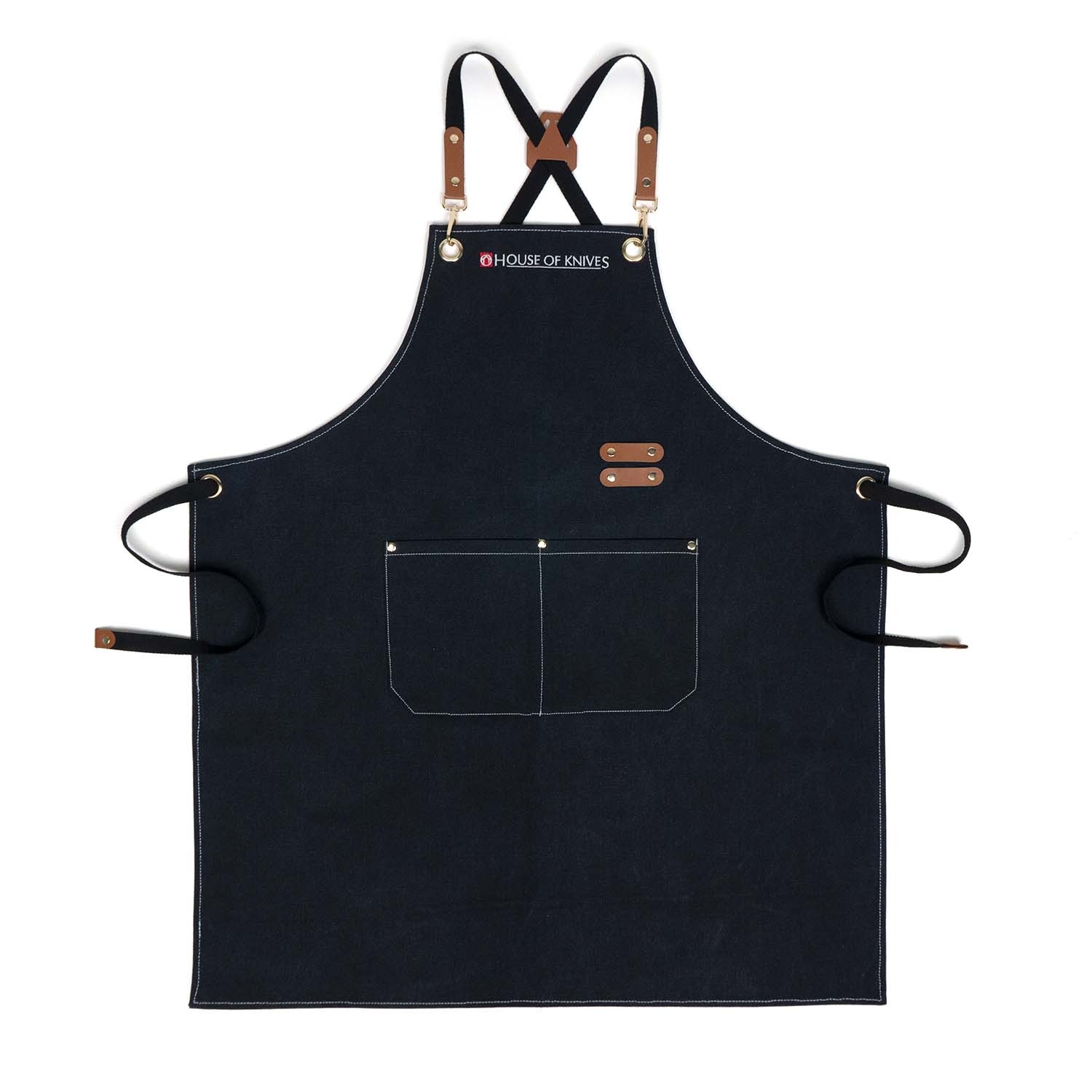
For barista or workwear-style aprons, cotton canvas can create a more substantial appearance and provide enough body for pockets and hardware.
However, heavier does not automatically mean better.
A heavy canvas apron may look premium but feel hot or tiring during a long indoor shift. Fabric weight should therefore match the working environment.
Where Cotton Requires More Attention
Compared with polyester, cotton generally needs more attention to:
Shrinkage
Wrinkling
Drying time
Dimensional stability
For commercial orders, pre-production wash testing is important, particularly when the apron will be laundered frequently.
A buyer should confirm how the actual fabric behaves after repeated washing rather than assuming that all 100% cotton aprons will perform the same way.
When Is Polyester the Better Choice?
Polyester is often the more practical option when operational efficiency matters more than natural hand feel.
It is commonly suitable for:
Polyester absorbs relatively little moisture, so it generally dries faster than cotton. It also provides good dimensional stability and wrinkle resistance.
For organizations managing large numbers of uniforms, this can mean:
But polyester is not automatically the most durable option.
A lightweight promotional polyester apron and a heavy cotton canvas apron are completely different products. Finished durability also depends on:
GSM
Fabric construction
Stitching
Pocket attachment
Strap construction
Reinforcement
Washing conditions
Why Poly-Cotton Is Often the Practical Commercial Choice
For restaurants, hotels and catering programs, a poly-cotton blend is often worth comparing before choosing either 100% cotton or 100% polyester.
A 65% polyester / 35% cotton twill is a common composition in commercial workwear and apron programs. Current industrial-laundry apron products use this combination together with soil-release finishes because it offers a useful balance of easy care, dimensional stability and cotton content.
It should not be treated as a mandatory industry standard, but it is a good sampling starting point for many commercial uniform projects.
Cotton-rich blends can also be considered when a softer, more natural hand is preferred.
The blend ratio should follow the requirement:
More polyester → easier care and dimensional stability
More cotton → more natural hand and absorbency
The weave, GSM and finish still matter.
Commercial Laundering: Check the Actual Wash Program
“Commercial use” does not automatically mean every apron will be washed at the same temperature.
Laundry programs vary by:
Restaurant or hotel
Soil level
Detergent system
Fabric
Logo method
Drying process
Some commercial 65/35 poly-cotton aprons are designed specifically for industrial laundry while specifying warm machine washing and low-temperature tumble drying, showing why material selection should follow the actual care program rather than a universal temperature rule.
For Cotton
Pay attention to:
Shrinkage control
Color change
Creasing
Drying conditions
If dimensional consistency is important, the fabric should be tested under the buyer's expected laundering conditions before bulk production.
For Polyester and Poly-Cotton
These materials generally offer better dimensional stability and faster drying, but the complete apron still needs to match the intended washing and drying temperatures.
This becomes particularly important when the apron includes:
Printed logos
PU patches
Coatings
Contrast fabrics
Special hardware
The care requirement should be evaluated for the finished apron, not just the base fabric.
What About Grease and Stains?
It is too simple to say:
Polyester is stain-resistant.
Polyester absorbs relatively little water, which can be useful for some spills, but oily soils can behave differently on synthetic fibers.
Cotton absorbs more liquid into the fiber, while polyester may retain certain oily soils more strongly.
For kitchen or food-service aprons exposed to grease, the better solution may be to consider:
Commercial poly-cotton aprons are commonly available with soil-release finishes, which is a useful indication that fiber choice and finishing should be considered together.
Cotton vs Polyester by Commercial Use
| Application |
Recommended Starting Point |
Main Reason |
| Barista / café |
Cotton canvas / cotton-rich blend |
Natural appearance and hand feel |
| Bakery |
Cotton / poly-cotton |
Comfort with easier maintenance |
| Premium restaurant |
Cotton / blend |
Refined textile appearance |
| High-volume restaurant |
Poly-cotton |
Wash-and-wear balance |
| Catering |
Poly-cotton / polyester |
Faster turnaround |
| Promotional event |
Polyester |
Lightweight and easy care |
| Florist |
Cotton canvas / blend |
Structure and workwear styling |
| Barber / salon |
Polyester / blend |
Easy maintenance |
| Workshop |
Cotton canvas |
Substantial workwear construction |
| Retail staff |
Polyester / poly-cotton |
Consistent uniform appearance |
These are starting points, not fixed material rules.
Cotton Is Not the Same as Canvas
This distinction matters when requesting quotations.
Cotton is a fiber.
Canvas is a fabric construction.
A canvas apron can be made from:
Cotton
Polyester-cotton blends
Other suitable fibers
So specifying:
“canvas apron”
does not completely define the material.
A buyer may also need to confirm:
Fiber composition
GSM or oz weight
Weave
Finish
Color
This is particularly important when comparing quotations from different suppliers.
Which Material Is Better for Logo Customization?
Both materials support customization.
Cotton
Common options include:
Screen printing
Embroidery
Heat transfer
Woven labels
Patches
Cotton and cotton canvas work particularly well for brands seeking a more natural or workwear-style appearance.
Polyester
Common options include:
Polyester can be particularly useful for promotional projects requiring detailed full-color graphics.
The printing method should be selected according to the actual fabric, logo, wash requirement and order quantity—not fiber content alone.
One Important Safety Limitation
A standard cotton, polyester or poly-cotton apron should not automatically be described as:
Flame resistant
Heat resistant
Protective PPE
If staff will work around significant open flame, sparks or industrial heat, the apron requires a material and performance specification designed for that environment.
Increasing GSM or switching from polyester to cotton does not by itself create a protective apron.
What Should Buyers Specify Before Ordering?
A useful commercial apron RFQ should answer:
| Item |
What to Specify |
| Application |
Café, restaurant, bakery, catering, retail, workshop |
| Apron Style |
Bib, waist, cross-back |
| Wear Time |
Short event or full shift |
| Laundry |
Washing frequency and intended wash process |
| Material |
Cotton, polyester, poly-cotton, canvas |
| Fabric Weight |
Preferred GSM / oz if known |
| Pockets |
Quantity, dimensions and purpose |
| Branding |
Print, embroidery, patch |
| Color |
Standard or Pantone requirement |
| Quantity |
Estimated order quantity |
If the material is not finalized, intended use + washing frequency + desired appearance are more useful starting points than simply asking for “a cotton apron.”
FAQ
Is cotton or polyester better for restaurant aprons?
For restaurants with frequent uniform washing, polyester or poly-cotton is often the more practical starting point. Cotton is attractive when comfort and a more natural appearance take priority.
Is 65/35 poly-cotton good for commercial aprons?
Yes. 65% polyester / 35% cotton twill is a common commercial workwear combination and is worth sampling when the apron needs easy maintenance together with some cotton content. It is not the only suitable ratio.
Is cotton better for barista aprons?
Often, but not always. Cotton canvas works well where a structured, natural workwear appearance is desired. A lighter cotton or cotton-rich blend may be more comfortable for long shifts.
Which apron fabric dries fastest?
Polyester generally dries faster than cotton because it absorbs much less moisture. Poly-cotton usually falls between the two.
Which material is best for greasy commercial kitchens?
Do not choose on fiber alone. Poly-cotton or polyester with a suitable soil-release finish can be a useful starting point, but the actual laundry program and finished apron should be tested.
Conclusion
The best commercial apron material depends on how the apron will be worn and maintained.
Choose cotton for comfort, natural texture and premium presentation.
Choose polyester for quick drying, wrinkle resistance and easy-care programs.
Choose poly-cotton when frequent commercial use requires a balance between the two.
For bulk orders, the most useful comparison is not simply:
Cotton vs polyester?
It is:
Which fabric construction, weight, blend and finish performs best under our actual working and washing conditions?
That is the specification worth testing before production.
Inquiry Support
For a custom apron project, you can provide:
If you have not finalized the material, send us the intended use, washing requirements and target quantity, and we can recommend suitable fabric directions for sampling.
Related Products
Related Blog Articles



 Hot News