How to Choose the Right Felt Thickness (2mm vs 3mm vs 4mm) for Custom Bags
Choosing felt for a custom bag is not simply a matter of selecting the thickest material available.
A thicker felt generally gives the bag more body and shape retention, but it also adds material, bulk and stiffness. A thinner felt is lighter and easier to fold, but large panels may lose their shape more easily.
For most projects, the practical starting point is:
| Felt Thickness |
General Character |
Good Starting Point For |
| 2mm |
Flexible, light, easier to fold |
Small bags, pouches, inserts, lightweight totes |
| 3mm |
Balanced structure and flexibility |
Shopping totes, wine bags, general-purpose felt bags |
| 4mm |
Firmer and more structured |
Organizers, larger totes, bottle carriers, structured sleeves |
The important point is that thickness is only one part of the specification.
A dense 3mm felt can feel firmer and hold its shape better than a softer 4mm felt. Bag dimensions, material density, handle design, bottom construction and expected load all affect the final result.
Quick Answer: 2mm, 3mm or 4mm?
Choose 2mm felt when you want:
Choose 3mm felt when you want:
A more defined bag shape
A balance between stiffness and flexibility
A practical starting point for medium-size totes, wine bags and storage bags
Choose 4mm felt when you want:
If you are unsure between two thicknesses, do not decide from the millimeter number alone. Compare actual material swatches or finished samples.
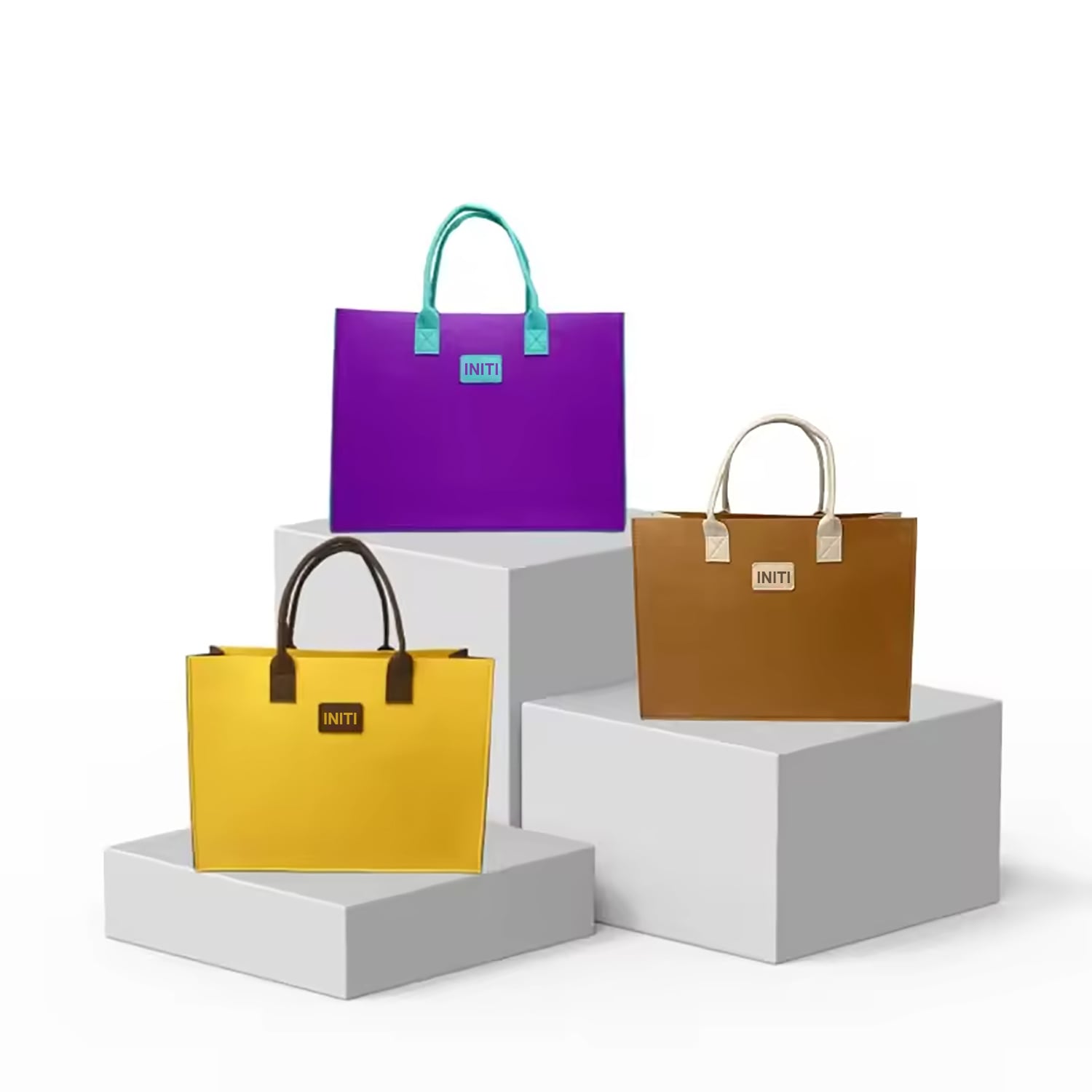
2mm vs 3mm vs 4mm Felt: Practical Comparison
| Factor |
2mm Felt |
3mm Felt |
4mm Felt |
| Flexibility |
High |
Medium |
Lower |
| Shape Retention |
Lower |
Good |
Higher |
| Foldability |
Good |
Moderate |
Lower |
| Cushioning |
Light |
Moderate |
Higher |
| Finished Bulk |
Low |
Medium |
Higher |
| Seam / Edge Bulk |
Lower |
Moderate |
Higher |
| Packing Efficiency |
Better |
Balanced |
Lower |
| Small Bag Suitability |
Very good |
Good |
Often unnecessary |
| Large Structured Bag Suitability |
Limited without reinforcement |
Good for many designs |
Better when extra rigidity is needed |
| Typical Development Direction |
Lightweight |
General purpose |
Structured |
This table assumes comparable felt composition and density.
It should not be interpreted as a fixed performance standard.
2mm Felt: For Lightweight and Flexible Designs
2mm felt works well when the product does not need strong self-supporting structure.
Typical applications include:
Its main advantage is efficiency.
The material is relatively easy to:
That can be useful for large promotional orders where carton volume matters.
But size changes the result.
A small 2mm pouch can feel perfectly structured, while the same felt used on a large 45–50 cm shopping tote may produce soft side panels and a sagging base.
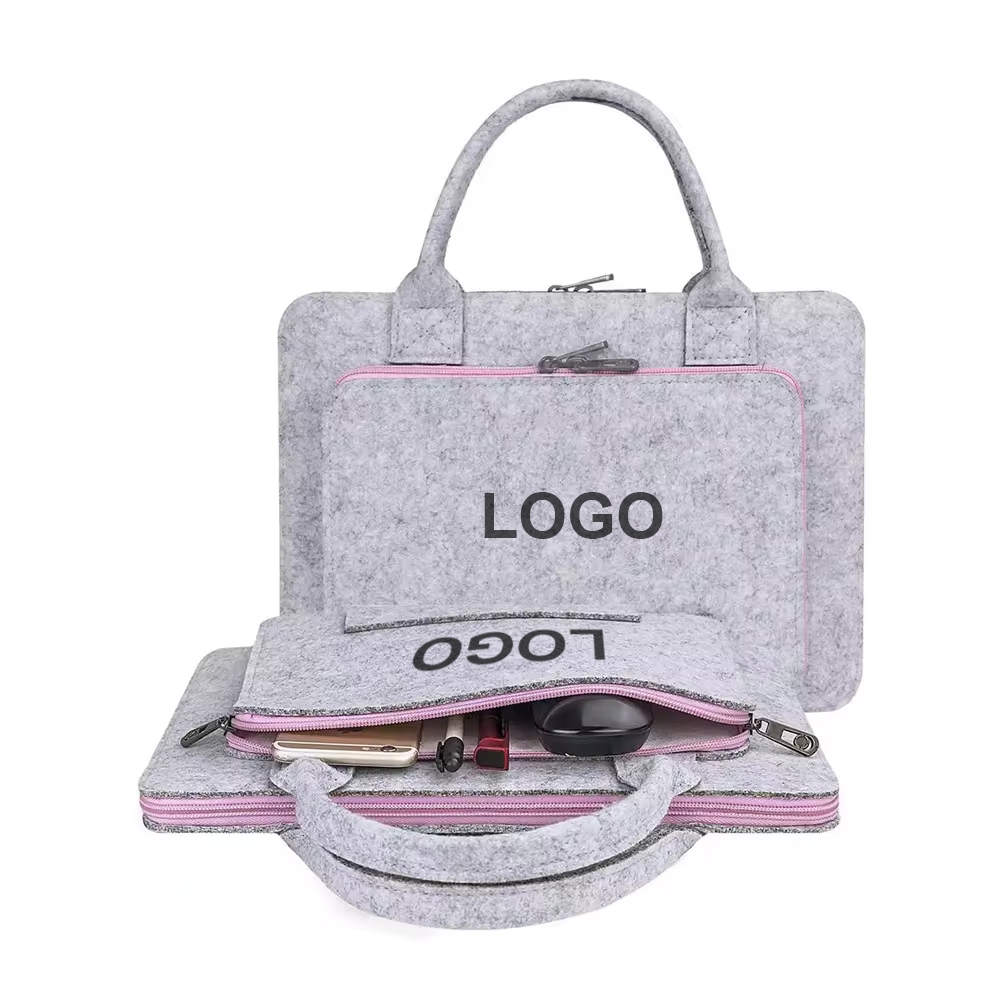
When 2mm starts becoming a problem
Be more cautious when the bag has:
In these cases, moving to 3mm or reinforcing specific areas may give a better result.
3mm Felt: A Balanced Starting Point for Many Bags
3mm is useful for many medium-size custom bag projects because it provides noticeably more body than 2mm without becoming excessively bulky.
Common applications include:
For a medium-size felt tote, a suitable 3mm material can provide enough stiffness to create a clean silhouette while still allowing the bag to flex during use and packing.
But this depends on the material itself.
Two suppliers can both offer “3mm polyester felt” and deliver noticeably different results.
One may feel:
while another feels:
That is why specifying only 3mm felt is not enough for repeat production.
4mm Felt: When the Bag Really Needs More Structure
4mm felt becomes useful when panel stiffness and shape retention are important to the product.
Typical applications include:
A firmer material can help larger side panels remain more upright and can provide additional cushioning between products.
However, 4mm also creates new manufacturing considerations.
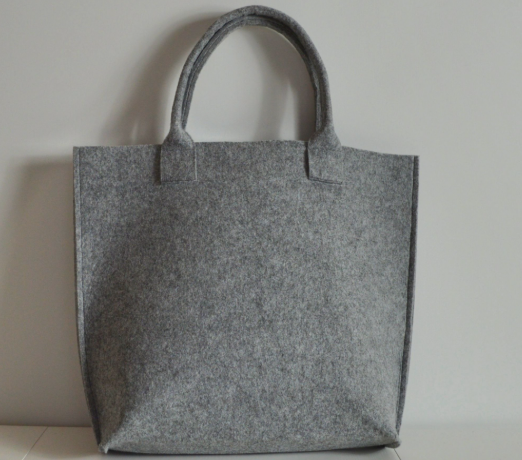
More Thickness Means More Bulk at the Seam
A 4mm sheet may not sound dramatically thicker than 3mm, but a seam can contain several overlapping layers.
For example:
Body panel
Gusset
Handle reinforcement
Folded construction
can create a much thicker sewing area.
This may affect:
Corner appearance
Stitch consistency
Hardware installation
Foldability
Carton packing
For that reason, 4mm should have a functional purpose. It should not be selected simply because it sounds more premium.
Thickness and GSM Are Not the Same Specification
This is one of the most important points for felt sourcing.
Thickness tells you the physical depth of the material.
GSM tells you how many grams one square meter of the material weighs.
They are related to material construction, but there is no universal rule such as:
2mm = X GSM
3mm = Y GSM
4mm = Z GSM
Different fiber structures and densities can produce different GSM values at the same thickness.
For example, two 3mm felt samples can have different:
Weight
Firmness
Surface texture
Compression resistance
Shape retention
So a buyer should not approve felt based on thickness alone.
A better specification includes:
Fiber composition + thickness + GSM + firmness/density + color + approved physical sample
For repeat orders, retaining an approved material sample is often more useful than relying only on written numbers.
Why Density Matters as Much as Thickness
Consider two materials:
Sample A
4mm thick
Soft construction
Lower density
Sample B
3mm thick
Firmer construction
Higher density
If the goal is a tote that maintains a clean shape, Sample B may perform better.
This is why the question should not be:
Should I choose 3mm or 4mm?
It should be:
What combination of thickness and stiffness gives this particular bag the structure it needs?
That difference prevents unnecessary material upgrades.
Which Thickness Works for Different Bag Types?
Use these as development starting points, not fixed industry standards.
| Bag Type |
Practical Starting Point |
What Matters Most |
| Small pouch |
2mm |
Flexibility and low bulk |
| Small gift bag |
2–3mm |
Presentation and bag dimensions |
| Lightweight tote |
2–3mm |
Size and expected contents |
| Shopping tote |
Around 3mm |
Shape retention and handle structure |
| Large structured tote |
3–4mm |
Panel size and bottom support |
| Single wine bag |
2–3mm |
Bottle fit and handle construction |
| Multi-bottle carrier |
3–4mm |
Dividers, bottom and loaded stability |
| Laptop sleeve |
3–4mm |
Fit, stiffness and cushioning requirement |
| Storage organizer |
3–4mm |
Upright side walls and bottom shape |
The larger the unsupported panel becomes, the more important material stiffness becomes.
That is why a thickness that works for a small gift bag may not work for a large organizer.
Do Not Use Felt Thickness as a Load-Capacity Rating
A common mistake is assuming that:
4mm felt carries more kilograms than 3mm felt.
That is too simplistic.
The load capacity of a finished bag can be limited by:
Handle attachment
Stitching
Die-cut handle openings
Bottom seams
Corners
Bag proportions
Reinforcement
rather than the main felt panel.
A poorly designed 4mm bag can fail earlier than a well-constructed 3mm bag.
For bags carrying heavier products, evaluate the complete structure and test the finished bag under load.
Die-Cut Felt Handles Need Extra Attention
Felt totes are often designed with the handle opening cut directly into the main panel.
This creates a clean appearance and reduces additional components, but it also concentrates load around the cutout.
Potential problems include:
The result depends on:
Simply moving from 3mm to 4mm does not automatically solve a poor handle design.
For heavier applications, stitched felt handles, webbing handles or reinforced handle areas may provide a better load path.
Sometimes Reinforcement Is Better Than Using Thicker Felt
This is one of the most useful ways to control product weight and cost.
Suppose a 3mm tote looks good overall but the bottom sags when loaded.
Changing the entire bag to 4mm increases:
Material consumption
Finished weight
Packing volume
but the real problem is concentrated at the base.
A better solution may be:
Bottom reinforcement
Add a separate base panel or removable bottom insert.
Handle reinforcement
Strengthen only the areas receiving lifting force.
Divider reinforcement
Use firmer material where bottles or products need separation.
Localized padding
For laptop sleeves, add cushioning where required rather than making every panel unnecessarily thick.
Good product development strengthens the area that needs help instead of simply increasing every material specification.
Felt Thickness for Laptop Sleeves
Laptop sleeves are a good example of why thickness should match function.
Moving from 2mm to 4mm generally creates:
More body
More cushioning
Firmer panels
but felt thickness alone does not make a sleeve shockproof.
If impact protection is required, the construction may also need:
Foam
Lining
Reinforced corners
Appropriate closure
Correct device fit
For a simple scratch-resistant sleeve, an excessively thick felt may only add bulk.
For a more structured sleeve, 3mm or 4mm can be evaluated during sampling.
Felt Thickness for Wine and Bottle Carriers
Bottle carriers create concentrated loads at the:
Bottom
Handles
Divider intersections
For multi-bottle designs, thicker or firmer felt may help the bag maintain its shape, but the divider and bottom structures are equally important.
A useful sample test should check whether the loaded bag:
Keeps its side walls reasonably upright
Maintains the bottom shape
Limits excessive bottle movement
Remains stable when lifted
Recovers acceptably after packing and folding
If the loaded sample performs poorly, adding another millimeter of felt may not solve the issue. The bag structure itself may need adjustment.
Does Thicker Felt Look More Premium?
Not necessarily.
Perceived quality also depends on:
Felt density
Surface consistency
Cutting quality
Edge appearance
Stitching
Hardware
Handle design
Bag proportions
A dense, clean 3mm material can look much better than a bulky 4mm material with a loose, fuzzy surface.
For retail products, evaluate the actual finished bag rather than treating material thickness as a quality ranking.
Thickness Also Affects Packing and Freight
This becomes important on bulk orders.
A thicker, firmer bag generally occupies more space after folding.
Moving from 2mm or 3mm to 4mm can affect:
For thousands of units, even a small change in packed volume can become meaningful.
This is another reason not to over-specify the material.
Use additional thickness when it improves the product—not simply because the specification sounds stronger.
What Should Be Checked Before Bulk Production?
Do not approve a felt thickness from a small swatch alone.
The finished sample should answer five questions.
1. Does the empty bag have the right shape?
Check whether it should:
Stand
Semi-stand
Collapse naturally
according to the design.
2. What happens when it is loaded?
Use the actual intended contents or an equivalent test load.
Look for:
Side-wall deformation
Bottom sag
Uneven balance
3. Are the stress points stable?
Pay attention to:
Handles
Cutouts
Stitching
Bottom seams
Corners
4. Does the material look clean after cutting and sewing?
Check:
Edge quality
Surface fuzz
Fiber shedding
Stitch appearance
5. What happens after packing?
Fold the sample in the intended export packing method and inspect:
Creasing
Shape recovery
Surface marks
This gives buyers much more useful information than simply comparing three material swatches on a table.
Material and Compliance Requirements
Thickness selection is only one part of a commercial felt project.
Depending on the material, target market and buyer requirements, custom projects can also involve requirements related to recycled content, chemical safety, social compliance and brand authorization.
INITI can support project requirements involving systems and certifications such as:
GRS
OEKO-TEX
BSCI
SEDEX
HIGG
ISO 9001
Disney FAMA
The relevant requirement should be confirmed according to the specific material, order and destination market rather than adding certifications that the project does not need.
FAQ
Is 3mm felt thick enough for a tote bag?
For many medium-size felt totes, 3mm is a practical starting point. Final suitability depends on felt density, bag dimensions, handles, bottom construction and expected contents.
Is 4mm felt stronger than 3mm felt?
Not automatically. It is thicker and may provide more structure, but a dense 3mm felt can perform better than a soft 4mm material. Finished bag strength also depends heavily on construction.
Is 2mm felt suitable for a shopping bag?
Yes, for smaller or lightweight designs. For larger totes or heavier contents, a firmer 3mm material or targeted reinforcement may produce a better result.
Should I specify GSM when ordering felt bags?
Yes, but not by itself. Thickness and GSM describe different material properties. For consistent bulk production, confirm thickness, GSM, composition, firmness and an approved physical sample.
Can different felt thicknesses be used in one bag?
Yes. Using additional material only at the bottom, handles, dividers or other stress areas can be more efficient than increasing the thickness of the entire bag.
Conclusion
There is no universal “best” felt thickness for every custom bag.
A practical rule is:
2mm when flexibility and low bulk matter most.
3mm when you need a balance of structure and flexibility.
4mm when firmer panels and stronger shape retention have a real functional benefit.
But the final decision should never be based on thickness alone.
The more reliable formula is:
Thickness + density/GSM + bag dimensions + expected load + construction
A dense 3mm material can be a better choice than a soft 4mm material, and targeted reinforcement can be more effective than making an entire bag thicker.
The correct specification is the one that produces the required finished-bag performance without adding unnecessary material, weight or shipping volume.
Inquiry Support
For a custom felt bag project, you can provide:
Intended use
Estimated quantity
Preferred size or reference dimensions
Expected contents
Preferred felt thickness, if known
Required stiffness or shape
Handle style
Required colors
Logo artwork
Compliance requirements
Packaging requirements
If you have not finalized the thickness, you can first send your intended bag size, use and target quantity, and we can recommend suitable material directions for sampling.
Related Products


 Hot News