Spring-Frame Cosmetic Pouch Specification Guide: Opening Width, Frame Tension and Lining
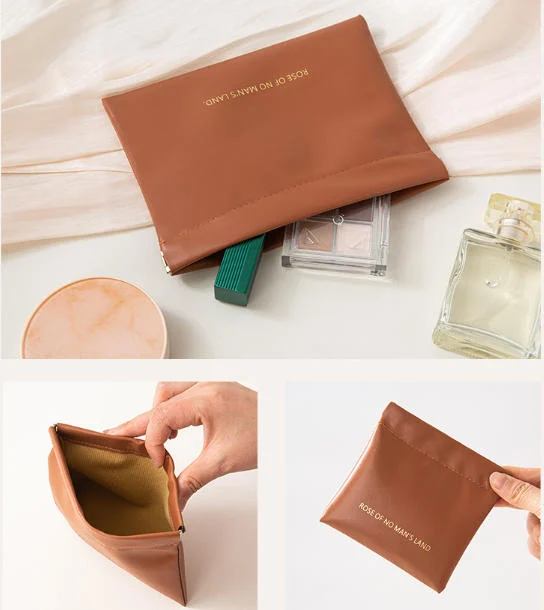
A spring-frame cosmetic pouch is designed for quick access: squeeze both ends, the opening spreads apart; release them, and the spring closes again.
That simple action makes this style useful for:
Beauty GWP gift sets
Private-label cosmetic collections
Fragrance and skincare promotions
Retail beauty launches
Makeup accessories
Selected hotel or travel amenity programs
But when a custom spring-frame makeup bag moves from a simple sample to a bulk beauty program, small structural details become important.
The main questions are:
Is the opening large enough for the products?
Is the spring easy to squeeze but strong enough to stay closed?
Will the lining interfere with the opening?
Can the frame ends damage the fabric after repeated use?
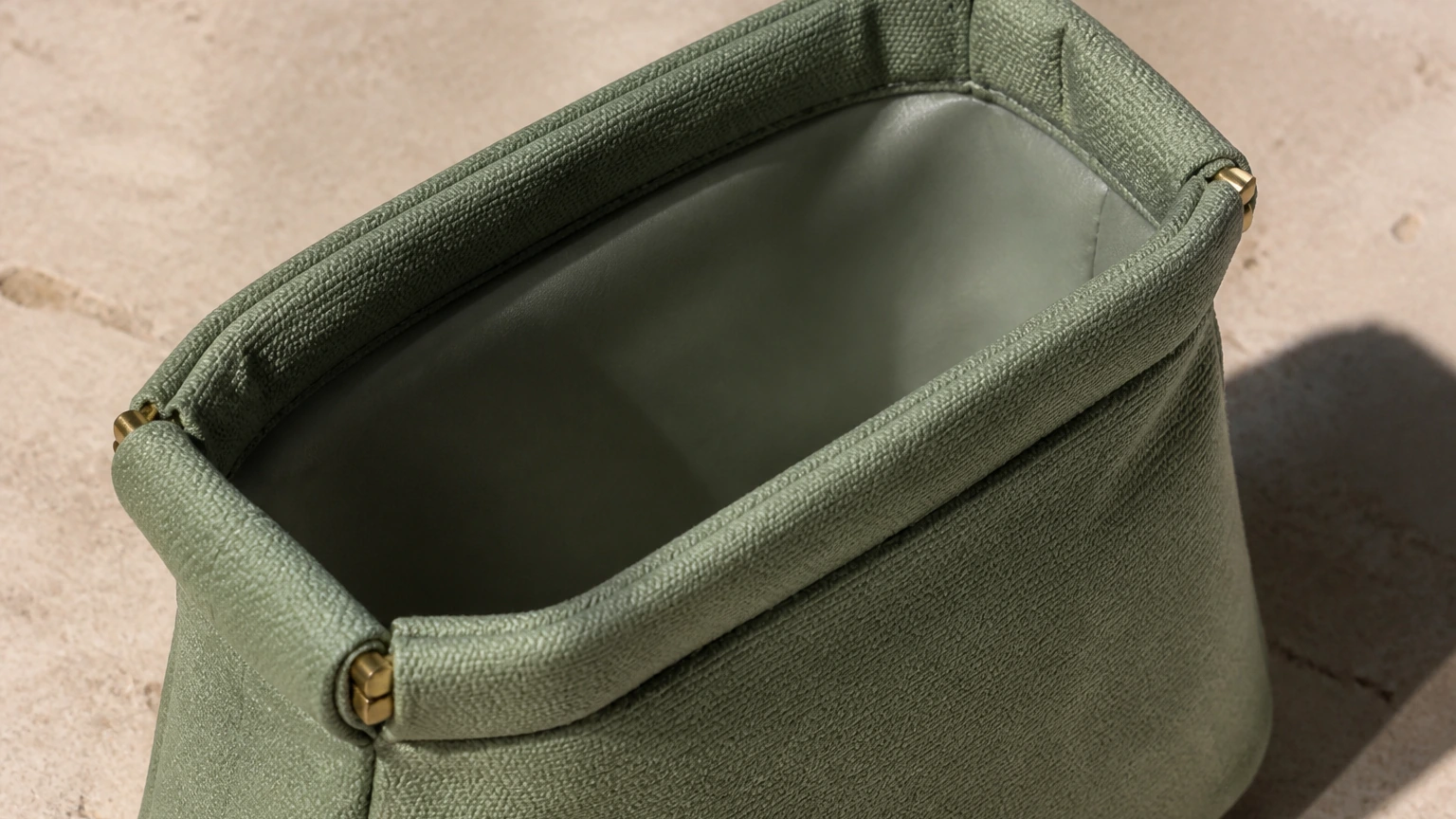
This guide focuses on the internal squeeze spring frame, where the flexible metal frame is hidden inside the top fabric channel.
It is different from a visible kiss-lock purse or rigid metal frame bag, which uses a different opening structure.
Quick Specification Guide
| What to Decide |
Why It Matters |
| Usable opening |
Determines whether bottles, compacts and makeup can pass through easily |
| Finished pouch width |
Controls overall shape and storage capacity |
| Spring tension |
Balances easy opening with secure closing |
| Outer material |
Changes structure and opening feel |
| Lining |
Should stay smooth and out of the way |
| Frame ends |
Need to avoid long-term rubbing or piercing |
| Gusset depth |
Determines usable internal space |
| Branding |
Must suit the material and flexible opening |
| Actual product fit |
Especially important for GWP and beauty gift sets |
Where This Type of Cosmetic Pouch Works Best
For bulk custom projects, the pouch is often developed around a specific beauty program rather than sold as a generic empty bag.
Beauty GWP Gift Sets
For example, a beauty brand may want to pack:
One lipstick
One compact
One fragrance sample
into a branded GWP cosmetic pouch.
In this case, the pouch size should be developed around those three actual products.
Private-Label Beauty Lines
A private-label beauty brand may use a custom makeup pouch as part of:
A seasonal collection
Travel makeup range
Beauty tool set
Skincare launch
The pouch then needs to match the brand's material, color, logo and retail positioning as well as the products inside.
Promotional Beauty Programs
For larger promotional campaigns, usability matters because a pouch that looks attractive but is difficult to open will reduce the perceived quality of the gift.
That is why the spring frame should be treated as part of the complete product—not just as a piece of hardware.
1. Sizing the Opening: Why Frame Length Is Not the Same as Pouch Width
The first mistake in developing a spring-frame cosmetic pouch is choosing the outside dimensions before checking what needs to go through the opening.
Start with the products.
Measure the Widest Item
A pouch for:
Lipstick
Coins
Jewelry
Earbuds
can use a smaller opening than one designed for:
Compact powder
Foundation bottles
Skincare jars
Makeup sponges
Example
Suppose a GWP set contains a compact that is approximately 9 cm wide.
The finished pouch may have plenty of space inside, but if the usable opening is too narrow, the customer has to force the compact through the top every time.
That is a poor user experience even if the overall pouch dimensions look correct.
A useful starting question is therefore:
What is the widest product that needs to enter and leave the pouch comfortably?
Frame Length and Finished Pouch Width Are Different
The metal spring controls the top opening.
The body below it can be wider because the pattern may include:
Side shaping
Darts
Bottom gussets
Gathered fabric
So an RFQ should not simply say:
18 cm wide cosmetic pouch
It is better to define:
This gives the cosmetic pouch manufacturer much more useful information.
Do Not Make the Opening Bigger Just Because You Can
A larger spring frame can improve access, but it also affects:
Pouch proportions
Hardware cost
Top stiffness
Packing size
Opening feel
The goal is not the widest possible opening.
The goal is:
large enough for the intended beauty products, without making the pouch unnecessarily bulky.
2. Choosing Spring Tension: Easy Opening Without Accidental Spillage
Spring tension sounds technical, but the practical question is simple:
How hard should the user need to squeeze the pouch?
The frame needs to open comfortably and still close securely.
If the Spring Is Too Stiff
The pouch may:
Require too much finger pressure
Need two hands to open
Feel uncomfortable during frequent use
Pull or wrinkle the fabric around the top
Imagine someone using the makeup pouch several times during the day.
If every opening requires a strong squeeze, the quick-access advantage of the spring frame disappears.
If the Spring Is Too Soft
The opposite problem can be more serious.
A cosmetic pouch is often placed inside a:
Tote bag
Handbag
Backpack
Travel bag
Now imagine a water bottle and umbrella pressing against both ends of the pouch.
If the spring is too light, that pressure may partially open the pouch.
Small items such as:
Lipsticks
Earrings
Coins
Hair accessories
can then fall out inside the larger bag.
So the spring needs enough closing force to resist normal accidental pressure.
Test the Finished Bag, Not Only the Metal Frame
A spring may feel fine before sewing but behave differently after it is installed.
For example, the frame may be surrounded by:
PU leather
Canvas
Lining
Folded fabric
Reinforcement
These layers create additional resistance.
That means the final opening feel is created by:
spring frame + outer material + lining + top construction
not the metal spring alone.
Simple Sample Test
Before approving the first custom spring-frame cosmetic pouch, check:
Can an adult open it comfortably with one hand?
Does it open evenly?
Does it close completely after release?
Does normal pressure inside a handbag make it open?
Does the opening still feel consistent after repeated use?
For most new projects, this simple finished-sample check is more useful than starting with a complicated force specification.
For Repeat Orders, Keep the Approved Frame Consistent
Once the correct opening feel is approved, the frame should remain part of the production reference.
A replacement frame that looks almost identical may still feel:
Softer
Harder
Less balanced
This is particularly important for GWP cosmetic pouch and private-label programs where thousands of finished bags need to feel consistent.
3. Choosing Fabric and Lining: Preventing Bulk, Wear and Frame-End Damage
The same spring frame can feel very different in different materials.
PU Spring-Frame Cosmetic Pouch
PU is a common choice for a more structured and polished spring-frame makeup bag.
It can work well with:
Debossed logos
Embossed logos
Printing
Metal logo details
But if the PU is thick and several layers are folded around the spring channel, the top can become difficult to squeeze.
The actual production material should therefore be used during sampling.
Polyester Cosmetic Pouch
Polyester generally allows a lighter and softer structure.
It can work well for:
The exact feel still depends on fabric weight, backing and lining.
Cotton and Canvas
Cotton creates a softer textile look.
Canvas gives more body.
With heavier canvas, however, too many folded layers around the spring frame can make the top unnecessarily bulky.
The Lining Should Stay Out of the Way
A lining has a simple job:
finish the inside without making the pouch harder to use.
For a custom cosmetic pouch, common options include:
Polyester is a practical starting option for many makeup bags because it can be relatively thin and smooth.
Cotton gives a softer textile feel but absorbs spills more readily.
For a pouch carrying foundation, creams or skincare products, an easy-to-wipe inner material may be useful.
However, an easy-clean lining does not automatically make the finished pouch waterproof or leakproof.
Watch for Lining Bunching
This is a common sample problem.
If too much lining collects near the top:
It can fold into the opening
The spring becomes harder to squeeze
The pouch may open unevenly
The inside looks untidy
Open the sample several times and look inside.
The lining should move naturally rather than catching around the spring channel.
Check the Frame Ends Before They Wear Through the Fabric
This is one of the most easily missed quality points.
The metal spring has connection areas near its ends. These points repeatedly move against the surrounding fabric whenever the pouch is opened.
If an end is sharp or repeatedly presses against the same small area, the fabric can gradually wear.
Early warning signs include:
Example
A sample can look perfect when it leaves the factory.
After the pouch has been squeezed open many times, one metal end may continue rubbing against exactly the same corner.
Eventually that area can become damaged.
For beauty brands, this is a much bigger problem than a small cosmetic defect because exposed hard metal can affect both appearance and user safety.
Possible Ways to Protect the Frame Ends
Depending on the spring hardware and pouch construction, protection may include:
There is no single solution required for every pouch.
The important question is:
After repeated opening, is the metal end damaging the casing or lining?
That should be checked on the finished sample.
4. Setting the Gusset Depth: Test Capacity with Real Cosmetic Products
Opening width tells you what can enter the pouch.
The gusset—the depth at the bottom—determines how much the pouch can actually hold.
Flat Spring-Frame Pouch
A flatter structure can work well for:
Lipstick
Small jewelry
Coins
Earphones
Small accessories
Gusseted Spring-Frame Makeup Bag
A deeper structure is more useful for:
Compact powder
Makeup bottles
Skincare products
Small beauty tools
Multi-item GWP sets
But there is a limit.
A very deep pouch with a narrow opening creates a bag that technically has plenty of volume but is difficult to access.
Example: A GWP Beauty Set
Suppose a promotional set contains:
Instead of choosing a generic cosmetic pouch size, place these four products together and determine:
Required internal width
Required height
Required bottom depth
Minimum comfortable opening
That usually gives a better result than starting from a standard bag dimension.
Test with the Real Products Whenever Possible
For a private-label cosmetic bag or beauty GWP project, actual product fit testing is one of the simplest ways to reduce sampling mistakes.
Check:
Can the largest item pass through the opening?
Can the user see the contents?
Can products be removed easily?
Does the pouch close when fully packed?
Do bottles press against the spring?
Does the bottom remain stable?
For fixed gift sets, the final pouch should be developed around the actual product combination.
Branding Also Needs to Match the Structure
A spring-frame cosmetic pouch can support branding such as:
Screen printing
Heat transfer
Embroidery
Woven labels
Debossing
Embossing
Metal logo details
The top area flexes every time the pouch opens.
So logos that need to stay flat and clean are usually better positioned on the main front panel rather than directly beside the spring channel.
For example, a PU cosmetic pouch can use a debossed logo lower on the front panel, away from the most flexible area.
Sample Approval Checklist for Beauty Buyers
Before approving a bulk custom cosmetic pouch, test the finished sample rather than reviewing appearance alone.
| Check |
What to Ask |
| Product fit |
Do the actual cosmetics fit comfortably? |
| Opening |
Can the largest item pass through easily? |
| Spring tension |
Is it easy to squeeze but secure when released? |
| Accidental opening |
Can normal pressure inside a handbag open it? |
| Lining |
Does it bunch up or interfere with the frame? |
| Frame ends |
Is there rubbing or fabric damage? |
| Capacity |
Is the inside still easy to use when full? |
| Closing |
Does the spring return evenly? |
| Branding |
Does the logo remain clean when the pouch bends? |
| Appearance |
Does the sample match the intended beauty positioning? |
Common Spring-Frame Cosmetic Pouch Problems
| Problem |
Possible Cause |
Better Direction |
| Cosmetics cannot enter easily |
Opening too narrow |
Increase usable opening |
| Hard to squeeze |
Strong spring or bulky top construction |
Review frame and fabric layers |
| Opens inside a handbag |
Spring too soft |
Increase closing tension |
| One side closes differently |
Frame or sewing position is uneven |
Check installation |
| Lining comes into the opening |
Lining too large or poorly positioned |
Adjust lining pattern |
| Fabric wears near frame end |
Concentrated metal contact |
Add protection or reinforcement |
| Large inside but awkward to use |
Deep gusset with narrow opening |
Rebalance opening and depth |
| Logo wrinkles |
Branding too close to flexible top |
Move logo lower |
RFQ Checklist for GWP and Private-Label Beauty Projects
For a standard project, buyers can provide:
Project Type
Beauty GWP campaign
Promotional gift set
Private-label beauty line
Retail cosmetic collection
Fragrance or skincare launch
Other custom program
Products to Fit
Provide the dimensions of the actual:
Lipstick
Compact
Bottle
Skincare jar
Perfume
Beauty tool
For a fixed gift set, also explain which products need to fit together.
Cosmetic Pouch Size
Material
PU
Polyester
Cotton
Canvas
Other requested material
Lining
Branding
Logo artwork
Pantone or target color
Logo method
Logo position
Project Information
You do not need to finalize the spring-frame size before contacting the supplier.
For a new beauty project, the products that need to fit inside are often more useful than a guessed frame measurement.
Planning a Beauty GWP or Private-Label Launch?
If you already know which cosmetics will be packed inside the pouch, send INITI the dimensions of the bottles, compacts, lip products or other items.
Before physical sampling, we can review the product arrangement and recommend a suitable direction for:
Finished pouch size
Usable opening
Bottom gusset
Spring-frame size
Outer material
Lining
This helps reduce the risk of making a sample that looks correct but does not fit the actual beauty products.
Email [email protected] with:
product dimensions + estimated quantity + target pouch style + reference image
If some details are not finalized, send the intended use and product combination first.
FAQ
Is a spring-frame cosmetic pouch suitable for beauty GWP programs?
Yes. The quick-opening structure can work well for branded beauty gift sets, fragrance promotions and cosmetic campaigns, provided the pouch is developed around the products that will actually be packed inside.
Can a spring-frame pouch be developed for a private-label beauty line?
Yes. Size, material, lining, color and branding can be developed around the private-label collection. Product fit and opening comfort should be confirmed during sampling.
How wide should the spring-frame opening be?
There is no fixed size. It should allow the widest intended cosmetic product to enter and leave comfortably without making the pouch unnecessarily large.
How tight should the spring frame be?
It should open comfortably when squeezed but remain firmly closed during normal carrying. The finished pouch should also be checked for accidental opening when placed inside a handbag or backpack.
Is a spring-frame pouch the same as a kiss-lock purse?
No. This guide focuses on the hidden internal squeeze spring frame. A kiss-lock pouch normally uses a visible rigid metal frame and clasp.
Conclusion
For a bulk spring-frame cosmetic pouch project, do not start with the metal frame alone.
Start with the actual beauty products.
Then determine:
usable opening → spring tension → material and lining → gusset depth
For GWP beauty gift sets and private-label cosmetic lines, this approach helps avoid a common problem: producing an attractive pouch that does not actually work well with the products it was designed to hold.
The best sample is not simply the one that looks good on the table.
It is the one that:
Fits the intended cosmetics
Opens easily
Stays closed inside a handbag
Protects the fabric around the spring ends
Remains easy to use when fully packed
Related Products
PU Leather Spring Frame Cosmetic Pouch
Soft Quilted Cosmetic Bag
Related Blog Articles
What Makes a Good Cosmetic Bag? Features, Materials and Design
What Is Bag Lining? A Complete Guide to Bag Lining Materials




 Hot News