Have you ever wondered how an ordinary plastic bottle can become a reusable shopping bag, tote bag, or promotional bag?
The process may look surprising, but the basic idea is straightforward: used PET plastic is collected, processed, converted into recycled polyester fibers, and then turned into fabric that can be cut and sewn into bags.
These bags are commonly known as RPET bags, short for recycled polyethylene terephthalate bags.
For brands, retailers, supermarkets, promotional companies, and packaging buyers, RPET bags offer a way to combine reusable functionality with recycled-material sourcing.
But how exactly does a plastic bottle become a bag?
This guide explains the complete journey from discarded PET bottle to finished RPET bag, including the recycling process, fabric production, bag manufacturing, bottle-to-bag calculations, quality considerations, and what B2B buyers should check when sourcing custom RPET bags.
What Are Bags Made from Plastic Bottles?
Bags made from plastic bottles are typically produced from recycled PET (RPET).
PET, or polyethylene terephthalate, is a type of plastic widely used for beverage bottles and food containers. After used PET bottles are collected and processed, the material can be converted into recycled polyester fibers.
Those fibers can then be made into fabrics suitable for products such as:
- Reusable shopping bags
- Tote bags
- Promotional bags
- Drawstring bags
- Cosmetic bags
- Backpacks
- Lunch bags
- Storage bags
- Retail packaging bags
The finished product does not look like a plastic bottle. After processing, the recycled PET becomes a textile material with properties similar to polyester fabric.
This makes RPET particularly useful for businesses that want a reusable bag while incorporating recycled content into their product or packaging strategy.
What Does “Made From Plastic Bottles” Actually Mean?
When a bag is described as being made from plastic bottles, it does not mean that whole bottles are directly shaped into bags.
The bottles first need to be processed into a material that can be used in textile production.
The basic journey is:
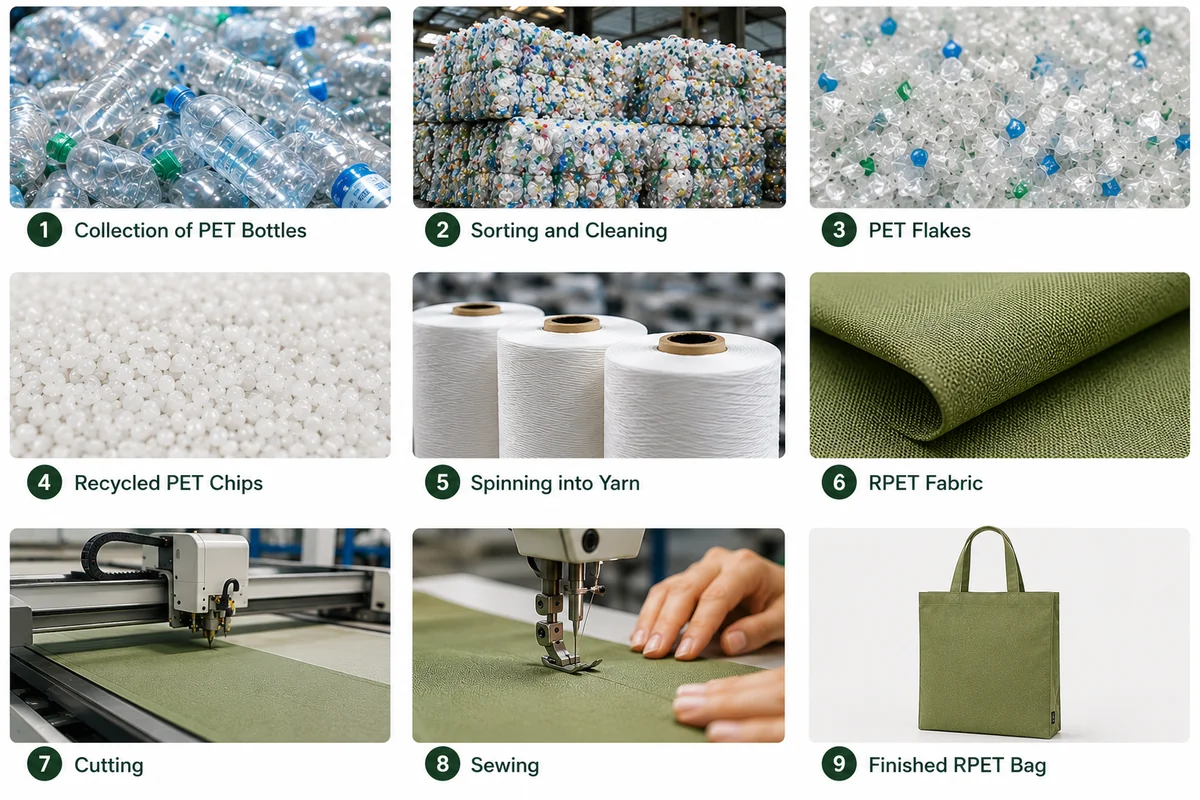
Used PET bottles-Sorting and cleaning-PET flakes-Recycled PET-Recycled polyester fibers-Yarn-RPET fabric-Cutting and sewing-Finished bag
So the plastic bottle is essentially used as the starting raw material.
By the time the process reaches the fabric stage, the original bottle has been transformed several times.
This distinction is important because it explains why an RPET bag can look and feel like an ordinary textile bag even though its raw material originally came from plastic.
How to Make Bags from Plastic Bottles: The Process
The process of turning PET bottles into bags can be divided into two broad parts.
The first part is recycling the plastic into textile material.
The second part is manufacturing that textile into a bag.
The recycling stage generally involves collection, sorting, cleaning, shredding, processing, fiber production, and yarn production.
The manufacturing stage then involves fabric production, cutting, sewing, finishing, and branding.
Let's look at each stage in detail.
Step 1: Collect Used PET Bottles
Everything starts with used PET products.
The raw material may come from beverage bottles and other PET products collected through recycling systems or commercial waste streams.
At this point, the material can contain many things that are not needed for producing recycled polyester.
For example:
- Plastic caps
- Labels
- Adhesive
- Dirt
- Liquid residue
- Other types of plastic
The first objective is therefore to collect suitable PET material and prepare it for recycling.
Not every plastic bottle is automatically suitable for every recycling process. The material needs to be identified and separated before it can move to the next stage.
Step 2: Sort the PET
After collection, the plastic is sorted.
Sorting separates PET from other materials and can also separate bottles according to color and quality.
This is an important step because different plastics behave differently during processing.
For textile applications, consistent raw material helps create more consistent recycled fibers and fabrics.
The bottles may also need to have unwanted components removed before further processing.
Once the suitable PET material has been separated, it can be cleaned.
Step 3: Clean the Bottles
Used bottles are not ready to become textile material immediately.
They need to be cleaned to remove contaminants such as:
- Dirt
- Beverage residue
- Labels
- Adhesive
- Other unwanted materials
The cleaning stage prepares the PET for mechanical processing.
The cleaner and more consistent the material entering the recycling process, the easier it is to produce a suitable recycled raw material.
After cleaning, the bottles are ready to be broken down.
Step 4: Shred the Bottles Into PET Flakes
The cleaned bottles are mechanically shredded into small pieces called PET flakes.
This is the first point where the original bottle begins to look completely different.
Instead of a bottle, the material now consists of small pieces of PET.
The transformation is:
Plastic bottle → PET flakes
These flakes provide the raw material for the next stage of recycling.
The size and quality of the flakes can vary depending on the recycling equipment and process being used.
Step 5: Melt and Process the PET
The PET flakes are then processed and melted under controlled conditions.
The material is transformed into recycled PET polymer that can be used to produce fibers.
This is an important transition.
The material has moved from:
A recycled plastic container
to:A raw material suitable for textile production
From here, the recycled PET can be processed into polyester fibers.
Step 6: Turn Recycled PET Into Polyester Fibers
The recycled PET is processed into fine polyester fibers or filaments.
These fibers are the foundation of the textile material used to make many RPET products.
The process is conceptually similar to producing conventional polyester fibers, except that the raw material comes from recycled PET rather than entirely from virgin feedstock.
The resulting fibers can then be processed into yarn.
At this stage, the material has moved much closer to becoming fabric.
Step 7: Spin the Fibers Into Yarn
The recycled polyester fibers are spun into yarn.
Yarn is the material that can be woven or knitted into fabric.
The characteristics of the final yarn and fabric can vary depending on the production process and intended application.
For example, different specifications can influence:
- Fabric weight
- Strength
- Texture
- Flexibility
- Appearance
- Surface feel
This is one reason why two bags can both be described as “RPET bags” but still feel completely different.
The term RPET tells you something about the source of the material, but it does not describe every characteristic of the finished fabric.
Step 8: Turn the Recycled Yarn Into Fabric
The recycled polyester yarn can be made into fabric using different textile construction methods.
For bags, two common approaches are woven and non-woven structures.
Woven RPET Fabric
Woven fabric is made by interlacing yarns.
It can be used for products such as:
- Tote bags
- Shopping bags
- Backpacks
- Promotional bags
- Reusable everyday bags
Non-Woven RPET Fabric
Non-woven material is produced differently from conventional woven textile fabric.
It can be used for lightweight shopping and promotional bags.
The appropriate construction depends on the desired product.
Fabric specifications can also vary according to:
- GSM
- Thickness
- Texture
- Strength
- Color
- Finishing
This is why the phrase “RPET fabric” alone does not tell you exactly how a finished bag will perform.
Step 9: Finishing the RPET Fabric
Before the fabric becomes a finished bag, additional processes may be used depending on the intended application.
For example, a fabric may receive treatments that change its:
- Surface appearance
- Handle
- Water resistance
- Stiffness
- Durability
Some bags may also use coatings or laminations.
This is especially relevant when the bag needs additional protection from moisture or requires a particular surface for printing.
However, it is important not to assume that every RPET bag is waterproof simply because its material originated from plastic.
Water resistance depends on the specific fabric construction and finishing.
Step 10: Cut the Fabric Into Bag Pieces
Once the RPET fabric is ready, it can be cut into the shapes needed for the bag.
A simple tote bag might only require a few large fabric panels.
A more complicated design can include:
- Front panels
- Back panels
- Side panels
- Bottom panels
- Gussets
- Pockets
- Handles
- Shoulder straps
- Zipper panels
- Linings
The pattern determines the final shape and capacity of the bag.
The amount of fabric required also has a direct relationship with the eventual amount of recycled material represented by the finished product.
Step 11: Sew the Bag Together
The cut fabric pieces are assembled into the finished bag.
Depending on the design, the production process may include:
- Sewing the main panels
- Attaching handles
- Adding gussets
- Sewing pockets
- Installing zippers
- Reinforcing stress points
- Finishing edges
A bag's durability does not come from the recycled material alone.
Construction also matters.
For example, the way handles are attached can have a major effect on how much weight the finished bag can comfortably carry.
A well-designed RPET bag therefore combines the appropriate fabric with suitable construction.
Step 12: Add Printing and Branding
Many bags made from recycled PET are designed for brands, retailers, events, or promotional campaigns.
At this stage, logos and artwork can be added.
Depending on the material and design, options may include:
- Screen printing
- Heat transfer
- Digital printing
- Sublimation
- Embroidery
- Woven labels
- Printed labels
The printing method needs to match the fabric.
A simple one-color logo and a detailed full-color image may require very different production methods.
How Many Plastic Bottles Does It Take to Make One Bag?
This is one of the most common questions people have about bags made from recycled plastic bottles.
The short answer is:It depends on the bag.
There is no single number that applies to every RPET bag.
A small lightweight tote requires less material than a large backpack.
A thin fabric requires less material than a heavy fabric.
And a bag made with a higher recycled-content percentage represents more recycled PET than one made with a blend of recycled and virgin polyester.
A useful way to understand the difference is to look at typical examples.
Approximate Bottle Equivalents
| Type of Bag |
Approximate Bottle Equivalent |
| Small lightweight tote |
3–5 bottles |
| Medium reusable shopping bag |
6–10 bottles |
| Large RPET tote |
10–15 bottles |
| Backpack |
15–20+ bottles |
These figures should be treated as approximate examples rather than fixed industry standards.
The actual number depends on the weight of the original PET bottles, the weight of the finished product, the recycled-content percentage, fabric GSM, production efficiency, and other factors.
This type of range is useful because it gives shoppers and buyers a simple way to visualize the amount of recycled material involved.
What Types of Bags Can Be Made From Plastic Bottles?
Once PET has been transformed into recycled polyester fabric, it can be used for many different types of bags.
RPET Tote Bags
Tote bags are one of the simplest applications.
They can be designed for:
- Shopping
- Retail packaging
- Events
- Promotional campaigns
-
Everyday use
RPET Shopping Bags
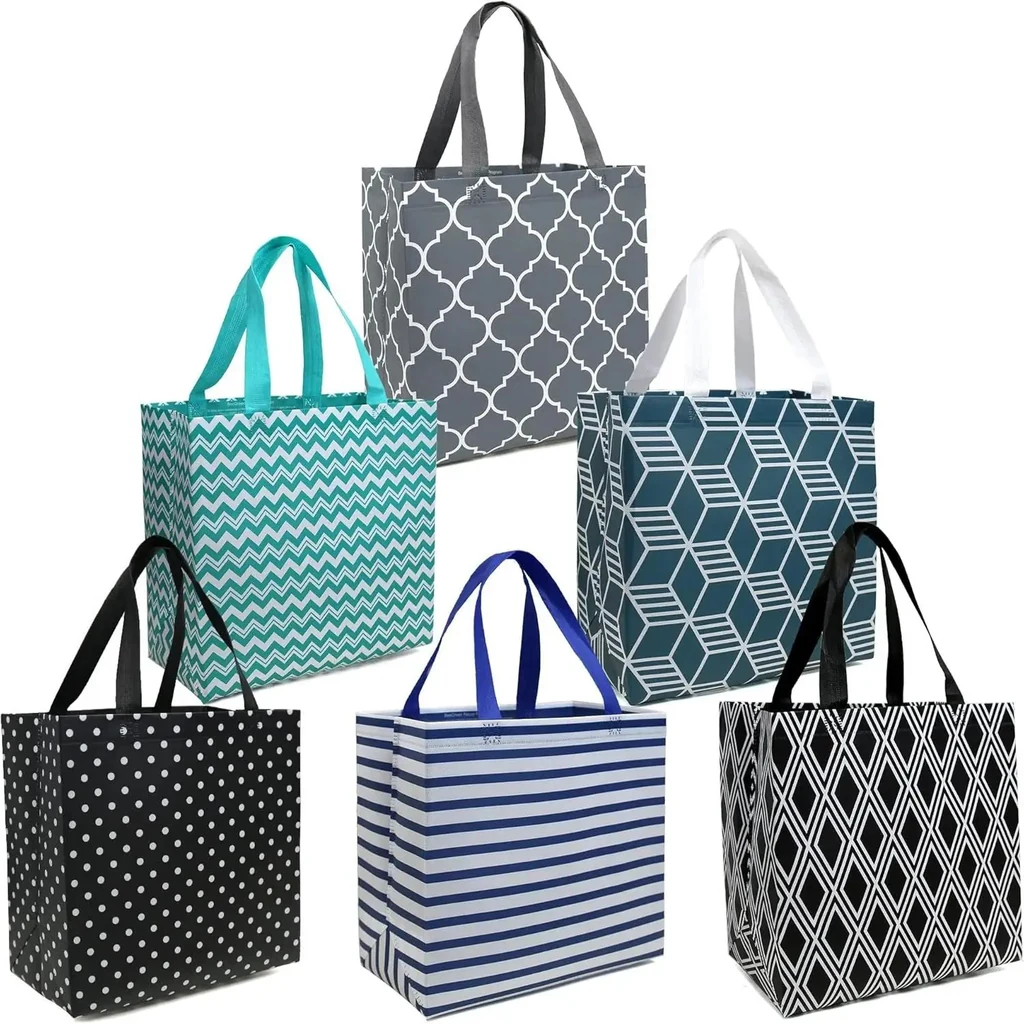
Shopping bags can be designed with different sizes, handle styles and fabric weights depending on their intended use.
RPET Drawstring Bags
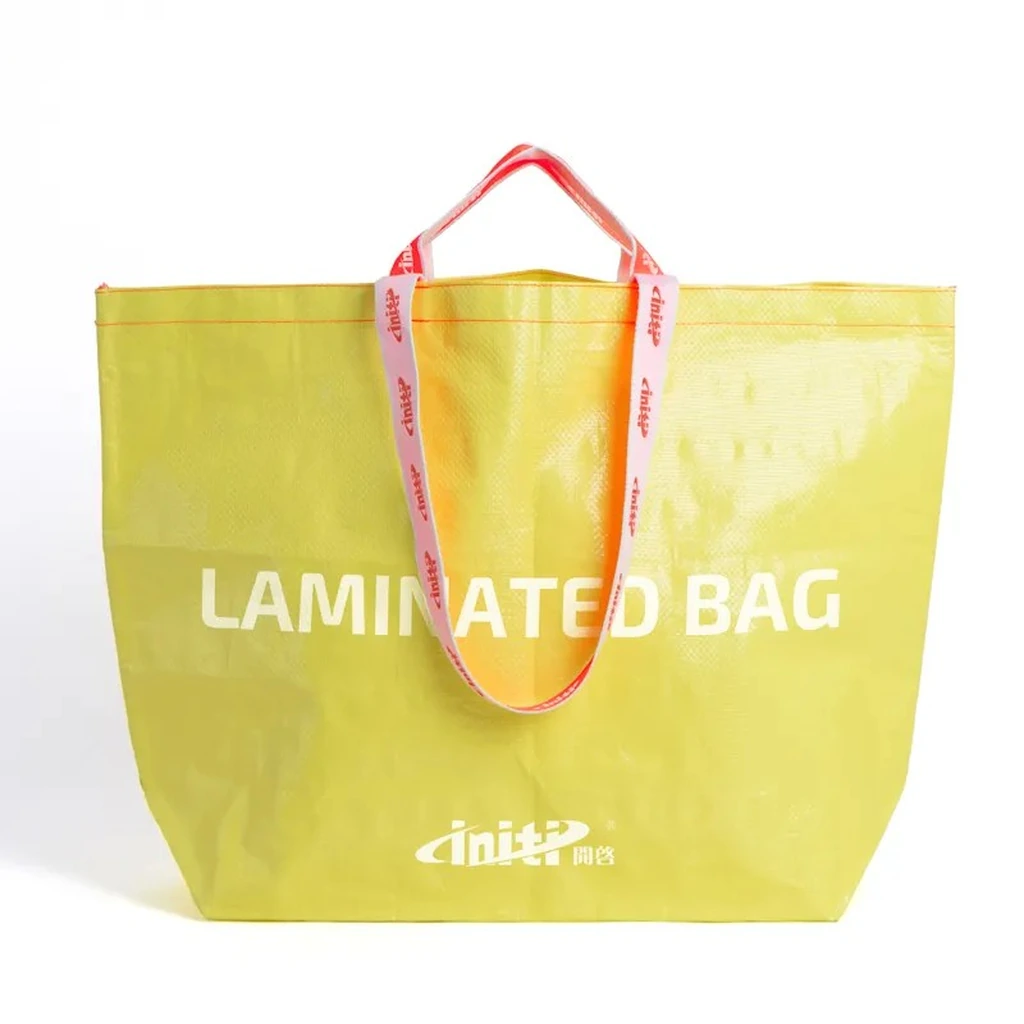
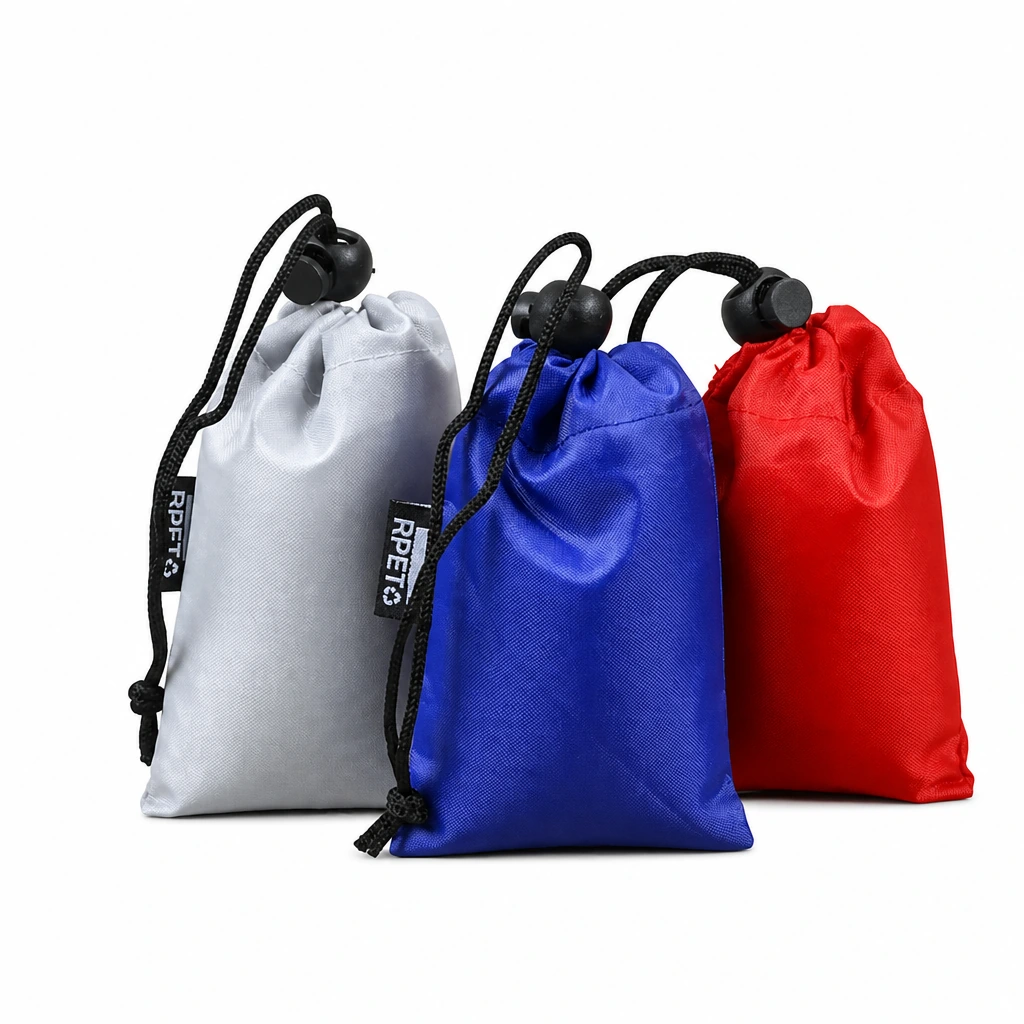
Drawstring bags are commonly used for:
- Events
- Sports
- Promotional campaigns
- Travel
- Everyday storage
RPET Backpacks
A stronger fabric and more complex construction can be used for backpacks.
Because backpacks generally contain more material and components than simple totes, their bottle equivalent can also be higher.
RPET Cosmetic and Storage Bags
Smaller bags can also be produced from recycled polyester fabrics.
These may include:
- Cosmetic pouches
- Travel organizers
- Storage bags
- Gift bags
The final application depends on the fabric, structure and design.
RPET and virgin polyester can have similar functional characteristics because both ultimately use polyester-based fibers.
The main difference is the source of the raw material.
| Factor |
RPET |
Virgin Polyester |
| Raw material |
Recycled PET |
New petrochemical feedstock |
| Recycled content |
Yes |
No |
| Waste reduction potential |
Higher |
Lower |
| Durability |
Can be highly durable |
Highly durable |
| Weight |
Depends on fabric |
Depends on fabric |
| Printing |
Depends on fabric |
Depends on fabric |
| Sustainability positioning |
Stronger |
More limited |
| Typical applications |
Retail, promotional, packaging |
Retail, apparel, bags, packaging |
The choice should depend on the product's technical requirements, sustainability objectives, certification needs, and budget.
RPET is not automatically the best material for every application.
For example, a buyer may prioritize recycled content for a sustainability campaign, while another project may prioritize a specific fabric weight, coating, appearance, or cost.
Are RPET Bags Durable?
They can be.
The durability of an RPET bag depends on more than the fact that it contains recycled material.
Important factors include:
- Fabric construction
- GSM
- Yarn
- Stitching
- Handle attachment
- Reinforcement
- Bag design
- Intended load
For example, a lightweight promotional tote and a heavy-duty shopping bag can both be made from recycled polyester, but they are designed for completely different purposes.
Therefore, it is better to evaluate the whole bag, rather than assuming that all RPET products have the same strength.
Are RPET Bags Waterproof?
Not necessarily.
This is another common misunderstanding.
PET is a plastic material, but an RPET textile is still a textile.
Whether the finished fabric or bag is water-resistant depends on factors such as:
- Fabric structure
- Coating
- Lamination
- Seams
- Zippers
- Construction
An untreated RPET fabric should not automatically be described as waterproof.
If a bag needs to resist rain or spills, the specific fabric and finishing should be selected for that purpose.
Why Are Plastic Bottles Used to Make Bags?
There are two important ideas behind the process.
The first is material recovery.
PET is a useful material that can be recycled into new products.
Instead of treating a suitable PET bottle as waste after one use, recycling allows its material to enter another production cycle.
The second is reusing the resulting material.
Once PET has been transformed into polyester fibers, it can be used to make products that people can use repeatedly.
For a reusable bag, this creates an interesting connection:
A disposable-looking item becomes raw material for a reusable product.
The value is therefore not only in the finished bag, but also in the way the raw material is sourced and reused.
How Can We Encourage More Sustainable Choices?
Turning plastic bottles into reusable bags is only one part of a more sustainable approach. What matters just as much is how we inspire those around us—customers, colleagues, friends, and local communities—to make greener choices in everyday life.
A few simple habits can make a difference, and they start with encouraging others:
- Lead by example: A bag designed for repeated use only helps the planet if people actually see it in action. Carry your recycled PET tote with pride—at the grocery store, the farmers' market, or on a weekend trip—and your visible commitment can speak louder than words.
- Share the material story: Understanding how a PET bottle becomes recycled polyester fabric helps people see the value of recycling and reuse. Mention to friends, family, or coworkers why you made the switch and what it means in practice.
- Make sustainable options convenient: Keeping a reusable bag in a car, backpack, or near the door makes it easier to remember—and easier for others to follow your lead.
- Gift thoughtfully: Sustainable products like rPET tote bags make meaningful gifts for birthdays, team events, or community gatherings. People are far more likely to try eco-friendly options when they're already in hand.
For businesses, the same idea applies on a larger scale: choosing reusable or recycled-material options for packaging, promotional products, and retail bags—and clearly explaining their material content—can help customers make more informed decisions. Organizing group orders or community initiatives gives everyone a chance to get involved and spread the habit further.
FAQ
Can RPET bags be customized?
Yes. Buyers can usually customize the bag size, shape, fabric weight, color, handles, pockets, printing, labels, and packaging.
What should buyers confirm before ordering?
Fabric GSM, dimensions, printing method, certifications, sample availability, minimum order quantity, lead time, and packaging requirements.
What is the difference between RPET and polyester?
RPET is recycled PET or recycled polyester. Conventional polyester may use virgin raw materials. The two materials can have similar textile applications, but their raw-material sources are different.
Conclusion:
So, how do you make bags from plastic bottles?
You don't simply reshape a plastic bottle into a bag.
Instead, the bottle goes through a series of transformations:
PET bottle → PET flakes → recycled PET → polyester fibers → yarn → fabric → bag
The most interesting part is perhaps the amount of recycled material represented by the finished product.
A small lightweight bag might represent only a few bottles, while a larger and heavier bag may represent the material from a dozen or more bottles. The exact number depends on the actual product specification rather than one universal formula.
This is why the phrase “made from recycled plastic bottles” is best understood as a description of the material journey.
A bottle that was once used for a drink can be collected, processed, transformed into textile material, and eventually become part of a bag that can be used again and again.
That journey—from PET waste to RPET fabric to a finished bag—is what makes recycled PET bags such an interesting example of material reuse.
Related Products



 Hot News