What Is the Best Material for Beach Bags?
There is no single material that is best for every beach bag.
For most practical beach totes, polyester mesh is one of the best all-around choices because it is lightweight, quick-drying and allows sand and water to pass through easily.
However, other materials perform better when the product has a different purpose:
- Polyester or Oxford fabric — best for durable general-purpose beach bags
- Mesh — best for sand drainage and wet swimwear
- EVA — best for structured, rinse-clean beach totes
- PVC or TPU — best for easy-clean transparent or water-resistant designs
- Canvas — best for natural appearance and premium lifestyle positioning
The correct material should therefore be selected according to how the bag will actually be used.
Quick Comparison of Beach Bag Materials
| Material |
Sand Release |
Water Resistance |
Drying Speed |
Structure |
Cleaning |
Best For |
| Polyester Mesh |
Excellent |
Open structure |
Excellent |
Soft–Medium |
Easy |
Beach, pool, wet gear |
| Polyester / Oxford |
Medium |
Good with coating |
Good |
Medium–High |
Easy |
General beach totes |
| Canvas |
Poor–Medium |
Low without treatment |
Slow |
High |
Medium |
Lifestyle and premium retail |
| EVA |
Excellent |
Excellent material surface |
Excellent |
High |
Very easy |
Structured beach totes |
| PVC |
Good |
Excellent material surface |
Excellent |
Medium–High |
Very easy |
Clear beach and pool bags |
| TPU |
Good |
Excellent material surface |
Excellent |
Flexible |
Very easy |
Premium waterproof-style bags |
The finished bag's water resistance still depends on seams, zipper construction and opening design.
1. Polyester Mesh: Best for Sand and Wet Beach Gear
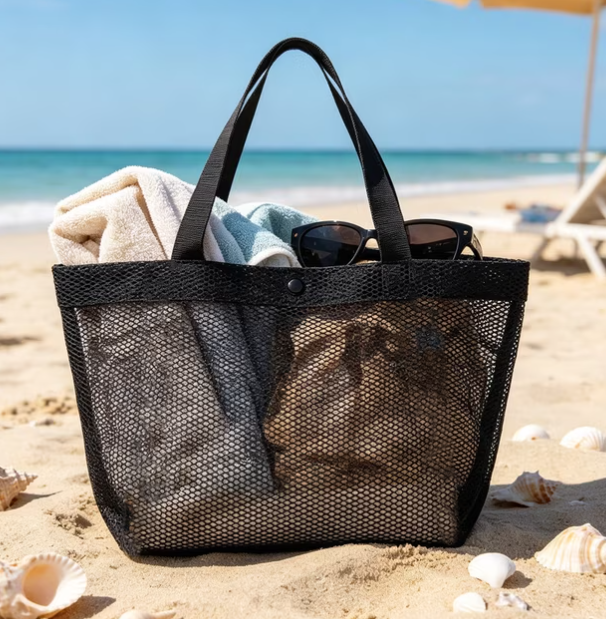
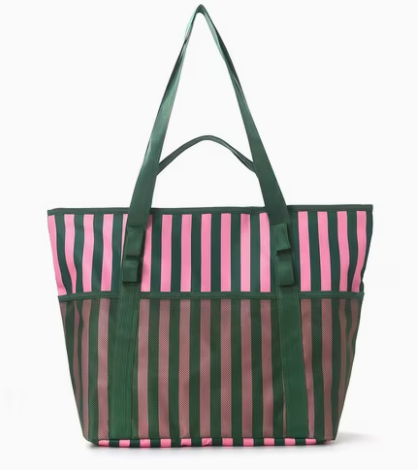
Mesh is one of the most practical materials for beach bags because its open structure allows:
- Sand to fall through
- Wet swimwear to ventilate
- Towels to dry more easily
- Water to drain instead of collecting inside
Polyester mesh is particularly useful because it provides a good balance between weight, durability and outdoor performance. Current beach-bag sourcing guides also commonly position polyester mesh as an all-around commercial choice for beach use.
Advantages
- Lightweight
- Quick drying
- Breathable
- Easy sand removal
- Foldable
- Suitable for large bags
- Relatively economical
Limitations
- Contents remain visible
- Small items can fall through large mesh openings
- Offers little protection from splashing water
- Can feel too soft without edge or bottom reinforcement
For this reason, many commercial beach bags combine mesh with:
- Polyester webbing handles
- Solid fabric bottom panels
- Zipper pockets
- PVC panels
- Reinforced edge binding
This hybrid construction can provide better strength without losing the main advantages of mesh.
Best For
- Swimwear brands
- Resorts
- Beach clubs
- Pool bags
- Water parks
- Summer promotions
- Travel retailers
2. Polyester and Oxford Fabric: Best Overall for Durable Beach Bags
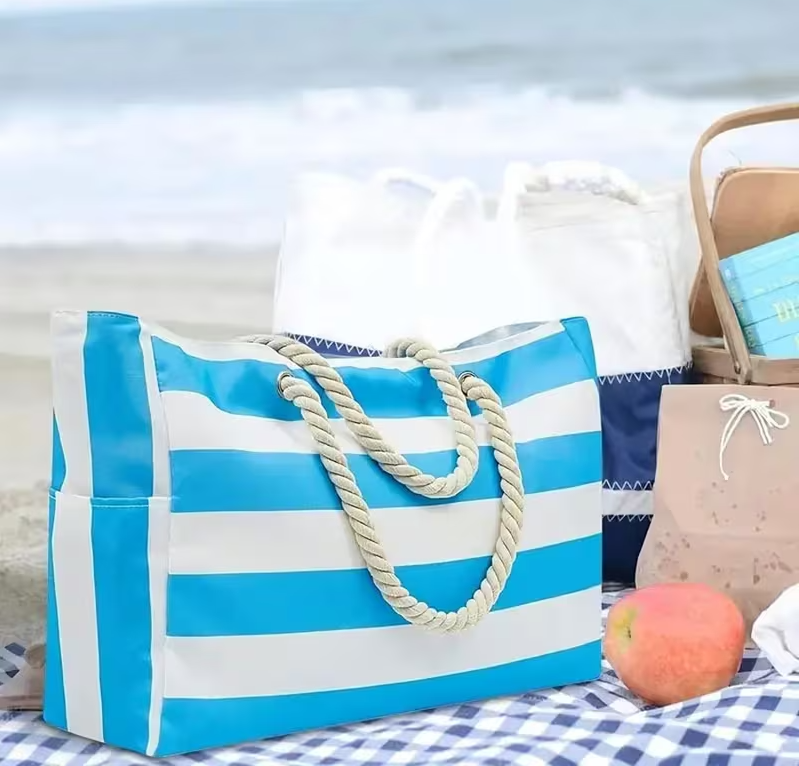
For buyers who want a more conventional fabric tote with better protection than mesh, polyester is one of the most versatile choices.
Oxford fabric is usually a woven polyester or nylon-based fabric with a more structured surface.
Depending on the specification, polyester beach bags can be made with:
- 210D
- 300D
- 420D
- 600D
- Heavier Oxford constructions
A coating can also be added to improve resistance to moisture.
Advantages
- Good durability
- Lightweight relative to strength
- Faster drying than cotton canvas
- Good color and print options
- Suitable for pockets and zippers
- Easy to combine with waterproof or insulated compartments
- Good for OEM/ODM development
Limitations
- Sand does not fall through the fabric
- Coating quality varies
- Fully sewn construction is not automatically waterproof
- Lightweight grades may require handle and bottom reinforcement
Polyester is therefore a strong choice for a beach bag that needs to work beyond the beach as a:
- Travel tote
- Picnic bag
- Resort bag
- Shopping bag
- Outdoor promotional bag
If a buyer wants one material that balances cost, durability and customization flexibility, polyester or polyester Oxford is usually one of the safest directions.
3. Canvas: Best for Natural and Lifestyle Beach Bags
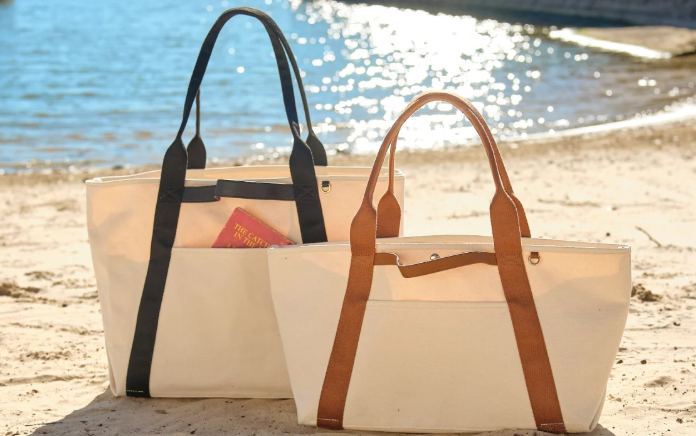
Canvas remains popular for beach totes because of its substantial textile appearance.
It works especially well for brands that prioritize:
- Natural styling
- Fashion positioning
- Large logo areas
- Embroidery
- Heavy-duty handles
- Retail presentation
Advantages
- Strong fabric structure
- Premium hand feel
- Good printing surface
- Excellent for embroidery
- Good load-bearing potential when properly constructed
- Fits fashion and lifestyle collections
Limitations
The main weakness of untreated canvas at the beach is moisture.
Cotton-based canvas can:
- Absorb water
- Take longer to dry
- Hold sand inside the weave
- Become heavier when wet
- Develop marks or odor if stored damp
Current beach-bag material guides also consistently identify moisture absorption as the main trade-off of untreated canvas.
This does not mean canvas is unsuitable.
It simply means canvas works best for dry-use lifestyle beach totes, rather than bags expected to carry dripping swimwear.
Possible improvements include:
- Polyester lining
- Coated lining
- Separate wet pocket
- Reinforced bottom
- Water-repellent treatment
Best For
- Fashion brands
- Resorts
- Gift shops
- Premium promotions
- Lifestyle retail
- Coastal merchandise
4. EVA: Best for Structured and Easy-to-Clean Beach Totes
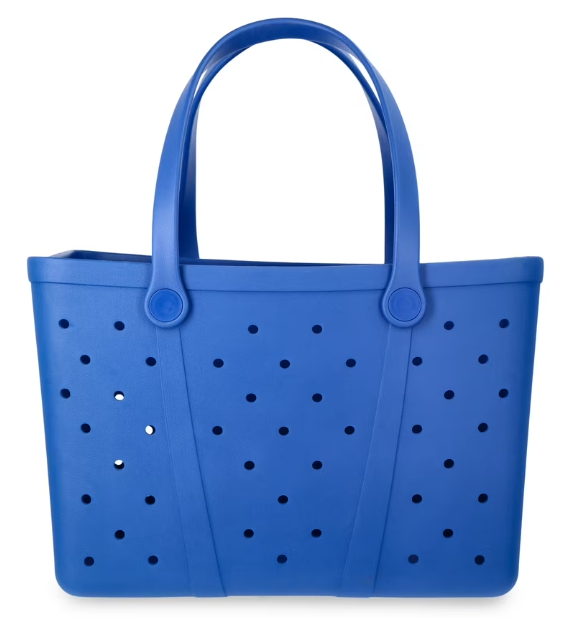
EVA has become popular for structured beach tote designs.
Unlike a conventional fabric bag, EVA can create a semi-rigid or molded structure that keeps the bag standing upright.
Perforated EVA designs can also allow sand and water to drain.
INITIGIFT currently carries a perforated EVA beach tote format within its beach/outdoor product range.
Advantages
- Water-resistant material
- Easy to rinse
- Quick drying
- Structured appearance
- Does not absorb water like cotton
- Suitable for perforated designs
- Good for sand and wet environments
Limitations
- Bulkier than foldable fabric bags
- Uses more storage and shipping volume
- Different EVA grades have different softness and recovery
- Material can deform under excessive heat depending on formulation
- Less suitable for highly compact packing
Best For
- Poolside retail
- Beach lifestyle brands
- Resort gift shops
- Family beach bags
- Premium summer collections
EVA is particularly useful when easy cleaning and structure matter more than foldability.
5. PVC: Best for Clear and Wipe-Clean Beach Bags
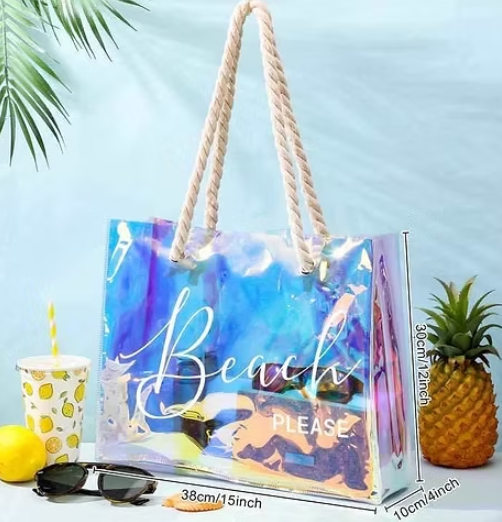
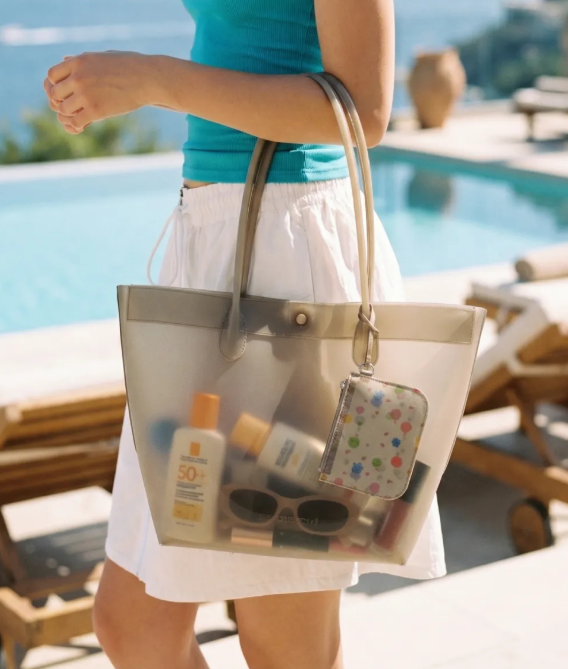
PVC is frequently used for transparent or translucent beach totes.
INITIGIFT currently offers transparent colored PVC tote structures for beach retail, swimwear, resort and travel applications.
Advantages
- Easy to wipe clean
- Does not absorb water
- Transparent or colored transparent appearance
- Strong fashion impact
- Suitable for wide gusset structures
- Easy content visibility
- Works well with webbing handles
Limitations
- Heavier than lightweight mesh
- Can become stiff depending on thickness and temperature
- Contents remain visible
- Fully sewn PVC bags are not automatically waterproof
- Material odor and clarity need to be controlled during sourcing
For beach use, PVC thickness should be matched to bag size.
An oversized beach tote using very thin PVC may stretch or distort around:
- Handles
- Corners
- Bottom panels
Reinforced webbing handles and edge binding are therefore important for larger structures.
Best For
- Swimwear brands
- Fashion retailers
- Resort shops
- Pool bags
- Transparent promotional bags
- Summer retail campaigns
6. TPU: Best for Premium Flexible Water-Resistant Designs
TPU is another thermoplastic film used for transparent or coated bag structures.
Compared with conventional PVC, TPU can offer a softer and more flexible feel depending on grade.
It is often used where buyers require:
- Flexible waterproof-style construction
- Premium transparent material
- Coated technical fabrics
- Outdoor performance
Advantages
- Flexible
- Good abrasion resistance
- Water-resistant material
- Can support welded construction
- Suitable for premium technical designs
Limitations
- Higher material cost
- Requires more controlled processing
- Not necessary for basic promotional beach bags
TPU makes more sense for premium outdoor or travel products than for low-cost seasonal giveaways.
Which Material Is Best for Sand?
If sand removal is the main problem:
Best Choice: Mesh
An open mesh structure allows sand to fall out rather than remain trapped inside the bag.
The actual performance depends on:
- Mesh hole size
- Mesh density
- Surface texture
Very fine mesh provides more protection for small items but releases sand less easily than larger openings.
For family beach bags carrying towels, toys and shoes, medium-to-large mesh openings often provide a practical balance.
Which Material Is Best for Wet Towels and Swimwear?
For wet items, good choices include:
- Polyester mesh
- EVA
- PVC
- TPU-coated structures
Mesh allows water and air to escape.
EVA and PVC do not absorb water and can be wiped or rinsed clean.
The correct choice depends on whether the buyer wants:
Drainage
→ Choose mesh.
Water containment
→ Use a properly designed coated or film compartment.
These are different requirements.
A mesh bag allows water out.
A sealed wet compartment tries to keep water in.
Which Material Is Best for Heavy Beach Loads?
Beach bags often carry:
- Large towels
- Water bottles
- Sunscreen
- Shoes
- Toys
- Food
- Books
- Electronics
For heavier loads, fabric choice alone is not enough.
The specification should also consider:
- Handle width
- Handle attachment depth
- Reinforcement stitching
- Bottom structure
- Gusset construction
- Seam strength
Good material directions include:
- 600D polyester
- Oxford fabric
- Heavy canvas
- Reinforced EVA
A strong material paired with weak handles will still fail.
Best Material by Beach Bag Type
There is therefore no benefit in forcing every beach bag into the same material specification.
What About RPET?
RPET can also be used for beach bags.
Common options include:
- RPET polyester fabric
- RPET Oxford
- RPET mesh
The basic performance characteristics still depend on how the recycled polyester is processed into the final fabric.
Buyers should therefore evaluate:
- Fabric weight
- Weave
- Coating
- Mesh construction
- Colorfastness
- Handle strength
rather than assuming that the term “RPET” defines the finished performance.
If recycled-content claims are used commercially, the sourcing documentation and certification requirements should also be confirmed according to the buyer's project.
A Practical Material Selection Guide for Buyers
Before selecting material, answer these questions.
1. Will the bag regularly carry wet products?
If yes:
Choose mesh, EVA, PVC or coated synthetic fabric rather than untreated cotton canvas.
2. Is sand drainage important?
If yes:
Choose an open mesh or perforated EVA structure.
3. Does the bag need to fold into luggage?
If yes:
Choose lightweight polyester, nylon or mesh.
Avoid rigid molded structures.
4. Is the product positioned as a premium fashion item?
If yes:
Canvas, structured polyester or high-quality transparent film may offer better perceived value.
5. Does the bag carry heavy items?
If yes:
Focus on:
- Fabric strength
- Handle reinforcement
- Bottom construction
- Seam strength
rather than material alone.
Common Beach Bag Material Mistakes
Choosing Canvas Only Because It Feels Strong
Canvas can carry weight well but may be inconvenient when repeatedly exposed to wet swimwear.
Calling Mesh Waterproof
Mesh is usually chosen because it allows water to drain, not because it prevents water penetration.
Assuming PVC Means the Finished Bag Is Waterproof
PVC material can resist water, but stitched seams and open tops can still allow water inside.
Selecting EVA Without Considering Shipping Volume
Structured EVA totes occupy considerably more carton space than foldable fabric bags.
Focusing on Material but Ignoring Handles
Beach bags are often heavily loaded. Handle attachment failure may occur before the main fabric fails.
FAQ
What is the best overall material for a beach bag?
For general functional beach use, polyester mesh is one of the best choices because it is lightweight, breathable, quick-drying and allows sand to escape. For a closed fabric tote, polyester Oxford provides a good balance of durability and customization.
Is canvas good for beach bags?
Yes, particularly for fashion and lifestyle beach totes. However, untreated cotton canvas absorbs moisture and dries more slowly than polyester or mesh.
Is mesh better than canvas for beach bags?
Mesh is better for sand drainage, wet towels and quick drying. Canvas offers a more premium textile appearance and better solid printing area. They serve different product positions.
Is EVA good for beach bags?
Yes. EVA is particularly suitable for structured, easy-to-rinse beach totes and pool bags. Its main disadvantage is greater bulk during storage and shipping.
Are PVC beach bags waterproof?
PVC itself is water-resistant, but the finished bag is not automatically waterproof. Open tops, sewing holes and seams can allow water to enter.
Conclusion
The best beach bag material depends on the product's main function.
For most buyers:
- Polyester mesh → best for sand, ventilation and quick drying
- Polyester/Oxford → best all-around fabric option
- Canvas → best for premium natural styling
- EVA → best for structured rinse-clean bags
- PVC/TPU → best for transparent and water-resistant designs
Rather than asking only “Which material is best?”, B2B buyers should first define:
sand exposure + wet contents + carrying load + cleaning method + target retail positioning.
The material can then be selected around the real use conditions.
Inquiry Support
For a custom beach bag project, provide:
- Intended use
- Preferred bag style
- Estimated quantity
- Target size or capacity
- Wet/dry storage requirement
- Preferred material
- Required pockets or cooler compartment
- Logo artwork
- Target market
- Packaging requirements
If the material has not been finalized, you can first provide the intended use and target quantity, and we can recommend a suitable beach bag structure.
Related Products


 Hot News