Mini Keychain vs Full-Size Tote: What Changes in the Specification
The mini keychain is often dismissed as "just a smaller tote." Almost every sourcing decision actually changes between the two — cost drivers, freight, and so on.
| Dimension |
Mini canvas tote bag keychain |
Full-size canvas tote bag |
| Typical dimensions |
5–12 cm (W × H), with 0–3 cm gusset depending on build |
Mid-size shopping totes commonly run around 25 × 31 × 11 cm |
| Relationship to each other |
Sold standalone, as a gift-with-purchase, or as the miniature twin in a matched set |
The parent product — the charm's proportions, handle color, and mark are derived from it |
| Fabric weight |
8–10 oz (≈271–339 g/m²) is the working range; heavier canvas resists the tight turns this size demands |
A heavier class, set by the load the bag must carry. The miniature cannot use the same weight without puckering and overloading the attachment |
| Material cost share |
A fraction of the full-size panel area — the smallest material line in the order |
The dominant material cost, and the first line a quotation is built from |
| Print area |
Roughly 5 × 5 cm per face, less once handle and trim margins are excluded |
In the region of 30 × 35 cm per face |
| Legible mark |
Simplified reduction only: 4–5 mm minimum cap height, ~1 mm minimum line weight; fine detail fills in |
Fine type, gradients, multi-color and photographic decoration are all viable |
| Build options |
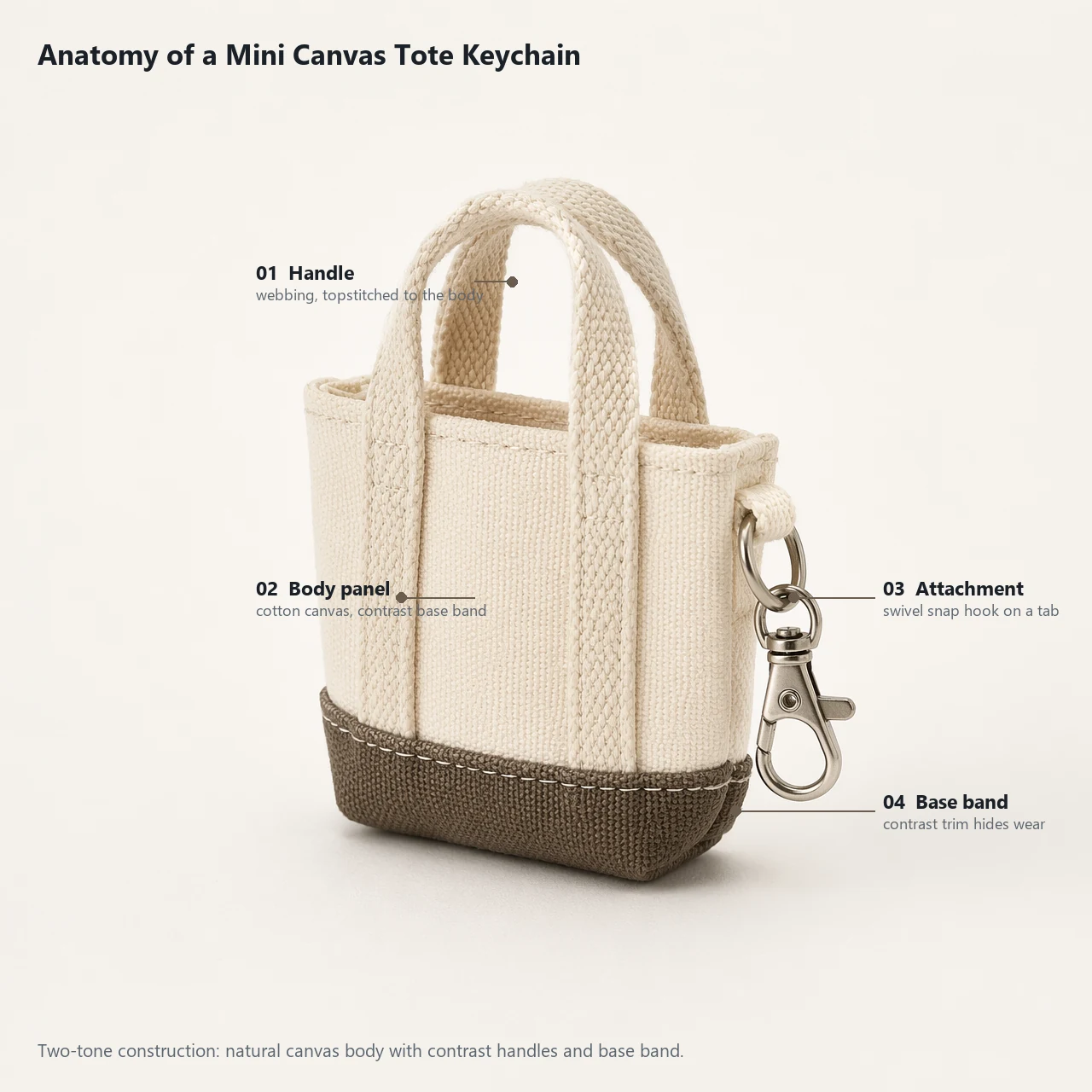
Flat two-panel, gusseted, zippered, quilted, or matched set |
Open-top or zippered, gusseted, lined, with inner pockets |
| Capacity |
Decorative when flat; pocket-scale when gusseted — earbuds, coins, cards, lip balm |
Primary carry: groceries, books, work items, retail purchases |
| Handle / attachment |
One purchased attachment — swivel snap hook, split ring, or ball chain — on a reinforced fabric tab |
Sewn self-fabric or webbing handles, bartacked to the body; no attachment component |
| Cost driver |
Print colors, build type, and packaging outweigh fabric cost |
Fabric weight and consumption dominate, followed by print coverage |
| Freight |
Hundreds of units per master carton; cube per unit is negligible |
High cube and weight per unit; freight is a material line in landed cost |
| QC focus |
Attachment pull and swing test, print registration at small scale, color match across body, handle, and base band |
Handle attachment under load, seam and bottom integrity, print coverage, dimensional tolerance |
| Typical channels |
Retail add-on beside the register, gift-with-purchase, promotional giveaway, museum and bookstore souvenir |
Core retail assortment, supermarket and distributor programs, promotional hero item |
The Five Build Types
Two mini totes at identical dimensions can differ by 60% in cost and by a full grade in perceived quality. The difference is construction, not fabric.
Type A — Flat two-panel. Two panels sewn face-to-face, turned through a gap, top-stitched, handles bartacked, attachment inserted at a side seam or fabric loop. No gusset, so depth is effectively zero. Lowest fabric consumption, fastest sewing, lays flat in packaging, prints easily on both faces — but cannot hold objects and reads as pure decoration.
Cost: Low. Best for high-volume giveaways and value retail.
Type B — Gusseted functional. Adds a base gusset and side panels for 1.5 to 3 cm of depth, opening into a real cavity that works as a coin pouch or earbud holder and justifies a higher retail price. Needs more operations and tighter tolerance control, with greater risk of puckering at miniature scale.
Cost: Medium. The most versatile configuration for retail add-on programs.
Type C — Zippered. Type B plus a small nylon or metal zip across the top edge. Holds contents securely and supports a higher price tier, but the zip is the highest-risk component: tape width, slider quality, and curvature must be validated against the miniature opening. Cheap zips are the leading cause of returns in this build.
Cost: Medium to High. Best where the product is marketed as an earbud case or coin purse.
Type D — Structured or quilted. A layered body of outer fabric, padding, and lining with quilted or paneled stitching. Highest perceived value, excellent for embroidery, and it holds shape on a peg hook — at the highest material and labor cost, with more complex print placement on multi-layer panels. .
Cost: High. Best for premium retail and higher-tier gift-with-purchase programs.
Type E — Matched set. A full-size tote and its miniature twin sold as a coordinated pair — the "mini-me" concept that dominates retail displays. The mini replicates the full-size proportions, handle color, and print placement so the two read as one design, giving the highest perceived value per unit and a single hero product for photography. Both components must be developed in parallel, and color matching between large and small panels is unforgiving.
Cost: High, with the lowest cost per unit of perceived value. Best for collections, corporate gifting, and museum or bookstore retail.
| Build |
Fabric use |
Sewing operations |
Closure |
Perceived value |
Best channel |
| A — Flat two-panel |
Lowest |
Lowest |
None |
Basic |
Giveaway, event, value retail |
| B — Gusseted functional |
Medium |
Medium |
None |
Good |
Retail add-on, gift shop |
| C — Zippered |
Medium |
High |
Zip |
Very good |
Accessory retail |
| D — Quilted / structured |
High |
High |
Optional |
Premium |
Fashion retail, GWP |
| E — Matched set |
Highest total |
Highest total |
Optional |
Highest |
Collections, corporate gift |
Fabric and Weight: The Ounce Ladder, and Why Heavier Is Wrong Here
Choosing the Weight
| Canvas weight |
Metric equivalent |
Hand feel |
Suitability for a mini tote |
| 6 oz |
≈ 203 g/m² |
Light, soft, slightly limp |
Workable for flat Type A only |
| 8 oz |
≈ 271 g/m² |
Balanced, holds a crease |
Sweet spot for most mini totes |
| 10 oz |
≈ 339 g/m² |
Firm, structured |
Good for gusseted and zippered builds |
| 12 oz |
≈ 407 g/m² |
Stiff, heavy-bodied |
Upper limit; adds bulk to small bodies |
| 14 oz |
≈ 475 g/m² |
Rigid, board-like |
Rarely appropriate below 10 cm |
Specifying the heaviest canvas available — sensible for a load-bearing grocery tote — works against you at charm scale, and three penalties compound as weight rises:
- Stiffness at miniature scale. Heavy canvas resists the tight turns required at corners and handle joints, producing puckering, flared seams, and a shape that never sits flat.
- Mass at the attachment point. A heavier body puts more static and dynamic load on an attachment only a few millimeters thick. Handle drop, a nuisance on a full-size tote, becomes product failure on a charm.
- Cost without perceived benefit. Heavier fabric costs more per square meter and takes longer to sew. In miniature products, value perception comes from print crispness, hardware finish, and packaging.
Recommendation: specify 8 oz to 10 oz (≈271–339 g/m²) as the working range, reserving 12 oz and above for structured Type D builds that must hold a shape on a display hook.
Attachment Hardware
Finding Options
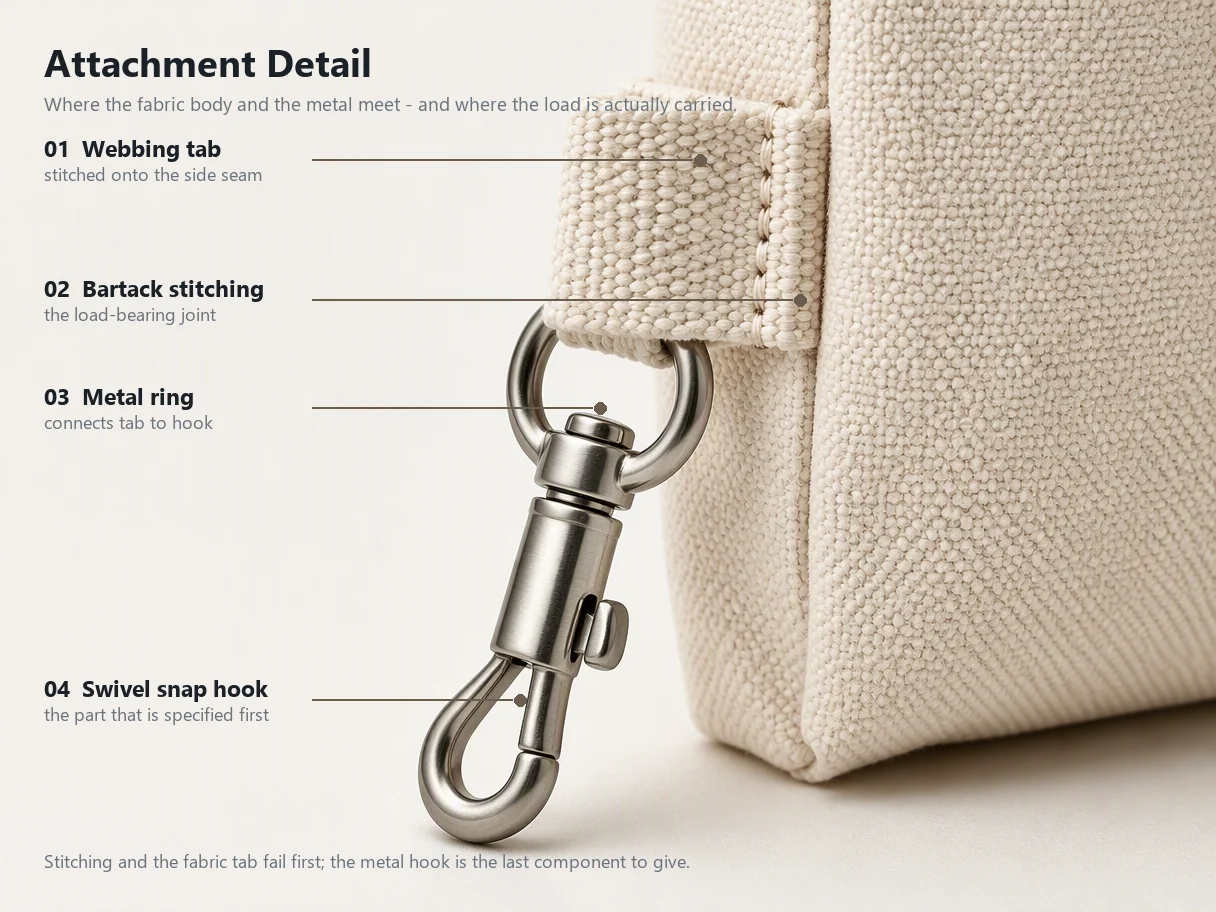
The attachment — the "finding," in hardware terminology — determines how the charm behaves in daily use. Five options cover nearly every program.
Finding |
Mechanism |
Best for |
Watch-outs |
Swivel snap hook |
Spring gate on a rotating base |
Clipping to bag straps, D-rings, belt loops |
The swivel joint is a wear point; specify a riveted or welded base, not a friction-fit pin |
Lobster clasp |
Larger trigger-style gate |
Chunky charm aesthetics; easy one-hand clipping |
Heavier and more visible; check it does not dominate a 6 cm body |
Split ring |
Coiled wire ring, no gate |
Lowest-cost keyring attachment |
Harder to attach; can chew through a lightweight fabric loop |
Ball chain |
Beaded chain with connector |
Delicate, jewelry-adjacent charms; short drop |
Weakest pull strength of the group; needs a reinforced fabric tab |
Fabric loop + D-ring |
Sewn loop through a metal D-ring |
Matched sets where the charm mirrors the tote's trim |
Adds a sewing operation; the loop must be bartacked or it pulls out |
For a canvas mini tote, the swivel snap hook is the default for good reason: it clips to almost anything, it rotates so the charm hangs front-facing, and it instantly signals "detachable accessory."
Plating and Finish
- Nickel-plated (bright silver):Lowest cost, brightest appearance, and the finish most likely to release nickel. Requires verified compliance.
- Nickel-free plating(for example copper–tin–zinc systems):Slightly higher cost, removes the nickel-release question entirely. The safest specification for EU-bound and child-adjacent merchandise.
- Antique brass or bronze:Warm and muted; reads as heritage or vintage. Popular in bookstore, museum, and home-goods retail.
- Matte black or gunmetal:Modern and masked; suits streetwear and utility aesthetics.
- Gold tone:A premium signal; oxidation and wear-through are the risks to test for.
Printing and Branding at Miniature Scale
Why Standard Artwork Fails
A full-size tote offers a print area around 30 × 35 cm; a mini tote keychain offers roughly 5 × 5 cm per face, less once handle and trim margins are excluded — a reduction of over 95%. Four failure patterns recur: fine detail collapses (thin strokes fill in, small serifs merge, negative space floods with color); small text becomes illegible (anything below roughly 4–5 mm cap height reads as a smudge in a photograph); gradients band (miniature screen printing cannot deliver smooth tonal transitions reliably); and multi-color registration drifts (each added color adds tolerance, and at this scale a 0.5 mm drift is a visible defect). The corrective approach is to design a single-purpose charm mark rather than shrink the tote artwork: a one- or two-color simplified icon, a monogram, a bold open typeface, or a solid silhouette reads perfectly at 4 cm.
Decoration Methods Compared
| Method |
Best for |
Minimum practical detail |
Durability |
Cost |
| Screen print |
1–3 solid colors, bold shapes |
~1 mm line weight; no gradients |
Excellent when properly cured |
Low |
| Heat transfer / DTF |
Multi-color and photographic designs |
Moderate; small text still a limit |
Good, adhesion-dependent |
Medium |
| Embroidery |
Logos, monograms, texture-rich marks |
~2 mm minimum stroke; no fine outlines |
Very good, abrasion-resistant |
Medium–High |
| Woven label / patch |
Brand labels and tag-like marks |
High detail even at small size |
Excellent |
Medium |
Two practical notes. First, the handle is a print surface: a logo along a dyed-to-match handle adds visibility without competing with the body design. Second, for matched sets the charm's mark should be a simplified reduction of the full-size mark, not an identical copy — the reduction is what makes the pair read as a designed family.
Sizes, Proportions, and the Specification Sheet
Reference Size Bands
| Size band |
Approx. dimensions |
Depth |
Typical use |
| Micro |
5 × 5 cm |
Flat |
Pure decoration; the smallest credible "tote" |
| Small |
6 × 6 cm |
1.5–2 cm gusset |
Candy, a single coin, a ring; retail impulse |
| Standard |
8 × 8 cm |
2–3 cm gusset |
Earbuds, coins, lip balm, cards; most versatile |
| Large mini |
10 × 10 to 12 × 12 cm |
3 cm gusset |
Small pouch use; strongest perceived value |
Proportions That Read as a Tote
- Body height : width — roughly 1 : 1 to 1.2 : 1 keeps the silhouette square and tote-like. Wider reads as a pouch; taller reads as a gift bag.
- Handle drop : body height — the handles should arc to about half the body height or slightly more. A shorter arc reads as a decorative tab rather than a handle.
- Handle width : body width — 10–18% of body width looks proportionate. Thicker looks clumsy; thinner looks flimsy before it is.
The Specification Sheet to Approve Before Sampling
| Field |
Example format |
Why it matters |
| Dimensions (W × H × D) |
80 × 80 × 25 mm |
The base specification |
| Dimensional tolerance |
± 3 mm |
Miniature bodies amplify variance |
| Fabric |
Cotton canvas, 10 oz / 339 g/m², pre-shrunk |
Cost and hand feel |
| Fiber content |
100% cotton (or blend %) |
Labeling and claims |
| Color references |
Body: natural; handle/band: Pantone TCX 19-4052 |
Reproducibility |
| Construction |
Type B, gusseted, bound inner seam |
Cost and durability |
| Stitching |
Lockstitch, ~8–10 stitches per inch, bartacked handle joints |
Strength |
| Attachment |
Swivel snap hook, nickel-free plating, 25 mm, tested pull value |
Compliance and durability |
| Print |
One color front, 40 × 40 mm maximum imprint, Pantone matched |
Branding |
| Labels |
Woven brand label in side seam, 20 × 10 mm |
Retail requirement |
| Packaging |
Header card + poly bag, 50 per inner, 500 per carton |
Freight and retail |
| Carton |
5-ply; dimensions in mm and gross weight in kg |
Freight quoting |
| Certification |
OEKO-TEX Standard 100 on fabric |
Buyer due diligence |
Developing a Matched Set
Develop both components against each other rather than sequentially:
- Approve fabric and lab-dips for the full-size and miniature bodies in a single color-approval step.
- Print the full-size artwork first, then derive the simplified miniature mark from it.
- Confirm handle width and color are identical across both components — the same fabric roll lot where possible.
- Photograph the pair on one background, in one light, at final production standard before approving bulk.
Step 3 is most often skipped and produces the most expensive complaints: a handle color that matches in isolation but shifts visibly when the large and small panels sit side by side.
Packaging
A mini tote keychain has no shelf presence on its own: it is small, soft, and often lighter in color than its surroundings. Packaging is what makes it findable on a pegboard, photographable for e-commerce, and compliant at retail. The workhorse format is a header card — folded over the product, stapled or clipped, with a euro slot punched so the item hangs from a standard retail peg. It is cheap, printable on both faces, and provides a legal surface for warnings, fiber composition, care instructions, and a barcode.
| Format |
When it is the right choice |
Cost |
| Header card with euro slot |
Pegboard retail; the default format |
Low |
| Backing card, no slot |
Flat lay-down or counter bin display |
Low |
| Poly bag with printed label |
Bulk, giveaway, in-house fulfillment |
Lowest |
| Rigid gift box with insert |
Corporate gifting, subscription boxes, premium retail |
High |
| Fabric drawstring pouch as outer pack |
High-end gift programs; reusable secondary packaging |
Medium–High |
Costing
On a miniature product, fabric is rarely the dominant cost.
| Cost driver |
Impact |
Notes |
| Build type (flat → gusseted → zippered → quilted) |
High |
The largest single lever; decide it first |
| Print colors and locations |
High |
Extra color means extra setup and an extra pass |
| Attachment type, material, plating finish |
Medium–High |
Nickel-free and premium finishes cost more |
| Fabric weight and fiber |
Medium |
Material premium with low labor impact |
| Lining and interior finishing |
Medium |
Labor-dominant; drops sharply when omitted |
| Packaging format |
Medium |
The most underestimated line |
| Woven or embroidered brand label |
Low–Medium |
High perceived value per cent spent |
| Order quantity |
High (inverse) |
Fixed setup costs spread across units |
Freight and Quality Control
Freight: The Structural Advantage
Freight is where the mini tote keychain outperforms almost any other bag product. Hundreds of units fit in the cube occupied by a few dozen full-size totes.Ask for pieces per inner bag, pieces per master carton, carton dimensions, and gross weight per carton at quotation stage — not after production. Carton dimensions drive volumetric charges, so a carton one centimeter too deep can move a shipment into a higher bracket. Confirm carton strength (5-ply corrugated is the usual export expectation) and whether the master carton will be palletized for the destination warehouse.
Pre-Shipment Quality Control Checklist
| # |
Check |
Method |
| 1 |
Dimensions within tolerance |
Measure 10 pieces against the spec sheet (W × H × D) |
| 2 |
Handle attachment integrity |
Visual check of bartacks; confirm stitch count per inch |
| 3 |
Attachment pull strength |
Static pull test to the agreed load; no deformation |
| 4 |
Plating condition |
No pitting, discoloration, or flaking on any attachment |
| 5 |
Print registration and adhesion |
Compare against golden sample; rub test for transfer |
| 6 |
Color consistency across components |
Body, handle, and band compared side by side |
| 7 |
Zip function (Type C only) |
Open and close 20 cycles; no jamming or skipped teeth |
| 8 |
Interior finish |
No loose threads, raw edges, or lining pull-out |
| 9 |
Label placement |
Woven label position, orientation, and secure stitching |
| 10 |
Packaging integrity |
Header card alignment, euro slot clean, barcode scannable |
| 11 |
Carton markings and count |
Correct quantity per carton; shipping marks legible |
| 12 |
Golden sample comparison |
Approve the lot against the sealed reference |
Applications of Mini Canvas Tote Bag Keychains
Because of its small size and recognizable tote bag appearance, a Mini Canvas Tote Bag Keychain can be used in many different business scenarios.
Unlike ordinary promotional items that are often discarded after use, this product combines decoration and functionality, making it more suitable for long-term brand exposure.
Current market applications include promotional merchandise, retail accessories, collectible items, and packaging accessories. Some suppliers position them specifically for logo printing, attaching them to handbags, backpacks, or keys, while customized versions may include embroidery, zipper functions, or small storage capabilities.
Promotional Gifts and Corporate Giveaways
One of the most common uses of Mini Canvas Tote Bag Keychains is as a promotional product.
Companies often need promotional items that are:
- affordable for bulk orders
- easy to distribute
- visually memorable
- related to their brand identity
Traditional promotional products such as plastic keychains or simple metal tags usually have limited branding space.
A canvas mini tote keychain provides a fabric surface where companies can add:
- logos
- brand colors
- slogans
- event information
This makes it suitable for:
- trade shows
- company events
- product launches
- customer appreciation gifts
- marketing campaigns
For example, a company selling lifestyle products may use a mini tote keychain as a small gift attached to the main product packaging.
The accessory reinforces the brand image while creating an additional customer touchpoint.
Retail Accessories and Merchandise Products
For retailers, Mini Canvas Tote Bag Keychains can become independent products rather than only promotional gifts.
Their small size creates several advantages:
- lower shipping cost
- easy inventory management
- suitable for impulse purchases
- attractive as collectible accessories
They can be sold as:
- handbag charms
- backpack accessories
- seasonal merchandise
- gift items
Many consumers are attracted to miniature versions of familiar products because they provide a sense of collectibility.
A mini tote keychain can also be designed as a smaller version of a brand's signature tote bag, creating consistency between different product categories.
Brand Merchandise and Lifestyle Collections
For fashion and lifestyle brands, accessories often help expand the product range.
A brand that already sells:
- canvas tote bags
- handbags
- apparel
- lifestyle products
can develop matching mini tote keychains as complementary merchandise.
For example:
A full-size canvas tote → mini tote keychain version
This creates a connection between the main product and accessory collection.
The mini version does not replace the original product.
Instead, it works as:
- a collectible item
- a gift option
- an extension of brand identity
Gift Packaging Accessories
Another interesting application is using mini tote keychains as part of product packaging.
Instead of traditional packaging decorations, brands can attach a customized mini tote to:
- gift boxes
- shopping bags
- subscription packages
- promotional bundles
This creates additional perceived value.
For example:
A skincare brand may include a small canvas tote keychain with a gift set.
A coffee brand may attach a branded mini tote charm to seasonal packages.
Because the accessory itself can be reused, it extends the life of the packaging beyond the original purchase.
FAQ
What is a Mini Canvas Tote Bag Keychain?
A Mini Canvas Tote Bag Keychain is a miniature tote-shaped accessory made from canvas fabric with a keychain attachment. It can be used as a bag charm, promotional gift, or small accessory.
Can Mini Canvas Tote Bag Keychains be customized with logos?
Yes. Common customization methods include screen printing, embroidery, woven labels, and custom colors.
Are Mini Canvas Tote Bag Keychains only decorative?
Not always. Some designs include zipper closures, allowing them to store small items such as coins, cards, or earbuds.
Conclusion
A Mini Canvas Tote Bag Keychain may be small in size, but it requires the same attention to design, materials, and craftsmanship as larger bags.
From canvas selection and handle construction to logo placement and hardware choices, each detail affects the final appearance and user experience.
For promotional companies, retailers, and private label brands, this product provides a flexible way to create customized accessories that are practical, visually attractive, and closely connected with textile products.
When developing a Mini Canvas Tote Bag Keychain, buyers should consider not only the price but also:
- product purpose
- material selection
- customization method
- quality requirements
- target customer expectations
A well-designed mini tote keychain can become more than a simple accessory. It can become a small but recognizable part of a brand's product identity.
Related Products


 Hot News