EVA is one of those materials that people often recognize without realizing what it actually is.
You may have seen it in shoe soles, protective cases, sports equipment, foam sheets, packaging, beach products, insulated bags, and molded accessories. In the bag industry, EVA can appear as a flexible sheet, a molded body, a structural panel, a protective layer, or a foam component.
But “EVA” does not describe one single material specification.
Two EVA products can look similar while behaving very differently. One may be soft and highly flexible, while another feels firm and structured. One may be designed for cushioning, while another is selected for shape retention. Density, vinyl acetate content, cell structure, thickness, hardness, and processing method can all influence the final performance.
This guide explains EVA from that practical perspective. It covers what EVA is, how it is made, how EVA foam differs from solid EVA, why EVA is lightweight and water-resistant, how its properties change with formulation and density, where EVA is used, and what buyers should consider when specifying EVA for bags and other products.
What Is EVA Material?
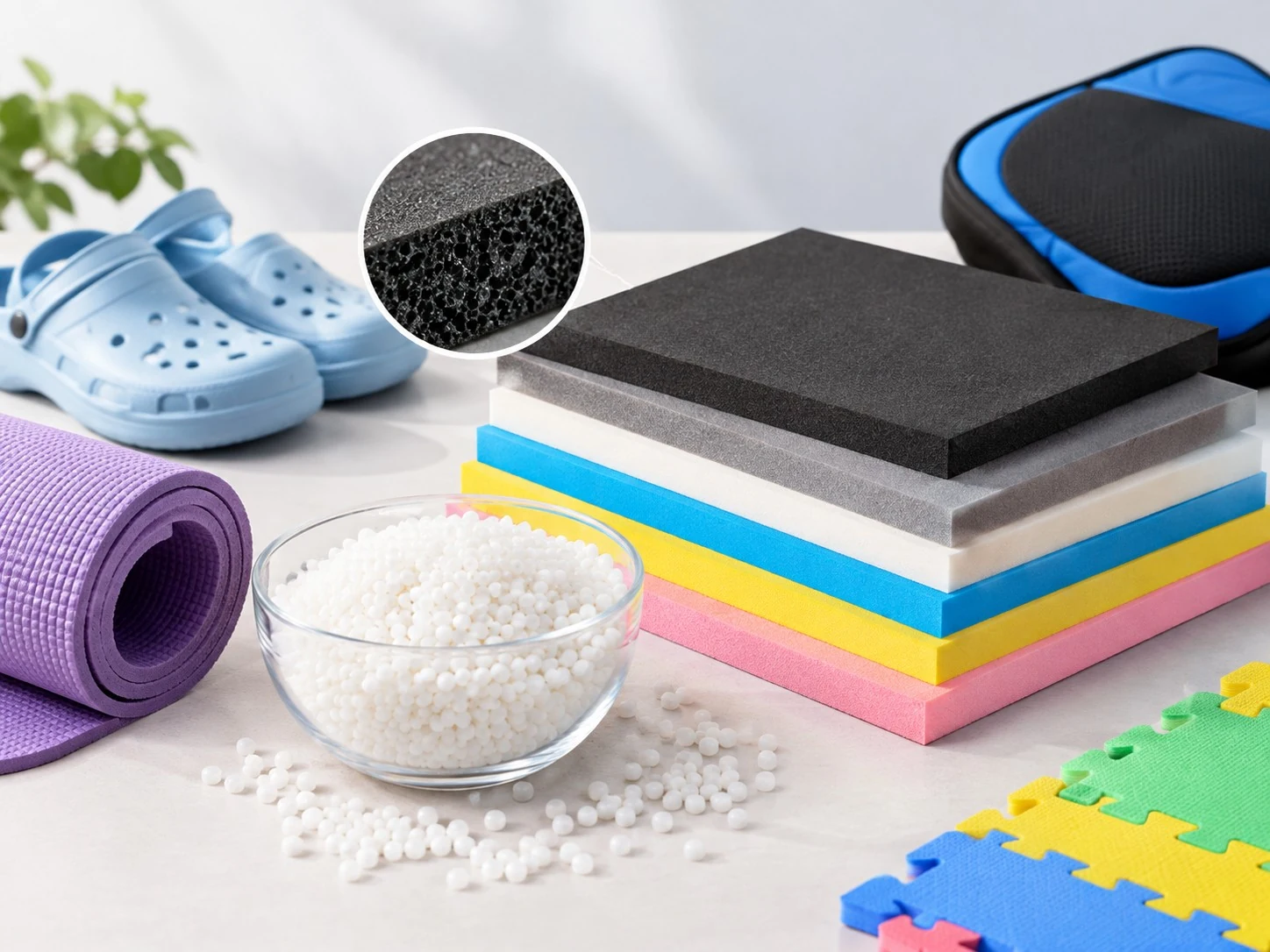
EVA stands for Ethylene-Vinyl Acetate.
It is a copolymer made by combining two monomers: ethylene and vinyl acetate. Unlike a simple polymer made from only one repeating monomer, a copolymer allows manufacturers to modify the balance of properties by changing the composition and processing conditions.
The result is a material that can combine characteristics associated with both plastics and rubber.
Depending on its formulation, EVA can be:
- Flexible rather than rigid
- Soft rather than hard
- Lightweight
- Resilient
- Impact-absorbing
- Moisture-resistant
- Easy to process
- Available in solid or foamed forms
- Suitable for molding, extrusion, laminating, and other manufacturing processes
The amount of vinyl acetate has an important influence on the behavior of EVA. As vinyl acetate content increases, the material generally becomes less crystalline and more flexible, with greater elasticity and toughness. EVA grades can therefore be formulated for substantially different applications.
This flexibility in formulation is one of the reasons EVA appears across such different industries.
A shoe sole and a protective bag insert may both contain EVA, but that does not mean they use the same EVA specification.
EVA Is a Copolymer, Not Simply “A Type of Foam”
One common misunderstanding is that EVA automatically means EVA foam.
It does not.
EVA is the underlying polymer material. It can be processed into different forms, including films, sheets, molded parts, and foams.
When EVA is expanded through a foaming process, gas-filled cells are introduced into the material. This changes its density, flexibility, cushioning behavior, and weight.
Therefore:
EVA ≠ EVA foam
EVA foam is one important form of EVA, but it is not the definition of EVA itself.
This distinction becomes particularly important when discussing bags.
A bag manufacturer may use EVA as a structural sheet, while another product may use EVA foam as an insulation or cushioning layer. Calling both simply an “EVA bag” does not tell a buyer enough about the actual construction.
How Is EVA Made?
EVA is produced by copolymerizing ethylene with vinyl acetate.
The resulting EVA resin can then be processed into different forms depending on the desired end use.
At a simplified level, the process can be understood in several stages:
1. Polymerization
Ethylene and vinyl acetate are chemically combined to create the EVA copolymer.
The proportion of vinyl acetate affects the resulting material's flexibility, toughness, crystallinity, adhesion, and other properties.
Commercial EVA grades can cover a relatively broad range of vinyl acetate concentrations, so “EVA” alone does not define a single performance level.
2. Resin Formation
The polymer is processed into a usable resin, commonly supplied in pellet form.
These pellets can later be melted and processed using manufacturing techniques appropriate to the final product.
3. Shaping and Processing
Depending on the application, EVA can be:
- Extruded into sheets or films
- Molded into three-dimensional components
- Processed into foam
- Combined with other materials
- Laminated onto fabrics or other substrates
- Converted into protective or structural components
4. Foaming
When EVA foam is required, the polymer is expanded during processing.
The foaming process creates cells within the material. Depending on the formulation and manufacturing method, the resulting foam can have different densities, hardness levels, cell structures, and compression characteristics.
Closed-cell EVA foam is particularly common in applications requiring lightweight cushioning and resistance to water penetration. EVA foam structures are widely used in cushioning, packaging, sports products, footwear, and protective applications.
The important point for buyers is that manufacturing does not simply turn EVA into one standard material.
The final performance depends on the specific grade and construction.
EVA vs. EVA Foam: What Is the Difference?
This is one of the most important distinctions to understand before discussing EVA applications.
Solid EVA
Solid EVA has a relatively uniform material structure.
It can be processed into:
- Sheets
- Films
- Molded components
- Flexible structural parts
- Sealing layers
- Other shaped products
Compared with foam, solid EVA generally provides a denser and more continuous material structure.
It may be selected when the product needs:
- A smoother surface
- More structural stability
- Controlled flexibility
- Shape retention
- A thin functional layer
- Specific sealing or bonding characteristics
EVA Foam
EVA foam contains a cellular structure created during foaming.
The air-filled cells reduce the material's density and change how it responds to pressure.
Depending on its specification, EVA foam can provide:
- Cushioning
- Impact absorption
- Lightweight structure
- Compression resistance
- Thermal insulation
- Softness
- Protective padding
Closed-cell EVA foam is especially useful when both cushioning and moisture resistance are important. The cellular structure also contributes to the material's low weight.
A Simple Comparison
| Characteristic |
Solid EVA |
EVA Foam |
| Structure |
More uniform |
Cellular |
| Density |
Generally higher |
Generally lower |
| Cushioning |
Moderate to application-specific |
Stronger cushioning potential |
| Weight |
Lightweight |
Usually even lighter |
| Flexibility |
Depends on formulation |
Depends on density and cell structure |
| Shape support |
Good |
Depends on thickness and density |
| Insulation |
Limited compared with foam |
Better suited to insulation |
| Common applications |
Films, sheets, molded parts |
Padding, protection, insulation, cushioning |
Neither form is automatically “better.”
The correct choice depends on what the product needs to accomplish.
For example, if a buyer wants a structured beach tote that can be rinsed easily, a molded or sheet-based EVA construction may be more relevant.
If a lunch bag needs a lightweight insulation layer, EVA foam may be considered as part of the multilayer construction.
What Properties Make EVA Useful?
EVA is popular because it does not rely on one exceptional property.
Its value comes from the combination of several characteristics.
The balance between flexibility, weight, resilience, moisture resistance, cushioning, and processability allows manufacturers to adapt EVA to different product requirements.
1. Flexibility
One of EVA's most recognizable characteristics is flexibility.
The vinyl acetate component reduces the crystallinity associated with polyethylene-like structures, allowing the polymer to become softer and more flexible as the formulation changes.
This makes EVA useful when a product needs to bend without behaving like a rigid plastic.
In practical product design, flexibility can help with:
- Folding
- Bending
- Compression
- Handling
- Ergonomic shapes
- Soft protective structures
However, flexibility should not be confused with unlimited stretch.
An EVA material can be flexible without being designed to stretch like an elastic fabric.
For custom products, buyers should therefore specify the desired behavior rather than simply asking for “soft EVA.”
2. Lightweight Construction
EVA is relatively lightweight, and EVA foam can be even lighter because its cellular structure introduces air into the material.
This is important in products that consumers carry frequently.
A protective material that adds too much weight can reduce the usability of the final product.
For bags, lightweight construction can be useful in:
- Beach totes
- Travel bags
- Cosmetic cases
- Lunch bags
- Protective sleeves
- Outdoor products
- Children's products
- Promotional products
The challenge is balancing weight against structural performance.
Reducing density can make EVA lighter, but a very low-density material may not provide the same firmness or compression resistance as a denser specification.
Therefore, lighter is not automatically better.
3. Cushioning and Impact Absorption
EVA foam is widely used for cushioning because its cellular structure can compress under impact.
When force is applied, the cells deform and help dissipate energy.
This property explains why EVA is commonly found in:
- Footwear
- Sports equipment
- Protective cases
- Packaging inserts
- Mats
- Padding
- Protective bag components
The actual cushioning performance depends on more than the word “EVA.”
Density, thickness, hardness, cell structure, and processing method all influence how a particular foam behaves.
For example, a thin EVA sheet and a thick EVA foam insert may both be called EVA, but their ability to protect a product will obviously be different.
For buyers developing protective bags, it is therefore useful to define:
- Product weight
- Expected impact level
- EVA thickness
- Foam density
- Desired firmness
- Required flexibility
- Whether the EVA is used as a full panel or only in selected areas
4. Moisture Resistance
EVA is generally resistant to water and moisture compared with absorbent textile materials.
This characteristic is one reason EVA is attractive for outdoor products.
A conventional cotton fabric can absorb water into its fibers.
EVA behaves differently because it is a polymer material with a relatively non-absorbent surface.
This can make EVA useful for:
- Beach products
- Poolside products
- Bathroom organizers
- Wet-item carriers
- Outdoor accessories
- Easy-clean bags
However, there is an important distinction:
Water-resistant material does not automatically mean a completely waterproof finished bag.
The finished product can still allow water through:
- Seams
- Stitching holes
- Zippers
- Handles
- Openings
- Attached fabric panels
- Poorly sealed joints
Therefore, when a buyer requires a waterproof product, the material specification is only one part of the equation.
Construction matters too.
5. Easy Cleaning
The relatively smooth and non-absorbent surface of EVA can make it easier to wipe or rinse than many textile materials.
This is particularly useful when products are exposed to:
- Sand
- Water
- Food residue
- Cosmetics
- Dirt
- Outdoor environments
This is one reason EVA is attractive for some beach bags and lifestyle products.
Your existing beach-bag content already identifies EVA's easy-clean and quick-drying characteristics as reasons it can work well in structured beach products.
6. Resilience and Shape Recovery
EVA can provide good resilience, meaning it can deform under pressure and recover toward its original shape depending on the grade and construction.
This characteristic is useful for products that experience repeated compression or handling.
For example:
- Protective padding
- Shoe components
- Travel accessories
- Flexible cases
- Bag panels
- Sports products
But resilience is not unlimited.
Repeated compression, excessive load, high temperatures, UV exposure, and unsuitable formulation can eventually affect performance.
A buyer should therefore evaluate the expected use environment rather than assume that all EVA products will have the same service life.
7. Thermal Insulation
EVA foam can contribute to thermal insulation because the cellular structure reduces heat transfer.
This is one reason foam materials are commonly used in insulated products.
However, EVA should not be treated as a complete insulation system by itself.
The thermal performance of a cooler or lunch bag depends on the entire construction, including:
- Outer fabric
- Foam type
- Foam thickness
- Lining
- Seams
- Opening design
- Zipper construction
- Bag volume
- Ambient temperature
- Amount and temperature of contents
Your existing lunch-bag content correctly treats insulation as a multilayer system rather than assuming that the outer material alone determines temperature retention.
This distinction is important when specifying EVA for insulated bags.
What Are the Limitations of EVA?
EVA has many useful characteristics, but it is not suitable for every application.
Understanding its limitations helps buyers avoid choosing it simply because it sounds versatile.
1. Heat Sensitivity
Some EVA products can deform or change performance under excessive heat.
This matters when products may be exposed to:
- Hot vehicles
- Direct sunlight
- High-temperature storage
- Industrial heat
- Hot surfaces
The exact temperature resistance depends on the formulation and construction.
If the product will regularly experience high temperatures, ask the manufacturer for the relevant technical specification.
2. UV Exposure
Long-term exposure to strong UV radiation can affect some EVA formulations.
Material aging may result in changes to:
- Color
- Flexibility
- Surface appearance
- Mechanical performance
The severity depends on formulation, additives, exposure conditions, and product design.
Therefore, outdoor products intended for prolonged sun exposure should be evaluated for the actual environment rather than assuming that all EVA has the same weathering resistance.
3. Compression Set
Foam materials can experience permanent deformation after prolonged compression.
This is important when EVA foam is used as padding or structural support.
A foam that repeatedly experiences high compression may gradually fail to return completely to its original thickness.
For protective products, compression-set performance can therefore be more important than simply knowing the material is EVA.
4. Bulk and Shipping Volume
Compared with thin textile bags, some EVA products can occupy more space.
This matters for:
- Warehousing
- Container loading
- Retail storage
- E-commerce fulfillment
- International shipping
A foldable canvas or polyester bag may collapse into a very small volume.
A molded EVA product may retain its shape.
For high-volume B2B orders, shipping volume should therefore be considered during product development.
5. Cost
EVA pricing depends on:
- Grade
- Density
- Thickness
- Processing
- Mold requirements
- Color
- Surface finish
- Quantity
- Construction
- Additional fabrics and components
A simple EVA sheet product and a complex molded EVA bag should not be expected to have the same cost structure.
The right question is not simply:Is EVA expensive?
It is:What EVA specification and construction are required for this product?
What Factors Change EVA Performance?
There is no single “standard EVA performance.”
Different EVA grades can behave differently.
For B2B buyers, several factors are particularly important.
Vinyl Acetate Content
Vinyl acetate content is one of the variables that affects EVA behavior.
As the vinyl acetate proportion increases, EVA generally becomes more flexible, less crystalline, and more rubber-like. It can also show changes in toughness, adhesion, transparency, and low-temperature behavior.
This means that two EVA materials can have noticeably different flexibility even though both are correctly described as EVA.
For most buyers, however, the exact chemical formulation is usually less important than the resulting performance requirements.
Instead of specifying chemistry without knowing why, it is often more practical to tell the manufacturer what the product needs to do.
Density
Density is especially important for EVA foam.
A higher-density foam generally provides a different combination of firmness, compression behavior, and structural support than a lower-density foam.
A lower-density foam may be lighter and softer.
A higher-density foam may provide more support and resistance to compression.
The appropriate value depends on the application.
For example:
| Density Band |
Feel and Behavior |
Typical Bag and Packaging Use |
| 20–35 kg/m³ (1.25–2.18 lb/ft³) |
Very soft, highly compressible, lightest |
Soft inserts, protective wrap for light items, cosmetic padding |
| 35–70 kg/m³ (2.18–4.37 lb/ft³) |
Soft to medium; balanced cushioning and recovery |
Laptop sleeve padding, cosmetic bag panels, cooler bag walls |
| 70–120 kg/m³ (4.37–7.49 lb/ft³) |
Firm; resists compression, holds shape |
Base panels, structured bag bodies, tool organizers |
| 120–200 kg/m³ (7.49–12.49 lb/ft³) |
Rigid-feeling, board-like; minimal give |
Semi-rigid shells, heavy-duty protective trays, industrial dividers |
There is no universal “best EVA density.”
Hardness
Hardness determines how firm the material feels and how it responds to pressure.
For foam products, hardness can be measured using standardized methods and scales such as Shore hardness.
| Scale |
Typical Range for EVA |
What It Describes |
Notes |
| Shore A |
A20–A70 |
Harder elastomeric grades |
The stiffer end of EVA foam; used for shoe soles and firm panels |
| Shore C / Asker C |
C20–C70 |
Mid-range cellular materials |
Common in shoe and foam component specifications in Asia |
| Shore 00 |
00-20 to 00-70 |
Soft foam |
Typical for cushioning foam, gaskets, and padding grades |
For custom bags, hardness can affect the final product's:
- Hand feel
- Shape
- Foldability
- Protection
- Compression
- Premium appearance
When requesting samples, buyers should evaluate hardness physically rather than relying only on a written description such as “soft,” “medium,” or “hard.”
Thickness
Thickness has an obvious influence on performance, but thicker is not automatically better.
Increasing EVA thickness can increase:
- Cushioning
- Structural support
- Insulation
- Protection
But it can also increase:
- Weight
- Material consumption
- Product bulk
- Shipping volume
- Production cost
The right thickness should therefore be determined by the intended function.
For example, a lightweight promotional cosmetic case may need only a thin EVA layer, while a protective equipment bag may require a substantially thicker structure.
Cell Structure
For EVA foam, the cell structure is another important consideration.
Closed-cell foam is commonly used where low water absorption, lightweight cushioning, and insulation are desired.
Open-cell and closed-cell foams behave differently, so a buyer should not assume that every EVA foam product has identical moisture or compression characteristics.
EKI, for example, identifies EVA foam products by parameters including closed-cell structure, hardness, density, and cross-linked construction.
This is a useful reminder that “EVA foam” is still a category rather than a complete technical specification.
EVA vs PEVA vs PVC vs Neoprene: Material Comparison
Buyers frequently meet four materials in the same quotation and assume they are interchangeable because the names sound similar. They are not.
| Material |
Composition |
Softness and Cushioning |
Water Resistance |
Typical Bag Use |
Relative Cost |
| EVA (ethylene vinyl acetate) |
Ethylene + vinyl acetate copolymer |
High; tunable from soft to firm |
Excellent when foamed (closed cell) |
Foam padding, linings, molded panels, packaging inserts |
Cost: Medium. |
| PEVA (polyethylene vinyl acetate) |
Polyethylene with vinyl acetate; marketed as a chlorine-free vinyl alternative |
Moderate; thinner and less cushioned than EVA foam |
Excellent as a film; used as a lining membrane |
Shower curtains, garment bag linings, insulated bag linings, food wrap |
Cost: Low to Medium. |
| PVC (polyvinyl chloride) |
Vinyl chloride polymer plus plasticizers |
Initially high, but stiffness increases over time |
Excellent, and weldable |
Transparent cosmetic bags, document pouches, printed bag windows |
Cost: Low. |
| Neoprene (polychloroprene) |
Synthetic rubber, crosslinked |
Very high; best-in-class cushioning and rebound |
Excellent, and stays flexible in cold water |
Laptop sleeves, camera inserts, hard-wearing padded cases |
Cost: High. |
Where Is EVA Used?
EVA is used across many industries because its properties can be adjusted for different applications.
Common examples include:
Footwear
EVA is widely used in midsoles, insoles, soles, and cushioning components.
The material's low weight, flexibility, and cushioning behavior make it suitable for footwear applications.
Sports Products
EVA foam is used in:
- Exercise mats
- Protective padding
- Sports equipment
- Training products
- Impact-protection components
Packaging
EVA can be used in protective inserts and packaging structures where lightweight cushioning is required.
Protective Cases
Electronics, tools, cameras, and other equipment can benefit from EVA cushioning and structural protection.
Medical and Orthotic Products
EVA foam is used in various healthcare and orthotic applications because its softness, cushioning, and formability can be adapted to different needs.
Automotive Applications
Depending on the formulation, EVA can be used in sealing, padding, insulation, and other automotive components.
Adhesives
EVA is also used in hot-melt adhesive formulations. Its processing and adhesion characteristics make it useful in adhesive systems and packaging applications.
Bags and Carriers
For the bag industry, EVA is particularly interesting when a product requires some combination of:
- Water resistance
- Easy cleaning
- Lightweight structure
- Cushioning
- Shape retention
- Insulation
- A molded appearance
This makes EVA relevant to beach bags, lunch bags, cosmetic cases, protective cases, travel accessories, and other functional products.
How Is EVA Used in Bags?
EVA can play several different roles in a bag.
This is more useful to understand than simply asking whether a bag is “made of EVA.”
1. Full EVA Construction
Some bags are made primarily from EVA sheets or molded EVA components.
This type of construction can create a distinctive:
- Structured appearance
- Smooth surface
- Lightweight body
- Water-resistant exterior
- Easy-clean design
Molded EVA bags can also achieve shapes that would be difficult to reproduce with conventional woven fabrics.
This makes them suitable for lifestyle, beach, outdoor, and promotional products.
2. EVA as a Structural Layer
EVA does not have to form the entire exterior of a bag.
It can be used as an internal structural layer.
For example, a fabric bag can contain an EVA panel to help maintain its shape.
This approach allows the designer to combine:
- Textile aesthetics
- EVA structure
- Lightweight construction
- Custom printing
- Different surface textures
The exterior might be polyester, nylon, canvas, or another textile, while EVA provides support inside the construction.
3. EVA as Padding
EVA foam can also be placed in specific areas.
Examples include:
- Laptop compartments
- Camera bags
- Equipment bags
- Protective cases
- Travel organizers
In these products, the goal is not necessarily to make the entire bag from EVA.
Instead, EVA is used where protection matters most.
This can reduce unnecessary material use while maintaining functional protection.
4. EVA as Insulation
EVA foam can be incorporated into insulated bags as part of the insulation structure.
This can include:
- Lunch bags
- Cooler bags
- Picnic bags
- Food carriers
But the EVA layer should be considered as one component of the overall thermal system.
The outer material, insulation thickness, lining, opening, zipper, and construction all influence the final result.
Your existing cooler-bag content similarly emphasizes that temperature retention depends on insulation thickness, lining, ambient conditions, and packing method rather than a single material alone.
5. Perforated EVA
Perforation is another interesting option.
Small holes can be incorporated into an EVA bag to provide drainage and airflow.
This is especially relevant for:
- Beach bags
- Pool bags
- Wet-item carriers
- Outdoor products
A perforated EVA beach bag can allow sand and water to pass through instead of remaining trapped inside the bag.
This is one reason your existing site already treats EVA as a suitable material for structured beach totes and perforated beach designs.
What Types of Bags Can Use EVA?
EVA is not equally suitable for every bag.
It becomes most useful when the product has a functional reason for using it.
EVA Beach Bags
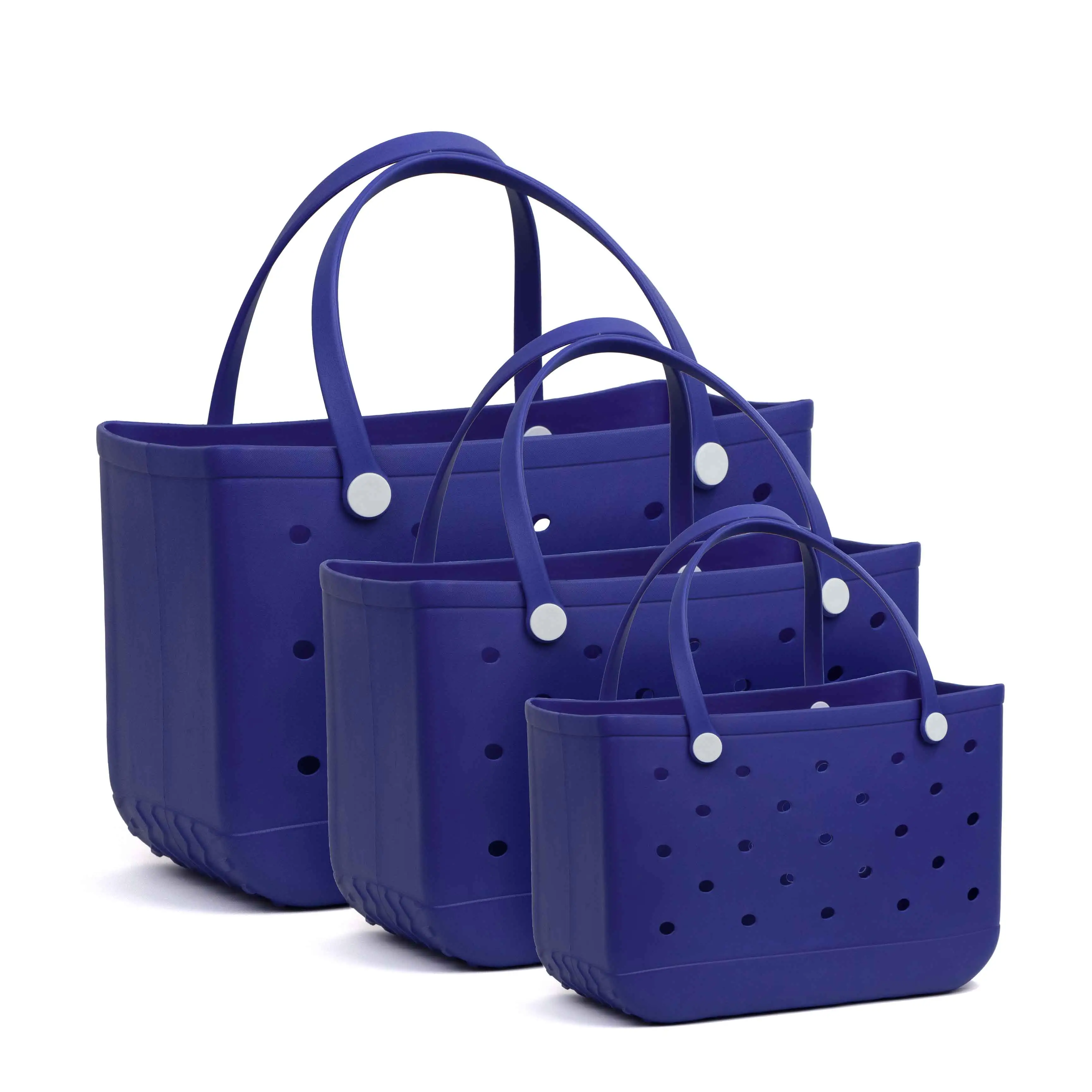
Beach products are one of the most visible applications.
EVA can provide:
- Water resistance
- Easy cleaning
- Quick drying
- Structural shape
- Sand-friendly perforation options
It can be especially attractive for brands looking for a more molded or modern appearance than a conventional canvas beach tote.
However, EVA bags can be bulkier than highly foldable fabric bags, which can affect storage and shipping.
EVA Lunch Bags and Cooler Bags
EVA can be used as part of insulated lunch and cooler bag constructions.
The material can contribute to:
- Insulation
- Structure
- Moisture resistance
- Easy cleaning
But buyers should not assume that an EVA exterior automatically provides excellent thermal retention.
The entire insulation system must be evaluated.
EVA Cosmetic Bags
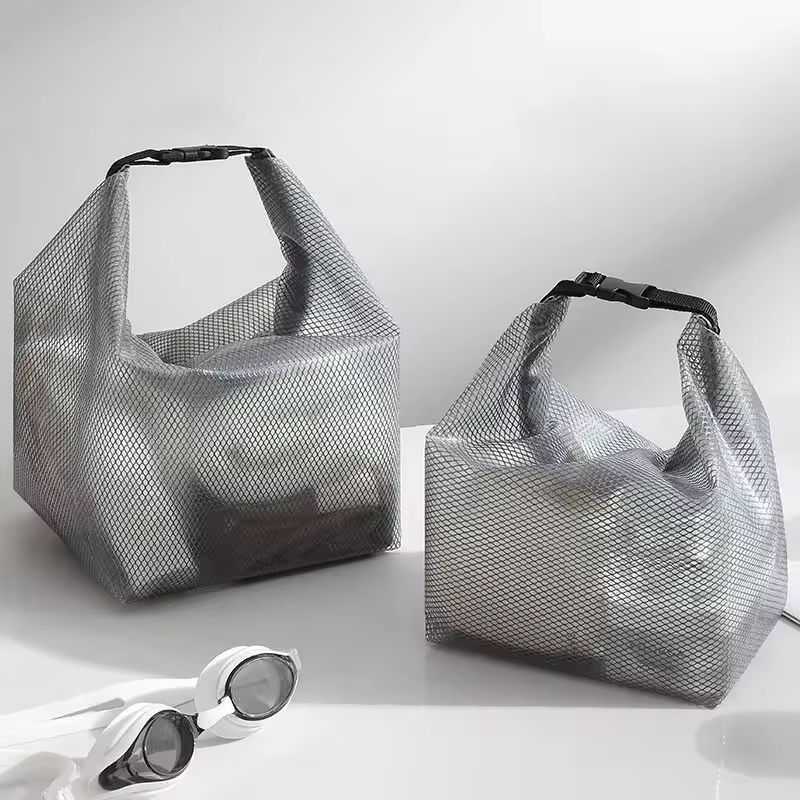
Cosmetic products can create a challenging environment for bags because liquids, creams, oils, and powders may come into contact with the interior.
EVA's relatively non-absorbent surface can make it attractive for easy-clean cosmetic products.
It can also provide a structured appearance.
However, if a cosmetic bag needs textile aesthetics, printing, softness, or a flexible pouch construction, EVA may be combined with other materials rather than used alone.
EVA Protective Cases
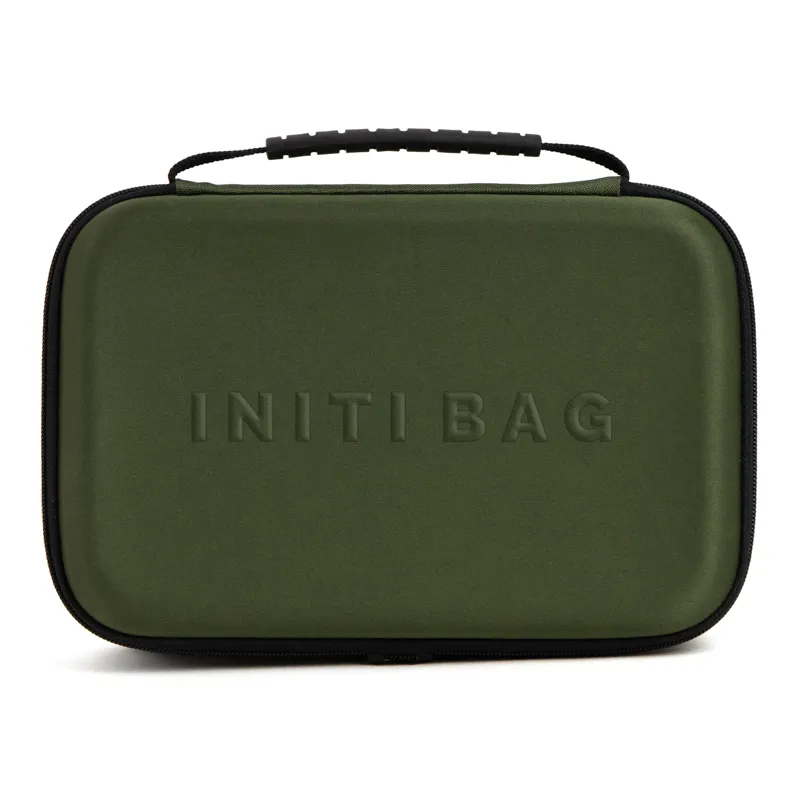
Protective cases are a natural application because EVA foam can provide cushioning.
Examples include:
- Electronics cases
- Camera cases
- Tool cases
- Travel cases
- Accessory cases
In these applications, the EVA specification should be matched to the object being protected.
A thin soft foam is not necessarily suitable for products requiring high-impact protection.
EVA Travel and Outdoor Bags
EVA can also be used in travel and outdoor products where users value:
- Lightweight construction
- Water resistance
- Easy cleaning
- Shape retention
- Protection
The exact construction can range from a fully molded EVA body to a textile bag with EVA reinforcement or padding.
How Should Buyers Specify EVA for a Custom Product?
For procurement teams and product developers, this is perhaps the most useful part of the entire discussion.
provide a more complete specification.
At minimum, consider the following.
1. Define the End Use
Start with the application.
Is it:
- A beach bag?
- A lunch bag?
- A cooler?
- A cosmetic bag?
- A protective case?
- A travel organizer?
- An outdoor product?
- A promotional product?
The intended use determines which EVA properties matter most.
2. Define the Required Form
Ask whether the EVA should be:
- Solid sheet
- Foam sheet
- Molded EVA
- Laminated EVA
- Internal padding
- Structural reinforcement
- Full-body construction
This can prevent major misunderstandings during development.
3. Define Thickness
Thickness should be specified according to function.
For example:EVA foam thickness: X mm
is much more useful than:Thick EVA.
If you do not know the required thickness, ask the supplier to recommend options based on the intended application.
4. Define Density When Foam Is Used
For EVA foam, density can significantly affect the product's performance.
Ask for the density specification and, where appropriate, compare samples.
Do not compare two EVA foams based only on appearance.
5. Define Hardness
If the feel or structural performance matters, specify the required hardness or provide an approved sample for comparison.
For consumer products, the tactile experience can be just as important as technical performance.
6. Define Surface Requirements
Consider whether the EVA should have:
- Smooth surface
- Matte surface
- Textured surface
- Embossing
- Debossing
- Printing
- Perforation
- Molded patterns
This becomes particularly important for branded products.
7. Define Color
EVA can be produced in different colors, but color consistency should be checked between production batches.
For private-label products, the brand's approved color reference should be established before bulk production.
8. Define Construction
For an EVA bag, clarify:
- Handle type
- Closure
- Zipper
- Seam construction
- Edge finishing
- Reinforcement
- Lining
- Pockets
- Attachment method
- Logo method
The EVA material itself is only one component of the final product.
What Should Buyers Test Before Mass Production?
A sample should not be approved only because it looks attractive.
The final product should be tested according to its intended use.
Useful checks can include:
Appearance Test
Check:
- Surface consistency
- Color
- Edges
- Mold quality
- Printing
- Logo position
- Wrinkles
- Scratches
- Visible defects
Dimensional Test
Measure:
- Length
- Width
- Height
- Thickness
- Opening
- Handle dimensions
This is especially important for molded or structured EVA products.
Flexibility Test
Repeatedly bend the material and observe whether it:
- Cracks
- Creases excessively
- Loses shape
- Shows surface damage
Compression Test
For EVA foam, evaluate whether repeated compression causes permanent deformation.
Water Resistance Test
If water resistance is an important selling point, test the finished product rather than the EVA material alone.
Pay particular attention to:
- Seams
- Closures
- Zippers
- Connections
- Material transitions
Load Test
If the product is a bag, test the finished bag under the expected load.
Check:
- Handles
- Attachment points
- Seams
- Bottom construction
- Structural panels
A strong EVA material cannot compensate for a weak handle attachment.
Environmental Test
For outdoor products, consider:
- UV exposure
- Temperature variation
- Humidity
- Repeated use
The exact test method should reflect the target market and product requirements.
EVA for Different Buyer Types
Different buyers may evaluate EVA for different reasons.
For Retailers
Retail buyers often care about:
- Appearance
- Shelf appeal
- Durability
- Easy cleaning
- Consumer usability
- Packaging volume
- Retail price
A molded EVA product may create a distinctive visual identity compared with conventional fabric bags.
For Promotional Gift Companies
Promotional buyers often need a balance between:
- Unit cost
- Branding area
- Usability
- Production quantity
- Lead time
- Packaging
- Consumer appeal
EVA can be interesting when the promotional product needs to look different from a standard cotton or polyester bag.
For Private-Label Brands
Private-label brands may have more detailed requirements.
They may specify:
- Exact dimensions
- Color
- Logo
- Surface finish
- Material thickness
- Packaging
- Labeling
- Retail presentation
- Product testing
In this situation, the EVA specification should become part of the product specification sheet rather than remaining a general material description.
FAQ
Is EVA plastic or rubber?
EVA is generally classified as a copolymer with properties that can fall between conventional plastics and rubber-like materials. Depending on its formulation, it can be flexible, soft, resilient, or relatively firm.
Is EVA the same as EVA foam?
No. EVA is the underlying polymer, while EVA foam is an expanded form of EVA with a cellular structure.
Is EVA waterproof?
EVA itself has good resistance to water and moisture, but an EVA product is not automatically waterproof. Seams, zippers, openings, and connections can still allow water to enter.
Is EVA better than PVC?
Neither material is universally better. EVA can be advantageous for cushioning, softness, flexibility, and molded structures, while PVC is commonly used where clear films and flexible coated structures are required.
Is EVA the same as PEVA?
No. EVA and PEVA are different material specifications. The similar names can cause confusion, so buyers should always confirm the exact material used in a product.
Is EVA environmentally friendly?
Traditional EVA is generally petrochemical-based, so it should not automatically be described as environmentally friendly. Reusability, material sourcing, manufacturing, lifespan, and end-of-life options all affect the environmental impact of a finished product.
Is EVA suitable for bags?
Yes. EVA can be used for beach bags, lunch bags, cooler bags, cosmetic bags, protective cases, travel products, and other functional bags. It can be used as the main material or as an internal structural, cushioning, or insulation layer.
What determines the quality of EVA foam?
Important factors include density, hardness, thickness, cell structure, formulation, processing method, and the requirements of the final application.
Can EVA be used for custom products?
Yes. EVA can be customized through material selection, thickness, density, hardness, color, shape, molding, perforation, surface treatment, and combination with other materials.
What should I ask an EVA bag supplier?
At minimum, ask about the EVA type, thickness, density if applicable, hardness, construction, dimensions, material combination, testing requirements, logo method, packaging, MOQ, and sample approval process.
Conclusion
EVA is a versatile material that can be used in solid sheets, foam, molded components, and different bag constructions. Its flexibility, lightweight structure, moisture resistance, cushioning, and easy-clean properties make it suitable for products ranging from beach bags and lunch bags to cosmetic bags and protective cases.
However, there is no single EVA specification for every application. Thickness, density, hardness, structure, and processing method can all affect the final performance. For custom products, the best approach is to start with the intended use and then choose the EVA specification that matches the product's functional and design requirements.
Related Products




 Hot News