Choosing between a duffel bag and a backpack is not simply a matter of appearance. Both can carry clothing, sports equipment, travel essentials, and everyday belongings, but their shapes, carrying systems, storage layouts, and practical advantages make them suitable for different situations.
A duffel bag is often preferred when users need a wide main compartment, easy access to bulky items, and flexible packing space. A backpack is generally more convenient when people need to walk longer distances, keep their hands free, and carry smaller items in an organized way. However, these differences are not absolute. A well-designed duffel can offer multiple compartments and backpack straps, while some backpacks are large enough for multi-day travel.
The right choice depends on what users carry, how far they travel on foot, how frequently they need to access their belongings, and where the bag will be used.
For brands, retailers, promotional gift companies, and procurement teams, the decision involves additional considerations. The target audience, product cost, customization requirements, expected usage frequency, and perceived value all influence which style makes the most sense.
This guide compares duffel bags and backpacks from both practical and product-selection perspectives.
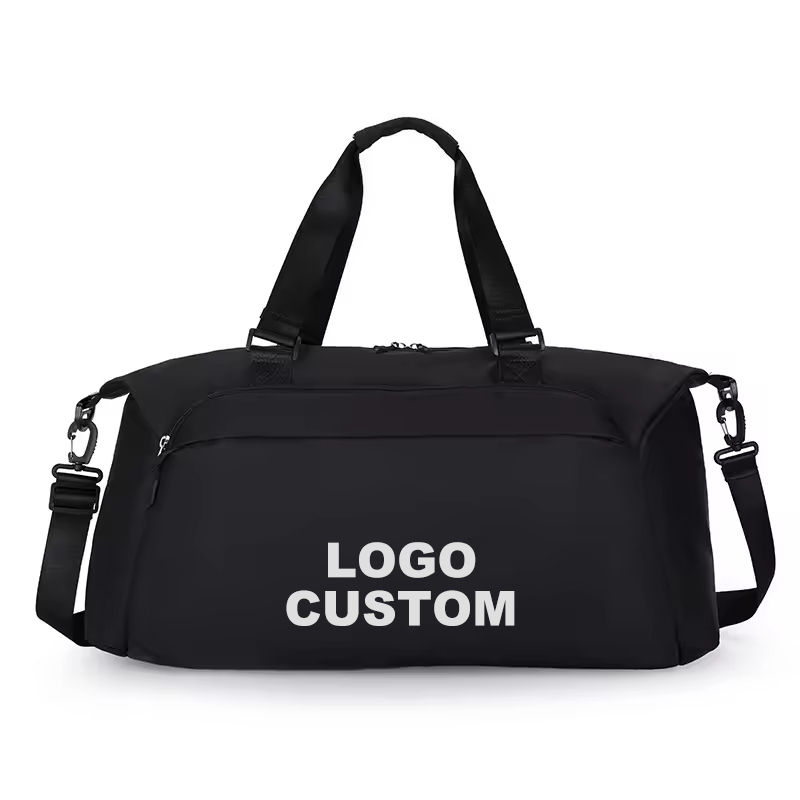
Duffel bags take their name from Duffel, a town in Flanders, Belgium, where a thick woolen cloth was produced from the seventeenth century onward. The cloth, and later the cylindrical kit bag made from it, carried the town's name into English.A duffel bag is a bag built around one dominant compartment, with an opening that runs along the bag's longest axis. Traditional forms are cylindrical; modern production is more often a rounded rectangular prism because that shape packs and ships better.
Three structural traits define how a duffel behaves in use.
One continuous volume. There is no internal frame, no back panel, and usually no structural divider. The bag has no shape of its own, so it takes the shape of its contents. That is why a duffel holds an awkward load — boots, a helmet, a folded tripod — more easily than a structured pack of identical capacity.
An opening on the long axis. A zip running along the length of the bag creates the largest possible aperture for the shortest possible zipper. A 55 cm body can accept a 45 cm opening, which means the entire contents are visible in one movement. This is the duffel's single greatest functional advantage, and it costs almost nothing to produce.
A carry system of limited ambition. Handles and one shoulder strap are the default. Two pack straps are an option, not an inherent property. Every duffel is therefore at its most comfortable when it is carried for short distances between vehicles, rooms, and venues.
The trade-off is direct: a duffel gives up load transfer and organization in exchange for volume efficiency and access speed.

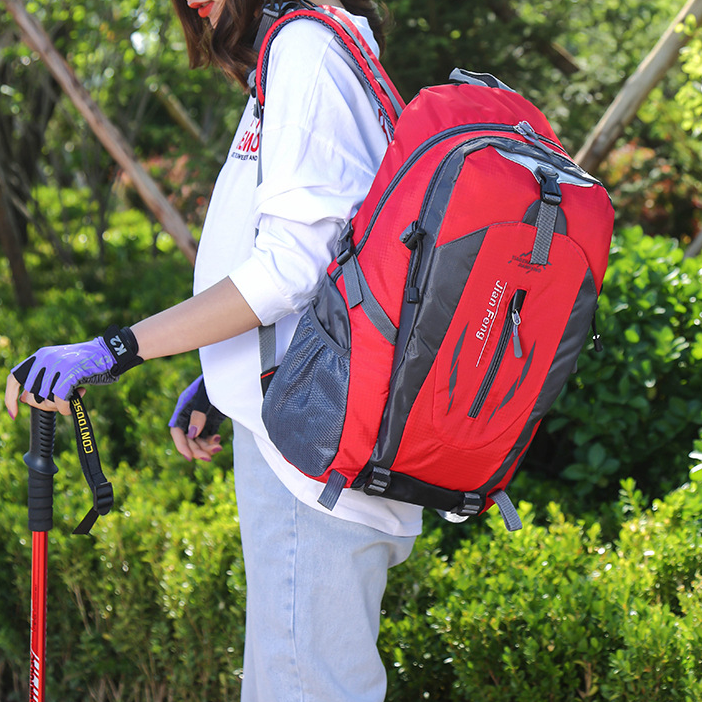
A backpack is a bag whose primary carry system is two shoulder straps, worn with the load against the back. The body is usually semi-structured: a back panel, a base, and seams that hold a defined silhouette even when partly empty.
Three traits define its behavior.
A load path that runs through the torso. The weight enters at the shoulder-strap anchors, travels down the back panel, and — when a hip belt is present — exits into the pelvis. This is the only reason a backpack can carry 12 kg comfortably while a duffel carrying the same weight is unbearable after 400 meters.
Volume divided by design. Pockets, sleeves and dividers are built in. Each one improves access to a specific item class and takes volume away from everything else. A 30-liter commuter pack with a padded laptop sleeve and three organizer pockets may offer less usable space for clothing than a 25-liter duffel.
Stability under movement. Because the load sits against the spine and is restrained by straps, the bag moves with the body. This matters on stairs, in crowds, on a bicycle, and on any surface where a swinging duffel would strike a knee or a fellow passenger.
The limitation is equally structural. A backpack's opening is constrained by its own shape. A top-loading design forces the user to unload the top to reach the bottom, and a narrow panel opening cannot accept an object wider than the panel.
Duffel Bags vs Backpacks: The Differences That Matter Most
1. Carrying Comfort and Weight Distribution
Comfort is not a feeling; it is contact pressure multiplied by duration. That makes it calculable.
A single duffel shoulder strap, 40 mm wide, in contact with the body over roughly 200 mm, distributes an 8 kg load across about 80 cm². Two backpack straps, 60 mm wide over the same contact length, spread the same 8 kg across roughly 240 cm². The pressure per square centimeter differs by a factor of three before any padding is considered.
| Carry configuration |
Approximate contact area |
Relative pressure at 8 kg |
Practical duration |
| Duffel, two short handles |
40–60 cm² |
Highest |
Seconds — lifting only |
| Duffel, single shoulder strap |
60–90 cm² |
High |
5–15 minutes |
| Duffel, two pack straps |
150–200 cm² |
Moderate |
20–40 minutes |
| Backpack, two shoulder straps |
200–260 cm² |
Low to moderate |
1–3 hours |
| Backpack with hip belt |
200–260 cm² plus pelvis |
Lowest |
3 hours and beyond |
Two details inside that table matter more than the numbers.
Where the strap anchors, not how thick it is. A padded strap anchored to a single row of stitching at the bag's top edge will tear out long before the padding compresses. Production should use a box-X stitch pattern at every strap anchor, with the webbing continuing down the body rather than terminating at the seam.
Whether a hip belt transfers load or merely stabilises. A hip belt that wraps the waist but carries no vertical load is a stabiliser, not a load-transfer device. On a genuine load-carrying pack, the belt is structurally connected to the frame or back panel so that weight can pass into the pelvis. On a promotional backpack, it is usually decorative, and buyers should not price it as a functional feature.
The deciding variable: distance per carry, not total distance per day. A traveler who walks 200 meters four times a day has no problem with a duffel. A commuter who walks 1.2 km each way has a problem with the same bag every morning.
2.Capacity: Nominal liters vs Usable liters
The nominal figure is a box calculation: length × width × height in centimeters, divided by 1,000. A bag measuring 60 × 30 × 30 cm is quoted as 54 liters. That number is arithmetically correct and practically misleading.
Consider what happens inside that 54-liter shell.
| Deduction |
Effect on usable volume |
| Wall thickness and seam allowance |
1.5 cm per side reduces an internal box to roughly 57 × 27 × 27 cm |
| Rounded ends and tapered lid |
Removes material that the box calculation still counts |
| Padded back panel and laptop sleeve |
A 30 × 40 cm sleeve with 2.5 cm foam displaces about 3 liters |
| Structural base board |
Removes depth at the bottom, where bulky items usually sit |
| External pockets |
Reduce internal depth wherever they are sewn on |
Applied to the same 54-liter backpack, the usable figure can fall to the mid-30s. The same arithmetic applied to a soft duffel — single wall, no back panel, no sleeve — typically lands in the mid-40s. Two bags with identical quoted capacity can differ by 25% in what a customer can actually put inside.
Practical consequences follow directly.
Order by internal dimensions, not by headline liters. A specification sheet that lists only "45L" tells a buyer nothing about whether a folded jacket, a pair of trainers, and a laptop will fit together. Internal length, width and depth are the only figures that answer the question.
Test the packed shape, not the empty shape. A bag that measures 55 × 32 × 25 cm flat will measure differently when full, because soft bodies bulge. The packed measurement is the one that must clear a cabin sizer or a locker.
Compare opening size to the largest intended item. If the customer's use case involves a 38 cm shoe box or a 42 cm laptop, the opening must exceed that dimension, not the bag.
The deciding variable: for a load of soft, bulky items, quoted liters are a reasonable guide. For a load of rigid or rectangular items, quoted liters overstate usable space by a wide margin, and internal dimensions decide the sale.
3.Opening Design
A duffel and a backpack solve access in opposite ways, and the difference is structural rather than stylistic. On a duffel, the zipper is effectively a structural element: the bag has no frame, so the aperture determines both what goes in and how the body holds its shape when full. On a backpack, the back panel and base carry the structure, which frees the opening to be small — and most backpack designs use that freedom to prioritise stability and weather resistance over access.
| Comparison factor |
Duffel bag |
Backpack |
| Dominant geometry |
Long-axis U-zip, barrel zip, or end-opening |
Top-load, top-zip lid, panel-load, or clamshell |
| Where the structure lives |
In the opening and the base seam; the body is otherwise unstressed |
In the back panel and base; the opening is secondary |
| Zip length as a share of body length |
Typically 70–90% on U-zip models |
Rarely above 60% except on clamshell models |
| What is visible when open |
The entire load in one view |
The top layer, or one half of the bag |
| Access while the bag is carried |
None — the bag must be set down |
Possible; a panel zip can be reached with one strap off |
| Repacking a full load |
Fast; items drop into an open trough |
Slow; items must be placed around existing contents |
| Consequence of over-packing |
Zip takes the load in compression |
Lid will not close, or the panel bulges away from the back |
| Typical opening failure |
Zip ends splitting under lateral pressure |
Hinge seam creasing, or slider strain on a curved run |
| Exposure when opened |
Full load exposed to rain |
Contents shielded unless the bag is fully open |
| Cost driver |
Zip length and slider count |
Number of curved zip runs and panel seams |
4.Access, Organization and the Cost of Compartments
Access is where the duffel's simplicity becomes a genuine advantage in some use cases and a genuine liability in others. The long top opening lets a user see and reach the entire load at once. Nothing is buried under a structural panel. For a team kit, a gym run or a car trip, that is faster than any compartment system.
A backpack inverts the trade. Its compartments reduce search time for known items but increase packing time because contents must be sorted into the right zones. The user pays for organization with attention.
The sourcing question is not "which is better organized" but "how many compartments justify their cost." Every pocket adds pattern pieces, zipper length, lining, sewing operations and a potential failure point. A six-pocket backpack can require meaningfully more labor than a three-pocket version of the same size, and the extra cost is invisible in a photograph of the closed bag.
| Compartment type |
Adds real value when |
Becomes waste when |
| Dedicated shoe compartment |
Gym, team sports, wet-weather climates |
The item is rarely carried, or the pocket steals volume from the main body |
| Laptop sleeve |
Commuter, campus, business travel |
The target user never carries a device |
| Wet or dry pocket |
Swimming, rain, sweaty kit |
It is described as waterproof without seam and zipper testing |
| Bottle pocket |
Fitness, outdoor, campus |
Its depth cannot hold a standard bottle, so it stretches and tears |
| Front admin panel |
Travel, work, frequent-access items |
It duplicates a pouch the user already owns |
| Internal mesh pocket |
Separating small valuables |
It tears at first use because the mesh is too light |
| Trolley sleeve |
Air travel with a wheeled case |
The program is a gym bag that never meets a suitcase |
| Key leash |
Any bag with keys |
The clip is the cheapest available and fails within a month |
Two design details deserve specific attention because they appear trivial and generate disproportionate returns.
5.Durability and Construction
Neither category is inherently stronger. They fail in different places, and those places are predictable enough to inspect on a sample in under ten minutes.
| Failure point |
Duffel bag |
Backpack |
How to check on a sample |
| Handle attachment |
Primary risk — all load passes through two points |
Secondary |
Lift a loaded bag by one handle and watch the stitch line |
| Strap anchors |
Risk only on convertible models |
Primary risk |
Look for box-X stitching with webbing continuing into the body |
| Zip ends |
High risk under compression |
Moderate |
Open and close a full bag twenty times; watch the closed end |
| Base abrasion |
High — the bag is set down repeatedly |
Moderate — the bag is usually worn |
Rub the base against concrete; check for coating wear |
| Back panel seams |
Not applicable |
Moderate — abrasion against the body |
Flex the panel; listen for coating crackle |
| Lining seams |
Low |
Low to moderate |
Turn the bag inside out at the corners |
6.Portability: Movement, Footprint, and Empty Weight
ortability has three components, and only one of them is comfort.
Lateral footprint. A hand-carried 60-liter duffel occupies roughly 65 cm of width at hip height. In a train aisle, a crowded lift, or a narrow shop, that width becomes a collision hazard and a theft risk. A backpack of the same volume occupies the wearer's own width. This is the practical reason backpacks dominate urban commuting regardless of comfort.
Center of gravity. A duffel carried at the side pulls the body laterally, and the carrier unconsciously leans away from it. A backpack places the load behind the spine, which the body handles better over distance. On stairs and uneven ground, this difference becomes visible within a few minutes.
Empty weight. Every gram of bag is a gram of payload the customer cannot use. Consider a carrier that applies a 7 kg (15 lb) cabin allowance — a common figure among airlines that enforce one. A 45-liter duffel weighing 0.9 kg leaves 6.1 kg for contents. A structured backpack of the same volume weighing 1.7 kg leaves 5.3 kg. The backpack costs the traveler 800 g of clothing before a single item is packed.
| Design choice |
Effect on empty weight |
Effect on carry comfort |
| Unpadded single-wall body |
Lowest |
Lowest |
| Padded base and reinforced corners |
+80–150 g |
Slight |
| Padded back panel and straps |
+150–250 g |
Substantial |
| Internal frame or frame sheet |
+200–350 g |
Substantial at high load |
| Luggage pass-through sleeve |
+40–80 g |
Practical benefit in airports |
| Convertible pack straps and harness cover |
+200–300 g |
Conditional |
Convertible designs deserve a specific warning, because they carry the weight of two systems while delivering the comfort of neither unless the straps are properly engineered. A duffel with pack straps sewn flat against the body has no load-bearing structure behind them; the straps pull on fabric rather than on a panel designed to distribute force. If a buyer wants a genuine convertible, the straps should anchor to a reinforced yoke, and the sample should be tested loaded rather than empty.
The deciding variable: measure the walking distance between the two most common stopping points in the customer's day. Under 300 meters, a duffel costs nothing in comfort. Over a kilometer, it costs the customer a shoulder and the brand a repeat purchase.
7.Appearance, Branding Surface, and the Cost of a Logo
The practical difference between the two categories for a branding program is not style. It is the size and continuity of the printable surface.
A 55 cm duffel side panel offers a continuous area of roughly 50 × 20 cm — about 1,000 cm² — with no seams, pockets, or curvature interrupting it. A backpack front panel is typically divided by a pocket zip, two seam lines, and a curved profile, leaving usable areas of 120–250 cm² each. A logo that reads clearly at 200 mm on a duffel has to be redrawn at 60 mm for a backpack, which changes the artwork, the print setup, and the legibility of fine detail.
Decoration method follows surface and volume, not preference.
| Method |
Best suited to |
Cost |
Practical limit |
| Screen print |
Large flat panels, one to three colors |
Low |
Loses detail below about 1 mm line width |
| Heat transfer |
Multi-color artwork, gradients, photographs |
Low to medium |
Can stiffen the fabric and crack at folds |
| Embroidery |
Caps, patches, small chest-height logos |
Medium |
Uneconomical above roughly 100 mm |
| Woven label |
Small logos, brand tabs, interior branding |
Low |
Limited to small sizes |
| Silicone or molded patch |
Premium positioning, dimensional logos |
Medium to high |
Requires a mold; volume-dependent |
| Metal badge |
Corporate gifting, premium travel |
High |
Weight and hardware cost |
Placement fails more often than decoration. A logo positioned where the bag folds when packed, where a pocket zip crosses it, or where a shoulder strap covers it during use will be invisible in exactly the situations the brand paid for. Before approving placement, the sample should be packed to capacity and carried the way the end user will carry it. If the logo disappears in that test, the placement is wrong.
Applications: Where Each Bag Actually Works
Gym and fitness
A duffel wins when the load includes footwear, a towel, a change of clothes and equipment that must be loaded and unloaded while standing at a bench. The required specification is a ventilated or wipe-clean compartment of at least 4 liters for footwear, a main compartment with a U-shaped aperture, and a base that tolerates wet floors. A backpack wins for members who commute by bicycle, train or on foot, or who carry a laptop alongside kit — in which case the laptop sleeve must be suspended above the base rather than resting on it.
Weekend travel of two to three nights
A 40–45 liter duffel holds clothing for a short trip efficiently because clothing is soft and fills irregular space. A backpack of the same volume is preferable when the itinerary includes public transport, stairs, or several changes of accommodation. The relevant question is not trip length but the number of times the bag must be carried more than a few hundred meters.
Air travel
Neither category is automatically cabin-compliant. The widely applied cabin limit of 22 × 14 × 9 inches (56 × 36 × 23 cm) is measured including handles and wheels, and the dimension that most often fails is depth. A soft duffel packed to capacity bulges past 23 cm even when its empty depth is 20 cm. Buyers should specify a packed depth — measured with the bag filled to its rated capacity — below the limit, and should treat the 9-inch figure as a hard constraint rather than a target.
Useful air-travel features, in order of value: a luggage pass-through sleeve, a wide aperture, a dedicated document pocket reachable without opening the main compartment, and low empty weight. A trolley sleeve is the single cheapest feature that makes a duffel genuinely useful in an airport, because it converts the bag into an appendage of rolling luggage rather than a burden.
Hiking and sustained outdoor use
A purpose-built backpack is the only defensible choice. The relevant construction is a load-bearing hip belt connected to a frame or framesheet, an adjustable harness, and a back panel that permits airflow. A duffel cannot substitute regardless of capacity, and a convertible duffel with pack straps should not be positioned as hiking equipment — the straps carry load into fabric rather than into a structure.
Daily commuting
A backpack wins on every axis except capacity for bulky items. The specification points that matter are a suspended laptop sleeve, a water-resistant base, a secure pocket for keys and cards, and strap geometry that keeps the bag high on the back. A duffel serves commuters who drive and carry gym kit as well as work items, provided it has an internal sleeve or a separate organizer.
Sports teams, clubs and events
A duffel serves this segment because team kit is bulky, identical, and loaded in bulk. The specification points are a reinforced base, a high-capacity main compartment, and a large panel for numbering or sponsor marks. Backpacks suit events where attendees carry personal items through a day of sessions — conferences, training programs, site visits — and where the bag must remain usable afterwards.
Corporate and promotional gifting
The relevant test is whether the recipient will use the bag in a context where the brand is visible. A neutral backpack with a padded sleeve enters daily commuting and is seen repeatedly. A duffel enters gyms, weekends and travel and is seen less often but in a more distinctive context. Neither is a better gift in the abstract; the budget per unit and the recipient's routine decide.
The fastest way to choose between the two structures is to describe the journey the bag will take.
| Application |
Structure that fits |
Capacity reference |
Specifications to lock down |
Cost posture |
| Gym and fitness |
Duffel, 20–35 L |
Fits shoes, towel, bottle, one change of clothes |
Shoe compartment with ventilation, wipe-clean lining, bottle pocket depth, wipeable base |
Low to Medium |
| Team sports and coaching |
Duffel, 45–70 L |
Multiple kits, pads, balls, equipment |
Extended webbing and box-X at handle roots, reinforced base, heavy main zip, name panel |
Medium |
| Air travel carry-on |
Duffel with compression, or clamshell backpack |
35–45 L |
Packed dimensions against a named airline allowance, trolley sleeve, lockable zips, luggage tag |
Medium |
| Daily commute and campus |
Backpack, 18–28 L |
Laptop, charger, lunch, light layer |
Padded sleeve sized to the device, frame sheet, ventilated back, bottle pocket, reflective trim |
Low to Medium |
| Business travel |
Clamshell backpack or structured duffel |
28–40 L |
Flat packing, garment-friendly interior, discreet branding, metal hardware where appropriate |
Medium to High |
| Outdoor and hiking |
Backpack, 30–65 L |
Layered clothing, food, water, shelter |
Hip belt, frame or stays, load lifters, rain cover, tool loops, abrasion-resistant base |
Medium to High |
| Promotional and giveaway |
Duffel or lightweight pack |
15–30 L |
Lowest achievable unit cost at acceptable strength, large print area, packability for bulk freight |
Low |
| Hospitality and gifting |
Structured duffel or weekender |
25–40 L |
Fabric hand-feel, clean stitching, hardware finish, presentation packaging, personalization |
Medium to High |
The Substitution Test: Can One Bag Do the Other's Job?
The question is usually asked in both directions, and the answer is the same in both: a bag substitutes successfully when the property it lacks is not the property the user depends on.
| Requirement |
Duffel covers it |
Backpack covers it |
Neither covers it |
| Load is soft and bulky |
Yes |
Partially |
— |
| Load includes rigid items wider than 35 cm |
Yes, with a wide aperture |
Only in clamshell designs |
— |
| Carry exceeds 1 km on foot |
No |
Yes |
Convertible, only with a proper harness |
| Hands must remain free |
Only with pack straps |
Yes |
— |
| Load exceeds 15 kg |
No |
Yes, with hip belt |
Trolley case |
| Frequent access to small items |
No |
Yes |
— |
| Bag must flatten for storage |
Usually |
Rarely |
— |
| Cabin depth must stay under 23 cm |
Only if under-packed |
Usually |
Soft travel bag sized to spec |
| Single bag for commute and gym |
Partially |
Yes |
— |
| Large continuous branding area |
Yes |
No |
— |
Read the table by column rather than by row. A duffel substitutes for a backpack in every situation where the bag is never carried far, and fails in every situation where it is. A backpack substitutes for a duffel wherever the load is divisible into items smaller than its opening, and fails where the load is a single awkward object.
What Brands and Wholesale Buyers Should Specify
For a procurement team, the duffel-versus-backpack question is a positioning decision before it is a design decision.
Matching the Bag to the Audience
Corporate and employee gifting. A backpack with a suspended laptop sleeve, restrained branding, and a neutral color enters the recipient's daily routine and generates repeated brand exposure. The failure mode is a bag that looks corporate but cannot hold a laptop safely.
Sports clubs, gyms and fitness brands. A duffel with a ventilated footwear compartment, a wipe-clean lining and a reinforced base meets a functional need that the buyer can name. The failure mode is a fashion-led duffel with a decorative base and no ventilation, which smells of damp kit after two weeks.
Travel and lifestyle retail. Both categories work, but the assortment logic differs. A duffel competes on capacity and price per liter; a backpack competes on features and perceived technical value. Stocking both without differentiating on these axes produces internal cannibalization rather than range depth.
Events and promotional programs. A backpack is retained when it is useful after the event — conferences, training, campus programs. A duffel is retained when the event itself involves kit — sports tournaments, outdoor programs, team-building. The retention rate, not the unit cost, determines the cost per impression.
Private-label brands. Differentiation rarely comes from adding features. It comes from one decision made better than competitors: an aperture that opens wider, a base that survives airport floors, a strap anchor that does not tear, or a color range that fits a specific retail environment. Choose one and specify it precisely.
Triaging Features Before They Reach the Quotation
Every feature added to a bag increases material cost, assembly time, and the number of ways the product can fail inspection. Sorting the specification into three tiers prevents the accumulation of features that no customer asked for.
| Tier |
Definition |
Examples |
| Essential |
The product cannot perform its function without it |
Main zip of adequate size, reinforced handle anchors, base abrasion resistance, correct internal dimensions |
| Value-adding |
Improves the experience in a way the customer can perceive |
Luggage pass-through, ventilated shoe compartment, suspended laptop sleeve, dual sliders |
| Optional |
Adds cost without a benefit the target user will notice |
Decorative piping on an unseen seam, excessive internal dividers, hardware that imitates a premium brand |
A fitness duffel needs a ventilated compartment (value-adding) and a reinforced base (essential). A corporate backpack needs a suspended sleeve (essential at that price point) and does not need a shoe compartment (optional, and it consumes 5 liters of the volume the buyer is paying for).
Material Selection by Application
Material names are not specifications. The same generic description covers products that perform very differently.
| Material |
Typical use |
Cost |
Watch for |
| Polyester, 600D |
Promotional bags, entry-level travel |
Low |
Denier quoted without coating weight or weave density |
| Polyester, 900–1680D |
Heavy-duty duffels, tool bags |
Medium |
Stiffness that makes the bag hard to pack |
| Nylon, 210–420D ripstop |
Lightweight travel, technical packs |
Medium |
Lower abrasion resistance at the base |
| Nylon, 1000D |
Premium tactical and outdoor |
High |
Cost premium rarely justified outside heavy use |
| Cotton canvas, 12–18 oz |
Lifestyle, retail, premium positioning |
Medium |
Weight, water absorption, and shrinkage |
| Recycled polyester (rPET) |
Sustainability-led ranges |
Low to medium |
Verify certification and recycled content percentage |
| Coated fabrics (PU/PVC) |
Wet-use, easy-clean applications |
Medium |
PVC restrictions in some markets; flex cracking in cold |
Compare Construction Requirements
Duffel bags and backpacks have different construction priorities.
A duffel often relies on its main body, base, zipper opening, handles, and shoulder-strap attachments. These areas must withstand repeated loading and lifting.
A backpack adds the demands of its shoulder-strap system, back panel, and the points where the carrying load transfers to the body. If it includes a laptop compartment or multiple pockets, the construction becomes more complex.
For bulk orders, samples should be evaluated for the actual intended load and use conditions. Relevant checks may include:
- Seam and attachment-point strength.
- Handle and shoulder-strap performance.
- Zipper operation under realistic loading.
- Fabric abrasion and colorfastness.
- Base wear where the bag contacts surfaces.
- Pocket dimensions and ease of access.
- Finished dimensions and consistency between samples and production.
Testing requirements should reflect the product's intended application and the buyer's quality standards. A lightweight promotional bag and a heavy-duty sports bag should not automatically be assessed against the same criteria.
Plan Customization Before Production
Customization can include logo printing, embroidery, woven labels, custom colors, zipper pulls, lining, pocket layouts, and packaging. The appropriate options depend on the bag's material, construction, budget, and expected order quantity.
Duffel bags often offer broad side panels suitable for prominent logos or graphics. Backpacks may provide branding areas on the front panel, front pocket, or selected straps and labels.
The location matters as much as the decoration method. Logos should remain visible during normal use and should not be obscured by seams, pocket openings, folds, or frequently covered areas.
Before approving a design, buyers should confirm:
- The logo's final dimensions and placement.
- The compatibility of the decoration method with the fabric.
- Color consistency and artwork requirements.
- Whether branding affects the pocket layout or construction.
- Sample approval procedures.
- Packaging and labeling requirements.
For products intended for repeated use, customization should complement the product rather than interfere with its function.
Minimum Order Quantities, Lead Times, and Landed Cost
MOQ and lead time depend on fabric availability, custom colors, hardware, decoration setup, and the factory's production calendar. A design requiring custom-dyed fabric or a new mold will add setup time regardless of order size.
Compare quotations only against identical specifications. A price difference between two suppliers usually reflects a difference in fabric weight, zip size, or stitching density rather than efficiency — and those differences appear as returns six months later.
Total landed cost includes sampling, tooling, packaging, freight, duties, inspection, and any testing required by the destination market. A supplier quoting a lower unit price with a less efficient carton can be more expensive per delivered unit.
FAQ
Are duffel bags better than backpacks for travel?
Duffel bags can be more convenient for flexible packing and easy access to clothing, while backpacks are often more practical for travelers who walk frequently or use public transport. The better choice depends on the packed weight, external dimensions, carrying comfort, and travel itinerary.
Which is more comfortable, a duffel bag or a backpack?
A properly fitted backpack generally distributes weight across two shoulders, making it a practical option for longer periods of carrying. A standard duffel carried on one shoulder may become uncomfortable under a heavy load. Strap design, padding, fit, and total weight also matter.
Do duffel bags hold more than backpacks?
Not necessarily. Many duffel bags offer a large, uninterrupted compartment, which can make them efficient for bulky items. However, backpacks are available in a wide range of capacities, and actual usable space depends on dimensions, compartment layout, and opening design.
What size duffel bag fits in a carry-on?
Most major US carriers apply a limit of 22 × 14 × 9 inches (56 × 36 × 23 cm) including handles and wheels, so a compliant duffel should measure below those figures when packed, not when empty. Because soft bags bulge, specify a packed depth of 21–22 cm rather than 23 cm. Confirm the rule with the specific airline before traveling.
Can a duffel bag be used as a gym bag?
Yes, and it is usually the better choice when the load includes footwear and a towel. Look for a ventilated or wipe-clean footwear compartment of at least 4 liters, a U-shaped aperture, and a base that tolerates wet floors. A simple single-compartment duffel without ventilation will retain odour within weeks.
Conclusion
Duffel bags and backpacks solve different carrying problems, even though their applications sometimes overlap.
Duffel bags are often the practical choice for flexible storage, bulky belongings, and quick access to a large main compartment. Backpacks are generally more suitable for hands-free movement, organized storage, and routines that involve frequent walking.
For brands and wholesale buyers, the decision should begin with the target audience and the product's primary purpose. Capacity, materials, construction, customization, and price should then be evaluated against those requirements.
A product does not need the most compartments, the heaviest fabric, or the longest feature list to be successful. It needs the right combination of usability, durability, appearance, and cost for the people who will actually use it.
For custom bag projects, INITI can help buyers evaluate design requirements, material options, branding placement, and product specifications for their intended application. Defining these details early makes it easier to develop a bag that meets customer expectations and supports the goals of a retail, private-label, or promotional program.
Related Products
Related Blog Articles


 Hot News