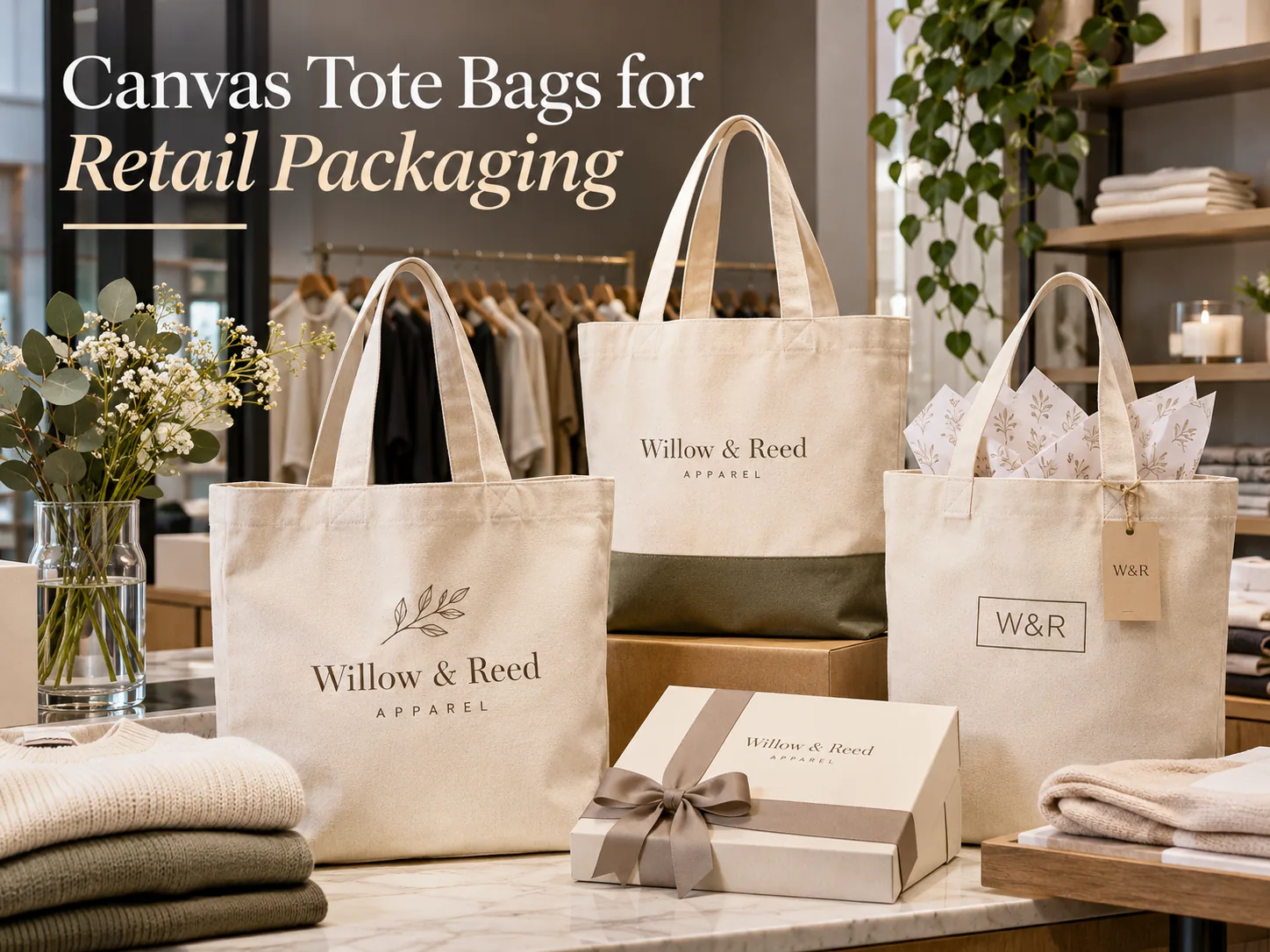
Canvas Tote Bags for Retail Packaging
For fashion boutiques, lifestyle stores, bookstores and gift retailers, the shopping bag handed to a customer is part of the retail experience.
A canvas tote may look excellent at checkout, but its performance matters most after the customer leaves the store. Color transfer onto a light-colored garment, a torn handle or a bag that cannot accommodate the purchased goods can quickly turn attractive retail packaging into a customer complaint.
Canvas tote bags for retail packaging must do more than display a logo. They need to fit the merchandise, protect the intended brand presentation, carry the expected load and remain consistent across production batches.
For B2B retail buyers, selecting custom canvas retail bags involves product design, fabric selection, printing, quality control and store distribution.
This guide explains how to develop branded canvas totes for checkout packaging, gift programs and private-label merchandise, with particular attention to the problems retailers may encounter during everyday use and bulk production.
Canvas tote bags can serve different purposes within a retail program.
| Retail Program |
How the Bag Is Used |
Main Purchasing Priority |
| Checkout packaging |
Carries merchandise purchased in-store |
Product fit, cost, easy packing and reliable construction |
| Gift-with-purchase |
Included with qualifying orders or promotional sets |
Presentation, branding and campaign budget |
| VIP and membership packaging |
Used for selected customer purchases |
Distinctive appearance, quality and customer experience |
| Private-label merchandise |
Sold as an independent retail product |
Construction, artwork, labeling and repeated-use performance |
These applications should not automatically use the same bag specification.
For example, canvas bags for boutiques may feature understated logos and comfortable shoulder handles, while a museum's private-label tote collection may prioritize large-format artwork and individual retail labels.
A chain retailer distributing thousands of checkout bags may place greater emphasis on standard dimensions, predictable production costs and efficient carton packing.
Before requesting quotations, decide whether the tote is packaging, a promotional gift or merchandise for resale.
That decision influences the fabric, features, quality requirements and packing method.
2. Common Problems With Canvas Tote Bags in Retail Stores
Many retail tote bag quality problems become noticeable only when staff begin packing products and customers carry the bags home.
Problem 1: Dye Transfer Onto Light-Colored Merchandise
Dark or strongly dyed cotton canvas may transfer color through rubbing, particularly when moisture is present.
This matters when a bag comes into direct contact with:
- White or cream-colored clothing
- Delicate fashion fabrics
- Light-colored textile accessories
- Premium gift packaging
A dark canvas tote that stains a customer's light garment can create a complaint even if the bag itself remains intact.
Buyer check: Specify appropriate dry and wet rubbing colorfastness requirements for the fabric and relevant printed areas.
ISO 105-X12:2016 provides a method for evaluating textile colorfastness to rubbing. Acceptance criteria should reflect the intended retail application.
Where merchandise is particularly sensitive, use suitable internal protective packaging rather than relying solely on the tote's colorfastness.
Problem 2: Handles Pulling Away or Seams Opening
Branded canvas retail bags may carry light clothing on one occasion and heavier books or boxed products on another.
Handle attachments and bottom seams are important load-bearing areas.
Inadequate stitching, insufficient seam allowance, poorly distributed loads or unsuitable reinforcement may cause handles to detach or fabric to tear.
Buyer check: Evaluate the complete bag using the intended merchandise weight and agreed repeated-lifting conditions.
Depending on the design, handle reinforcement may include Box-X stitching, bar-tacks, backing patches or extended webbing.
No individual stitching pattern guarantees a specific carrying capacity without finished-bag testing.
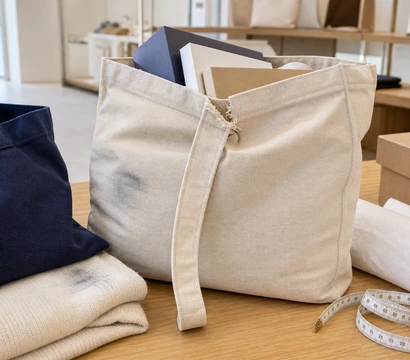
Problem 3: The Bag Does Not Fit the Purchased Products
A bag can meet its external dimensions but still be difficult to use at checkout.
Possible causes include:
- Insufficient usable internal height
- A top opening narrower than the product box
- An undersized bottom gusset
- A closure that restricts access
- A bag that changes shape significantly when loaded
Buyer check: Place the actual products, retail boxes and protective packaging into a finished sample before approval.
For boxed products, confirm the usable base and top opening separately.
Problem 4: Logos Crack, Peel or Appear Inconsistent
Printed canvas tote bags are folded, handled and rubbed against other surfaces during distribution and use.
Poor ink compatibility, incomplete curing or inconsistent printing conditions may result in cracking, peeling, blurred artwork or noticeable differences between batches.
Buyer check: Approve a physical printed sample with the final artwork, colors, placement and selected printing process.
Use relevant print-durability checks rather than relying only on a digital mockup.
Problem 5: Bags Arrive With Dust, Loose Threads or Odors
Canvas bags can collect fabric dust, loose fibers and thread ends during cutting, sewing, storage and packing.
Poor storage conditions may also contribute to unwanted odors or moisture problems.
This is particularly undesirable for premium retail packaging and fashion merchandise.
Buyer check: Inspect visible cleanliness, loose threads, fabric defects, odor, packing condition and finished appearance.
Use an approved reference sample to distinguish normal canvas texture from unacceptable stains or manufacturing defects.
Problem 6: Mixed Designs or Incorrect Quantities Reach Stores
Retail chains often purchase several bag colors, sizes or artwork versions.
If production identification and carton packing are not controlled, stores may receive the wrong design, mixed SKUs or inaccurate quantities.
Buyer check: Define SKU-specific specifications, carton labels and quantity verification before shipment.
3. Choosing the Right Canvas Tote Construction for Retail Packaging
A suitable retail shopping bag should be developed around its actual contents, not selected only by appearance.
Bag Size, Opening and Gusset
Start with the largest item or retail box the bag must carry.
Confirm:
- Usable internal width and height
- Top opening clearance
- Bottom width and gusset depth
- Required product protection
- Handle drop and carrying method
- Closure requirements
A flat canvas tote may be sufficient for lightweight apparel, brochures or documents.
A gusseted canvas retail bag is more suitable when boxed merchandise needs a defined base.
For tapered totes, specify the top opening and bottom widths separately.
For a more detailed sizing method, read How to Choose Tote Bag Size and Fabric Weight.
Canvas Fabric Weight
Cotton canvas shopping bags can be developed with different fabric weights and finishes.
A lighter construction may suit high-volume checkout programs. More substantial canvas may be appropriate for branded merchandise or premium retail tote collections.
Buyers should confirm whether the material specification is stated in GSM or ounces per square yard (oz/yd²).
Higher fabric weight does not automatically mean a stronger finished bag.
The fabric must be evaluated together with the seams, handles, reinforcement and expected carrying conditions.
Handles, Closures and Accessories
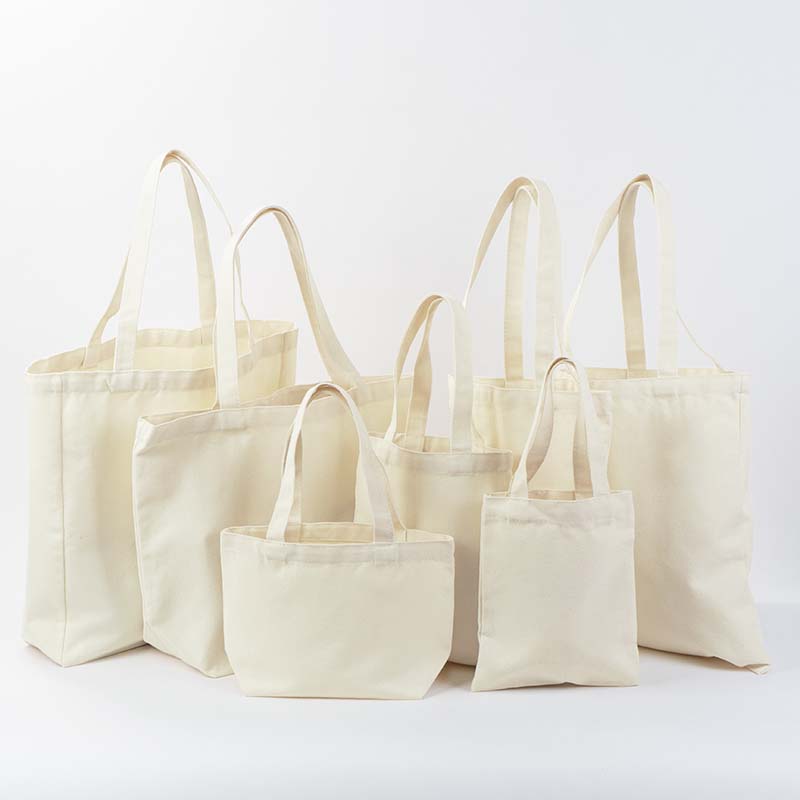
Depending on the retail program, custom canvas bags may include:
- Long shoulder handles
- Short hand-carry handles
- Branded or contrast-color webbing
- Suitable handle reinforcement
- Open-top, snap or zipper closures
- Internal or external pockets
- Retail labels and hangtags
A pocket may add value to a private-label canvas tote sold as merchandise, but it may be unnecessary for a basic checkout bag.
Each additional feature should serve a defined use or presentation requirement.
4. Custom Branding and Printing for Canvas Retail Bags
Consistent branding is important when the same canvas tote is distributed through different stores or production batches.
| Branding Method |
Suitable Application |
Main Quality Check |
| Screen printing |
Simple logos and bulk canvas shopping bags |
Print coverage, color and curing |
| Digital or transfer printing |
Detailed illustrations and multicolor artwork |
Image clarity, adhesion and fabric compatibility |
| Embroidery |
Decorative or premium brand elements |
Stitch quality and fabric distortion |
| Woven labels |
Private-label identity and product information |
Placement and attachment |
| Branded webbing |
Repeated logos or text on handles |
Alignment, legibility and material quality |
For custom logo canvas tote bags, approve a physical pre-production sample that establishes:
- Main fabric and handle colors
- Logo dimensions and placement
- Printed color references
- Label wording and position
- Acceptable appearance variations
- Final construction and packing presentation
A computer rendering is useful for design review, but it cannot establish final print adhesion, fabric hand feel or workmanship.
For further information, see Complete Guide to Custom Bag Printing Methods.
5. Production Quality Control: What Should Manufacturers Check?
Retail tote bag quality should be controlled throughout production, not only during the final inspection.
Stage 1: Fabric and Material Inspection
Before cutting, confirm that the canvas matches the approved specification.
Important checks include:
- Fiber composition and fabric construction
- GSM or oz/yd²
- Fabric width and surface condition
- Color differences between fabric rolls
- Stains, holes and weaving defects
- Required rubbing colorfastness
- Relevant dimensional stability
- Matching handles, thread, labels and closures
For colored canvas retail bags, fabric-roll shade differences should be evaluated before mixing panels in production.
If the finished product is intended for washing or wet care, the agreed material and construction tests should reflect those instructions.
Stage 2: Pattern Making and Cutting
Cutting accuracy affects final dimensions, bag shape and print alignment.
Production controls should cover:
- Approved pattern measurements
- Fabric grain direction
- Cutting consistency
- Gusset and bottom-panel dimensions
- Front and back panel matching
- Seam allowances
- Size and color identification
For tapered bags, the pattern must clearly distinguish top width, bottom width and bottom depth.
Stage 3: Printing and Logo Placement
Before starting full production, verify that the printed result matches the approved sample.
Check:
- Correct artwork version
- Logo position and orientation
- Print dimensions
- Color matching
- Ink or transfer compatibility
- Suitable curing or fixation
- Appearance after relevant handling tests
Printing before sewing can help control placement on certain bag designs, but the manufacturing sequence should suit the selected construction.
Stage 4: Sewing and Handle Reinforcement
Sewing errors may not be obvious while a bag is empty but can become serious when loaded.
Check:
- Seam alignment and allowances
- Stitch consistency
- Thread suitability
- Handle attachment
- Reinforcement at load-bearing points
- Bottom seams and gusset corners
- Pocket and closure placement
- Loose threads and incomplete stitching
- Excessive needle damage
For heavier merchandise, the reinforcement should distribute carrying forces into suitable areas of the bag.
A dense bar-tack is not automatically an improvement if it creates excessive needle perforations or weakens the surrounding fabric.
Stage 5: Finishing and Packing
Before cartons are closed, inspect the bags for:
- Loose threads and fabric dust
- Visible stains or contamination
- Incorrect labels or missing accessories
- Inconsistent folding
- Incorrect colors or artwork
- Moisture or unsuitable packing conditions
- Incorrect quantities and carton identification
Bags and cartons should be clean and dry before packing.
For private-label retail merchandise, barcode, hangtag and care-label requirements should be checked against the approved SKU.
Stage 6: In-Process and Final Inspection
For larger wholesale canvas tote bag orders, buyers may agree on:
- First-piece approval
- In-process sampling
- Final appearance inspection
- Finished-dimension checks
- Closure and handle checks
- Agreed carrying-load tests
- Carton quantity and SKU verification
Where appropriate, ISO 2859-1:2026 can be used as a reference for attribute-based lot inspection.
Sampling level, defect classifications and acceptance limits should be specified in the purchasing agreement. An AQL-based plan does not guarantee that every item in a lot is defect-free.
6. Finished-Bag Quality Testing for Retail Canvas Totes
A retail tote should be tested according to its intended application and the risks identified during development.
| Test or Check |
Purpose |
Reference |
| Dry and wet rubbing colorfastness |
Evaluate the risk of dye transfer |
ISO 105-X12:2016, where applicable |
| Straight-seam strength |
Assess appropriate woven-fabric seam performance |
ISO 13935-2:2026, where applicable |
| Finished-bag carrying test |
Evaluate handles, seams and bag body under a specified load |
Agreed load, duration, cycles and pass/fail criteria |
| Dimensional verification |
Confirm merchandise fit and finished measurements |
Approved drawing and tolerances |
| Print durability |
Assess artwork under expected handling conditions |
Method selected for the printing process |
| Dimensional change |
Evaluate relevant washing and drying effects when care instructions require it |
ISO 5077:2007 with an appropriate washing/drying procedure |
| Workmanship inspection |
Check appearance, cleanliness, stitching and accessories |
Approved reference sample |
| Lot inspection |
Assess defined defect categories |
Agreed sampling plan, such as ISO 2859-1:2026 |
A testing standard does not necessarily define the required pass level for every retail tote.
For example, the carrying-load requirement for a lightweight boutique checkout bag may be different from that of a bookstore tote carrying several heavy books.
Similarly, canvas tote bags should not be marketed as machine washable unless the fabric, printing, construction and proposed care instructions have been validated.
7. INITI Canvas Tote Bag Options for Retail Packaging
INITI's existing canvas products provide development references for different retail programs.
Artwork Printed Canvas Tote Bag
Artwork Printed Canvas Tote Bag
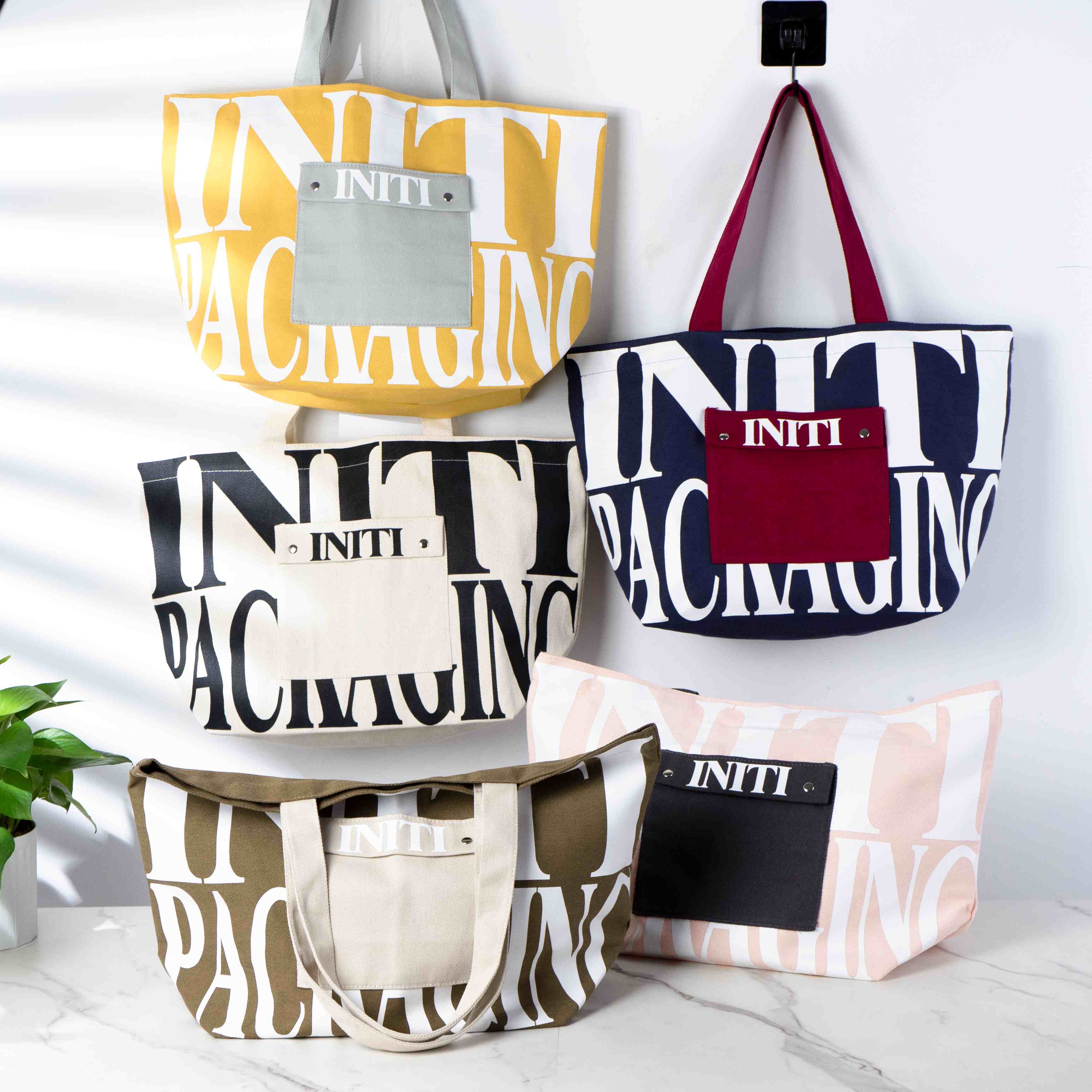
A cotton canvas tote featuring large-format artwork, typography, contrast shoulder handles and a bottom gusset.
It can be developed for fashion collections, museums, galleries and other branded merchandise programs.
Quality priorities: Print accuracy, logo placement, fabric appearance and handle attachment.
Contrast Canvas Tote Bag
Contrast Canvas Tote Bag
Existing size: 42 × 29 × 11 cm
This design features a gusseted body, contrast reinforced bottom panels, long shoulder handles with an approximate 27 cm drop and a magnetic snap closure.
It is a reference for boutique checkout packaging, premium gift presentation and lifestyle retail merchandise.
Quality priorities: Color matching between fabric panels, rubbing colorfastness, bottom seams and snap operation.
Large Logo Webbing Canvas Tote Bag
Large Logo Webbing Canvas Tote Bag
Existing dimensions: 56/42 × 45 × 15 cm
- Top opening width: approximately 56 cm
- Bottom width: approximately 42 cm
- Height: approximately 45 cm
- Bottom depth: approximately 15 cm
The tapered body, wide opening, branded shoulder webbing and shorter handles create a large-format retail tote.
Its construction uses a bottom gusset with comparatively flat side panels rather than a conventional full three-sided gusset.
Quality priorities: Webbing alignment, logo consistency, attachment strength, bottom seams and loaded carrying performance.
Custom Canvas Tote Bag with Pocket
Custom Canvas Tote Bag with Pocket
The existing product uses 12 oz cotton canvas, a contrast bottom panel, long shoulder handles, an exterior slip pocket and an internal zipper pocket.
It is a reference for private-label retail tote bags intended for independent sale.
Quality priorities: Pocket attachment, zipper operation, panel alignment, fabric consistency and retail labeling.
Additional designs are available in the Cotton Canvas Tote Bag Collection.
8. Planning Bulk Canvas Tote Bags for Multiple Retail Stores
For retail chains, product quality must be matched by reliable packing and store distribution.
SKU and Artwork Allocation
Confirm whether the retail program requires:
- One universal tote size
- Different sizes for merchandise categories
- Seasonal or regional colors
- Different artwork for individual stores
- Separate checkout, gifting and merchandise products
Each variation should have an approved specification and an identifiable SKU.
Quantity and Replenishment
A simple planning calculation is:
Expected bag consumption per store × Number of stores × Replenishment period
Adjust the result for launch inventory, promotions, existing stock and actual store consumption.
For larger programs, agree on whether goods will ship in one delivery or under a staged replenishment plan.
Protect Bags During Store Distribution and Storage
Retail stores often have limited backroom space. Canvas shopping bags may remain in cartons before staff move them to the checkout area.
If the cartons are stored in damp or dusty conditions, the bags can become soiled or develop unwanted odors. Prolonged moisture exposure may also create a risk of mold growth.
To reduce handling and storage problems, buyers may specify:
- Clean inner carton liners where moisture or dust protection is necessary
- Smaller, clearly identified bundles of 25 or 50 bags, where appropriate for store replenishment
- SKU labels showing bag style, color and quantity
- Carton identification for the intended store or distribution center
- Suitable stacking and storage instructions
Bags, liners and cartons must be dry before packing.
A moisture-resistant liner can reduce exposure to external moisture, but it can also trap residual moisture if damp products are sealed inside. Shipping conditions and possible condensation should be considered when choosing the packing method.
Inner polybags or protective liners should be selected according to the actual transport and storage risk. They should not be added automatically where simpler packaging provides adequate protection.
For EU-bound programs, the additional packaging should also be considered against applicable packaging and packaging-minimization requirements.
Verify Carton Assortment Before Shipment
Before dispatch, check that each carton contains the correct design, color, size and quantity.
For multi-store allocation, packing accuracy is part of the purchasing requirement, even when the bags themselves pass physical quality inspection.
9. Sustainability Claims and Retail Requirements
Canvas tote bags can be developed for repeated use, but cotton canvas is not automatically environmentally superior simply because it is a natural fiber or reusable.
Environmental performance depends on material sourcing, manufacturing, actual use and end-of-life handling.
Claims such as organic cotton, recycled cotton or specific environmental benefits should be supported by the appropriate evidence.
For European retail programs, it is also important to establish whether a canvas tote is supplied as checkout packaging or sold separately as merchandise, because the relevant product and packaging requirements may differ.
For further context, see EU PPWR Compliance & Reusable Bag Standards.
10. Custom Canvas Retail Tote Bag RFQ Checklist
For an accurate quotation and practical sample approval, provide:
| RFQ Item |
Buyer Information |
| Retail application |
Checkout packaging, gift-with-purchase, membership program or merchandise |
| Contents |
Largest item, packaging dimensions and intended load |
| Bag size |
Width, height, gusset, opening and handle drop |
| Canvas specification |
Composition, GSM or oz/yd², color and finish |
| Branding |
Artwork, logo position, printing, labels and color references |
| Carrying structure |
Handles, attachment, reinforcement, pockets and closures |
| Quality requirements |
Colorfastness, carrying tests, dimensions and print appearance |
| Production approval |
Physical pre-production sample and approved artwork |
| Inspection |
Agreed defects, sampling and acceptance criteria |
| SKU breakdown |
Quantity by size, color, design and destination |
| Packing |
Bundling, inner protection, carton quantity and labeling |
| Delivery |
Destination, timing and replenishment arrangement |
INITI's general MOQ for custom canvas tote bags starts from 500 pieces. Higher quantities may be required for some fabric colors, constructions or individual artwork versions.
Why Choose INITI for Canvas Retail Packaging?
Hangzhou INITI Imp&Exp Co., Ltd. has over 16 years of experience in custom bags and packaging, supported by two production facilities and OEM/ODM development capabilities.
Our canvas tote range includes artwork-printed designs, contrast-color shoulder bags, large branded-webbing styles and tote bags with pockets.
INITI supports custom materials, dimensions, artwork, printing, handle construction, reinforcement, sampling, quality inspection and export packing.
For retail-chain projects, these specifications can be developed around merchandise dimensions, intended loads, approved brand colors, SKU variations and store distribution requirements.
We provide fast quotation support and free design assistance. Specific materials, testing, production arrangements and quality acceptance criteria are confirmed for each project.
FAQ
What quality problems should retailers check when ordering canvas tote bags?
Important risks include dye transfer, handle failure, seam damage, incorrect usable dimensions, printing defects and inconsistent production batches. Approve a finished sample using actual merchandise and agree on relevant quality requirements before bulk production.
How can dark canvas shopping bags be prevented from staining light-colored clothing?
Use suitable dry and wet rubbing colorfastness requirements, approve the actual fabric and evaluate appropriate protective packaging for sensitive merchandise. Acceptance criteria should reflect the intended retail use.
Does heavier canvas guarantee a stronger retail tote?
No. Fabric weight alone does not establish finished-bag carrying capacity. Handles, seams, reinforcement, bag geometry and actual loading conditions must also be evaluated.
How should bulk canvas tote bags be packed for multiple stores?
Specify carton identification, correct SKU allocation, suitable folding and clean, dry packing. Depending on store replenishment needs, smaller labelled bundles or inner carton liners may be useful.
What is the MOQ for custom canvas retail tote bags?
INITI's general starting MOQ is 500 pieces, with higher minimums possible for certain materials, colors or designs. Send the required specifications for a project quotation.
Conclusion
Canvas tote bags for retail packaging must perform reliably after the customer leaves the checkout counter.
They should fit the merchandise, maintain the intended brand appearance, carry the expected load and reach each store in the correct quantity and condition.
For B2B buyers, successful development combines suitable bag construction, fabric and print approval, controlled manufacturing, finished-product testing and practical distribution planning.
A well-specified canvas retail tote can serve as checkout packaging, a branded gift or a private-label product while reducing avoidable quality and delivery problems.
Inquiry Support
For custom canvas retail tote bags, please provide:
- Retail application and target market
- Merchandise or gift-box dimensions
- Preferred canvas weight, size and construction
- Logo and branding requirements
- Expected carrying load
- Required quality tests and acceptance criteria
- Total quantity and SKU breakdown
- Packing, store allocation and delivery requirements
Email us at [email protected] for a fast quotation, free design support and OEM canvas tote bag development.
Related Products
Artwork Printed Canvas Tote Bag
Contrast Canvas Tote Bag
Large Logo Webbing Canvas Tote Bag
Custom Canvas Tote Bag with Pocket
Cotton Canvas Tote Bag Collection
Custom Tote Bag Collection
Related Blog & Application Articles
How to Choose Tote Bag Size and Fabric Weight
Complete Guide to Custom Bag Printing Methods
Canvas Tote Bags for Promotional Campaigns & Bulk Orders
Sustainable Bag Solutions for International Retailers
EU PPWR Compliance & Reusable Bag Standards