How to Choose Tote Bag Size and Fabric Weight
Choosing a tote bag for a retail brand, promotional campaign or wholesale order involves more than selecting a standard size and a heavy fabric.
A small cotton tote for event giveaways has different requirements from a gusseted shopping bag carrying boxed merchandise. A large canvas shoulder tote may need wide straps and reinforced handles, while a lightweight reusable shopping tote may prioritize compact packing and cost.
For B2B buyers, the right specification comes from matching tote bag dimensions, gusset construction, fabric weight, expected contents and finished-bag performance.
This guide explains how to select those details, compare GSM and canvas oz specifications, and prepare a clear custom tote bag RFQ before sampling.
1. Tote Bag Size Chart: Start With the Products Inside
There is no universal small, medium or large tote bag standard. The same dimensions may suit one retail program and fail in another.
Use the following tote bag size chart as a starting point for custom development.
| Tote Bag Application |
Illustrative Size (W × H × D) |
Recommended Direction |
| Small gift tote or accessory bag |
28 × 30 cm, flat |
Compact promotional or retail tote |
| Trade show tote for brochures and samples |
35 × 40 cm, flat |
Lightweight cotton or non-woven bag |
| Medium everyday or bookstore tote |
38 × 42 × 10 cm |
Gusseted cotton or canvas tote |
| Retail tote for boxed merchandise |
42 × 35 × 12 cm |
Defined bottom depth and suitable handles |
| Large shopping or lifestyle tote |
48 × 40 × 15 cm |
Wider body with appropriate reinforcement |
These are illustrative prototype dimensions, not fixed industry sizes or guaranteed capacities.
What Should You Measure?
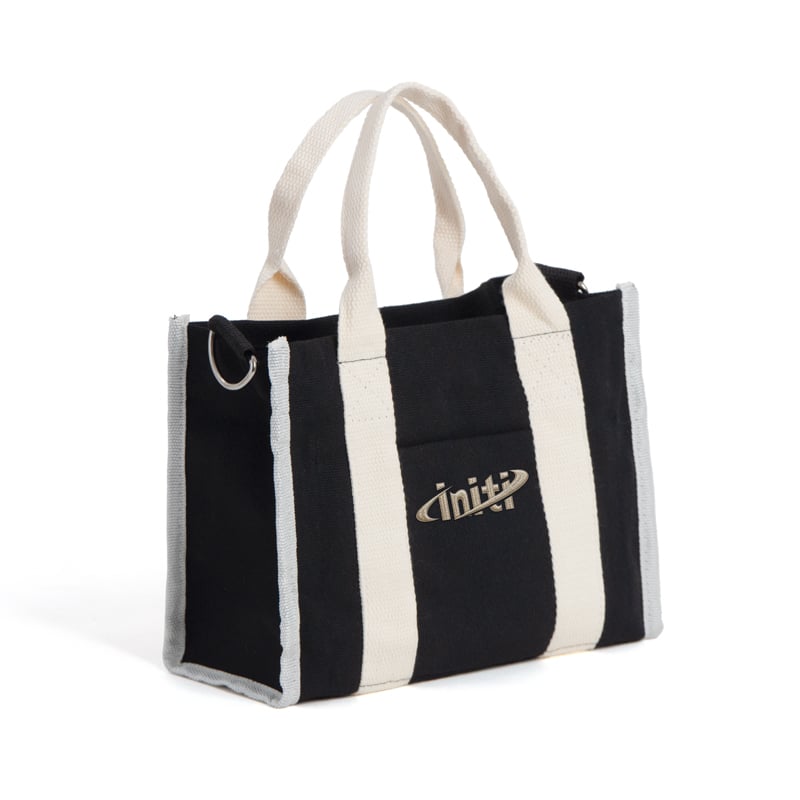
Before choosing a tote bag size, confirm:
The largest item: Measure the width, height and depth of the actual product, including its retail packaging.
The complete load: Consider the total weight of the contents, not just the dimensions.
The carrying method: Hand-carry shopping bags and shoulder totes require different handle lengths and carrying proportions.
The distribution method: An event giveaway tote may need to pack flat into cartons, while a retail merchandise tote may need a more substantial appearance.
For custom logo tote bags, also check whether the chosen size leaves enough usable space for printing or embroidery.
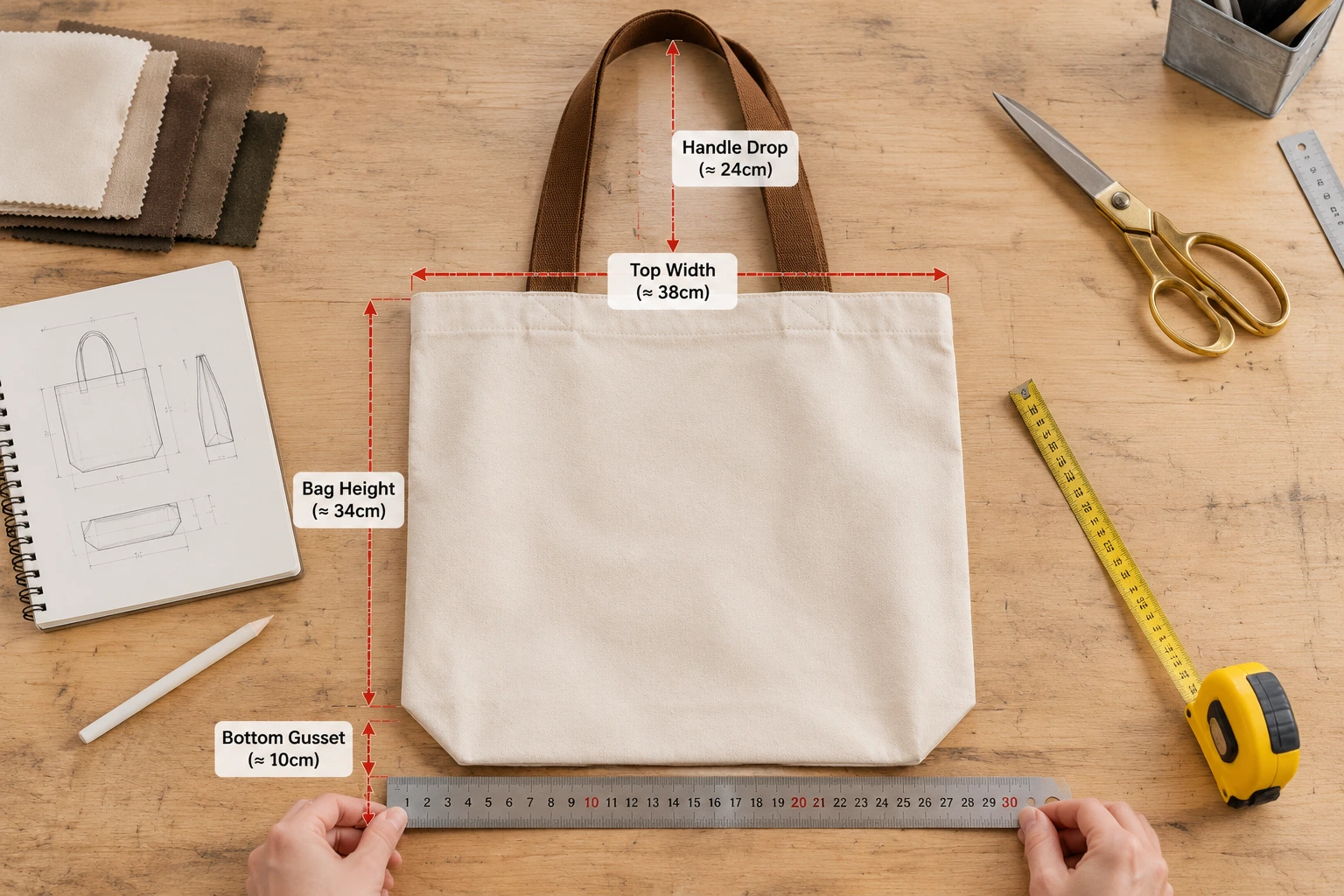
2. How to Measure a Tote Bag: Width, Height, Gusset and Handles
A tote bag is commonly specified as W × H × D, meaning width, height and depth. However, suppliers may use different measurement orders.
Always confirm the finished dimensions on a technical drawing.
Tote Bag Width: Top Opening vs. Bottom Width
For a rectangular tote, the top and bottom widths may be similar.
For a tapered tote bag, the top opening may be wider than the base. In this case, a single width measurement is insufficient.
A useful RFQ format is:
Top Width / Bottom Width × Height × Bottom Gusset
For example:
56/42 × 45 × 15 cm
This means:
- Top opening width: 56 cm
- Bottom width: 42 cm
- Height: 45 cm
- Bottom gusset depth: 15 cm
This is a convenient sourcing notation rather than a universal industry measurement standard. Label each dimension clearly.
The drawing should also identify whether the dimensions refer to the finished bag, the flattened bag or the fully expanded base.
Tote Bag Height: Check Internal Clearance
Height determines whether products such as books, folders and packaged gifts fit vertically.
External height does not always equal usable internal height. A top hem, zipper or other closure may reduce the available space.
For example, A4 paper measures 21 × 29.7 cm. A tote with an external height of 30 cm may not have enough internal clearance for an A4 folder.
For a book tote bag or conference tote bag, test the actual documents rather than relying on external measurements alone.
Three Common Tote Bag Gusset Constructions
The gusset affects how the tote expands and how its contents sit inside.
| Tote Bag Structure |
Construction |
Suitable Applications |
| Flat Tote |
Front and back panels without a defined gusset |
Documents, lightweight apparel, simple promotional bags |
| Bottom-Gusset Tote |
Depth formed mainly at the base through folds, corners or bottom-panel construction |
Gift bags, everyday totes, boxed retail merchandise |
| Full-Gusset Tote / Three-Sided Gusset |
Defined depth at the sides and bottom |
Grocery totes, larger shopping bags, bulky retail products |
These categories describe the finished structure, not one mandatory sewing method.
Terms such as T-gusset, box gusset and boxed corners can describe different pattern-making methods and should not automatically be treated as identical.
For OEM production, confirm the gusset by providing the finished depth, side-profile drawing and a reference photo or sample.
Handle Drop and Strap Length
Handle drop is the vertical distance from the top of the bag to the inside top of the raised handle.
It differs from the total handle length.
A shoulder tote bag generally requires a different handle drop from a short-handled gift tote.
For larger shopping bags, test the loaded carrying position and ensure the bag does not hang uncomfortably low.
3. How to Choose Tote Bag Fabric Weight: GSM and Canvas Oz
Fabric weight is an important sourcing specification, but it should not be confused with bag thickness or finished load capacity.
What Does GSM Mean for Tote Bags?
GSM means grams per square metre (g/m²).
For example, 200 GSM fabric weighs 200 grams per square metre before additional bag components are included.
Higher GSM generally means more fabric mass per unit area, but two fabrics with the same GSM may differ in yarn construction, weave, stiffness, coating and tear resistance.
Cotton Tote Bag GSM Guide
For cotton and canvas tote bag sampling, these weight ranges can help narrow the options.
| Cotton or Canvas GSM |
General Feel |
Typical Sourcing Direction |
| 140–200 GSM |
Lightweight and flexible |
Promotional cotton tote bags, event giveaways |
| 220–300 GSM |
More substantial but still flexible |
Branded retail totes, bookstore bags, everyday shopping |
| 340–475 GSM |
Heavier canvas with more body |
Premium canvas totes, structured retail bags |
| Above 475 GSM |
Very substantial, depending on construction |
Selected oversized or structured merchandise designs |
These are approximate development ranges, not fixed product grades or tested load ratings.
A lightweight promotional tote bag may perform well for brochures and gifts. A heavy canvas tote bag may provide the hand feel desired for a retail collection, but the final structure still requires testing.
Canvas Tote Bag Weight: Oz to GSM Conversion
Canvas fabric is often specified in ounces per square yard (oz/yd²).
When this is the actual unit:
GSM = oz/yd² × 33.906
| Canvas Weight |
Approximate GSM |
| 6 oz/yd² |
203 GSM |
| 8 oz/yd² |
271 GSM |
| 10 oz/yd² |
339 GSM |
| 12 oz/yd² |
407 GSM |
| 14 oz/yd² |
475 GSM |
| 16 oz/yd² |
542 GSM |
If a supplier quotes ounces per linear yard, the fabric width is needed to convert the weight correctly.
8 oz vs. 12 oz Canvas Tote Bags
An 8 oz canvas tote may suit a flexible promotional or everyday design where low weight and flat packing matter.
A 12 oz canvas tote has more fabric mass per unit area and may be appropriate when a more substantial hand feel or firmer structure is desired.
However, 12 oz canvas does not automatically provide a specific carrying capacity. Fabric construction, seams, handles and reinforcement still determine finished-bag performance.
For detailed fabric testing and shrinkage considerations, see Canvas Fabric Weight for Custom Bags.
PP Non-Woven and RPET Tote Bag Weights
Cotton canvas weight ranges should not be applied directly to other materials.
For PP non-woven shopping bags, buyers may initially compare samples around 60–70, 80–90 or 100–120 GSM, depending on the intended construction and product positioning.
For RPET tote bags, specify both the GSM and fabric construction, such as woven polyester or stitch-bond fabric.
Material composition, bonding, handles and sewing methods matter as much as nominal fabric weight.
A 150 GSM RPET tote fabric and a 150 GSM cotton fabric should not be expected to perform identically.
4. Match Tote Bag Size and Fabric Weight to the Application
A suitable tote bag specification depends on what the buyer needs to carry and how the bag will be used.
| Buying Scenario |
Size Direction |
Material Direction |
Key Check |
| Promotional tote bags |
Small or medium, often flat |
Lightweight cotton or PP non-woven |
Printing, distribution and cost |
| Bookstore or museum tote bags |
Medium vertical tote |
Midweight cotton or canvas |
Internal height and handle performance |
| Fashion retail tote bags |
Sized around apparel or packaging |
Cotton, canvas or selected textiles |
Product fit and visual presentation |
| Supermarket shopping totes |
Medium to large, usually gusseted |
PP woven, RPET, non-woven or canvas |
Load, base and handles |
| Premium canvas tote bags |
Medium to large |
Substantial canvas or selected woven fabrics |
Shape, hand feel and finish |
| Oversized shoulder tote bags |
Large body with defined depth |
Fabric matched to reinforcement |
Carrying comfort and loaded volume |
Example: Promotional Tote Bags for Trade Shows
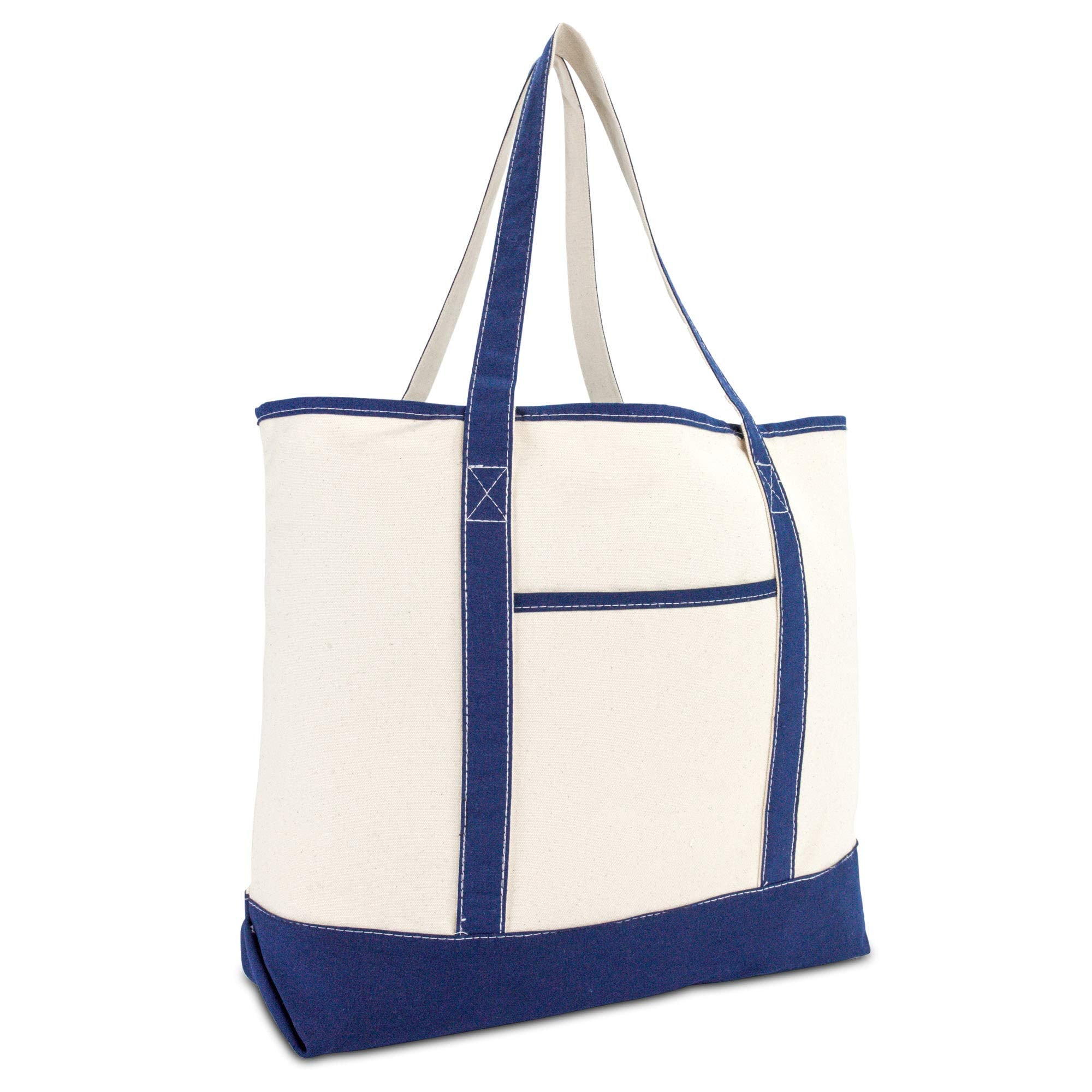
For brochures, catalogues and small gifts, a flat cotton tote bag may be enough.
A deep gusset or 16 oz canvas may add cost without improving the intended application.
Example: Retail Tote Bags for Boxed Products
When the bag must hold a gift box, measure the complete box first.
A defined bottom gusset can help accommodate its depth, but the finished opening and usable internal base still need checking.
Increasing fabric GSM cannot correct an undersized bag.
Example: Reusable Shopping Totes for Groceries
A reusable grocery tote bag may need a broader base and reinforced handles.
The bag's capacity, load distribution and seam performance should be tested using the actual intended products.
The same principle applies to large wholesale tote bag orders: select material weight together with construction, not separately.
5. Real INITI Tote Bag Sizes and Construction Examples
INITI's existing products show how size and gusset construction change the function of a tote bag.
A. Contrast Canvas Tote Bag — Medium Gusseted Shoulder Tote
Contrast Canvas Tote Bag
Existing size: 42 × 29 × 11 cm
Key details:
- Approximately 27 cm handle drop
- Defined side and bottom gusset
- Magnetic snap closure
- Contrast reinforced bottom panel
This style is a reference for retail merchandise, lifestyle tote bags and corporate gifts needing a wider but relatively low-profile body.
Because its external height is 29 cm, buyers carrying A4 folders vertically should check the actual internal height before ordering.
B. Oversized Wide Strap Tote Bag — Large Shopping and Lifestyle Tote
Oversized Wide Strap Tote Bag
Existing size: 54 × 37 × 16 cm
This tote features a deep side and bottom gusset, an integrated wide shoulder strap and an open-top construction.
Its large body can serve as a reference for apparel, retail merchandise and oversized shopping programs.
The bag's fabric weight, strap dimensions and target carrying load should be selected and tested for the specific project.
C. Large Logo Webbing Canvas Tote Bag — Tapered Bottom-Gusset Tote
Large Logo Webbing Canvas Tote Bag
Existing dimensions: 56/42 × 45 × 15 cm
- Top opening: approximately 56 cm
- Bottom width: approximately 42 cm
- Height: approximately 45 cm
- Bottom gusset: approximately 15 cm
- Handle drop: approximately 30 cm
This design combines a wide top opening with a narrower base.
It uses bottom-gusset construction with comparatively flat side panels, rather than a conventional full three-sided gusset.
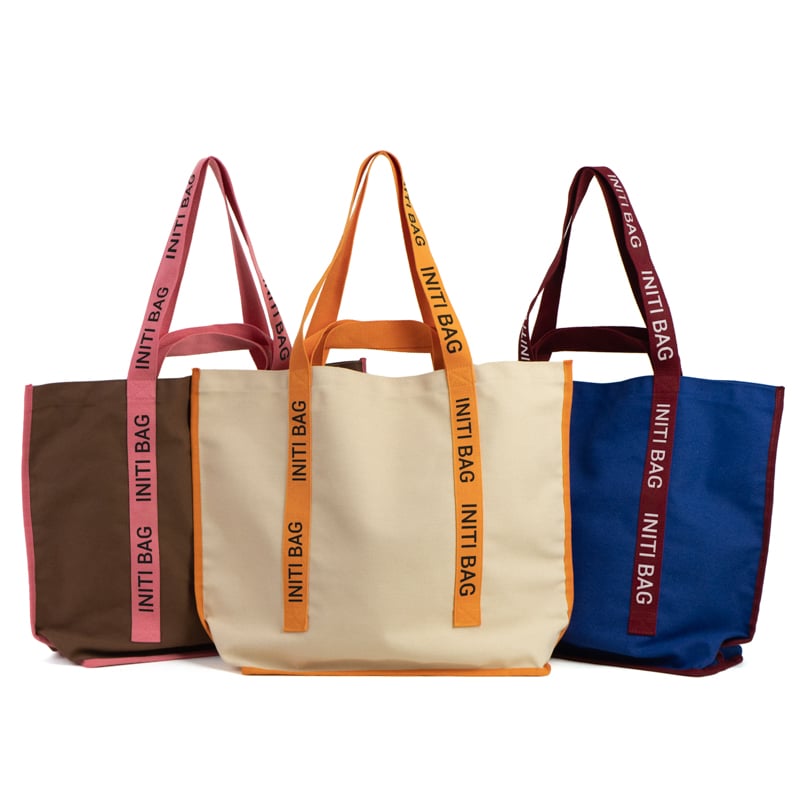
Long branded shoulder webbing and shorter handles provide two carrying options.
For buyers developing a custom tapered tote, this product illustrates why top width, bottom width and bottom depth should be specified separately.
Explore additional structures in the Cotton Canvas Tote Bag Collection, RPET Bag Collection and Non-Woven / PP Woven Tote Bag Collection.
6. Does a Higher GSM Make a Tote Bag Stronger?
Not necessarily.
A higher GSM can increase fabric mass and change the bag's hand feel, but finished tote bag load capacity depends on the complete construction.
Important factors include:
- Fabric composition and weave
- Bag dimensions and load distribution
- Handle width and attachment method
- Seam construction and reinforcement
- Bottom design and gusset
- Repeated carrying and lifting conditions
A heavy canvas bag with poorly attached handles can still fail under load.
Similarly, a lighter fabric with an appropriate structure may meet the needs of a specified promotional or retail project.
How to Test Tote Bag Carrying Capacity
For custom or wholesale tote bags, request sample testing based on actual use.
Specify:
- Target load in kilograms
- Contents and weight distribution
- Carrying method
- Repeated lifting or carrying cycles
- Seam, fabric and handle acceptance criteria
- Maximum packed dimensions
The supplier should evaluate the complete finished bag rather than assigning a load rating solely from fabric weight.
For additional guidance, see How Durable Are Canvas Tote Bags?.
7. Choose a Cost-Effective Tote Bag Specification
For bulk tote bag orders, material and size choices directly influence purchasing and distribution costs.
Increasing dimensions can increase fabric consumption. Heavier canvas can increase finished-bag weight, while extra gussets, pockets, linings, closures and reinforced handles add material and production operations.
These choices can also affect carton packing and freight volume.
Before confirming production, compare two or three realistic specifications.
| Factor |
More Basic Specification |
More Substantial Specification |
| Bag size |
Fits intended products with reasonable clearance |
Additional width or depth for broader use |
| Fabric |
Lighter material suitable for the application |
Higher GSM or heavier canvas |
| Handles |
Standard tested construction |
Additional webbing or reinforcement |
| Branding |
Simple custom logo printing |
Larger prints, embroidery or detailed labels |
| Packing |
Potentially more compact |
May require more carton volume |
| Best choice |
When functional and visual requirements are met |
When added features deliver measurable value |
The correct decision is not always the cheapest or heaviest option.
It is the specification that meets the required capacity, appearance and carrying performance without unnecessary cost.
8. Custom Tote Bag RFQ: Size, Gusset, GSM and Branding Checklist
A clear RFQ helps a manufacturer quote the correct bag and reduces revisions during sampling.
| RFQ Item |
What to Specify |
| Intended application |
Promotional tote, retail shopping bag, grocery tote, fashion merchandise or gift packaging |
| Actual contents |
Largest item, packaging dimensions and target load |
| Finished dimensions |
Width × height × depth; state the measurement order |
| Tapered dimensions |
Top width / bottom width × height × bottom gusset, if applicable |
| Gusset construction |
Flat, bottom-gusset only or full side-and-bottom gusset; attach a drawing |
| Fabric |
Cotton, canvas, RPET, PP non-woven, PP woven or another defined material |
| Fabric weight |
GSM or oz/yd², including the correct measurement unit |
| Handles |
Hand-carry or shoulder-carry, width, length, drop and reinforcement |
| Opening and extras |
Open top, zipper, snap, pockets, lining or base support |
| Custom branding |
Logo artwork, printing, embroidery and labels |
| Quality checks |
Product fit, finished-bag load testing and appearance requirements |
| Order information |
Quantity per size or color, delivery destination and timing |
| Packing |
Pieces per carton, carton dimensions, gross weight and CBM |
For shaped totes, a reference image and technical drawing are more reliable than a style name alone. Terms such as T-gusset or box bag may be interpreted differently by manufacturers.
For INITI custom tote bag projects, MOQ starts from 500 pieces, with higher minimums possible for specific materials, colors and constructions.
Why Choose INITI for Custom Tote Bags?
Hangzhou INITI Imp&Exp Co., Ltd. has over 16 years of experience in custom bags and packaging, supported by two production facilities and OEM/ODM development capabilities.
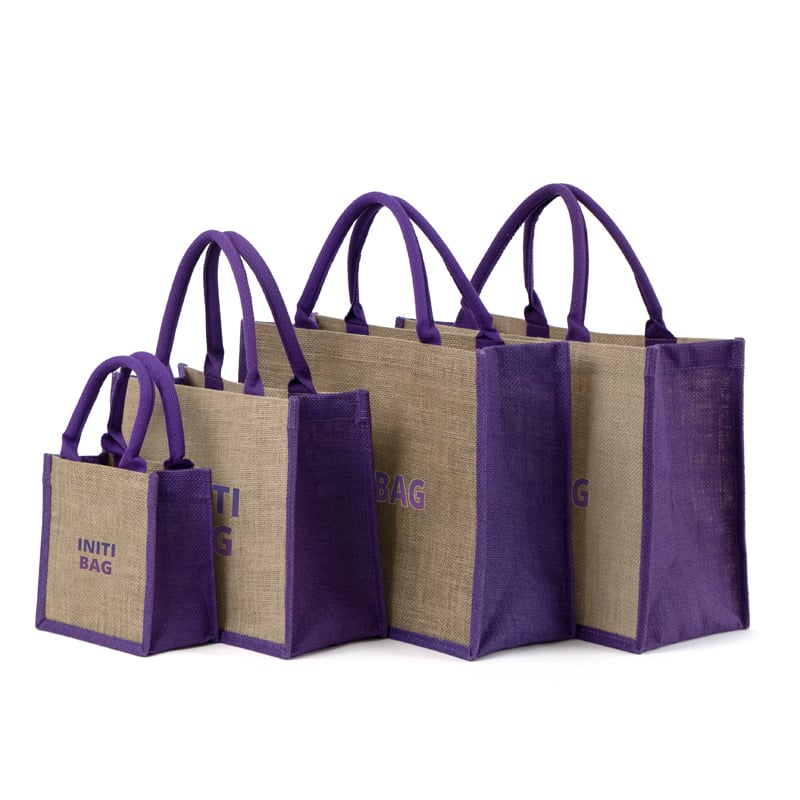
Our tote bag range includes cotton canvas, PP woven, non-woven, RPET, polyester, nylon, jute and other constructions for retailers, distributors, promotional companies and private-label brands.
INITI can develop custom tote bag dimensions around a buyer's actual products, then review fabric GSM, canvas weight, gusset construction, handle drop, reinforcement and branding together.
We support custom logo printing, sampling, material selection, quality inspection and export packing. Buyers can also specify target carrying loads and verify the finished construction through agreed sample tests before bulk production.
Our focus is to help buyers move from a reference image or product dimensions to a practical manufacturing specification.
FAQ
What is a standard tote bag size?
There is no universal standard. A flat tote around 35 × 40 cm is one possible starting point for brochures and lightweight merchandise. Retail boxes and larger contents may require custom dimensions and a gusset.
What GSM is best for a cotton tote bag?
For sampling, 140–200 GSM may suit lightweight promotional cotton bags, while 220–300 GSM can provide a more substantial everyday tote direction. Heavier canvas may suit premium or structured designs. Final performance depends on construction and testing.
Is a 12 oz canvas tote better than an 8 oz tote?
Not automatically. A 12 oz/yd² fabric is heavier than an 8 oz/yd² fabric, but the right choice depends on hand feel, intended use, cost and finished-bag construction.
What is the difference between a bottom-gusset and full-gusset tote?
A bottom-gusset tote creates depth mainly at the base. A full-gusset tote has defined side and bottom depth. The finished pattern and dimensions should be confirmed by drawing or sample.
Can I customize the tote size, fabric weight and logo?
Yes. INITI supports custom dimensions, GSM, canvas weights, handles, gussets, closures and branding. Custom orders start from 500 pieces, subject to the final specification.
Conclusion
The best tote bag size and fabric weight depend on the products being carried.
Start with the actual contents, then define the usable width, height, gusset and handle design. Compare cotton, canvas, RPET or non-woven fabric weights only after the intended construction is clear.
A reliable wholesale tote bag specification should combine correct dimensions, suitable material weight, practical carrying performance and an approved finished sample.
For B2B buyers, this produces more useful results than choosing a standard size or the heaviest available canvas without considering the application.
Inquiry Support
For custom tote bag quotations or OEM development, send us:
- Intended use and target market
- Product dimensions and expected load
- Preferred tote size and gusset style
- Cotton, canvas, RPET or other material preference
- GSM or canvas oz requirement, if known
- Logo artwork and branding specifications
- Estimated order quantity
- Packing and destination requirements
If the specifications are not final, send the products the bag must carry and your target price range so suitable size and fabric options can be evaluated.
Email us at [email protected] to discuss custom tote bags, wholesale pricing and sample development.
Related Products
Contrast Canvas Tote Bag
Oversized Wide Strap Tote Bag
Large Logo Webbing Canvas Tote Bag
Custom Canvas Tote Bag with Pocket
Cotton Canvas Tote Bag Collection
RPET Bag Collection
Non-Woven / PP Woven Tote Bag Collection
Custom Tote Bag Collection
Related Blog Articles
Canvas Fabric Weight for Custom Bags: GSM, OZ, Shrinkage and Load Testing
How Durable Are Canvas Tote Bags?
Cotton vs Canvas vs RPET Bags: Which Material Should Your Brand Choose?
Non-Woven Bag Styles: D-Cut, W-Cut, Loop Handle & Box Bags


 Hot News