A practical SEO guide for retailers, brand owners, promotional companies, importers, and OEM packaging buyers.
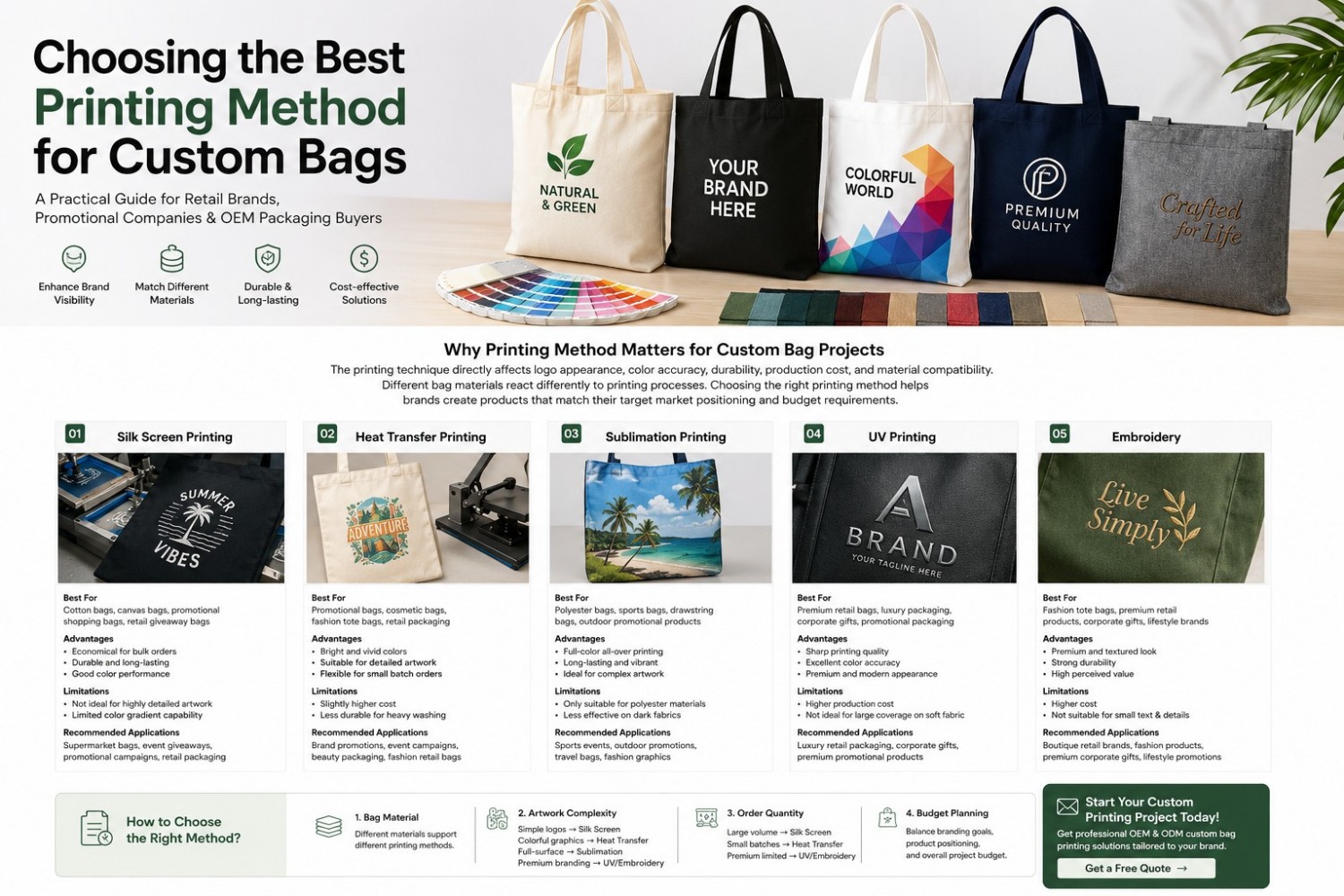
custom bags with different printing effects, material swatches, and branding samples.
Introduction: Why Printing Method Matters
For B2B custom bag projects, printing is not only a decoration process. It directly affects brand presentation, product positioning, durability, production cost, and buyer satisfaction. A supermarket may need a simple one-color logo on thousands of reusable shopping bags, while a fashion brand may prefer a premium embroidery logo on canvas tote bags. A sports event buyer may need full-color sublimation printing on polyester drawstring bags, while a gift supplier may request UV printing or offset printing for high-end packaging bags and paper boxes.
Choosing the wrong printing method can increase cost, reduce logo clarity, delay sampling, or create quality issues during bulk production. Choosing the right method helps buyers improve branding results, control budget, and match the final product with the target sales or promotional scenario.
This guide compares seven common methods: Silk Screen Printing, Heat Transfer Printing, Sublimation Printing, UV Printing, Offset Printing, Digital Printing, and Embroidery. It explains the features, advantages, limitations, suitable bag types, typical scenarios, and customer groups for each method.
Quick Comparison of Custom Bag Printing Methods
Printing Method |
Best Materials |
Best For |
Typical Customers |
Silk Screen Printing |
Cotton, canvas, non-woven, jute, paper |
Simple logos, bulk orders, promotional bags |
Supermarkets, retailers, promotional companies |
Heat Transfer Printing |
Cotton, canvas, polyester, non-woven, nylon |
Colorful artwork and medium/small batches |
Fashion brands, event buyers, gift suppliers |
Sublimation Printing |
Polyester and coated fabrics |
Full-color all-over printing |
Sports brands, outdoor brands, event organizers |
UV Printing |
Canvas, leather-like surfaces, PVC, acrylic, paper packaging |
Premium logo effects and detailed graphics |
Luxury brands, corporate gift buyers, premium retailers |
Offset Printing |
Paper bags, paper boxes, flat packaging materials |
High-volume paper packaging with accurate color |
Retail packaging buyers, gift suppliers, brand owners |
Digital Printing |
Cotton, canvas, paper, polyester blends |
Fast samples and personalized designs |
E-commerce sellers, small brand launches, creative agencies |
Embroidery |
Cotton, canvas, felt, corduroy, apparel fabrics |
Premium textured logo and durable branding |
Fashion brands, lifestyle brands, corporate gift buyers |
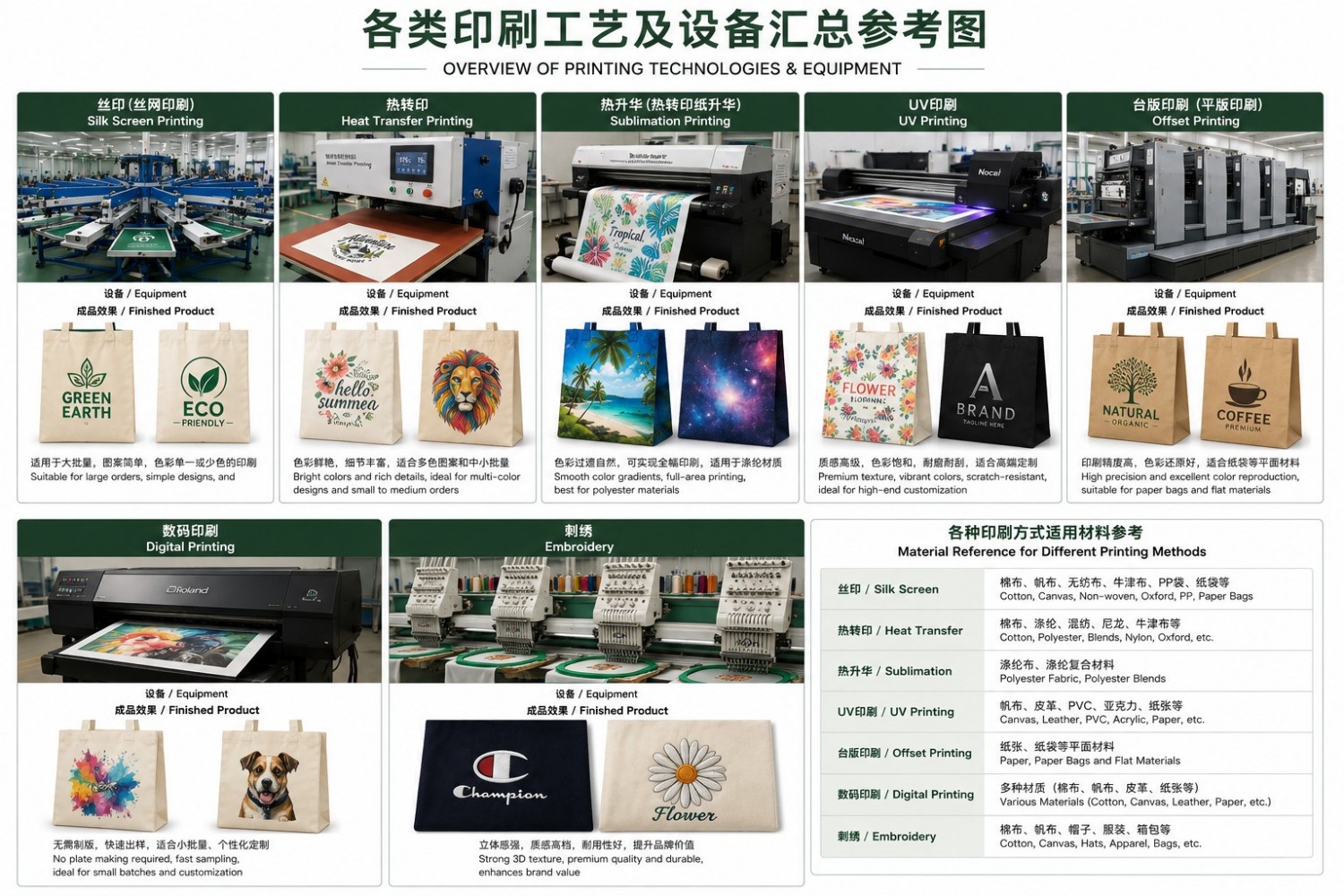
Reference image: overview of different printing equipment and finished custom bag effects.
1. Silk Screen Printing
Silk screen printing is one of the most widely used methods for custom bags. It pushes ink through a screen stencil onto the bag surface. It is especially suitable for simple logos, solid colors, and large-volume promotional orders. For many B2B buyers, this is the most practical solution when cost control and production stability are important.
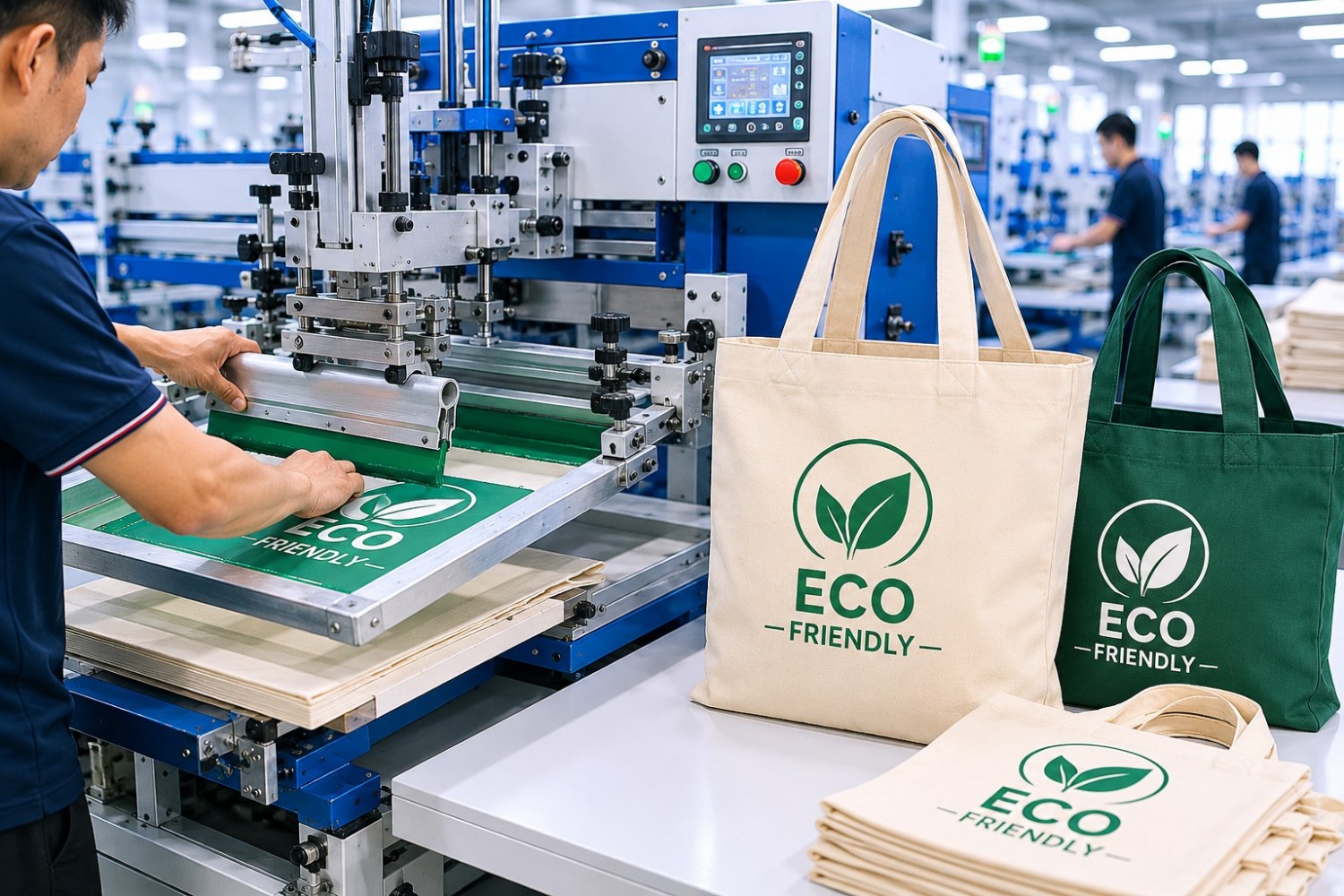
Silk screen printing production scene with finished tote bags and bulk manufacturing setup.
Key Features |
Works well with solid-color logos
Good opacity on cotton and canvas
Suitable for repeat production
Efficient for bulk orders |
Advantages |
Economical for large quantities
Stable color performance for simple designs
Durable for daily-use tote bags
Works on many common bag materials |
Limitations |
Not ideal for photo-level artwork
Each color usually requires separate setup
Gradient effects are limited
Sampling cost may be higher for many colors |
Best Bag Types |
Cotton canvas tote bags
Non-woven shopping bags
Jute tote bags
Drawstring bags
Paper bags with simple logos |
Best Customers & Scenarios |
Supermarkets ordering reusable shopping bags
Retailers launching seasonal promotions
Promotional companies buying event giveaways
Distributors needing cost-effective bulk bags |
2. Heat Transfer Printing
Heat transfer printing uses heat and pressure to transfer printed artwork onto the bag surface. It is suitable for colorful graphics, multi-color logos, detailed artwork, and smaller or medium-volume custom orders. This method is often used when the design is more complex than a simple one-color logo.
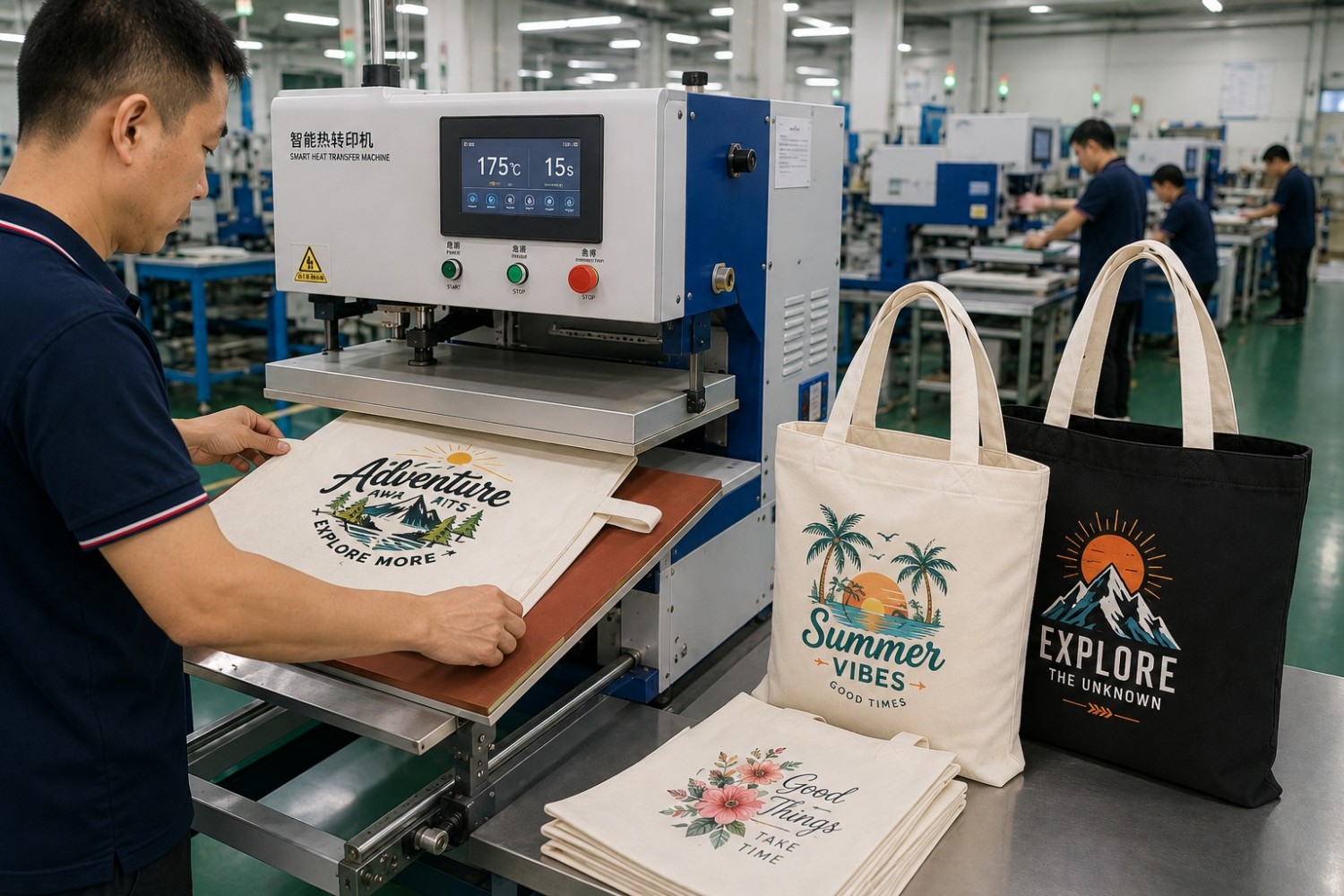
Heat transfer production scene with colorful finished tote bags and factory equipment.
Key Features |
Supports colorful artwork
Good for detailed graphics
Flexible for smaller batches
Suitable for multiple materials |
Advantages |
Bright visual effect
Lower setup complexity for multi-color designs
Good choice for promotional artwork
Works well for samples and brand campaigns |
Limitations |
May cost more than simple silk screen printing
Durability depends on material and usage conditions
Not ideal for very rough textile surfaces
Large heat-transfer areas may affect hand feel |
Best Bag Types |
Fashion tote bags
Cosmetic bags
Polyester or nylon bags
Non-woven promotional bags
Gift bags and retail packaging bags |
Best Customers & Scenarios |
Brand owners needing colorful marketing artwork
E-commerce sellers testing new product designs
Gift suppliers developing custom seasonal items
Event companies needing attractive giveaway bags |
3. Sublimation Printing
Sublimation printing is a heat-based printing process commonly used for polyester materials. It transfers dye into the fibers, creating vivid full-color patterns. This method is ideal for all-over designs, sports products, outdoor bags, and promotional bags that require strong visual impact.
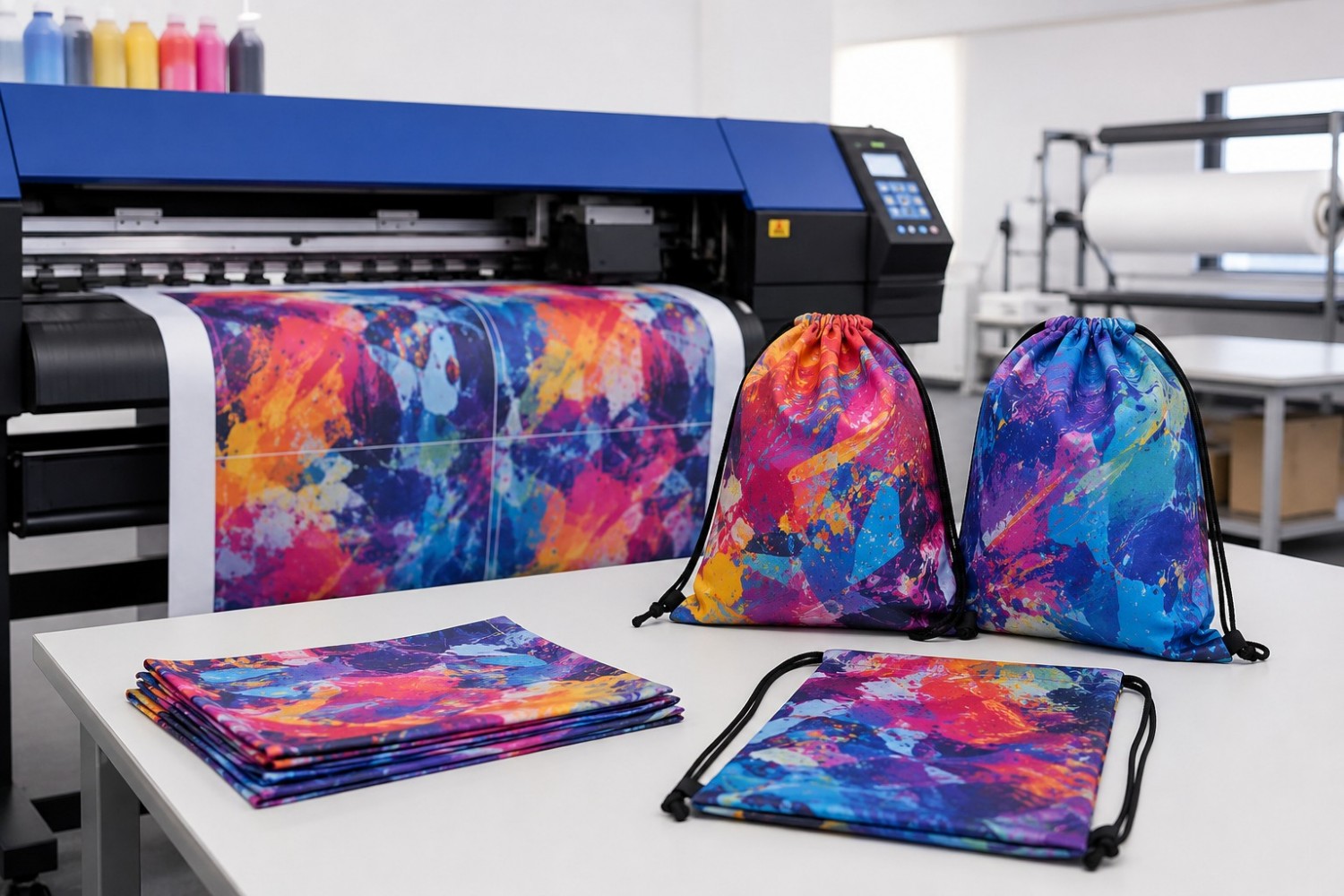
Sublimation-style colorful bag printing reference with full-color fabric artwork.
Key Features |
Best for polyester materials
Allows full-surface printing
Good for photo-like graphics
Color becomes part of the fabric surface |
Advantages |
Excellent for complex patterns
Smooth hand feel after printing
Good color brightness on white polyester
Suitable for sports and event merchandise |
Limitations |
Not suitable for cotton or jute
Works best on light-colored polyester
Less practical for simple low-cost logo orders
Requires suitable material selection from the beginning |
Best Bag Types |
Polyester drawstring bags
Sports bags
Outdoor bags
Travel bags
Beach bags and event merchandise |
Best Customers & Scenarios |
Sports event organizers
Outdoor brands
Travel and lifestyle brands
Promotional companies needing colorful campaign bags |
4. UV Printing
UV printing uses ultraviolet light to cure ink quickly on the product surface. It can create sharp details and premium visual effects, especially for high-end packaging or branded promotional products. UV printing is often selected when the buyer needs strong detail, modern presentation, and higher perceived value.
Key Features |
Sharp image quality
Fast curing process
Premium modern look
Suitable for detailed logos and artwork |
Advantages |
High color accuracy
Good detail performance
Works well for premium branding
Suitable for high-end packaging projects |
Limitations |
Higher cost than basic printing methods
Not required for simple low-cost promotional bags
Material compatibility must be checked
Some soft fabrics may not be ideal |
Best Bag Types |
Premium retail tote bags
Luxury packaging bags
PVC or leather-like bags
Corporate gift bags
Paper packaging with detailed artwork |
Best Customers & Scenarios |
Luxury retail brands
Corporate gift buyers
Design agencies
Brand owners launching premium packaging projects |
5. Offset Printing
Offset printing, also called lithographic printing, is widely used for paper packaging. It is highly suitable for paper bags, paper boxes, gift packaging, and flat packaging materials that require accurate color reproduction and clear printed details. It is especially useful when the packaging design includes gradients, product images, or complex graphics.
Key Features |
High precision for paper-based packaging
Good color reproduction
Suitable for flat materials
Efficient for large-volume paper printing |
Advantages |
Excellent print clarity
Professional retail packaging effect
Cost-effective for high-volume paper packaging
Suitable for complex graphics on paper products |
Limitations |
Mainly suitable for paper materials
Less suitable for fabric bags
Requires plate setup
Not ideal for very small urgent orders |
Best Bag Types |
Paper bags
Paper boxes
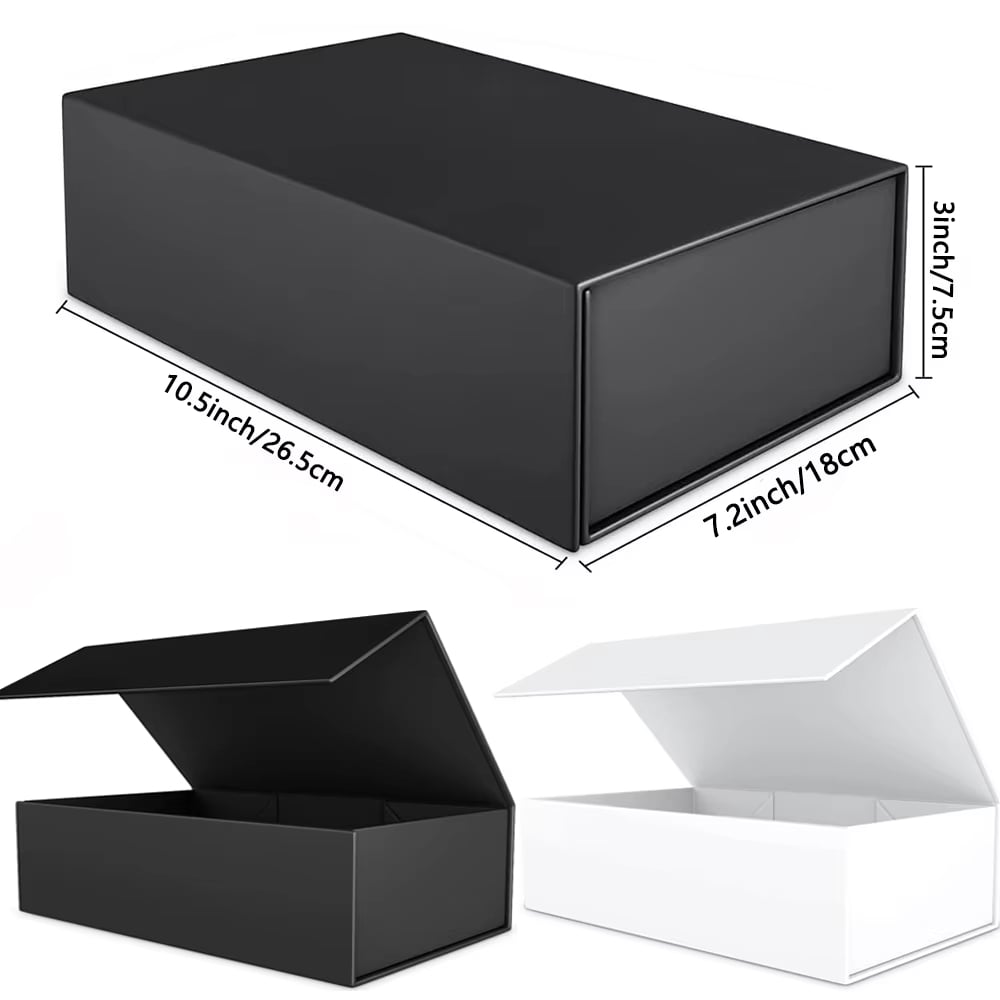
Gift packing boxes
Office gift box sets
Retail packaging sleeves |
Best Customers & Scenarios |
Gift suppliers
Retail packaging buyers
Brand owners needing paper shopping bags
Corporate buyers ordering gift packaging |
6. Digital Printing
Digital printing is flexible and suitable for small-batch customization, fast samples, and detailed artwork. It does not require traditional plates, which makes it useful for design testing, personalized products, and short production runs. Many e-commerce brands and creative agencies use digital printing when they need flexibility before scaling production.
Key Features |
No printing plate required
Suitable for detailed artwork
Fast sample development
Flexible for small-batch orders |
Advantages |
Good for prototypes and design testing
Supports personalized graphics
Shorter setup process
Useful for many creative projects |
Limitations |
Unit cost can be higher for large volumes
May not be as economical as silk screen for simple bulk logos
Material compatibility should be confirmed
Color performance depends on machine and fabric type |
Best Bag Types |
Sample tote bags
Canvas bags
Small-batch promotional bags
Personalized gift bags
Creative packaging projects |
Best Customers & Scenarios |
E-commerce sellers
Creative agencies
Start-up brands
Design teams preparing market tests |
7. Embroidery
Embroidery uses thread stitching to create a raised, textured logo or artwork. It is not a traditional ink printing process, but it is one of the most important branding methods for premium bags. It gives products a more tactile and durable appearance, making it popular for fashion, lifestyle, and corporate gift projects.
Key Features |
Thread-based logo effect
Premium tactile texture
Long-lasting branding
Works well for simple icons and text |
Advantages |
High perceived value
Durable and elegant
Suitable for premium retail products
Strengthens brand quality impression |
Limitations |
Higher cost than basic printing
Not suitable for very small details
Large embroidery areas may increase weight and cost
Requires artwork simplification for best results |
Best Bag Types |
Canvas tote bags
Quilted tote bags
Corduroy bags
Felt bags
Corporate gift bags
Fashion and lifestyle bags |
Best Customers & Scenarios |
Fashion brands
Corporate gift buyers
Premium retailers
Lifestyle brands needing higher product value |
How Different Customers Should Choose Printing Methods
Customer Type |
Main Need |
Recommended Printing Methods |
Reason |
Supermarkets & Retail Chains |
Large-volume reusable shopping bags with clear logos |
Silk Screen Printing, Non-woven Printing, Offset Printing for paper bags |
Cost control, stable quality, and repeatable production are usually more important than complex artwork. |
Brand Owners |
Product differentiation and stronger brand identity |
Heat Transfer, UV Printing, Embroidery, Digital Printing |
Brand owners often need a balance of visual effect, product positioning, and retail presentation. |
Promotional Companies |
Event bags, giveaways, and campaign products |
Silk Screen, Heat Transfer, Sublimation |
Projects often require visible logos, fast delivery, and controlled budget. |
Gift Suppliers |
Premium gift packaging and seasonal promotional products |
UV Printing, Offset Printing, Heat Transfer, Embroidery |
Gift products need stronger visual presentation and packaging value. |
Sports & Outdoor Brands |
Colorful, durable, lightweight products |
Sublimation, Heat Transfer |
Polyester-based sports and outdoor bags often need full-color graphics and lightweight performance. |
E-commerce Sellers |
Fast samples and market testing |
Digital Printing, Heat Transfer |
Smaller batches and flexible artwork testing are more important at the early stage. |
Corporate Buyers |
Professional gifts and event packaging |
Embroidery, UV Printing, Silk Screen |
Corporate projects often need clean logos, professional appearance, and stable quality. |
Decision Checklist Before Confirming Printing Method
Before placing a custom bag order, B2B buyers should confirm the following points with the supplier. This helps reduce sampling revisions and makes bulk production easier to control.
- What is the bag material? Cotton, canvas, RPET, polyester, jute, paper, or PVC?
- Is the artwork a simple logo, multi-color design, photo image, or full-surface pattern?
- What is the order quantity and expected delivery time?
- Will the bag be used for retail sales, giveaway campaigns, gift packaging, or outdoor events?
- Does the brand need a premium effect or a cost-effective promotional solution?
- Is a custom sample required before bulk production?
- Does the final product need specific packaging, hang tags, or retail-ready presentation?
OEM & ODM Printing Support for Custom Bags
A professional bag manufacturer should not only offer printing machines. More importantly, the supplier should help buyers choose suitable materials, adjust artwork for production, control sampling accuracy, and manage quality during mass production. Our OEM and ODM support covers custom logo printing, material recommendation, sample development, bulk manufacturing, and final inspection.
For B2B clients, the best printing method is not always the most expensive option. It is the option that matches product material, brand positioning, order quantity, budget, and customer usage scenario. A reliable supplier should explain these choices clearly before production starts.
FAQ: Custom Bag Printing
Which printing method is best for cotton tote bags?
Silk screen printing is commonly used for simple logos and bulk cotton tote bag orders. Embroidery is recommended when the buyer wants a more premium appearance.
Which method is best for colorful artwork?
Heat transfer printing is suitable for colorful artwork on many materials, while sublimation is better for full-color polyester bags.
What is the most cost-effective method for bulk orders?
Silk screen printing is usually cost-effective for large-volume orders with simple logos and limited colors.
Can different printing methods be combined?
Yes. Some projects may combine printing with woven labels, embroidery patches, or custom packaging to improve the final branding effect.
Should I make a sample before bulk production?
For most custom bag projects, sampling is recommended. It helps confirm material, logo size, color, placement, and overall workmanship before mass production.
Conclusion: Match Printing Method with Product Strategy
Choosing the best printing method for custom bags requires more than comparing prices. Buyers should consider material compatibility, logo complexity, production quantity, final usage, and brand positioning. Silk screen printing is practical for large-volume simple logo projects. Heat transfer and digital printing are useful for colorful or flexible custom orders. Sublimation is suitable for polyester and sports-related products. UV printing and embroidery support premium branding. Offset printing is the right choice for paper bags and gift boxes.
For retailers, brand owners, gift suppliers, importers, and promotional companies, the right printing method can improve product presentation, reduce sourcing risk, and make each custom bag project more effective.
We provide OEM & ODM custom bag printing solutions for global B2B buyers, including material selection, artwork adjustment, sample development, bulk production, quality inspection, and export support. Send your logo, bag style, quantity, and target usage. Our team will recommend a suitable printing method for your project.
- Custom Logo Printing
- Multiple Printing Technologies
- Eco-Friendly Materials
- Sample Development
- Large-Volume Manufacturing
- Quality Control & Packing Support


 Hot News