Canvas bag construction is about much more than sewing several pieces of fabric together. The way a bag is patterned, assembled, reinforced, and finished determines its shape, usable capacity, appearance, durability, and production consistency.
Two canvas tote bags may use the same fabric weight and have similar dimensions, yet perform very differently in actual use. One may hold its shape and keep its handles securely attached, while the other may develop loose seams, stretched corners, or distorted handles after repeated carrying. These differences often come from construction details rather than the canvas material alone.
For procurement teams, retailers, promotional products companies, and private-label brands, understanding canvas bag construction makes it easier to evaluate supplier proposals and identify which specifications deserve attention before mass production.
This guide explains these construction elements from a sourcing and product-development perspective.
What Is Canvas Bag Construction?
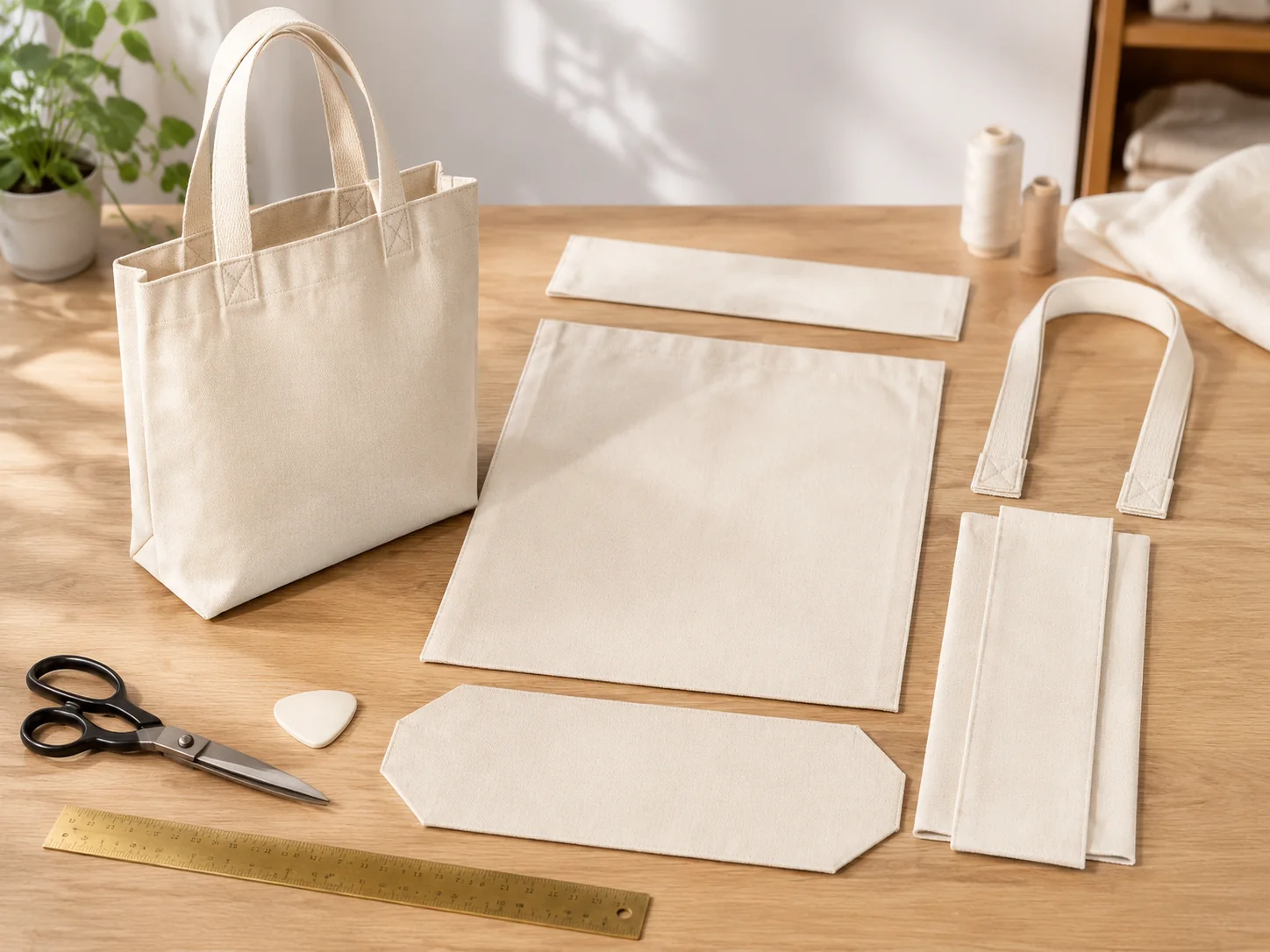
Canvas bag construction refers to the complete process of turning canvas fabric and related components into a finished bag. It includes pattern development, fabric cutting, panel assembly, sewing, reinforcement, edge finishing, and final inspection.
The construction method determines how the bag is shaped and how its different components work together.
For example, a simple promotional tote may consist of two body panels, two handles, and a folded top edge. A structured retail tote may require additional side panels, a separate bottom piece, lining, an internal pocket, and reinforced handle attachments.
Although both products are canvas bags, their manufacturing processes and construction requirements are different.
Main Components of a Canvas Bag
| Component |
Main Function |
Common Construction Considerations |
| Front and back panels |
Form the main body of the bag |
Panel dimensions, fabric direction, printing position, seam allowance |
| Side panels |
Create width and internal space |
Gusset depth, corner alignment, seam finishing |
| Bottom panel |
Forms the base of the bag |
Base dimensions, reinforcement, load distribution |
| Handles |
Allow the bag to be carried |
Handle material, width, length, attachment area |
| Top opening |
Creates the entrance to the bag |
Folded hem, facing, zipper, snap or other closure |
| Lining |
Covers the inside of the bag |
Material compatibility, seam finishing, pocket integration |
| Reinforcement patches |
Support areas under repeated stress |
Fabric thickness, patch dimensions, placement |
| Labels and accessories |
Add identification and functional details |
Position, attachment method, hardware compatibility |
Not every bag needs all these components. A lightweight promotional tote can use a relatively simple construction, while a premium retail bag may need a more developed structure.
The first step in product development is therefore to identify the intended application, expected contents, appearance requirements, and target price. These factors should guide the construction method rather than adding details simply because they are available.
Common Canvas Bag Construction Types
The overall structure is one of the first decisions buyers should confirm. It affects the bag's shape, capacity, material consumption, sewing process, and finished appearance.
Flat Construction
A flat canvas bag usually consists of two main body panels joined along the sides and bottom. The top edge is left open or finished with a folded hem.
This is one of the simplest and most economical construction methods.
Typical characteristics:
- Relatively simple pattern and cutting process
- Low material consumption compared with gusseted designs
- Lightweight and easy to store
- Limited depth when the bag is filled
- Suitable for flat or relatively thin contents
Flat construction is commonly used for lightweight promotional totes, document bags, event giveaway bags, and simple retail packaging.
For buyers, the main consideration is whether the intended contents require additional depth. A flat bag may look spacious when empty, but its usable capacity is limited when carrying bulky products.
Boxed-Corner Construction
Boxed-corner construction creates depth by shaping the lower corners of a flat bag.
The manufacturer typically forms the bottom corners by aligning the side and bottom seams, marking a measured section, and sewing across the corner before trimming or finishing the excess fabric.
The resulting base allows the bag to stand more easily and creates additional internal space.
Typical characteristics:
- Adds depth without requiring a separate bottom panel
- Keeps the overall pattern relatively simple
- Creates a more practical base for everyday contents
- Can be economical for medium-volume production
- Requires consistent corner measurement and sewing
Boxed corners are often suitable for shopping totes, promotional bags, and retail carriers that need more capacity than a flat bag.
The finished depth depends on the corner measurement and the way the pattern is assembled. Buyers should not assume that the marked corner measurement is automatically equal to the finished internal depth. The supplier should confirm the actual finished dimensions on the sample.
Side-Gusset Construction
A side-gusset bag includes additional fabric panels along the sides. These panels create a defined depth and allow the bag to expand when filled.
Unlike a simple flat tote, the side panels provide a more structured three-dimensional shape.
Advantages include:
- More internal volume
- A clearer rectangular or box-like profile
- Better suitability for wider products
- More room for organized storage
- Greater flexibility in designing the bag's proportions
Side-gusset construction is useful for retail shopping bags, gift bags, product packaging, and larger canvas carriers.
However, additional panels create more seams and alignment points. If the side panels are not cut consistently or sewn evenly, the finished bag may lean, twist, or have uneven corners.
Bottom-Gusset Construction
A bottom-gusset design creates additional depth at the base while keeping the side structure relatively simple.
The bottom may be formed by folding the body fabric, adding a separate base panel, or using another pattern arrangement depending on the bag design.
This construction is useful when buyers want a wider base for carrying products that need a stable bottom surface.
The main points to confirm are:
- Finished bottom depth
- Width of the base
- Whether the bottom is made from one or multiple fabric layers
- Whether a removable or fixed insert is required
- How the bottom connects to the side seams
A bottom gusset can improve usable capacity, but it does not automatically make a bag suitable for heavy contents. The base seam, handle attachment, and overall fabric construction still need to be evaluated.
Full-Gusset Construction
A full-gusset bag uses additional panels to create depth along both the sides and bottom.
This produces a more defined three-dimensional structure and can help the bag maintain its shape when filled.
Typical applications include structured shopping totes, larger retail bags, merchandise bags, and product carriers.
Compared with flat construction, full-gusset designs generally involve more fabric pieces, longer sewing time, and more demanding panel alignment.
Buyers should consider whether the extra structure provides a meaningful functional benefit. If the bag only needs to carry flat promotional materials, a full gusset may add cost without improving the user experience.
Expandable Construction
Expandable canvas bags use additional folds, gussets, or adjustable features to increase usable capacity.
For example, a bag may have side folds that open when filled or a bottom structure that provides additional depth.
This type of construction can be useful for retail bags and multipurpose carriers where the contents vary in size.
However, expandable features should be evaluated in both their folded and expanded states. Buyers should confirm whether the bag remains balanced, whether the folds open smoothly, and whether the seams can withstand repeated expansion.
Construction Type Comparison
| Construction Type |
Shape and Depth |
Material and Sewing Complexity |
Typical Applications |
| Flat |
Minimal depth |
Low |
Promotional totes, document bags |
| Boxed corner |
Moderate base depth |
Low to medium |
Shopping totes, event bags |
| Side gusset |
Defined side depth |
Medium |
Retail bags, gift bags |
| Bottom gusset |
Wider or deeper base |
Medium |
Shopping and merchandise bags |
| Full gusset |
Defined three-dimensional shape |
Medium to high |
Structured retail totes |
| Expandable |
Adjustable capacity |
Medium to high |
Multipurpose shopping bags |
The most suitable construction is not necessarily the most complicated one. Buyers should match the structure to the product's intended use, dimensions, expected contents, and target cost.
Canvas Bag Pattern Design and Fabric Cutting
Before sewing begins, the manufacturer needs a pattern that defines the dimensions and shapes of all fabric components.
Pattern accuracy is important because even small differences in panel size can affect the finished bag's symmetry, depth, and handle position.
Main Body Panels
For a basic flat tote, the front and back panels are usually cut to matching dimensions.
For a gusseted bag, the pattern may also include separate side and bottom panels. These pieces need to be compatible with the body panels so that the final bag has the intended proportions.
Buyers should confirm whether the quoted dimensions refer to:
- Finished external dimensions
- Finished internal dimensions
- Cutting dimensions before sewing
- Dimensions including or excluding the gusset
These measurements are not interchangeable.
For example, a bag specified as 40 cm wide and 35 cm high may have different cutting dimensions depending on its seam allowance, top hem, and construction method.
A technical specification should clearly identify the intended finished dimensions.
Fabric Direction and Grain
Canvas is a woven fabric, so its warp and weft directions can influence how it behaves during use.
The warp direction generally runs along the length of the fabric, while the weft direction runs across its width.
During pattern development, manufacturers should consider fabric direction when arranging panels. Cutting different components in inconsistent directions may create differences in stretching, drape, or appearance.
This is especially relevant for bags with large printed panels, prominent seams, or a structured shape.
For printed canvas, buyers should also confirm the print direction and whether the pattern needs to match across adjacent panels.
Seam Allowance
Seam allowance is the distance between the fabric edge and the stitching line. It provides the material needed to join panels and finish the seams.
A seam allowance that is too narrow may leave insufficient fabric around the stitching line. A very wide allowance may create unnecessary bulk, particularly where several layers meet.
Practical initial reference:
| Construction Area |
Suggested Seam Allowance |
| General body seams |
10–15 mm |
| Lightweight simple construction |
Around 10 mm, subject to fabric behavior |
| Heavier or more complex panel joins |
Around 12–15 mm |
| Areas requiring additional internal finishing |
Confirm according to the selected seam type |
These values are starting points for sample development, not fixed requirements for every canvas bag.
The appropriate allowance depends on fabric thickness, seam type, edge-finishing method, and the number of layers being joined.
For example, a bound seam may need a different allowance from a simple overlocked seam. The manufacturer should confirm the pattern and finished dimensions together rather than treating seam allowance as an isolated number.
Cutting Accuracy and Panel Consistency
Uneven cutting can lead to several visible problems:
- One side of the bag appears higher than the other.
- The bottom panel does not align evenly with the side panels.
- The handles are positioned at different heights.
- The top opening becomes slanted.
- Printed artwork is not centered.
For larger production orders, buyers should ask the supplier how cutting consistency is controlled.
Depending on the factory's equipment and production scale, this may involve cutting templates, cutting dies, marker planning, or other repeatable cutting methods.
For printed products, the manufacturer should also confirm the cutting allowance required around the artwork. A design that looks centered on a flat fabric panel may appear off-center after the bag is assembled.
Common Sewing Seams Used in Canvas Bags
Seams connect the different fabric panels and help the finished bag maintain its shape.
The best seam depends on the fabric, construction type, appearance requirements, and expected use.
A seam should not be judged only by the number of visible stitch rows. Its performance also depends on the stitch type, thread, stitch density, seam allowance, fabric strength, and sewing quality.
Plain Seam
A plain seam joins two pieces of fabric with their right sides facing each other. The pieces are sewn together and then opened or pressed into position.
This is a common method for assembling basic bag panels.
Advantages:
- Straightforward production process
- Suitable for many standard canvas constructions
- Relatively low sewing complexity
- Can create a clean external appearance
The raw edges may need additional finishing to prevent fraying.
For bags with an unlined interior, buyers should check whether the exposed seam allowances are overlocked, bound, folded, or otherwise finished.
Overlocked Seam
An overlocked seam uses an overlock stitch to wrap or secure the raw fabric edges.
It is often used to reduce fraying and keep the inside of a bag neater.
Advantages:
- Helps control loose fabric edges
- Efficient for production
- Suitable for many internal seams
- Can reduce the need for additional edge-folding operations
Overlocking is an edge-finishing method. It does not automatically mean that the seam is suitable for every load-bearing area.
For a bag designed to carry heavier contents, the main joining seam and reinforcement structure still need to be evaluated.
Bound Seam
A bound seam covers the raw fabric edges with a separate strip of fabric or binding tape.
This creates a more finished interior and can improve the appearance of unlined bags.
Bound seams are commonly considered for premium retail totes, structured canvas bags, and products where the inside will be visible to customers.
The binding material should be compatible with the main fabric in thickness, flexibility, and color.
Buyers should inspect whether the binding is attached evenly and whether it remains secure around corners and thicker seam intersections.
French Seam
A French seam encloses the raw edges inside the seam itself.
The fabric is sewn once with the wrong sides together, trimmed if necessary, then turned and sewn again to enclose the raw edges.
This method creates a neat interior finish.
It can be useful for lighter canvas constructions and products where a clean internal appearance is important.
However, it creates additional fabric layers. For very thick canvas or multiple-layer intersections, the resulting bulk may be difficult to manage.
The manufacturer should confirm whether the selected fabric thickness is suitable for this construction.
Flat-Felled Seam
A flat-felled seam encloses the raw edges and creates a relatively flat, durable seam structure.
It is commonly associated with products that require a neat and robust seam finish.
Potential advantages include:
- Enclosed raw edges
- A clean appearance on the inside and outside
- Additional stitching along the seam
- A relatively stable seam construction
However, flat-felled seams require more sewing operations and may increase production time.
They are worth considering where the appearance and seam structure justify the additional manufacturing work.
Seam Construction Comparison
| Seam Type |
Edge Finish |
Appearance |
Typical Considerations |
| Plain seam |
Raw edges require finishing |
Simple |
Efficient for basic assembly |
| Overlocked seam |
Edges secured by overlocking |
Functional interior finish |
Check thread security and edge coverage |
| Bound seam |
Raw edges covered with binding |
Neat and finished |
Adds material and sewing time |
| French seam |
Raw edges enclosed |
Clean interior |
Can create bulk with heavy canvas |
| Flat-felled seam |
Raw edges enclosed |
Neat, structured |
Requires additional sewing operations |
The most appropriate seam should be selected according to the bag's fabric weight, construction, intended use, and target price.
Stitch Density, Thread, and Sewing Quality: Practical Reference Standards
Stitch density is the number of stitches within a specified length. It is often expressed as stitches per inch, or SPI.
It is an important construction parameter, but more stitches do not always mean a stronger seam.
If stitches are too widely spaced, the seam may not hold the fabric securely. If they are too close together, repeated needle penetrations can weaken certain woven materials or create a perforation line.
The appropriate setting depends on fabric thickness, weave density, thread size, needle selection, seam type, and sewing tension.
Suggested Stitch Density for Initial Sampling
The following ranges can be used as practical starting points when discussing a canvas bag sample with a manufacturer.
| Application |
Initial Reference |
What Buyers Should Check |
| Lightweight to medium canvas body seams |
8–10 SPI |
Consistent stitch formation without puckering |
| Medium to heavy canvas seams |
7–9 SPI |
Balanced seam appearance and fabric integrity |
| Heavy canvas or thick multi-layer areas |
Around 6–8 SPI |
Needle penetration, thread compatibility, and seam security |
| Handle attachment areas |
Confirm by stitch pattern and material; often around 7–9 SPI as a starting point |
No fabric tearing, loose threads, or excessive perforation |
| Decorative topstitching |
Confirm according to appearance requirements |
Even spacing and consistent alignment |
These are not universal industry requirements. A factory may need to adjust the stitch density after testing the selected canvas, thread, and sewing machine settings.
For example, a lightweight cotton canvas may tolerate a different stitch arrangement from a dense 16 oz duck canvas. A handle attachment also has different mechanical demands from a decorative seam.
Buyers should avoid writing only "strong stitching" in a purchase specification. It is more useful to identify the seam location, stitch pattern, approximate density, thread requirements, and expected performance.
Thread Selection
Sewing thread should be selected according to the fabric and the function of the seam.
Common thread options include:
- Polyester thread: Often used for general-purpose canvas bags because of its strength and resistance to everyday wear.
- Cotton thread: Can be considered when a natural-material appearance is important, although its properties should be checked against the intended application.
- Bonded polyester thread: Often considered for applications requiring stronger thread performance and abrasion resistance.
Needle Selection and Thread Tension
Needle size and point type should match the fabric and thread.
A needle that is too small may struggle to penetrate dense canvas. An unsuitable needle point may damage the yarns or create irregular holes.
Thread tension also needs to be balanced. Excessive tension can cause puckering or pull the fabric out of shape, while insufficient tension may result in loose or poorly formed stitches.
During sample approval, buyers should inspect:
- Whether stitches are evenly formed
- Whether the upper and lower threads are balanced
- Whether the fabric is puckered around the seam
- Whether needle holes are excessively visible
- Whether the thread ends are properly secured
- Whether the seam remains flat and consistent
What Standards Can Buyers Reference?
Buyers looking for a more formal technical reference can refer to ASTM standards related to stitches, seams, and sewn seam performance.
ASTM D6193 – Standard Practice for Stitches and Seams
This standard covers the classification and general characteristics of stitches and seams used in sewn products. It explains that seam engineering involves several variables, including fabric properties, seam type, stitch type, stitch density, thread tension, and thread strength.
For buyers, the important takeaway is that seam quality should be assessed as a complete construction system rather than by stitch count alone.
ASTM D1683/D1683M – Standard Test Method for Failure in Sewn Seams of Woven Fabrics
This test method addresses the strength and failure behavior of sewn seams in woven fabrics. It can be used to evaluate factors such as seam strength, seam efficiency, and the way a sewn seam fails under applied force.
However, it should not be interpreted as a universal load-capacity standard for finished canvas bags. A seam test on fabric specimens does not automatically represent the performance of a complete bag with handles, corners, and a bottom structure.
For a formal testing requirement, buyers should confirm the test method, specimen preparation, test direction, conditioning, acceptance criteria, and reporting requirements with the testing laboratory and supplier.
Canvas Bag Handle Construction
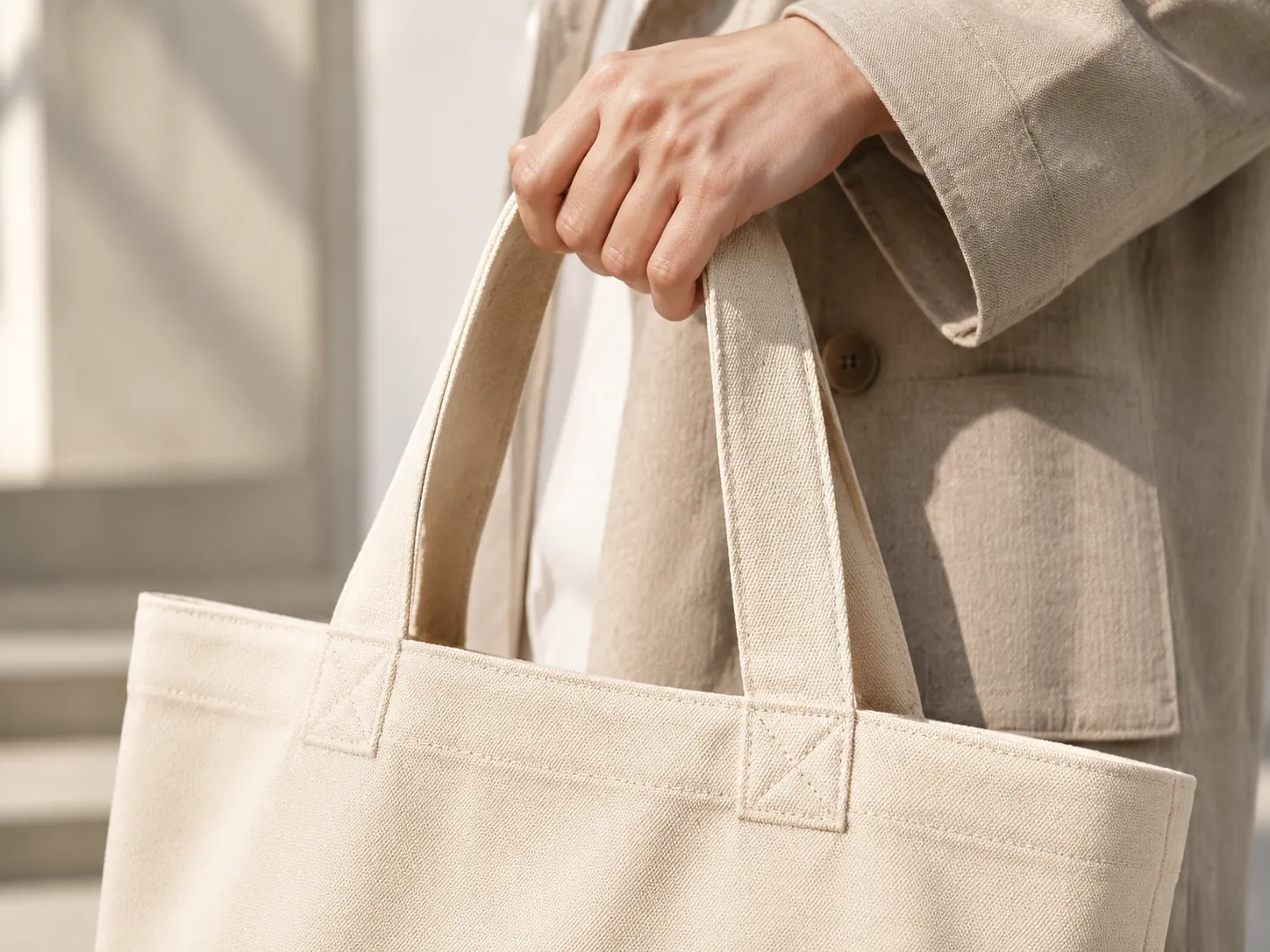
Handles are among the most important functional components of a canvas bag.
Their design affects carrying comfort, appearance, usable space, and the way force is transferred to the bag body.
A handle may be made from the same canvas as the bag, separate webbing, or another compatible material.
Self-Fabric Handles
Self-fabric handles are made from the main canvas material.
They can create a coordinated appearance and are often selected for promotional totes, retail bags, and custom branded bags.
The handle may be formed by folding a strip of canvas and sewing along one or both edges.
Important considerations include:
- Fabric weight and flexibility
- Finished handle width
- Number of fabric layers
- Stitching along the handle
- Handle length and drop
- Attachment method
A self-fabric handle should feel comfortable enough for its intended use. If the material is too thin, the handle may feel less substantial. If it is too thick or stiff, it may become uncomfortable or difficult to fold.
Cotton Webbing Handles
Cotton webbing is a common choice for canvas tote bags.
It offers a coordinated textile appearance and can be easier to specify consistently than a handle cut from the main body fabric.
Cotton webbing is available in different widths, thicknesses, and constructions.
Buyers should confirm whether the webbing is woven densely enough for the intended application and whether its color, texture, and shrinkage behavior are compatible with the bag body.
Polyester and Polypropylene Webbing
Polyester webbing is often considered when buyers want a synthetic handle material with good resistance to everyday abrasion.
Polypropylene webbing is another option for cost-conscious designs and certain lightweight applications.
Handle Width Reference
| Handle Type |
Suggested Initial Width |
Typical Use |
| Narrow webbing |
20–25 mm |
Lightweight promotional bags |
| Standard webbing |
25–30 mm |
General canvas tote bags |
| Wider webbing |
30–38 mm |
Larger shopping totes and heavier designs |
| Self-fabric handles |
25–40 mm |
Custom canvas handles |
These dimensions are practical design references, not fixed standards. The finished width should be considered together with the handle thickness, material, bag size, and carrying requirements.
Handle Length and Drop
Handle length and handle drop are different measurements.
- Handle length is the total length of the handle material, measured according to the agreed construction method.
- Handle drop is the vertical distance from the top edge of the bag to the top of the handle when the bag is held in its intended position.
Buyers should specify which measurement they require.
| Handle Style |
Suggested Handle Drop |
Typical Use |
| Short handle |
100–150 mm |
Hand-carry bags |
| Medium handle |
150–230 mm |
Hand carrying with some wrist or forearm clearance |
| Long handle |
230–300 mm |
Shoulder-carry tote bags |
The correct drop depends on the bag's height, the intended carrying method, and the target user experience.
A large bag with a short handle may be difficult to carry over the shoulder. A small bag with an excessively long handle may hang too low or look disproportionate.
For this reason, buyers should confirm handle drop on a physical sample rather than relying only on a drawing.
Handle Attachment Methods
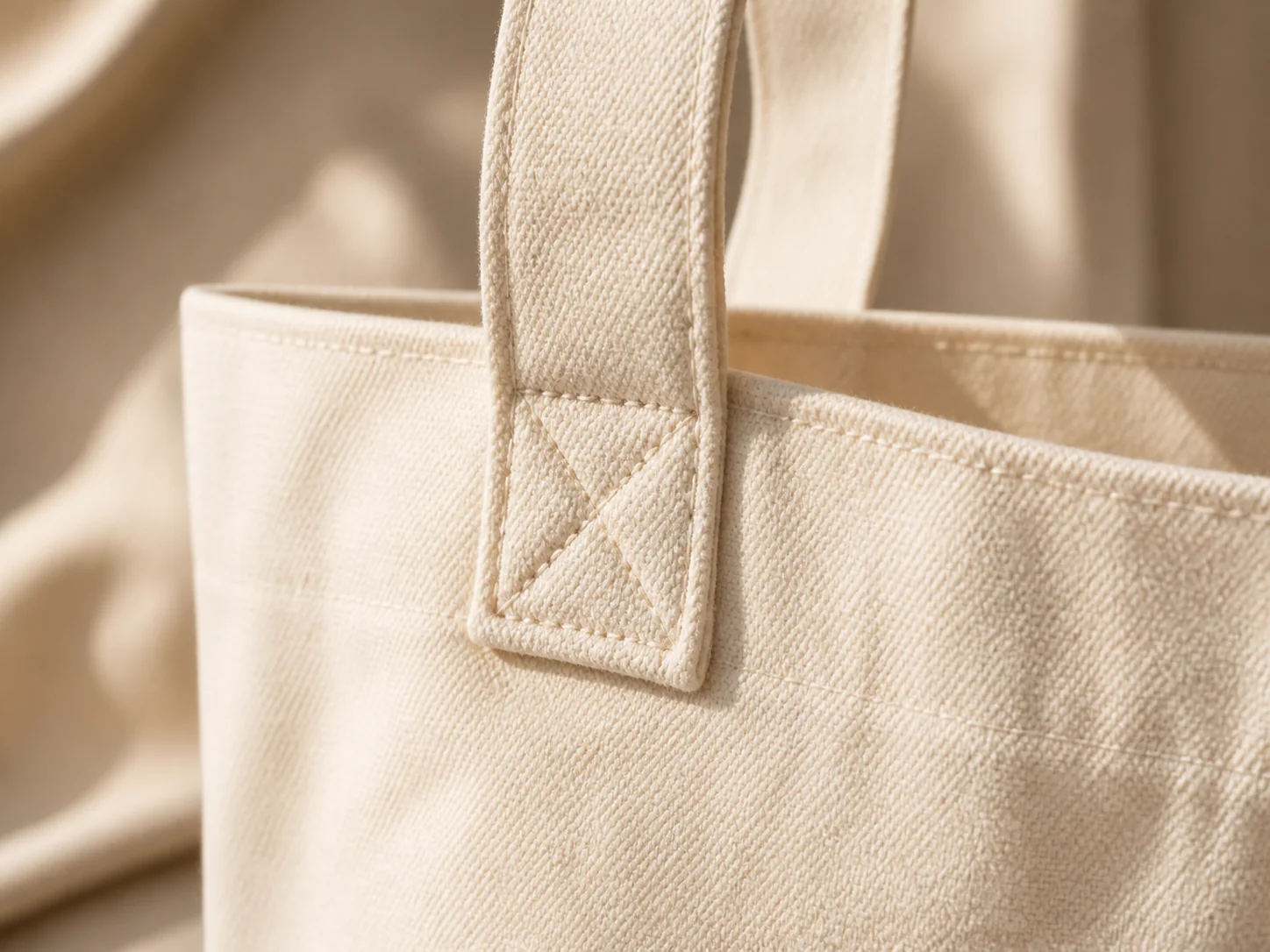
| Stitching Pattern |
Geometric Configuration |
Active Thread Path Area |
Tensile Stress Distribution |
Recommended Safe Load Limit |
| Linear Bar-Tack (ISO 304) |
Single dense zig-zag strip (1.5–2.0 mm width)
|
Minimal (1.0× baseline)
|
Highly concentrated along one yarn line; high risk of warp yarn shear |
≤6–8 kg (Auxiliary loops & pocket corners only)
|
| Standard Perimeter Box |
4-sided outer perimeter rectangle |
Moderate (2.2× baseline)
|
Distributes force over 4 perimeter lines; weak against central torsion |
≤10–12 kg (Lightweight retail shopping totes)
|
| Box-X Cross Stitch |
Perimeter box plus 2 intersecting diagonal lines |
Maximum (3.6× baseline)
|
Re-routes shear stress diagonally across both warp and weft canvas yarns |
≥20–30 kg (Commercial standard for heavy canvas)
|
| Solid Rivet + Washer |
Copper/brass tubular rivet through leather backing |
Mechanical clamping force |
High point-load; requires internal washer to prevent weave blowout |
≥25–35 kg (Heritage workwear & leather-handle bags)
|
Bottom Construction and Reinforcement
The bottom of a canvas bag supports its contents and helps maintain the bag's shape.
The construction method should be selected according to the bag's size, depth, expected contents, and desired appearance.
Single-Layer Bottom
A single-layer bottom uses the same main fabric structure without an additional reinforcement panel.
It is suitable for lightweight bags that carry relatively light contents.
Potential advantages include:
- Lower material consumption
- Less sewing complexity
- Lightweight finished construction
- Easier folding and storage
However, a single-layer bottom may not provide enough structure for larger bags or designs expected to carry heavier products.
Double-Layer Bottom
A double-layer bottom uses an additional layer of fabric to reinforce the base.
This can improve the bottom's resistance to everyday wear and help the bag maintain a more substantial feel.
The additional layer may be made from the same canvas or a compatible material.
Buyers should confirm whether the extra layer covers the full base or only selected areas. They should also check whether the additional thickness makes the corners difficult to sew evenly.
Reinforced Bottom Insert
Some canvas bags include a separate insert or stiffener inside the bottom.
Depending on the design, this may be made from a suitable plastic sheet, board, or other reinforcement material.
A bottom insert can help the bag maintain a flatter base and support products that need a more stable carrying surface.
Before approving this feature, buyers should confirm:
- Insert material and thickness
- Finished insert dimensions
- Whether the insert is removable
- Whether it is covered by fabric
- Whether the corners fit the bag correctly
- Whether it can be cleaned or replaced if necessary
A removable insert can be practical for certain retail or utility bags, while a fixed insert may create a more integrated structure.
External Bottom Protection
For selected applications, the bottom may include additional external protection, such as reinforced fabric, a coated panel, or other compatible material.
This can be considered when the bag is frequently placed on the ground or exposed to repeated surface contact.
The material should be selected according to the product's intended use and overall appearance. A protective bottom should not create unnecessary stiffness or interfere with folding if portability is a priority.
Bottom and Gusset Reference Dimensions
| Design Element |
Suggested Initial Reference |
Main Consideration |
| Boxed bottom depth |
80–150 mm |
Suitable for many medium-sized totes |
| Side gusset depth |
80–150 mm |
Match the width of intended contents |
| Bottom reinforcement patch |
Confirm from base dimensions and load requirements |
Should cover the intended stress area |
| Double-layer bottom |
Full base or defined reinforcement area |
Avoid uneven thickness at corners |
| Removable bottom insert |
Match the finished internal base |
Check fit and movement during use |
These dimensions are starting points for common tote designs. A small promotional bag may need less depth, while a large retail carrier may require more.The final dimensions should be confirmed on the approved sample.
Internal Linings, Organization & Pocket Mechanics
The decision between a lined and unlined interior directly impacts manufacturing labor, unit weight, washability, and internal organization capabilities.
Lined vs. Unlined Architecture: Engineering Trade-Offs
| Parameter |
Unlined (Clean Bound Finish) |
Fully Lined (Drop-in / Piped Liner) |
| Interior Aesthetics |
Exposed structural seams encased in twill tape |
100% clean; all internal seams and anchor backs concealed |
| Average Unit Weight |
Baseline (1.0×)
|
+25%–35% heavier
|
| Washability & Drying |
Fast drying; can be turned inside-out |
Slower drying; moisture can get trapped between shell and liner |
| Material Cost |
Lowest (canvas only + binding tape) |
+18%–28% (lining fabric + interfacings + cutting)
|
| Assembly Labor (SAM) |
Baseline (1.0×)
|
+35%–50% (bag-in-a-bag assembly + top turning)
|
| Ideal Use Case |
Farmer's market totes, utility gear, beach bags |
Laptop work totes, luxury travel bags, diaper bags |
Internal Pocket Engineering
Flat Patch Pocket: Stitched directly onto the main interior body panel before bag assembly.
Hanging / Floating Drop Pocket: Attached solely to the upper top-hem facing seam, suspended freely inside the main compartment. Highly economical; allows quick zippered pocket integration without stitching through the outer shell.
Closures, Hardware & Perimeter Finishes
Selecting and installing the bag mouth closure governs security, ease of access, and weather resistance.
Top Opening Closure Typologies
| Closure System |
Mechanical Structure |
Primary Advantages |
Engineering Watch-Out |
| Open Top (Double Hem) |
Double-turned 3.5–4.5 cm hem with twin lockstitch lines
|
Instant cargo access; lowest production cost; zero hardware |
Contents exposed to weather and theft; bag mouth can flare outward |
| Recessed Sunken Zipper Gusset |
Drop collar positioned 2.5–4.0 cm below bag mouth rim
|
Weather protection; maintains clean rectangular tote silhouette |
Requires fabric end-tabs on zipper chain to prevent slider derailment |
| Full Continuous Perimeter Zip |
Continuous zipper tape sewn flush along upper edge |
Maximum internal volume retention; complete enclosure |
Slightly restricts aperture width when fully unzipped |
| Magnetic Snap / Press Stud |
Centered metal hardware riveted through internal facing |
Fast single-handed closure; clean minimalist aesthetic |
Requires internal 1.5 mm backing washer to prevent fabric tear-out
|
Zipper Mechanics & Sizing Standards
| Zipper Gauge |
Material Type |
Recommended Canvas Applications |
| No. 3 (3.9–4.5 mm) |
Nylon Spiral Coil |
Internal drop pockets, wallet slots |
| No. 5 (5.5–6.2 mm) |
Nylon Coil / Metal / Vislon |
Main top closure for 10–14 oz totes
|
| No. 8 (7.2–8.0 mm) |
Chunky Metal / Molded Plastic |
Heavy utility totes, duffle main zip |
| No. 10 (8.5–10.0 mm) |
Heavy Industrial Brass/Coil |
Expedition duffles, tool bags (18 oz)
|
Specialized Canvas Finishes & Chemical Treatments vs. Construction
Canvas substrates interact dynamically with manufacturing processes depending on their pre-treatments and chemical coatings. A pattern engineered for raw cotton duck will fail if cut from waxed or PU-backed canvas without adjusting production parameters.
Treatment vs. Manufacturing Calibration Table
| Canvas Surface Finish |
Material Behavior During Production |
Factory Machine Calibration & Adjustments |
| Paraffin & Beeswax Waxed Canvas |
Severe needle friction; needle temperatures exceed 180∘C, melting synthetic thread
|
Use titanium-coated needles (SAN 5.1); reduce machine speed to 1,200 RPM; zero steam pressing |
| Polyurethane (PU) / PVC Backing |
100% waterproof barrier, but needle penetrations are irreversible |
Reduce SPI to 6–7; use light ballpoint needles; apply hot-air PU seam sealing tape |
| Enzyme / Vintage Garment Washed |
High shrinkage (4%–8% warp, 2%–4% weft)
|
Pre-shrink canvas roll prior to cutting, or engineer +5% shrinkage allowance in CAD Gerber patterns
|
| Fluorocarbon-Free DWR Coating |
Hydrophobic finish repels standard water-based adhesives |
Use solvent-based contact adhesives for fold cementing; test heat-transfer adhesion |
Additional Construction Details and Finishing
Small finishing details can influence the perceived quality of a canvas bag.
They may not change the overall structure significantly, but inconsistent finishing can make a product look poorly manufactured.
Corner Finishing
Corners are areas where multiple fabric layers and seams meet.
They should be sewn and trimmed consistently to avoid excessive bulk, loose threads, or uneven shapes.
For gusseted bags, the bottom corners should be checked carefully because they affect the bag's symmetry and ability to stand.
Piping
Piping is a narrow strip of material inserted into a seam to create a defined edge.
It can add a structured appearance to selected canvas bags, especially retail or premium designs.
However, piping requires additional material and sewing work. It should be used where the design benefits from a more defined edge.
Labels and Branding
Labels may be sewn into side seams, attached to the exterior, or positioned inside the bag.
Common options include woven labels, printed labels, fabric labels, and other branding components.
Buyers should confirm:
- Label dimensions
- Placement
- Color and artwork
- Attachment method
- Distance from seams and edges
- Whether the label is visible in the intended product presentation
The position should be approved on the physical sample because a label may shift slightly during assembly.
Decorative Stitching
Decorative stitching can create visual detail or support a particular brand style.
It may include contrast stitching, parallel stitch lines, or other visible sewing details.
Decorative stitching should remain consistent in color, spacing, and alignment. It should not interfere with the main structural seams or create unnecessary needle perforations.
Hardware and Accessories
Some canvas bags include metal or plastic accessories such as rivets, snaps, D-rings, buckles, or zipper pulls.
These components should be compatible with the fabric thickness and the intended use.
Buyers should check that hardware is securely attached, correctly positioned, and free from visible damage.
If the product is intended for repeated use, the accessory attachment should be included in the sample inspection and any relevant performance testing.
How Construction Affects Cost and Production
In custom OEM manufacturing, every additional fold, binding operation, and pocket directly influences the garment-minute labor cost. Sourcing managers can optimize unit pricing by understanding where production costs accumulate.
Unit Cost Breakdown for a Typical Commercial 14 oz Canvas Tote
-
Raw Materials (Canvas Shell Fabric): 42% of total FOB cost
-
Cut & Sew Labor (SAM Operations): 28% of total FOB cost
-
Hardware & Trims (Zippers, Webbing, Rivets): 14% of total FOB cost
-
Finishing, Quality Control & Packaging: 9% of total FOB cost
-
Factory Overhead & Operating Margin: 7% of total FOB cost
Standard Allowed Minutes (SAM) Breakdown by Operation
| Manufacturing Operation |
Estimated SAM (Minutes) |
Production Cost Impact Tier |
| Automated CNC Laser/Knife Fabric Cutting |
0.8 – 1.2 min |
Low Impact |
| Double-Turned Top Hem Lockstitching |
1.0 – 1.5 min |
Low Impact |
| Boxed Corner Pinch-Stitching (2 Corners) |
1.2 – 1.8 min |
Low Impact |
| Continuous U-Gusset Alignment & Assembly |
3.5 – 5.0 min |
Medium Impact |
| Interior Seam Twill Edge Binding |
2.5 – 4.0 min |
Medium Impact |
| Flat-Felled Seam (LSc-2) Multi-Fold Assembly |
4.0 – 6.5 min |
High Impact |
| Box-X Handle Attachment (4 Anchor Points) |
2.0 – 3.2 min |
Medium Impact |
| Recessed Zipper Gusset Assembly |
3.8 – 5.5 min |
High Impact |
| Internal Padded Laptop Sleeve Attachment |
3.0 – 4.5 min |
Medium Impact |
| Full Internal Lining Drop-in & Top Turn |
4.5 – 7.0 min |
High Impact |
Smart Value-Engineering: Cost Optimization Matrix
| Traditional Expensive Specification |
Value-Engineered Equivalent Alternative |
Estimated FOB Cost Reduction |
| 18 oz Heavy Canvas (Single-Ply Body) |
12 oz Body Canvas + Dual-Ply 12 oz Reinforced Base |
15%–20% Material Savings
|
| Hand-Turned French Seams Throughout |
SSa Lockstitch Seam + Clean 100% Cotton Twill Binding
|
12%–18% Cut & Sew Labor Savings
|
| Full Vegetable-Tanned Leather Straps |
Heavy Cotton Twill Webbing + Die-Cut Leather Grip Patch |
25%–35% Trim & Hardware Savings
|
| Recessed Sunken Metal Zipper Collar |
Heavy-Duty Solid Brass Magnetic Press Stud (Snap) |
18%–24% Assembly & Hardware Savings
|
| Fixed Enclosed Base Stiffener Floor |
Removable Encased HDPE Sleeve Insert |
8%–12% Finishing Labor Savings
|
Construction Recommendations for Different Canvas Bag Applications
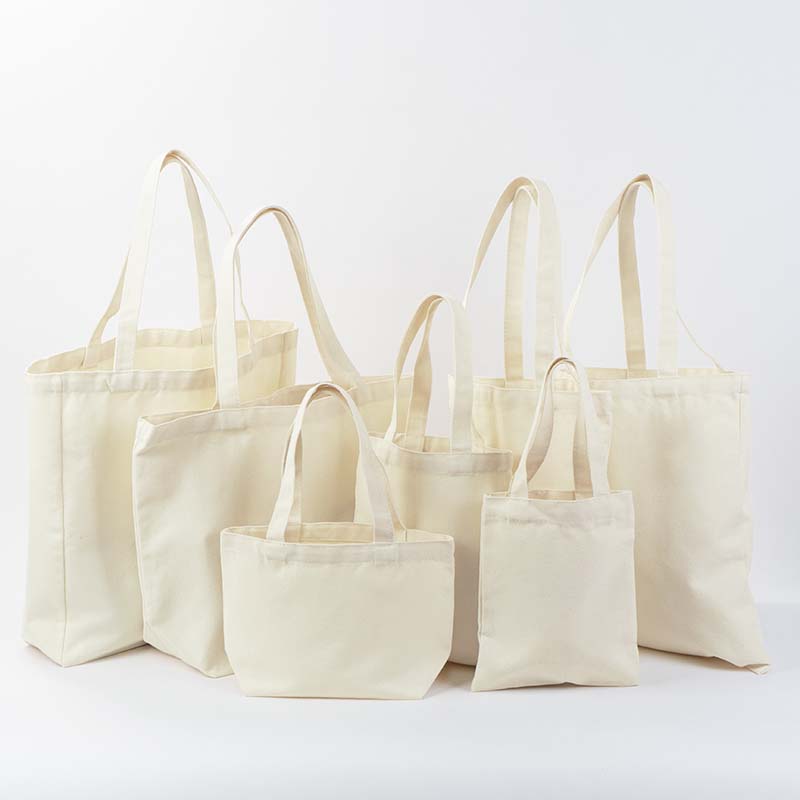
Different applications require different combinations of structure, materials, and finishing.
The following examples can help buyers narrow down their initial specifications.
Promotional Canvas Tote Bags
Promotional totes are often produced in larger quantities for events, campaigns, conferences, and brand giveaways.
Typical priorities include:
- Cost control
- Clear logo presentation
- Practical carrying capacity
- Consistent dimensions
- Efficient production
A flat or boxed-corner construction may be sufficient for many promotional applications.
The handle material and attachment should match the expected contents. A simple promotional tote may not need a full lining or a complicated bottom structure.
Buyers should prioritize accurate printing placement, consistent handle positioning, and clean top-edge finishing.
Retail Shopping Bags
Retail shopping bags often need a more substantial appearance and enough depth to carry packaged products.
A boxed-corner, side-gusset, or full-gusset construction may be suitable depending on the product dimensions.
Useful features may include:
- Wider handles
- A defined bottom
- Reinforced handle attachments
- Neat internal seam finishing
- A suitable closure, if required
The bag should be tested with representative retail products rather than evaluated only when empty.
Premium Brand Tote Bags
Premium retail totes may place greater emphasis on appearance, hand feel, and finishing consistency.
Possible construction features include:
- Heavier or more structured canvas
- Bound or flat-felled seams
- Fully lined interiors
- Reinforced handle tabs
- Carefully finished top openings
- Woven labels or selected hardware
Not every premium bag needs every feature. The design should be evaluated as a complete product, including how the fabric, handles, lining, and finishing work together.
Book and Document Bags
Book and document bags often carry relatively flat but sometimes heavy contents.
A flat construction may be suitable for lightweight documents, while a gusseted structure may be more practical for books, folders, and multiple items.
Buyers should pay attention to:
- Finished width and height
- Bottom depth
- Handle drop
- Handle attachment
- Side seam construction
- Whether the opening needs a closure
The finished dimensions should be checked with the actual document or book sizes the bag is expected to hold.
Gift and Merchandise Bags
Gift bags and merchandise bags may need to balance presentation with carrying function.
A structured bottom, clean top hem, and coordinated handles can improve the overall appearance.
For branded merchandise, buyers should also consider label placement, print position, and whether the interior needs a lining.
A simple construction may be sufficient for lightweight gift packaging. More substantial merchandise bags may require additional reinforcement.
Application-Based Construction Reference
| Bag Application |
Suggested Structure |
Handle Considerations |
Other Details to Evaluate |
| Promotional tote |
Flat or boxed corner |
Self-fabric or webbing |
Logo placement, top hem |
| Retail shopping bag |
Boxed corner or gusseted |
Medium or wide webbing |
Bottom structure, seam finishing |
| Premium brand tote |
Gusseted or structured |
Wider self-fabric or webbing |
Lining, bound seams, labels |
| Book/document bag |
Flat or bottom gusset |
Comfortable medium or long drop |
Finished internal dimensions |
| Gift/merchandise bag |
Flat, boxed corner, or gusseted |
Coordinated handles |
Appearance, top opening, branding |
Practical Finished-Dimension Tolerances for Canvas Bags
-
Main Body Dimensions (W×H×D): ±5 mm (±0.2 in)
-
Handle Drop & Length: ±10 mm (±0.4 in)
-
Stitch Density (SPI): ±0.5 SPI across all seams
-
Seam Allowance Uniformity: ±1.5 mm
-
Box-X Anchor Symmetry: ±2.0 mm relative to center-line
These are suggested starting points for specification discussions, not universal industry tolerances.
A small bag with a precise retail presentation may need tighter controls. A large promotional tote may allow a different tolerance depending on the fabric and construction.
Buyers should also clarify how measurements are taken.
For example:
- Is the bag measured flat or standing?
- Is the width measured at the top opening or across the bottom?
- Is the height measured from the bottom seam to the top edge?
- Is the bottom depth measured internally or externally?
- Is handle drop measured with the handle relaxed or held upright?
The measurement method should be consistent between the technical drawing, approved sample, and mass-production inspection.
How Buyers Should Inspect a Canvas Bag Sample
A sample is the most practical way to evaluate whether the proposed construction matches the product requirements.
Before approving a sample, buyers should inspect more than the overall appearance.
A useful sample review can be divided into several checkpoints.
Overall Shape and Symmetry
Place the bag on a flat surface and check whether it sits evenly.
Inspect:
- Whether the front and back panels are aligned
- Whether the side gussets have matching depth
- Whether the bottom corners are symmetrical
- Whether the top opening is level
- Whether the bag leans or twists
- Whether the bag maintains its intended shape when filled
A small visual difference may be acceptable depending on the product, but obvious distortion should be corrected before approval.
Stitching and Seam Quality
Inspect the visible and internal seams.
Look for:
- Skipped stitches
- Broken or loose threads
- Uneven stitch spacing
- Puckering around the seam
- Unsecured thread ends
- Exposed raw edges
- Uneven binding
- Gaps at seam intersections
Pay particular attention to the handle attachment, bottom corners, and side-to-bottom connections.
Handle Attachment
Check whether both handles are positioned evenly and whether the attachment areas are consistent.
The handles should not be twisted, excessively loose, or visibly misaligned.
If the bag is intended for carrying weight, buyers should also evaluate the attachment structure under an agreed test procedure.
A visual inspection alone cannot confirm the finished bag's load capacity.
Bottom Construction
Check whether the bottom lies flat and whether the reinforcement insert, if included, fits properly.
For a gusseted bag, inspect the corners and the connection between the base and side panels.
If the bottom is intended to support packaged products, test the bag with representative contents.
Top Opening and Accessories
Check whether the top edge is even and whether the closure operates smoothly.
For zipper bags, open and close the zipper repeatedly. For snap closures, check the alignment and attachment.
Labels, decorative details, and hardware should also match the approved artwork and technical specification.
Filled-Bag Evaluation
A bag should be evaluated in a condition that reflects its intended use.
For example, a shopping tote should be checked with representative shopping products, while a document bag should be evaluated with the folders or materials it is designed to carry.
This helps identify problems that may not be visible when the bag is empty, such as:
- Excessive bottom sagging
- Handle distortion
- Side seam strain
- Uneven gusset expansion
- Difficulty closing the opening
Performance Testing and Acceptance Criteria
A finished canvas bag should be assessed according to its intended use.
There is no single load value or stitch specification that applies to every canvas bag. A lightweight event tote, a large retail shopping bag, and a premium utility tote have different performance requirements.
Before production, buyers should agree with the supplier on the test method and acceptance criteria.
Handle and Attachment Testing
Handle testing evaluates whether the handle and its attachment can withstand an agreed force or load.
The test plan should identify:
- Test load
- Loading method
- Holding time
- Number of test cycles, if repeated loading is required
- Whether the bag is tested empty or with contents
- Acceptable deformation
- Acceptable stitching and fabric condition after testing
The load should be selected according to the intended application and bag dimensions.
A result from one bag size should not automatically be applied to every other size in the same product range.
Seam Strength Testing
For buyers who require a more technical evaluation, sewn seam testing can provide information about how the joined fabric behaves under force.
ASTM D1683/D1683M is one reference for evaluating failure in sewn seams of woven fabrics.
The test can help identify whether failure occurs through thread rupture, fabric damage, or seam slippage.
However, seam strength testing is not the same as testing the load capacity of a complete bag. A finished bag has several interacting components, including the body panels, handles, bottom, and corners.
Repeated-Use Evaluation
Some bags are intended for repeated shopping or everyday carrying.
In these cases, buyers may want to evaluate the product after repeated handling, loading, and unloading.
The test plan should reflect the actual use scenario rather than relying only on a single static load test.
Possible inspection points include:
- Loose stitching
- Handle stretching
- Fabric tearing
- Bottom deformation
- Seam opening
- Closure damage
- Hardware loosening
Appearance and Dimensional Inspection
Performance testing should be supported by dimensional and visual inspection.
A bag may pass a load test but still have unacceptable production defects, such as uneven handles, poor seam finishing, or incorrect dimensions.
The acceptance criteria should therefore cover both functional performance and product appearance.
Build a Clear Acceptance Standard
A useful purchase specification should distinguish between:
| Requirement Level |
What It Covers |
Example |
| Design reference |
Initial dimensions and construction choices |
25–38 mm handle width |
| Manufacturing requirement |
How the product must be assembled |
Double-fold top hem, defined seam finish |
| Quality requirement |
Acceptable workmanship and appearance |
No skipped stitches or loose thread ends |
| Performance requirement |
How the finished bag must perform |
Agreed handle or load test |
| Measurement tolerance |
Permitted variation from the approved specification |
Bag width ±10 mm, if agreed |
This distinction helps avoid misunderstandings. A suggested handle width is not automatically a performance guarantee, and a visually neat seam is not proof of a specific load capacity.
Common Canvas Bag Construction Problems and Their Causes
Understanding common defects helps buyers identify potential problems during sample approval and mass-production inspection.
| Problem |
Possible Cause |
What Buyers Should Check |
| Uneven bag shape |
Inconsistent panel cutting or sewing alignment |
Pattern dimensions and panel matching |
| Twisted side gusset |
Incorrect panel alignment or uneven stitching |
Gusset width and seam position |
| Uneven top opening |
Inconsistent folding or sewing |
Hem width and top-edge alignment |
| Loose internal threads |
Incomplete edge finishing or unsecured thread ends |
Overlocking and seam finishing |
| Puckered seams |
Incorrect thread tension or unsuitable stitch density |
Machine settings and fabric compatibility |
| Handle misalignment |
Inaccurate positioning during assembly |
Attachment position and symmetry |
| Fabric damage near handle |
Excessive needle penetration or unsuitable reinforcement |
Stitch pattern, backing patch, and fabric condition |
| Bottom corners look bulky |
Excessive fabric layers or poor trimming |
Corner pattern and seam allowance |
| Lining moves inside the bag |
Incorrect lining dimensions or attachment |
Lining fit and connection points |
| Zipper opening is uneven |
Poor alignment or inconsistent sewing |
Zipper placement and top-edge construction |
| Bag does not stand evenly |
Uneven bottom dimensions or unsuitable structure |
Base pattern and panel assembly |
When a defect appears, buyers should identify its construction cause rather than asking the supplier to make a general adjustment.
For example, if the bag leans to one side, the problem may come from uneven panel dimensions, gusset alignment, or bottom construction. Simply adding more stitching may not solve it.
Canvas Bag Construction Specification Checklist for Buyers
Before placing a bulk order, buyers can use the following checklist to confirm the main construction details with the supplier.
| Item |
Key Points to Confirm |
| Bag Structure |
Flat panel / gusseted bottom / gusset style |
| Finished Size |
Width × Height × Base Depth; specify measurement method (flat / upright, inner / outer) |
| Main Fabric |
Canvas composition, weight, color, surface finish |
| Pattern & Grain |
Fabric grain direction, panel layout |
| Sewing Specs |
Seam allowance, stitch type (plain stitch / overlock / binding etc.) |
| Reinforcement for Load |
Reinforcement for handles, bottom and corners |
| Inner Finishing |
Overlock / binding requirement (critical for unlined bags) |
| Sample & Spec Sheet |
Sample for reference only; formal spec sheet with tolerance required |
If your product specifications are not finalized, you can simply send us your reference images, intended application, and estimated quantity.
FAQ
What is the most common construction method for canvas tote bags?
Flat construction and boxed-corner construction are common options for canvas tote bags. Flat construction is relatively simple and suitable for lightweight applications, while boxed corners add depth without requiring a separate side panel. The best choice depends on the intended contents and required capacity.
What is the difference between a boxed corner and a gusset?
A boxed corner creates depth by shaping the lower corners of a bag, usually through a folding and sewing process. A gusset uses an additional panel or structured section to create depth along the side, bottom, or both. Gusseted bags generally provide a more defined three-dimensional shape.
Does adding a full internal lining increase the bag's load-carrying capacity?
No. This is a common design fallacy. In standard bag construction, carry handles are anchored through the outer canvas shell (or through both shell and facing). The kinetic load transfers entirely through the handle anchors, outer body canvas, and base seams. An internal lining finishes the interior, conceals pocket backs, and adds structural body, but it contributes zero measurable tensile capacity to the bag's carry rating.
Is a double-layer bottom necessary?
Not for every canvas bag. A single-layer bottom may be sufficient for lightweight applications. A double-layer base or insert can be considered when the bag needs a more substantial bottom structure. The complete bag still needs to be evaluated because bottom reinforcement alone does not determine load capacity.
Which seam type is best for canvas bags?
There is no single best seam for every design. Plain seams are common for basic assembly, overlocked seams help finish raw edges, bound seams create a cleaner interior, and flat-felled seams provide an enclosed and structured finish. The choice depends on fabric thickness, appearance, cost, and intended use.
Conclusion
Canvas bag construction determines how the fabric, seams, handles, bottom, and finishing details work together. A simple flat tote and a structured gusseted bag may use similar canvas, but their construction requirements and production costs can be very different.
For buyers, the key is not to select the most complicated construction or simply add more stitching. It is to match the structure to the bag's intended use, confirm the critical dimensions, and establish clear requirements for sewing, reinforcement, and quality inspection.
At INITI, these construction details are important when developing custom canvas bags for promotional, retail, and private-label projects. By confirming the intended application, dimensions, handle design, and finishing requirements early, buyers can work toward a bag that meets both functional and branding expectations.
Related Products


 Hot News