A shoe wash bag is a laundry accessory designed to hold footwear during machine washing. Depending on its construction, it can help reduce direct contact between shoes and the washing machine drum, contain loose components and limit some movement and friction.
But a shoe wash bag does not make every pair of shoes machine washable. Some sneakers, running shoes and delicate footwear can be damaged by water, detergent or machine agitation even when placed inside a protective bag.
The correct approach is simple: check the shoe manufacturer's instructions first, prepare the shoes, load the bag properly, select a suitable wash cycle and air-dry everything completely.
This guide explains each step and highlights the features that matter when choosing or developing a shoe washing bag.
1. Can You Wash Shoes in a Washing Machine?
Before using a shoe wash bag, confirm that both the shoes and the washing machine are suitable for the process.
Shoe material alone is not enough to determine machine-washability. Adhesives, internal support, cushioning, decorative components and the footwear manufacturer's instructions also matter.
| Shoe Type |
Recommended Approach |
| Canvas shoes |
Machine washing may be possible if the manufacturer permits it |
| Fabric or synthetic sneakers |
Check the specific model's care instructions |
| Mesh sports shoes |
Follow brand guidance; mesh uppers do not guarantee machine-washability |
| Leather shoes |
Generally avoid machine washing; use appropriate leather care |
| Suede or nubuck shoes |
Avoid machine washing; use material-specific cleaning methods |
| Shoes with beads, delicate decorations or vulnerable glued components |
Prefer manufacturer-recommended or specialist cleaning |
| Heavy boots or footwear with rigid metal components |
Do not assume suitability for machine washing |
The American Cleaning Institute recommends following the footwear manufacturer's instructions because washing-machine agitation and detergents can damage shoe materials and adhesives.
Similarly, Nike's shoe-care guidance generally recommends hand cleaning rather than putting Nike shoes in a washing machine.
If the manufacturer advises against machine washing, do not use the washing machine simply because you have a shoe wash bag.
2. How to Use a Shoe Wash Bag: Step by Step
The following method is intended only for footwear whose care instructions permit machine washing.
Step 1: Remove Loose Dirt and Check the Shoes
Before placing shoes in the washing bag:
- Brush away dried mud, sand and loose dirt.
- Remove stones or debris lodged in the outsole.
- Check for loose stitching, damaged soles or peeling adhesive.
- Treat visible stains according to the footwear care instructions.
Removing heavy dirt first helps prevent debris from circulating inside the washing machine and reduces the cleaning work required during the wash.
A shoe wash bag should not be expected to remove dried mud or stubborn stains without preparation.
Step 2: Remove the Laces and Insoles
Remove the shoelaces and insoles when the shoe manufacturer recommends doing so.
Shoelaces can become tangled, while some insoles retain water or require a different cleaning method.
Wash laces separately by hand or place them in a small, securely closed mesh laundry bag if their care instructions allow machine washing.
Clean removable insoles according to the manufacturer's guidance. Hand cleaning is generally preferable when their construction or washing instructions are uncertain.
Step 3: Place the Shoes Inside the Wash Bag
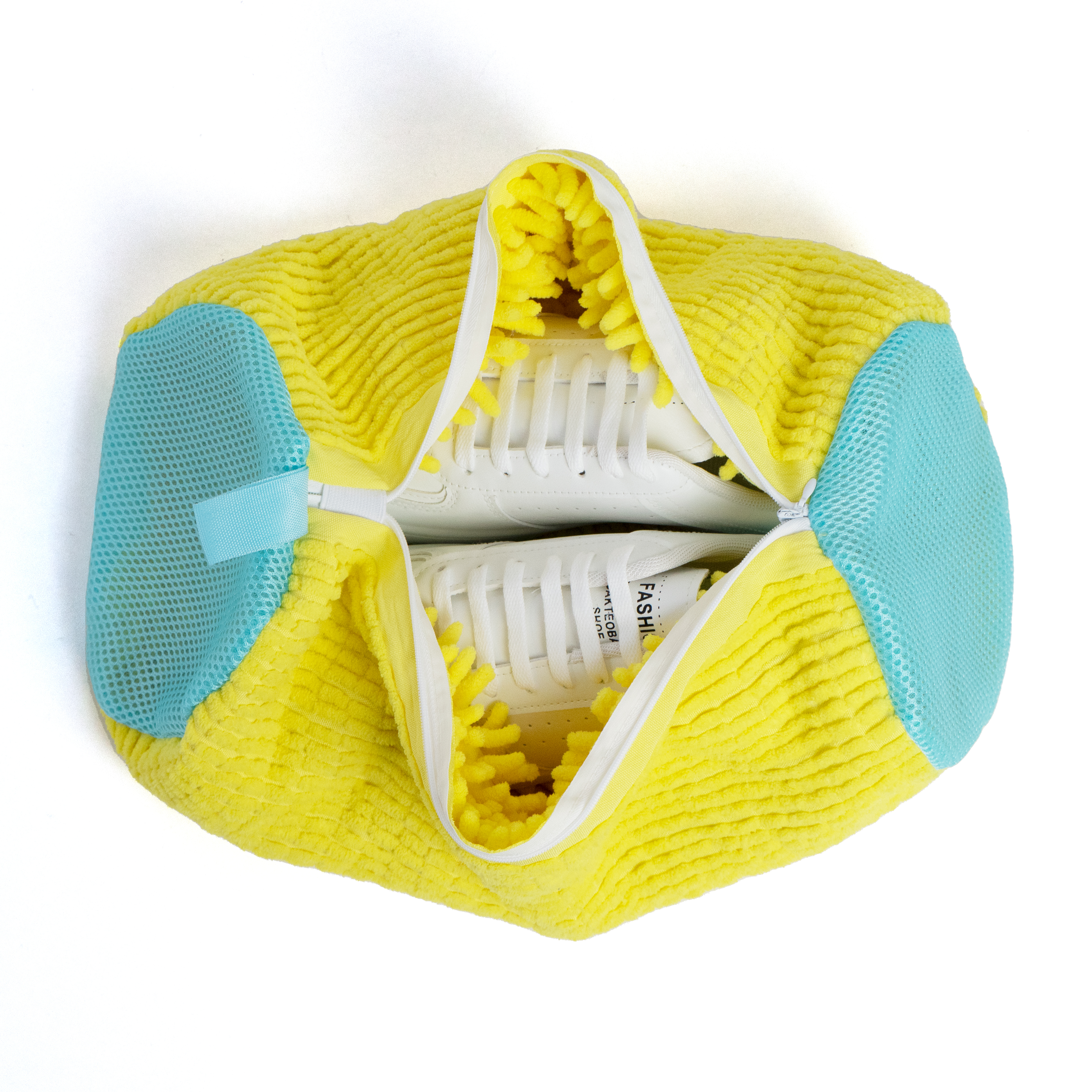
Open the shoe washing bag and place the prepared footwear inside.
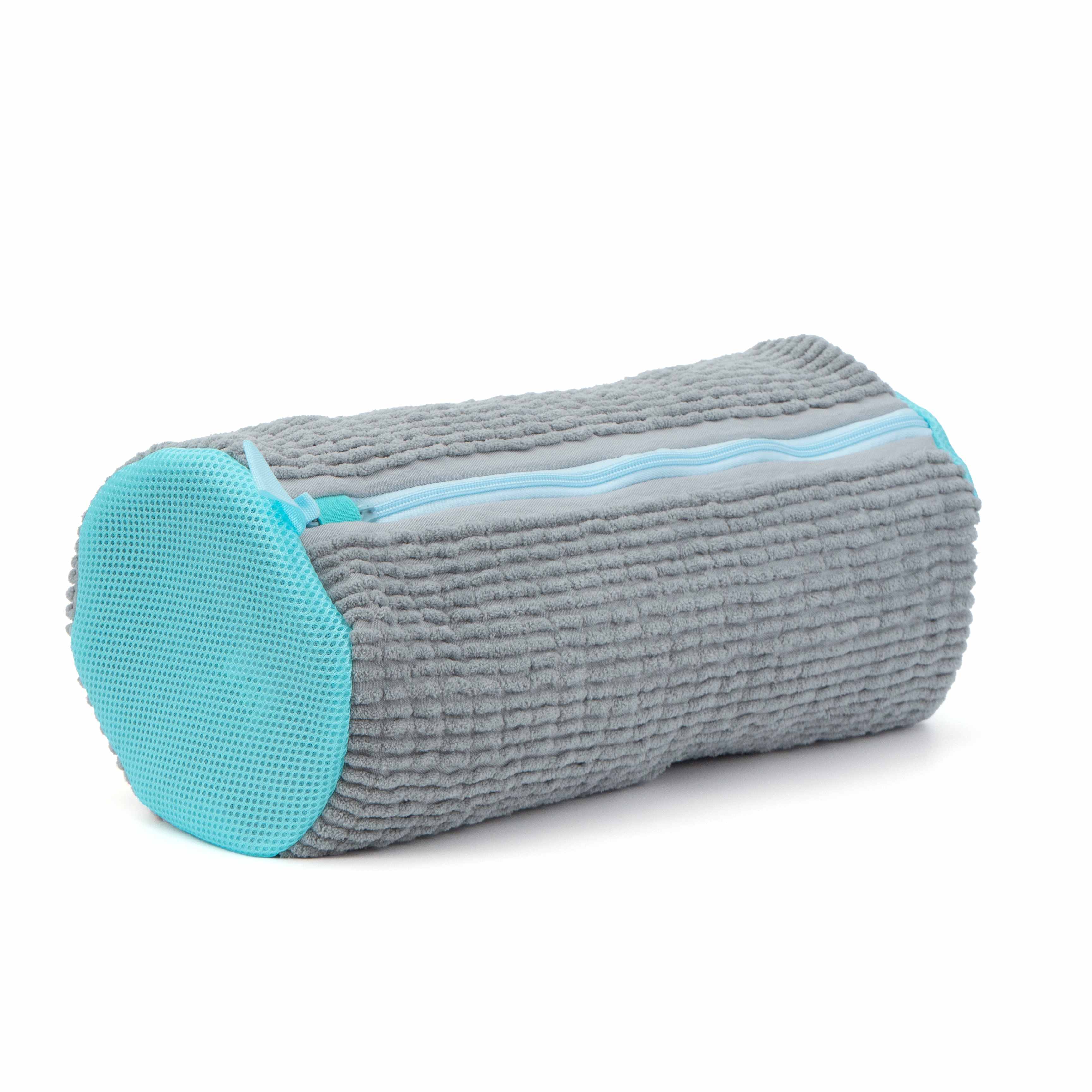
For a cylindrical chenille or microfiber shoe wash bag, the soft textile surface provides a cushioning layer, while mesh panels allow water and detergent to pass through.
Do not overfill the bag. The shoes should fit without forcing the zipper closed or excessively compressing the bag.
Whether one bag should contain one shoe or a pair depends on the bag's actual dimensions, internal construction and the size of the shoes.
For larger sneakers, two separate bags may be more appropriate than squeezing both shoes into one.
Step 4: Close the Zipper Securely
Close the zipper completely before starting the wash.
If the shoe wash bag has a protective zipper flap or zipper garage, position the slider beneath it as intended by the product design.
Check that:
- The zipper runs smoothly.
- No shoelaces or shoe fabric are caught in the closure.
- The zipper remains securely closed.
- The bag has no torn seams or damaged mesh.
A partially open zipper may allow shoes to escape from the bag during washing.
For drawstring laundry bags, secure the drawstring and stopper according to the product instructions. Loose cords should not be left where they can become entangled.
Step 5: Add the Bag and Balance the Washing Machine Load
Place the closed shoe wash bag inside the washing machine.
If permitted by the washer manufacturer, add one or two old towels to help cushion movement and balance the load.
Use clean, low-lint, colorfast towels. Avoid heavily shedding towels, as loose fibers may become trapped in chenille surfaces or shoe mesh. Be cautious with dark or poorly colorfast towels, which could transfer dye onto light-colored shoes or wash bag fabrics.
Avoid washing shoes together with delicate clothing, light-colored garments that could become stained, or items that may be damaged by shoe hardware.
Do not overload the machine or place footwear inside a washer that prohibits this type of load.
Step 6: Choose a Gentle Washing Cycle
Follow the shoe and washer manufacturers' instructions.
For footwear explicitly approved for machine washing, a typical starting point is:
| Setting |
Recommended Starting Point |
| Water temperature |
Cold water, or the temperature permitted by the shoe care instructions |
| Wash program |
Gentle or delicate |
| Spin speed |
Low or no spin, where appropriate |
| Detergent |
Small amount of suitable mild liquid detergent |
| Bleach |
Avoid unless specifically permitted |
| Drying program |
Air-dry rather than applying direct heat |
Whirlpool's shoe-washing instructions recommend a cold, delicate wash with a slow or no-spin option for suitable shoes.
Avoid automatically selecting high-temperature washing or high-speed spinning. The settings should match the particular footwear and washing machine, not simply the wash bag.
Step 7: Remove the Shoes and Air-Dry Them
When the cycle ends:
- Remove the shoe wash bag from the machine.
- Open it and take out the shoes.
- Gently absorb excess water using a clean towel.
- Place the shoes in a well-ventilated location to dry naturally.
- Allow the laces, insoles and wash bag to dry separately.
- Reassemble the shoes only after all parts are completely dry.
To help absorb moisture and maintain shoe shape, loosely stuff the shoes with plain white, unprinted absorbent paper or white paper towels, where suitable for the footwear.
Avoid placing newspaper directly against damp shoe linings. Newspaper printing ink may transfer onto the material and cause unwanted staining.
The American Cleaning Institute's sneaker-care advice specifically recommends white paper towels instead of newspaper.
Avoid direct heaters, tumble-dryer heat or intense sunlight unless the footwear manufacturer specifically permits them.
Drying time varies with shoe construction, padding, ventilation and ambient conditions. Thick soles and insoles may remain damp even when the exterior feels dry.
3. What Does a Shoe Wash Bag Actually Do?
A shoe washing bag is a protective laundry accessory, not a substitute for detergent or a guarantee against damage.
Its benefits depend on the bag's materials, dimensions and construction.
| Function |
How the Bag Helps |
Important Limitation |
| Reduce direct friction |
Separates parts of the shoe surface from the drum |
Cannot prevent every abrasion mark |
| Cushion movement |
Soft or padded fabrics may reduce some impacts |
Does not eliminate movement or mechanical force |
| Contain footwear |
Keeps shoes within a closed compartment |
Requires a secure, intact closure |
| Allow washing water through |
Mesh panels support water and detergent circulation |
Dense fabric or overloading may restrict flow |
| Organize laundry |
Keeps the shoe-washing process contained |
Does not replace checking shoe compatibility |
For example, INITI's Custom Shoe Wash Bag combines soft chenille fabric, breathable mesh side panels, a cylindrical body and a zipper closure.
Its structure is designed to provide a protective layer while allowing washing water to reach the contents.
The actual cleaning result still depends on the shoes, detergent, machine settings and how the bag is loaded.
4. Common Mistakes When Using a Shoe Wash Bag
Washing Shoes That Should Be Hand Cleaned
The most important mistake is ignoring the manufacturer's care instructions.
Leather, suede, specialty finishes and certain athletic shoes may be unsuitable for machine washing even when enclosed in a bag.
Putting Muddy Shoes Straight Into the Bag
Heavy mud, sand and small stones should be removed before washing.
A bag can help contain the shoes, but it should not replace basic preparation.
Overloading the Bag
A tightly packed shoe wash bag may restrict water circulation, strain the closure and create excessive pressure between the shoes.
Choose a bag sized for the actual footwear rather than relying only on the description “universal size.”
Using Hot Water or Aggressive Spin Settings
High temperatures and strong mechanical action may affect adhesives, cushioning, surface finishes and shoe shape.
Follow the footwear and appliance instructions, and select the least aggressive suitable program.
Storing the Bag While Damp
After washing, inspect the shoe wash bag for trapped lint and debris, then dry it fully before storage.
Leaving chenille, microfiber or padded sections damp can encourage unpleasant odors and reduce storage hygiene.
5. Mesh vs. Chenille Shoe Washing Bags: Which Should You Choose?
Not every shoe wash bag uses the same construction.
| Bag Construction |
Main Characteristics |
Suitable Purchasing Direction |
| Basic mesh wash bag |
Lightweight, flexible and water-permeable |
General laundry organization and suitable lightweight shoes |
| Reinforced mesh shoe bag |
Stronger mesh, reinforced seams and secure closure |
Shoe-specific laundry accessory programs |
| Chenille / microfiber padded shoe bag |
Soft textile cushioning and mesh sections |
Retail shoe-care products requiring a more substantial protective structure |
| Drawstring mesh laundry bag |
Adjustable opening and flexible capacity |
Multi-purpose laundry sets; closure must suit footwear |
A thicker or more padded bag is not automatically better. It must still allow sufficient water circulation, fit the shoes and withstand the intended washing process.
INITI Shoe Washing Bag Options
Custom Shoe Wash Bag
A cylindrical chenille and mesh design with zipper closure. Size, color combination, material, logo, labels and retail packaging can be customized.
Microfiber Shoe Washing Bag
A padded microfiber chenille design with breathable mesh panels and a protected zipper area. It can be developed in different diameters and lengths for shoe sizes and retail programs.
Drawstring Mesh Laundry Wash Bag Set
A multi-purpose mesh laundry bag with drawstring and stopper. Larger, reinforced versions can be developed for suitable footwear, but its closure requirements differ from those of a dedicated zipper shoe washing bag.
Explore more styles in the Shoes Storage/Wash Bag Collection.
What About the Zipper?
For a machine-wash shoe bag, closure security is as important as mesh and padding.
A properly selected zipper should remain closed during the intended wash cycle, resist damage at the zipper ends and avoid unnecessary contact between exposed hardware and footwear.
An auto-lock slider may help reduce unintended slider movement. A zipper garage or protective flap may help shield the slider from contact.
These are different functions. An auto-lock slider does not automatically prevent chain separation caused by excessive loads, unsuitable zipper specifications or weak stitching.
The correct zipper type should therefore be selected and tested as part of the complete bag design.
6. How to Create Better Shoe Wash Bag Instructions for Retail Customers
For supermarkets, online sellers, household brands and laundry-care product lines, clear usage instructions are part of the finished product.
A useful instruction card should explain:
| Instruction Area |
Information to Include |
| Shoe compatibility |
Check footwear care instructions before machine washing |
| Preparation |
Remove loose dirt, laces and insoles as appropriate |
| Loading |
Maximum suitable shoe size and quantity per bag |
| Closure |
Close the zipper fully and secure any protective flap |
| Washing |
Follow footwear and machine instructions; use an approved gentle cycle |
| Drying |
Air-dry shoes and bag completely; use plain white, unprinted paper if needed |
| Warnings |
No guarantee of damage prevention; avoid unsuitable footwear |
The instruction sheet should correspond to the actual product design.
For example, a padded shoe bag designed for one large sneaker should not be labelled as suitable for two adult shoes without physical fit testing.
Likewise, claims such as “100% safe,” “damage-proof” or “guaranteed deep cleaning” should not be used without evidence.
Checks for Bulk OEM Orders
B2B buyers should specify:
- Bag dimensions and target shoe sizes
- Single-shoe or pair-shoe capacity
- Chenille thickness and mesh construction
- Secure zipper type, slider mechanism and protective flap
- Seam and zipper-end reinforcement
- Repeated washing and colorfastness test requirements
- Logo, care label and instruction card
- Retail packaging and carton packing
Zipper and Closure Durability: Specify a secure zipper system, with a #5 nylon coil zipper and auto-lock slider considered where appropriate. Evaluate an elastic zipper garage or protective flap to reduce slider exposure.
Confirm zipper-end reinforcement, closure security, resistance to unintended opening and overall zipper integrity through repeated loaded washing tests.
The #5 auto-lock configuration is a possible OEM specification, not a mandatory standard for every shoe wash bag. The zipper size and slider design must match the finished bag's dimensions, load and performance requirements.
Confirm the design through a finished sample loaded with the intended footwear. A product photo alone cannot establish the correct capacity or washing performance.
For additional technical reference, see Zipper Specifications for Custom Bags.
Why Choose INITI for Custom Shoe Wash Bags?
Hangzhou INITI Imp&Exp Co., Ltd. has over 16 years of experience in custom bags and packaging, supported by two production facilities and OEM/ODM development capabilities.
Our shoe-washing bag range includes cylindrical chenille designs, padded microfiber washing bags and customizable mesh laundry solutions. These existing structures provide development options for home-care retailers, supermarket chains, laundry accessory brands, importers and private-label sellers.
INITI supports size and material selection, zipper construction, branding, sampling, quality inspection and retail packaging development. Buyers can specify intended shoe sizes, washing conditions, closure-performance requirements and instructions before approving bulk production.
Our experience includes SEDEX, Disney-related requirements, GRS, Higg assessments and ISO 9001. Relevant documentation and testing can be reviewed according to the specific product and destination market.
Custom shoe wash bag projects start from 500 pieces, with final minimum quantities depending on the design and specifications.
FAQ
Can I put both shoes in one wash bag?
Only if the bag is designed and sized for a pair. Large or bulky shoes may need separate bags. Do not force two shoes into a bag intended for one.
Should I remove the shoelaces before using a shoe wash bag?
Removing laces is usually advisable when the footwear instructions allow it. Wash them separately by hand or in a small closed laundry bag as appropriate.
What washing machine setting should I use?
For shoes approved for machine washing, a cold, gentle cycle with low or no spin is a common starting point. Always follow the specific footwear and machine instructions.
Can a shoe wash bag go in the dryer?
Do not assume it can. Air-drying is the safer default unless the bag manufacturer specifically approves tumble drying. The shoes also need their own drying instructions.
Can I order custom shoe wash bags with my logo?
Yes. INITI supports OEM/ODM development for dimensions, fabric, colors, zippers, labels and retail packaging. Custom orders start from 500 pieces, subject to the final product specification.
Conclusion
Using a shoe wash bag correctly begins before the shoes enter the washing machine.
Check whether the footwear is approved for machine washing, remove loose dirt, prepare laces and insoles, load the bag without overfilling, secure the closure and use appropriate washer settings.
If using towels to balance the load, choose clean, low-lint and colorfast ones. After washing, air-dry the shoes and bag completely, using plain white, unprinted absorbent paper for shape retention where appropriate.
A suitable shoe wash bag can help reduce some direct friction and impacts, but it cannot eliminate all washing risks.
For brands developing shoe laundry accessories, clear instructions, tested capacity and a reliable closure are as important as the bag's appearance.
Inquiry Support
For custom shoe wash bag projects, please provide:
- Target shoe type and size range
- Preferred mesh or chenille construction
- Single-shoe or pair-shoe design
- Zipper, slider and protective flap requirements
- Logo, colors and branding
- Required care labels and instruction cards
- Estimated order quantity
- Retail packaging and destination market
Email [email protected] to discuss OEM shoe wash bags, private-label development and wholesale orders.
Related Products
Custom Shoe Wash Bag
Microfiber Shoe Washing Bag
Drawstring Mesh Laundry Wash Bag Set
Shoes Storage/Wash Bag Collection
Laundry Bag Collection
Related Blog Articles
Mesh Laundry Bag vs Fabric Laundry Bag: Which Is Better?
Mesh Fabric for Custom Bags: Material, Hole Size, Reinforcement and Airflow
Zipper Specifications for Custom Bags: Coil, Metal, Waterproof and Reverse Zippers




 Hot News