Canvas Fabric Weight for Custom Bags: GSM, OZ, Shrinkage and Load Testing
Canvas fabric weight is one of the first specifications buyers encounter when sourcing custom tote bags, shopping bags, work bags, promotional bags, storage bags, and private-label accessories.
Suppliers may describe the fabric as:
- 6 oz canvas
- 8 oz cotton canvas
- 10 oz heavy canvas
- 280 GSM canvas
- 12 oz duck canvas
- Lightweight, medium-weight or heavy-duty canvas
These descriptions are useful, but they do not provide a complete answer to the most important buyer questions:
- How thick will the finished bag feel?
- How much weight can it safely carry?
- Will it shrink after washing?
- Will the handles tear away from the body?
- Will the printed logo remain properly positioned?
- Will bulk production match the approved sample?
- Is a heavier fabric worth the additional cost?
The main sourcing mistake is assuming that a higher GSM or oz value automatically guarantees a stronger finished bag.
Fabric weight measures the mass of the material over a defined area. It does not directly measure seam strength, handle attachment strength, tear resistance, shrinkage, abrasion resistance or finished-bag load capacity.
A reliable canvas bag specification must therefore consider four separate areas:
- Fabric weight
- Fabric construction and finishing
- Shrinkage and dimensional stability
- Finished-product load testing
What Is Canvas Fabric?
Canvas is generally a firm woven fabric produced with a relatively dense construction. Cotton is commonly used, although canvas can also be made from polyester, recycled fibers, blended yarns or other materials.
The word cotton identifies the fiber. The word canvas mainly describes the fabric construction and the substantial character normally associated with it.
This means:
- A lightweight cotton bag is not necessarily a canvas bag.
- A canvas bag may be made from cotton.
- A canvas fabric may also contain synthetic or recycled fibers.
- Two canvas fabrics with the same nominal weight can perform differently.
Plain weave is commonly used for canvas, while duck canvas generally refers to a tightly woven canvas construction. Yarn thickness, yarn density, weaving tension and finishing all affect the final result.
For B2B sourcing, the term “canvas” should not be treated as a complete material specification. Buyers should also confirm:
- Fiber composition
- Fabric weight
- Weave construction
- Finished width
- Color and dyeing method
- Surface finish
- Shrinkage requirement
- Wash treatment
- Coating or lamination
- Intended application
What Does GSM Mean?
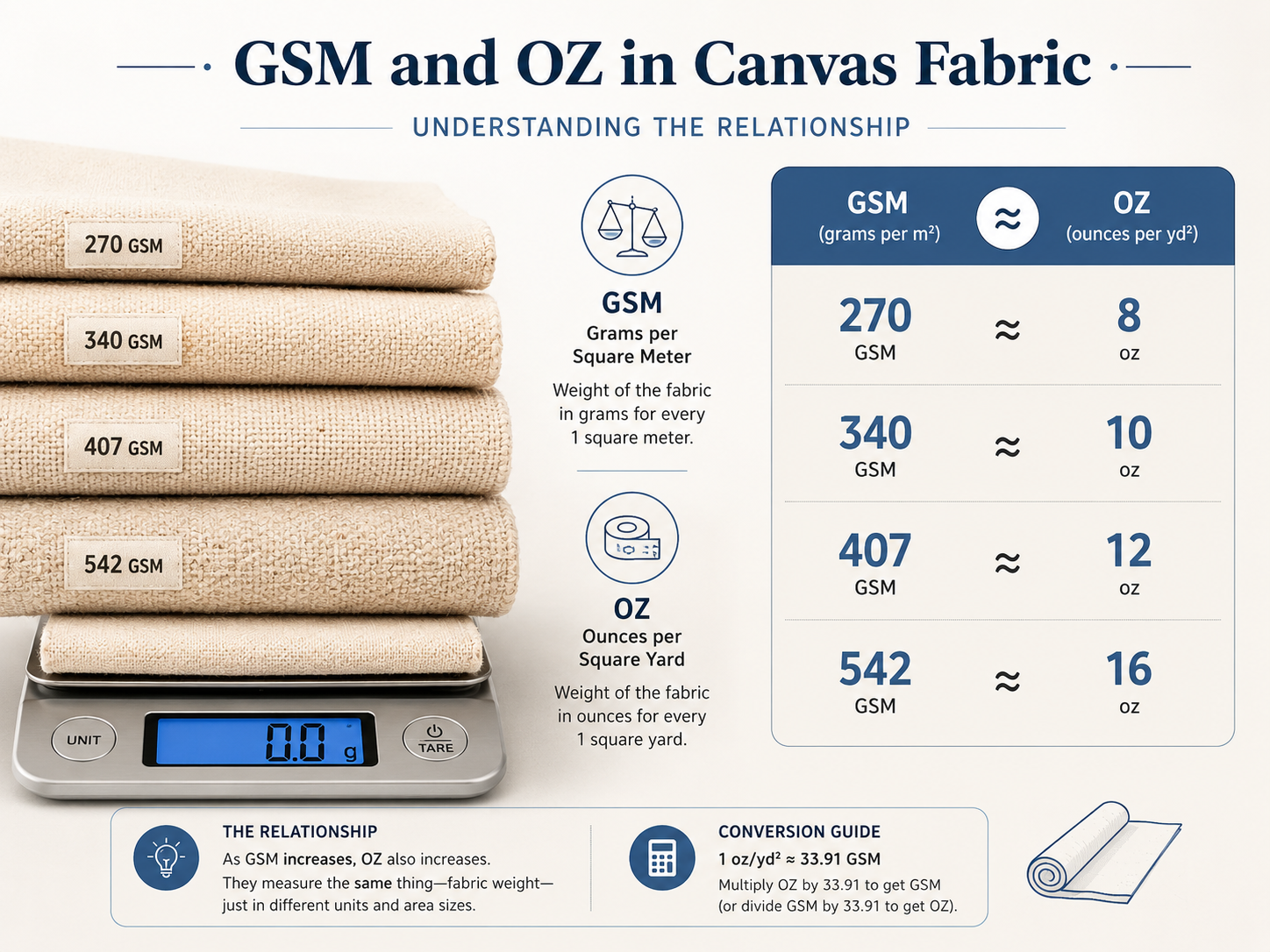
GSM means grams per square meter.
It expresses the mass of one square meter of fabric. ASTM D3776/D3776M covers methods for measuring fabric mass per unit area and recognizes both SI and US customary measurements. The method is applicable to most fabrics.
The basic calculation is:
GSM = Fabric mass in grams ÷ Fabric area in square meters
For example, if one square meter of canvas weighs 340 grams, its nominal fabric weight is 340 GSM.
GSM is useful because it creates a standardized basis for comparing fabrics. However, GSM does not directly tell a buyer:
- The exact fabric thickness
- The yarn diameter
- The weave density
- The fabric stiffness
- The tensile strength
- The tear strength
- The finished-bag carrying capacity
A compact, tightly woven fabric may feel firmer than a bulkier fabric with a similar GSM. A fabric with coating, sizing or another finish may also have a higher weight without providing a proportional increase in structural strength.
What Does OZ Mean for Canvas?
Canvas is also frequently described in ounces.
In a clear technical specification, this normally means ounces per square yard, written as:
oz/yd²
Ounces per square yard are commonly used to describe canvas, denim and other fabrics in markets that use US customary measurements.
The approximate conversions are:
1 oz/yd² = 33.906 GSM
GSM = oz/yd² × 33.906
oz/yd² = GSM ÷ 33.906
Common Canvas Weight Conversion Table
| Canvas Weight |
Approximate GSM |
| 4 oz/yd² |
136 GSM |
| 5 oz/yd² |
170 GSM |
| 6 oz/yd² |
203 GSM |
| 7 oz/yd² |
237 GSM |
| 8 oz/yd² |
271 GSM |
| 10 oz/yd² |
339 GSM |
| 12 oz/yd² |
407 GSM |
| 14 oz/yd² |
475 GSM |
| 16 oz/yd² |
542 GSM |
| 18 oz/yd² |
610 GSM |
These conversions are mathematical equivalents, but commercial fabric descriptions may be rounded.
For example, a supplier might describe a material as “10 oz canvas” even though its measured weight is slightly above or below 339 GSM.
Buyers should therefore define an acceptable tolerance rather than expecting every fabric roll to produce exactly the nominal number.
Always Confirm What “OZ” Refers To
The term “oz canvas” can create confusion when suppliers, buyers and mills use different conventions.
Before comparing quotations, confirm whether the stated value means:
- Ounces per square yard
- Ounces per linear yard at a specified fabric width
- Fabric weight before washing
- Fabric weight after washing
- Greige fabric weight
- Finished fabric weight
- A supplier’s internal commercial material grade
A quotation stating only “12 oz canvas” is less precise than one stating:
100% cotton canvas, approximately 407 GSM finished weight, measured according to an agreed fabric mass test method.
The second specification makes it easier to compare materials from different suppliers and to inspect bulk production.
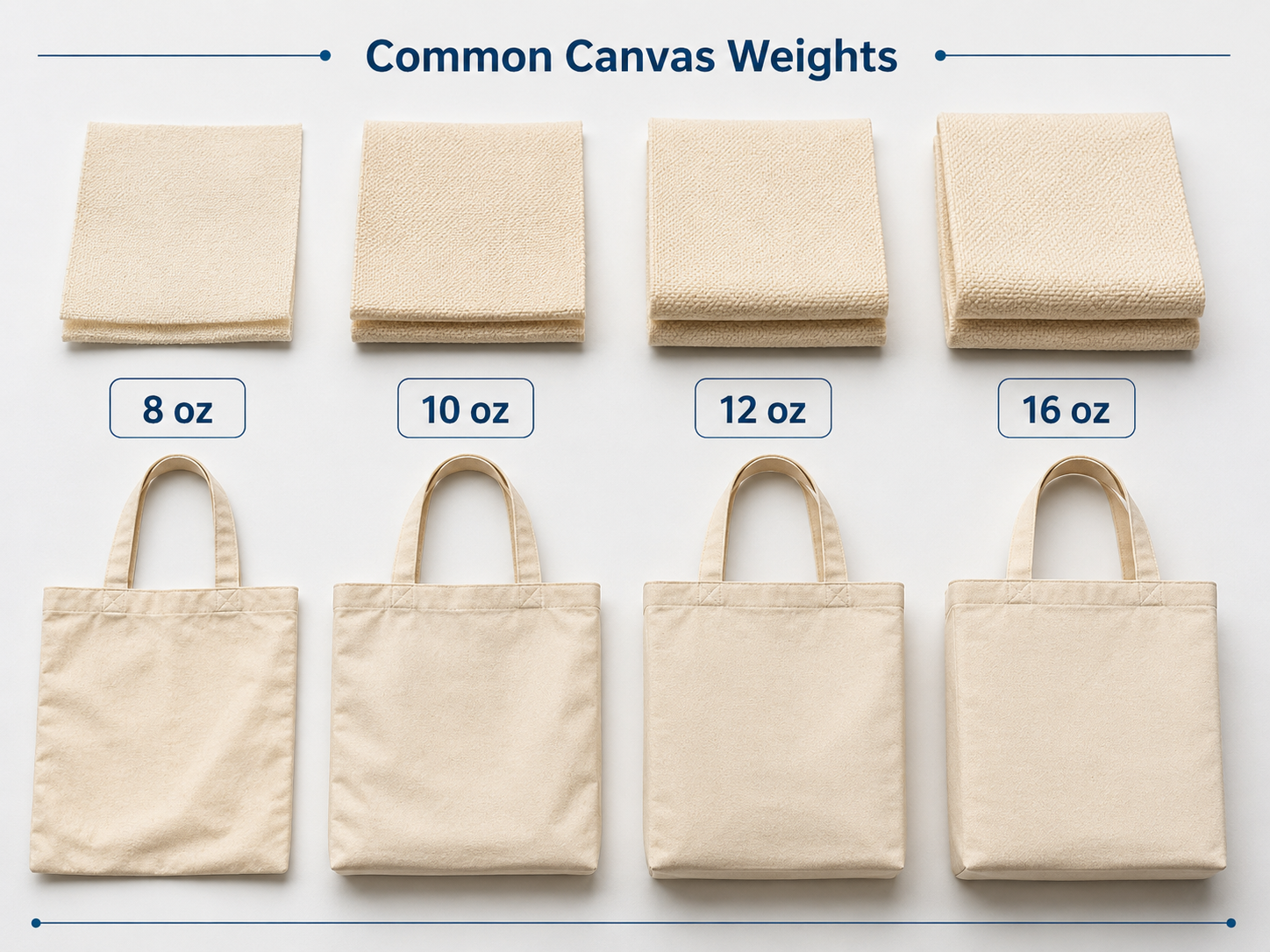
Practical Canvas Weight Ranges for Custom Bags
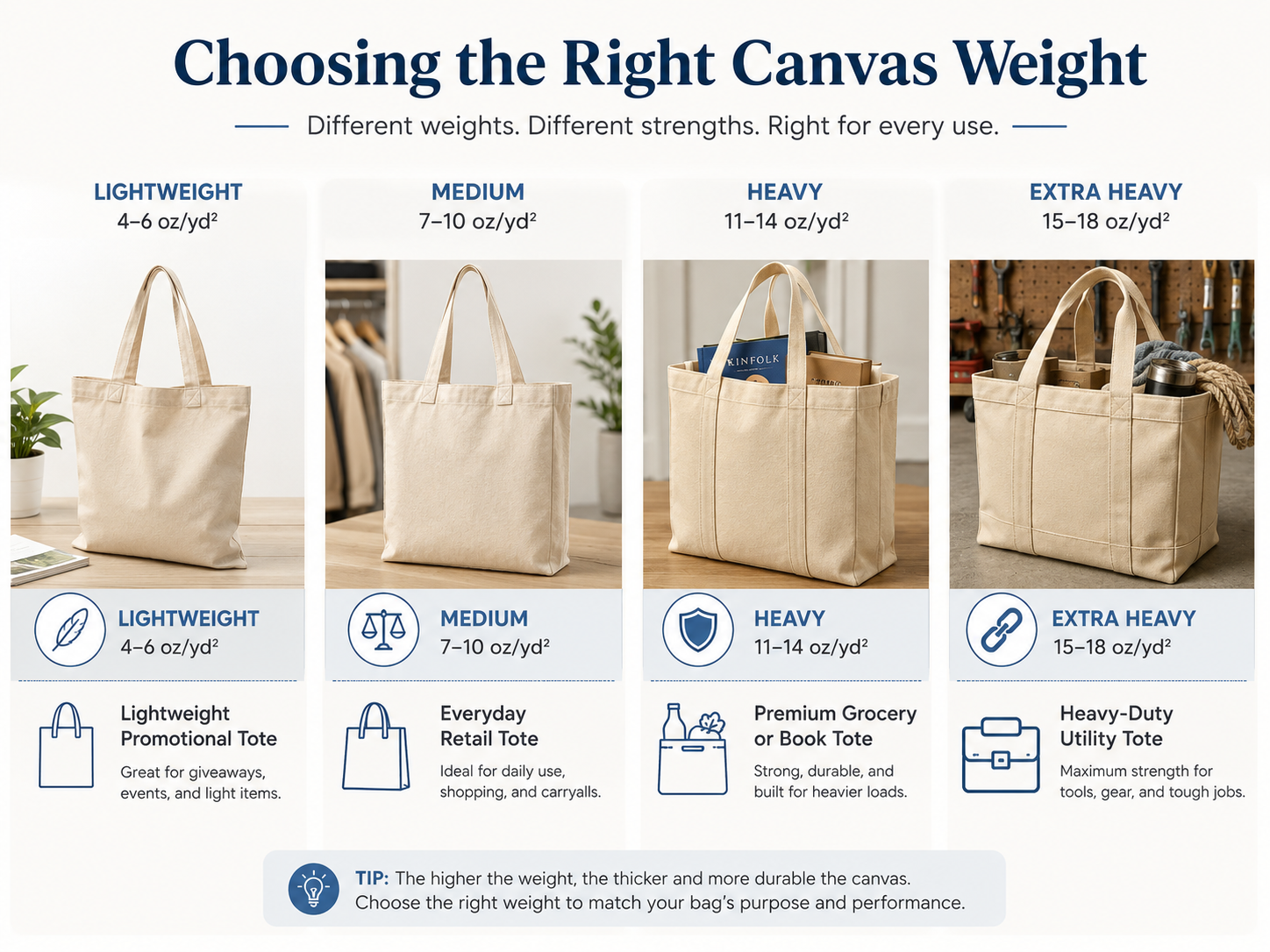
The following ranges can be used as general sourcing references. They are not universal load-capacity standards.
Actual performance depends on the weave, yarn quality, bag dimensions, seams, handles and construction.
| Fabric Range |
General Description |
Common Applications |
| 100–170 GSM |
Lightweight cotton or light canvas |
Dust bags, simple packaging, event giveaways and light promotional bags |
| 180–240 GSM |
Light-to-medium canvas |
Flat totes, branded giveaways, light retail products and foldable shopping bags |
| 250–320 GSM |
Medium canvas |
Daily tote bags, bookstore bags, retail merchandise and corporate gifts |
| 330–420 GSM |
Heavy canvas |
Grocery totes, wide-gusset bags, structured retail bags and repeated daily use |
| 430–550 GSM |
Very heavy canvas |
Premium totes, work-style bags, reinforced carry products and structured accessories |
| Above 550 GSM |
Extra-heavy canvas |
Specialized products where stiffness, abrasion resistance and substantial construction are required |
These ranges should be used to narrow the material direction, not to guarantee performance.
A 280 GSM canvas bag with correctly designed handles may perform better than a 400 GSM bag with weak stitching and poorly positioned handle attachments.
Is Higher GSM Always Better?
No.
A heavier fabric can provide:
- A more substantial hand feel
- Greater shape retention
- A more premium appearance
- A stronger base for reinforcement stitching
- Better resistance to distortion
- More material around stitch holes
- Greater suitability for certain embroidery methods
However, increasing GSM can also create disadvantages:
- Higher material cost
- Higher finished-product weight
- Increased shipping cost
- Greater carton volume
- More difficult folding
- Increased sewing difficulty
- Greater needle and thread requirements
- Longer drying time
- More visible creasing on some finishes
- Less suitability for high-volume giveaways
The correct weight depends on the intended product.
A conference giveaway bag does not require the same material as a grocery tote carrying bottles and packaged food. A premium fashion tote may need structure and hand feel, while a foldable travel bag needs low weight and compact packing.
The objective is not to select the heaviest fabric available. It is to select the lightest construction that reliably satisfies the required appearance and performance.
Why Two Fabrics with the Same GSM Can Feel Different
GSM describes mass per unit area, but several other variables determine fabric behavior.
1. Yarn Thickness
A canvas fabric can be woven from:
- Fine yarns at high density
- Coarse yarns at lower density
- Single yarns
- Plied yarns
- Ring-spun yarns
- Open-end yarns
Two fabrics can have similar GSM but different surface texture, stiffness and tensile performance because their yarn structures are different.
2. Warp and Weft Density
Warp yarns run along the fabric length. Weft yarns run across the fabric width.
A higher yarn density can produce:
- A tighter surface
- Better print definition
- Reduced transparency
- Improved stability
- Lower risk of yarn movement
- A firmer hand feel
However, high density alone does not guarantee high strength if the yarn quality is poor.
3. Weave Structure
Canvas is often produced using a plain weave, but variations in yarn interlacing, tension and density affect the finished material.
Twill constructions generally display a diagonal surface and may provide different flexibility and tear behavior from plain weave fabrics. CottonWorks identifies canvas as a common plain-weave fabric and explains that different woven constructions create different strength and surface properties.
4. Fiber Composition
A canvas bag may use:
- Conventional cotton
- Organic cotton
- Recycled cotton
- Cotton-polyester blend
- Recycled polyester blend
- Synthetic canvas
A blended fabric can behave differently from 100% cotton in shrinkage, drying speed, abrasion resistance, color consistency and hand feel.
5. Finishing
Finishing can alter:
- Fabric weight
- Width
- stiffness
- softness
- shrinkage
- surface smoothness
- color
- water resistance
Possible treatments include:
- Washing
- Enzyme washing
- Softening
- Compacting
- Calendering
- Coating
- Waxing
- Water-repellent treatment
- Pigment dyeing
- Garment dyeing
Mechanical finishing can deliberately reduce fabric length to improve later dimensional stability.
Fabric Weight Is Not the Same as Fabric Thickness
GSM and thickness are related, but they are not interchangeable.
A heavy, loosely constructed fabric can be thicker than a compact fabric with similar weight. A coated material may have additional mass and thickness from the coating. A washed fabric can feel fuller because the yarns relax and the surface becomes more textured.
For projects where bag structure matters, buyers should request both:
- Fabric weight
- Fabric thickness or approved physical swatch
A physical swatch helps the buyer evaluate:
- Hand feel
- opacity
- flexibility
- surface texture
- stiffness
- color
- printing suitability
The finished bag sample remains more important because seams, lining, pockets and reinforcement can change the product’s overall structure.
How Canvas Weight Affects Printing
Fabric weight influences printing, but weave and surface preparation may be equally important.
Lightweight Canvas
Lightweight canvas may:
- Allow ink to pass through more easily
- Show the color of the contents behind the fabric
- Distort under large print areas
- Produce less consistent edges on open weaves
- Require careful curing control
It can still be suitable for simple logos, event graphics and economical promotional programs.
Medium Canvas
Medium-weight canvas commonly provides a practical balance between:
- Print clarity
- product cost
- foldability
- durability
- visual quality
It is often suitable for screen printing, heat transfer, direct-to-fabric printing and selected embroidery applications.
Heavy Canvas
Heavy canvas can provide a substantial surface for printing and embroidery, but additional weight does not automatically improve every logo method.
A coarse texture may reduce fine print detail. Heavy embroidery may make the panel stiff or cause puckering if the stabilizer, thread density and artwork are not correctly developed.
Buyers should test the intended logo on the actual bulk fabric rather than approving artwork only on a digital mockup.
Understanding Canvas Shrinkage
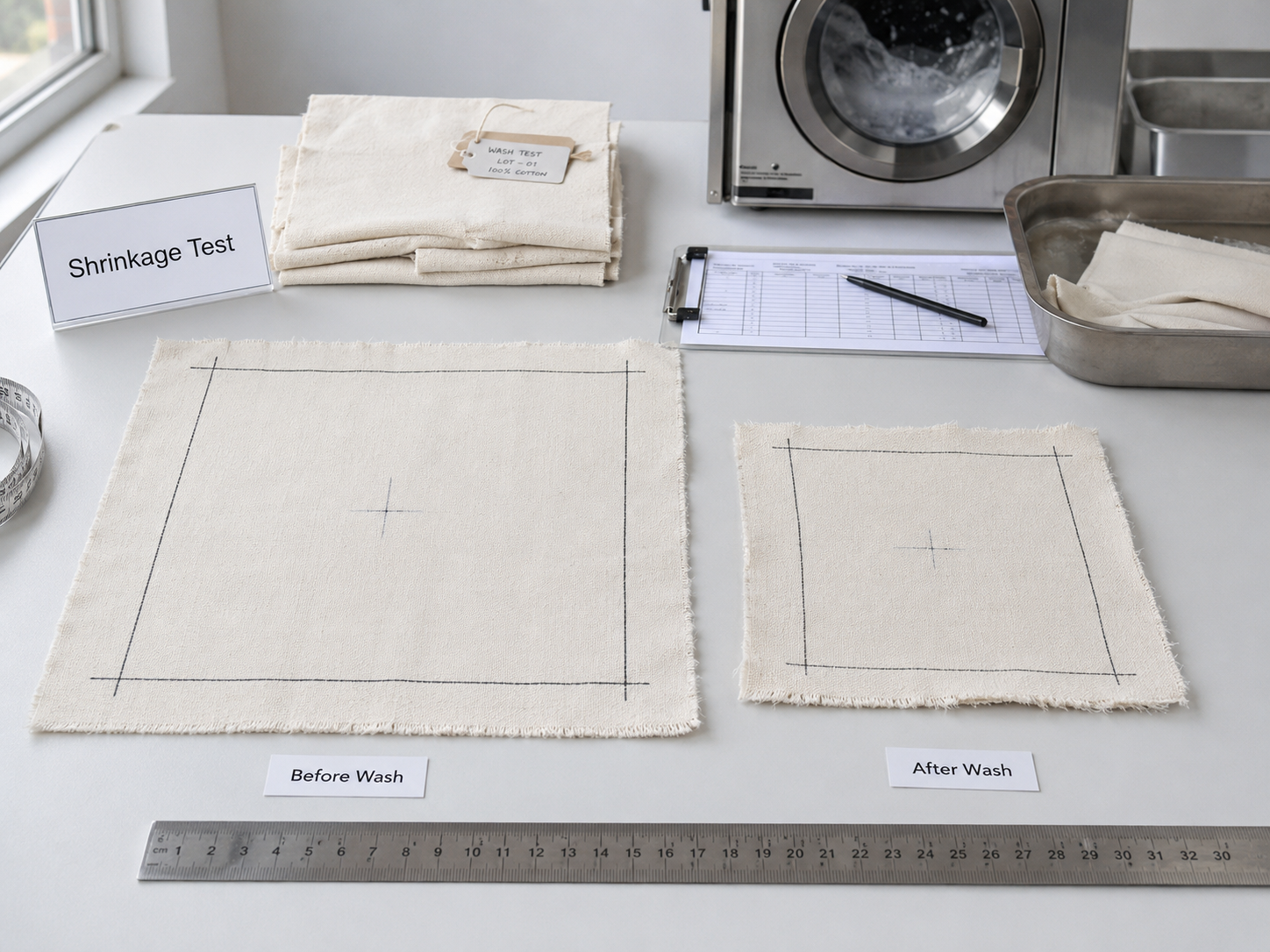
Cotton canvas can change dimensions when exposed to water, heat, agitation and drying.
Shrinkage is a loss of length or width after processing or laundering. CottonWorks defines shrinkage as dimensional change that results in shortening.
Common causes include:
- Yarn tension introduced during spinning and weaving
- Fabric tension during dyeing and finishing
- Relaxation when the fabric becomes wet
- Mechanical agitation
- Drying temperature
- Fiber swelling
- Inadequate preshrinking
- Differences between warp and weft construction
The amount of dimensional change depends on the specific fabric and processing route. It should not be assumed from fiber composition or GSM alone.
Greige, Finished, Washed and Preshrunk Canvas
Buyers should understand which production stage the quoted weight and dimensions refer to.
Greige Canvas
Greige fabric is woven material before full dyeing, washing or finishing.
Its:
- Weight
- width
- color
- hand feel
- shrinkage
- surface appearance
may change during later processing.
Finished Canvas
Finished canvas has passed through the agreed dyeing, washing, setting or other finishing processes.
Finished fabric weight is generally more useful for a custom bag specification because it more closely represents the material entering cutting and sewing.
Washed Canvas
Washed canvas is processed to create a softer, more relaxed or worn appearance.
Washing can alter:
- Fabric dimensions
- weight per square meter
- color
- surface texture
- softness
- seam appearance
Preshrunk Canvas
Preshrunk canvas has been processed to reduce dimensional change during later washing.
“Preshrunk” does not necessarily mean zero shrinkage. Buyers should still define an acceptable percentage and test the actual material.
How Shrinkage Is Measured
AATCC TM135 is intended to determine length and width changes in fabrics subjected to home-laundering procedures. The method provides controlled laundering variables so that dimensional change can be measured under defined conditions.
A basic shrinkage calculation is:
Dimensional change (%) = (Dimension after washing − Dimension before washing) ÷ Dimension before washing × 100
A negative result normally indicates shrinkage.
For example:
- Original width: 500 mm
- Width after washing: 485 mm
- Change: −15 mm
- Dimensional change: −3%
Shrinkage should be measured separately in:
- Warp direction
- Weft direction
The two values may not be the same.
Fabric Shrinkage Test vs Finished-Bag Wash Test
Testing only the fabric does not provide the full result for a washable bag.
A finished bag contains:
- Multiple fabric directions
- Seams
- Handles
- Thread
- Reinforcement layers
- Lining
- Pockets
- Zippers
- Printed logos
- Labels
- Hardware
These components may react differently during washing.
A complete development process may therefore include:
Fabric-Level Test
Used to evaluate:
- Warp shrinkage
- Weft shrinkage
- color change
- surface change
- fabric distortion
Finished-Bag Test
Used to evaluate:
- Final dimensions
- handle length
- seam puckering
- bag twisting
- lining distortion
- zipper movement
- print durability
- color transfer
- overall appearance
A bag may pass the fabric test but still distort because the body, lining and reinforcement materials shrink at different rates.
Why Shrinkage Matters Before Cutting
If the bulk canvas shrinks after cutting or washing, it can change:
- Bag width
- Bag height
- Gusset depth
- Handle length
- Pocket position
- Logo position
- Zipper alignment
- Lining fit
- Finished capacity
For a simple flat tote, small dimensional changes may be manageable.
For a structured product with:
- A fitted lining
- A zipper opening
- Several pockets
- A rigid base
- Panel printing
- Pattern matching
the same shrinkage can create visible defects.
The factory must know whether the bag will be:
- Sold unwashed
- Washed before shipment
- Garment-dyed
- Washed by the consumer
- Marketed as machine washable
This determines whether shrinkage allowance should be built into the pattern and whether preshrinking is necessary.
What Shrinkage Requirement Should Buyers Specify?
There is no single appropriate shrinkage limit for every canvas bag.
The requirement should reflect:
- Intended washing method
- Product structure
- Target market
- Buyer quality standard
- Fabric treatment
- Logo process
- Acceptable finished dimensions
A practical specification should state:
- The test method
- The washing procedure
- The drying procedure
- The number of cycles
- Maximum warp change
- Maximum weft change
- Finished-product measurement tolerance
- Appearance requirements after washing
A statement such as “low shrinkage required” is too vague for production control.
Does Higher GSM Mean Lower Shrinkage?
Not necessarily.
A heavier canvas may shrink more, less or similarly to a lighter fabric depending on:
- Yarn type
- Weaving tension
- finishing
- washing treatment
- compaction
- fiber composition
- drying method
A raw heavy cotton canvas can show greater dimensional change than a lighter fabric that has been properly stabilized.
Shrinkage should therefore be tested independently from GSM.
Canvas GSM and Load Capacity Are Not the Same Measurement
Fabric GSM measures material mass.
Load capacity describes how the complete bag performs when carrying weight.
A finished canvas bag may fail through:
- Fabric tearing
- Seam rupture
- Seam slippage
- Thread breakage
- Handle failure
- Reinforcement failure
- Hardware failure
- Bottom-panel distortion
- Excessive permanent stretching
The weakest component determines the practical result.
ISO 13934-1 specifies a strip method for determining maximum force and elongation of textile fabrics. ISO 13935-2:2026 addresses the maximum force of sewn seams when force is applied perpendicular to the seam. These are different measurements, demonstrating why fabric strength and seam strength should be evaluated separately.
Why a Heavy Canvas Bag Can Still Fail
A 400 GSM canvas body does not guarantee a strong bag if it uses:
- Narrow seam allowance
- Low-strength sewing thread
- Excessively large stitch holes
- Poor stitch density
- No reinforcement at handle points
- Handles attached only to the upper edge
- Weak lining material
- Inadequate bottom construction
- Metal parts not designed for the target load
Common failure points are located where force becomes concentrated.
For a tote bag, this is often where the handles connect to the body. The heavier the contents, the more force is transferred into a relatively small stitched area.
Reinforcement methods may include:
- Box stitching
- Cross stitching
- Bartacks
- Multiple rows of stitching
- Extended handle attachment
- Internal reinforcement patches
- Webbing handles running under the base
- Reinforced upper hems
The correct method depends on the bag design and target load.
Fabric Tensile Testing
Tensile testing evaluates how the material responds when pulled.
Possible results include:
- Maximum force before rupture
- Elongation at maximum force
- Directional differences
- Fabric break behavior
ISO 13934-1 specifies the determination of maximum force and elongation using a strip method, while ISO 13934-2 specifies a grab test for textile fabrics.
Fabric should normally be evaluated in both principal directions because warp and weft performance may differ.
Tensile testing can help compare materials, but it does not replace testing the sewn bag.
Seam Strength and Seam Failure Testing
A seam can fail through:
- Sewing thread breakage
- Fabric rupture beside the seam
- Yarn slippage
- Stitch opening
- Seam deformation
ASTM D1683/D1683M addresses failure in sewn seams of woven fabrics and recognizes that failure can occur in the fabric, sewing thread or through seam slippage.
For custom bags, seam testing is particularly relevant for:
- Side seams
- Bottom seams
- Gusset connections
- Handle attachments
- Pocket seams
- Zipper panels
- Lining connections
A laboratory seam test provides controlled comparison data. A finished-product load test shows how these seams interact in the actual bag.
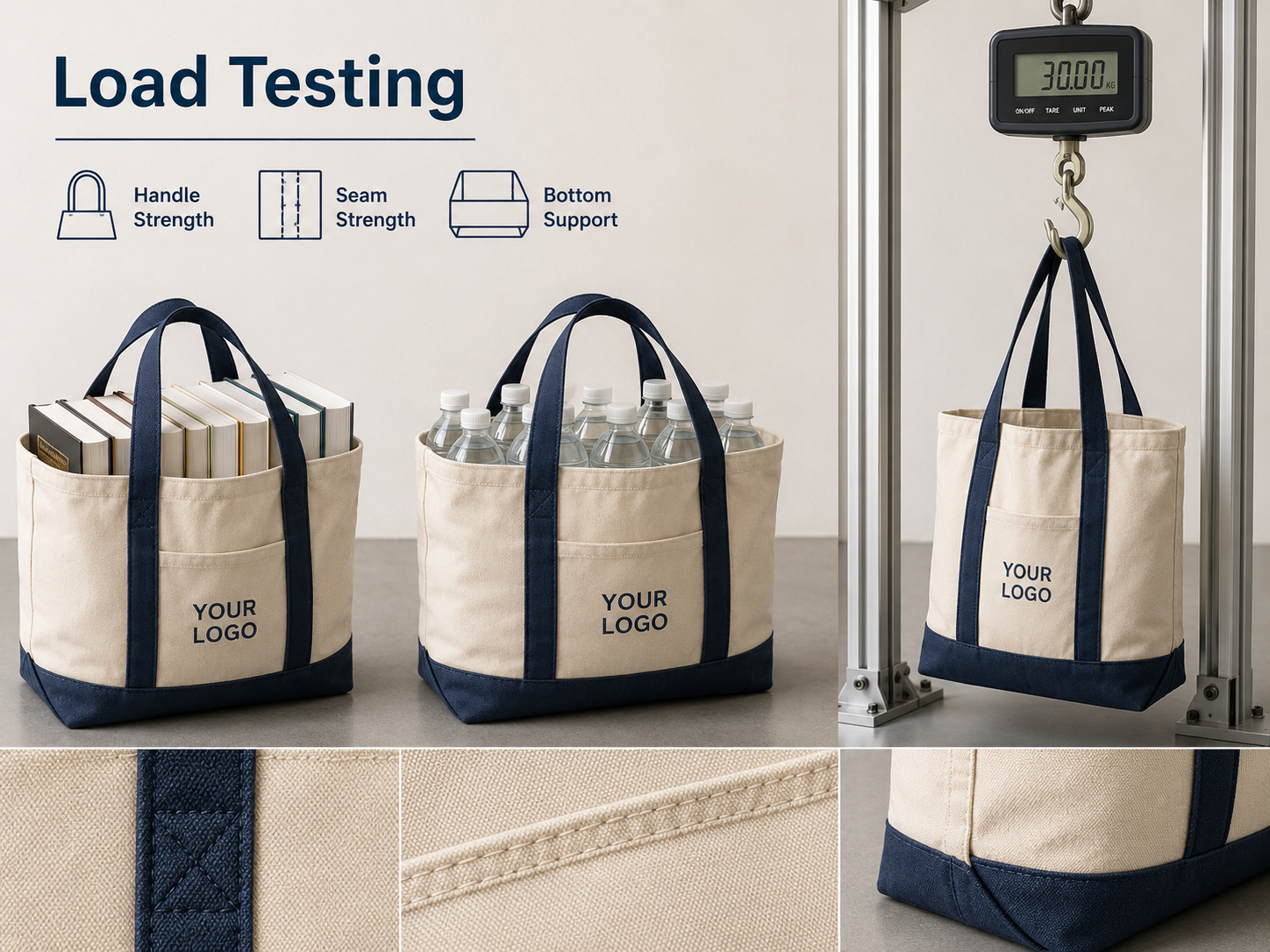
Static Load Testing
A static load test places a defined weight inside the finished bag for a specified period.
The test protocol should state:
- Test load
- Type of contents or test weights
- Load distribution
- Suspension method
- Test duration
- Environmental conditions
- Acceptable deformation
- Pass/fail criteria
After testing, the bag should be inspected for:
- Broken stitches
- Fabric tearing
- Handle elongation
- Seam opening
- Permanent distortion
- Hardware movement
- Print cracking
- Bottom sagging
The test weight should be agreed according to the intended working load. A claimed carrying capacity should not be based only on an informal factory demonstration.
Dynamic and Repeated Load Testing
Real use involves movement rather than constant suspension.
A dynamic test may simulate:
- Repeated lifting
- Short drops
- Swinging
- Walking movement
- Loading and unloading
- Sudden force at handle attachments
The protocol should define:
- Load
- Number of cycles
- Lift height
- Movement speed
- Drop distance, if applicable
- Inspection intervals
- Failure criteria
Repeated testing can reveal gradual problems that a short static test may not show, including:
- Stitch loosening
- Progressive seam slippage
- Handle stretching
- Fabric tearing around needle holes
- Hardware fatigue
There is no single cycle count suitable for every custom bag. The requirement should match the product category and buyer risk level.
Handle Pull Testing
Handle strength is one of the most important quality points for tote bags.
Testing may evaluate:
- Individual handle attachment strength
- Combined handle strength
- Elongation under force
- Failure location
- Symmetry between both sides
The test should use the actual production construction, including:
- Body fabric
- reinforcement
- thread
- stitch pattern
- handle material
- seam allowance
Testing a loose fabric swatch does not provide the same information as testing a completed handle assembly.
Suggested Test Direction by Bag Type
| Bag Type |
Main Technical Risks |
Recommended Test Focus |
| Lightweight promotional tote |
Fabric tearing, print distortion and weak upper hems |
Fabric weight, seam inspection and basic carrying test |
| Daily retail tote |
Handle failure, seam opening and dimensional inconsistency |
Static load, repeated lifting and handle attachment test |
| Wide-gusset grocery bag |
Bottom distortion and high load concentration |
Bottom seam, gusset seam, handle strength and repeated load |
| Premium lined canvas bag |
Shrinkage mismatch, zipper distortion and appearance change |
Finished measurements, wash test, lining fit and closure test |
| Embroidered canvas bag |
Panel puckering and stiffness |
Embroidery sample, fabric stability and post-decoration dimensions |
| Heavy work-style bag |
Abrasion, seam rupture and hardware failure |
Tensile, seam, repeated load, abrasion and hardware testing |
Do Not State Load Capacity Without Defining the Test
A product description stating “holds 20 kg” is incomplete unless the supplier and buyer agree on:
- Whether 20 kg is a working load or test load
- Static or repeated testing
- Test duration
- Number of cycles
- Load distribution
- Bag size
- Handle configuration
- Pass criteria
A bag may hold 20 kg once without immediately breaking, but that does not prove it is suitable for repeated 20 kg use.
For responsible B2B specifications, load claims should be linked to a documented test condition.
How Bag Dimensions Affect Load Performance
The same canvas and stitching can behave differently in different bag sizes.
A large bag can contain more volume, encouraging users to place heavier items inside. It may also create greater leverage on seams and handles.
Important structural variables include:
- Bag width
- Bag height
- Gusset depth
- Handle spacing
- Handle length
- Handle width
- Seam location
- Bottom shape
- Internal divider placement
A wide-gusset grocery tote should not use the same construction assumptions as a small flat promotional tote.
How Handle Length Affects the Design
Long shoulder handles provide convenience but may create more movement when the bag is carried.
Short hand-carry handles may feel more controlled under heavy loading.
Handle design should consider:
- Intended carrying method
- Bag width
- User comfort
- Handle material
- Attachment depth
- Target load
- Reinforcement method
Wider handles can improve comfort, but width alone does not guarantee higher strength. The handle material and connection to the bag remain critical.
How Washing Can Affect Load Performance
A washable canvas bag should be evaluated both before and after laundering.
Washing can affect:
- Fabric dimensions
- Seam tension
- Thread performance
- handle length
- reinforcement position
- print adhesion
- surface abrasion
- hardware appearance
Shrinkage can sometimes tighten a fabric structure, but it can also create seam puckering, distortion or stress between components.
Where washability is an important product claim, a post-wash load test can provide more useful information than testing only a new sample.
How Buyers Should Write a Canvas Fabric Specification
A practical fabric specification can include:
Material
- Fiber composition
- Recycled or organic content, if required
- Certification requirement
Fabric Construction
- Canvas or duck canvas
- Weave type
- Yarn specification, when necessary
- Warp and weft density, when necessary
Weight
- Target GSM
- Equivalent oz/yd²
- Measurement method
- Acceptable tolerance
- Finished or greige weight
Color and Finish
- Pantone or approved color reference
- Natural, bleached, dyed or printed
- Washed or unwashed
- Softened or structured
- Coated or uncoated
Dimensional Stability
- Test method
- Wash cycle
- Drying method
- Maximum warp shrinkage
- Maximum weft shrinkage
Performance
- Fabric tensile requirement
- Seam strength requirement
- Finished-bag load test
- Repeated load cycle
- Abrasion requirement, where necessary
Example of an Incomplete Specification
Natural 12 oz canvas tote bag with logo.
This leaves several points unclear:
- Is the fabric 100% cotton?
- Does 12 oz mean oz/yd²?
- Is the weight measured before or after washing?
- What tolerance is accepted?
- Is the fabric preshrunk?
- What is the bag size?
- What weight should the bag carry?
- How are the handles reinforced?
- Is the logo printed before or after washing?
- Is the bag intended to be washable?
Different suppliers could quote materially different products against the same statement.
Example of a More Complete Specification
Custom natural cotton canvas tote bag made from approximately 407 GSM finished fabric, equivalent to 12 oz/yd². Fabric composition, weight tolerance and shrinkage requirements to be confirmed before sampling. Bag to include a wide gusset, reinforced shoulder handles, defined seam construction and buyer-approved logo printing. Finished sample to pass agreed static and repeated load tests under documented conditions.
This specification is still concise, but it establishes a clearer development direction.
Bulk Production Quality Control
Canvas weight should be verified during bulk production, not only during sample development.
Important checkpoints include:
Incoming Fabric Inspection
Check:
- Fabric weight
- width
- color
- weave consistency
- stains
- holes
- yarn defects
- surface finish
- roll-to-roll variation
Cutting Inspection
Check:
- Grain direction
- panel dimensions
- shrinkage allowance
- pattern positioning
- logo area
- handle dimensions
- gusset dimensions
Sewing Inspection
Check:
- Seam allowance
- stitch density
- thread
- skipped stitches
- handle symmetry
- reinforcement
- seam slippage
- loose threads
Final Product Inspection
Check:
- Finished measurements
- bag shape
- logo position
- closure function
- handle strength
- load performance
- stains
- packaging
- carton quantity
Bulk fabric should be compared with the approved sample, but the written specification should remain the main control reference.
Common Buyer Mistakes
Mistake 1: Selecting Canvas Only by GSM
GSM does not describe seam strength, finishing or bag construction.
Mistake 2: Comparing GSM with an Undefined OZ Value
Confirm that ounces mean ounces per square yard and refer to finished fabric.
Mistake 3: Assuming Heavier Fabric Cannot Shrink
Shrinkage depends on processing and construction, not only weight.
Mistake 4: Testing Only the Fabric
Finished bags can fail at seams, handles, zippers or reinforcement points.
Mistake 5: Using One Load Requirement for Every Bag Size
Larger and deeper bags require separate structural evaluation.
Mistake 6: Approving an Unwashed Sample for a Washed Product
Washing can change dimensions, color, surface appearance and logo position.
Mistake 7: Ignoring Fabric Weight Tolerance
Textile production has normal variation. The acceptable range should be written into the specification.
Mistake 8: Treating a One-Time Load Demonstration as a Durability Test
Repeated use can reveal progressive seam and handle failure.
Recommended Canvas Direction by Application
| Application |
Suggested Development Direction |
| Trade show giveaway |
Lightweight canvas, flat structure and simple logo |
| Retail merchandise |
Medium canvas with controlled shrinkage and stronger branding |
| Corporate gift |
Medium-to-heavy canvas with lining, pocket or closure |
| Grocery shopping |
Heavy canvas, wide gusset and reinforced handle attachments |
| Bookstore or museum tote |
Medium canvas with stable dimensions and clear printing surface |
| Fashion collection |
Weight selected by desired drape, wash effect and visual positioning |
| Work or utility bag |
Heavy canvas with reinforced seams, hardware and documented testing |
| Foldable travel tote |
Lightweight canvas or cotton blend with low packing volume |
These are development directions rather than fixed technical rules. Sampling and testing remain necessary.
Questions Buyers Should Ask Suppliers
Before confirming a custom canvas bag, ask:
- Is the canvas weight stated in GSM or oz/yd²?
- Is the value measured before or after finishing?
- What is the acceptable fabric weight tolerance?
- What is the fiber composition?
- Is the fabric washed or preshrunk?
- What are the warp and weft shrinkage results?
- Which washing method was used?
- What weave and yarn construction are used?
- How are the handles attached?
- What reinforcement is included?
- Has the finished bag been load tested?
- Was the test static or repeated?
- What load, duration and cycle count were used?
- Has the product been tested after washing?
- Will bulk fabric be checked against the approved specification?
These questions make quotations easier to compare and reduce misunderstandings before production.
How INITI Supports Custom Canvas Bag Development
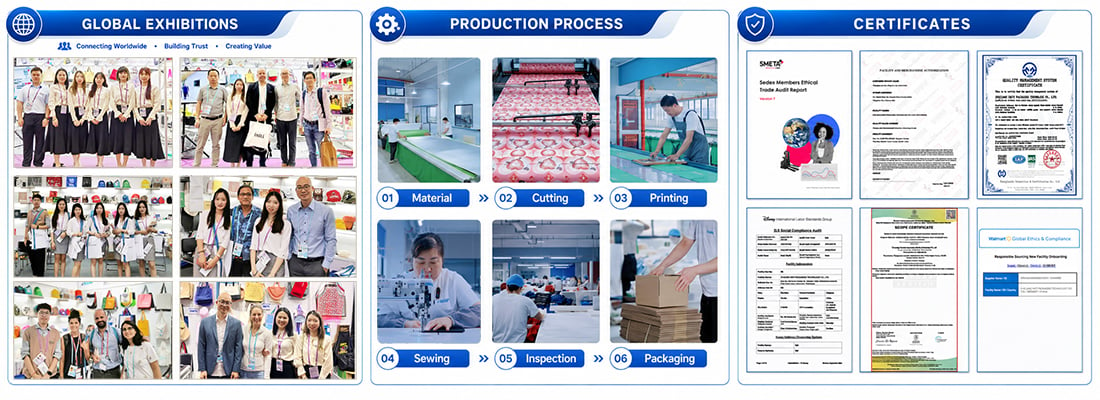
INITI supports OEM and ODM canvas bag projects for retailers, supermarkets, promotional companies, gift suppliers, brand owners, importers and distributors.
Our development process can cover:
- Cotton and canvas material selection
- Fabric weight comparison
- Custom sizes and gussets
- Handle and seam development
- Logo printing and embroidery
- Washed and unwashed finishes
- Shrinkage review
- Sample preparation
- Finished-product load testing
- Production inspection
- Retail and export packaging
Buyers can compare lighter promotional canvas, medium retail canvas and heavier structured canvas before confirming the final specification.
For projects requiring specific performance, the intended load, usage frequency, washing method and test conditions should be agreed during sample development rather than after mass production.
FAQ
What does GSM mean for a canvas bag?
GSM means grams per square meter. It measures the mass of the fabric over one square meter but does not directly state the bag’s load capacity.
How many GSM is 10 oz canvas?
If the measurement is 10 oz per square yard, it is approximately 339 GSM.
Is 12 oz canvas stronger than 10 oz canvas?
It contains more mass per unit area, but the finished strength also depends on yarn, weave, seams, handles, reinforcement and finishing. A higher oz value alone does not guarantee a stronger bag.
What GSM is suitable for a canvas tote bag?
Light promotional bags may use lower weights, while daily retail and grocery bags commonly require medium or heavy canvas. The correct GSM should be selected according to bag dimensions, intended load, structure, target cost and brand positioning.
Does cotton canvas shrink?
Cotton canvas can shrink when exposed to washing, heat, agitation and drying. The actual dimensional change should be tested on the selected fabric and, where relevant, on the finished bag.
Does preshrunk canvas have zero shrinkage?
No. Preshrinking is intended to reduce later dimensional change, but buyers should still define and test an acceptable shrinkage limit.
Should canvas weight be measured before or after washing?
For custom bag production, finished fabric weight is generally more useful. The specification should clearly state the production stage at which weight is measured.
Can GSM determine how many kilograms a bag can carry?
No. GSM does not measure the complete bag. Finished carrying performance depends on fabric strength, seams, handles, reinforcement, dimensions and test conditions.
How should a canvas bag load claim be verified?
Use an agreed finished-product test that defines the load, duration, cycle count, suspension method and pass criteria.
Should washable canvas bags be tested after laundering?
Yes, particularly when washability is part of the product claim. Post-wash testing can identify dimensional changes, seam distortion, print damage and reduced structural performance.
Conclusion
Canvas fabric weight is an important sourcing specification, but it should never be used as the only indicator of custom bag quality.
GSM and oz describe the mass of the fabric per unit area. They help buyers compare materials, estimate cost and select an appropriate product direction. They do not independently determine thickness, shrinkage, seam strength or finished-bag load capacity.
A reliable custom canvas bag project should confirm:
- The exact weight unit
- Finished fabric weight
- Fiber composition
- Weave and finishing
- Weight tolerance
- Warp and weft shrinkage
- Seam and handle construction
- Static and repeated load requirements
- Performance before and after washing
The most suitable canvas is not automatically the heaviest option. It is the fabric and construction combination that meets the intended use, visual standard, cost target and documented performance requirements without unnecessary material consumption.
Inquiry Support
For a technical canvas bag recommendation, provide the intended bag type, finished dimensions, target load, expected usage frequency, preferred canvas weight, fiber composition, washing requirement, logo method, structure, order quantity, packaging method and destination market. These details allow the fabric, seams, handles, shrinkage allowance and test protocol to be evaluated together.
Related Products
Related Blog Articles



 Hot News