Supermarket Vendor Audit Guide: BSCI, Sedex SMETA & ISO9001 Compliance
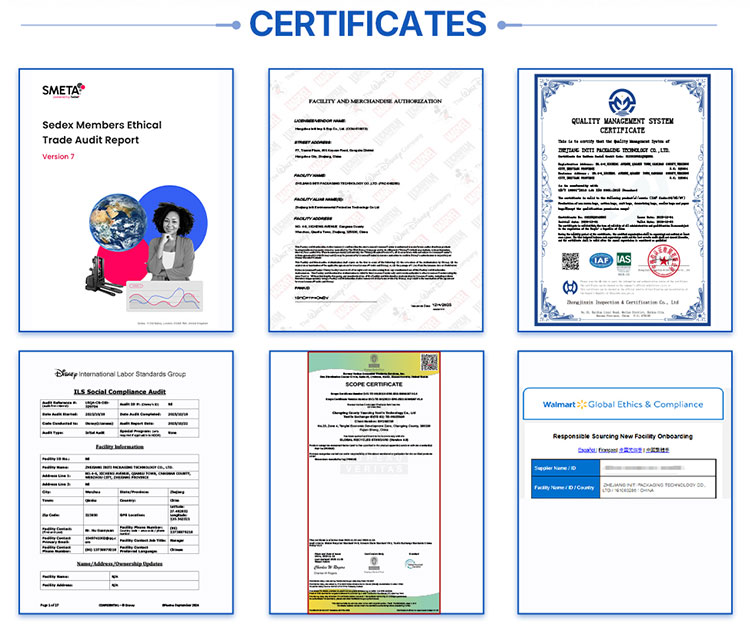
A supermarket buyer receives three documents from a potential shopping bag supplier: a BSCI audit summary, a Sedex membership record, and an ISO 9001 certificate.
The supplier appears qualified. But do these documents cover the factory that will actually manufacture the bags? Are there unresolved audit findings? Does the quality management certificate include the relevant production operations?
These questions matter more than the number of certificates displayed on a supplier's website.
For supermarket chains, retail brands, and importers, a supermarket vendor audit should establish whether a supplier meets the buyer's ethical sourcing, quality management, and operational requirements. It should also identify risks that could affect production approval or repeat orders.
This guide explains how to interpret amfori BSCI, Sedex SMETA, and ISO 9001 evidence, what to check before accepting an audit report, and how these assessments apply to custom shopping bag and retail packaging procurement.
1. BSCI vs Sedex SMETA vs ISO 9001: What Does Each Verify?
The three frameworks address different aspects of supplier performance. They are complementary, but they are not interchangeable.
| Framework |
Main Purpose |
Evidence to Review |
What It Does Not Prove |
| amfori BSCI |
Assess social compliance and working conditions |
Monitoring report, performance rating and findings |
Product quality or universal retailer approval |
| Sedex SMETA |
Assess ethical sourcing and workplace risks |
Audit report, findings and Corrective Action Plan Report |
Formal certification or automatic pass/fail approval |
| ISO 9001 |
Assess a quality management system |
Valid certification and supporting management records |
That every finished product meets its specifications |
amfori BSCI: Working Conditions and Social Compliance
amfori BSCI evaluates how a production site manages employment practices, working hours, remuneration, occupational health and safety, worker rights, and other social responsibility requirements.
The monitoring system uses performance ratings from A to E.
These ratings help buyers understand the overall assessment, but a rating alone is not sufficient for every supplier approval decision. Purchasing teams may also need to review individual findings, corrective actions, and retailer-specific acceptance criteria.
BSCI is a social compliance monitoring system, not a product certification.
An important procedural development took effect on 2 July 2025. Eligible business partners linked to an amfori member can request monitoring for their own sites through the amfori Sustainability Platform, subject to specified conditions.
This does not remove the need to coordinate with the relevant buyer or comply with the platform's responsibility arrangements.
Sedex SMETA: Ethical Sourcing and Corrective Actions
Sedex is a responsible sourcing platform, while SMETA is its social audit methodology.
SMETA 7.0, introduced in September 2024, remains the current methodology as of November 2026.
SMETA audits are commonly conducted under two scopes:
- 2-Pillar: Labour standards and health and safety.
- 4-Pillar: Labour standards, health and safety, environment, and business ethics.
SMETA 7.0 also includes management systems assessment and Collaborative Action Required (CAR) findings for certain complex issues.
A SMETA audit does not produce an official certification or pass/fail result. The audit report and Corrective Action Plan Report (CAPR) document identified issues and the actions required to address them.
Sedex membership by itself does not demonstrate that a factory has completed a SMETA audit.
ISO 9001: Quality Management and Production Consistency
ISO 9001 addresses how an organisation manages quality-related processes, including purchasing, production controls, inspection, nonconformities, and corrective actions.
For a custom shopping bag manufacturer, this can involve controlling incoming fabric specifications, approved samples, sewing quality, printing accuracy, and finished-goods inspection.
However, ISO 9001 certification does not guarantee that an individual production batch is defect-free.
Important 2026 update: ISO 9001:2026 was published on 16 September 2026. Organisations already certified under ISO 9001:2015 have until 30 September 2029 to complete their transition, subject to the applicable certification requirements.
A valid ISO 9001:2015 certificate should therefore not be rejected solely because the newer edition has been published.
2. Can a SMETA Audit Replace BSCI for Supermarket Approval?
The answer depends on who is asking.
Within the amfori BSCI system, SMETA audits are not recognised as substitutes for BSCI monitoring.
Individual supermarket chains, however, may accept BSCI, SMETA, or another specified assessment under their own supplier qualification policies.
For example, a retailer that accepts both BSCI and SMETA may allow a supplier to submit an existing SMETA report rather than commission another social audit. A retailer that specifically requires amfori BSCI monitoring may not.
Buyers should therefore confirm three points before requesting a new audit:
- Which framework does the retailer accept?
- Is the existing report still acceptable under the retailer's policy?
- Does the report cover the correct production facility and required audit scope?
There is no universal rule that every supermarket accepts a particular BSCI rating or a SMETA report for a fixed number of years.
Those conditions must be established with the purchasing organisation.
3. How to Check Whether a Factory Audit Report Is Valid for Your Order
A supplier may hold genuine audit documentation without that documentation covering the planned production.
This is particularly relevant to custom bag manufacturing, where cutting, printing, lamination, sewing, and packing may take place at different facilities.
Before approving a supplier, review the following evidence.
| Checkpoint |
What to Verify |
Potential Problem |
| Factory identity |
Registered name and actual manufacturing address |
Report belongs to a different facility |
| Audit scope |
Sites, operations and activities covered |
Approved site does not manufacture the ordered product |
| Report status |
Audit date, findings and follow-up requirements |
Buyer relies on outdated or incomplete evidence |
| Social compliance |
Significant findings and corrective action status |
Serious workplace risks remain unresolved |
| Quality certification |
Certificate validity, covered locations and activities |
ISO scope excludes the relevant production operation |
| Subcontracting |
Actual production sites and approved external processes |
Production is transferred without buyer approval |
Confirm the Actual Manufacturing Site
A common mistake is checking only the supplier's registered company name.
Suppose a purchasing company operates two factories. One manufactures cotton shopping bags, while the other produces laminated PP woven bags.
If only the first site was audited, the buyer should not assume that the second facility is covered.
The same applies when printing, lamination, or other operations are subcontracted.
Not every subcontractor necessarily requires a separate audit under every retailer programme. The correct action is to identify the production arrangement and apply the buyer's approved subcontracting policy.
Check Report Access and Authenticity
A certificate image or audit summary shared by email may be useful for initial screening, but it should not be the only basis for qualification.
For BSCI, buyers should obtain authorised access to the appropriate monitoring information through the applicable amfori procedures.
For SMETA, buyers should review the relevant audit report and corrective action information through the authorised Sedex sharing process.
For ISO 9001, verify the certificate details with the issuing certification body or an appropriate recognised verification service.
A valid audit report is evidence of an assessment at a particular time. It is not a guarantee of future performance.
4. What Audit Findings Should Supermarket Buyers Pay Attention To?
Not every finding presents the same risk.
A documentation weakness, a recurring overtime problem, and an immediate threat to worker safety require different responses.
The following examples illustrate how a purchasing team might assess findings.
Working Hours and Payroll Records
Excessive working hours or inconsistent payroll records can indicate social compliance risks.
Buyers should consider the extent of the issue, whether the relevant records are reliable, and whether management has identified the underlying causes.
For example, repeatedly extending working hours to recover delayed production may indicate an unrealistic capacity plan rather than an isolated administrative mistake.
A corrective action that addresses only the attendance records would not resolve the production-planning problem.
Fire Safety and Emergency Access
Blocked emergency exits, inadequate fire protection, or dangerous machinery conditions require careful attention.
Where workers face immediate danger, appropriate protective measures should be taken without waiting for the next routine audit.
Simply clearing an obstructed exit on the day of inspection does not demonstrate that adequate safety management is in place.
The supplier should also establish controls that prevent the condition from recurring.
Incomplete Management Records
Missing inspection records, inconsistent training documentation, or outdated procedures may indicate weaknesses in the management system.
The consequences depend on the nature and severity of the finding.
A missing document should not automatically be treated as equivalent to evidence of a serious labour violation. Equally, complete documentation does not necessarily prove that workplace practices are satisfactory.
Unapproved Subcontracting
A supplier that transfers production to another factory without approval can undermine the original qualification process.
This is a particular concern for custom bags involving multiple operations or specialised machinery.
The buyer needs to know where the product will be made and whether the intended manufacturing arrangements comply with the retailer's requirements.
5. Corrective Action Plans: How to Decide Whether a Finding Is Resolved
An audit finding is not necessarily the end of a supplier relationship. The key question is whether the risk can be addressed adequately.
For SMETA, corrective actions are documented through the CAPR process. BSCI also involves findings, improvement measures, and applicable follow-up monitoring.
Buyers should examine both the proposed action and the evidence that it has worked.
Consider this example.
Finding: Workers repeatedly exceed the working-hour limits applicable to the factory.
Weak corrective action: Management instructs supervisors to reduce overtime.
More substantial corrective action: Management reviews production capacity, adjusts scheduling, monitors working-hour records, and verifies that the new arrangements are functioning.
The second approach addresses the underlying system rather than relying only on an instruction.
A useful corrective action record should establish:
- The specific finding and its root cause
- Immediate measures required to protect workers or control risk
- Responsibility for implementation
- An agreed completion deadline
- Evidence of implementation
- The process for verifying effectiveness
The buyer's approval decision should depend on the applicable audit requirements and the severity of the findings.
For serious unresolved issues, purchase order release or production approval may need to be withheld until the required conditions are met.
SMETA 7.0 also recognises that some systemic problems require collaboration between buyers, suppliers, and other parties rather than a simple one-time corrective action.
Current update: In November 2026, Sedex announced planned changes to the CAR process, including clearer progress tracking and revised closure arrangements. These changes are scheduled for the second quarter of 2027 and are not yet part of the current audit procedure.
6. ISO 9001 Is Not a Substitute for Bag Quality Inspection
A supermarket may approve a factory's social compliance documentation and quality management system, yet still receive a shipment with defective handles, inaccurate dimensions, or incorrect printing.
Factory qualification and product acceptance are separate decisions.
For custom reusable bags, the purchasing specification should define the characteristics that matter to the finished product.
| Product Area |
Recommended Verification |
| Fabric |
Approved composition, construction, weight and tolerances |
| Dimensions |
Finished width, height, gusset and agreed measurement method |
| Handles |
Attachment structure, reinforcement and carrying performance |
| Seams |
Stitching or bonding quality and agreed strength requirements |
| Printing |
Artwork, colour reference, registration and durability where relevant |
| Packing |
Quantity per carton, carton identification, labels and barcode requirements |
Define Testing Before Production
A statement such as "heavy-duty shopping bag" is not an adequate technical specification.
The buyer and manufacturer should establish the intended carrying load, test method, number of loading cycles where relevant, and acceptance criteria.
Different bag constructions may require different testing arrangements. A laminated PP woven shopping bag, a stitched cotton canvas tote, and a thermally bonded non-woven bag should not automatically be assessed using identical assumptions.
Where third-party testing is required, the laboratory should be provided with the correct product specification and applicable standard or agreed test protocol.
For additional information, see Quality Control Protocols for Bulk Bag Manufacturing.
Separate Quality Management From Product Compliance
BSCI, SMETA, and ISO 9001 do not replace market-specific product compliance assessments.
Depending on the product, intended use, and destination market, additional evidence may be needed for chemical restrictions, recycled content claims, labelling, or packaging requirements.
An ordinary reusable grocery carrier should not automatically be treated as a food-contact product merely because consumers may use it to carry groceries.
The regulatory assessment must consider its intended and reasonably foreseeable use.
7. A Practical Supplier Approval Process for Retail Bag Orders
A well-organised qualification process should prevent missing documents from delaying production after commercial terms have been agreed.
The following sequence connects audit review with actual purchasing decisions.
Before Supplier Selection
Request the supplier's legal details, manufacturing site addresses, available social audit information, ISO 9001 evidence, and production capability overview.
Confirm which requirements are mandatory under the retailer's supplier policy.
Do not request a new audit before checking whether suitable existing evidence can be accepted.
Before Sample Approval
Confirm the actual production route, including important subcontracted operations.
Review the available audit findings and agree on any conditions that must be satisfied before production.
At the same time, establish the product specification, material requirements, test methods, and approval sample.
Before Purchase Order Release
Make a documented decision about supplier approval.
Possible outcomes include approval, conditional approval subject to defined requirements, further verification, or rejection.
There is no universal approval threshold across all retailers.
For high-risk outstanding findings, a supplier may need to complete specified corrective actions before the order is released.
Before Shipment
Confirm that the finished products meet the approved specification and agreed inspection criteria.
Check that the actual production site, materials, and manufacturing arrangements have not changed without approval.
Review the required inspection records, test reports, shipping marks, and other contractual documents.
Supplier approval should continue to be monitored after the first shipment, especially where substantial changes occur in production location, ownership, process, or audit status.
8. Common Mistakes in Supermarket Supplier Qualification
Several problems appear repeatedly in sourcing programmes.
Accepting a certificate without checking its scope. The certificate may be genuine, but it may cover a different location or activity.
Confusing Sedex membership with a SMETA audit. A membership record is not evidence that an ethical trade audit has been completed.
Treating every social audit as interchangeable. A retailer's acceptance policy determines which audit reports it recognises.
Assuming an ISO 9001 certificate guarantees product conformity. Actual goods still require appropriate specifications, production controls, and verification.
Ignoring unresolved corrective actions. A recently completed audit is not necessarily a satisfactory audit.
Approving a supplier but not its production arrangements. Changes in factories or subcontractors can create new risks that were not covered during onboarding.
These mistakes can be reduced through a consistent document review process and clear approval responsibilities.
9. Supermarket Vendor Audit FAQ
Is BSCI mandatory for supermarket suppliers?
There is no universal requirement for every supermarket supplier to undergo BSCI monitoring. Individual retail groups may require BSCI, accept SMETA, or specify another recognised assessment under their own supplier policies.
Does a SMETA audit have a pass or fail result?
No. Sedex does not issue an official SMETA pass/fail certification. Buyers assess the audit findings, corrective actions, and their own qualification requirements.
How long is a SMETA audit valid?
There is no single universal validity period that applies to every retail buyer. Acceptance depends on the retailer's policy, the report date, the site's risk profile, and any outstanding findings or required follow-up.
Can a supplier still use an ISO 9001:2015 certificate in 2026?
Yes, if it remains valid and meets the applicable transition and buyer requirements. The transition to ISO 9001:2026 for organisations already certified to the 2015 edition must be completed by 30 September 2029.
Do BSCI, SMETA, and ISO 9001 cover product safety?
They do not replace product-specific safety or regulatory testing. Relevant testing and compliance documentation must be determined by the product's materials, intended use, and destination market.
Conclusion
The purpose of a supermarket vendor audit is not to collect as many certificates as possible.
It is to determine whether the actual manufacturing site is suitable for the proposed order, whether important risks have been identified and addressed, and whether production can be controlled to the buyer's requirements.
BSCI and SMETA provide different approaches to social compliance assessment. ISO 9001 addresses quality management. Neither replaces product specifications, material verification, or finished-goods inspection.
For buyers sourcing reusable shopping bags and retail packaging, the most useful supplier assessment is one that connects audit evidence with the factory, the product, and the production arrangements.
Recommended Products: Reusable Bags for Supermarket Programs
Selecting a reusable shopping bag involves more than choosing a material or printing a supermarket logo. Bag construction, carrying performance, packaging requirements, and the intended manufacturing site should all be considered during supplier qualification.
The following INITI products offer different starting points for supermarket and retail sourcing projects.
1. Large Laminated PP Woven Shopping Tote
Best suited for: Large-capacity supermarket shopping, branded retail merchandise, and reusable shopping bag programs.
This design features laminated PP woven fabric, wide gussets, long shoulder straps, shorter carry handles, and reinforced webbing. The reference model also includes a snap-button closure.
Buyer checkpoints: Fabric construction, lamination quality, handle attachment strength, finished dimensions, printing consistency, and loaded carrying performance.
View Large Laminated PP Woven Shopping Tote
2. Large Gusseted RPET Stitch-Bond Shopping Bag
Best suited for: Supermarket and retail programs that specify recycled polyester materials.
Made with RPET stitch-bond non-woven fabric, this design uses a large gusseted body, open-top construction, and sewn fabric handles. Its lightweight structure also supports relatively flat packing for bulk distribution.
Buyer checkpoints: Recycled-content documentation, fabric specifications, handle reinforcement, intended carrying load, and the traceability evidence required for any recycled-material claims.
View Large Gusseted RPET Stitch-Bond Shopping Bag
3. Non-Woven Tote Bag
Best suited for: Supermarket promotional campaigns, retail giveaways, and cost-controlled bulk distribution.
This lightweight tote features a gusseted body, open top, short carrying handles, and broad panels for custom printing. It is more appropriate for promotional and lighter retail uses than applications requiring substantial carrying loads, unless a suitable construction has been developed and tested.
Buyer checkpoints: Material composition, fabric weight, gusset dimensions, handle attachment, printing accuracy, and carrying performance under the intended load.
View Non-Woven Tote Bag
Product Selection and Factory Compliance
The products above are design references, not product-level BSCI, SMETA, or ISO 9001 certifications.
For a supermarket purchasing program, the relevant manufacturing site, available audit documentation, approved materials, testing requirements, and production controls should be verified against the final order specifications.
Inquiry Support
For supermarket shopping bag or retail packaging projects, INITI can assist with product specifications, material selection, sampling, quality inspection arrangements, and applicable factory documentation.
Send your product type, estimated order quantity, target market, and retailer-specific audit requirements to [email protected] for a fast quotation and free design support.
Related Articles
Official References






 Hot News