Choosing the right drawstring bag dimensions is not simply a matter of selecting a bag that looks large enough. A bag may have sufficient width and height on paper but still be difficult to load, close, or carry once the actual products are placed inside.
For retailers, promotional product distributors, private-label brands, and procurement teams, incorrect sizing can create several problems. A bag that is too small may not accommodate the complete product set or allow the drawstring to close properly. An oversized bag, on the other hand, can increase material consumption, affect packaging presentation, and add unnecessary costs to a bulk order.
The challenge is that drawstring bags are available in many dimensions, from small jewelry pouches to large laundry bags and full-size drawstring backpacks. There is no single standard size suitable for every application. Even bags with identical flat measurements can offer different usable capacities depending on their gusset construction, fabric flexibility, opening design, and drawstring channel.
This guide explains common drawstring bag dimensions in inches and centimeters, compares their practical applications, and examines how bag structure affects usable space. It also covers measurement methods, product-fitting allowances, cord specifications, logo placement, and important considerations when developing custom drawstring bags for wholesale or promotional projects.
Understanding Drawstring Bag Dimensions
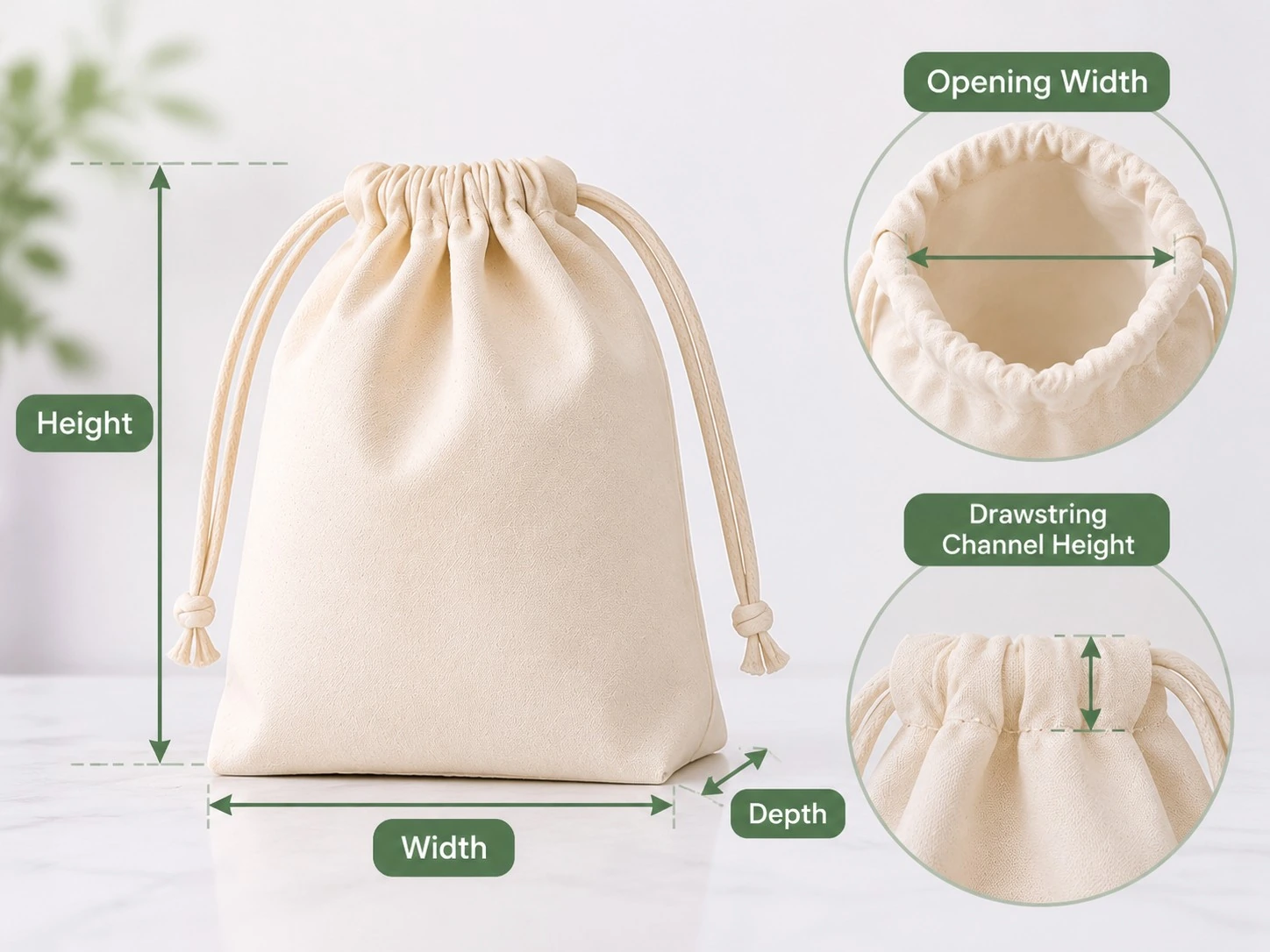
Before comparing different sizes, it is important to understand how drawstring bags are measured. Unlike rigid packaging, fabric bags are flexible and can change shape depending on what they contain.
A typical drawstring bag specification includes width, height, and sometimes depth. These measurements describe the finished bag, but they do not necessarily represent the exact space available for storing products.
Width, Height, and Depth Explained
Most flat drawstring bags are specified using two dimensions: width × height (W × H).
Measurement |
Definition |
Why It Matters |
Width (W) |
Horizontal distance from the left edge to the right edge of the finished bag |
Determines how much room is available across the front panel |
Height (H) |
Vertical distance from the bottom edge to the top edge |
Determines the available body length and affects product insertion |
Depth (D) |
Distance between the front and back panels when the bag is expanded |
Determines how well the bag accommodates thicker contents |
Opening Width |
Width of the mouth when the drawstring is fully released |
Affects how easily products can be inserted and removed |
Usable Height |
Available internal height below the drawstring channel |
Indicates how much of the bag can actually hold products |
For example, a drawstring bag measuring 12 × 16 inches (30 × 40 cm) has a flat width of 12 inches and a finished height of 16 inches.
However, this does not mean that every product measuring 12 × 16 inches will fit comfortably. The bag needs additional room for product thickness, seams, and the fabric gathered at the opening.
Depth is particularly important for bags designed to hold shoes, folded clothing, toiletries, and other three-dimensional products. A flat bag without a gusset may accommodate these products differently from a bag with an expandable bottom.
Flat Dimensions vs. Usable Dimensions
One common mistake when purchasing drawstring bags is treating the listed dimensions as the actual internal storage space.
Manufacturers generally specify fabric bags by their finished external measurements when laid flat. These measurements include the overall body construction, but several areas may not be fully available for storing products.
Three factors affect usable dimensions:
- Seam allowances: Side and bottom seams consume a small amount of internal space.
- Drawstring channel: The fabric at the top is folded and stitched to create a passage for the cord.
- Product thickness: Bulky contents push the front and back panels outward, changing the available width and height.
Consider a bag with a finished height of 16 inches. If approximately 1–1.5 inches is allocated to the drawstring channel, the usable body height below the channel will be shorter.
This difference becomes especially important when the bag needs to accommodate a tall product or a retail box that must remain completely covered.
For procurement specifications, it is useful to distinguish between:
- Finished external dimensions
- Internal usable dimensions
- Drawstring channel height
- Expanded depth, if applicable
These measurements provide a clearer basis for sample approval and bulk production.
The Anatomy of the Closure: Header, Channel, and Cinch Mechanics
The upper section of a drawstring bag is composed of distinct structural zones that do not contribute to product storage:
- Top Header / Ruffle: The decorative fabric extension above the drawstring channel. On luxury velvet, satin, or cotton gift pouches, the header typically ranges from 0.5 to 1.5 inches (13 to 38 mm). When cinched, this fabric flutes outward to form an elegant rosette. On utility backpacks, this header is often eliminated to maximize opening efficiency.
- Drawstring Channel / Casing: The tunnel through which the cinch cord passes. The internal channel height must equal:Channel Height ≥(2×Cord Diameter)+0.25 inches (6 mm) For a standard 4 mm round cord, the casing height must be at least 0.625 to 0.75 inches (16 to 19 mm) to prevent excessive friction.
- Cinch Reduction & Gathering Factor: Cinching a bag reduces the effective vertical height of the upper body by 10% to 18% as the fabric bunches into tight axial folds. If rigid contents sit directly beneath the casing, the cord cannot be pulled to complete closure, leaving a gaping aperture.
Standard Drawstring Bag Dimensions: Size Chart
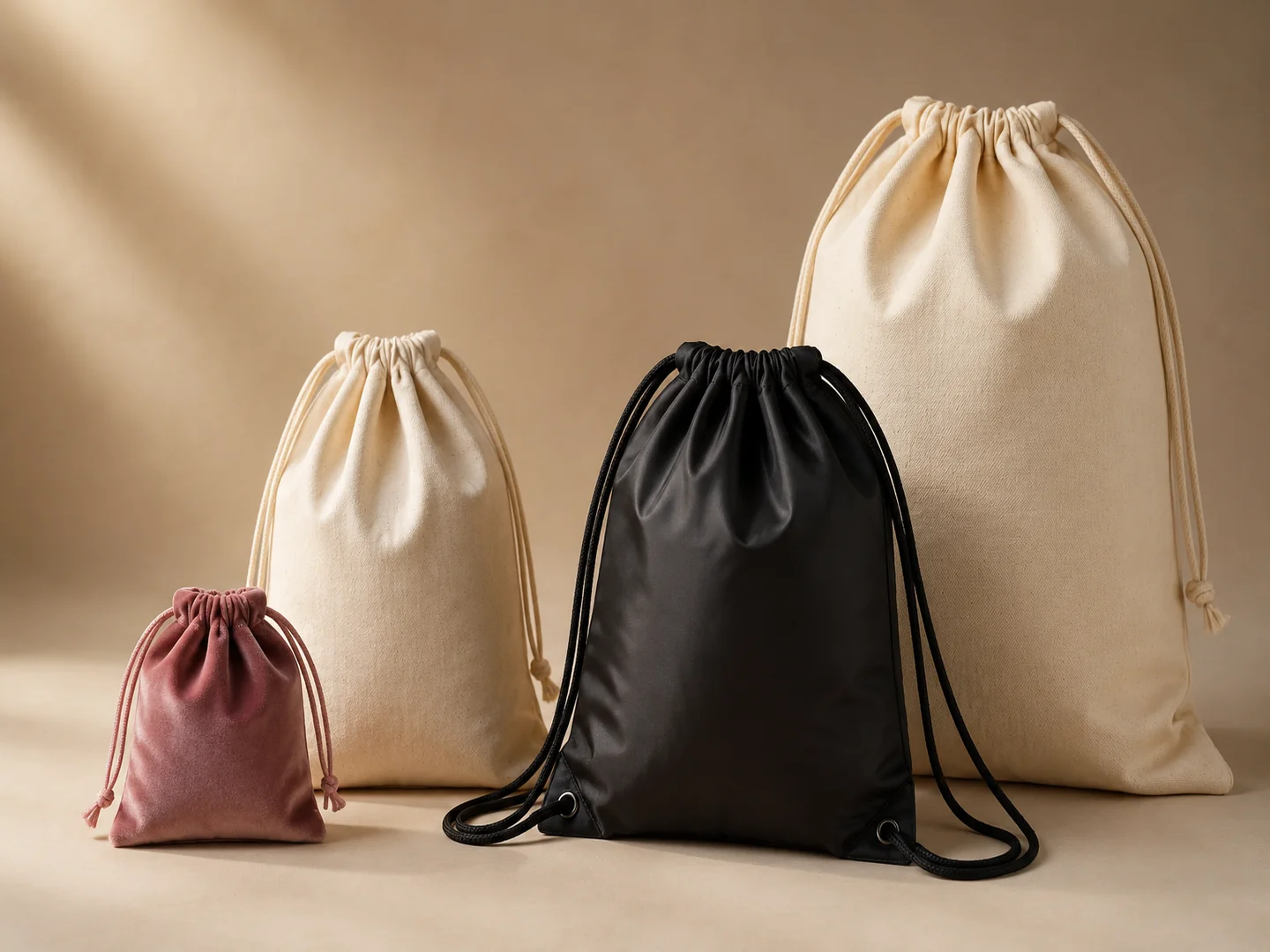
A size chart provides a useful starting point when comparing available options. However, the most suitable size depends on what the bag needs to contain, how frequently it will be used, and whether it is designed for packaging, storage, or carrying.
The following chart covers common commercial size ranges, from small drawstring pouches to extra-large storage bags.
Size Category |
Dimensions (Inches) W × H |
Dimensions (CM) W × H |
Typical Applications |
Mini |
3 × 4 – 4 × 5 |
8 × 10 – 10 × 13 |
Jewelry, small samples, accessories |
Small |
4 × 6 – 6 × 8 |
10 × 15 – 15 × 20 |
Cosmetics, gift favors, small products |
Small-Medium |
8 × 10 – 10 × 12 |
20 × 25 – 25 × 30 |
Toiletries, folded accessories, retail packaging |
Medium |
12 × 14 – 12 × 16 |
30 × 36 – 30 × 40 |
Shoes, apparel, promotional kits |
Standard Backpack |
13 × 17 – 14 × 18 |
33 × 43 – 36 × 46 |
Events, school supplies, gym essentials |
Large |
16 × 20 – 18 × 24 |
41 × 51 – 46 × 61 |
Sportswear, towels, travel items |
Extra Large |
20 × 24 – 24 × 30 |
51 × 61 – 61 × 76 |
Laundry, blankets, bulk storage |
Note: These are practical sourcing reference ranges, not fixed industry standards. Actual product capacity varies with depth, fabric flexibility, opening construction, and the shape of the contents.
Recommended Drawstring Bag Dimensions for Different Applications
A standard size chart is useful for initial comparison, but buyers usually need a more specific answer: What dimensions should be selected for a particular product?
The following recommendations focus on the relationship between product dimensions, packaging requirements, and the finished bag structure.
Jewelry and Small Accessories
Product |
Suggested Bag Dimensions (W × H) |
Sizing Considerations |
Earrings |
3 × 4 in (8 × 10 cm) |
Compact enough to prevent excessive movement |
Rings |
3 × 4 in (8 × 10 cm) |
Allow room for a small protective insert |
Bracelets |
4 × 5 in (10 × 13 cm) |
Consider the bracelet's circumference and clasp |
Necklaces |
4 × 6 in (10 × 15 cm) |
Allow enough room to avoid excessive folding |
Sunglasses |
4 × 7 in (10 × 18 cm) |
Measure the complete case if one is included |
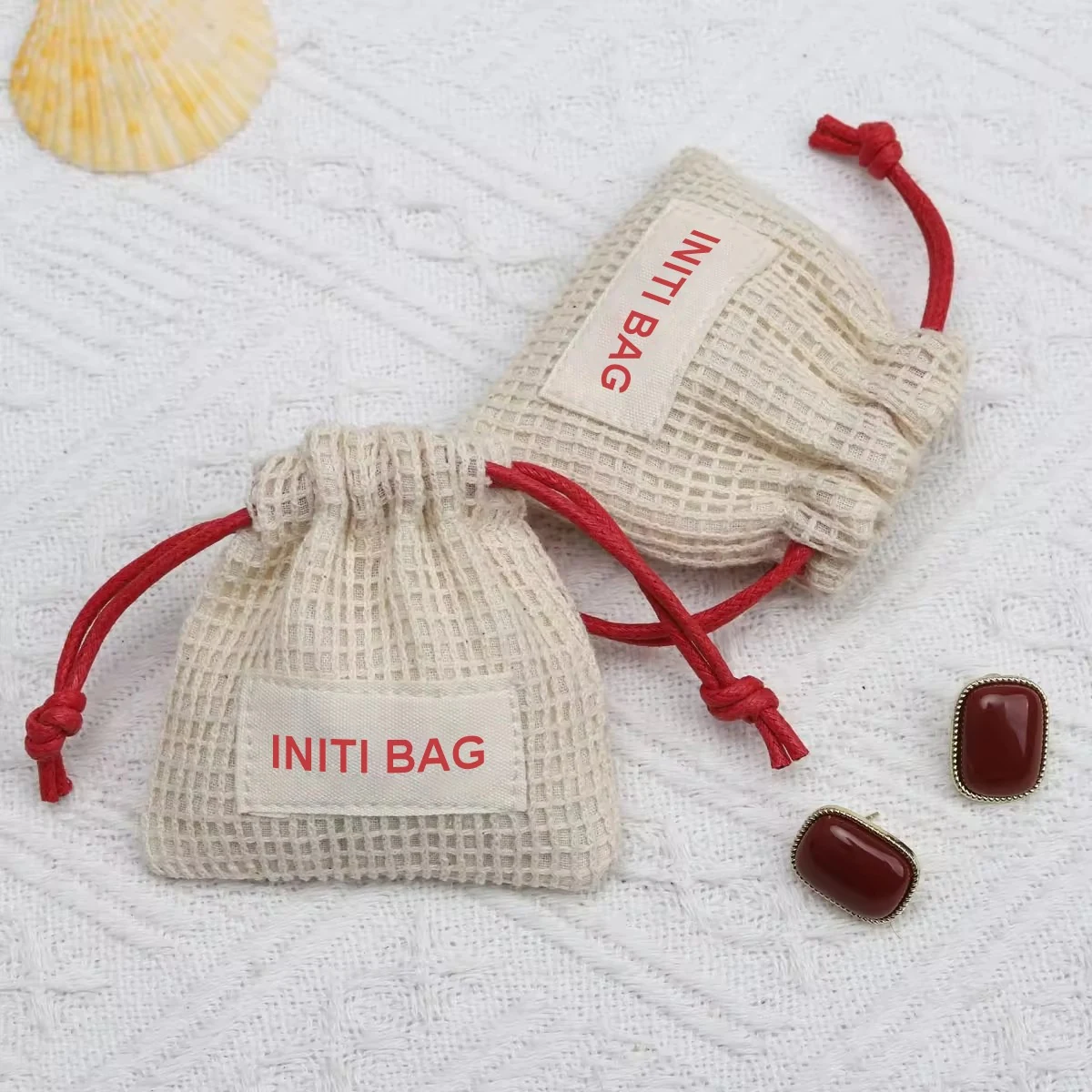
For jewelry and accessories, the objective is not to maximize storage capacity. A bag that is too large may allow delicate items to move around, potentially causing tangling or unnecessary friction.
For products with their own retail boxes, the box dimensions should be used as the starting point. A jewelry pouch designed for a loose necklace may not accommodate the same necklace when placed inside a rigid presentation box.
The material also influences the appropriate fit. Velvet and soft microfiber can provide a more protective interior for delicate accessories, while cotton and polyester are common choices for general promotional packaging.
Cosmetics and Toiletry Products
Product Set |
Suggested Bag Dimensions (W × H) |
Sizing Considerations |
Small cosmetic samples |
5 × 7 in (13 × 18 cm) |
Suitable for a few small sachets or samples |
Basic makeup accessories |
6 × 8 in (15 × 20 cm) |
Consider brushes and compact products |
Travel-size toiletries |
8 × 10 in (20 × 25 cm) |
Check bottle height and combined thickness |
Skincare gift set |
10 × 12 in (25 × 30 cm) |
Measure all products in their final packaging |
Larger beauty kit |
12 × 16 in (30 × 40 cm) |
May require a gusset for multiple bottles |
Cosmetic and toiletry products often have different shapes and heights. A collection of flat makeup accessories may fit into a relatively shallow bag, whereas several cylindrical bottles require more depth.
For example, three travel-size bottles placed upright may need more usable height than the same bottles arranged horizontally. Their combined width and thickness should also be considered.
If the products include glass containers, buyers should not assume that simply increasing the bag size will provide adequate protection. Additional padding, individual product compartments, or protective inserts may be necessary.
For cosmetic gift sets, it is also worth checking whether the drawstring opening is wide enough to insert the complete set without removing individual products from their arrangement.
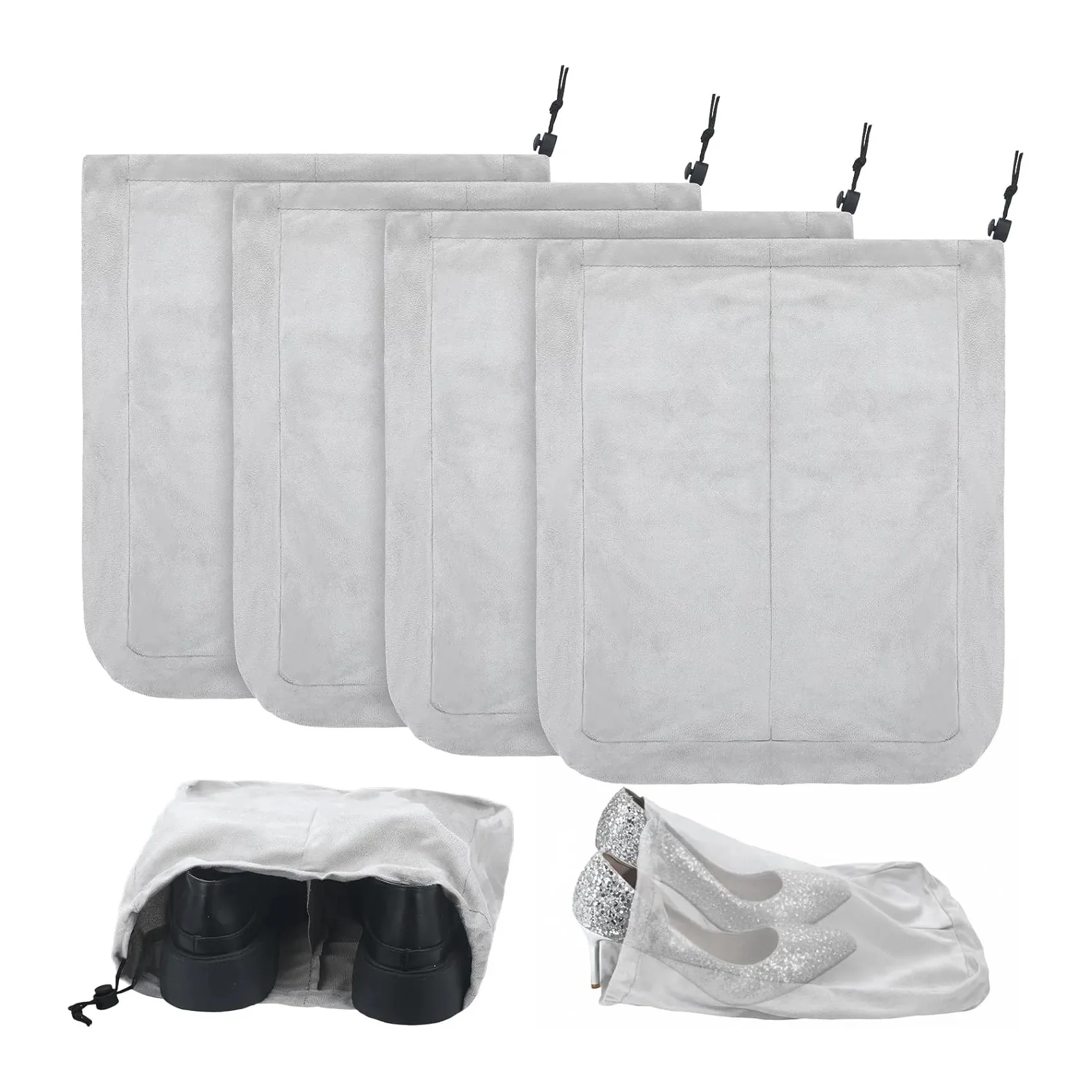
Shoes and Footwear Accessories
Product |
Suggested Bag Dimensions (W × H) |
Sizing Considerations |
Children's shoes |
10 × 14 in (25 × 36 cm) |
Depends on shoe size and shape |
Slippers |
10 × 14 in (25 × 36 cm) |
A flat construction may be sufficient |
Adult casual shoes |
12 × 16 in (30 × 40 cm) |
Consider whether both shoes are packed together |
Larger athletic shoes |
14 × 18 in (36 × 46 cm) |
A gusset may improve loading space |
Shoe care accessories |
8 × 10 in (20 × 25 cm) |
Depends on the number of included products |
Shoe bags require particular attention to depth because footwear is not flat. The widest points of the shoes, sole thickness, and orientation inside the bag can all affect the final fit.
For example, two slim slippers placed sole-to-sole may fit into a relatively flat bag. Two bulky athletic shoes positioned side by side may need more width and depth.
Buyers should also decide whether the bag is intended for one shoe or a complete pair. These are different packaging requirements and should not be treated as interchangeable.
For premium footwear packaging, the bag should provide enough clearance to insert and remove shoes without excessive friction. A slightly more generous size may also help prevent the fabric from being stretched tightly over the shoe surface.
Clothing and Apparel
Product |
Suggested Bag Dimensions (W × H) |
Sizing Considerations |
Folded children's T-shirt |
10 × 12 in (25 × 30 cm) |
Depends on folding method |
Adult T-shirt |
12 × 16 in (30 × 40 cm) |
Allow for fabric thickness |
Lightweight shirt |
12 × 16 in (30 × 40 cm) |
Consider folded collar and sleeves |
Hoodie |
16 × 20 in (41 × 51 cm) |
More space needed for bulky fabric |
Multiple garments |
16 × 20 – 20 × 24 in (41 × 51 – 51 × 61 cm) |
Depends on the number and thickness of garments |
Apparel sizing is closely related to the folding method. The same T-shirt can occupy different amounts of space depending on whether it is folded into a compact rectangle, rolled, or placed inside an additional retail package.
For clothing brands, the dimensions of the folded garment should be measured after the final folding and packaging process has been established.
This is particularly important for private-label apparel programs. A drawstring bag may need to accommodate not only the garment but also hangtags, tissue paper, inserts, or other retail presentation materials.
For thicker products such as hoodies and sweatshirts, increasing bag depth can be more effective than simply increasing height.
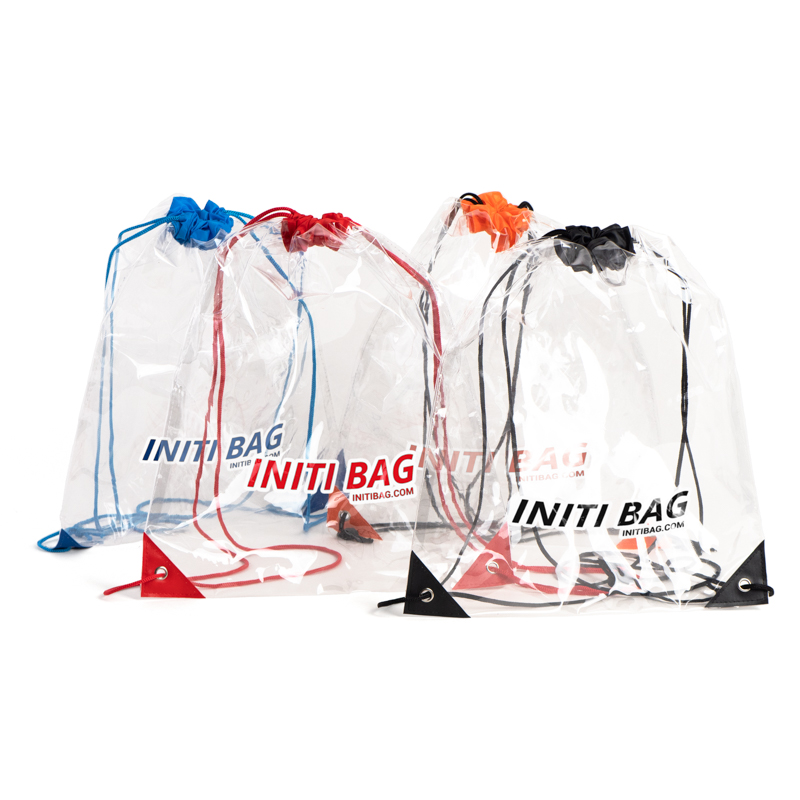
Sports, Gym, and Promotional Applications
Application |
Suggested Bag Dimensions (W × H) |
Typical Contents |
Children's sports activities |
12 × 15 in (30 × 38 cm) |
Small towel, water bottle, sports accessories |
School events |
13 × 17 in (33 × 43 cm) |
Notebooks, stationery, lightweight personal items |
Promotional giveaways |
14 × 18 in (36 × 46 cm) |
Event merchandise, T-shirts, brochures |
General gym use |
16 × 20 in (41 × 51 cm) |
Workout clothing, towel, accessories |
Larger sports kits |
18 × 24 in (46 × 61 cm) |
Multiple clothing items and sports accessories |
For promotional projects, the 14 × 18-inch size is a practical starting point because it offers a balance between carrying space, portability, and branding area.
However, the final specification should reflect the campaign's intended audience and contents.
A conference giveaway containing a notebook, T-shirt, and promotional materials has different requirements from a gym bag intended to hold shoes, a towel, and workout clothing.
For sports applications, buyers should also evaluate the relationship between bag dimensions and carrying performance. A larger bag can accommodate more products, but if it is intended to be worn as a backpack, the cord length, attachment points, and fabric strength must be appropriate for the expected load.
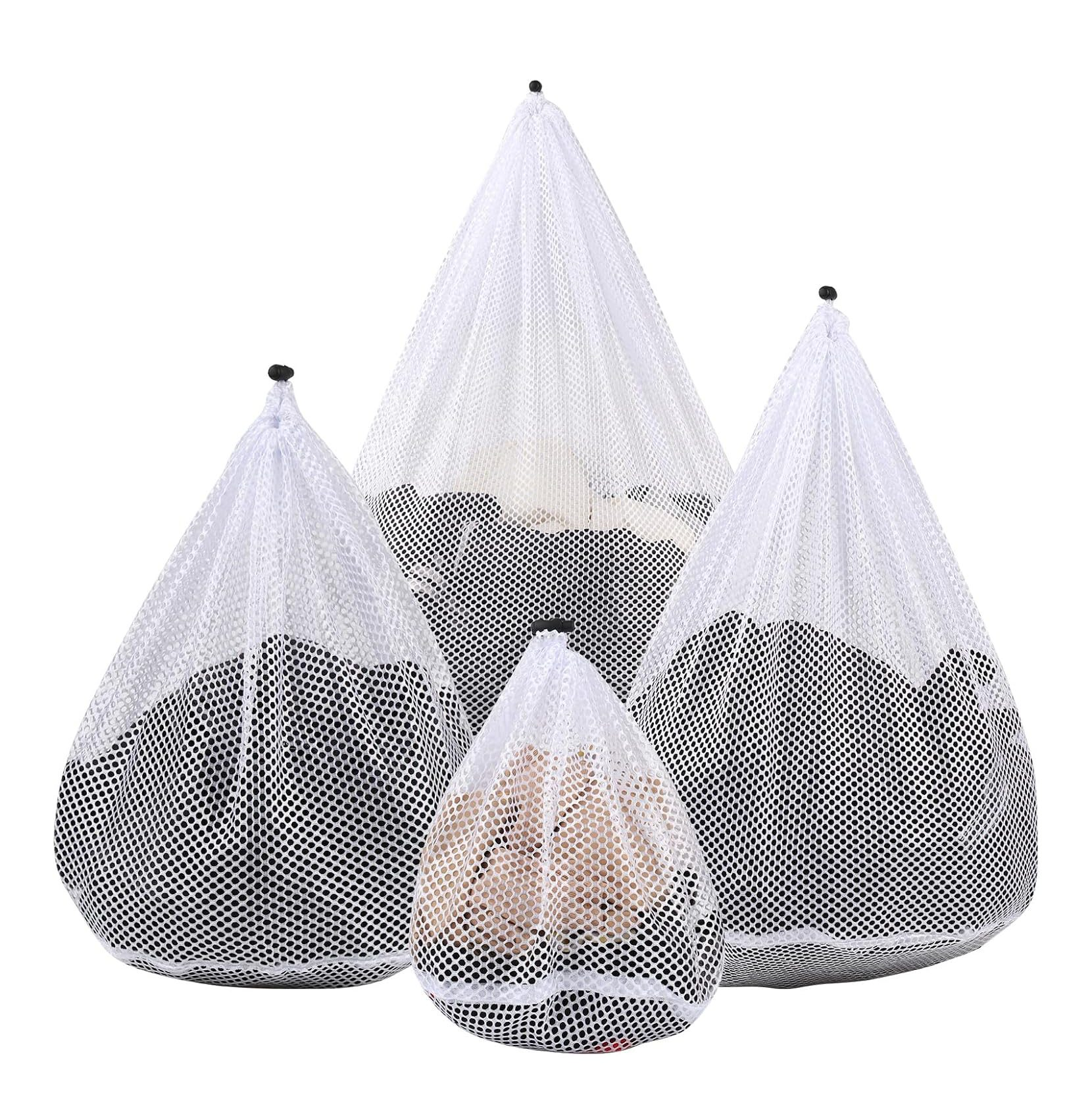
Laundry and Household Storage
Application |
Suggested Bag Dimensions (W × H) |
Typical Contents |
Small travel laundry |
12 × 16 in (30 × 40 cm) |
Underwear, socks, lightweight clothing |
Medium laundry storage |
16 × 20 in (41 × 51 cm) |
Several garments |
Large laundry collection |
20 × 24 in (51 × 61 cm) |
Multiple clothing items and towels |
Blanket storage |
20 × 27 in (51 × 69 cm) |
Folded lightweight blankets |
Bulky textile storage |
24 × 30 in (61 × 76 cm) |
Bedding, seasonal clothing, larger textiles |
Storage bags often need more flexibility than product packaging bags because the contents may vary from one use to another.
For example, a laundry bag may hold a small number of garments on one occasion and a much larger load on another. Its design should therefore allow the fabric to expand without placing excessive tension on the seams or drawstring channel.
For bedding and blankets, measuring the folded textile is more useful than measuring it when fully spread out.
If the storage bag will be used for repeated handling, buyers should pay attention to seam reinforcement and the strength of the cord attachment points. These factors become increasingly important as the bag dimensions and potential load increase.
How Bag Structure Affects Usable Capacity
Two drawstring bags with identical width and height measurements may have noticeably different storage capabilities.
The main reason is construction.
A flat pouch, a bottom-gusset bag, and a backpack-style drawstring bag distribute space and weight differently. Buyers should identify the required structure before confirming the final dimensions.
Flat Drawstring Bags
Flat drawstring bags generally consist of two fabric panels joined along the sides and bottom, with a drawstring channel at the top.
They do not have an independently constructed expandable bottom.
Advantages:
- Simple construction
- Lower material consumption for many applications
- Easy to fold and store
- Suitable for flat or relatively slim products
- Straightforward printing and embroidery layouts
Limitations:
- Limited capacity for bulky products
- Contents may push the front and back panels outward
- Thick items can make the bag difficult to close
- Less stable when holding products with substantial depth
Flat designs are commonly used for jewelry, gift packaging, accessories, and lightweight textile products.
For a product with limited thickness, a flat bag can provide a clean presentation without unnecessary construction complexity.
Bottom-Gusset Drawstring Bags
A bottom-gusset drawstring bag includes an additional construction feature that allows the base to expand when filled.
Unlike a flat bag, it can create a more defined bottom and accommodate products with greater thickness.
For example, a bag with a 12-inch width, 16-inch height, and 4-inch bottom gusset can provide more usable space for bulky contents than a comparable flat design.
The specification should be written as:
Width × Height × Bottom Gusset Depth
Advantages:
- Better accommodation of three-dimensional products
- More defined base when filled
- Improved arrangement of bulky contents
- Reduced need to force thick products into a flat structure
Limitations:
- Additional fabric and sewing operations
- More complex construction
- Different folding and packaging characteristics
- Potentially higher production cost
A bottom gusset is particularly useful for gift sets, toiletries, and other products with a relatively consistent thickness.
Side-Gusset Drawstring Bags
Side-gusset designs add expandable panels along the sides of the bag.
This construction increases the distance between the front and back panels and creates additional room for thicker products.
Side gussets can be useful when the contents need more internal depth but the bag still needs a relatively compact front-facing shape.
For procurement purposes, buyers should specify the fully expanded gusset depth rather than relying on the visible folded width of the side panel.
Drawstring Backpacks
A drawstring backpack is a carrying-oriented version of a drawstring bag.
Its cords typically pass through the upper channel and connect near the lower corners, allowing the same cords to function as shoulder straps.
Although its main dimensions may resemble those of a regular drawstring bag, the construction requirements are different.
Important specifications include:
- Main body width and height
- Opening width
- Shoulder cord length
- Cord diameter
- Bottom-corner reinforcement
- Seam construction
- Expected carrying load
A standard 14 × 18-inch backpack may work for lightweight everyday items, while larger versions may be more appropriate for sports clothing or travel accessories.
However, increasing the bag dimensions without reviewing the cord and reinforcement construction can create performance problems.
The carrying system must be designed for the expected use, not simply scaled up with the fabric body.
How to Measure a Drawstring Bag Correctly
Accurate measurements are essential when developing custom drawstring bags or approving samples before mass production.
A consistent measuring method helps prevent misunderstandings between buyers and manufacturers.
Measure the Finished Bag Width
Place the empty bag on a flat surface with the front panel facing upward.
Measure horizontally from the outermost left edge to the outermost right edge of the main bag body.
Keep the fabric naturally flat without stretching it.
Do not include loose cords, decorative accessories, or unrelated attachments in the body width.
Measure the Finished Bag Height
Measure vertically from the bottom edge to the top edge of the bag body.
The measurement should include the drawstring channel if the manufacturer's specification defines height as the overall finished external height.
However, buyers should separately record the channel height when the usable internal space is important.
For example:
Specification |
Measurement |
Overall finished height |
16 in (40.6 cm) |
Drawstring channel height |
1.25 in (3.2 cm) |
Approximate body height below channel |
14.75 in (37.5 cm) |
This distinction is useful when the bag needs to cover a product with a specific vertical dimension.
Measure the Gusset Depth
Fully open and manually extend the gusset pleat to its maximum perpendicular extension. Measure the distance between parallel seam edges.
Measure the Opening Width
The opening width is often overlooked because buyers focus mainly on the overall bag dimensions.
However, the opening needs to accommodate the product during insertion and removal.
Measure the opening with the drawstring fully released.
For a bag with a flexible fabric mouth, it is also useful to test the opening using the actual packaged product rather than relying only on a flat measurement.
A bag can have sufficient body width but still be inconvenient to load if its opening cannot expand enough.
Test the Filled Dimensions
Empty-bag measurements alone cannot fully demonstrate how a drawstring bag will perform.
For sample approval, place the actual product or an equivalent sample inside the bag.
Then:
- Arrange the contents in their intended packing position.
- Check whether the product enters without excessive force.
- Allow the fabric to expand naturally.
- Pull the drawstring to close the opening.
- Check whether the closure gathers evenly.
- Observe whether the bag becomes excessively stretched or distorted.
- Confirm that the product can be removed without difficulty.
Record the results separately from the empty-bag dimensions.
This is particularly important for rigid boxes, footwear, multiple-item gift sets, and bulky apparel.
How Much Extra Space Should You Add When Choosing a Drawstring Bag?
One of the most common sizing questions is how much larger a drawstring bag should be than the product it contains.
There is no single allowance that works for every design. A flexible pouch containing a flat product needs less additional space than a gusseted bag containing several rigid items.
The following figures can be used as preliminary planning references.
Product Characteristics |
Suggested Additional Width |
Suggested Additional Height |
Additional Consideration |
Thin, flat products |
0.5–1 in (1.3–2.5 cm) |
1–2 in (2.5–5 cm) |
Allow room for insertion and closure |
Soft, flexible products |
1–2 in (2.5–5 cm) |
1–2 in (2.5–5 cm) |
Consider how the product is folded |
Rigid boxes |
1–2 in (2.5–5 cm) |
2–3 in (5–7.6 cm) |
Check corners and opening clearance |
Thick products |
1–2 in (2.5–5 cm) |
2–3 in (5–7.6 cm) |
Consider a gusset |
Multiple products |
Depends on arrangement |
Depends on stacking |
Measure the complete set |
These are starting allowances, not fixed manufacturing tolerances.
The final dimensions should be confirmed with an actual sample because fabric flexibility, seam construction, and product arrangement can change the fit.
Example: Choosing a Bag for a Retail Gift Box
Suppose a retailer wants to package a gift box measuring:
- Width: 8 inches
- Height: 10 inches
- Depth: 3 inches
A flat 9 × 11-inch drawstring bag might appear suitable based on width and height alone.
However, the 3-inch product depth means the fabric will need to expand around the box. The opening may also be difficult to close if the product reaches too close to the top.
A more suitable starting specification could be a 10 × 13 × 4-inch bottom-gusset bag.
The additional width provides insertion clearance, the additional height leaves room for the closure, and the gusset accommodates the product thickness.
The sample should then be tested with the actual gift box to confirm that the drawstring closes properly.
Example: Choosing a Bag for Multiple Clothing Items
Suppose a promotional kit contains:
- Two folded T-shirts
- One lightweight towel
- One small accessory pouch
The combined package may measure approximately 12 × 10 × 4 inches after folding and arrangement.
A 12 × 14-inch flat bag may be too tight because the combined thickness will push the panels outward.
A 14 × 18-inch bag with a suitable bottom gusset would provide a more practical starting point.
This example illustrates why the combined packed dimensions are more useful than measuring each individual item separately.
Allow Space for the Drawstring Closure
The upper section of a drawstring bag is not entirely available for storing products.
When the cord is pulled, the fabric gathers around the contents. If the product extends too close to the channel, there may not be enough material to close the opening securely.
For preliminary design, buyers can reserve approximately 1–3 inches (2.5–7.6 cm) of free height above the product, depending on bag size and closure construction.
A tall rigid product may need more clearance than a soft folded garment.
The final allowance should be confirmed through sample testing rather than applied as an identical rule to every bag.
Choosing the Right Drawstring Length and Cord Specifications
The drawstring itself is an important part of the bag's dimensions and functionality.
A bag can have the correct body measurements but still be inconvenient if its cord is too short, too long, or unsuitable for the intended carrying method.
Recommended Cord Length Reference
Bag Application |
Typical Body Height |
Preliminary Cord Length Reference |
Small gift pouch |
4–7 in (10–18 cm) |
12–18 in (30–46 cm) |
Medium product pouch |
8–12 in (20–30 cm) |
18–24 in (46–61 cm) |
Large storage pouch |
14–18 in (36–46 cm) |
24–36 in (61–91 cm) |
Drawstring backpack |
17–20 in (43–51 cm) |
60–70 in (152–178 cm) per continuous cord, depending on routing |
These are preliminary design references, not universal cord-length standards. Cord length depends on whether the bag uses a single closure cord, two separate cords, or backpack-style shoulder straps.
It is important not to apply the same cord-length formula to every drawstring bag.
A simple gift pouch needs enough cord to gather and secure its opening. A backpack requires considerably more cord because the cord also needs to pass through the closure system and extend down the sides to create shoulder straps.
Single vs. Double Drawstring
Single Drawstring Configuration
- Mechanism: A single continuous cord passes through the front channel, loops around the side, passes through the back channel, and exits from the same opening.
- Kinematics: Pulling the cord exerts one-directional lateral tension. The fabric gathers unevenly toward the exit side.
- Best For: Small, low-cost utility packaging, parts bags, and laundry hampers where rapid one-handed pulling is prioritized over aesthetic symmetry.
Double Drawstring (Twin Cord) Configuration
- Mechanism: Two independent cords are threaded through both front and back channels in opposite directions, exiting on opposite sides.
- Kinematics: Pulling both sides simultaneously creates balanced, opposing radial tension. The opening gathers symmetrically toward the center axis with 50% less pulling effort due to mechanical distribution.
- Best For: Luxury packaging, cosmetic gift bags, retail dust covers, and all backpack configurations.
Cord Material Science and Hardware Selection
| Cord Type |
Material Composition |
Available Diameters |
Tensile Strength |
Surface Friction Index |
Recommended Application |
| Braided Cotton Cord |
100% Bleached / Dyed Cotton |
2 mm – 8 mm |
Medium (25 – 60 kg) |
Medium (Natural grip) |
Luxury apparel dust bags, organic cosmetic pouches |
| Flat Cotton Tape / Ribbon |
Plain Woven or Herringbone Tape |
10 mm – 25 mm (Width) |
Medium (30 – 70 kg) |
Low-Medium |
High-end retail packaging, jewelry pouches |
| Polyester Paracord |
100% High-Tenacity Poly |
3 mm – 6 mm |
Very High (120 – 250 kg) |
Low (Smooth glide) |
Sports backpacks, tactical utility bags |
| PP Round Cord |
Polypropylene Filament |
2.5 mm – 5 mm |
High (50 – 100 kg) |
Very Low (Cost-effective) |
High-volume promotional cinch packs |
| Double-Faced Satin Ribbon |
100% Polyester Filament |
6 mm – 20 mm (Width) |
Low-Medium |
Very Low (Slippery) |
Cosmetics, perfumery, lingerie packaging |
| Jute / Hemp Twine |
Natural Bast Fiber |
2 mm – 4 mm |
Medium (20 – 45 kg) |
High (Abrasive) |
Eco-friendly packaging, rustic promotional gifts |
End Terminations and Attachment Hardware
Overhand / Figure-8 Knots: Standard cost-effective finishing. Cords must be heat-sealed (synthetic) or liquid-dipped to prevent fraying.
Plastic / Metal Aglets: Clear acetate or crimped metal caps that give cord ends a refined finish and prevent unravelling.
Spring-Loaded Cord Locks : Polyoxymethylene (POM) plastic toggles with stainless steel internal springs. Essential for laundry sacks, sports bags, and sleeping bag covers to prevent slackening under dynamic load.
Bottom Attachment Construction for Backpacks:
- Metal Eyelets / Grommets: Nickel-free brass grommets inserted through reinforced PU triangle corner patches.
- Integrated Fabric Webbing Loops: Heavy-duty polyester webbing folded into the side seam at a 45-degree angle. Provides 40% higher tear resistance than stamped metal eyelets on lightweight polyester fabrics.
How Drawstring Bag Size Affects Logo Placement and Printing
Bag dimensions also influence the available branding area.
For B2B buyers, particularly promotional distributors and private-label brands, the front panel needs to accommodate the logo without interfering with the drawstring channel, seams, or gathered fabric.
Suggested Logo Size by Bag Dimensions
The following table provides preliminary artwork sizing references for common bag dimensions.
|
Bag Size (W×H)
|
Top Exclusion Zone (Below Apex) |
Bottom Exclusion Zone (Above Base) |
Side Margin Exclusion |
Maximum Recommended Print Window (W×H)
|
Optimal Visual Placement Center (From Bottom) |
| 4×6 in ( |
1.75 in (4.5 cm) |
0.75 in (2.0 cm) |
0.50 in (1.3 cm) |
2.5 × 2.5 in (6.5 × 6.5 cm) |
2.25 in (5.7 cm) |
| 6×8 in ( |
2.25 in (5.7 cm) |
0.75 in (2.0 cm) |
0.75 in (2.0 cm) |
4.0 × 4.0 in (10 × 10 cm) |
3.25 in (8.2 cm) |
| 8×10 in (20×25 cm) |
2.50 in (6.3 cm) |
1.00 in (2.5 cm) |
0.75 in (2.0 cm) |
5.5 × 5.5 in (14 × 14 cm) |
4.25 in (10.8 cm) |
| 10×12 in (25×30 cm) |
3.00 in (7.6 cm) |
1.00 in (2.5 cm) |
1.00 in (2.5 cm) |
7.0 × 7.0 in (18 × 18 cm) |
5.00 in (12.7 cm) |
| 12×16 in (30×40 cm) |
3.50 in (8.9 cm) |
1.25 in (3.2 cm) |
1.00 in (2.5 cm) |
8.5 × 9.5 in (21 × 24 cm) |
6.50 in (16.5 cm) |
| 14×18 in (36×46 cm) |
4.00 in (10.2 cm) |
1.50 in (3.8 cm) |
1.25 in (3.2 cm) |
10.0 × 11.0 in (25 × 28 cm) |
7.50 in (19.0 cm) |
|
16×20 in
(
|
4.50 in (11.4 cm) |
2.00 in (5.1 cm) |
1.50 in (3.8 cm) |
11.5 × 12.0 in (29 × 30 cm) |
8.50 in (21.5 cm) |
These are artwork planning references rather than mandatory print dimensions. The actual logo size depends on the design's proportions, printing method, and available flat panel area.
A wide wordmark, for example, may need more horizontal space but relatively little height. A square brand symbol may work better as a compact central graphic.
Printing Method and Bag Material
Different materials support different printing and decoration methods.
Printing Method |
Common Materials |
Main Consideration |
Screen printing |
Cotton, canvas, polyester, non-woven |
Suitable for relatively simple graphics and repeat orders |
Heat transfer |
Selected polyester and compatible fabrics |
Useful for detailed artwork and multiple colors |
Digital printing |
Compatible fabric surfaces |
Suitable for more complex graphics, depending on fabric and process |
Embroidery |
Cotton, canvas, polyester and selected fabrics |
Requires attention to fabric stability and stitch density |
The printable area should not be confused with the entire front panel.
A bag may measure 14 × 18 inches, but the practical print area will be smaller once the seams, drawstring channel, and artwork proportions are considered.
Before mass production, buyers should approve the artwork layout on a sample or production-ready mock-up.
Material Engineering, Fabric Weights, and Structural Performance
A bag’s dimensional stability, load capacity, and protective characteristics depend directly on the chosen fabric. The table below details engineering specifications for common drawstring bag substrates.
| Material Substrate |
Weight / Thickness Specification |
ISO / ASTM Tensile Strength |
Elasticity & Drape |
Puncture Resistance |
Recommended Max Safe Working Load |
Primary B2B Usage |
| Lightweight Cotton Sheeting |
100−130 GSM (
|
Warp: 220 N / Weft:
|
Soft / High Drape |
Low |
2.0−3.5 kg (4.4−7.7 lbs)
|
Jewelry, small favors, inner dust liners |
| Medium Cotton Canvas |
200−280 GSM (6.0−8.2 oz/yd2)
|
Warp: 450 N / Weft: 380 N
|
Moderate / Structured |
Medium |
6.0−10.0 kg (
|
Footwear dust bags, retail shopping bags |
| Heavy Canvas Duck |
340−450 GSM (10−14 oz/yd2)
|
Warp: 950 N / Weft: 820 N
|
Rigid / Firm Body |
High |
15.0−25.0 kg (
|
Heavy tools, pro-grade utility backpacks |
| 190T / 210D Polyester |
65−85 GSM (50−70 Denier)
|
Warp: 310 N / Weft: 280 N
|
Crisp / Water-Repellent |
Medium-Low |
4.0−6.0 kg (
|
Standard event giveaway cinch backpacks |
| 420D / 600D Oxford Polyester |
180−250 GSM (300−450 D)
|
Warp: 850 N / Weft: 780 N
|
Semi-Rigid / PU Coated |
Very High |
12.0−18.0 kg (26−40 lbs)
|
High-durability sports gear bags, travel |
| Spunbond Non-Woven PP |
70−100 GSM
|
MD: 120 N / CD: 95 N
|
Stiff / Low Recovery |
Low-Medium |
3.0−5.0 kg (
|
Low-cost promotional dust covers, tradeshows |
| Plush Velvet (Polyester) |
220−300 GSM
|
Warp: 380 N / Weft:
|
Very Soft / Padded Pile |
Medium |
3.0−5.0 kg (
|
Luxury jewelry, cosmetic gift packaging |
| Optical Microfiber |
180−240 GSM (80/20 Blend) |
Warp: 340 N / Weft:
|
Supple / Non-Abrasive |
Medium |
2.5−4.0 kg (
|
Eyewear pouches, lens and watch packaging |
| Breathable Poly Mesh |
110−160 GSM (Hexagonal Hole) |
Warp:400 N / Weft: 360 N
|
Open / Highly Flexible |
High Tear Res. |
8.0−12.0 kg (17−26 lbs)
|
Wet sports gear, laundry washing bags |
These are preliminary design references, not universal standards.
Logistics Optimization: Carton Packing, Palletization, and CBM Efficiency
For large-scale B2B procurement, bag dimensions and packing methods directly affect shipping container utilization, cubic meters (CBM), and volumetric freight charges.
Logistics Formula for Master Carton Volumetric Weight:
Dimensional Weight (Air Freight kg)=(Carton Length×Width×Height in cm)/5000 or 6000
Master Carton Packaging Density Matrix
| Bag Size & Material Specification |
Units Per Polybag |
Units Per Master Carton |
Standard Export Carton Dimensions (L×W×H) |
Gross Weight (GW) |
Carton Volume (CBM) |
40ft High Cube Container Capacity (68 CBM) |
| 3×4 in Velvet Jewelry Pouch |
50 pcs |
2,500 pcs |
45 × 35 × 30 cm (18 × 14 × 12 in) |
11.5 kg |
0.047 CBM |
≈3,600,000 pcs (1,440 ctns)
|
| 5×7 in 5 oz Cotton Pouch |
25 pcs |
1,000 pcs |
48 × 38 × 32 cm (19 × 15 × 13 in) |
14.0 kg |
0.058 CBM |
≈1,170,000 pcs (1,170 ctns) |
| 10×12 in 8 oz Canvas Shoe Bag |
10 pcs |
300 pcs |
52 × 42 × 36 cm (20 × 17 × 14 in) |
16.5 kg |
0.079 CBM |
≈255,000 pcs (850 ctns) |
| 14×18 in 210D Poly Cinch Pack |
10 pcs |
250 pcs |
50 × 40 × 35 cm (20 × 16 × 14 in) |
12.5 kg |
0.070 CBM |
≈240,000 pcs (960 ctns) |
| 16×20 in 10 oz Heavy Canvas Bag |
5 pcs |
100 pcs |
55 × 45 × 35 cm (22 × 18 × 14 in) |
18.0 kg |
0.087 CBM |
≈78,000 pcs (780 ctns) |
| 24×36 in Commercial Laundry Sack |
Flat Pack |
50 pcs |
60 × 40 × 38 cm (24 × 16 × 15 in) |
19.5 kg |
0.091 CBM |
≈37,000 pcs (740 ctns)
|
Note that the table is for reference only
Freight Savings Strategy: For high-volume synthetic drawstring bags (210D/Non-Woven), specify vacuum-compressed inner packaging. Vacuum packing can reduce shipment volume by 30% – 45%, lowering ocean freight and domestic warehouse storage costs.
Key Factors to Consider When Ordering Custom Drawstring Bags
Selecting the right dimensions is only one part of developing a successful custom drawstring bag.
For wholesale orders, the final specification should consider the product, fabric, construction, closure, and intended market together.
Define the Product's Final Packed Dimensions
Start with the product in the condition in which it will actually enter the bag.
This means including:
- Retail boxes
- Protective sleeves
- Individual product packaging
- Inserts and accessories
- Tissue paper or other presentation materials
If the bag is designed for a product set, measure the complete set after arranging it in the intended packing position.
This is more reliable than adding the dimensions of individual products together because the arrangement determines the final width, height, and depth.
Select the Material According to the Intended Load
Material selection affects how much flexibility the bag has and how it performs during use.
The same bag dimensions may behave differently depending on the material.
A flexible polyester bag may conform around a rounded product, while a heavier canvas bag may maintain a more defined shape. A thicker fabric can also increase the amount of internal space occupied by seams and folded construction.
Buyers should therefore confirm the material and its weight before finalizing dimensions.
Consider Fabric Thickness and Seam Construction
The bag's usable capacity is affected by more than the main fabric.
Seam allowances, folded edges, reinforcements, and lining materials can all influence the finished dimensions.
For a simple lightweight pouch, basic side and bottom seams may be sufficient.
For larger bags or products with more weight, reinforced stitching and stronger attachment points may be necessary.
When reviewing a sample, buyers should check whether:
- The side seams are straight and consistent.
- The bottom corners are securely constructed.
- The drawstring channel is evenly stitched.
- The cord can move freely.
- Reinforcement areas do not interfere with the usable opening.
For backpack-style bags, the lower cord attachment points deserve particular attention because they are exposed to repeated pulling and carrying forces.
Confirm the Intended Load
Bag dimensions and load capacity are related, but they are not the same thing.
A large bag does not automatically have a high load capacity.
A 16 × 20-inch bag made from lightweight non-woven fabric may be suitable for promotional materials but unsuitable for heavy tools or sports equipment.
A buyer should provide the manufacturer with an estimated load and the expected frequency of use.
This information helps determine whether the design needs:
- Heavier fabric
- Reinforced bottom seams
- Stronger cord
- Reinforced eyelets or attachment points
- Additional stitching
- A different carrying structure
The final sample should be tested under representative conditions rather than judged by dimensions alone.
Consider Storage and Shipping Requirements
Larger bags generally require more material and can occupy more space during storage and transportation.
For promotional projects with large order quantities, the folded size and packing method can affect carton efficiency.
Buyers should consider:
- Whether the bags can be folded flat.
- Whether cords need to be arranged separately.
- Whether individual polybag packaging is required.
- How many units can fit into a carton.
- Whether the finished bags will be packed in bulk or individually.
For retail packaging, presentation may be more important than minimizing folded volume. For large promotional orders, efficient packing may be a more significant purchasing consideration.
Balance Dimensions and Cost
Increasing the bag dimensions generally increases fabric consumption, although the exact cost impact depends on the pattern, material, gusset, and manufacturing process.
For example, increasing a bag from 12 × 16 inches to 14 × 18 inches changes both the width and height of the main panels. If the design also includes a bottom gusset, additional fabric and sewing operations may be required.
However, selecting the smallest possible size is not always the most economical decision.
An undersized bag can create loading difficulties, product damage, poor presentation, or customer complaints.
A better purchasing approach is to determine the minimum dimensions that provide reliable product fit and comfortable use, then compare the cost of different construction options.
Approve a Pre-Production Sample
Before confirming bulk production, buyers should request a sample that reflects the actual specification.
The sample should be evaluated using the complete product or an equivalent dummy package.
Check:
Inspection Item |
What to Confirm |
Finished width |
Matches the agreed specification |
Finished height |
Includes the correct channel reference |
Gusset depth |
Expands to the specified measurement |
Opening |
Allows easy insertion and removal |
Drawstring |
Opens and closes smoothly |
Cord attachment |
Securely constructed |
Stitching |
Consistent and free from obvious defects |
Logo |
Correct size, position, and appearance |
Filled shape |
Accommodates the intended contents |
Carrying performance |
Suitable for the intended load and use |
A signed-off sample or approved specification sheet can help reduce misunderstandings during bulk production.
Establish Measurement Tolerances
Fabric bags are sewn products, so small measurement variations can occur during manufacturing.
Buyers should agree on acceptable tolerances with the manufacturer before production begins.
For example, a project may specify a finished width of 14 inches and a height of 18 inches, together with an agreed dimensional tolerance.
The acceptable range should depend on the bag's intended function.
A small jewelry pouch may require closer dimensional consistency because even a small variation can affect the fit of the product box. A large laundry bag may be more flexible in this respect.
It is also important to specify how the measurement will be taken. Measurements should be based on the same finished-product reference points during sample approval and final inspection.
FAQ
What is the standard size of a drawstring bag?
There is no single standard size for all drawstring bags. A 14 × 18-inch (36 × 46 cm) bag is a common reference for general promotional drawstring backpacks. Smaller pouches may measure 4 × 6 inches (10 × 15 cm), while large storage bags can measure 20 × 24 inches (51 × 61 cm) or more.
How do you calculate drawstring bag size?
Start by measuring the product's final packed width, height, and depth. Add sufficient clearance for insertion and removal, account for the drawstring channel, and determine whether a gusset is needed. Test the proposed dimensions with the actual product before confirming bulk production.
Are drawstring bag dimensions measured flat or when expanded?
Drawstring bag dimensions are generally specified with the empty bag laid flat. For gusseted bags, the expanded depth should be recorded separately. Filled dimensions can also be measured during sample testing to understand the actual shape and capacity.
What is the difference between a drawstring bag and a drawstring backpack?
A drawstring bag is a broad category that includes pouches and storage bags with cord closures. A drawstring backpack is designed for carrying on the back, with cords that also function as shoulder straps. Therefore, backpack designs require additional consideration of cord length, reinforcement, and carrying comfort.
Can drawstring bags be made in custom sizes?
Yes. Custom drawstring bags can be developed with different widths, heights, gusset depths, materials, cord specifications, and branding options. Buyers should provide the product dimensions and intended application so the manufacturer can recommend an appropriate construction.
Conclusion
The right drawstring bag dimensions depend on more than whether a product fits inside an empty bag. Buyers need to consider the complete packed dimensions, product thickness, opening clearance, drawstring channel, and the way the finished bag will be used.
Small pouches measuring 4 × 6 inches may work well for jewelry and accessories, while 12 × 16-inch bags are useful for many shoe and apparel packaging applications. A 14 × 18-inch design is a practical reference for general promotional drawstring backpacks, whereas larger 16 × 20-inch and 20 × 24-inch options are more suitable for sportswear, laundry, and storage.
These measurements provide a starting point, not a universal sizing standard. Flat bags, gusseted bags, and backpack-style designs have different capacity and construction requirements, even when their main dimensions appear similar.
For brands, retailers, and procurement teams developing custom drawstring bags, the most reliable approach is to measure the actual contents, define the required structure, and verify the finished dimensions with a pre-production sample.
At INITI, custom bag development should begin with the intended application and product specifications rather than selecting dimensions based on a generic size label. By considering bag measurements, material, construction, drawstring details, and branding together, buyers can develop drawstring bags that provide a better fit, consistent presentation, and practical performance for their projects.
Related Products


 Hot News