PFAS-Free Waterproofing Requirements: What Bag Importers Need to Know for EU & US Market
A bag can be made from a fabric advertised as PFAS-free and still fail a chemical compliance assessment.
The problem may come from a coated zipper tape, a laminated lining, a printed decoration or another component that was not included in the original material review.
There is a second problem: removing fluorinated water-repellent chemistry does not automatically produce a bag with the same water resistance, stain resistance or durability as the previous design.
For importers, switching to PFAS-free waterproofing is therefore not simply a matter of asking a fabric supplier for a new coating.
It requires three separate decisions:
- Chemical compliance: Does the finished product meet the PFAS requirements of its destination markets?
- Functional performance: Does the material and finished bag provide the water protection customers need?
- Production control: Can the supplier demonstrate that approved materials and components are used consistently in bulk production?
This guide explains current EU and US requirements, PFAS risks across bag components, fluorine-free waterproofing alternatives, testing methods, documentation and practical solutions when something fails.
Regulatory information is reviewed as of November 19, 2026. Product classification, exceptions and subsequent legal changes must be checked before placing an order or making a compliance claim.
1. What Does PFAS-Free Waterproofing Actually Mean?
PFAS are a large group of per- and polyfluoroalkyl substances. Certain PFAS chemistries have been used in textile finishes to provide water, oil and stain repellency.
Historically, some outdoor and travel bag fabrics used fluorinated durable water-repellent treatments, commonly referred to as DWR.
As restrictions have developed, suppliers have introduced alternative fluorine-free treatments.
However, several expressions frequently used in product quotations do not mean the same thing.
| Term |
What It Generally Means |
What It Does Not Prove |
| PFAS-free |
A claim that specified PFAS are absent or have not been intentionally added, subject to the claim's definition and evidence |
Absolute absence of every PFAS at every detection limit |
| No intentionally added PFAS |
PFAS have not deliberately been introduced for a technical or functional purpose |
Every trace of PFAS is absent |
| C0 DWR |
A common trade term for a fluorine-free durable water-repellent finish |
That the entire finished bag is PFAS-free or waterproof |
| Water-repellent |
Water tends to bead and run off the treated surface |
Protection against prolonged water pressure |
| Water-resistant |
The material or product resists water entry under specified conditions |
Complete protection in all rain conditions |
| Waterproof |
Water penetration is prevented under defined conditions of use and testing |
Indefinite protection against immersion or every exposure condition |
Can a Bag Be PFAS-Free and Waterproof?
Yes.
Water resistance can be achieved through suitable non-fluorinated coatings, films, laminates and construction methods.
For example, a bag may combine a selected TPU-laminated fabric with compatible welded seams and a properly designed closure.
However, the material composition, lamination adhesive, seam construction and closure system still need to be assessed.
A material being described as TPU, PU, silicone-based or recycled polyester does not automatically prove that the finished bag meets PFAS requirements.
The supplier must confirm the actual formulation and the components used.
2. EU and US PFAS Regulations: What Applies to Bag Importers?
The regulatory requirements depend on where the product will be sold, how it is classified and which PFAS substances are covered.
There is no single global PFAS-free standard for all bags.
European Union: REACH, PFHxA and Other PFAS Restrictions
Commission Regulation (EU) 2024/2462 amended REACH Annex XVII to restrict PFHxA, its salts and PFHxA-related substances in specified applications.
From October 10, 2026, relevant restrictions apply to textiles, leather, furs and hides in clothing and related accessories for the general public, including handbags.
The regulation specifies concentration limits, measured in homogeneous material, of:
- 25 ppb for the sum of PFHxA and its salts.
- 1,000 ppb for the sum of PFHxA-related substances.
Certain other textile, leather, fur and hide applications for the general public are subject to a later application date of October 10, 2027, depending on their classification.
For bag importers, this makes product classification important.
A fashion handbag, textile backpack and industrial transport bag should not automatically be treated as one identical regulatory category.
Buyers should confirm how the specific finished product falls within the applicable restriction and whether any exclusions or separate requirements apply.
The EU also has other existing PFAS-related restrictions, including requirements under the Persistent Organic Pollutants framework.
The PFHxA restriction is not a complete ban on all PFAS.
A broader EU restriction covering PFAS as a group has been under regulatory evaluation. As of the date of this guide, that wider proposal should not be presented as an already implemented universal ban.
United States: State Rules Matter
The United States does not have one nationwide consumer-bag PFAS prohibition that replaces all state-level requirements.
Importers distributing products across multiple states must consider relevant state restrictions.
| Market |
Main Requirements Relevant to Bags |
Effective Date or Status |
| California |
AB 1817 restricts regulated PFAS in specified textile articles, including handbags and backpacks. It addresses intentionally added PFAS and total organic fluorine thresholds. |
Prohibition began January 1, 2025 |
| California — lower threshold |
The total organic fluorine threshold changes from 100 ppm to 50 ppm under the statute. |
January 1, 2027 |
| Maine |
Specified textile articles containing intentionally added PFAS are prohibited, subject to applicable exceptions. Handbags and backpacks are included in the statutory textile-article definition. |
January 1, 2026 |
| Colorado |
Restrictions on intentionally added PFAS are being phased in across product categories, with textile articles among the categories covered by the 2028 phase. |
January 1, 2028 for relevant textile-article restrictions |
| New York |
Restrictions apply to specified apparel categories. The apparel rules should not automatically be interpreted as covering every handbag or backpack. |
Classification-specific requirements |
California AB 1817: Two Separate Compliance Questions
California's textile rules require buyers to consider:
1. Whether PFAS were intentionally added
This concerns deliberately introduced PFAS that provide a functional or technical effect.
2. Whether the product meets the applicable total organic fluorine threshold
The threshold is 100 parts per million from January 1, 2025, reducing to 50 parts per million from January 1, 2027.
Passing a numerical threshold alone does not automatically resolve a restriction on intentionally added PFAS.
Likewise, a supplier declaration stating that no PFAS were intentionally added does not replace appropriate investigation of the analytical threshold.
California also requires manufacturers of covered textile articles to provide a certificate of compliance to relevant persons offering the product for sale or distribution in the state.
What If an Importer Sells in Several Markets?
An importer supplying retail chains in the EU and United States should build a market-by-market compliance matrix before approving materials.
A practical process is:
- Identify the product's destination countries and US states.
- Determine the legal product category in each market.
- Record applicable substances, thresholds, dates and exceptions.
- Identify any additional retailer restricted-substance requirements.
- Establish the test and documentation requirements before sample approval.
If a customer requires one specification for distribution across multiple markets, develop against the combined applicable requirements rather than testing only for the first destination.
Do not assume that a single report labelled "REACH compliant" establishes compliance with every state law.
3. Where Can PFAS Be Found in a Finished Bag?
One of the largest sourcing risks is focusing exclusively on the main fabric.
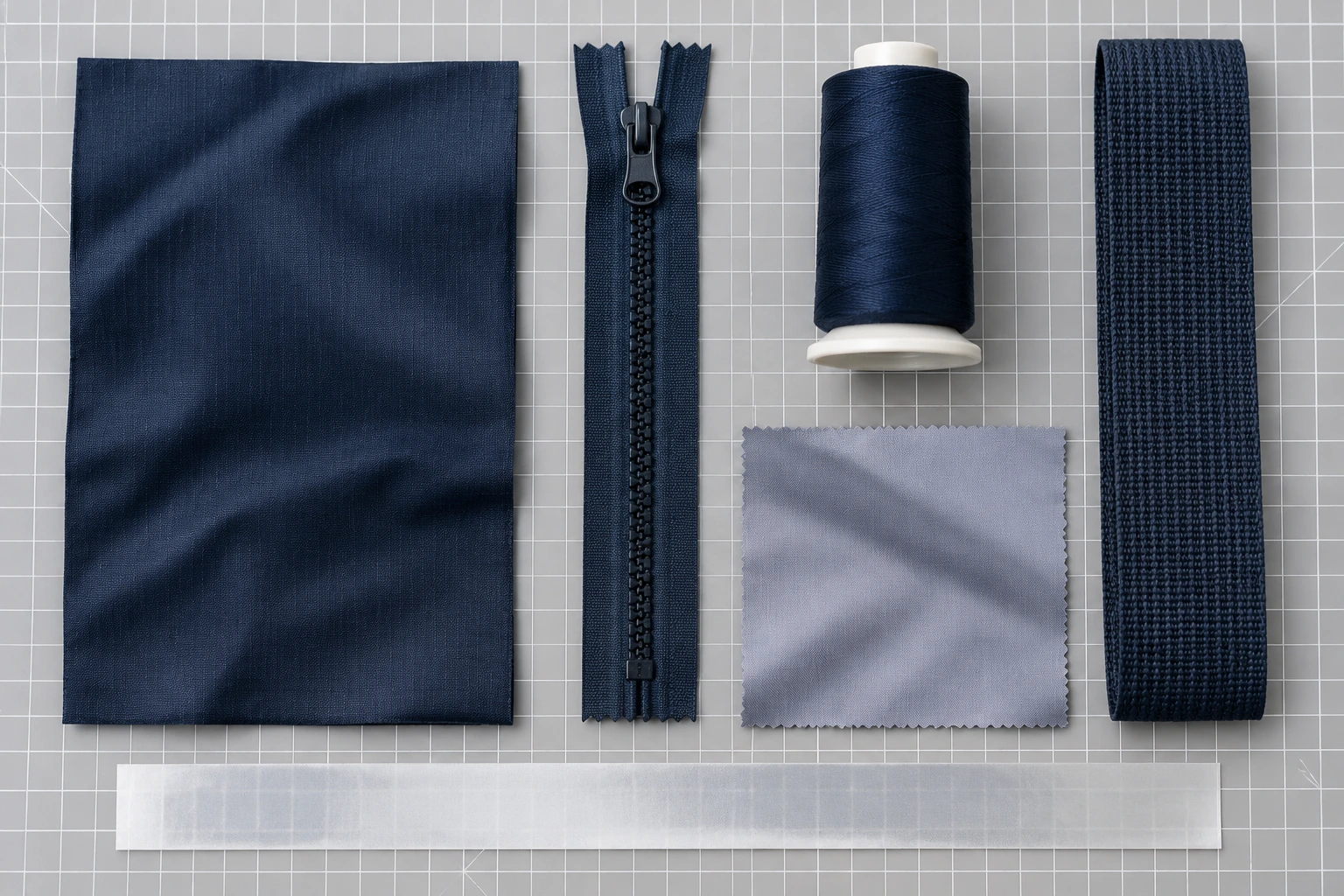
A finished backpack may contain coated outer fabric, lining, zipper tapes, laminated pockets, printing, webbings, binding and various other components.
Each may come from a different supplier.
A main fabric supplier can provide a suitable declaration while another component manufacturer uses a different chemical finishing system.
Component-Level PFAS Risk Matrix
The following matrix identifies components that merit investigation. It does not mean each component normally contains PFAS.
| Bag Component |
Potential Source of Concern |
Recommended Action |
Risk-Based Priority |
| Main outer fabric |
Fluorinated DWR, coating or laminated surface |
Confirm treatment chemistry, formulation and applicable test results |
High for treated fabrics |
| Water-resistant zipper |
Treated zipper tape, surface film or coating |
Check tape and coating specifications separately |
High for treated zippers |
| Laminated lining |
Coating, film, lamination chemistry or finishing |
Request layer and adhesive information |
Depends on chemistry |
| Printing and logo panels |
Specialty inks, stain-repellent finishes or coatings |
Check ink and decoration supplier declarations |
Medium to high where treated |
| Binding tape |
Special water- or stain-repellent finishing |
Confirm whether functional finishing was applied |
Process-dependent |
| Shoulder webbing |
Repellent treatment or surface finishing |
Review material and processing information |
Process-dependent |
| Sewing thread |
Special surface treatments or processing chemicals |
Check thread treatment where relevant |
Usually lower unless specially treated |
| Buckles and hardware |
Selected surface coatings or specialty chemical applications |
Review any relevant coating chemistry |
Process-dependent |
| Adhesives and seam tapes |
Specialty polymer formulations and bonding chemicals |
Check supplier formulation declarations |
Depends on materials |
| Packaging accessories |
Chemically treated packaging materials, if separately regulated or specified |
Review according to destination-market and customer requirements |
Application-dependent |
Important: TPU and Silicone Are Not Automatically PFAS
A conventional TPU film is not equivalent to a fluorinated treatment.
Likewise, silicone oil used in some textile processing is not automatically a PFAS-containing lubricant.
It would be incorrect to claim that every zipper lubricant, TPU film or sewing thread contains PFAS.
The proper approach is to identify which specific processing substances were used.
What Should an Importer Do?
Start with the bill of materials (BOM).
For each relevant component, record:
- Material description and supplier
- Coating or treatment, if applicable
- Whether PFAS were intentionally used
- Available declarations and test reports
- Material or component identification code
- Approved specification and production lot
Prioritize testing for chemically treated or insufficiently documented components.
Where applicable legal limits are measured by homogeneous material, combining unrelated components into one composite sample can make results difficult to interpret.
Problem: Main Fabric Passes, but Zipper Tape Fails
Possible cause: The zipper supplier uses a treated tape or coating that was not included in the original material qualification.
Corrective action:
- Hold the affected component lot and any assemblies using it.
- Identify the exact zipper element or layer associated with the result.
- Review the test method, sample identification and applicable limit.
- Ask the zipper supplier for formulation and treatment information.
- Replace or requalify the affected component as appropriate.
- Repeat relevant testing before approving production.
Do not assume that washing or wiping the zipper will remove the underlying compliance problem.
The objective is to eliminate or control the source, not conceal the analytical result.
4. C0 DWR: What Changes When Fluorinated Repellents Are Removed?
Fluorine-free DWR treatments are used to improve surface water repellency without relying on intentionally added fluorinated repellent chemistry.
Examples include selected silicone, hydrocarbon, wax and other non-fluorinated finishing systems.
However, an alternative treatment should not be approved based only on its initial water-beading appearance.
Water Repellency Is Not Oil Repellency
Traditional fluorinated treatments could provide both water and oil repellency.
Many fluorine-free DWR systems can provide useful water repellency but have limited resistance to oils and certain stains.
This matters for:
- Fashion bags exposed to skin oils and cosmetics
- Travel bags used around food and beverages
- Work bags exposed to grease
- Outdoor bags handled repeatedly in dirty conditions
A C0 finish should not be described as oil-repellent unless that performance has been demonstrated.
Coffee stains also depend on the liquid formulation, fabric, exposure and cleaning method. They cannot universally be described as permanent.
Does C0 DWR Wear Off Faster?
It depends on the product.
Performance after washing or abrasion varies with:
- Fiber and fabric construction
- Finishing chemistry
- Application amount and curing conditions
- Laundering procedure
- Abrasion and bending exposure
- Storage and cleaning conditions
There is no defensible universal rule that C0 finishes fail after 5–10 washes while fluorinated finishes always last 20–30 washes.
Buyers should require test results for the specific finish and fabric.
What Should Buyers Test?
For washable products, establish performance targets both before and after the agreed laundering cycles.
For bags that are normally spot-cleaned rather than machine-washed, repeated abrasion, flexing or other use-relevant testing may be more informative.
| Performance Concern |
Recommended Evaluation |
| Initial water repellency |
ISO 4920 or AATCC TM22 |
| Water repellency after cleaning |
Agreed cleaning procedure followed by repeat spray testing |
| Abrasion durability |
Defined abrasion procedure followed by inspection and repeat testing |
| Oil resistance |
Appropriate oil-repellency testing if the product requires this property |
| Surface appearance |
Check hand feel, whitening, color change and coating defects |
| Flexing |
Check for coating cracks, delamination or visible crease marks |
Problem: Water-Repellent Performance Drops After Cleaning
Possible causes: Incompatible cleaning conditions, insufficient finish durability, poor adhesion or unsuitable application and curing conditions.
Corrective action:
- Confirm the agreed cleaning method was followed.
- Compare initial and post-cleaning performance.
- Review the finish supplier's application specifications.
- Check fabric preparation, chemical application and curing records.
- Produce a revised sample and repeat testing.
- Approve changes only after evaluating appearance, performance and cost together.
Increasing curing temperature without checking the chemistry and substrate is not a universal solution. Excessive heat can damage the fabric or other components.
Problem: A C0-Coated Bag Develops White Crease Marks
Certain coatings or surface finishes may show whitening or chalk-like marks after folding or abrasion.
The issue should be investigated at the actual coated-fabric level.
Check whether the marks result from coating stress, surface abrasion, pigment behavior or another cause.
Possible corrective actions include changing the coating formulation, finish thickness, substrate or folding method.
The revised material should be evaluated under the intended packing and handling conditions before production resumes.
5. Water Repellency vs Waterproof Construction: What Testing Is Needed?
A bag does not become waterproof simply because the outer fabric passes a spray test.
Water can enter through stitch holes, zipper openings, panels, seams and other construction details.
Buyers need to evaluate both the fabric and the assembled product.
Surface Water Repellency
ISO 4920 and AATCC TM22 are commonly used to evaluate surface wetting or spray repellency.
These methods help show whether water beads on a textile surface.
They do not demonstrate resistance to prolonged water pressure.
Fabric Water Penetration Resistance
ISO 811 and AATCC TM127 assess resistance to water penetration under hydrostatic pressure.
A coated or laminated fabric may resist water penetration under the specified laboratory conditions but still leak after being cut and sewn into a bag.
Buyers should agree on the required test method, pressure performance and testing conditions based on intended use.
A reported hydrostatic-head value should not be treated as a universal guarantee of finished-bag waterproofing.
Seam Taping and Heat Welding
Sewn seams create needle holes that can allow water to pass through a fabric barrier.
For suitable constructions, manufacturers may use:
- Seam sealing tape
- Compatible adhesive sealing systems
- High-frequency or other suitable welding methods
- Heat-welded panels where the materials permit
The method must suit the actual coated or laminated fabric.
Poor bonding, contamination, incorrect temperature or incompatible materials can cause local leakage or delamination.
Water-Resistant Zippers
A water-resistant zipper can reduce water entry at a closure, but its performance depends on the zipper design, ends, stitching and installation.
A coated zipper does not automatically provide a watertight seal.
For bags expected to face heavy rain, buyers should pay particular attention to zipper ends, corners and the surrounding seams.
Finished-Bag Rain Testing
A finished-bag rain or spray test can help assess realistic water entry.
The test plan should define:
- Rain or spray intensity
- Exposure time
- Direction of water application
- Bag orientation and loading
- Zipper and closure positions
- Acceptable internal moisture or leakage
Where appropriate, the design may also require additional testing for the intended use.
A rain test should not be presented as a universal immersion test.
A bag for commuting in rain and a dry bag intended for water activities have different performance requirements.
Problem: Fabric Passes Hydrostatic Testing, but the Finished Bag Leaks
Likely sources: Sewing needle holes, poorly sealed seams, zipper ends, panel corners or openings.
Corrective action:
- Identify the first location where water enters.
- Inspect the corresponding seam, coating, zipper or closure.
- Check seal adhesion and construction compatibility.
- Repair the design or processing method, not merely the test sample.
- Repeat finished-bag testing using the same agreed procedure.
- Update the approved sample and production instructions.
A material substitution should not be approved until both chemical compliance and finished-bag performance have been reconfirmed.
6. Which PFAS-Free Waterproofing System Should Importers Choose?
The correct solution depends on the intended exposure.
| Bag Application |
Starting Material or Construction |
Main Quality Checks |
| Retail tote bag |
Appropriate fabric, with fluorine-free repellent finish if needed |
Material compliance, appearance, printing and ordinary-use performance |
| Everyday backpack |
Fluorine-free DWR fabric or suitable coating/laminate |
Spray repellency, abrasion, seams and zipper construction |
| Travel duffel bag |
Selected coated polyester or other suitable fabric |
Flexing, coating adhesion, handling durability and leakage |
| Outdoor equipment bag |
Appropriate laminated fabric with compatible seam and closure design |
Hydrostatic pressure, seam durability and finished-bag water testing |
| Dry bag |
Suitable weldable coated or laminated material, with engineered closure |
Weld quality, closure integrity and use-specific water-entry tests |
| Insulated cooler bag |
Outer fabric and internal liner selected for separate functional requirements |
Chemical compliance, thermal construction, liner seams and leakage where required |
Should Buyers Choose C0 DWR or TPU Lamination?
These are not mutually exclusive technologies.
A fluorine-free DWR finish mainly helps water bead on the fabric surface.
A compatible TPU laminate can provide a more substantial barrier against water penetration through the fabric itself.
Some constructions use both.
If the requirement is everyday rain resistance, a suitable DWR or coated fabric may be sufficient.
If the requirement is stronger water-barrier performance, buyers should assess laminated structures and appropriate seam sealing.
For continuous water exposure or possible immersion, the complete closure and welded construction become central.
Do not pay for a more complicated structure unless the intended use requires it.
The application should determine the engineering specification, not the number of waterproofing features advertised.
7. How Should PFAS Testing Be Planned?
There is no single analytical test that identifies every PFAS in every material at every relevant level.
Different methods answer different questions.
Targeted PFAS Testing
Targeted methods, often using LC-MS/MS for suitable compounds and matrices, measure a defined list of PFAS.
The test report must identify which substances were included.
A report showing "not detected" for a limited target list does not mean every PFAS is absent.
Fluorine Screening
Fluorine screening can help identify materials requiring further investigation.
However, the terminology matters.
- Total fluorine (TF): Measures fluorine from multiple possible sources.
- Total organic fluorine (TOF): Concerns fluorine associated with organic compounds under the selected analytical method.
- Extractable organic fluorine (EOF): Concerns the extractable organic-fluorine fraction under specified conditions.
These measurements are not interchangeable.
Combustion ion chromatography may be used as part of an appropriate analytical approach, but the sample preparation and reported measurand must match the testing objective.
A fluorine result alone does not identify the specific PFAS compound or prove intentional addition.
What Should the Testing Request Include?
A proper laboratory instruction should specify:
- Destination market and applicable legislation.
- Product and component identification.
- Targeted substances or fluorine-screening requirements.
- Test method and reporting basis.
- Detection and quantification limits.
- Sample preparation and whether components are tested separately.
- Relevant legal or customer acceptance limits.
- Report format and sample traceability.
Buyers should use a competent laboratory and confirm that its selected method is suitable for the material and regulatory question.
Problem: A Report Says "PFAS Not Detected," but the Buyer Rejects It
The problem may be incomplete test coverage rather than a confirmed material failure.
For example, the report may cover only selected target PFAS while the customer's restricted-substance specification also requires a total organic fluorine result.
Before ordering a retest:
- Compare the report's analyte list with the actual requirement.
- Verify detection limits.
- Identify the tested component and batch.
- Confirm the correct analytical method.
- Ask the customer or laboratory to clarify the missing evidence.
Do not assume that ordering the same test from a second laboratory will resolve a mismatch in testing scope.
8. What Compliance Documents Should Be Available Before Shipment?
For importers, compliance documentation needs to connect the material purchased, the components assembled and the finished goods shipped.
An isolated material certificate is often insufficient to demonstrate that connection.
PFAS Compliance Documentation Package
| Document |
Purpose |
Key Check |
| Approved Bill of Materials (BOM) |
Identifies the main components |
Does it match the approved finished design? |
| Supplier Material Declarations |
Records chemical treatment and material statements |
Are the declarations specific, signed and current? |
| Manufacturer Certificate of Compliance |
Supports applicable product-level legal requirements |
Does it cover the correct product and destination market? |
| Targeted PFAS Test Reports |
Measures specified compounds |
Are the methods, substances and limits appropriate? |
| Fluorine Screening Reports |
Provides additional analytical screening where required |
Is the correct fluorine measurement reported? |
| OEKO-TEX or bluesign-related documentation |
May support material or chemical-management verification |
Is the certificate valid and within scope? |
| Finished-Bag Performance Reports |
Documents agreed water protection performance |
Was the complete relevant construction evaluated? |
| Batch and Production Records |
Links approved materials to production |
Can the shipment be traced to its components and test samples? |
Are OEKO-TEX and bluesign Certifications Mandatory?
Not automatically.
These systems can support chemical management and material verification, but they are not universally required legal certificates for every bag imported into the EU or US.
The certificate's product scope, material coverage, validity and applicable version must be checked.
A GRS certificate, recycled-content claim or general factory audit also does not independently establish PFAS compliance.
What Should Batch Traceability Look Like?
A practical tracking record might connect:
Customer PO → Approved BOM → Material Supplier and Lot → Component Lot → Finished Product Batch → Test Report → Shipment
For example, if an approved zipper tape is replaced because the original color is unavailable, the new tape should not automatically inherit the old compliance report.
The revised component requires appropriate review before use.
Problem: The Supplier Changes a Material During Bulk Production
Corrective action:
- Stop unauthorized use of the substitute.
- Identify products already made with it.
- Request updated material declarations and relevant test evidence.
- Evaluate chemical compliance and functional performance.
- Obtain buyer approval before releasing the affected goods.
- Update the BOM, approved sample and traceability records.
Changing the main fabric, coating supplier, zipper tape or printed decoration may create different compliance and quality risks.
The level of requalification should reflect those risks.
Can These Documents Guarantee Customs Clearance?
No.
An appropriate compliance file supports importer due diligence and helps respond to customer or regulatory requests.
It does not eliminate the possibility of inspections, additional testing or enforcement.
Importers remain responsible for meeting the requirements applicable to their products and destination markets.
9. What Happens When a PFAS Test Fails?
A failed result should trigger an investigation, not an immediate assumption that every component in the order is defective.
The correct response depends on the reported substance, concentration, component, test method and applicable requirement.
Step 1: Contain the Affected Material
Hold the identified lot and determine whether it has already been used in production.
Avoid mixing unapproved material with approved stock.
Step 2: Check the Result
Confirm:
- Sample identity
- Test method
- Unit and reporting basis
- Target substances or fluorine parameter
- Detection limits
- Applicable legal or customer threshold
- Whether the result refers to one component or a composite
Step 3: Investigate the Source
Review material formulation, coatings, finishing agents, printed decorations, component changes and supplier records.
Where appropriate, conduct additional targeted testing to locate the source.
Step 4: Select a Corrective Action
Possible actions include:
- Replacing the noncompliant material
- Removing an unnecessary treatment
- Changing a component supplier
- Revising a coating or lamination system
- Segregating affected lots
- Reworking only where technically appropriate and permitted
Do not assume that washing or surface cleaning can correct a chemically noncompliant coating.
Step 5: Requalify the Replacement
The new material must satisfy the applicable chemical specification.
It must also be checked for functional suitability.
Replacing a fluorinated finish with a non-fluorinated alternative may change hand feel, abrasion behavior, water repellency and appearance.
Step 6: Release Only After Approval
Update the relevant reports, approved samples and production records before releasing the affected batch.
Where goods have already shipped, notify the responsible importer or customer promptly and determine the appropriate regulatory and commercial response.
10. Production Problems That Importers Should Anticipate
Many PFAS transition projects encounter problems that are not visible in a small fabric swatch.
| Problem |
Likely Area to Investigate |
Practical Solution |
| Main fabric passes, zipper material fails |
Separate component chemistry |
Investigate and replace or requalify the zipper component |
| C0 DWR loses performance after cleaning |
Finish durability or cleaning conditions |
Review application process and revalidate after defined exposure |
| Material passes hydrostatic pressure, finished bag leaks |
Seams, zipper ends and openings |
Locate leakage path and revise construction |
| Coating becomes stiff or develops white marks |
Coating formulation, bending or packing |
Evaluate formulation, thickness and handling |
| Supplier cannot provide a meaningful declaration |
Incomplete chemical supply-chain information |
Require specific documentation or qualify another source |
| Bulk-production report differs from sample report |
Material substitution or lot inconsistency |
Hold affected lots, investigate and retest as appropriate |
| A customer rejects a "PFAS-free" claim |
Claim definition or testing scope is unclear |
Align the claim with specified laws, tests and evidence |
| A newly compliant fabric increases production cost |
Additional finishing, lamination or process requirements |
Compare designs against actual performance requirements |
Cost Control Without Weakening Compliance
An importer should not simply select the cheapest coating or require the most expensive waterproof structure for every bag.
Instead:
- Define the intended exposure.
- Establish mandatory chemical requirements.
- Select the simplest material system that meets the performance target.
- Minimize unnecessary coated components.
- Standardize approved trims across suitable SKUs.
- Avoid repeated material substitutions.
- Confirm packaging and carton efficiency.
A product intended for occasional rain exposure should not automatically be engineered as an immersion-resistant dry bag.
Likewise, a product sold as a true dry bag should not rely only on a surface DWR treatment.
11. PFAS-Free Bag Sourcing: An Importer's Approval Process
A practical development process should link compliance and product performance from the beginning.
Before Sampling
Confirm the target markets, applicable product categories, requirements and customer restricted-substance list.
Issue the approved component and chemical specifications.
During Sampling
Review the selected materials, component supplier information and proposed testing plan.
Check waterproofing construction and the finished product's intended use.
Before Bulk Production
Approve the material and component BOM.
Complete risk-based chemical testing and product performance checks as required.
Confirm that the approved sample reflects the intended production materials.
During Bulk Production
Control incoming materials, chemical finishing, component substitutions and production lot identification.
Any change affecting compliance or performance should trigger a documented review.
Before Shipment
Verify that the finished goods correspond to the approved specification and required evidence.
Check the applicable compliance documents, inspection results, packaging and lot records.
Release should be based on the agreed acceptance criteria, not simply on a supplier's general statement that the product is "eco-friendly."
12. Custom PFAS-Free Bag RFQ Checklist
When requesting a quotation, importers should provide enough information to evaluate both legal compliance and performance.
| RFQ Item |
Information Needed |
| Destination markets |
EU countries and relevant US states |
| Bag type |
Tote, backpack, duffel, cooler, dry bag or other |
| Intended use |
Retail, commuting, travel, outdoor or water activity |
| Main fabric |
Fiber composition, weight, weave and finish |
| Water protection |
Surface repellency, hydrostatic resistance or finished-bag waterproofing requirement |
| Coating or laminate |
Proposed chemistry and construction |
| Seams |
Sewn, taped, welded or other |
| Zippers and closures |
Required water protection and component specifications |
| Other components |
Lining, webbing, printing, binding and adhesives |
| PFAS requirements |
Applicable legal limits and buyer restricted-substance list |
| Testing |
Target substances, screening, test methods and acceptance criteria |
| Documentation |
Supplier declarations, certificates, reports and traceability |
| Durability |
Cleaning, abrasion, flexing and other relevant conditions |
| Branding |
Logo artwork, printing method and decoration |
| Order details |
Estimated quantity, colors, SKUs and packing |
Minimum order quantities, tooling and production arrangements depend on the selected product and materials.
Why Choose INITI for Custom PFAS-Free Bags?
Hangzhou INITI Imp&Exp Co., Ltd. has over 16 years of experience in custom bags and packaging, supported by two production facilities and OEM/ODM development capabilities.
INITI supports material selection, structural development, custom branding, sampling, testing coordination, quality inspection and export packaging.
For projects requiring fluorine-free water-repellent materials or specific PFAS compliance documentation, we can review the target market requirements alongside the proposed fabric, coating, lining and other components.
Relevant certifications, supplier declarations and testing reports can be supported according to the selected product and applicable requirements.
INITI also owns a PET bottle recycling and processing facility supporting recycled-polyester material development for appropriate applications. Recycled content and PFAS compliance are evaluated as separate requirements.
Our objective is to help buyers define a manufacturable bag specification that meets its intended use, rather than relying on unsupported claims such as "100% chemical-free" or "waterproof in all conditions."
We provide fast quotations and free design support for OEM/ODM bag projects.
FAQ
1. Does PFAS-free mean a bag is waterproof?
No. PFAS-free concerns the chemical composition or use of specified substances. Waterproofing depends on the fabric barrier, seams, closures and finished-bag construction.
2. Is C0 DWR sufficient for a waterproof backpack?
Not necessarily. C0 DWR can improve surface water repellency, but prolonged rain protection may require a suitable coating or laminate and an appropriately designed seam and closure system.
3. Does a PFAS-free main fabric make the whole bag compliant?
No. Other relevant components, such as treated zipper tapes, coatings, linings and printed parts, may require review. The finished product must be assessed against applicable market requirements.
4. What PFAS documents should an importer request?
Depending on the market and product, buyers may need material declarations, product-level compliance certificates, targeted PFAS reports, fluorine-screening results and batch traceability records. The required evidence should match the relevant legal and customer specifications.
5. Can INITI develop custom PFAS-free water-resistant bags?
Yes. INITI supports OEM/ODM bag projects involving selected fluorine-free materials, custom constructions, product testing coordination and relevant compliance documentation. The final specification and claims are confirmed for each product and destination market.
Conclusion
PFAS-free waterproofing is not simply a coating replacement.
For bag importers, it requires controlling chemical risks across the finished product while maintaining the water protection customers actually need.
A suitable procurement program should:
- Identify the legal requirements in each destination market.
- Examine chemically treated components, not only the main fabric.
- Validate fluorine-free material performance under relevant conditions.
- Test the appropriate level of water resistance, including finished-bag construction where required.
- Maintain traceable documentation from material approval to shipment.
- Resolve failures before releasing affected production.
The right outcome is a bag with clear, supportable chemical and performance claims—not just a fabric labelled PFAS-free.
Related Blog & Application Articles
PFAS-Free Canvas Bags: Compliance Guide for Brands
Waterproof Materials for Outdoor Bags
Technical and Regulatory References
- European Union — Commission Regulation (EU) 2024/2462, REACH restriction on PFHxA, its salts and related substances. EUR-Lex: https://eur-lex.europa.eu/eli/reg/2024/2462/oj/eng
- European Chemicals Agency (ECHA) — Universal PFAS restriction proposal and regulatory updates: https://echa.europa.eu/hot-topics/perfluoroalkyl-chemicals-pfas
- California — Health and Safety Code, Sections 108970–108971; AB 1817 textile-article PFAS requirements.
- Maine — 38 M.R.S. §1614 and Maine Department of Environmental Protection, PFAS in Products: https://www.maine.gov/dep/spills/topics/pfas/PFAS-products/index.html
- Colorado — SB24-081 and applicable PFAS-in-products provisions.
- ISO 4920 — Textiles: Determination of resistance to surface wetting (spray test).
- ISO 811:2018 — Textiles: Determination of resistance to water penetration (hydrostatic pressure test).
- AATCC TM22 — Water Repellency: Spray Test.
- AATCC TM127 — Water Resistance: Hydrostatic Pressure Test.
- AATCC TM118 — Oil Repellency: Hydrocarbon Resistance Test.
Inquiry Support
Developing PFAS-free water-resistant or waterproof bags for European or US retail, travel, outdoor or promotional programs?
Send us your target market, bag type, material preferences, required water protection, chemical compliance specifications, estimated quantity and packaging requirements.
Email us at [email protected] for a fast quotation, free design support and OEM/ODM development assistance.



 Hot News