A lunch bag can look surprisingly spacious when it is empty.
Once you put a lunch box inside, add a water bottle, ice pack, fruit, snacks, utensils, and a few other essentials, that same bag may suddenly feel much smaller.
This is why choosing a lunch bag based only on its appearance, external dimensions, or advertised liter capacity can be misleading.
For consumers, the difference may simply mean a slightly inconvenient lunch bag.
For brands, retailers, promotional gift companies, and private-label buyers, however, getting the capacity wrong can create a much bigger problem. A bag that looks large enough in a product photo may not accommodate the containers customers actually use. A bag that is oversized may become unnecessarily bulky, expensive to ship, and less attractive for everyday carrying.
The more useful question is therefore not:
“How many liters should a lunch bag be?”
It is:
“What needs to fit inside the lunch bag, how will those items be arranged, and how much usable space should the finished bag provide?”
This lunch bag capacity guide explains how to evaluate capacity from the inside out. It covers common lunch bag capacity ranges, dimensions, internal versus external measurements, container fit, liter calculations, insulation, opening size, gussets, different user requirements, and custom lunch bag specifications for bulk buyers.
What Does Lunch Bag Capacity Actually Mean?
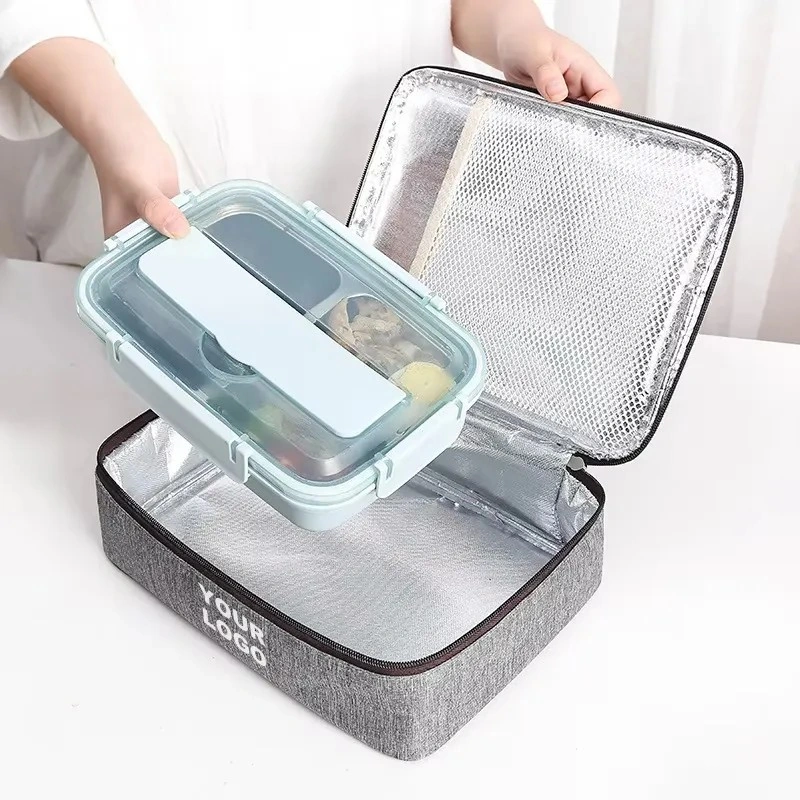
Lunch bag capacity refers to the amount of space available inside a lunch bag for food containers, drinks, ice packs, snacks, utensils, and other items.
However, there is an important distinction between theoretical volume and usable capacity.
A rectangular bag measuring 25 × 15 × 20 cm has a theoretical volume of:
25 × 15 × 20 ÷ 1,000 = 7.5 liters
That calculation is useful, but it does not mean that the bag can practically hold 7.5 liters of food.
The actual usable space may be lower because of:
- Insulation thickness
- Inner lining
- Seams
- Rounded corners
- Tapered construction
- Internal pockets
- Dividers
- Zipper construction
- Bottom reinforcement
- Bag shape
- The shape of the food containers
The same principle applies when comparing two lunch bags with the same external dimensions.
Two bags may both measure 30 × 20 × 10 cm externally, but their internal capacity can be different if one uses thicker insulation or has additional internal compartments.
For custom lunch bags, buyers should therefore distinguish between three measurements:
| Measurement |
What It Means |
Why It Matters |
| External dimensions |
Overall outside size of the finished bag |
Shipping, appearance, portability |
| Internal dimensions |
Approximate space inside the insulated compartment |
Determines whether containers fit |
| Usable capacity |
Space that can realistically be occupied by the intended contents |
Most important for actual use |
The distinction between external dimensions, internal dimensions, and usable capacity is also emphasized in current lunch bag sizing guidance because the internal construction can significantly reduce the space available inside.
Why Usable Capacity Is More Important Than Empty Volume
Imagine a lunch bag with a calculated capacity of 10 liters.
If the user carries:
- A rigid 22 × 15 × 7 cm lunch box
- A 7 cm diameter water bottle
- A 15 × 10 × 2 cm ice pack
- Fruit
- Snacks
- Utensils
the user does not simply need “10 liters.”
The items need to fit into a particular arrangement.
The lunch box may need to lie flat.
The bottle may need to stand vertically.
The ice pack may need to sit beside the lunch box.
The zipper opening must also be wide enough for the rigid container to enter and exit easily.
This means capacity is three-dimensional. It is not simply a number printed on a product specification sheet.
Common Lunch Bag Capacity Ranges
There is no single universal standard for lunch bag capacity.
Terms such as “small,” “medium,” and “large” are commonly used by manufacturers, but these labels can describe different dimensions from one supplier to another.
The most reliable approach is to compare actual dimensions and intended contents.
As a general reference, lunch bags can be divided into several practical capacity ranges.
| Lunch Bag Category |
Approx. Capacity |
Typical Application |
| Mini / Small |
3–6 L |
Snacks, children's meals, compact lunches |
| Small-Medium |
6–8 L |
Individual daily meals |
| Medium |
8–12 L |
Office lunches, school meals, complete daily meals |
| Large |
12–20 L |
Meal prep, multiple containers, outdoor use |
| Extra Large |
20 L+ |
Family outings, group meals, commercial applications |
These ranges are guidelines rather than fixed industry standards. Published lunch bag guides commonly place small bags around 3–8 liters, medium bags around 8–12 liters, and larger bags around 12–20 liters or more.
For a custom product, however, the capacity category should be considered only as a starting point.
The actual design should be based on what the bag needs to carry.
Lunch Bag Capacity Chart: Size, Dimensions and Typical Uses
The following chart can be used as a practical starting point when comparing lunch bag designs.
| Capacity Class |
Approximate External Size |
Typical Contents |
Common Applications |
| 3–6 L |
About 18–24 × 10–14 × 15–20 cm |
Small lunch box, fruit, snack, drink |
Kids, snacks, light meals |
| 6–8 L |
About 22–27 × 12–16 × 17–22 cm |
Lunch box, small bottle, ice pack, snacks |
Individual daily lunch |
| 8–12 L |
About 25–30 × 15–20 × 18–24 cm |
Bento box, bottle, fruit, ice pack, utensils |
Office, school, daily meals |
| 12–20 L |
About 30–36 × 18–25 × 22–30 cm |
Multiple food containers, bottles, meal prep |
Outdoor work, meal prep, family use |
| 20 L+ |
30 cm+ on multiple dimensions |
Multiple meals, drinks, food supplies |
Picnics, group activities, commercial use |
These dimensions should not be treated as mandatory standards.
The final external dimensions depend on:
- Required internal dimensions
- Insulation thickness
- Lining construction
- Handle position
- Zipper construction
- Gusset depth
- Bag shape
- Pocket design
- Product positioning
Small Lunch Bag Capacity: When 3–6 Liters Is Enough
A small lunch bag is designed around portability rather than maximum storage.
A 3–6 liter lunch bag can work well when the user carries only a limited number of items.
Typical contents may include:
- One small lunch container
- Sandwich
- Fruit
- Small snack
- Juice box
- Small water bottle
- Compact ice pack
This capacity range is particularly suitable for:
- Children's school lunches
- Short commutes
- Light office meals
- Snack bags
- Promotional giveaways
- Compact meal programs
The main advantage is that the bag remains easy to carry.
However, there is a common mistake with small lunch bags: trying to make the dimensions as compact as possible without considering the actual lunch container.
A bag can technically be large enough by volume but still be difficult to use.
For example, a rigid lunch box may require a relatively wide opening. If the bag is narrow at the top, the user may struggle to insert the container even though the body has sufficient internal volume.
For a small lunch bag, therefore, opening geometry can be just as important as capacity.
6–8 Liter Lunch Bags: A Compact Daily Option
A 6–8 liter lunch bag provides more flexibility than a very small snack bag while remaining relatively compact.
This range can accommodate a typical individual lunch arrangement such as:
- One bento box
- One small drink
- Fruit
- Snack
- Ice pack
- Small utensils
This capacity is useful when portability is important.
For example, a lunch bag designed for an office worker who already carries a laptop backpack does not necessarily need to be large.
The lunch bag may need to fit inside or alongside another work bag.
In this situation, adding unnecessary capacity can actually make the product less convenient.
For retail products, 6–8 liters can also be useful for compact lifestyle positioning because it provides more usable space than a simple sandwich pouch without becoming a large cooler.
8–12 Liter Lunch Bags: A Practical Everyday Capacity
An 8–12 liter lunch bag is often suitable for a more complete daily meal.
This capacity can accommodate combinations such as:
- Full-size lunch container
- Salad container
- Fruit
- Water bottle
- Ice pack
- Snacks
- Cutlery
- Condiments
This type of lunch bag is particularly relevant for:
- Office workers
- Students
- Meal-prep users
- Parents
- Commuters
- Corporate promotional programs
- Retail lunch bag collections
Published lunch bag guidance commonly places medium lunch bags around the 8–12 liter range and associates them with daily meals, lunch containers, drinks, and accessories.
However, even within this capacity range, shape makes a significant difference.
A tall and narrow 10-liter bag may be suitable for a bottle and vertically stacked containers.
A wider 10-liter bag may be better for a flat bento box.
Both may technically have the same volume.
They do not necessarily have the same usability.
12–20 Liter Lunch Bags: When More Capacity Is Necessary
A 12–20 liter lunch bag moves closer to a small cooler bag.
This size can be useful for users who carry:
- Multiple meal containers
- Several drinks
- Meal-prep boxes
- Larger food portions
- Snacks for several people
- Outdoor food supplies
- Longer work-shift meals
Typical applications include:
- Meal preparation
- Construction and field work
- Outdoor activities
- Camping
- Picnics
- Family outings
- Catering-related uses
- Food delivery
At this point, capacity becomes increasingly connected to carrying comfort.
A larger lunch bag may contain significantly more food, but that also means the loaded weight can increase.
The handle, shoulder strap, attachment points, and bottom construction should therefore be considered together with capacity.
How to Calculate Lunch Bag Capacity
For a simple rectangular lunch bag, theoretical capacity can be calculated using:
Length × Width × Height ÷ 1,000 = Approximate capacity in liters
For example:
30 × 20 × 15 cm ÷ 1,000 = 9 liters
So a rectangular internal compartment measuring 30 × 20 × 15 cm has a theoretical volume of approximately 9 liters.
But this is only a starting point.
Why the Calculated Capacity Is Not the Same as Usable Capacity
A soft insulated lunch bag may contain:
- Curved corners
- Tapered panels
- Thick insulation
- Seams
- Zipper construction
- Internal pockets
- Dividers
As a result, not every cubic centimeter can be efficiently used.
Food containers also create empty spaces.
For example, placing a round bottle next to a rectangular lunch box leaves unused gaps.
Therefore:
Theoretical capacity ≠ practical packing capacity
This is especially important when a buyer is comparing suppliers.
One supplier may advertise a 10-liter bag based on theoretical internal volume.
Another may use a more conservative usable-capacity estimate.
The numbers may look different even if the physical products are relatively similar.
For custom projects, asking for both internal dimensions and approximate capacity is more useful than relying on a liter number alone.
How to Choose Lunch Bag Capacity Based on the Lunch Box
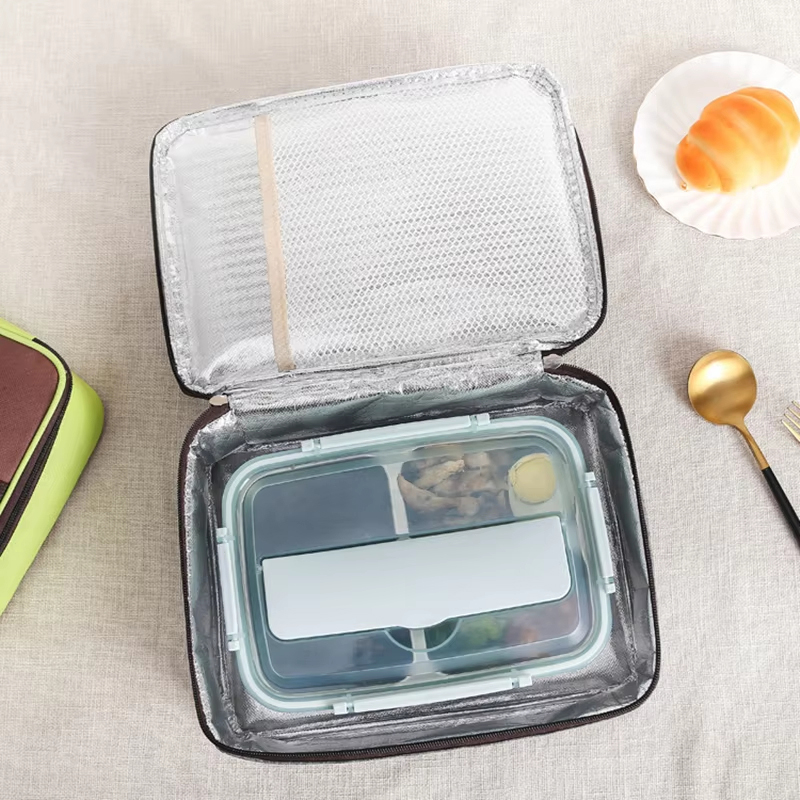
The most reliable way to determine lunch bag capacity is to start with the container rather than the bag.
This is particularly important for rigid lunch boxes.
Suppose the main lunch box measures:
22 × 15 × 7 cm
The bag should not be designed at exactly 22 × 15 × 7 cm.
That would leave almost no practical clearance.
The user needs enough space to:
- Insert the lunch box
- Remove it easily
- Add an ice pack
- Add a drink
- Add small accessories
The final bag should therefore be slightly larger than the largest rigid item.
But “slightly larger” should not mean adding excessive empty space.
Too much clearance creates:
- Unnecessary bulk
- Higher material consumption
- More shipping volume
- More internal movement
- Less compact carrying
The goal is functional clearance, not maximum empty space.
Build the Capacity Around the Packing Arrangement
Another common mistake is adding the volume of each item together.
Suppose the user carries:
- Lunch box: 2.3 L
- Bottle: 0.8 L
- Ice pack: 0.3 L
- Snacks: 0.5 L
A simple calculation might suggest that a 4-liter bag is sufficient.
But the items still need to physically fit together.
The lunch box may need to sit flat.
The bottle may need to stand vertically.
The ice pack may need to sit beside the food container.
The actual required dimensions therefore depend on the combined footprint and height, not simply the sum of individual volumes.
This is one of the most important principles in lunch bag capacity planning.
Example
Imagine a packing arrangement like this:
Bottom layer
Side
Top or side
Remaining space
The bag should be sized around this arrangement.
Changing the bottle from vertical to horizontal can change the required dimensions.
Moving the ice pack from the side to the top can change the required height.
This is why a capacity calculation should be combined with an actual packing test.
External Dimensions vs Internal Dimensions
One of the most important measurements in custom lunch bag development is the difference between external and internal dimensions.
Consider a bag with an external width of 30 cm.
If the construction includes insulation and lining on both sides, the usable internal width will be smaller.
For example, if the total construction thickness on each side is approximately 5 mm, the internal width could lose approximately 10 mm before accounting for other construction factors.
With thicker insulation, the difference becomes greater.
This means a buyer should avoid specifying:“I need a 30 cm wide lunch bag.”
Instead, it is better to specify:“I need approximately 28 cm of usable internal width for a 26 cm lunch box.”
That gives the manufacturer a functional target.
The external size can then be developed around the internal requirement.
How Insulation Thickness Changes Capacity and Cold Retention
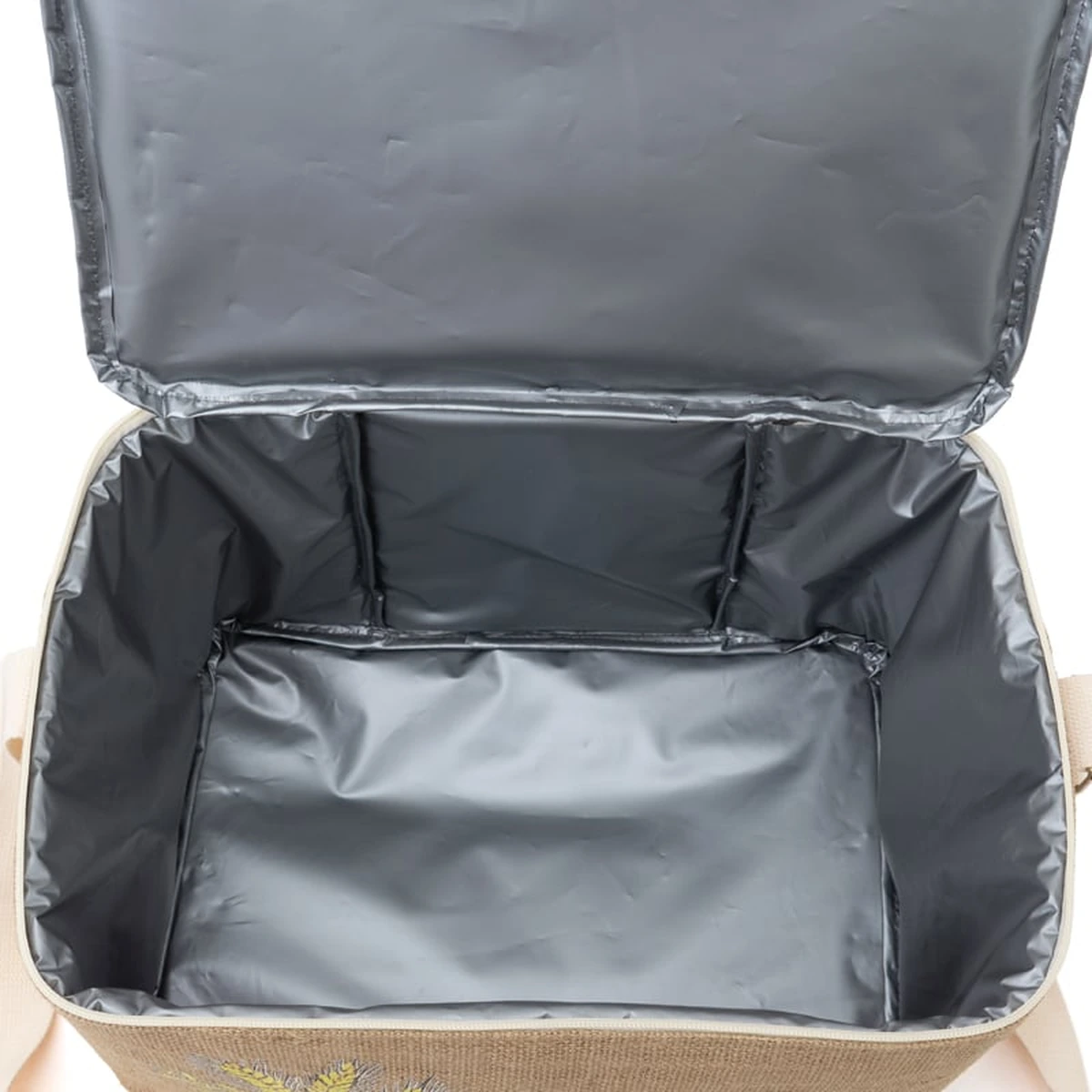
Insulation is another reason why two bags with similar external dimensions can have different internal capacity.
A typical insulated lunch bag has multiple layers:
Outer fabric → insulation → inner lining
The insulation layer occupies physical space.
If the outer dimensions remain fixed while insulation becomes thicker, the internal compartment becomes smaller.
Conversely, if the required internal capacity stays unchanged while insulation becomes thicker, the external bag dimensions may need to increase.
This creates an important trade-off:
More insulation → potentially less internal space
or
Same internal space + more insulation → potentially larger external dimensions
Therefore, buyers should finalize capacity and insulation together.
| Foam Insulation |
Total Wall Build-Up |
Cold Hold Reference |
Typical Position |
| No foam, coated shell only |
1–2 mm |
Under 1 hour |
Paper and Tyvek lunch bags |
| 3 mm EPE or PE foam |
4–5 mm |
2–3 hours |
Entry-level promotional lunch bags |
| 5 mm EPE with foil layer |
6–7 mm |
3–4 hours |
Mainstream retail lunch bags |
| 8 mm PE or NBR foam with foil |
10–11 mm |
4–6 hours |
Mid-tier insulated lunch bags |
| 10 mm NBR plus taped seams |
12–14 mm |
5–7 hours |
Premium and professional use |
| Dual-layer foam with sealed lid |
15 mm+ |
6–9 hours |
Cooler bags and shift-work products |
What Materials Can Affect Lunch Bag Capacity?
Capacity is primarily determined by dimensions and structure, but materials influence how much of the external volume becomes usable internal space.
Common outer materials include:
| Shell Fabric |
Typical Thickness |
Stiffness |
Capacity Effect |
| 190T–210D polyester |
0.20–0.30 mm |
Soft |
Thinnest common wall, but slumps under a loaded lid; realized capacity can fall 5 to 15 percent below calculation |
| 300D polyester |
0.30–0.40 mm |
Moderate |
Balanced wall thickness and shape retention |
| 600D polyester or Oxford |
0.40–0.60 mm |
Stiff |
Holds the compartment open; consumes slightly more wall |
| Nylon, 210D–420D |
0.25–0.45 mm |
Supple but strong |
Thin wall with good shape retention; higher material cost |
| 12 oz cotton canvas |
0.80–1.00 mm |
Heavy, stiff |
Most wall thickness and most carton volume of the common fabrics |
| Jute or burlap |
0.90–1.40 mm |
Bulky and irregular |
Least predictable internal dimensions; bulky seams and uneven interior |
| Non-woven (PP) |
0.15–0.35 mm |
Very soft |
Lowest shape retention of the fabric options |
| Tyvek or coated kraft paper |
0.10–0.20 mm |
Creases, semi-stiff |
Very thin wall preserves capacity, but needs a stiff liner to hold form |
| Neoprene |
1.50–3.00 mm |
Thick, conforming |
The wall is itself the insulation; used in separate flat constructions |
| Corduroy or brushed cotton |
0.50–0.90 mm |
Soft pile |
Pile adds thickness and compresses over time |
| RPET at matched denier |
Same as virgin polyester |
Same as virgin |
Recycled origin changes certification and cost, not capacity |
Inner constructions may include:
| Material Option |
Typical Thickness |
Capacity Mechanism |
| PE film |
0.05–0.12 mm |
Thinnest liner, but folds inward and steals usable space |
| PEVA |
0.10–0.25 mm |
Mainstream balance of thickness, durability and flexibility |
| EVA or TPU film |
0.05–0.30 mm |
TPU gives toughness at lower thickness, preserving capacity |
| Foil-laminated PE |
0.10–0.20 mm |
Semi-rigid; the liner itself helps hold the compartment open |
| Coated fabric |
0.35–0.60 mm |
Most durable and most capacity-consuming liner option |
Does a Larger Lunch Bag Always Perform Better?
No.
More capacity does not automatically mean a better lunch bag.
A larger bag can provide more room, but it can also:
- Become heavier when full
- Take up more storage space
- Require stronger handles
- Increase material usage
- Increase shipping volume
- Be less convenient for commuting
- Contain more empty air around food
Thermal performance can also depend on the complete bag construction rather than capacity alone.
Factors include:
- Insulation material
- Insulation thickness
- Lining
- Zipper construction
- Seams
- Ambient temperature
- Quantity and temperature of contents
- Cooling media
- How frequently the bag is opened
This is important when developing a product specification.
Instead of simply saying:“Make the bag as large and thick as possible.”
A better approach is:“Define the required internal capacity, intended contents, target carrying conditions, and thermal performance first.”
How the Lunch Bag Opening Affects Usable Capacity
The opening is often overlooked.
Imagine a lunch bag with a large internal compartment but a relatively narrow zipper opening.
The theoretical capacity may look good.
But inserting a rigid bento box can still be difficult.
This is particularly relevant for:
- Hard lunch boxes
- Glass food containers
- Meal-prep boxes
- Tall bottles
- Large food trays
A wide-opening zipper can make the same internal volume much easier to use.
This is why buyers should evaluate:
- Body dimensions
- Internal dimensions
- Opening width
- Zipper position
- Zipper length
- Lid construction
together.
For a retail product, the opening can also affect the perceived quality of the bag.
A product that is technically large enough but difficult to load may receive negative customer feedback even if its stated capacity looks competitive.
How Gusset Depth Changes Lunch Bag Capacity
For soft bags, gusset depth can have a surprisingly large impact on usable capacity.
A flat bag may have a large front panel but limited three-dimensional storage.
Adding depth creates a boxed compartment.
For example:
25 × 20 × 3 cm
and
25 × 20 × 10 cm
have dramatically different theoretical volumes even though the front dimensions are identical.
The second design has a much deeper storage compartment.
This is why lunch bags commonly use:
- Side gussets
- Bottom gussets
- Boxed corners
- Wide bases
A wider bottom can also improve stability.
When the bag is placed on a desk or table, a structured base helps prevent it from collapsing sideways.
Lunch Bag Capacity for Different Business Applications
The intended business model can also influence the right capacity.
Retail Lunch Bags
Retail buyers need to consider the end consumer.
The product should have:
- A clear capacity proposition
- Practical dimensions
- Attractive proportions
- Easy carrying
- Useful storage
- Appropriate packaging
Instead of marketing a bag simply as “large,” a retail product can be positioned more specifically:
- Compact lunch bag
- Daily office lunch bag
- Meal-prep lunch bag
- Family lunch cooler
- Insulated picnic bag
Specific positioning makes the capacity easier for customers to understand.
Promotional Lunch Bags
Promotional products may prioritize:
- Compact shipping
- Large logo area
- Competitive unit cost
- Practical everyday use
- Easy distribution
In this case, the biggest possible capacity is not necessarily the priority.
A medium-sized lunch bag may offer a better balance between:
- Cost
- Function
- Branding space
- Portability
- Shipping efficiency
Supermarket and Grocery Programs
For supermarket programs, the product may be positioned as a reusable food-carrying bag.
Capacity may need to accommodate:
- Lunch containers
- Bottles
- Snacks
- Grocery items
- Prepared foods
A wider base and stronger handles may be more important than a compact lunch-bag profile.
Private-Label Lunch Bags
Private-label brands have more flexibility.
They can develop a specific capacity around their target consumer.
For example:
Urban commuter collection
→ Compact 6–8 L design
Meal-prep collection
→ 10–15 L structured design
Outdoor lunch collection
→ 12–20 L insulated design
This approach is often more effective than simply selecting an existing generic size.
Common Lunch Bag Capacity Mistakes
Mistake 1: Choosing Based Only on External Dimensions
A 30 cm wide bag does not necessarily provide 30 cm of usable internal width.Insulation and construction reduce internal space.
Mistake 2: Choosing Based Only on Liter Capacity
A 10-liter bag may have a shape that does not fit the buyer's lunch box.The actual internal dimensions and opening still matter.
Mistake 3: Matching the Bag Exactly to the Lunch Box
A bag that is exactly the same size as the lunch box may be difficult to use.Clearance is required for insertion and removal.
Mistake 4: Ignoring the Opening
A container can fit inside the body but fail to pass through the zipper opening comfortably.This is especially common with rigid lunch boxes.
Mistake 5: Adding Too Much Empty Space
Oversizing the bag creates unnecessary:
- Material consumption
- Shipping volume
- Weight
- Bulk
Capacity should be functional rather than excessive.
Mistake 6: Ignoring the Bottle
A bottle can dramatically change the required dimensions.A lunch bag designed around a flat food container may not have enough vertical space for a bottle.
Mistake 7: Forgetting Ice Packs
If the bag is designed for chilled food, ice packs occupy real space.They should be included in the capacity calculation.
Mistake 8: Increasing Insulation Without Rechecking Internal Space
Thicker insulation can reduce the internal compartment if external dimensions remain unchanged.Any insulation change should therefore trigger a capacity review.
Mistake 9: Increasing Capacity Without Strengthening the Bag
A larger bag can carry more weight.
That may require:
- Stronger webbing
- Reinforced handles
- Stronger stitching
- Better bottom construction
- More durable zipper components
How to Develop a Custom Lunch Bag Capacity
For brands and bulk buyers, the best process is to develop the product from the inside out.
Step 1: Define the Intended Contents
List everything that needs to fit inside.
For example:
- Lunch box
- Bottle
- Ice pack
- Fruit
- Snacks
- Utensils
Do not start with an arbitrary external bag size.
Step 2: Measure the Largest Containers
Record:
- Length
- Width
- Height
- Diameter where relevant
Measure the actual containers rather than estimating.
Step 3: Decide the Packing Arrangement
Determine whether the containers will be:
- Stacked
- Side by side
- Vertical
- Horizontal
- Mixed
This affects the required dimensions.
Step 4: Add Practical Clearance
Allow enough space for:
- Easy loading
- Easy removal
- Ice packs
- Accessories
- Small variations in container size
Do not make the compartment unnecessarily oversized.
Step 5: Determine the Required Internal Dimensions
At this point, establish the target internal dimensions.
This should be one of the main product specifications.
Step 6: Select Insulation
Then determine:
- Insulation material
- Thickness
- Lining
- Thermal requirements
Remember that insulation occupies space.
Step 7: Calculate the External Dimensions
Once the internal dimensions and construction are confirmed, the manufacturer can establish the external size.
This is more reliable than choosing external dimensions first.
Step 8: Check the Opening
Confirm that the largest rigid container can comfortably pass through the opening.
Step 9: Review Carrying Requirements
For larger capacity bags, check:
- Handle length
- Handle reinforcement
- Shoulder strap
- Webbing
- Bottom construction
- Weight distribution
Step 10: Test a Physical Sample
A physical sample should be packed using the actual containers.
Check:
- Fit
- Opening
- Closure
- Capacity
- Stability
- Handle comfort
- Internal organization
A sample test can reveal problems that cannot be identified from a theoretical liter calculation.
Inquiry Support
For a custom lunch bag project, you can provide:
| Specification |
What to Provide |
| Intended use |
Office, school, retail, promotional, outdoor, etc. |
| Target capacity |
Approximate liters |
| Internal dimensions |
L × W × H |
| External dimensions |
If already defined |
| Main container |
Actual dimensions |
| Bottle |
Diameter × height |
| Ice pack |
Dimensions |
| Packing arrangement |
Stacked, side-by-side, vertical, etc. |
| Outer material |
Polyester, Oxford, RPET, etc. |
| Insulation |
Material and thickness |
| Lining |
PEVA, foil, or other |
| Opening |
Zipper, flap, roll-top, etc. |
| Carrying |
Handle, shoulder strap, both |
| Pockets |
Internal/external requirements |
| Branding |
Logo method and position |
| Quantity |
Estimated order quantity |
| Packaging |
Individual or bulk packaging |
| Testing |
Any specific thermal or leakage requirements |
If you have not finalized all details, you can first send your intended use and target quantity, and we can recommend a suitable specification.
FAQ
How many liters should a lunch bag be?
There is no universal ideal capacity. A compact lunch bag may be around 3–6 liters, while an everyday lunch bag may fall around 6–12 liters. Larger lunch or cooler bags can reach 12–20 liters or more. Actual internal dimensions are more important when a specific container must fit.
What size lunch bag do I need for meal prep?
Meal-prep users should start with the dimensions and number of containers they carry rather than selecting a liter capacity first. A wider bag can be more useful than a tall narrow bag if several rectangular containers need to be packed side by side.
Should a lunch bag be bigger than the lunch box?
Yes. The bag should provide enough clearance to insert and remove the lunch box comfortably and leave space for additional items such as an ice pack or drink. However, excessive empty space can make the bag unnecessarily bulky.
How do I calculate lunch bag capacity?
For a simple rectangular compartment, multiply length × width × height in centimeters and divide by 1,000 to estimate liters. For example, 30 × 20 × 15 cm equals approximately 9 liters. This is theoretical volume, not guaranteed usable packing capacity.
Does thicker insulation reduce lunch bag capacity?
If the external dimensions stay the same, thicker insulation generally reduces internal space. If the internal capacity must remain unchanged, the external dimensions may need to increase.
Does the zipper opening affect capacity?
Yes. A bag can have sufficient internal volume but still be difficult to use if the opening is too narrow for a rigid lunch box or food container.
Can lunch bag capacity be customized?
Yes. Custom lunch bags can be developed around specific internal dimensions, containers, insulation requirements, opening designs, gusset depths, pockets, handles, and carrying methods. INITI currently supports custom dimensions and capacity for lunch and cooler bag projects.
Conclusion
Lunch bag capacity is not simply a number measured in liters.
A bag's real capacity depends on the relationship between its internal dimensions, container arrangement, opening, insulation, gusset, pockets, and overall construction.
For everyday users, a small lunch bag may be enough for a simple meal, while a medium-capacity bag can provide more flexibility for complete lunches, drinks, snacks, and ice packs. Larger bags become more useful when multiple containers, meal-prep portions, or outdoor food supplies need to be carried.
For brands and B2B buyers, the most reliable approach is to work from the inside out.
Start with the actual products that need to fit.Measure them.Decide how they will be arranged.Add practical clearance.Define the internal compartment.Then account for insulation, lining, opening construction, gusset, handles, and the desired external dimensions.
In other words:
Don't choose the lunch bag first and hope your containers fit.
Define what the bag needs to carry, then develop the capacity around it.
That approach creates a lunch bag that is easier to use, easier to specify, and easier to position for the target market.
Related Products




 Hot News