Puffer Bag vs Quilted Bag: What’s the Difference?
Puffer bags and quilted bags often look similar because both use soft outer fabrics, padding and visible stitching.
The difference is mainly about what the design emphasizes.
A quilted bag is defined mainly by the stitching that joins fabric and padding into repeated sections such as diamonds, squares, grids or channels.
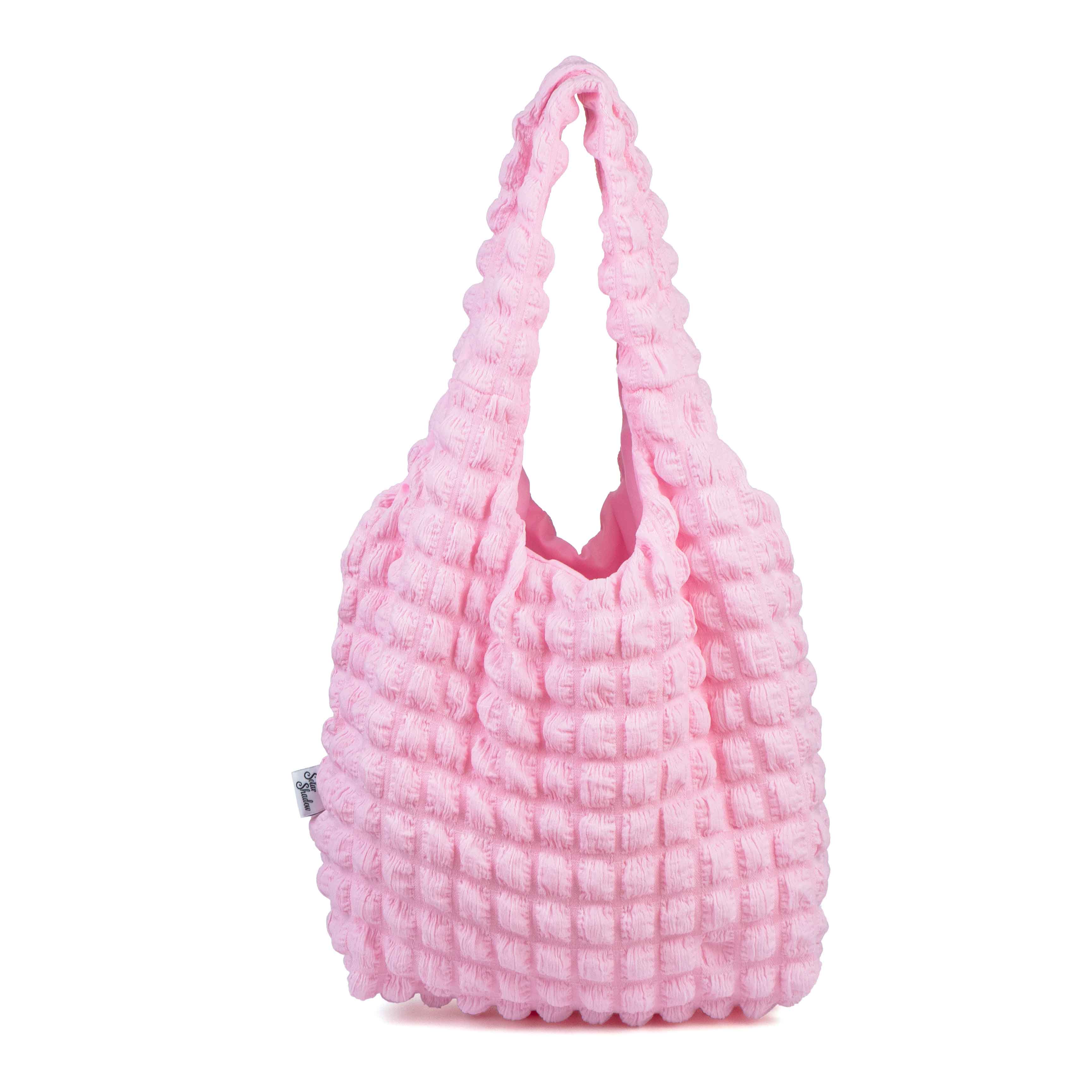
A puffer bag is defined more by its volume. It uses enough filling to create visibly raised, soft sections and a fuller, cloud-like shape.
That means the two categories can overlap.
A bag can be:
Quilted but only lightly padded
Heavily padded and clearly puffer-style
Both quilted and puffer at the same time
The easiest way to understand the difference is:
Quilted describes the stitched construction.
Puffer describes the fuller padded appearance.
This distinction is also reflected in current bag construction: smaller or tighter quilting creates a flatter, more controlled surface, while larger padded sections and thicker filling create the stronger volume associated with puffer bags.
Puffer Bag vs Quilted Bag at a Glance
| Feature |
Quilted Bag |
Puffer Bag |
| Main characteristic |
Visible quilting pattern |
Soft, inflated volume |
| Padding |
Light to medium, sometimes heavy |
Usually more noticeable |
| Quilting sections |
Small to large |
Often larger |
| Shape |
Controlled to structured |
Soft, rounded, voluminous |
| Surface |
Defined stitched pattern |
Raised, pillowy sections |
| Empty bag |
Often holds shape better |
Usually softer and more collapsible |
| Packing volume |
Usually lower |
Usually higher |
| Visual style |
Classic to contemporary |
Modern, casual, fashion-led |
| Branding |
Embroidery, labels, patches, selected printing |
Labels, embroidery, patches, subtle branding |
| Tote bags |
Very common |
Very common |
| Cosmetic bags |
Very common |
Common |
| Fashion handbags |
Common |
Very common |
| Laptop / work bags |
Suitable with correct padding |
Possible but needs controlled structure |
These are tendencies rather than strict rules.
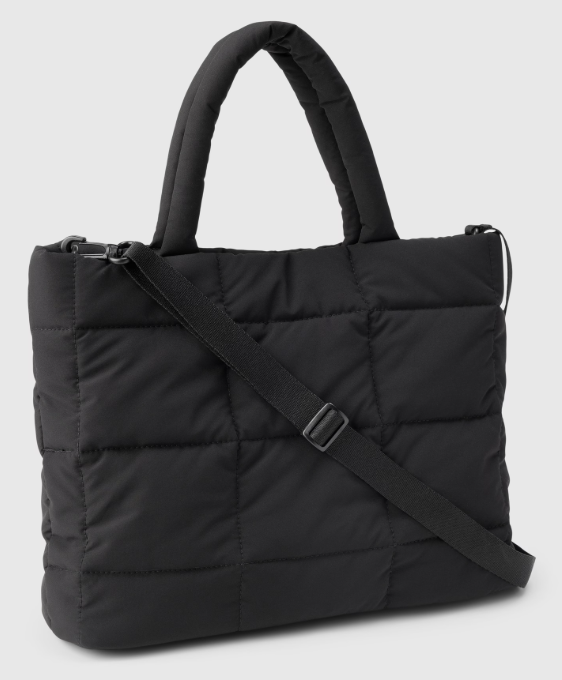
A heavily padded quilted tote can look almost identical to what retailers call a puffer tote.
A quilted bag normally combines several layers.
A typical construction may include:
Outer fabric
Padding or filling
Backing layer or lining
Quilting stitches
The stitching passes through the layers and divides the surface into sections.
Common patterns include:
The quilting is not only decorative.
It also helps keep the padding distributed across the bag instead of allowing it to move freely inside the panels.
The amount of padding can vary considerably.
A lightly padded quilted bag may have only a subtle texture.
A thicker quilted bag may have deep, visibly raised sections.
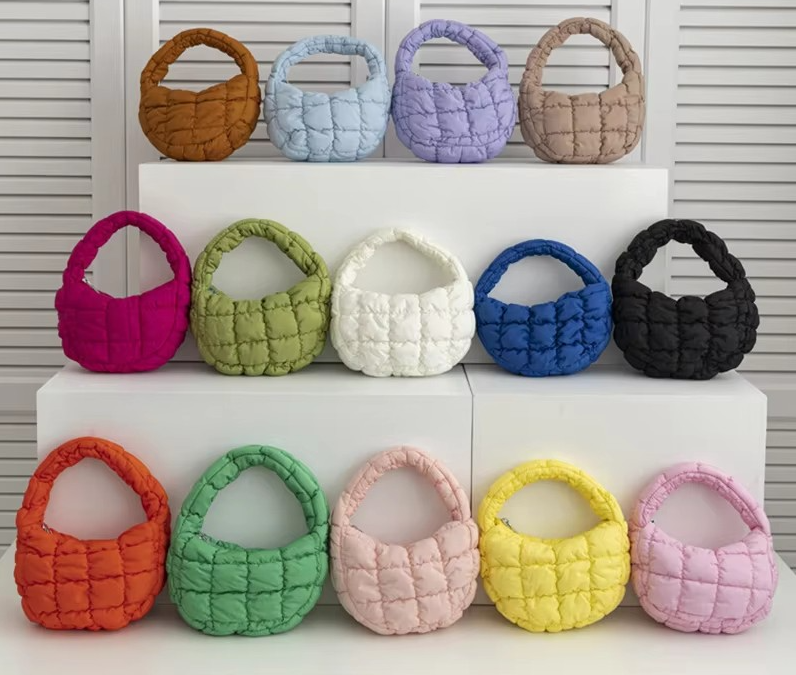
A puffer bag takes the padded idea further.
Instead of creating only a textured stitched surface, the design deliberately uses filling and larger sections to create:
Volume
Rounded edges
Softness
A fuller silhouette
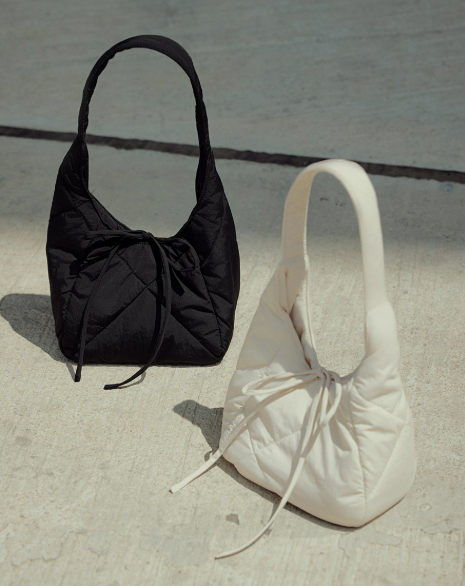
The visual reference is similar to a puffer jacket.
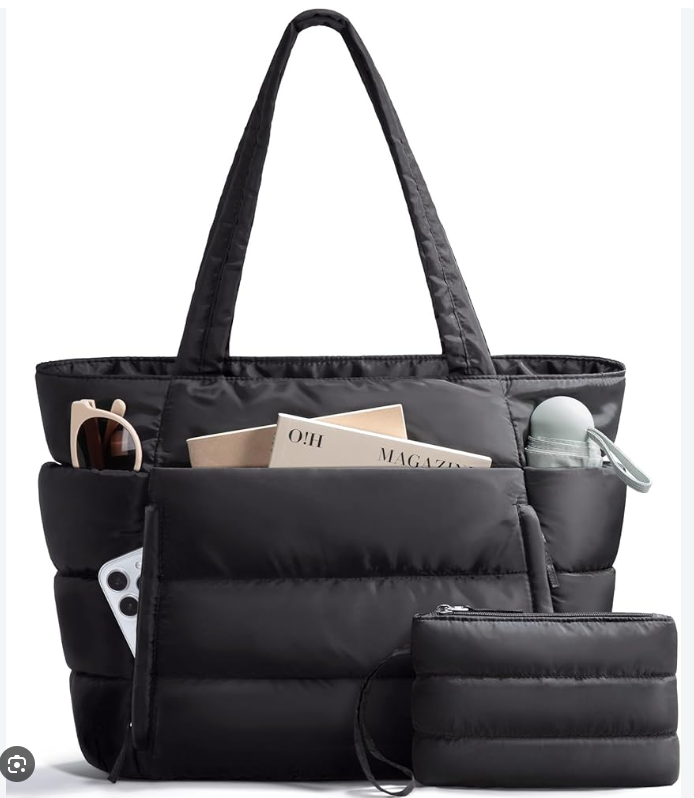
Common puffer-bag styles include:
Larger padded chambers and thicker filling create the more pronounced puffer appearance.
Are Puffer Bags and Quilted Bags the Same?
Not exactly, but they overlap heavily.
This is the most important point in the comparison.
A quilted bag is identified mainly by the stitching technique.
A puffer bag is identified mainly by its soft volume and visual thickness.
For example:
Light Diamond-Quilted Tote
It may use thin padding and closely spaced stitching.
The result is clearly quilted but not particularly puffy.
Large Bubble-Quilted Handbag
It may use thicker filling and oversized quilted sections.
The result is both:
quilted + puffer
Padded Bag with Minimal Stitching
A bag may have thick padding and a very soft shape without a complex decorative quilting pattern.
Retailers may still describe it as puffer-style.
So the difference is better understood as a spectrum than as two completely separate product categories.
The Biggest Difference: Padding Volume
Padding is one of the main factors separating a subtle quilted bag from a strong puffer look.
Light Padding
Creates:
Suitable for:
Medium Padding
Creates:
Clear quilted texture
Softer hand feel
Moderate cushioning
More visible volume
Suitable for:
Heavy Padding
Creates:
Strong puffer effect
Larger raised sections
Softer silhouette
Greater visual volume
Suitable for:
More padding is not automatically better.
As padding increases, the bag also becomes:
Quilting Pattern Changes the Look
Padding thickness is only half of the story.
The quilting pattern also changes how the same filling appears.
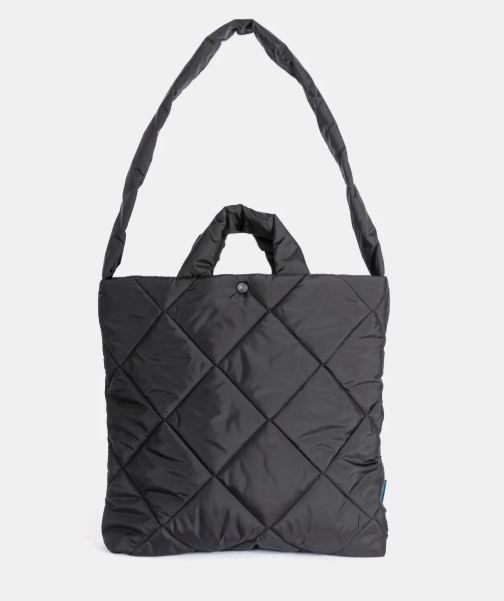
Small Diamond Quilting
Creates:
This style often works well for:
Fashion accessories
Cosmetic bags
Classic totes
Square or Grid Quilting
Creates a cleaner and more contemporary surface.
It can range from:
As the squares become larger and the padding becomes thicker, the same grid pattern can move visually from a conventional quilted bag into a puffer bag.
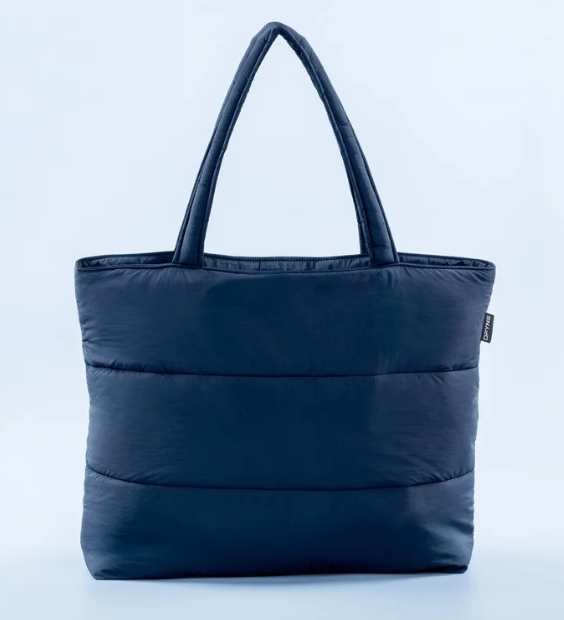
Horizontal Channels
Create long raised sections.
This construction can make a bag resemble:
Puffer jackets
Padded outerwear
Soft travel accessories
It works particularly well for casual and fashion-led products.
Bubble Quilting
Bubble or oversized grid quilting creates strongly rounded padded sections.
This is one of the clearest ways to achieve a puffer appearance.
Which One Is More Structured?
Usually the quilted bag—if it uses lighter padding and smaller stitching sections.
Closely spaced quilting helps control the layers and can create a flatter, more stable panel.
A puffer bag normally prioritizes:
Softness
Volume
Rounded shape
rather than rigid structure.
But construction matters.
A puffer bag can still include:
to keep the finished bag from becoming too loose.
Likewise, a very soft quilted cotton tote can remain flexible even with many quilting lines.
So structure comes from the whole construction, not simply the product name.
Which One Is Softer?
A strong puffer construction usually feels softer and more cushioned.
Its thicker filling allows the outer surface to compress more noticeably when pressed.
A lightly quilted bag can still feel soft, but the smaller stitched sections restrict how much each area can expand.
If the product brief says:
soft, pillowy, cloud-like
a puffer construction is usually closer to the desired result.
If it says:
padded but neat and controlled
a conventional quilted construction may be more suitable.
Does a Puffer Bag Provide Better Protection?
Not automatically.
A thicker puffer bag may provide more cushioning against everyday bumps, but visual puffiness is not the same as tested impact protection.
For example, soft polyester filling may create a very full appearance without providing the same protective performance as:
EVA foam
EPE foam
Dense protective foam
Molded padding
If the product is intended to carry:
Laptop
Tablet
Electronics
Fragile products
the padding should be selected according to the protection requirement rather than simply trying to make the bag look thicker.
A highly puffy fashion tote can still provide relatively little technical impact protection.
Which One Is Lighter?
There is no fixed answer.
Both can be lightweight.
Finished weight depends on:
Outer fabric
Filling type
Filling thickness
Lining
Bag size
Hardware
Zippers
Handles
A puffer bag usually contains more filling, but lightweight polyester wadding can create considerable visual volume without making the bag extremely heavy.
A quilted bag using:
Heavy cotton
Thick lining
Metal hardware
Structured reinforcement
may actually weigh more than a lightweight nylon puffer tote.
Which One Takes Up More Shipping Space?
Usually the puffer bag.
This matters for bulk orders.
Thicker filling and larger padded sections can increase:
Quilted bags with thinner padding usually compress more easily.
However, excessive compression can also affect a puffer bag's appearance.
After long periods packed tightly in cartons, some products may need time to recover their original volume.
For bulk production, samples should therefore be checked not only immediately after sewing but also after realistic packing and compression.
What Materials Are Commonly Used?
Both quilted and puffer bags can use many of the same outer fabrics.
Polyester
One of the most versatile options.
It can provide:
Lightweight construction
Wide color availability
Smooth surface
Different finishes
Common for:
Nylon
Often selected when the product needs a smoother or more technical appearance.
Common for:
Puffer shoulder bags
Travel products
Lightweight fashion bags
Do not assume nylon automatically makes the finished bag waterproof.
The fabric, coating, seams, stitching and zipper all affect water resistance.
RPET Polyester
Recycled-polyester fabrics can be used when recycled content is part of the product specification.
The actual recycled content and supporting documentation should be confirmed rather than assumed from the term RPET alone.
Cotton
Cotton creates a softer and more textile-oriented appearance.
It is commonly used for:
It generally creates a very different look from shiny nylon or smooth polyester.
Corduroy
Corduroy combines two textures:
This can work well for seasonal fashion and lifestyle products.
What Is Used Inside the Bag?
The outer material creates the visible surface.
The filling creates the volume.
Common internal padding directions include:
Polyester wadding or fiberfill works well when the main objective is:
Softness
Volume
Low weight
Puffer appearance
Foam is more appropriate when the product needs more defined cushioning or structural support.
The two can create very different bags even when the outer fabric and quilting pattern are identical.
Which One Is Better for Everyday Totes?
Both can work.
Quilted Tote
Better when you want:
More controlled shape
Moderate padding
Easier packing
Classic texture
Everyday usability
Puffer Tote
Better when you want:
The practical question is how much volume the bag needs after the visual effect is removed.
A large puffer tote may look very spacious externally, but thick padded walls also use some of the overall dimensions.
Which One Is Better for Fashion Bags?
Puffer bags are especially suited to fashion collections where the shape itself needs to attract attention.
They work well for:
Seasonal collections
Boutique accessories
Fashion collaborations
Lifestyle brands
Trend-led retail
Quilted bags have a broader visual range.
Depending on pattern and material, they can look:
Classic
Elegant
Casual
Technical
Handmade
Contemporary
So quilting gives designers more control over the style, while puffer construction creates a more specific soft-volume aesthetic.
Which One Is Better for Cosmetic Bags?
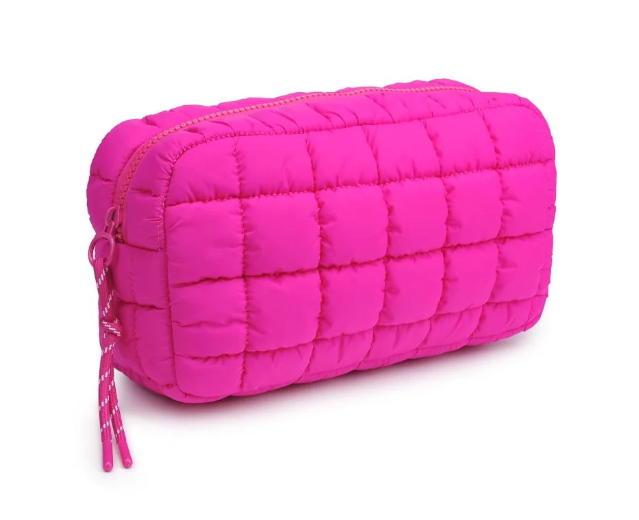
Usually a moderate quilted construction.
Cosmetic bags benefit from:
Excessively thick padding can reduce usable interior space and increase packing volume without providing much additional value.
A stronger puffer effect can still make sense for:
Beauty gift sets
Fashion collections
Seasonal promotions
where appearance is a major part of the product.
Which One Is Better for Travel Bags?
The answer depends on the product.
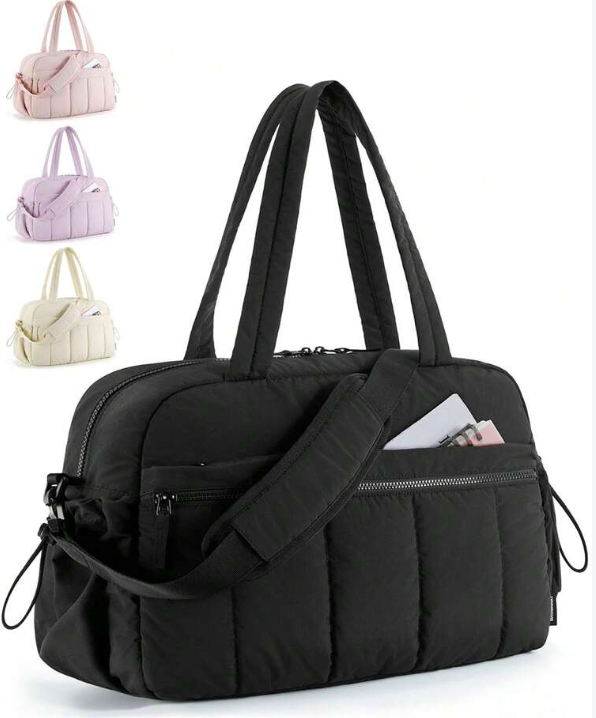
A lightly quilted travel pouch can provide:
Soft organization
Moderate cushioning
Easier packing
A heavily padded puffer bag may occupy unnecessary luggage space if compact packing is important.
For travel products, thicker is not always more practical.
Which One Is Easier to Brand?
Neither surface is as simple to print as a completely flat conventional tote.
The quilting itself creates an uneven surface.
Embroidery
Works well on many quilted and puffer bags.
However, embroidery should be planned before or during production so that the stitching and internal backing do not create an untidy inside surface.
Woven Labels
A good option for both styles.
They provide clear branding without competing with the padded texture.
Logo Patches
Options can include:
Fabric patches
PU patches
Rubber patches
These often work better than large flat prints on heavily padded surfaces.
Printing
Printing is possible depending on the outer material and construction.
For cleaner graphics, it is often easier to print the outer fabric before quilting.
Trying to print fine artwork across a deeply quilted finished surface can distort the design.
Large Logo or Small Logo?
Puffer and quilted bags often look better with restrained branding.
The surface texture is already a major visual feature.
A very large logo can compete with:
Quilting
Padding
Bag silhouette
Common directions include:
Small embroidery
Woven label
Tonal logo
Small patch
Discreet metal logo
The right method depends on the intended retail positioning.
Which One Is Easier to Clean?
The answer depends more on the outer fabric than on whether the bag is called quilted or puffer.
For example:
Polyester / Nylon Outer
Often easier to wipe or spot clean.
Cotton Outer
May absorb more moisture and dirt.
Coated Fabric
May provide easier surface cleaning.
The padding adds another consideration.
A thick puffer bag can take longer to dry after becoming fully wet because there is more material inside.
For this reason, repeated full soaking is usually less desirable than spot cleaning unless the finished bag has been developed for washing.
Does Quilting Make a Bag More Durable?
Quilting helps stabilize the layers and keep padding distributed across the surface.
But it does not automatically make the entire bag durable.
Finished durability also depends on:
Outer fabric
Seam strength
Handle attachment
Zipper
Lining
Bottom construction
Quilting stitch quality
In fact, more quilting means more stitching lines, so poor stitch tension or weak thread can create additional failure points.
The quilting needs to remain stable without:
Broken stitches
Uneven sections
Loose threads
Padding migration
What Should Be Checked on a Puffer Bag Sample?
A puffer bag should be evaluated for more than appearance.
Check:
Padding Distribution
The filling should not create obvious:
Empty sections
Hard lumps
Uneven thickness
Loft
Compare whether different parts of the bag have similar volume.
Quilting Alignment
Grid and channel lines should remain visually consistent.
Compression Recovery
After packing or pressing the bag, check whether the padded sections recover their intended shape.
Handle Attachment
Soft body construction still needs strong handle reinforcement.
Zipper Area
Excessive padding close to a zipper can make opening and closing less smooth.
What Should Be Checked on a Quilted Bag Sample?
Check:
For geometric quilting, small alignment errors can become very visible after the bag is assembled.
Puffer Bag vs Quilted Bag for Different Uses
| Use |
Better Starting Point |
Why |
| Everyday tote |
Quilted |
Balanced texture and practicality |
| Trend-led fashion tote |
Puffer |
Stronger visual volume |
| Boutique handbag |
Puffer or quilted |
Depends on collection style |
| Cosmetic bag |
Quilted |
Easier balance of padding and capacity |
| Beauty gift set |
Either |
Depends on desired presentation |
| Work tote |
Quilted |
Easier to keep structure controlled |
| Laptop tote |
Quilted with suitable foam |
Protection can be specified more precisely |
| Travel pouch |
Quilted |
Lower bulk |
| Seasonal fashion collection |
Puffer |
Distinctive soft silhouette |
| Corporate gift |
Quilted |
Easier to keep branding understated |
| Lifestyle retail |
Either |
Depends on brand style |
When Should You Choose a Quilted Bag?
Choose a quilted construction when you want:
Quilting is particularly suitable when the texture should add interest without dominating the entire bag.
When Should You Choose a Puffer Bag?
Choose a puffer design when you want:
More visual volume
A soft, rounded silhouette
Larger padded sections
A more casual fashion look
A stronger tactile effect
A trend-led lifestyle product
Puffer construction works best when the padding itself is one of the main features customers are expected to notice.
Can a Bag Be Both Puffer and Quilted?
Yes.
In fact, many current puffer bags are quilted.
The quilting divides the surface into padded sections, while the amount of filling gives those sections their puffy appearance.
A large bubble-grid handbag is a good example:
So when developing a product, it is often more useful to specify:
quilted puffer tote with oversized square sections
rather than arguing over whether the bag belongs exclusively to one category.
What Should Buyers Specify for a Custom Puffer or Quilted Bag?
A useful product brief should include:
| Specification |
What to Define |
| Bag Type |
Tote / shoulder bag / pouch / handbag |
| Outer Fabric |
Polyester / nylon / cotton / RPET / other |
| Padding |
Wadding / fiberfill / foam |
| Padding Level |
Light / medium / strong puffer effect |
| Quilting Pattern |
Diamond / grid / channel / bubble / custom |
| Section Size |
Small / medium / oversized |
| Lining |
Material and color |
| Closure |
Open / zipper / snap |
| Handle |
Webbing / padded / self-fabric / other |
| Pockets |
Interior / exterior |
| Logo |
Embroidery / label / patch / print |
| Dimensions |
Width × height × depth |
| Intended Load |
What the bag will carry |
| Quantity |
Estimated order quantity |
| Packaging |
Folded / individual / retail packaging |
A reference photo is useful for puffer bags because words such as:
thick
soft
puffy
cloud-like
can mean very different things to different buyers.
Common Mistakes When Comparing Puffer and Quilted Bags
Treating Them as Completely Separate Categories
Many puffer bags are also quilted.
The terms describe different aspects of the construction.
Assuming More Padding Means Better Quality
More padding increases volume.
It does not automatically improve:
Durability
Protection
Usability
The correct thickness depends on the product.
Ignoring Shipping Volume
A strong puffer effect can substantially increase carton volume.
This matters in bulk orders.
Choosing a Quilting Pattern Without Considering Bag Size
A pattern that works on a cosmetic pouch may look too busy on a large tote.
Quilting scale should match the finished product.
Using Fine Printing Across Deep Quilting
The uneven surface can distort detailed artwork.
Printing before quilting or using another branding method may produce a better result.
Calling a Puffer Bag Shockproof
Visual padding alone is not evidence of impact protection.
If protection is required, the actual padding system needs to be developed for that purpose.
FAQ
What is the main difference between a puffer bag and a quilted bag?
A quilted bag is defined mainly by stitched sections that hold fabric and padding together. A puffer bag is defined mainly by thicker padding and a fuller, more inflated appearance.
Can a puffer bag also be quilted?
Yes. Many puffer bags use quilting to divide the padding into large squares, channels or bubble-like sections.
Is every quilted bag a puffer bag?
No. A lightly padded quilted bag may have a clear stitched texture without the strong volume associated with a puffer bag.
Which bag is more structured?
A lightly or moderately padded quilted bag is usually easier to keep structured. Puffer bags generally have a softer and more flexible silhouette.
Which bag has more padding?
Puffer bags generally use more visible padding, although there is no fixed technical thickness that defines a puffer bag.
Are puffer bags heavier?
Not necessarily. Lightweight filling can create a large amount of volume without excessive weight. Outer fabric, hardware, lining and bag size also affect total weight.
A moderate quilted construction is usually more practical because it provides softness without sacrificing too much internal capacity. A stronger puffer effect works when visual presentation is the main priority.
Which is better for fashion retail?
Both can work. Puffer bags create a softer and more trend-led look, while quilted bags offer a broader range from classic diamond quilting to modern grid designs.
Are puffer bags waterproof?
Not automatically. A nylon or polyester outer fabric may have water-resistant properties, but seams, zippers and stitching still affect the performance of the complete bag.
Can quilting patterns be customized?
Yes. Grid size, line direction and pattern can be customized for suitable projects, although more complex quilting generally requires more sampling and production control.
Conclusion
The difference between a puffer bag and a quilted bag is not simply that one has stitching and the other does not.
Quilting describes how the layers are stitched and controlled.
Puffer describes how much volume and softness the padded construction creates.
Choose a quilted bag when you want:
Choose a puffer bag when you want:
And in many cases, the most accurate product is actually both:
a quilted puffer bag.
For custom development, the more useful questions are not simply “puffer or quilted?”
They are:
What outer fabric?
What filling?
How much padding?
What quilting pattern?
How large should each padded section be?
How structured should the finished bag feel?
Those details determine what the final product actually becomes.
Inquiry Support
For a custom puffer or quilted bag project, you can provide:
If you have not finalized all details, you can first send your intended use and target quantity, and we can recommend a suitable specification.
Related Products



 Hot News