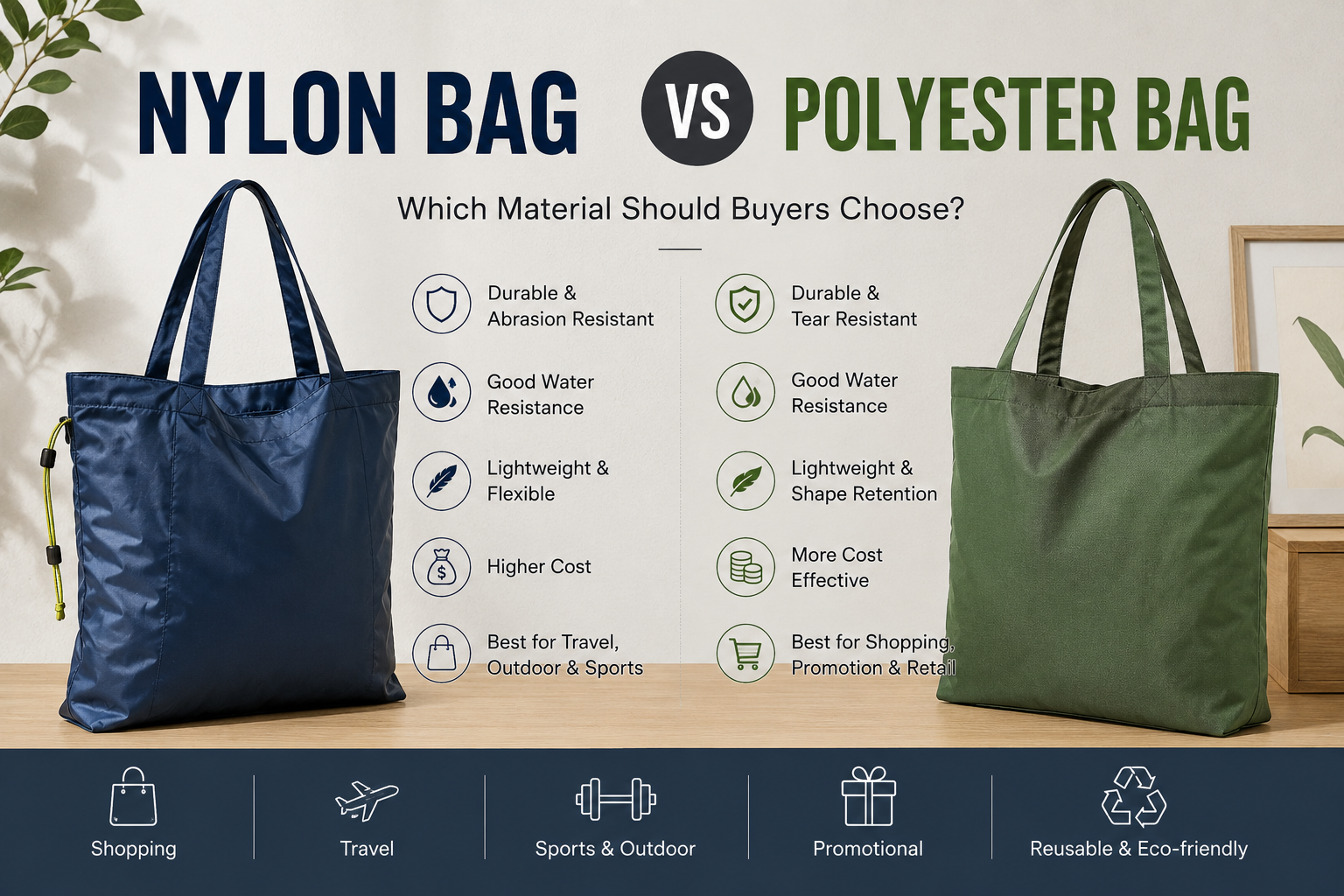
Nylon Bag vs Polyester Bag: Which Material Should Buyers Choose?
Nylon and polyester are two of the most commonly used synthetic materials in bag manufacturing. Both materials are lightweight, durable, easy to customize, and suitable for a wide range of reusable bag products.
However, nylon bags and polyester bags are not exactly the same. They differ in hand feel, abrasion resistance, water resistance, cost, appearance, printing performance, and ideal applications.
For B2B buyers, choosing the right material affects not only the final product quality, but also product positioning, cost control, customer experience, and long-term market performance. This guide explains the key differences between nylon and polyester bags and helps buyers choose the right material for custom bag projects.
1. What Is Nylon Material for Bags?
Nylon is a synthetic fabric known for its strength, flexibility, smooth surface, and good abrasion resistance. It is often used in bags that require durability and a softer technical fabric feel.
Nylon bags are commonly used for:
- Travel bags
- Sports bags
- Outdoor bags
- Foldable shopping bags
- Drawstring bags
- Waist bags
- Waterproof pouches
- Lightweight tote bags
- Backpack components
Nylon fabric can be made in different thicknesses, densities, coatings, and finishes. It can also be treated with water-resistant coatings for travel, outdoor, or daily-use bag products.
The main impression of nylon is:
Lightweight, smooth, flexible, and durable.
2. What Is Polyester Material for Bags?
Polyester is another widely used synthetic fabric in the bag industry. It is popular because it is cost-efficient, stable, color-friendly, and suitable for mass production.
Polyester bags are commonly used for:
- Shopping bags
- Promotional tote bags
- Cooler bags
- Drawstring bags
- Backpacks
- Cosmetic bags
- Travel organizers
- Laundry bags
- Storage bags
- RPET recycled bags
Polyester is especially common in promotional and retail bag production because it offers good durability at a more controlled cost. It also performs well for printing and color customization.
The main impression of polyester is:
Practical, stable, cost-effective, and easy to customize.
3. Nylon vs Polyester: Quick Comparison
| Comparison Point |
Nylon Bag |
Polyester Bag |
| Hand Feel |
Softer, smoother, more flexible |
Slightly firmer, more stable |
| Durability |
Strong abrasion resistance |
Good general durability |
| Water Resistance |
Good with coating |
Good with coating |
| Weight |
Lightweight |
Lightweight |
| Cost |
Usually higher |
Usually more cost-efficient |
| Color Stability |
Good |
Very good |
| Printing Suitability |
Good, depends on finish |
Very suitable for many methods |
| Best Use |
Travel, outdoor, sports, premium lightweight bags |
Promotion, retail, shopping, storage, RPET bags |
| Market Positioning |
More technical or premium |
More practical and commercial |
Both materials are suitable for bag manufacturing, but they serve slightly different market needs.
4. Durability and Strength
Nylon is generally known for strong abrasion resistance and flexibility. This makes it suitable for bags that may experience frequent movement, rubbing, folding, or outdoor use.
For example, nylon works well for:
- Travel organizers
- Sports waist bags
- Lightweight backpacks
- Outdoor pouches
- Foldable bags
- Drawstring gym bags
Polyester also has good durability, but it is often selected for projects where buyers need stable quality, clear printing, and cost-efficient mass production. It is widely used for shopping bags, promotional bags, cooler bags, and storage bags.
For heavy-duty outdoor use, nylon can be a stronger choice. For general retail and promotional use, polyester is often enough.
5. Water Resistance
Both nylon and polyester can offer water resistance when treated with coating, lamination, or waterproof finishing.
However, the material itself is not the only factor. Water resistance also depends on:
- Fabric density
- Coating type
- Sewing structure
- Zipper type
- Seam finishing
- Lining material
- Bag construction
Nylon often feels more suitable for technical outdoor bags because of its smooth surface and flexible structure. Polyester is widely used for waterproof shopping bags, cooler bags, storage bags, and promotional bags when coating is applied.
For buyers, the correct question is not only:
“Is nylon or polyester waterproof?”
The better question is:
“What water-resistant level does my product need, and what coating or structure should be used?”
6. Weight and Portability
Both nylon and polyester are lightweight compared with natural materials such as canvas, jute, or heavy cotton fabric.
Nylon is often used when the buyer wants a very light, soft, and compact bag. It folds easily and is suitable for travel bags, foldable shopping bags, running bags, and portable organizers.
Polyester is also lightweight, but it can feel slightly more structured depending on fabric density. It is useful for promotional tote bags, drawstring bags, cooler bags, and shopping bags where buyers need a balance between cost, durability, and appearance.
If portability is the main selling point, both materials can work. Nylon usually gives a softer premium feel, while polyester offers stronger cost control.
7. Printing and Logo Customization
Polyester is generally easier to use for many promotional printing methods, especially when the surface is smooth and stable. It is commonly used for screen printing, heat transfer, sublimation printing, and full-color promotional designs.
Nylon can also be customized, but printing depends more on the fabric coating and surface finish. Some coated nylon fabrics may require specific printing techniques to achieve better logo adhesion and clarity.
Common branding methods include:
- Screen printing
- Heat transfer printing
- Sublimation printing
- Rubber patch
- Woven label
- Embroidery
- Zipper puller customization
- Hangtag and packaging branding
For large promotional graphics, polyester is often easier and more cost-efficient. For premium outdoor or travel bags, nylon with woven labels, patches, or heat transfer logos can create a stronger technical look.
8. Cost Difference
Cost is one of the main reasons many buyers choose polyester.
Polyester is usually more cost-efficient than nylon, especially for large-volume promotional orders. This makes it a practical choice for:
- Trade show bags
- Supermarket bags
- Event giveaways
- Drawstring bags
- Foldable shopping bags
- Promotional tote bags
Nylon is usually positioned slightly higher. It may be more suitable for products where the buyer wants better hand feel, stronger abrasion resistance, or a more premium lightweight product.
Cost is affected by:
- Fabric type
- Fabric density
- Coating
- Bag size
- Printing method
- Zipper and accessories
- Lining
- Structure complexity
- Packaging method
For price-sensitive promotional projects, polyester is often the better choice. For travel, outdoor, or premium lightweight products, nylon can be more suitable.
9. Appearance and Market Positioning
Nylon bags often look more technical, sporty, and modern. They are suitable for travel, outdoor, running, gym, and premium lightweight products. The surface can be smooth, shiny, matte, crinkled, or coated depending on fabric selection.
Polyester bags are more versatile. They can be used for basic promotional bags, colorful shopping bags, RPET recycled bags, cooler bags, cosmetic bags, storage bags, and many other daily-use products.
In simple terms:
Nylon is often better for technical and premium lightweight bags.
Polyester is often better for practical, promotional, and cost-efficient bags.
10. Which Material Should Buyers Choose?
Choose Nylon If:
- The product needs a softer hand feel
- The bag is for travel, outdoor, sports, or running use
- Lightweight portability is important
- The market positioning is more premium
- The bag needs good abrasion resistance
- The design uses technical or modern styling
Choose Polyester If:
- Cost control is important
- The product is for promotion or retail packaging
- The bag needs bright colors or printed graphics
- The project requires large-volume production
- The product is a shopping bag, drawstring bag, cooler bag, or storage bag
- RPET recycled material is required
Choose Coated Fabric If:
- The product needs water resistance
- The bag is used outdoors
- The bag is for food, beach, travel, or wet items
- The buyer needs easy-clean performance
The best material depends on the product function, buyer budget, target market, and expected product value.
Recommended Products
Based on this nylon vs polyester material guide, buyers can consider the following product categories:
1. Nylon Shoulder Shopping Bags
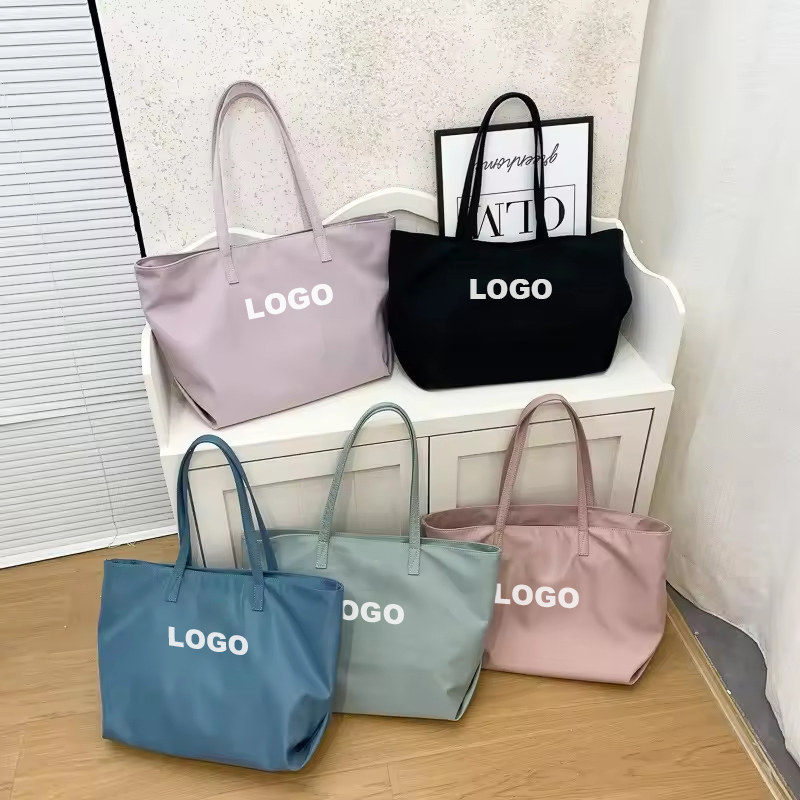
Nylon shoulder bags are suitable for lightweight shopping, travel, lifestyle retail, and promotional projects. They can be customized with drawstring closures, shoulder handles, logo printing, and foldable structures.
Suggested internal link: Nylon / Polyester Tote Bags
2. Polyester Promotional Tote Bags
Polyester tote bags are suitable for large-volume promotional campaigns, retail giveaways, trade shows, and supermarket programs. They offer good cost control and flexible printing options.
Suggested internal link: Promotional Tote Bags
3. RPET Recycled Polyester Bags
RPET bags are made from recycled polyester and are suitable for buyers who want a more sustainable material story. They can be developed as shopping bags, cooler bags, drawstring bags, and foldable bags.
Suggested internal link: RPET Bags
4. Foldable Shopping Bags
Foldable nylon or polyester bags are ideal for travel, supermarkets, retail gifts, and daily carry. Their lightweight structure makes them easy to store and reuse.
Suggested internal link: Foldable Tote Bags
5. Sports and Outdoor Bags
Nylon and polyester are both suitable for sports, running, camping, beach, waterproof, and outdoor bag products. Buyers can choose coated fabrics, mesh panels, zippers, buckles, and reinforced structures based on application.
Suggested internal link: Sports / Outdoor Bags
Buyer Checklist Before Ordering Nylon or Polyester Bags
Before confirming a custom bag project, buyers should check:
-
Material type
Confirm whether nylon, polyester, RPET polyester, or coated fabric is more suitable.
-
Fabric density and thickness
Decide the correct fabric strength based on product use.
-
Water resistance level
Confirm whether coating, lining, waterproof zipper, or sealed seams are required.
-
Bag structure
Choose open-top, zipper, drawstring, foldable pouch, lining, pocket, or reinforced bottom.
-
Logo method
Match the logo method with fabric surface, color, and branding requirements.
-
Color requirement
Confirm standard color, custom dyed color, or Pantone matching.
-
Packaging method
Choose bulk packing, individual polybag, hangtag, barcode label, or retail-ready packaging.
-
Sample confirmation
Check hand feel, sewing quality, zipper function, logo accuracy, and final shape before bulk production.
Conclusion
Nylon and polyester are both practical materials for custom bag manufacturing, but they are best suited for different buyer needs.
Nylon bags are usually better for travel, outdoor, sports, running, and premium lightweight products. They offer a soft hand feel, flexible structure, and strong abrasion resistance.
Polyester bags are usually better for promotional projects, shopping bags, retail packaging, cooler bags, storage bags, and cost-efficient mass production. They offer good durability, strong color options, and flexible printing performance.
For importers, distributors, retailers, supermarkets, promotional companies, and brand owners, the right choice depends on product use, budget, target market, branding method, and required performance.
As a professional custom bag manufacturer, we support OEM/ODM development for nylon bags, polyester bags, RPET bags, foldable bags, shopping bags, sports bags, and outdoor bags. Our factory can help buyers select suitable materials, develop custom structures, confirm logo methods, create samples, and manage bulk production with stable quality control.
FAQ
1. Is nylon stronger than polyester?
Nylon usually has stronger abrasion resistance and a softer hand feel, making it suitable for travel, outdoor, and sports bags. Polyester is still durable enough for most shopping, promotional, and retail bag projects.
2. Is polyester cheaper than nylon?
In many bag projects, polyester is more cost-efficient than nylon. This is why it is widely used for promotional bags, shopping bags, drawstring bags, and large-volume orders.
3. Which material is better for waterproof bags?
Both nylon and polyester can be water-resistant if coating or lamination is applied. The final performance depends on fabric coating, zipper type, seam construction, and bag structure.
4. Which material is better for promotional bags?
Polyester is often better for promotional bags because it offers good cost control, stable quality, and flexible printing options.
5. Which material is better for travel bags?
Nylon is often preferred for premium lightweight travel bags, while polyester is suitable for cost-efficient travel organizers and retail travel accessories.
6. Can nylon and polyester bags be customized?
Yes. Both materials can be customized in size, color, coating, lining, zipper, pocket layout, handle, logo method, and packaging.
Related Topics
- How to Customize Lightweight Shopping Bags for Retail Brands
- Drawstring Closure Bags: Structure, Benefits, and Applications
- Best Materials for Reusable Shopping Bags
- RPET Bag Material Guide: What Buyers Should Know
- Waterproof Bag Materials: Nylon, Polyester, PVC and TPU
- Foldable Shopping Bags: Material and Structure Guide


 Hot News