Quilted and padded tote bags have become increasingly common in fashion, work, travel, beauty, and promotional products. Unlike a conventional flat tote, these bags are built with additional layers that create a softer, thicker, and more dimensional appearance.
The terms quilted and padded describe different aspects of the same construction. Padding refers to the soft or cushioning layer placed between fabrics, while quilting refers to the stitching used to secure the layers and create a distinctive surface pattern. A tote bag can therefore be both padded and quilted at the same time.
Depending on the fabric, padding thickness, quilting pattern, and functional features, a quilted tote can range from a lightweight everyday shopping bag to a more structured laptop or work tote.
Understanding how these elements work together makes it easier to choose the right design for a particular product, brand, or target market.
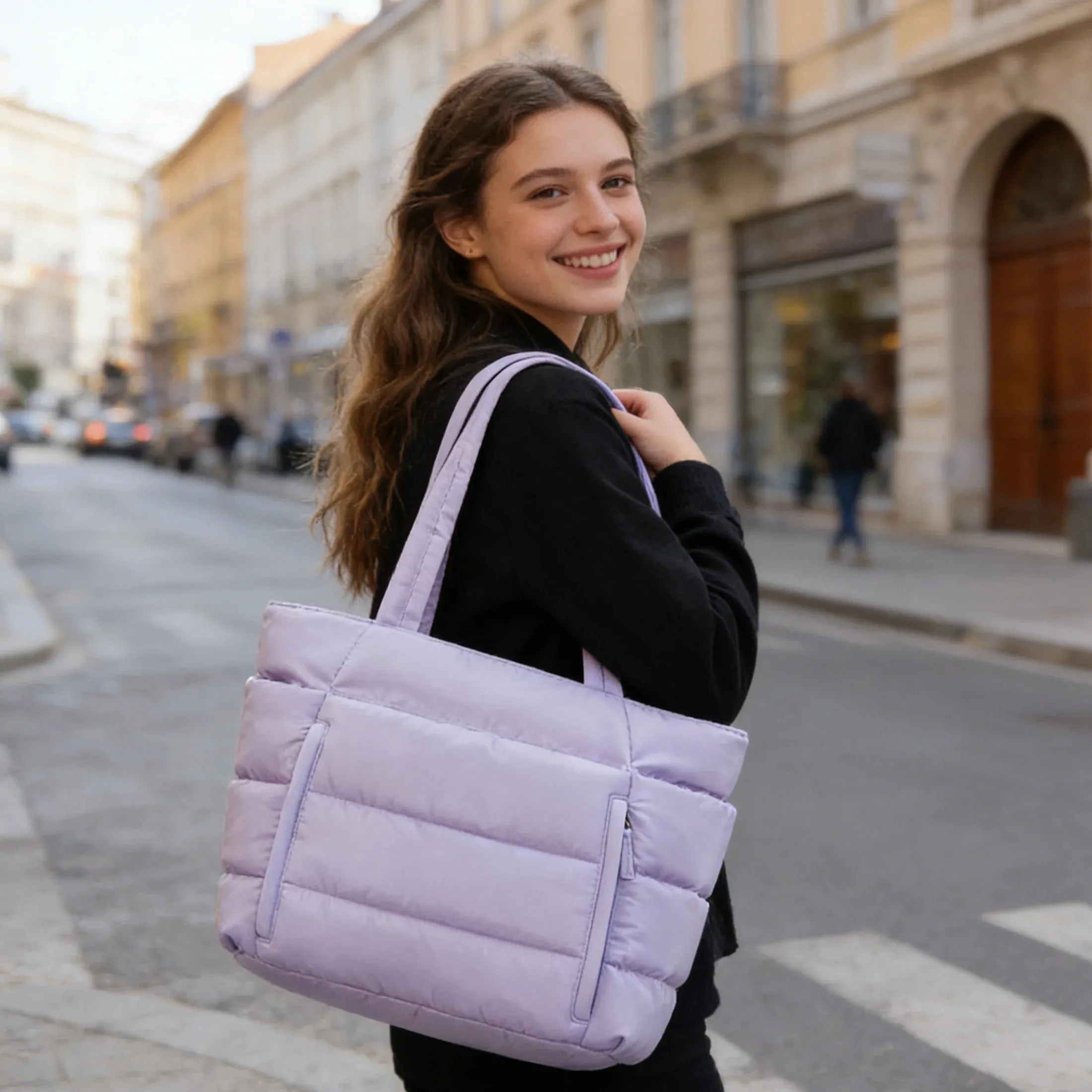
A quilted and padded tote bag is a tote constructed with a cushioning layer between fabric layers and secured with quilting stitches.
The two terms describe different aspects of the same construction:
- Padded refers to the cushioning or filling layer inside the bag.
- Quilted refers to the stitching pattern used to secure the layers and create the characteristic textured surface.
In many products, these two features are used together. A typical construction may consist of an outer fabric, a middle padding layer, and an inner lining, with quilting stitches running through the layers. This creates the soft, dimensional appearance associated with quilted or puffer-style totes.
This also explains why the terms can sometimes appear together in product names such as padded quilted tote bag, quilted puffer tote, or padded tote bag.
The final appearance can vary significantly depending on the padding thickness, fabric, stitch pattern, and bag structure.
A lightly padded tote may have a subtle quilted texture, while a heavily padded puffer tote can have a much fuller and softer appearance.
How Is a Quilted Padded Tote Bag Constructed?
The basic construction is relatively simple, but each layer affects the finished product.
1. Outer Fabric
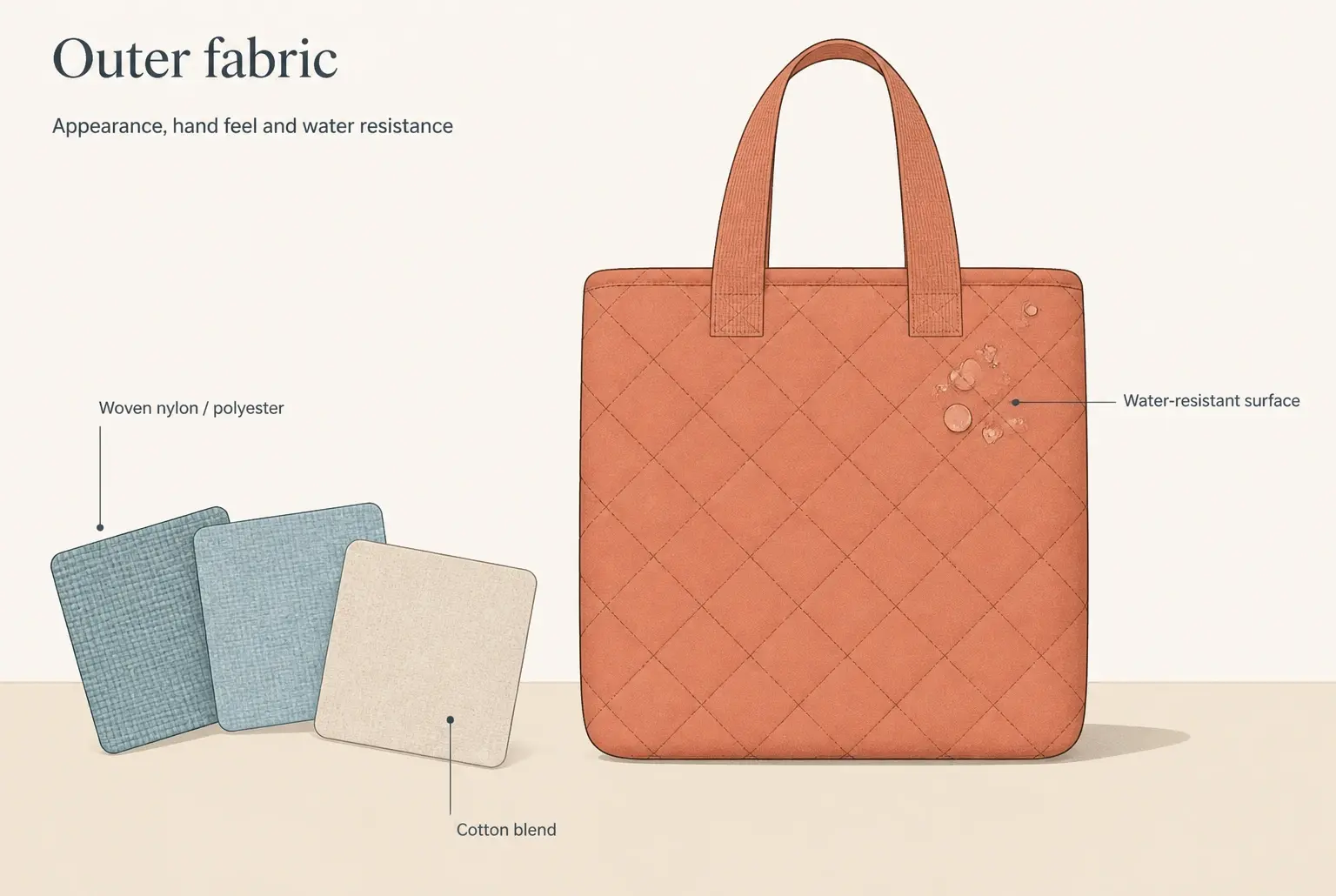
The outer fabric forms the visible surface of the tote.
It affects:
- Appearance
- Hand feel
- Abrasion resistance
- Color
- Branding
- Water resistance
- Overall product positioning
Nylon and polyester are commonly used for lightweight puffer and quilted designs, while cotton and cotton-blend fabrics can create a softer or more natural appearance.
The outer fabric also determines how clearly the quilting pattern appears.
Smooth fabrics can make stitching lines more visible, while textured fabrics create a softer and less technical appearance.
2. Padding or Filling
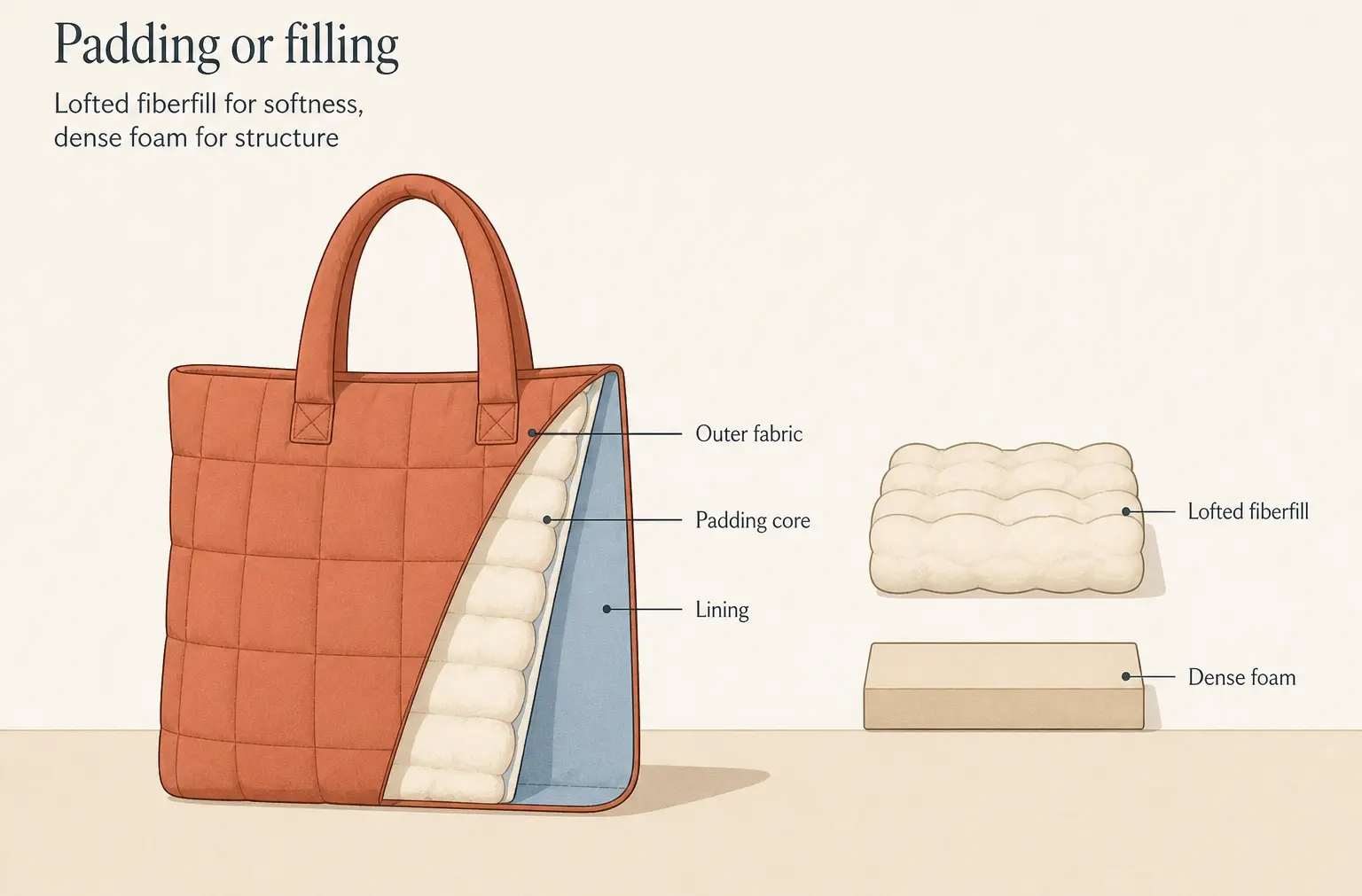
The padding is positioned between the outer fabric and lining.
Its main purposes can include:
- Creating a soft feel
- Adding cushioning
- Increasing visual volume
- Helping the bag maintain its shape
- Providing additional protection for contents
Different padding materials produce different results.
A lightweight filling can create a soft, slightly puffy appearance without adding much weight. A denser foam or padding layer can provide more defined cushioning and structure.
This is why padding thickness should be selected according to the intended application rather than simply choosing the thickest available option.
3. Inner Lining
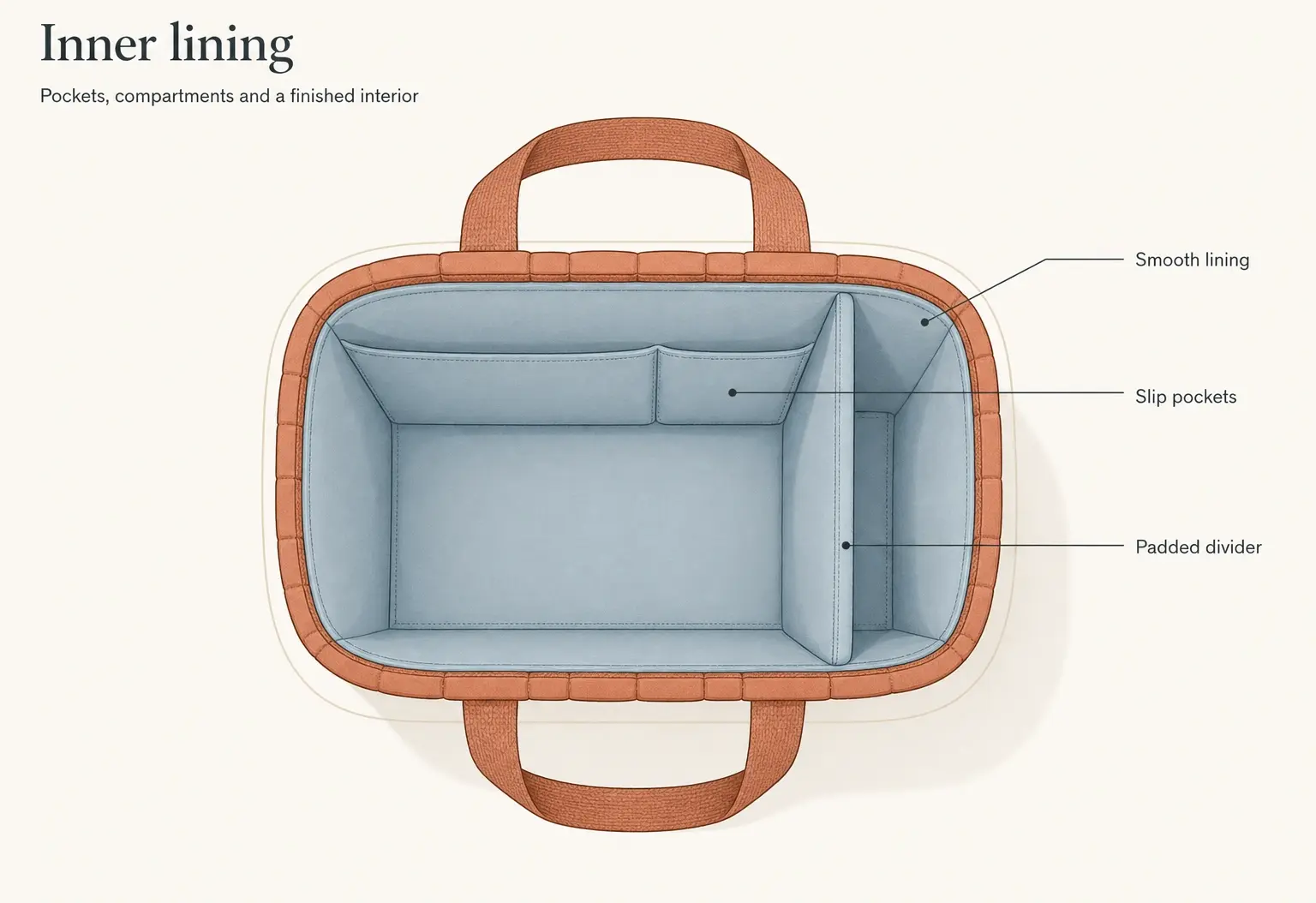
The lining provides a finished interior and can also influence the bag's structure and usability.
Depending on the product, the lining may be used for:
- Smooth interior finishing
- Easier cleaning
- Additional structure
- Interior branding
- Pockets and compartments
For work or laptop totes, the lining can also form part of a dedicated padded compartment or organizer system.
4. Quilting
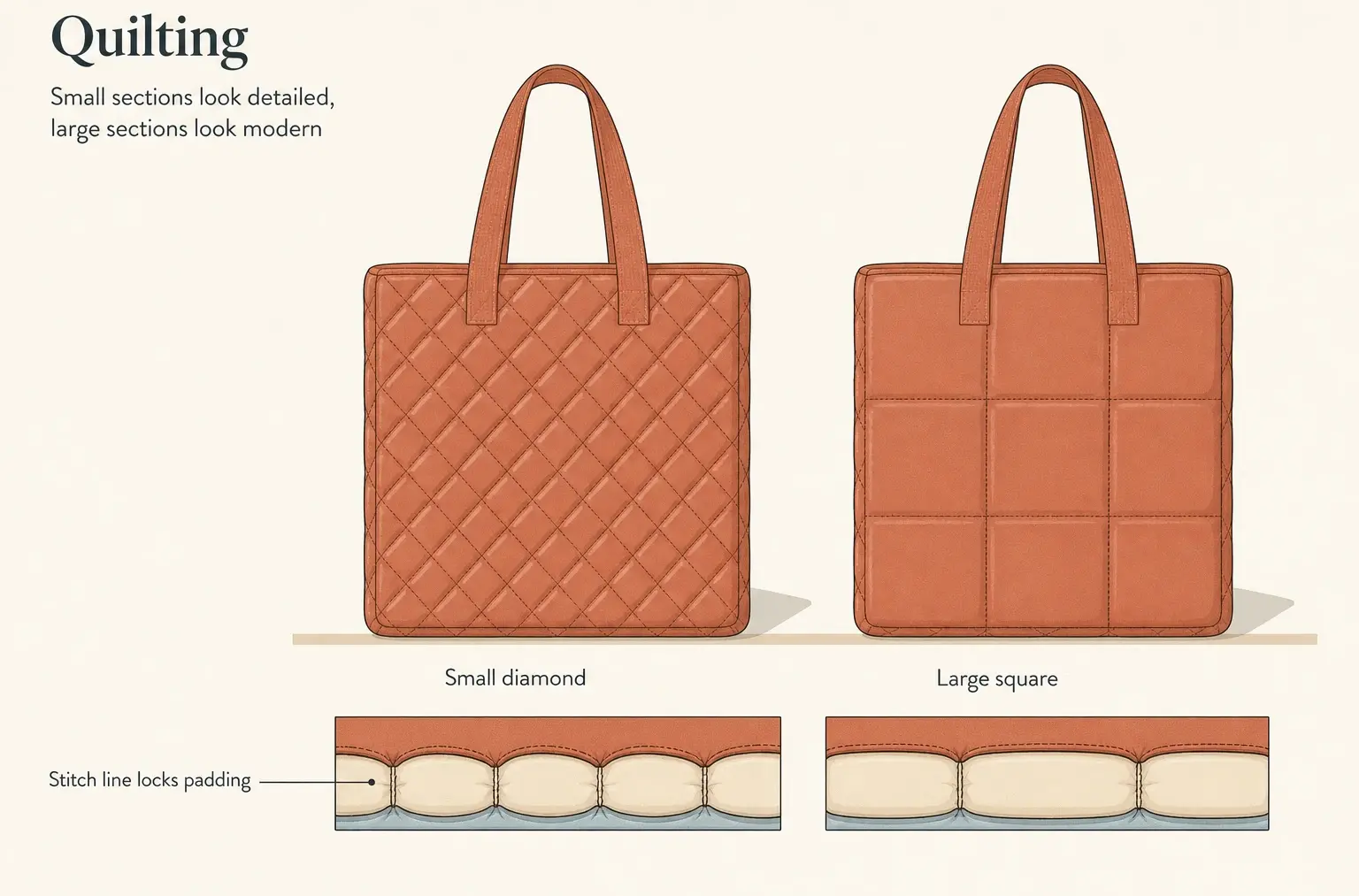
Quilting stitches connect the fabric layers and keep the padding in position.
The stitch pattern determines how the surface is divided into sections.
The size of each quilted section matters.
Small quilting sections can create a more detailed appearance, while larger sections can create a simpler and more modern look. The pattern should also be appropriate for the size and shape of the tote.
How Do Quilting and Padding Work Together?
Padding and quilting are closely connected, but they are not the same thing.
Padding provides thickness, softness, and cushioning. Quilting secures the layers and creates the surface design.
For example, a tote made with polyester outer fabric, polyester wadding, and a polyester lining can be quilted into a diamond pattern. The wadding creates the soft volume, while the diamond stitching divides the surface into individual sections.
This is why many quilted totes have a dimensional appearance rather than looking like a conventional flat fabric bag.
What Outer Fabric Are Commonly Used for Quilted Padded Totes?
There is no single material that is suitable for every quilted tote. The appropriate choice depends on the desired appearance, weight, durability, cost, and intended use.
Polyester
Polyester is a practical option for many quilted tote designs.
It can provide:
- Consistent color
- Good dimensional stability
- A wide range of surface finishes
- Relatively easy care
- Cost-effective production
Polyester can also work well with different quilting patterns because the fabric can maintain a relatively consistent surface during construction.
It is commonly considered for promotional totes, everyday bags, retail products, and fashion-oriented designs.
Nylon
Nylon is often selected when a lighter and smoother material is preferred.
Compared with some heavier fabrics, nylon can help create a lightweight tote while maintaining good strength.
It can be suitable for:
- Lightweight everyday totes
- Travel bags
- Work totes
- Casual fashion bags
Depending on its specific construction and finishing, nylon can also offer some resistance to light moisture. However, the fabric itself should not automatically be considered waterproof.
Cotton
Cotton gives a quilted tote a more natural textile appearance.
It can be particularly suitable when a brand wants to emphasize:
- Natural texture
- Soft hand feel
- Lifestyle positioning
- Casual appearance
The weight and weave of cotton make a significant difference. A lightweight cotton fabric can create a softer, more flexible tote, while heavier cotton can provide greater body and structure.
Cotton is also a useful choice when the visual identity of a product is more important than achieving the lightest possible construction.
Cotton Blends
Cotton blends combine cotton with other fibers to achieve a different balance of appearance, strength, weight, or cost.
For quilted totes, blends can be useful when the desired product needs the visual character of cotton while requiring additional performance characteristics from another fiber.
The exact result depends on the fiber composition and fabric construction.
Corduroy
Corduroy offers a noticeably different appearance because of its raised ribbed surface.
When used in a quilted tote, the combination of corduroy's texture and quilting creates a more visually distinctive product.
It can work particularly well for:
- Fashion accessories
- Seasonal collections
- Lifestyle products
- Boutique retail bags
However, the ribbed texture should be considered when selecting the quilting pattern. A complicated quilting design combined with a strongly textured fabric can produce a very different appearance from the same pattern on a smooth fabric.
Recycled Polyester
Recycled polyester can be considered when recycled content is part of a brand's product requirements.
Its suitability should still be evaluated based on the specific fabric construction, performance requirements, appearance, and certification requirements rather than assuming that recycled content alone determines product quality.
Does the Outer Fabric Change the Look of Quilting?
Yes.
The same quilting pattern can look very different depending on the fabric.
A smooth polyester fabric may create a clean and uniform appearance. Cotton can make the surface look softer and more natural. Nylon may create a smoother and more contemporary effect, while corduroy introduces an additional layer of texture.
This is why fabric selection should be considered together with quilting rather than treated as two completely independent decisions.
What Padding Materials Are Used Inside Quilted Tote Bags?
Polyester Wadding
Polyester wadding can create a soft and lightweight padded effect.
It is useful when the primary goals are:
- Softness
- Volume
- Lightweight construction
- Comfortable handling
- A puffer-style appearance
It is commonly used for fashion and lifestyle-oriented quilted bags.
Foam Padding
Foam can provide a more defined cushioning effect.
This can be useful for products where additional protection is important, such as:
- Laptop totes
- Tablet bags
- Electronics-related carrying bags
- Structured work totes
However, the correct foam type and thickness depend on the required protection, bag structure, and target weight.
Fiberfill and Other Lightweight Fillings
Fiber-based fillings can be used to create a soft, flexible appearance without making the bag excessively rigid.
They may be suitable when the design needs to balance:
Softness + volume + flexibility + lightweight construction
The important point for buyers is that padding should be selected based on the finished product requirement, not just the visual thickness of a sample.
How Does Padding Affect a Quilted Tote Bag?
Padding is one of the main factors that determines how a quilted tote looks and feels.
It affects thickness, softness, weight, flexibility, and sometimes the level of cushioning provided by the finished product.
Lightweight Padding
Light padding produces a subtle quilted effect without making the bag excessively bulky.
It can work well for:
- Everyday totes
- Promotional bags
- Lightweight fashion bags
- Simple retail packaging
The main advantage is that the tote can retain some flexibility and remain relatively easy to carry or store.
Medium Padding
Medium padding creates a more noticeable cushioned appearance while maintaining a reasonable balance between softness and usability.
This type of construction can be useful for work totes, lifestyle bags, and products that need a more substantial appearance without becoming excessively bulky.
Heavier Padding
Heavier padding creates a more pronounced puffy appearance.
It can be considered when the product requires:
- More cushioning
- A stronger puffer effect
- A softer hand feel
- A more substantial visual appearance
However, increasing padding also has trade-offs.
The finished bag may become:
- Heavier
- Thicker
- Less flexible
- More difficult to fold
- More expensive to produce
Is Thicker Padding Always Better?
No.
The right padding thickness depends on what the tote is expected to do.
A promotional tote may benefit from lightweight padding because the bag needs to remain easy to carry and cost-effective. A laptop tote may require more substantial cushioning around the dedicated compartment.
Choosing padding based only on thickness can therefore lead to an unnecessarily heavy or bulky product.
The better approach is to match the padding to the intended function.
Popular Quilting Styles for Tote Bags
Quilting is not only a construction technique. It can also become part of the product's visual identity.
Diamond Quilting
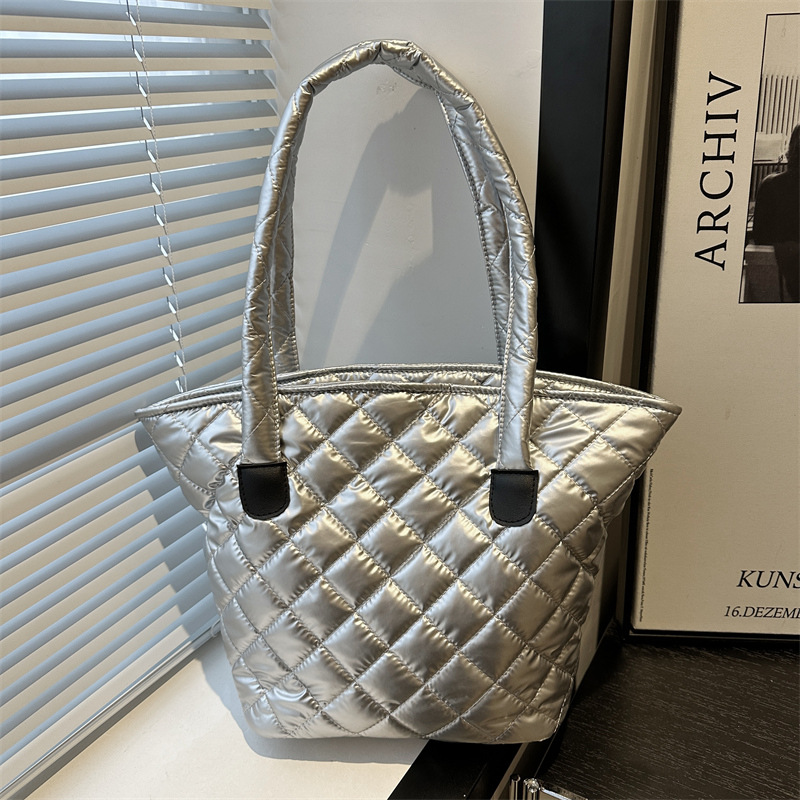
Diamond quilting is one of the most recognizable patterns.
It can give a tote a classic and decorative appearance while creating consistent padded sections across the surface.
It can work well for:
- Fashion accessories
- Lifestyle totes
- Promotional products
- Boutique collections
Square or Grid Quilting
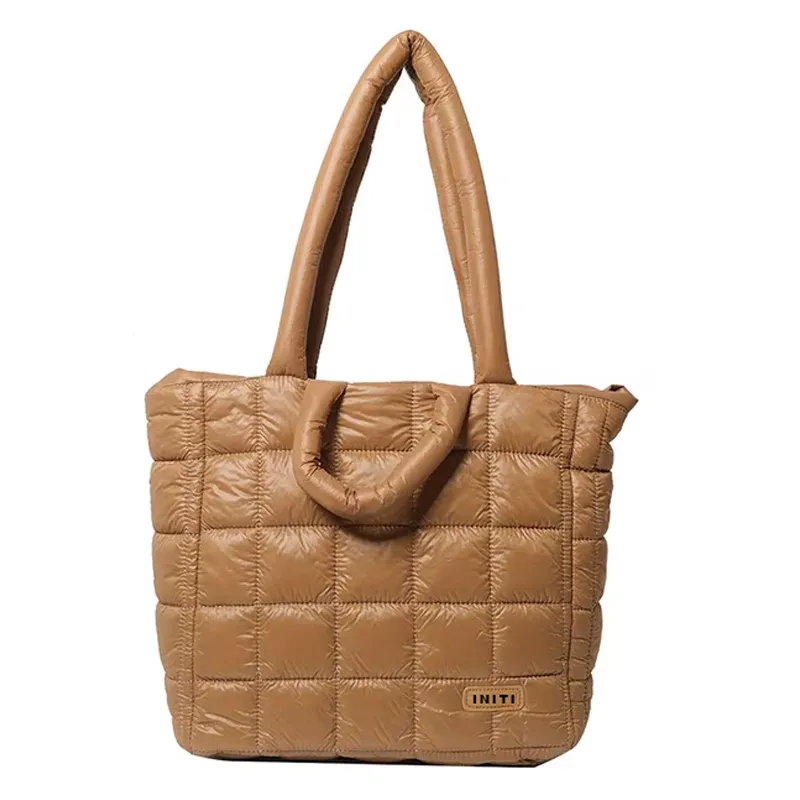
Square quilting produces a more regular and structured appearance.
It can suit minimalist products where the quilting is intended to add texture without becoming the dominant design feature.
Channel Quilting
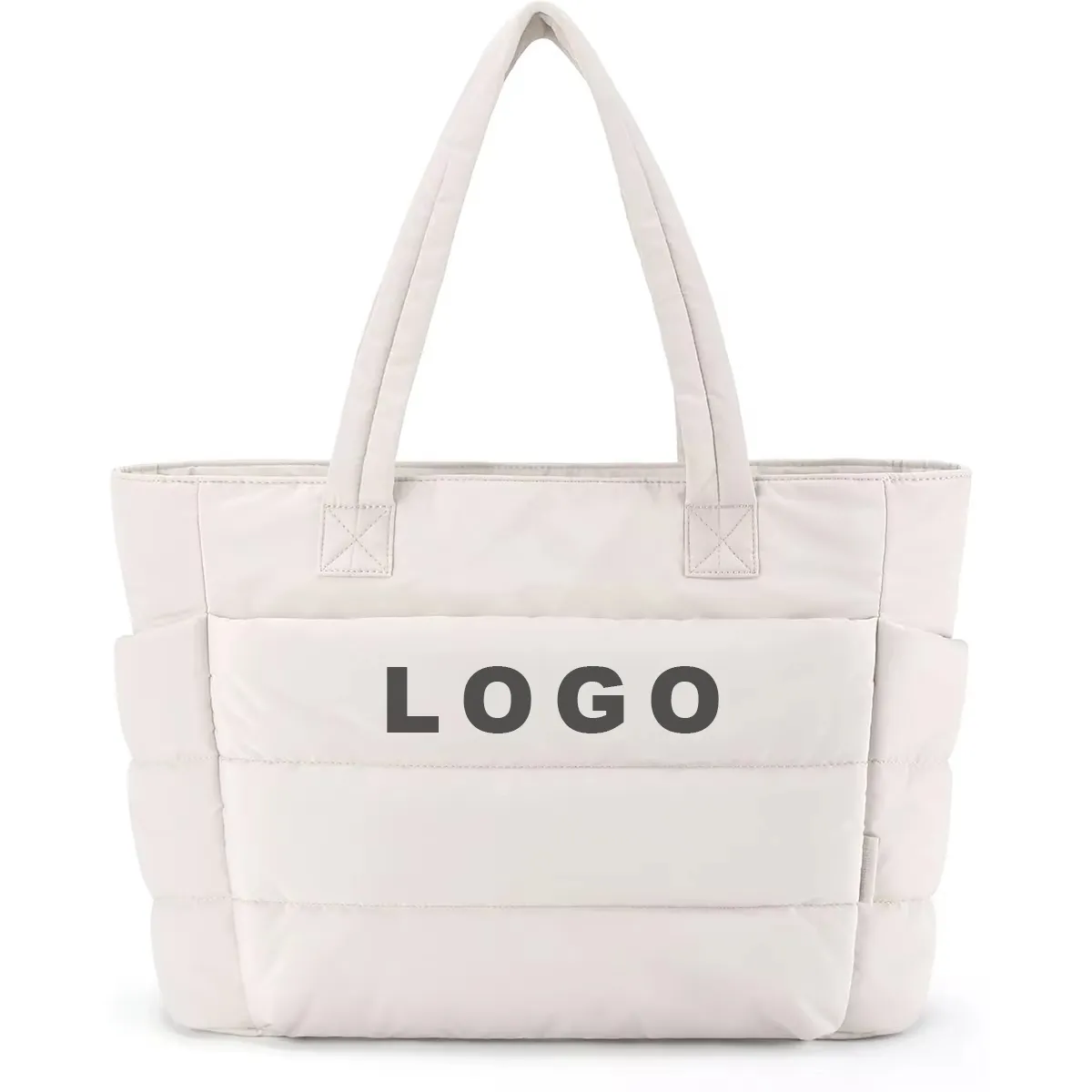
Channel quilting uses parallel stitched lines to create elongated padded sections.
It can create a more modern appearance and works particularly well on larger panels.
Wave Quilting
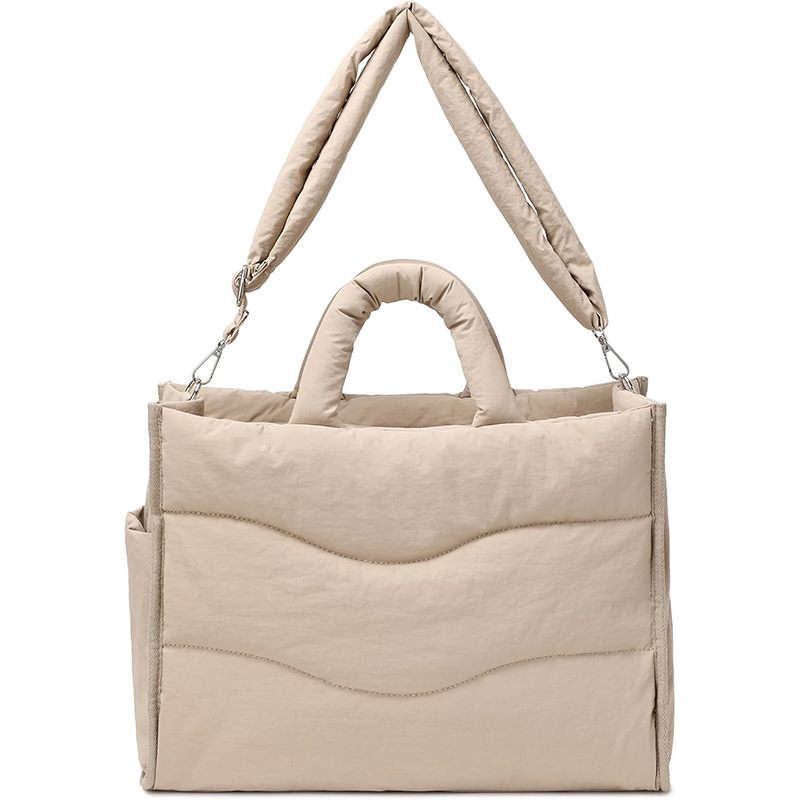
Wave patterns can make a padded tote appear softer and more dynamic.
This type of pattern can be useful when a brand wants something less conventional than standard diamond or square quilting.
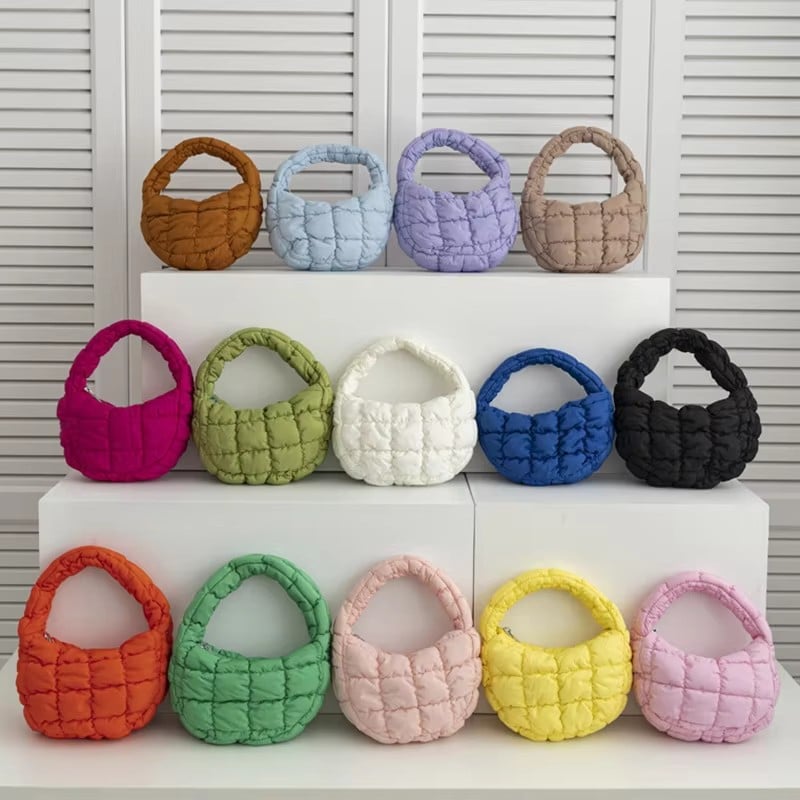
Bubble or Puffer Quilting
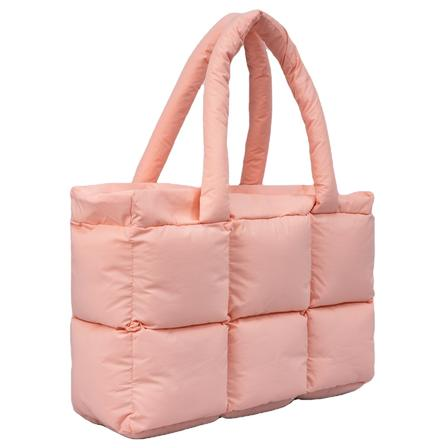
Bubble-style quilting creates larger padded sections and a fuller three-dimensional appearance.
This style is often associated with contemporary puffer bags and soft lifestyle accessories. Current retail and OEM products show bubble, puffer, and larger geometric quilting as active design directions.
Custom Quilting Patterns
For private-label products, the quilting pattern itself can become part of the design language.
Instead of using a standard diamond or square pattern, buyers can develop:
- Custom geometric patterns
- Brand-inspired patterns
- Special panel layouts
- Different stitch spacing
- Mixed quilting patterns
However, the pattern should be considered together with the bag size and padding thickness. A pattern that works well on a small sample may not look balanced when scaled to a larger tote.
What Design Features Can a Quilted Tote Have?
Quilting creates the basic visual identity, but additional features determine how the tote works in everyday use.
Open-Top Design
An open-top tote allows users to access the contents quickly.
It is particularly practical when convenience is more important than complete closure.
Open-top designs are commonly suitable for:
- Everyday carry
- Shopping
- Casual use
- Simple promotional products
The trade-off is that the contents are more exposed.
Zipper Closure
A zipper creates a fully enclosed main compartment.
It can provide better security for personal belongings and is useful for work, commuting, and travel-oriented totes.
However, adding a zipper increases construction complexity and can affect both the appearance and finished weight of the bag.
Magnetic Closure
A magnetic closure offers a middle ground between an open tote and a fully zipped compartment.
It allows relatively quick access while helping keep the opening partially closed.
It can be particularly suitable for fashion-oriented quilted totes where a clean appearance is important.
Interior Pockets
Interior pockets help organize smaller items inside a large tote.
Depending on the intended use, these may include:
- Slip pockets
- Zipper pockets
- Phone pockets
- Small organizer compartments
More pockets do not necessarily make a tote more functional. The number and size should correspond to what users actually need to carry.
Laptop Compartment
A dedicated laptop compartment can turn a soft quilted tote into a more practical work bag.
The compartment can provide:
- Separation from other items
- Additional padding
- More organized storage
- Easier access
The dimensions should be designed around the intended laptop size, while the handle and main-body construction should also be able to support the additional weight.
Gusseted Bottom
A gusset can increase the usable volume of a tote.
For padded designs, the bottom and side construction can also influence how the bag stands and how its contents are distributed.
A wider base can be useful when the tote needs to carry bulkier items.
Reinforced Handles
Handle reinforcement is particularly important when the tote is designed to carry heavier contents.
The handle length also affects how the bag is used. Short handles may suit hand carrying, while longer handles can make shoulder carrying more comfortable.
Why Choose a Quilted and Padded Tote Bag?
The main attraction of this construction is that it combines visual texture with practical functionality.
A Softer Appearance
Compared with a flat canvas or polyester tote, padding creates a more dimensional appearance.
This can help a product feel more like a finished fashion or lifestyle accessory rather than a basic promotional bag.
Added Cushioning
The padded construction can provide some cushioning around the contents.
For bags designed to carry laptops, tablets, or other sensitive items, additional internal padding can be combined with dedicated compartments.
Your existing padded quilted tote, for example, uses a dedicated laptop compartment together with the padded outer construction.
Comfortable Everyday Carry
Soft padded handles and a flexible body can make the tote comfortable to carry over the shoulder.
This is particularly useful for larger everyday bags where the product may be carried for extended periods.
Stronger Lifestyle Positioning
Quilted totes can sit between a traditional utility tote and a fashion accessory.
That makes them suitable for brands that want a product that feels practical but still has a distinctive appearance.
Where Are Quilted and Padded Tote Bags Used?
The same basic construction can be adapted for different markets.
Fashion and Lifestyle Retail
Fashion brands can use quilted totes as standalone accessories or as part of a seasonal collection.
The main design focus may be:
- Quilting pattern
- Fabric appearance
- Color
- Handle design
- Overall silhouette
In this case, the padding may be relatively light because visual appearance and hand feel are more important than heavy cushioning.
Work and Commuting
A padded tote can also be developed as a work or commuter bag.
Useful features may include:
- Laptop compartment
- Interior organizer
- Zipper pocket
- Water bottle pocket
- Reinforced handles
- Secure closure
Current retail examples show quilted totes being positioned for commuting, work, travel, gym use, and general everyday carrying.
Laptop and Device Carrying
When a tote is intended for laptops or tablets, the internal construction becomes more important than simply increasing the outer padding.
A better approach is often to combine:
Padded body + dedicated device compartment + reinforced structure
This can provide more targeted protection without making the entire bag unnecessarily thick.
Travel and Weekend Bags
Larger quilted totes can work as lightweight travel or weekend carry bags.
Important considerations include:
- Capacity
- Handle length
- Weight
- Closure
- Interior pockets
- Bottom construction
For larger bags, reinforcement becomes especially important because the contents can place significant stress on the handles and seams.
Beauty and Wellness Brands
Quilted totes can also work well for beauty, skincare, wellness, and spa brands.
They can be used as:
- Retail accessories
- Gift-with-purchase products
- Brand merchandise
- Product bundle packaging
- Reusable shopping bags
This can give a promotional product a longer useful life than disposable packaging.
Promotional Products
For promotional applications, the design usually needs to balance appearance with target cost.
A simpler quilting pattern, lightweight padding, standard fabric, and uncomplicated structure can help control production costs while still giving the product a more distinctive appearance than a basic flat tote.
What Can Be Customized in a Quilted Padded Tote Bag?
For brands and importers, quilted totes offer many customization possibilities.
Fabric
Possible choices can include:
- Polyester
- Nylon
- Cotton
- Cotton blends
- Recycled polyester
- Corduroy
- Other custom fabrics
Padding
Buyers can discuss:
- Padding material
- Thickness
- Density
- Softness
- Overall puff level
Quilting
Customization can include:
- Pattern
- Stitch spacing
- Quilting direction
- Panel layout
- Pattern scale
Bag Structure
The basic tote can be developed with:
- Custom width and height
- Gusset
- Reinforced bottom
- Laptop compartment
- Interior pockets
- Exterior pockets
Handles
Handle customization can cover:
- Length
- Width
- Material
- Attachment
- Reinforcement
- Shoulder-carry configuration
Closure
Depending on the design:
- Zipper
- Magnetic closure
- Snap
- Open top
Branding
Branding options can include:
- Screen printing
- Heat transfer
- Embroidery
- Woven labels
- Patches
- Custom zipper pulls
- Interior labels
Packaging
For retail products, packaging can also be customized to match the brand and sales channel.
This may include:
- Hangtags
- Individual packaging
- Custom labels
- Branded cartons
- Retail-ready packaging
The important point is that these choices should be developed as one product system rather than selected independently.
Common Problems to Avoid When Designing a Quilted Tote
A visually attractive quilted tote can still have practical weaknesses if the construction is not matched to its intended use.
Making the Padding Too Thick
Excessive padding can make the tote heavier and bulkier without providing meaningful additional value.
The thickness should correspond to the function of the bag.
Choosing Quilting Only for Appearance
A quilting pattern should complement the fabric, bag dimensions, and desired hand feel.
Choosing a pattern simply because it looks attractive in a sample image may not produce the same result on a different fabric or bag size.
Ignoring Handle Reinforcement
The main body may be soft and attractive, but the handles still need to support the intended load.
This is particularly important for laptop and work totes.
Adding Too Many Pockets
Additional compartments can improve organization, but excessive pockets can make the bag heavier, more expensive, and harder to use.
Each compartment should have a clear purpose.
Making a Large Tote Without Enough Structure
A larger tote needs to support more weight and accommodate more contents.
If the construction is too soft for its size, the bag may lose its shape when loaded.
Choosing Fabric Only for Appearance
A fabric may look attractive in a sample but may not be the best option for frequent use.
The final choice should consider appearance, hand feel, durability, maintenance, weight, and intended application together.
FAQ
Are quilted tote bags padded?
Many quilted tote bags are padded because quilting is commonly used to secure an internal wadding or cushioning layer. However, the amount and type of padding can vary, so not every quilted tote has the same thickness or level of cushioning.
What is the difference between quilting and padding?
Padding is the material placed between fabric layers to create thickness and softness. Quilting is the stitching pattern used to secure those layers together. A tote can use both at the same time.
What material is best for a quilted tote bag?
There is no single best material. Polyester and nylon can be practical for lightweight and durable designs, cotton can provide a more natural appearance, and corduroy can create a distinctive textured look. The intended use should determine the material choice.
Are padded tote bags suitable for laptops?
They can be, particularly when the tote includes a dedicated laptop compartment with appropriate cushioning. General padding alone should not automatically be treated as equivalent to dedicated laptop protection.
Does thicker padding make a tote bag better?
Not necessarily. Thicker padding can increase cushioning and create a stronger puffy appearance, but it can also increase weight, bulk, and cost. Padding should be selected according to the intended use.
Are quilted tote bags durable?
Durability depends on the fabric, stitching, handle reinforcement, padding construction, lining, and overall workmanship. A quilted appearance by itself does not determine how durable the finished tote will be.
Can quilted tote bags have zippers and pockets?
Yes. Quilted totes can incorporate zippers, magnetic closures, interior pockets, laptop compartments, gussets, reinforced handles, and other functional features depending on the intended design.
Can quilted padded tote bags be customized?
Yes. Custom quilted padded totes can be developed with different fabrics, colors, dimensions, quilting patterns, padding thicknesses, linings, handles, pockets, closures, logos, and other product specifications.
Conclusion
Quilted and padded tote bags combine several elements that work together to create their characteristic appearance and feel. The outer fabric determines much of the visual identity, the padding creates thickness and softness, and quilting secures the layers while adding texture and design.
The right construction ultimately depends on the intended application. A lightweight promotional tote may require a very different combination of materials and padding from a laptop tote or a fashion-oriented retail product.
For brands, retailers, promotional companies, and businesses looking for custom quilted padded tote bags, factors such as fabric, padding, quilting pattern, lining, size, handles, pockets, closures, and intended use can be adjusted to create a product that balances appearance and practical function.
INITI can support custom tote bag requirements across different materials, sizes, quilting designs, functional features, and branding needs, helping buyers develop quilted padded tote bags suited to their target market and application.
Related Products


 Hot News