| Comparison Dimension |
Clear PVC Backpack (0.40–0.50mm) |
Clear TPU Backpack (0.35–0.50mm) |
Heavy-Duty Polyester Mesh Backpack |
Heavy-Duty Nylon Mesh Backpack |
| Visual Transparency Level |
100% Optical Clarity |
100% Crystal Clarity |
40%–60% Visible Silhouette |
50%–70% Visible Silhouette |
| Stadium / NFL / NCAA Compliance |
Fully Compliant |
Fully Compliant |
Non-Compliant (Rejected) |
Non-Compliant (Rejected) |
| K-12 School Safety Policy |
Approved Nationwide |
Approved Nationwide |
Policy-Dependent (Selected Districts) |
Policy-Dependent (Selected Districts) |
| Air Permeability / Breathability |
0 cm³/cm²/s (Hermetic) |
0 cm³/cm²/s (Hermetic) |
550 cm³/cm²/s (High) |
600 cm³/cm²/s (Very High) |
| Hydrostatic Water Resistance |
10,000 mm H₂O (Impermeable) |
10,000 mm H₂O (Impermeable) |
0 mm H₂O (Free-Draining) |
0 mm H₂O (Free-Draining) |
| Tensile Strength (Body Material) |
18 – 28 MPa |
45 – 55 MPa |
750 – 950 N / 5cm |
950 – 1300 N / 5cm |
| Cold-Crack Threshold (°C) |
-5°C (Std) / -20°C (Cold-Add) |
-30°C to -35°C |
Immune (-40°C) |
Immune (-40°C) |
| Notch / Puncture Sensitivity |
High (Requires Webbing Reinf.) |
Low to Moderate |
Very Low (Arrests Runs) |
Extremely Low (High Tenacity) |
| UV Resistance / Yellowing |
Moderate (Yellows under UV) |
High (Aliphatic Grade) |
High (PET UV-Stabilized) |
Moderate (Polyamide UV Aging) |
| Chemical Safety Mandates |
CPSIA / Prop 65 Lab Audit Req. |
Inherently Phthalate-Free |
Azo-Free / Oeko-Tex Cert. |
Azo-Free / Oeko-Tex Cert. |
| Packaging Density (Units/40HQ) |
~18,000 – 22,000 pcs |
~20,000 – 24,000 pcs |
~32,000 – 38,000 pcs |
~34,000 – 40,000 pcs |
| Wholesale Production FOB Cost |
Base ($) |
Base + 60% to 110% ($$$) |
Base - 10% to + 15% ($) |
Base + 20% to 45% ($$) |
Disclaimer: Data in this comparison matrix is for reference only. Actual performance, compliance and price vary by material grade, production batch and local venue/school regulations. NFL/NCAA/K12 approval is not guaranteed. All price and loading figures are non-binding estimates. Final specs to be confirmed against pre-production samples.
Clear Backpack vs Mesh Backpack: Which Is Better for Schools?
Schools are one of the most important markets for clear and mesh backpacks, but their purchasing requirements are not always the same.
Some school districts require fully transparent backpacks. Others allow mesh backpacks under specific conditions. Some permit mesh only for certain grade levels or school activities.
For this reason, buyers should not assume that a mesh backpack is automatically accepted simply because it allows some visibility.
Why Do Schools Require Clear Backpacks?
Schools may introduce clear backpack requirements as part of broader campus safety procedures.
A transparent design allows staff to see the contents without opening every compartment manually. This can support visual inspection and reduce the time needed for some entry procedures.
For schools, the key product requirement is usually visibility rather than fashion or ventilation.
Important design considerations include:
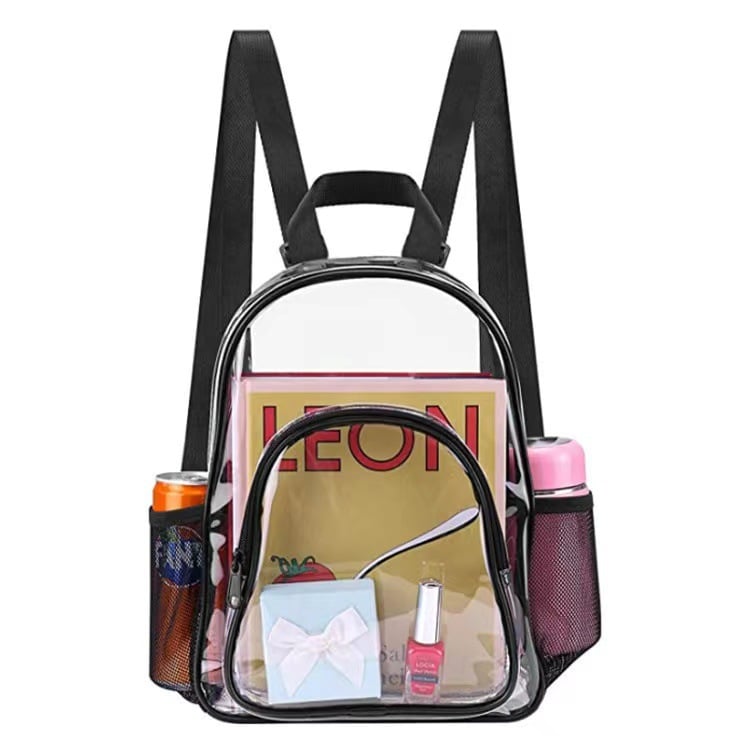
- Transparent front and side panels
- Visibility through the back panel
- Limited opaque reinforcement
- Suitable storage capacity
- Durable shoulder straps
- Secure closures
- Clearly visible contents inside pockets
However, a transparent backpack does not replace a school's overall security procedures. It is one part of a wider approach to campus management.
Are Mesh Backpacks Allowed in Schools?
The answer depends on the individual school district.
For example, Hoke County Schools in North Carolina states that both clear and mesh backpacks are allowed, provided that the contents are clearly visible through the bag.
By contrast, Jefferson Parish Schools specifies that students must use clear backpacks and does not permit mesh backpacks.
Ascension Public Schools provides another example of a more detailed approach: its 2026–27 guidelines allow mesh backpacks for middle and high school students under specific design conditions, including solid-color mesh and sufficient visibility of the contents.
School policies can differ significantly.
For procurement teams, the practical lesson is straightforward: confirm the current school or district requirements before finalizing the product specification.
What Should Buyers Check Before Sourcing School Backpacks?
When purchasing backpacks for a school program, buyers should clarify the following points.
1. Required Transparency
Does the school require fully transparent plastic material, or does it accept mesh?
If mesh is allowed, does the entire bag need to be mesh, or are selected mesh panels sufficient?
2. Approved Material
Does the policy specify PVC, vinyl, transparent plastic, or other materials?
Some schools define acceptable materials rather than simply requiring a see-through appearance.
3. Opaque Areas
Are fabric backs, reinforced bottoms, colored piping, decorative panels, and large logos permitted?
This is important because these features may affect the visibility of the bag's contents.
4. Pocket Requirements
Can the backpack have front pockets, internal organizers, and mesh side pockets?
Are all pockets required to remain visible?
5. Dimensions and Capacity
Does the school specify maximum dimensions, or should the bag simply be large enough for standard books, folders, and electronic devices?
6. Privacy Accessories
Can students carry a small non-transparent pouch for personal-care items?
Are there limits on the size or type of such accessories?
These questions should be answered before bulk production. A product can be manufactured according to a buyer's drawing and still fail to meet the end customer's policy if the original requirements were incomplete.
Clear Backpack Design for School Programs
For schools that require fully transparent bags, a simple construction is often the safest starting point.
A practical design may include:
- Transparent main body
- Transparent front and side panels
- A transparent back panel
- Reinforced transparent bottom
- Adjustable shoulder straps
- Durable zipper closure
- Minimal opaque decoration
- A small logo area that does not obstruct visibility, if permitted
The shoulder straps may use colored webbing when the school allows it.
However, buyers should not assume that colored straps, printed patterns, or large brand panels are universally acceptable.
For mesh-approved school programs, the specification should define the required mesh density, color, opening size, and proportion of solid panels.
The goal is to balance visibility with the intended level of durability and comfort.
Clear Backpack vs Mesh Backpack for Stadiums and Events
Stadiums, concerts, festivals, and large public events are another important market for clear backpacks.
However, stadium requirements should be evaluated separately from school requirements.
A venue may allow certain transparent bags while prohibiting mesh backpacks, ordinary fabric backpacks, or even some clear backpacks that exceed the permitted dimensions.
Why Do Stadiums Use Clear Bag Policies?
Clear bag policies are intended to make security screening easier and help staff identify the contents of bags.
A transparent bag allows security personnel to see stored items without relying entirely on manual inspection.
This can support entry procedures at large events where many people arrive within a relatively short period.
The specific requirements depend on the organizer, stadium, event, and local security procedures.
What Is the NFL Clear Bag Policy?
The most rigorous and globally recognized standard is the NFL Stadium Clear Bag Policy, adopted across NCAA collegiate athletic venues, major concert stadiums, and amphitheaters:
- Approved Dimensional Standard: Bags must be clear plastic, vinyl, or PVC and must not exceed 12" x 6" x 12" (30.5 cm x 15.2 cm x 30.5 cm).
- Alternative Approved Option: One-gallon clear plastic freezer storage bag (Ziploc style).
- Clutch Purse Exception: Small clutch bags, approximately the size of a hand (maximum 4.5" x 6.5"), are permitted alongside an approved clear bag.
- Explicit Prohibition: Traditional backpacks, tinted plastic bags, printed solid pattern bags, and MESH BACKPACKS are strictly prohibited.
- Procurement Takeaway: Any brand manufacturing licensed sports merchandise or promotional stadium giveaway bags must configure designs to strictly conform to the 12" x 6" x 12" clear PVC/TPU blueprint.
Clear vs Mesh Backpacks: High-Security Facilities, Logistics & Correctional Settings
Amazon, FedEx, Target Fulfillment Centers (Loss Prevention):
To deter internal inventory shrinkage in consumer electronics and apparel warehouses, employees are required to carry clear bags through checkpoint turnstiles and security metal detectors. Clear dual-compartment backpacks (0.50 mm heavy-duty PVC) streamline entry and exit shifts, saving thousands of labor hours annually in screening lines.
Correctional Facilities:
Staff and visitors must adhere to transparent bag policies to prevent contraband smuggling (narcotics, communication devices, weapons). Bags must have no hidden linings, false bottoms, or opaque internal dividers.
Which Backpack Is Better for Sports, Swimming, and Outdoor Activities?
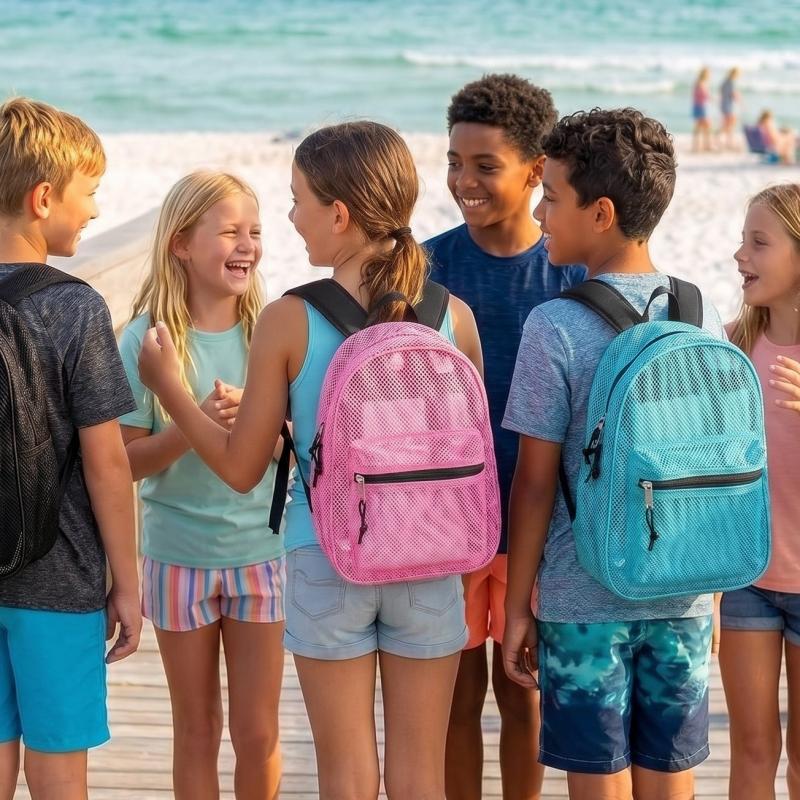
When the application changes from security-oriented environments to sports and outdoor activities, mesh backpacks often become the more practical option.
This is because the requirements are different.
Sports users may carry wet towels, clothing, footwear, swimming accessories, or equipment that benefits from ventilation.
A clear backpack can still be used for selected sports programs, but its non-breathable construction is less suitable for carrying damp equipment over extended periods.
Gym and Fitness Programs
Mesh backpacks are suitable for carrying:
- Workout clothes
- Towels
- Lightweight footwear
- Water bottles
- Small training accessories
The open structure allows air to circulate around the contents.
For larger gym backpacks, buyers should consider combining mesh panels with solid fabric sections.
For example, a solid bottom panel can improve abrasion resistance, while mesh side panels can support ventilation.
Swimming and Water Activities
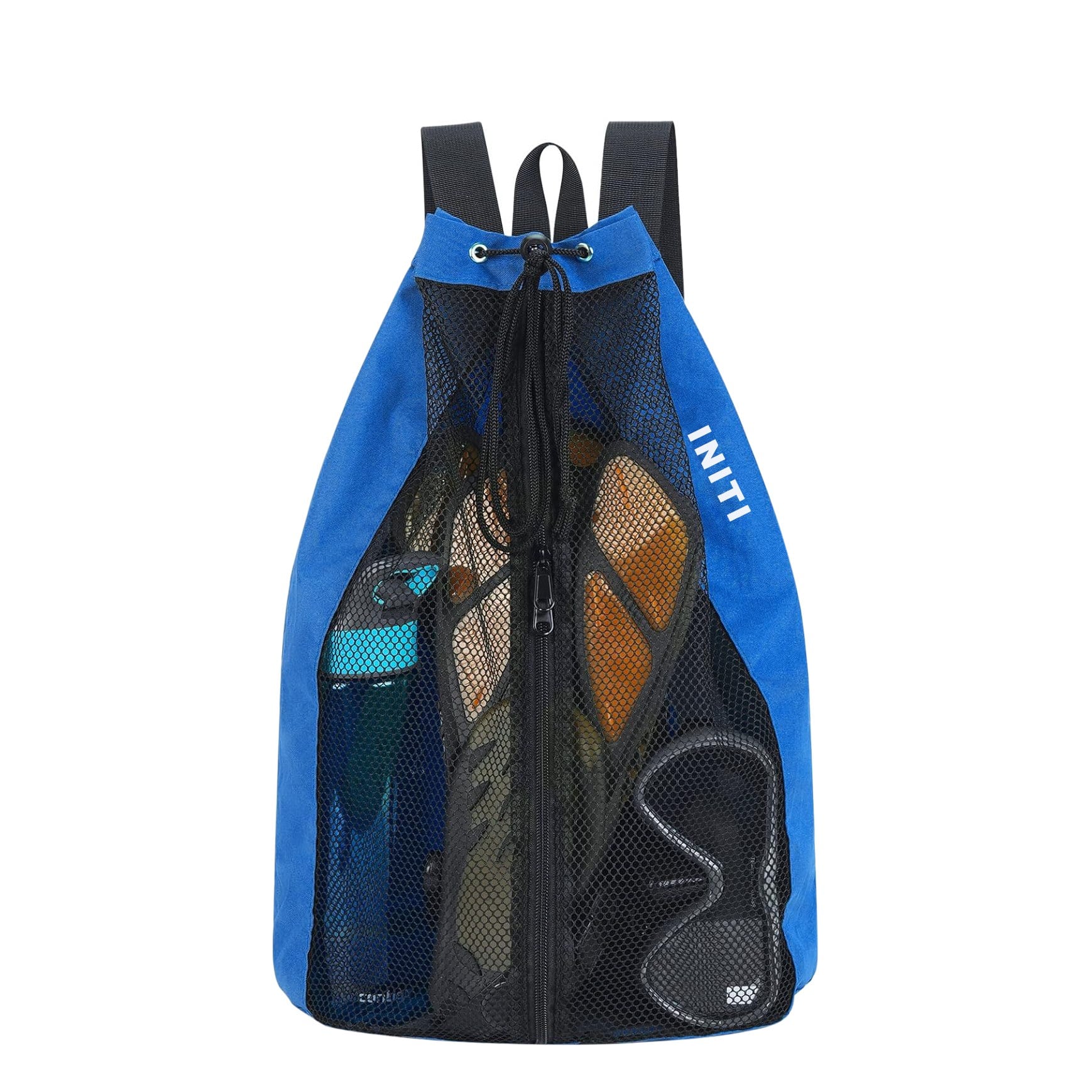
Mesh backpacks are particularly useful for swimming programs.
After swimming, users often need to carry wet swimsuits, towels, goggles, and other accessories.
A mesh construction allows water to drain and helps the contents dry more efficiently than a sealed film-based bag.
However, buyers should distinguish between a drainage bag and a waterproof storage bag.
If the user needs to carry a dry phone, wallet, or documents together with wet swimming accessories, a separate waterproof compartment or protective pouch may be necessary.
A simple mesh backpack does not provide reliable moisture protection for these items.
Beach and Outdoor Programs
For beach and outdoor applications, mesh backpacks can provide several practical advantages.
Sand and loose debris may fall through larger mesh openings instead of remaining trapped inside the bag.
The fabric also allows air to circulate around damp towels and clothing.
However, the opening size should be appropriate for the intended contents.
Very large openings may allow small accessories to fall out, while very fine mesh may retain more sand and reduce drainage.
Buyers should also consider abrasion around the bottom, especially when the backpack is frequently placed on rough surfaces.
Strategic Hybrid Designs
Recognizing that neither 100% clear PVC nor 100% mesh represents a universal solution for every environment, forward-thinking OEM/ODM manufacturers have engineered Hybrid Architectural Configurations.
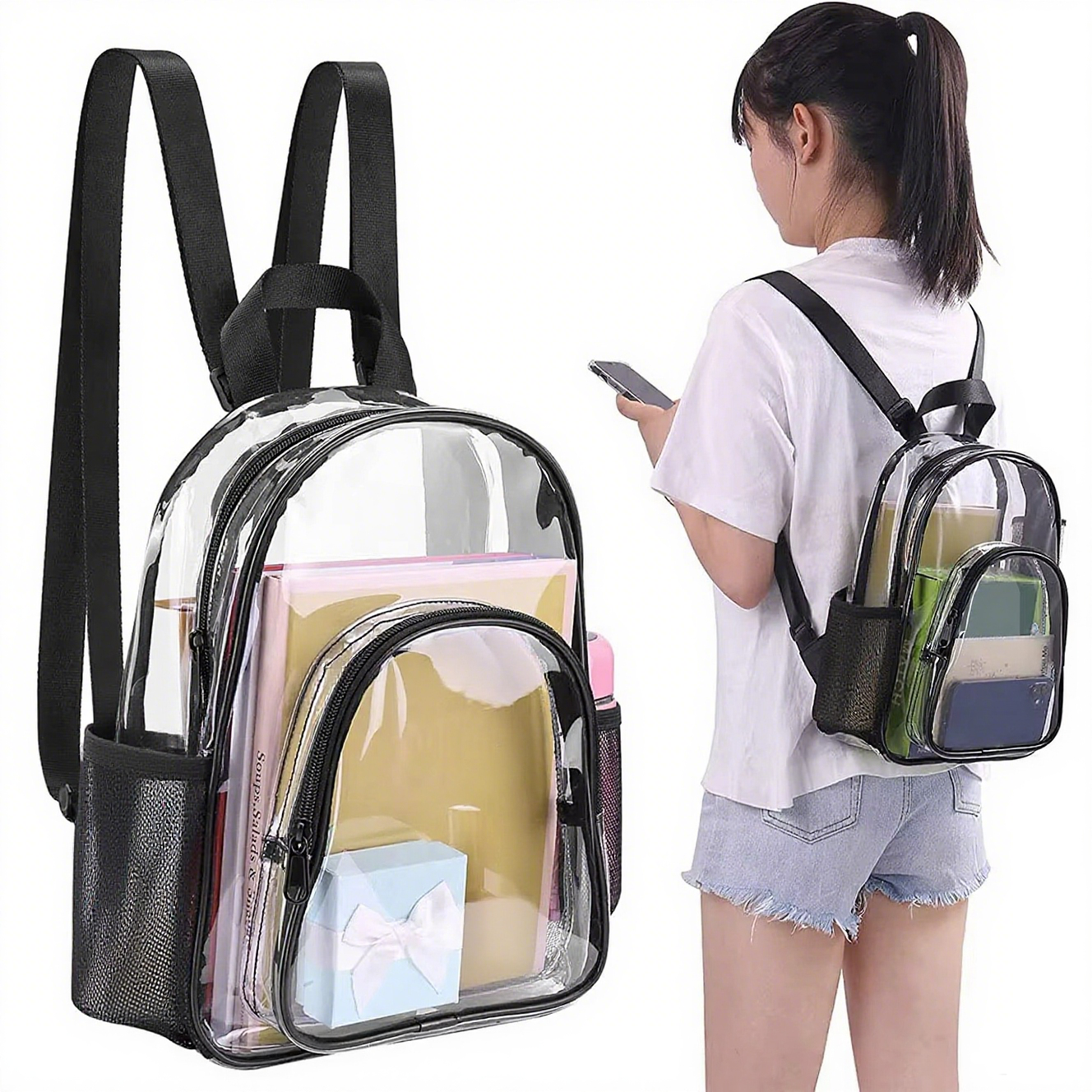
| Hybrid Zone |
Material Specification |
Functional & Security Purpose |
| Top Panel |
0.40mm Clear TPU Film |
Enables rapid top-down visual inspection by security officers. |
| Front Main Face |
0.40mm–0.50mm Clear PVC/TPU |
Provides 100% unobstructed optical clarity for entry turnstiles and checkpoints. |
| Side Pockets |
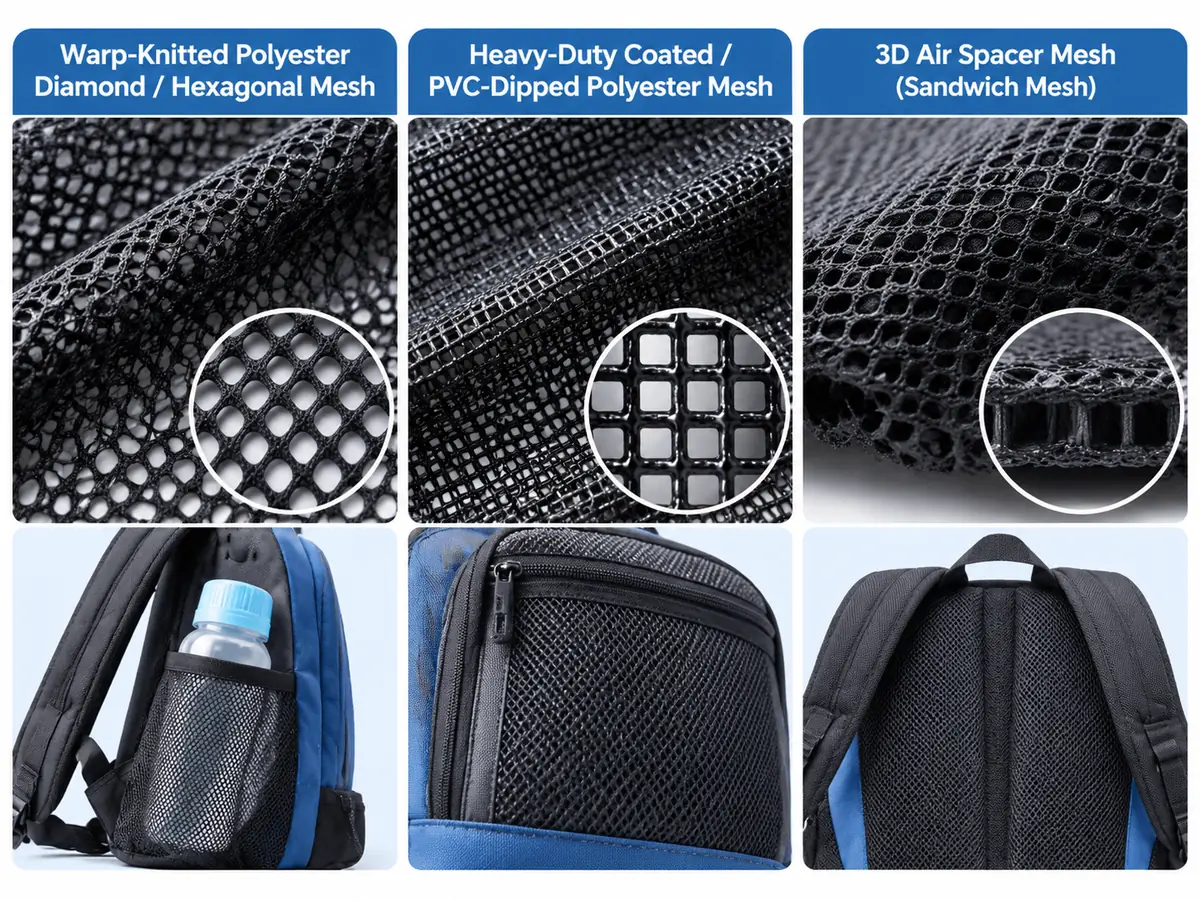
Heavy-Duty Polyester Mesh |
Delivers flexible, free-draining storage for hydration bottles and umbrellas. |
| Back Panel |
3.5mm 3D Air Spacer Mesh + Perforated EVA |
Delivers continuous ventilation and moisture dissipation across the user's back. |
| Bottom Boot |
Dual-Layer 900D Oxford with Molded Base |
Shields against ground moisture, concrete abrasion, and internal puncture hazards. |
Key Engineering Advantages of the Hybrid Configuration:
- Front & Top Security Compliance: Security personnel look directly through the transparent front and top panels to verify interior contents instantly.
- Back Contact Ergonomics: The user's back touches only high-airflow 3D air spacer mesh, eliminating sweat accumulation and skin irritation.
- Bottom Structural Protection: The high-abrasion bottom boot prevents ground moisture penetration and puncture failures from dropped pencils, keys, and concrete friction.
- Side Utility: Mesh side pockets accommodate hydration bottles and umbrella gear with free-draining breathability.
Manufacturing Engineering, Seam Construction
Seam Joining Technologies: Stitching vs. High-Frequency Welding
| Seam Method |
Structural Mechanism |
Engineering Advantages |
Key Vulnerabilities & Mitigations |
| Method 1: Stitched Seam with Polyester Binding |
Needle punctures film; high-tensile bonded thread secures layers inside folded polyester webbing tape. |
Compatible with both PVC/TPU and mesh textiles; flexible seam movement; low tooling startup costs. |
High needle puncture density creates tear lines. Mitigation: Strictly calibrate to 5.5–6.5 SPI with Tex 70 thread. |
| Method 2: High-Frequency (RF) Dielectric Welding |
High-frequency electromagnetic energy (27.12 MHz) fuses polymer dipoles into a single molecular bond. |
100% waterproof hermetic seal; zero needle holes; eliminates tear initiation points; high burst strength. |
Tooling-intensive; strictly limited to polar polymers (PVC/TPU); cannot bond standard polyester mesh without hot-melt films. |
Structural Reinforcement Engineering for Clear Backpacks
Because clear film lacks continuous woven fibers, all high-stress anchor points require secondary reinforcement substrates:
- Shoulder Strap Join Points: Never stitch shoulder strap webbing directly into a single layer of clear plastic. The strap must be sandwiched between the clear film and an interior/exterior backing plate made of 600D PVC-backed polyester or heavy-duty hypalon, secured with a reinforced box-X stitch pattern.
- Top Haul Handle: Must be anchored through a continuous horizontal webbing load-spreader bar extending across the entire top panel to distribute lifting tension.
- Zipper Seam Attachment: Zippers must be stitched to an intermediate polyester webbing strip before being joined to the clear body, preventing direct shear stress on the film edge.
- Bottom Gusset Corners: Incorporate triangular corner gussets made of solid 600D Oxford to prevent puncture failures when the bag is dropped onto rough concrete floors.
Quality Control: What Should Buyers Inspect Before Bulk Production?
A backpack's quality should be assessed through both material inspection and finished-product testing.
A sample may look attractive but still have problems that become noticeable after repeated use.
For bulk procurement, buyers should establish inspection requirements before mass production begins.
1.Material Inspection
For clear backpacks, inspect:
- Transparency and visual consistency
- Material thickness
- Surface scratches
- Bubbles or visible imperfections
- Flexibility
- Resistance to expected handling conditions
For mesh backpacks, inspect:
- Mesh opening consistency
- Yarn quality
- Fabric weight
- Stretch and recovery
- Color consistency
- Snagging and abrasion performance
- Edge stability
Material inspection should also confirm that the supplied material matches the approved specification.
2.Seam and Stitching Inspection
Seam quality is important because backpacks experience repeated movement and concentrated loads.
Inspect the following areas:
- Main body seams
- Bottom seams
- Shoulder-strap attachment points
- Handle attachment points
- Front pocket seams
- Zipper ends
- Binding and edge finishing
Check for skipped stitches, loose threads, uneven stitching, and areas where the material may be damaged during sewing.
For clear materials, stitching holes and seam processing should also be reviewed for appearance and strength.
For mesh materials, the edges should be finished properly to reduce fraying and prevent the fabric from opening during repeated use.
3.Zipper and Hardware Testing
The zipper should operate smoothly without catching on the material.
Check:
- Opening and closing performance
- Zipper alignment
- Slider movement
- End stops
- Attachment strength
- Repeated operation
If the backpack includes buckles, adjusters, or other accessories, these should also be inspected for correct installation and functionality.
4.Load and Strap Testing
The backpack should be tested with a representative load based on the intended application.
Inspect whether:
- The shoulder straps remain securely attached
- The body maintains an acceptable shape
- The bottom does not deform excessively
- Seams remain intact
- Closures continue to operate correctly
- The contents remain securely contained
The test load and duration should be agreed upon by the buyer and manufacturer.
A school backpack carrying textbooks may require a different evaluation from a lightweight mesh promotional backpack.
5.Practical Use Testing
Laboratory-style checks are useful, but practical use evaluation is also important.
For clear backpacks, test:
- Visibility from different angles
- Ease of wiping the surface
- Appearance after repeated folding or handling
- Comfort when carrying the intended load
- Whether the pockets interfere with visibility
For mesh backpacks, test:
- Airflow through the main body
- Drainage when carrying wet accessories
- Snagging during normal handling
- Stretch under load
- Drying and cleaning performance
The purpose is to identify issues that may not be obvious during a visual inspection of an empty sample.
6.Establishing a Quality Standard for Bulk Orders
Before production, buyers should approve a sample that clearly defines the expected product.
The approved sample should include:
- Material type and specification
- Finished dimensions
- Color
- Logo artwork
- Pocket layout
- Zipper and hardware
- Stitching details
- Packaging method
Any changes to these specifications should be reviewed before production.
For repeat orders, maintaining a documented product specification helps reduce differences between production batches.
How to Develop a Clear or Mesh Backpack for Your Market
Developing a successful backpack product requires more than choosing a material and adding a logo.
Buyers should begin with the target market, define the functional requirements, and then translate those requirements into a practical product specification.
A structured development process can reduce unnecessary revisions and improve communication between the buyer and manufacturer.
- Step 1: Define the Target Application
- Step 2: Confirm the Required Visibility Level
- Step 3: Select the Material
- Step 4: Confirm Dimensions and Structure
- Step 5: Develop Branding and Customization
- Step 6: Review and Approve Samples
- Step 7: Confirm Bulk Production Specifications
FAQ
1.What is the main difference between a clear backpack and a mesh backpack?
The main difference is their material structure and intended function.A clear backpack uses transparent materials such as PVC or TPU to make its contents visible. A mesh backpack uses open-structured fabric, usually polyester or nylon, to provide airflow and partial visibility.Clear backpacks are more suitable for projects that prioritize transparency and visual inspection, while mesh backpacks are better suited to sports, swimming, and outdoor activities where ventilation and drainage are important.
2.How do clear and mesh backpacks compare in terms of odor retention?
Clear backpacks do not absorb odors or moisture, making them easy to clean and sanitize; however, if wet gym gear is sealed inside an unventilated clear bag, the trapped moisture will cause mold and bacterial odor within hours. Mesh backpacks provide continuous 360-degree passive airflow, allowing damp athletic gear to dry continuously and preventing anaerobic bacterial odor buildup.
3.Which backpack is more durable?
Neither design is automatically more durable.Clear backpacks may experience scratches, punctures, or damage around stress points. Mesh backpacks may experience snagging, stretching, or tearing around seams.Material quality and construction have a significant influence on the finished product's service life.
4.Can mesh backpacks be printed?
Yes, but the printing method depends on the mesh structure.Printing directly onto open mesh may result in interrupted graphics because the openings affect the printing surface.For larger or more detailed logos, buyers can consider adding a solid-fabric panel or using a sewn-on label or patch.
5.Which backpack is better for promotional gifts?
Both can work well.Clear backpacks are suitable for school-related campaigns, events, and programs where visibility is important.Mesh backpacks are suitable for sports promotions, outdoor activities, summer campaigns, and fitness-related merchandise.The best choice depends on the campaign's audience, budget, intended use, and branding requirements.
Conclusion
Clear backpacks and mesh backpacks may both offer visibility, but they serve different functional needs.
Clear backpacks are designed around transparency, visual inspection, and better resistance to external water through their film panels. They are commonly considered for school programs, security-oriented environments, stadium merchandise, and event-related products.
Mesh backpacks focus on breathability, lightweight construction, and drainage. Their open fabric structure makes them more suitable for sports, swimming, outdoor activities, and casual everyday use.
At INITI, we support OEM and ODM backpack development for different market requirements. Whether a project calls for a transparent PVC or TPU backpack, a breathable polyester or nylon mesh backpack, or a combination of different materials, the design can be developed around the intended application, target market, and purchasing specifications.
From material selection and structural development to logo customization, sample approval, and bulk production, a clear product specification helps ensure that the finished backpack matches both the buyer's expectations and the needs of its end users.
Related Products
Related Articles


 Hot News