Zipper Specifications for Custom Bags: Coil, Metal, Waterproof and Reverse Zippers
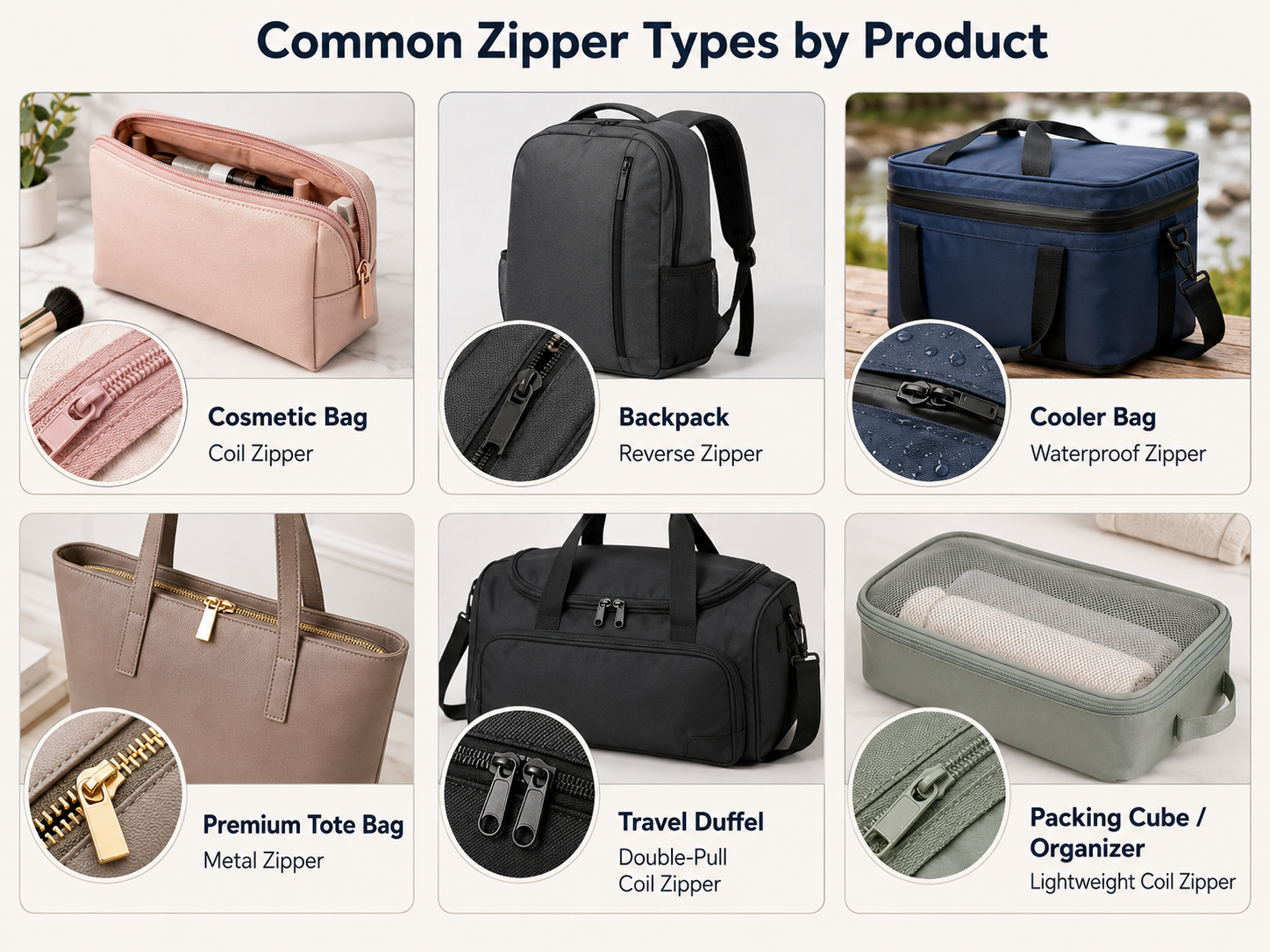
Zippers are used on cosmetic bags, backpacks, cooler bags, travel bags, shoe bags and many other custom products.
For B2B buyers, specifying only “zipper closure” is not enough.
The zipper affects:
- Opening smoothness
- Bag appearance
- Moisture resistance
- Product weight
- Durability
- Cost
- Custom branding
A practical zipper specification should identify:
- Zipper type
- Zipper size
- Tape and element color
- Slider and puller
- Opening structure
- Water-resistance requirements
- Intended load and usage
The four zipper terms buyers encounter most often are coil zipper, metal zipper, water-resistant zipper and reverse zipper.
Quick Comparison
| Zipper Type |
Main Advantage |
Main Limitation |
Common Bag Applications |
| Coil zipper |
Flexible, lightweight and versatile |
Coil can wear under heavy abrasion |
Cosmetic bags, backpacks, travel bags |
| Metal zipper |
Premium appearance and substantial feel |
Heavier and usually more expensive |
Fashion bags, canvas bags, premium pouches |
| Water-resistant zipper |
Better protection against light moisture |
Not automatically waterproof |
Outdoor, sports and travel bags |
| Reverse zipper |
Cleaner appearance with hidden coil |
Surface tape receives more exposure |
Backpacks, sports bags, modern retail bags |
YKK broadly divides zippers into metal, coil and molded-plastic structures. Standard coil zippers use continuous resin coil elements and are more flexible than metal or molded zippers.
1. Coil Zippers
A coil zipper uses continuous synthetic elements formed into a coil and attached to zipper tape.
This is one of the most common zipper structures for bags.
Main Advantages
- Lightweight
- Flexible
- Smooth around moderate curves
- Available in many colors
- Suitable for single or double sliders
- Easy to integrate into soft bags
- Usually more economical than premium metal zippers
Common applications include:
- Cosmetic bags
- Toiletry bags
- Backpacks
- Travel bags
- Shoe bags
- Laundry bags
- Cooler bags
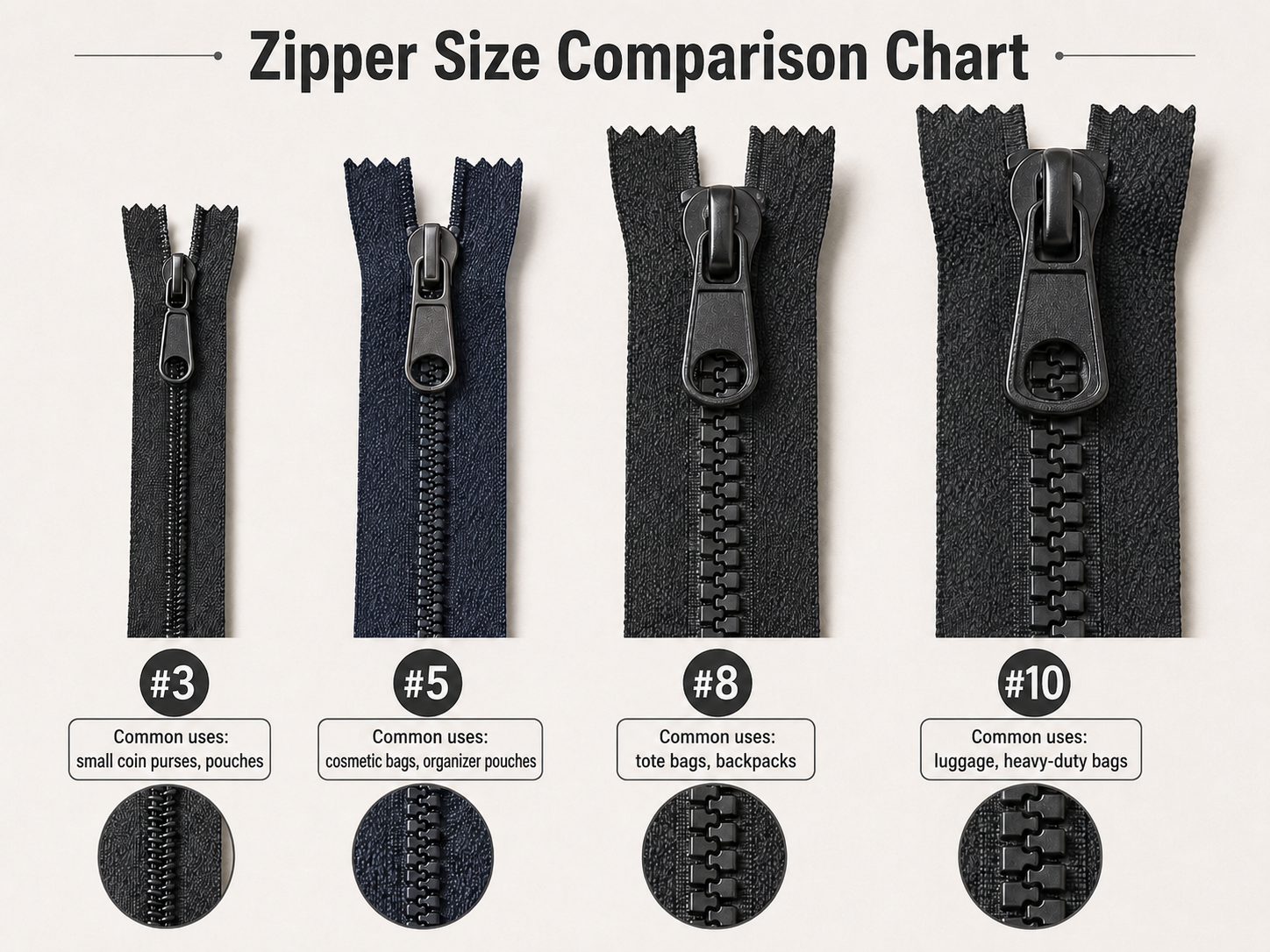
YKK offers standard coil zipper sizes from small No.2 and No.3 constructions through larger No.8 and No.10 options, depending on the required application.
Choosing Coil Zipper Size
Zipper size generally refers to the approximate chain width.
A higher number normally means a larger zipper structure.
For custom bags, a simplified selection direction is:
| Zipper Size |
General Application |
| No.3 |
Small cosmetic pouches and lightweight accessory bags |
| No.5 |
Tote bags, backpacks, travel pouches and general-purpose bags |
| No.8 |
Larger travel, sports and outdoor bags |
| No.10 |
Large-capacity bags and heavier-duty applications |
These are selection directions rather than fixed load standards.
A small No.3 zipper may look appropriate on a lightweight makeup pouch but be undersized for a large travel duffel.
The final choice should consider:
- Bag dimensions
- Opening length
- Material thickness
- Frequency of use
- Expected load
- Required appearance
2. Metal Zippers
Metal zippers use individual metal elements fixed to the zipper tape.
Common element materials include aluminum and copper alloys.
Metal zippers are frequently chosen for their visual and tactile qualities rather than minimum product weight.
Main Advantages
- Premium appearance
- Distinctive metal finish
- Strong visual branding value
- Suitable for fashion-oriented products
- Works well with canvas, denim and PU materials
Possible finishes include:
- Silver
- Gold
- Antique gold
- Gunmetal
- Black nickel
- Copper
Common Applications
Metal zippers are often suitable for:
- Canvas cosmetic bags
- Fashion totes
- Premium travel pouches
- Small handbags
- Lifestyle accessories
- Gift products
Limitations of Metal Zippers
Compared with coil zippers, metal zippers are generally:
- Heavier
- Less flexible
- More expensive
- More noticeable visually
- More sensitive to surface-finish requirements
Buyers should inspect:
- Element color consistency
- Oxidation or discoloration
- Sharp edges
- Slider smoothness
- Missing or misaligned teeth
- Surface scratches
For products requiring metal detection, buyers should also confirm compatibility with their inspection requirements rather than assuming all zipper finishes behave the same way.
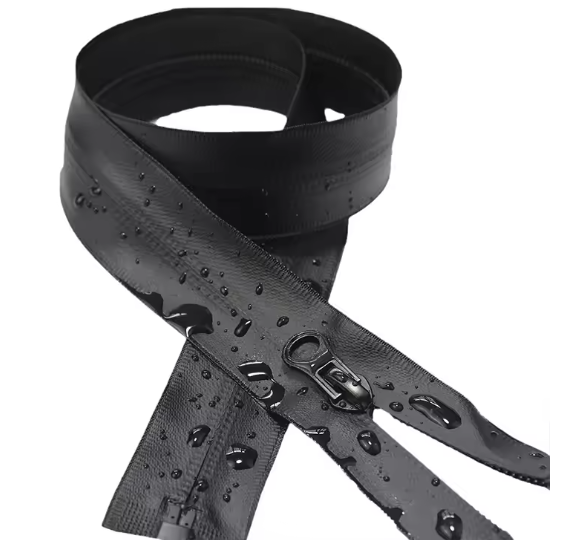
3. “Waterproof” and Water-Resistant Zippers
The term waterproof zipper is widely used in commercial sourcing, but it should be used carefully.
Many zippers sold for bags as “waterproof zippers” are more accurately described as:
- Water-resistant zippers
- Water-repellent zippers
- PU-coated coil zippers
- Laminated reverse-coil zippers
For example, YKK AQUAGUARD® is produced by laminating PU onto a coil zipper. YKK explicitly describes it as water repellent rather than waterproof or watertight.
This distinction is important for product claims.
Why Use a Water-Resistant Zipper?
A coated zipper can help reduce moisture entry around the zipper opening.
It is commonly considered for:
- Outdoor backpacks
- Sports bags
- Travel bags
- Cycling bags
- Technical pouches
- Selected cooler-bag pockets
The coated surface also provides a clean, technical appearance.
Limitations
A water-resistant zipper does not make the complete bag waterproof.
Water may still enter through:
- Stitch holes
- Bag seams
- Slider gaps
- Zipper ends
- Fabric panels
- Handle attachments
The complete bag construction must be tested if waterproof performance is required.
Coated Zipper Durability
PU-coated zipper surfaces should also be checked for:
- Scratching
- Film delamination
- Clouding
- Fold marks
- Heat damage
- Color changes
YKK notes that repeated bending can affect the appearance of coated film, and prolonged heat, humidity and UV exposure can also affect PU-coated zipper surfaces.
For bulk production, the zipper should be tested after it has been sewn into the actual bag.
4. Reverse Zippers
A reverse zipper is commonly a coil zipper installed so that the coil elements face toward the inside of the bag and the zipper tape becomes more visible from the outside.
This creates a cleaner exterior appearance.
Reverse construction is commonly used on:
YKK offers coil products specifically designed for reverse-use applications and lists bag and accessory applications among their intended uses.
Reverse Zipper Is Not Automatically Waterproof
This is an important purchasing distinction.
A standard reverse coil zipper and a coated water-resistant reverse zipper are not the same thing.
Standard Reverse Coil
Provides:
- Cleaner appearance
- Less visible coil
- Contemporary styling
But does not automatically provide significant moisture protection.
Coated Reverse Coil
Adds a PU or similar film to the exposed zipper surface.
This can provide:
- Improved water resistance
- Cleaner technical appearance
- Reduced exposure of the zipper coil
Therefore, buyers should not write only:
Reverse waterproof zipper
A clearer specification would be:
No.5 reverse coil zipper with PU-coated water-resistant surface, black tape and double sliders.
Single vs Double Zipper Pullers
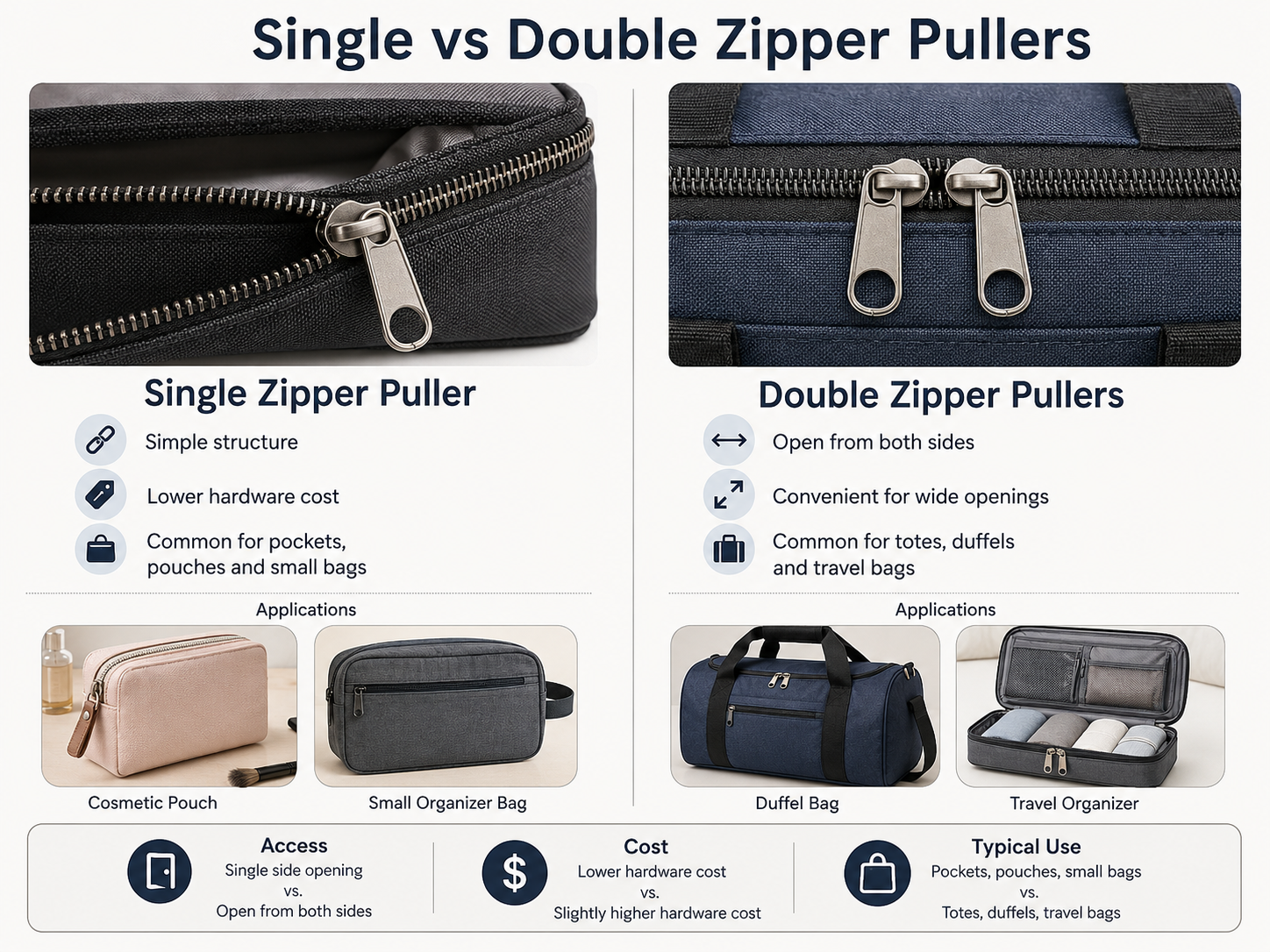
Custom bags may use either one or two sliders.
Single Slider
Suitable for:
- Small pouches
- Simple side pockets
- Short zipper openings
- Basic cosmetic bags
Double Slider
Suitable for:
- Backpacks
- Travel bags
- Wide-opening cosmetic cases
- Large storage compartments
Double sliders allow users to open the bag from either direction or position the opening in the center.
INITIGIFT’s existing Custom Plaid Cosmetic Bag, for example, uses a double zipper closure, while current backpack products also support single or double pullers according to the structure.
Zipper Puller Specifications
The slider and puller should be considered separately from the zipper chain.
Possible pullers include:
- Standard metal puller
- Cord puller
- Rubber puller
- Molded plastic puller
- Branded metal puller
- Custom-shape puller
- Extended webbing pull
Custom pullers can strengthen branding but may increase:
- MOQ
- Tooling cost
- Lead time
- Product weight
A standard slider combined with a branded cord or rubber attachment may be more practical for smaller orders.
Zipper Tape Color
Zipper tape can be:
- Matched to the body fabric
- Contrasting
- Matched to lining
- Coordinated with brand colors
Buyers should specify whether matching requires:
- A standard supplier color
- Closest available color
- Pantone reference
- Custom dyeing
Custom zipper tape colors may have a higher MOQ than standard stock colors.
This should be confirmed before the body fabric is approved.
Zipper Sewing and Installation
A good zipper can still perform poorly if it is installed incorrectly.
Important sewing points include:
- Straight zipper alignment
- Correct seam allowance
- No fabric caught in slider path
- Controlled tape tension
- Reinforcement at zipper ends
- Smooth corners
- Correct opening dimensions
If the zipper is sewn under excessive tension, the finished opening may:
- Wave
- Twist
- Become difficult to close
- Pull the surrounding fabric out of shape
For curved zipper openings, buyers should test the actual bag structure. Some coated zipper constructions are less suitable for tight curves because the slider can place additional stress on the laminated tape.
Zipper Quality Checks for Custom Bags
A practical bulk inspection should include:
Opening and Closing
Operate the zipper several times and check for:
- Jamming
- Excessive resistance
- Uneven movement
- Slider separation
Zipper Alignment
Check:
- Straight installation
- Matching left and right sides
- Correct opening length
- Stable zipper ends
Slider and Puller
Inspect:
- Puller attachment
- Surface finish
- Logo orientation
- Sharp edges
- Slider deformation
Tape and Elements
Check:
- Missing elements
- Damage
- Color consistency
- Tape distortion
- Coating defects
Finished-Bag Test
Test the zipper when the bag is loaded.
A zipper that operates smoothly on an empty bag may become difficult to close when:
- The compartment is full
- The fabric stretches
- Internal contents push against the opening
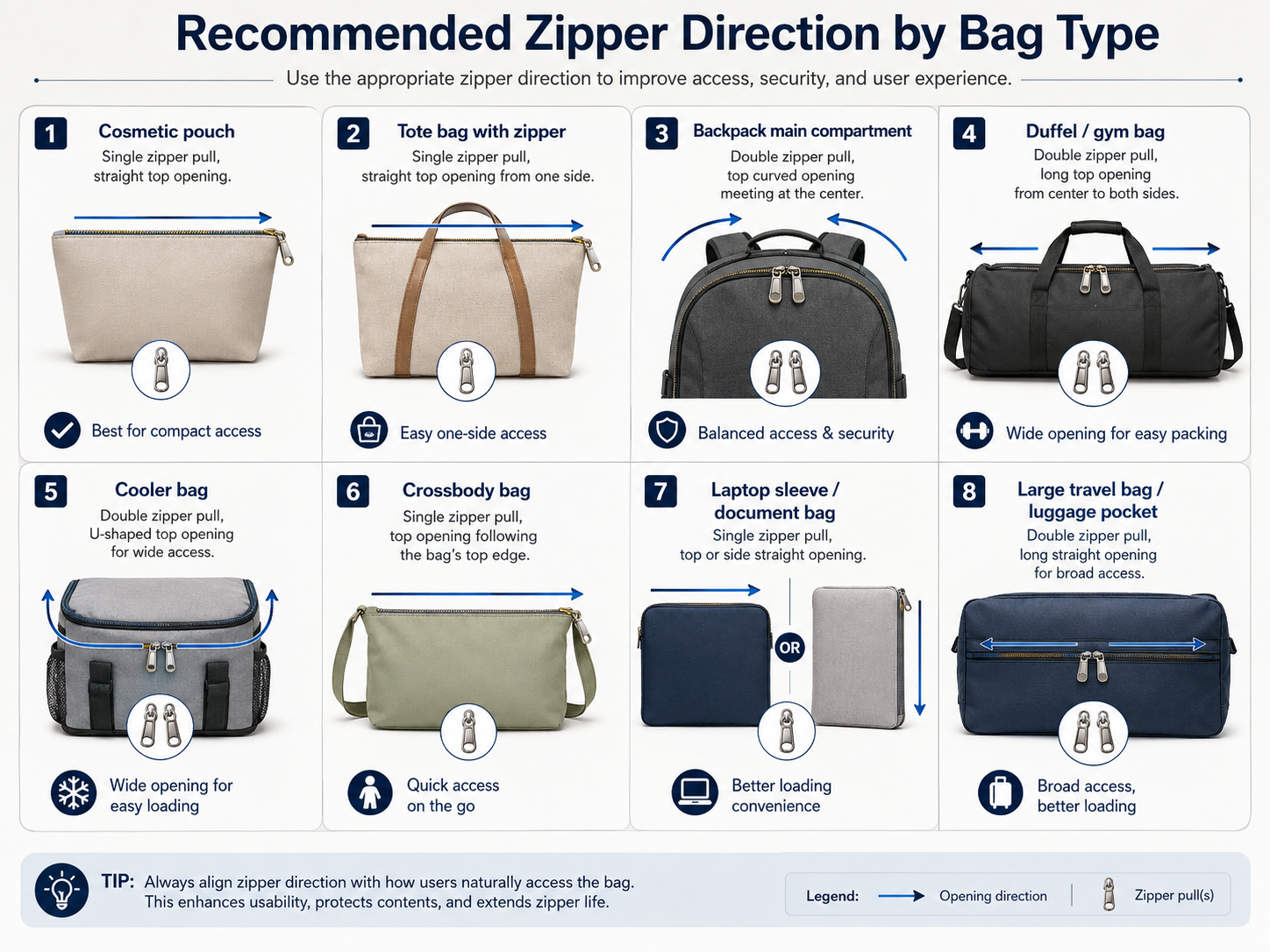
Recommended Zipper Direction by Bag Type
The correct zipper should be confirmed through sampling rather than selected only by product category.
Buyer Specification Checklist
A custom bag zipper specification should include:
- Zipper type
- Zipper size
- Chain length
- Coil or element material
- Standard or reverse orientation
- Coated or uncoated surface
- Tape color
- Element color
- Single or double sliders
- Slider type
- Puller style
- Custom logo requirement
- Opening direction
- Zipper end construction
- Intended contents
- Water-resistance requirement
- Testing requirements
For larger projects, an approved zipper sample should be included with the production reference materials.
Common Buyer Mistakes
Calling Every Coated Zipper Waterproof
Many coated zippers are water-resistant rather than fully watertight.
Treating Reverse and Waterproof Zippers as the Same Thing
Reverse describes orientation. Water resistance requires additional material or construction.
Choosing Zipper Size Only by Appearance
A very small zipper may not suit a large opening or heavily loaded bag.
Ignoring the Slider and Puller
The chain may be suitable while the slider, hardware or custom puller causes failure.
Testing the Zipper Only on an Empty Bag
The finished bag should also be tested under its intended load.
Selecting a Metal Zipper Only for Strength
Metal zippers are often selected for appearance and feel. Finished durability still depends on zipper size, installation and intended use.
How INITI Supports Custom Zipper Development
INITI custom bag projects can support:
- Coil zippers
- Metal zippers
- Reverse coil zippers
- Water-resistant coated zippers
- Custom zipper tape colors
- Single or double sliders
- Custom zipper pullers
- Contrast-color zippers
- Zipper reinforcement
- Sample testing
- Bulk production inspection
The zipper specification can be selected according to the bag material, dimensions, intended contents, moisture exposure and target price.
FAQ
What zipper is most commonly used for custom bags?
Coil zippers are widely used because they are lightweight, flexible and available in many sizes and colors.
Is a reverse zipper waterproof?
No. Reverse describes the orientation of the zipper. Additional coating or construction is required for improved water resistance.
Are waterproof zippers completely waterproof?
Not necessarily. Many commercial “waterproof” bag zippers are technically water-resistant or water-repellent. The complete bag must be tested if watertight performance is required.
Which is better, a metal or coil zipper?
It depends on the application. Coil zippers provide flexibility and lower weight, while metal zippers provide a more substantial and premium appearance.
What zipper size should buyers specify?
Small pouches often use smaller zipper sizes, while backpacks and travel bags generally require larger structures. Final selection should consider the opening length, bag size, material and expected use.
Conclusion
Zipper selection should be based on function rather than appearance alone.
The main differences are:
- Coil zippers provide flexibility and broad application.
- Metal zippers provide a heavier, more premium appearance.
- Water-resistant coated zippers improve moisture protection but are not automatically watertight.
- Reverse zippers hide the coil for a cleaner exterior but are not inherently waterproof.
Buyers should define zipper size, orientation, coating, slider, puller, tape color and intended performance before approving the final bag sample.
Inquiry Support
For a custom zipper bag project, provide:
- Bag type and dimensions
- Estimated quantity
- Preferred zipper type
- Required zipper color
- Single or double pullers
- Water-resistance requirements
- Custom puller or logo requirements
- Required colors
- Packaging requirements
If you have not finalized all details, you can first send your intended use and target quantity, and we can recommend a suitable specification.
Related Products
Related Blog Articles


 Hot News