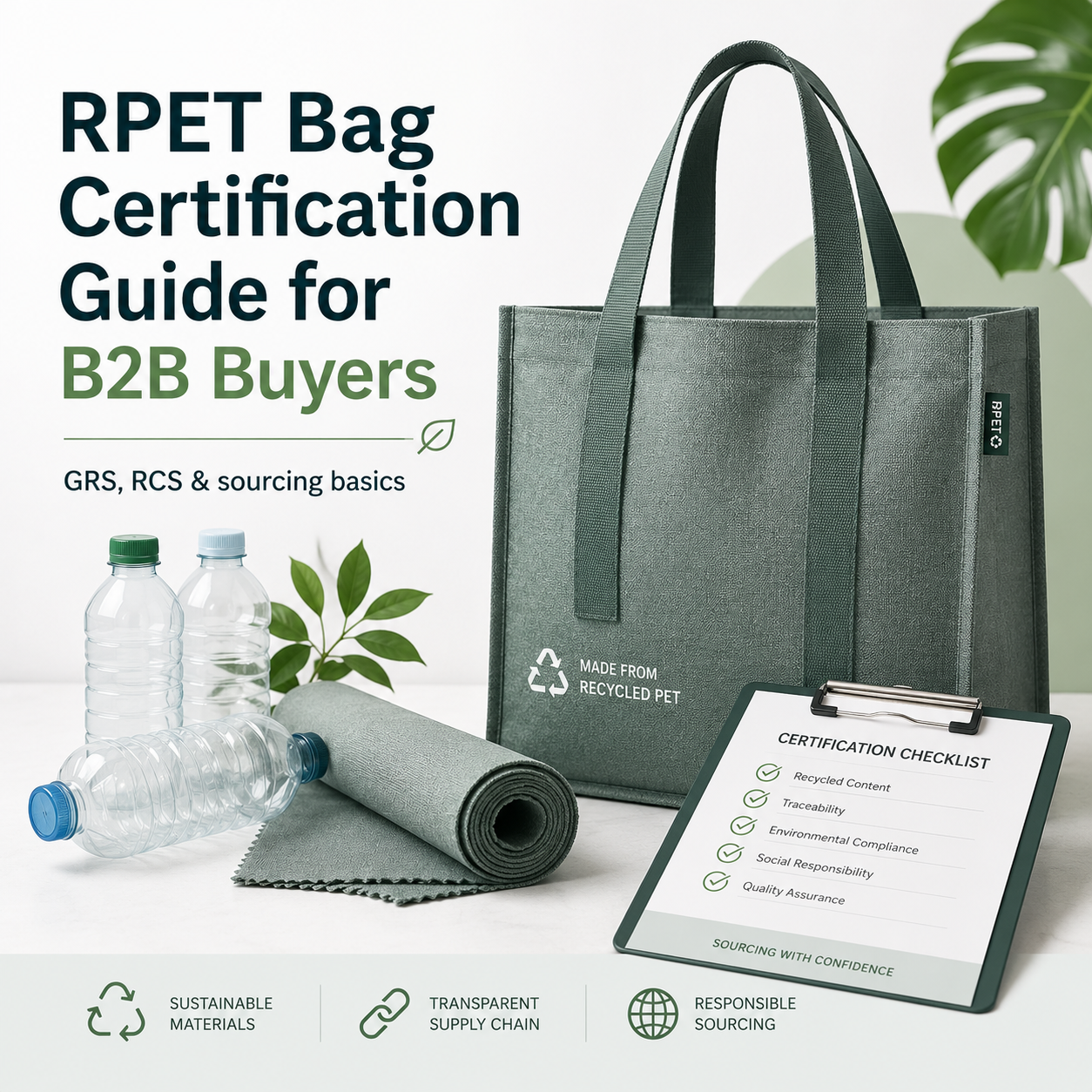
RPET Bag Certification Guide for B2B Buyers
RPET bags have become an important product category for supermarkets, retailers, corporate gifting companies, promotional buyers, travel brands, and sustainability-focused product programs.
However, purchasing an RPET bag is not as simple as asking:
“Is this bag made from recycled plastic bottles?”
For professional B2B sourcing, buyers may also need to understand:
- What recycled material standard applies
- Whether the supplier is within a certified supply chain
- What recycled content is being claimed
- Whether certification applies to the material, the supplier, or the final product
- What documents should accompany an order
- Whether a sustainability claim can be used in marketing
- How certification requirements affect material selection, production, and cost
The two most familiar Textile Exchange recycled-material standards have been the Global Recycled Standard (GRS) and Recycled Claim Standard (RCS). GRS verifies and tracks recycled raw materials through the supply chain while also adding processing requirements concerning social, environmental, and chemical criteria. RCS focuses on verifying and tracking recycled material through the supply chain, without the additional chemical, social, and environmental processing requirements found in GRS.
For B2B buyers, understanding this distinction helps avoid two common mistakes:
- Requesting certification that the project does not actually need.
- Assuming that any product described as “RPET” automatically qualifies for a certified product claim.
This guide explains how to evaluate certification requirements before starting an RPET bag project.
1. What Does RPET Mean?
RPET generally refers to recycled PET material. In bag production, recycled PET can be processed into polyester fiber and then manufactured into woven, knitted, or non-woven materials suitable for products such as:
Certification adds a separate layer of verification and traceability. In other words:
“Made with recycled polyester” is a material statement. A certified recycled-material claim requires the relevant standard, supply-chain control, and claim requirements to be met.
GRS and RCS were developed to verify and track recycled materials through supply chains rather than relying only on unsupported supplier declarations.
2. Why Certification Matters to B2B Buyers
For a small promotional order, a buyer may only need a functional reusable bag made from a recycled-material fabric.
For other projects, certification may be a purchasing requirement.
Common examples include:
- Supermarket reusable bag programs
- International retail chains
- Corporate sustainability campaigns
- Branded promotional products
- Licensed product programs
- Retail collections with recycled-content claims
- Projects requiring material traceability
- Buyers with internal responsible-sourcing policies
The value of certification is not that it automatically makes one bag structurally better than another. Instead, it provides a framework for verifying specific claims about recycled content and supply-chain traceability.
That distinction is important.
A strong, well-sewn RPET bag and a certified RPET bag answer two different buyer questions:
Product Quality Question
Is the bag durable, correctly sized, well printed, and suitable for the intended use?
Certification Question
Can the recycled material and related claim be verified according to the applicable standard and supply chain?
Professional sourcing should evaluate both.
3. What Is GRS?
The Global Recycled Standard is a Textile Exchange standard that verifies and tracks recycled raw materials through the supply chain. In addition to traceability, it includes processing criteria related to social requirements, environmental principles, and chemical restrictions.
Under the current GRS framework, products with at least 20% recycled content may be handled within the GRS system for business-to-business purposes, while product-specific consumer-facing GRS labeling has required at least 50% recycled content.
For bag buyers, GRS is often considered when the project requires:
- Recycled material verification
- Supply-chain traceability
- Stronger sustainability positioning
- More structured environmental and social processing requirements
- Approved product claims or labeling, where applicable
4. What Is RCS?
The Recycled Claim Standard verifies and tracks recycled raw materials through the supply chain.
Unlike GRS, RCS does not add broader chemical, social, or environmental processing requirements beyond recycled-material integrity and chain of custody.
Under the RCS framework, RCS 100 covers products containing at least 95% certified recycled material, while RCS Blended covers products containing 5–94% certified recycled material.
From a buyer's perspective, RCS may be appropriate when the primary goal is:
- Verification of recycled content
- Recycled-material traceability
- A simpler recycled-material certification requirement
rather than the broader processing criteria associated with GRS.
GRS vs RCS: Quick Comparison
| Buying Question |
GRS |
RCS |
| Tracks recycled material |
Yes |
Yes |
| Chain-of-custody approach |
Yes |
Yes |
| Additional social processing requirements |
Yes |
No |
| Additional environmental processing requirements |
Yes |
No |
| Chemical processing criteria |
Yes |
No |
| Best suited to |
Broader sustainability and traceability requirements |
Recycled-content verification and traceability |
GRS is the more rigorous of the two standards because it combines recycled-material traceability with additional social, environmental, and chemical requirements.
5. Does Every RPET Bag Project Need GRS?
No.
This is one of the most important sourcing decisions for B2B buyers.
The correct certification requirement depends on:
- The buyer's sustainability policy
- Retailer requirements
- Product labeling plans
- Target market
- Material composition
- Supply-chain structure
- Marketing claims
- Budget
A Project May Need GRS When:
- The retailer specifically requires it
- The brand wants verified recycled-material traceability
- The project requires eligible GRS product claims
- The buyer's internal procurement specification names GRS
- A corporate customer requires certified recycled products
A Project May Not Need GRS When:
- The customer only requires a reusable bag
- The buyer does not intend to make a certified product claim
- The project specification only asks for recycled-content material without a certification requirement
- Certification would add complexity without serving a buyer, legal, contractual, or marketing requirement
The practical rule is:
Do not add certification merely as a decorative marketing term. Define the required claim and documentation before material sourcing begins.
6. The Three Questions Buyers Should Ask Before Ordering
Before asking a supplier for a “GRS bag,” clarify three things.
Question 1: What Exactly Do We Want to Claim?
Possible intentions are very different:
- “Reusable shopping bag”
- “Made with recycled polyester”
- “Contains X% recycled material”
- “GRS certified recycled material”
- A standard-specific consumer-facing claim or label
These statements should not be treated as interchangeable.
Textile Exchange maintains specific claims and labeling policies for standards-based communication, so buyers should align product wording with the actual certification status and approved claim requirements.
Question 2: Which Parts of the Product Need to Be Certified?
A bag may contain:
- Main body fabric
- Webbing handles
- Sewing thread
- Zipper
- Binding
- Buckles
- Labels
- Lamination
- Lining
The buyer needs to determine whether the certification requirement applies to:
- Main fabric only
- Specific components
- A defined product composition
- The complete certified product scope
This should be agreed before sampling and costing.
Question 3: What Documents Does the Buyer Need?
The required document level may depend on:
- Buyer policy
- Customer contract
- Retail program
- Order structure
- Certification claim
- Supply-chain arrangement
Professional buyers should define documentation expectations before ordering instead of asking for them only after goods are completed.
7. Scope Certificate vs Transaction Certificate
This is one of the most misunderstood parts of certified RPET sourcing.
Scope Certificate
A Scope Certificate generally demonstrates that an organization has been certified for specified standards, processes, materials, or product categories within its approved certification scope.
From a buyer's perspective, this helps answer:
Is this company certified for the relevant scope?
But that is not the same as proving that one specific commercial shipment was transferred as certified material.
Transaction Certificate
Transaction Certificates are part of the supply-chain traceability mechanism used to document certified material movement through applicable transactions. Textile Exchange's current and transitioning standards systems use certification and transaction documentation as part of their chain-of-custody and traceability infrastructure.
From a buyer's perspective, this helps answer a different question:
Does the relevant certified transaction documentation support this order or material transfer?
Therefore:
A supplier showing a general certification document is not automatically the same as providing transaction-level traceability for every order.
Buyers should align documentation requirements with the actual purchasing contract and certification claim.
8. How Buyers Should Verify an RPET Bag Supplier
Certification should not replace supplier evaluation.
A professional buyer should assess several layers.
Layer 1: Certification Scope
Check whether:
- The certificate is valid
- The organization name matches the supplier involved
- Relevant materials or processes are covered
- The certification status fits the intended project
Layer 2: Product Capability
Check whether the supplier can actually manufacture the required:
- Bag structure
- Material thickness
- Printing method
- Handles
- Gussets
- Zippers
- Pockets
- Packaging
A supplier can understand certification but still lack product-development capability.
Layer 3: Bulk Production Control
Evaluate:
- Material batch consistency
- Color control
- Cutting accuracy
- Sewing quality
- Logo consistency
- Load-bearing construction
- Final inspection
Layer 4: Documentation Process
Confirm whether the supplier understands the project's:
- Certified material requirements
- Traceability documentation
- Claims restrictions
- Shipping documentation
- Repeat-order requirements
The best RPET supplier for a B2B project is not necessarily the supplier that uses the most sustainability terminology. It is the one that can connect material requirements, certification controls, product engineering, and stable mass production.

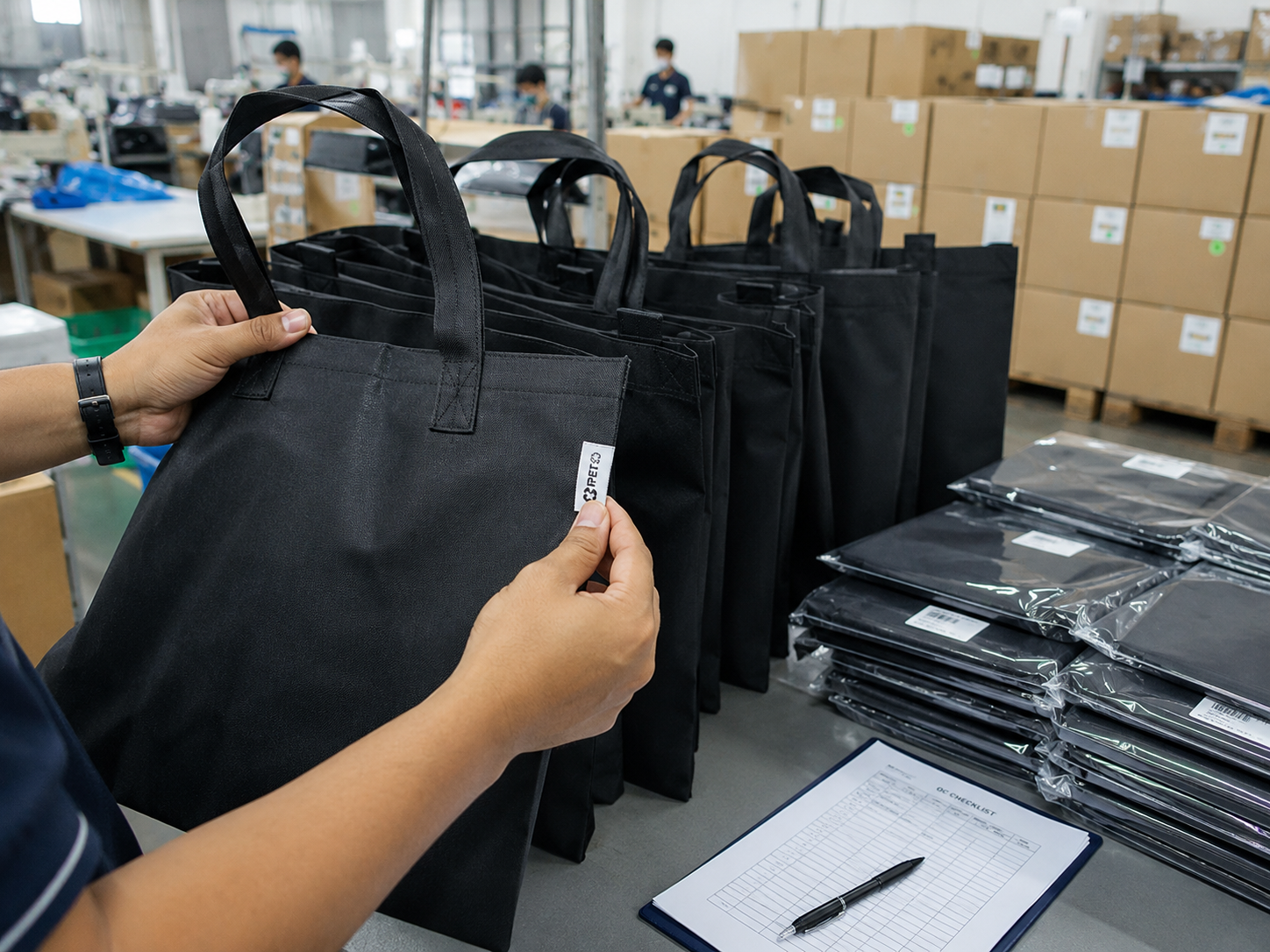
9. Certification Does Not Replace Product Testing
A certification standard and a product-quality inspection solve different problems.
For RPET bags, buyers should still test or inspect:
- Fabric weight
- Material thickness
- Color difference
- Stitching strength
- Handle reinforcement
- Zipper performance
- Print adhesion
- Size tolerance
- Load suitability
- Packaging quality
For example, certification can support recycled-material traceability, but it does not automatically determine:
- Whether a shopping bag handle is strong enough
- Whether a foldable bag folds compactly
- Whether a cooler bag leaks
- Whether a print cracks
- Whether a zipper works smoothly
Therefore, certification and quality control should work together.
10. What About OEKO-TEX STANDARD 100?
OEKO-TEX STANDARD 100 is different from GRS and RCS.
It is a label for textiles tested for harmful substances, covering textile safety from yarn through finished products.
For an RPET bag buyer:
- GRS/RCS-related systems: focus on recycled material verification and traceability.
- OEKO-TEX STANDARD 100: focuses on testing textile products for harmful substances.
These standards answer different sourcing questions.
A buyer should not assume that:
“OEKO-TEX certified” automatically proves recycled content.
or that:
“GRS certified” automatically means the same thing as harmful-substance testing under STANDARD 100.
The certification requirement should match the actual procurement objective.
11. What About ISO 14001?
ISO 14001 is an environmental management system standard for organizations. The current ISO 14001:2026 edition provides requirements for environmental management systems and supports organizations in managing environmental impacts systematically.
For RPET sourcing, this means ISO 14001 should not be treated as a substitute for product-level recycled-material traceability.
The distinction is:
| Requirement |
Main Focus |
| GRS / RCS |
Recycled material and chain of custody |
| OEKO-TEX STANDARD 100 |
Harmful-substance testing of textiles |
| ISO 14001 |
Organizational environmental management system |
A serious procurement specification should use the correct tool for the correct objective.
12. Common Certification Mistakes Made by Buyers
Mistake 1: Asking for “GRS Material” After the Sample Is Approved
If the initial sample was developed using a standard fabric and the buyer later requests a certified material supply chain, it may affect:
- Material availability
- Color
- Minimum production planning
- Cost
- Documentation
- Lead time
Certification requirements should be confirmed during project planning.
Mistake 2: Assuming Every Component Is Automatically Covered
A bag can contain multiple materials and accessories. Buyers should define what material or product-level certification requirement applies rather than assume that one certified main fabric automatically answers every product-composition question.
Mistake 3: Using Certification Logos Without Checking Claim Rules
Claims and labels are governed by the relevant standards' policies. Under Textile Exchange's current transition program, claims and labeling requirements are also moving toward the Materials Matter framework.
Marketing teams should coordinate with procurement and compliance teams before finalizing:
- Hangtags
- Bag printing
- Product descriptions
- Websites
- Retail packaging
Mistake 4: Choosing Certification Before Defining the Business Need
The correct order is:
Application → Buyer Requirement → Claim Requirement → Certification Requirement → Material Selection → Sample Development
not:
Choose a certification logo first → design the product around it later.
13. RPET Certification Requirements by Application
Supermarket Reusable Bag Programs
Buyers may care about:
- Verified recycled content
- Large-volume consistency
- Durable handles
- Load performance
- Repeat-order stability
- Approved sustainability communication
Recommended approach:
- Confirm retailer certification policy.
- Define recycled-content requirements.
- Confirm documentation.
- Select suitable RPET fabric.
- Develop size and load structure.
- Test printing and handles.
- Approve bulk production controls.
Corporate Promotional Projects
The buyer should first determine whether the project requires:
- Certified recycled material
- A general reusable product
- A specific recycled-content claim
- Sustainability reporting documentation
For corporate programs, the marketing message should match the evidence available.
Retail Product Collections
Retail brands should consider certification alongside:
- Hand feel
- Surface finish
- Color range
- Print quality
- Retail packaging
- Product price point
Certification is one part of the product value proposition, not the complete value proposition.
Foldable RPET Bags
For foldable products, buyers should also evaluate:
- Fabric weight
- Folded dimensions
- Pouch construction
- Handle reinforcement
- Print compatibility
A fabric can meet certification requirements but still be unsuitable for a compact foldable structure if it is too stiff or heavy for the intended design.
RPET Cooler Bags
For cooler bags, recycled-material requirements must be coordinated with the complete multi-layer structure, which may include:
- Outer fabric
- Insulation
- Inner lining
- Foam
- Zipper
- Webbing
- Binding
These projects require more careful component planning than a basic single-layer tote.
14. Current 2026 Update: Materials Matter Standard Transition
B2B buyers planning long-term recycled-material sourcing should be aware of an important standards transition.
Textile Exchange published the final Materials Matter Standard criteria on December 12, 2025. The standard becomes effective on December 31, 2026 and mandatory from December 31, 2027 for the specified transition pathway. Textile Exchange states that recycled materials currently covered through GRS and RCS are within the scope of this transition.
Textile Exchange's published transition timeline also states that claims and labels are to transition to the Materials Matter system by June 30, 2029.
For buyers sourcing in 2026 and beyond, the practical advice is:
- Do not assume certification requirements will remain static for multi-year programs.
- Ask suppliers about current certification status and transition planning.
- Review updated Textile Exchange policies when launching new long-term collections.
- Avoid creating long-life packaging artwork based on outdated claim assumptions.
- Coordinate compliance review before printing certification-related claims.
For projects with delivery schedules extending into 2027–2029, transition planning should be considered early rather than after production begins.
15. A Practical Certification Decision Framework
| Buyer Situation |
Recommended Starting Point |
| Need a reusable bag, no recycled claim |
Product quality and material specification |
| Need verified recycled content |
Review RCS or applicable recycled-material standard requirements |
| Need stronger recycled traceability plus broader processing criteria |
Review GRS requirements |
| Need harmful-substance testing |
Review OEKO-TEX STANDARD 100 or buyer-specific testing requirements |
| Need factory environmental management system |
Review ISO 14001 requirements |
| Multi-year program after 2026 |
Review Materials Matter transition requirements |
The final certification decision should always follow the buyer's own contractual, compliance, retailer, and marketing requirements.
16. Buyer Checklist for Certified RPET Bag Projects
Before placing an RPET bag order, buyers should confirm:
Certification Objective
Understand whether the project needs:
- Recycled-content verification
- Chain-of-custody traceability
- Product-specific claims
- Retailer compliance
- Internal sustainability reporting
Product Specification
Confirm:
- RPET material type
- Fabric weight
- Bag dimensions
- Handles
- Gusset
- Closure
- Pockets
- Printing
Component Scope
Review:
- Main fabric
- Lining
- Handles
- Zippers
- Binding
- Labels
Quality Requirements
Define inspection points for:
- Material consistency
- Sewing
- Color
- Print
- Dimensions
- Load performance
- Packaging
Claims and Artwork
Review before printing:
- Product wording
- Hangtags
- Certification references
- Website descriptions
- Retail packaging
Recommended Products
Suitable for supermarkets, retailers, reusable shopping programs, and promotional campaigns.
Suitable for travel, retail promotions, compact shopping programs, and corporate gifts.
Suitable for supermarkets and large-capacity retail applications requiring a durable, easy-clean surface.
Suitable for events, sports programs, school projects, giveaways, and promotional campaigns.
Suitable for grocery, picnic, food delivery, retail promotions, and outdoor programs.
Why Work With Us
Certified-material projects require coordination between material sourcing, documentation, product design, sampling, printing, production control, and export delivery.
With 16+ years of manufacturing experience, two factory buildings, and project experience with global brands and Fortune 500 companies, we support custom RPET bag projects from initial material selection through sample development, structure optimization, logo testing, bulk production, quality control, and final packing.
Our quality and compliance capabilities include GRS-related project support, SEDEX, DISNEY, HIGG, and ISO9001 systems, together with experience developing products in RPET, polyester, nylon, cotton, canvas, jute, felt, Tyvek, PVC, TPU, and other functional materials.
For RPET projects, we focus on the issues B2B buyers actually need to control:
- Correct material specification
- Certification requirement confirmation
- Supply-chain coordination
- Fabric consistency
- Color control
- Handle strength
- Logo compatibility
- Bulk quality
- Repeat-order stability
The objective is to help buyers connect sustainability requirements with a bag that is commercially suitable and consistently manufactured.
FAQ
1. Does every RPET bag need GRS certification?
No. Certification requirements depend on buyer policy, intended claims, target market, retailer requirements, and project specifications.
2. What is the main difference between GRS and RCS?
Both standards verify and track recycled materials through supply chains, but GRS adds social, environmental, and chemical processing requirements beyond the recycled-content traceability focus of RCS.
3. Is a supplier certificate enough to prove every shipment is certified?
A supplier's certification scope and transaction-level documentation serve different purposes. Buyers should define the documentation required for the specific order and claim.
4. Can an RPET bag use different materials for handles and accessories?
Yes, but certification and claim requirements should be assessed according to the actual product composition and applicable standard rules.
5. Does GRS certification guarantee bag durability?
No. GRS addresses recycled-material traceability and additional processing criteria; product durability still needs to be controlled through material specification, construction, testing, and quality inspection.
6. Is OEKO-TEX STANDARD 100 the same as GRS?
No. STANDARD 100 concerns testing textiles for harmful substances, while GRS concerns recycled-material traceability plus additional processing criteria.
7. Is GRS being replaced?
Textile Exchange is transitioning GRS and RCS-covered recycled materials into the Materials Matter Standard system. The new standard becomes effective on December 31, 2026, with later mandatory transition milestones.
Conclusion
For B2B buyers, RPET certification should be treated as a sourcing and traceability requirement, not simply a marketing label.
A successful certified RPET bag project requires alignment between:
- The buyer's intended claim
- Recycled-content requirement
- Certification standard
- Supplier scope
- Transaction traceability
- Product specification
- Quality control
- Marketing communication
GRS and RCS have served different roles in recycled-material verification: GRS combines traceability with broader social, environmental, and chemical processing criteria, while RCS focuses on recycled-material verification and chain of custody.
At the same time, buyers planning future programs should prepare for Textile Exchange's transition toward the Materials Matter Standard beginning at the end of 2026.
The best sourcing decision is therefore not:
“Which certification sounds better?”
It is:
“What do we need to verify, what do we intend to claim, and what supply-chain evidence is required to support that claim?”
Once those questions are clear, material selection, product development, supplier qualification, and bulk production become much easier to manage.
Related Topics