RPET vs Nylon Foldable Bags: Which Is Better?
Foldable bags are widely used by supermarkets, retail brands, travel companies, promotional agencies, corporate buyers, and lifestyle brands.
Their appeal is simple: the bag can provide useful carrying capacity when opened while remaining compact enough to fit into a handbag, backpack, car compartment, or luggage when folded.
However, one of the first decisions B2B buyers face is material selection.
Two common options are:
At first glance, both materials can produce lightweight and compact foldable bags. But their sourcing story, surface appearance, weight, hand feel, durability, printing compatibility, price structure, and marketing value can be different.
There is no single material that is always better.
RPET is usually more suitable for sustainability-focused retail and promotional programs, while nylon is often selected when lightweight performance, compact folding, softness, and functional durability are the priority.
This guide explains the differences so buyers can select the right material for their project.
1. What Is an RPET Foldable Bag?
RPET stands for recycled polyethylene terephthalate.
For bag manufacturing, recycled PET materials can be processed into polyester fibers and woven into fabrics suitable for reusable shopping bags, tote bags, drawstring bags, storage bags, and foldable bags.
An RPET foldable bag may look similar to a conventional polyester shopping bag. The major difference is the recycled material sourcing and the sustainability communication associated with the product.
Common RPET foldable bag styles include:
- Foldable supermarket bags
- Packable shopping totes
- Attached pouch bags
- Inner-pocket foldable bags
- Drawstring storage pouch bags
- Custom printed promotional bags
- Recycled shopping bags
- Travel backup totes
RPET bags are often selected for:
- Sustainability campaigns
- Retail environmental programs
- Supermarket reusable bag projects
- Corporate sustainability gifts
- Promotional campaigns
- Brand merchandise
- Events and exhibitions
For buyers, the main value of RPET is not simply appearance. It is the combination of practical reusable function and a recycled-material brand story.
2. What Is a Nylon Foldable Bag?
Nylon is a synthetic material widely used in bags, luggage, outdoor products, sports accessories, and lightweight travel products.
For foldable shopping bags, nylon is valued because the fabric can be:
- Lightweight
- Flexible
- Soft
- Compact when folded
- Durable for repeated carrying
- Suitable for different coatings and finishes
Nylon foldable bags are commonly used for:
- Travel shopping
- Everyday carry
- Outdoor activities
- Lifestyle retail
- Sports brands
- Promotional gifts
- Fashion accessories
- Reusable shopping programs
The material is particularly useful when the product needs to fold into a very small pouch.
A lightweight nylon bag can provide a soft hand feel and compact packed volume while still maintaining useful carrying capacity after opening.
3. RPET vs Nylon Foldable Bags: Quick Comparison
| Comparison Point |
RPET Foldable Bag |
Nylon Foldable Bag |
| Material Positioning |
Recycled polyester |
Functional synthetic fabric |
| Sustainability Story |
Stronger |
Depends on material source |
| Weight |
Lightweight |
Often very lightweight |
| Folding Performance |
Good |
Excellent |
| Compact Packed Size |
Good |
Usually excellent |
| Surface Feel |
Polyester-like |
Softer and smoother |
| Durability |
Good |
Very good |
| Abrasion Performance |
Good |
Often strong |
| Printing |
Very suitable |
Suitable, depending on coating |
| Color Options |
Wide |
Wide |
| Retail Positioning |
Eco, retail, promotion |
Travel, lifestyle, functional |
| Typical Cost Position |
Competitive |
Depends strongly on fabric grade |
| Certification Demand |
Often important |
Depends on buyer project |
The basic buying conclusion is:
Choose RPET when recycled-material communication and sustainability positioning are important.
Choose nylon when lightweight construction, compact folding, soft feel, and functional performance are the main priorities.
4. Material Source and Brand Positioning
The biggest commercial difference between RPET and standard nylon is often the story behind the material.
RPET Positioning
RPET is commonly selected when the project needs to communicate:
- Recycled material use
- Sustainability goals
- Reduced reliance on virgin materials
- Environmental campaign messaging
- Responsible retail concepts
- Corporate ESG-related promotional projects
For supermarkets and brand owners, this material story can be used across:
- Product labels
- Hangtags
- Packaging
- Website content
- Promotional campaigns
- Corporate sustainability reports
- Event communication
However, buyers should manage sustainability claims carefully.
Material claims should match the actual fabric specification, recycled content, certification scope, and documentation available for the project.
Nylon Positioning
Nylon is normally selected for functional product value rather than primarily for recycled-material marketing.
It can support positioning such as:
- Lightweight
- Packable
- Travel-friendly
- Durable
- Outdoor-oriented
- Modern lifestyle
- Everyday carry
For travel brands, outdoor companies, sports brands, and lifestyle retailers, this functional positioning may be more valuable than a recycled-material story.
5. Weight and Folding Performance
Foldable bags need to perform well in two forms:
- As a compact folded product
- As a useful full-size shopping bag
This is where nylon often has an advantage.
Lightweight nylon fabrics can fold into very compact storage pouches. They are suitable for consumers who want to carry a backup shopping bag inside another bag.
RPET foldable bags also provide good folding performance, but the final packed size depends on:
- Fabric weight
- Fabric weave
- Coating
- Bag dimensions
- Pocket structure
- Handle construction
- Number of layers
A heavy RPET fabric may create a larger folded package than a lightweight nylon fabric.
However, very lightweight fabric is not always automatically better. Buyers should also consider:
- Load capacity
- Handle comfort
- Sewing strength
- Fabric distortion
- Perceived quality
The correct material should balance compact size and practical use.
6. Strength and Durability
Both RPET and nylon can produce durable reusable bags, but durability depends on more than material name.
Important factors include:
- Fabric density
- Yarn specification
- Weave structure
- Fabric thickness
- Coating
- Seam construction
- Handle reinforcement
- Edge binding
- Bag size
- Carrying weight
RPET Foldable Bags
RPET polyester fabric can provide stable performance for:
- General shopping
- Supermarket use
- Promotional programs
- Retail merchandise
- Daily carrying
The correct material weight and stitching structure should be selected according to intended load.
Nylon Foldable Bags
Nylon is commonly associated with flexible and durable performance. It can be particularly useful for:
- Travel
- Outdoor use
- Frequent folding
- Daily carry
- Compact storage products
For either material, buyers should not evaluate strength based only on visual appearance.
A successful project requires testing of:
- Fabric
- Seams
- Handles
- Pouch structure
- Connection points
7. Handle Strength Is as Important as Fabric Strength
One common purchasing mistake is focusing only on fabric thickness.
In many foldable bag projects, the weakest point may be:
- Handle seams
- Pocket connection
- Bag side seams
- Bottom corners
- Binding areas
A stronger fabric cannot solve weak sewing construction.
For medium and large foldable bags, buyers should evaluate:
Handle Width
Wider handles can improve comfort when carrying heavier products.
Handle Length
Confirm whether the bag is designed for:
- Hand carrying
- Shoulder carrying
- Both
Reinforcement
Depending on the bag structure, reinforcement may include:
- Box stitching
- Cross stitching
- Double stitching
- Reinforced connecting seams
- Binding
Material choice and structural engineering should be evaluated together.
8. Printing and Logo Customization
Both RPET and nylon foldable bags can support brand customization.
Common methods include:
- Screen printing
- Heat transfer
- Sublimation
- Digital printing
- Woven labels
- Rubber patches
- Custom pouch printing
However, the correct printing method depends on the actual fabric surface.
RPET Printing
RPET polyester fabric can support different printing methods depending on:
- Surface coating
- Fabric texture
- Artwork complexity
- Number of colors
- Order volume
It is suitable for:
- Retail logos
- Supermarket branding
- Corporate campaign graphics
- Environmental messaging
Nylon Printing
Nylon surface treatments vary widely.
Before mass production, buyers should test:
- Ink adhesion
- Color appearance
- Logo edges
- Heat sensitivity
- Fabric coating compatibility
For both materials, logo testing on actual production fabric is better than approving only a digital mock-up.
9. Sustainability: Is RPET Always Better?
From a marketing and material sourcing perspective, RPET has a clearer recycled-material positioning than conventional virgin nylon.
However, buyers should avoid oversimplifying the decision.
The environmental value of a reusable bag also depends on:
- Material source
- Bag weight
- Manufacturing process
- Product durability
- Transportation
- Packaging
- Number of actual reuses
- End-of-life management
A reusable bag that is durable and used frequently can provide more practical value than a poorly designed bag that is discarded quickly.
For sustainability-focused projects, buyers should ask suppliers about:
- Recycled content
- Material traceability
- Certification availability
- Factory documentation
- Printing and coating systems
- Product durability
- Packaging reduction options
For certified RPET projects, GRS-related documentation may be important depending on the buyer's requirements and supply chain arrangement.
10. Cost Differences Between RPET and Nylon
There is no universal price difference that applies to every RPET and nylon project.
Cost depends on:
- Material grade
- Fabric weight
- Fabric density
- Coating
- Printing
- Bag dimensions
- Pouch structure
- Handle structure
- Packaging
- Testing requirements
- Certification requirements
A basic nylon foldable bag and a certified custom RPET project can have very different cost structures.
Similarly, premium nylon fabrics can cost more than standard RPET polyester.
Therefore, buyers should not ask only:
Which material is cheaper?
A better question is:
Which material provides the correct balance of function, brand positioning, compliance, and target price?
11. RPET vs Nylon for Supermarkets
For supermarket projects, RPET is often a strong choice when the retailer wants:
- Recycled material communication
- Environmental campaigns
- Reusable shopping programs
- Custom sustainability labels
- Large retail distribution
The bag can be developed with:
- Attached pouch
- Supermarket logo
- Custom promotional graphics
- Recycled-content labels
- Barcode packaging
- Retail hangtags
Nylon may be selected when the supermarket wants a more lightweight, compact, and lifestyle-oriented foldable bag.
For example, premium grocery chains may offer compact nylon bags as a reusable retail accessory rather than only as low-cost shopping packaging.
12. RPET vs Nylon for Promotional Campaigns
For promotional buyers, the material should match the campaign message.
Choose RPET When the Campaign Focuses on:
- Sustainability
- Environmental awareness
- Recycling
- Corporate responsibility
- Retail reuse programs
- Eco events
Choose Nylon When the Campaign Focuses on:
- Travel
- Sports
- Outdoor lifestyles
- Convenience
- Lightweight products
- Premium functional gifts
The best promotional product is one that matches the campaign story rather than simply using the cheapest material.
13. RPET vs Nylon for Travel Use
For travel products, nylon often has several practical advantages.
It can be used for foldable bags that need to:
- Pack small
- Stay lightweight
- Fit inside luggage
- Work as a backup shopping bag
- Carry travel essentials
- Handle repeated folding
RPET can also work well for travel products, especially for brands that want a recycled-material product collection.
The decision depends on whether the buyer prioritizes:
Compact functional performance → nylon
or
Recycled material positioning → RPET
14. Which Material Is Better for Retail Brands?
Retail brands should evaluate more than material performance.
The bag should fit the complete brand system.
Consider:
Target Customer
Does the customer prioritize:
- Sustainability?
- Lightweight convenience?
- Travel use?
- Premium appearance?
- Low price?
Retail Price
Is the product:
- A free promotional gift?
- A gift with purchase?
- A retail accessory?
- A premium reusable bag?
Branding Message
Does the campaign emphasize:
- Recycled materials?
- Travel convenience?
- Outdoor performance?
- Everyday practicality?
Product Collection
Will the foldable bag be sold alongside:
- RPET totes?
- Travel accessories?
- Sports bags?
- Shopping bags?
- Gift products?
The right material should strengthen the wider collection rather than function as an isolated item.
15. Which Material Is Better for Large-Volume Orders?
For large-volume projects, buyers should consider supply chain stability in addition to material choice.
Important purchasing factors include:
- Fabric availability
- Dye lot consistency
- Printing consistency
- Sewing capacity
- Certification requirements
- Sample approval
- Production lead time
- Quality inspection
- Export packing
For RPET projects, buyers may need stronger material documentation and certification control.
For nylon projects, buyers should carefully confirm fabric grade, denier, coating, weight, color, and surface feel, because different nylon fabrics can produce very different final products.
A detailed specification sheet is essential for both materials.
Buyer Decision Guide
Choose RPET Foldable Bags If:
- Your project requires recycled-material positioning
- Sustainability communication is central to the campaign
- The bag is for supermarkets or retail reusable programs
- Corporate buyers require recycled material documentation
- The product will include environmental marketing messages
- You want to build an eco-oriented product collection
Choose Nylon Foldable Bags If:
- Very compact folding is important
- Lightweight performance is a priority
- The product is for travel or outdoor use
- You want a soft and flexible hand feel
- The bag will be carried daily as a backup tote
- Functional positioning matters more than recycled-material marketing
Consider Both Materials If:
- You serve different retail customer groups
- Your collection includes eco and functional product lines
- You need different price and performance tiers
- You want RPET for sustainability campaigns and nylon for travel products
For many B2B buyers, the best strategy is not replacing one material with another. It is using each material for the right application.
Recommended Products
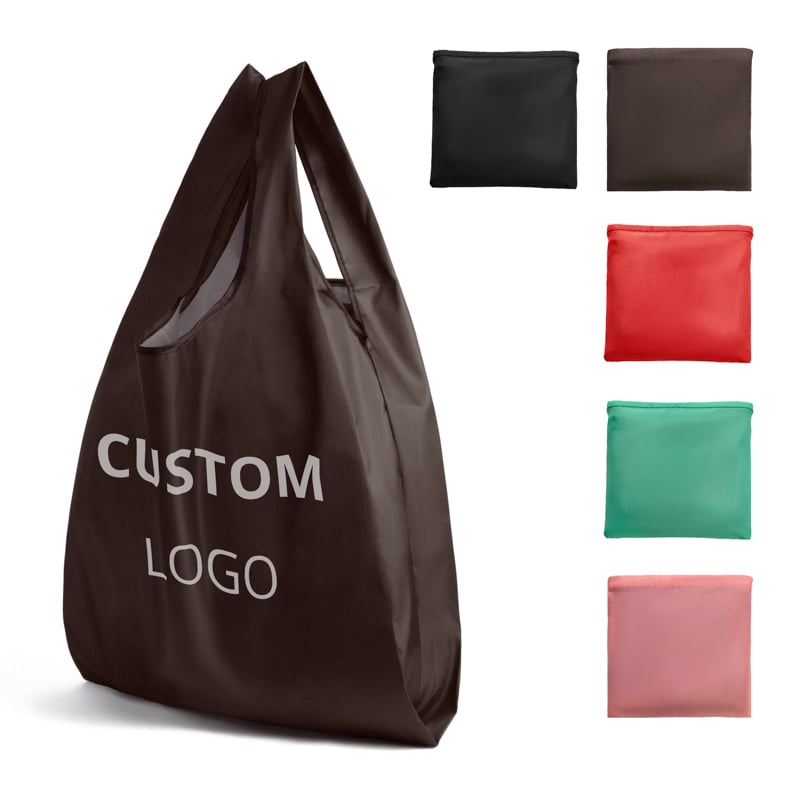
Suitable for supermarkets, retailers, sustainability campaigns, corporate programs, and environmentally focused promotional projects.
Customization options include:
- Recycled fabric specification
- Size
- Color
- Logo printing
- Folding pocket
- Attached pouch
- Labels
- Retail packaging
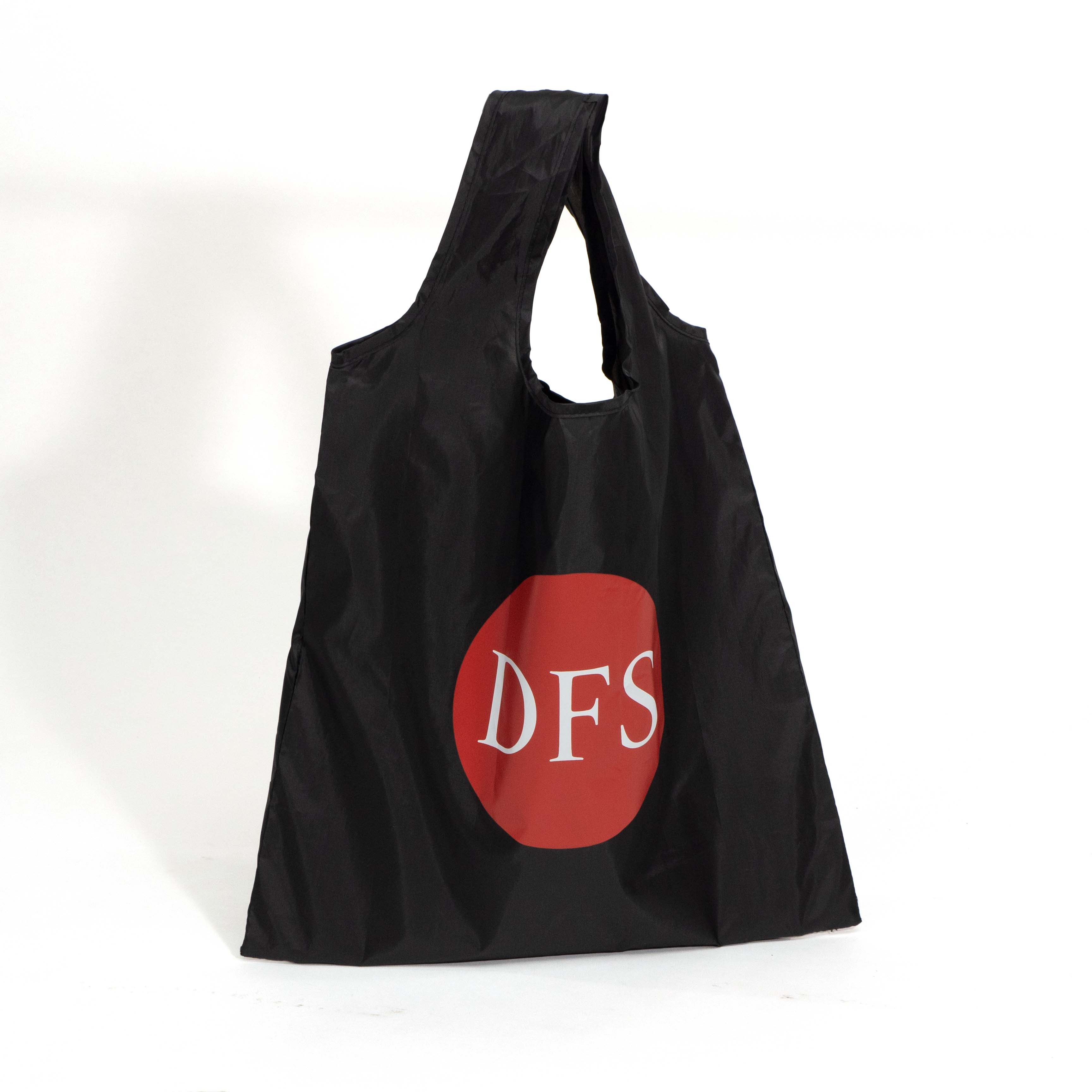
Suitable for travel, everyday shopping, sports, lifestyle retail, and promotional campaigns requiring lightweight and compact storage.
Available in different materials and folding structures for retail, supermarket, gift, and promotional use.
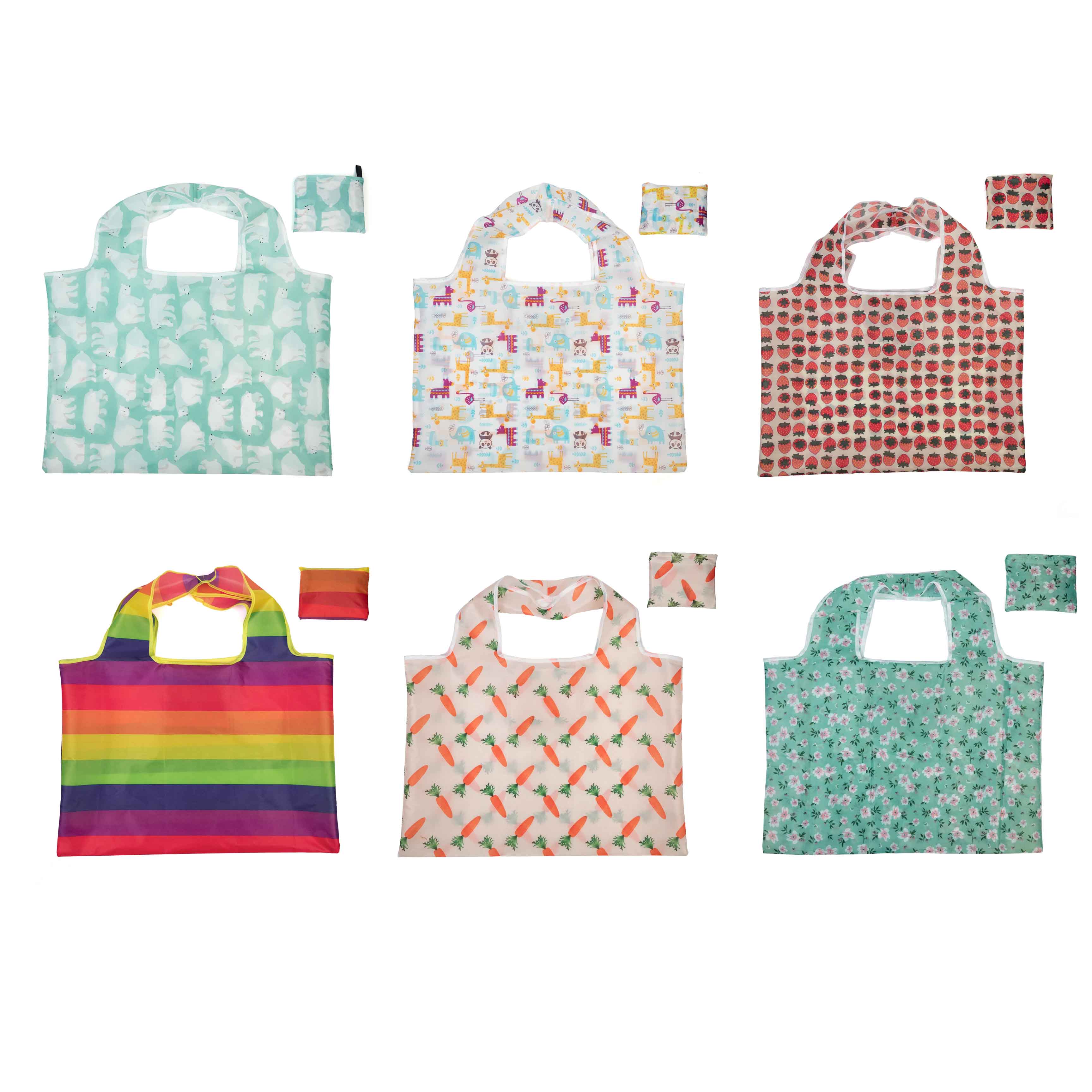
For buyers requiring larger reusable shopping or promotional bags with recycled-material positioning.
Suitable for brands developing coordinated travel collections with foldable shopping bags, shoe bags, cosmetic bags, and packing organizers.
Buyer Checklist Before Ordering
Before confirming an RPET or nylon foldable bag order, buyers should check the following.
Material Specification
Confirm:
- RPET or nylon
- Fabric weight
- Fabric density
- Surface treatment
- Coating
- Color
Bag Size
Confirm:
- Width
- Height
- Gusset
- Handle length
- Handle width
- Folded dimensions
Folding Structure
Choose:
- Attached pouch
- Corner pocket
- Inner pocket
- Separate pouch
- Drawstring pouch
Logo Method
Confirm:
- Screen print
- Heat transfer
- Sublimation
- Digital printing
- Label
- Patch
Performance
Test:
- Carrying load
- Handle strength
- Seam strength
- Folding function
- Pocket durability
- Print adhesion
Packaging
Choose:
- Bulk packing
- Individual bag
- Paper sleeve
- Hangtag
- Barcode label
- Retail box
Why Work With Us
With 16+ years of manufacturing experience, two factory buildings, and cooperation experience with global brands and Fortune 500 companies, we provide OEM/ODM development for foldable bags, reusable shopping bags, RPET bags, travel bags, and promotional products.
For foldable bag projects, B2B buyers typically care about:
- Correct material selection
- Fabric consistency
- Folding performance
- Handle strength
- Logo quality
- Color control
- Stable bulk production
- Certification support
- Packaging development
- Export delivery
Our team supports projects from material sourcing and sample development through printing tests, structural adjustment, production inspection, and final packing.
Our quality and compliance systems include SEDEX, DISNEY, GRS, HIGG, and ISO9001, supporting buyers with retail, brand, social compliance, sustainability, and international sourcing requirements.
We also support different material categories including RPET, nylon, polyester, cotton, canvas, jute, Tyvek, felt, PVC, TPU, and other functional or reusable materials.
Conclusion
RPET and nylon are both suitable materials for foldable bags, but they serve different purchasing priorities.
RPET foldable bags are generally better for sustainability-focused retail programs, supermarket reusable bag projects, corporate environmental campaigns, and buyers who need a recycled-material story.
Nylon foldable bags are generally better for lightweight travel products, compact everyday carry, outdoor use, and projects where soft feel and folding performance are more important than recycled-material positioning.
For B2B buyers, the correct decision should consider:
- Target market
- Product use
- Brand positioning
- Sustainability requirements
- Folding size
- Load capacity
- Printing method
- Certification requirements
- Budget
The best foldable bag is not simply the one made from the most fashionable material. It is the product that provides the right combination of function, branding, cost, and market value.
FAQ
1. Is RPET better than nylon for foldable bags?
Not in every situation. RPET is better for recycled-material and sustainability positioning, while nylon is often selected for lightweight, compact, and functional foldable bags.
2. Which material folds smaller?
Lightweight nylon often provides very compact folding performance, but the actual folded size also depends on fabric weight, bag dimensions, handle design, and pocket structure.
3. Are RPET bags durable?
Yes, properly specified RPET polyester fabrics can provide suitable durability for reusable shopping and promotional applications. Final performance depends on fabric specification and bag construction.
4. Is nylon suitable for supermarket bags?
Yes. Nylon can be used for premium lightweight supermarket or retail foldable bags, especially where compact storage is important.
5. Can RPET and nylon bags be custom printed?
Yes. Both materials support different logo methods, but the printing process should be tested according to the fabric surface and coating.
6. Which material is more suitable for travel?
Nylon is often preferred for lightweight and compact travel products. RPET is suitable when the travel brand also wants recycled-material positioning.
7. Can RPET foldable bags support certification requirements?
Certification and documentation depend on the actual material, supplier, production chain, and project scope. Buyers should confirm requirements before material approval and mass production.
8. Can the same bag design be developed in both materials?
Yes. The same basic foldable bag structure can often be developed in both RPET and nylon, allowing buyers to compare hand feel, folded size, appearance, performance, and price before final selection.
Suggested Internal Links
Related Blog Topics



 Hot News