Puffer & Quilted Tote Bags OEM: Materials, Stitching Patterns & Wholesale Guide
Developing a puffer or quilted tote is not simply a matter of choosing a fabric and adding padding.
The finished result comes from the combination of:
shell fabric + filling + quilting pattern + lining + reinforcement + packing method
Change any one of these, and the same basic tote can become a flat quilted shopper, a softly padded work bag or a full-volume puffer tote.
For OEM and wholesale buyers, the goal is to define the finished look, carrying function and packing requirement before sampling.
Key Takeaways for OEM Buyers
- Puffiness depends on filling type, filling amount, quilting spacing and shell fabric—not fabric thickness alone.
- Handle strength should be engineered separately from the padded body; heavier loads may require internal reinforcement.
- Branding and quilting sequence should be planned together so logos are not distorted by the padded surface.
- If compressed export packing is planned, carton efficiency and loft recovery should be tested before bulk shipment.
Quick OEM Selection Guide
| Target Result |
Shell Direction |
Padding |
Quilting Direction |
| Lightweight everyday tote |
Polyester / nylon / RPET |
Light |
Small grid, diamond, channels |
| Soft lifestyle tote |
Polyester / cotton blend |
Medium |
Medium grid, wave |
| Strong puffer look |
Nylon / polyester |
Higher loft |
Oversized grid, bubble, wide channels |
| Natural quilted look |
Cotton / cotton blend |
Light–medium |
Diamond, square, wave |
| Work / laptop tote |
Polyester / nylon |
Controlled cushioning |
Small or medium sections |
| Promotional quilted tote |
Polyester / RPET |
Light |
Simple repeat pattern |
These are starting directions rather than fixed specifications.
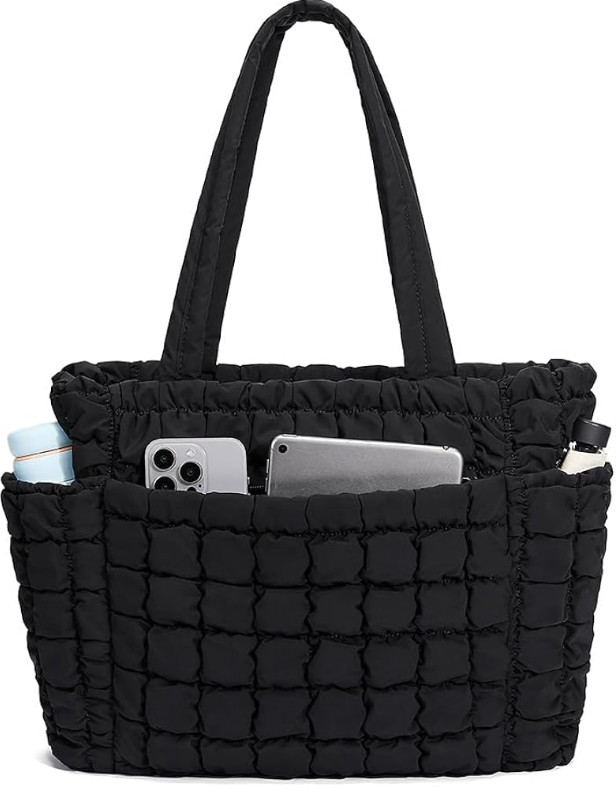
1. Define the Finished Look Before Choosing Materials
Two buyers can both request a “polyester quilted tote” and expect completely different products.
One may want:
- Thin padding
- Small diamond quilting
- A flat body
- Easy carton packing
Another may expect:
- Large padded sections
- Rounded panels
- Soft handles
- A strong puffer appearance
Before selecting the material, define three things.
Desired Puff Level
Use a reference image or physical sample and describe the target as:
- Lightly padded
- Medium volume
- Strong puffer effect
Terms such as “thick” and “soft” are too subjective on their own.
Required Structure
Decide whether the bag should:
- Collapse naturally
- Hold a semi-structured shape
- Stand more upright when loaded
Padding alone does not determine this. Lining, interlining, bottom structure and panel size also matter.
Intended Contents
A fashion tote and a laptop tote may look similar but require very different construction.
The expected contents affect:
- Handles
- Bottom reinforcement
- Pockets
- Padding
- Closure
2. Choose the Shell Fabric for the Desired Appearance
Polyester
Polyester is one of the most flexible choices for quilted OEM bags.
It can support:
- Matte or smooth finishes
- Printed designs
- Different weights
- Recycled polyester options
It works well for retail, promotional and everyday tote programs.
Nylon
Nylon is useful when the bag needs a lighter, smoother or more technical appearance.
It is commonly suited to:
Some finishes can provide resistance to light moisture, but the finished bag should not automatically be described as waterproof.
RPET
Recycled polyester can be used when recycled-content requirements are part of the project.
For certified programs, traceability requirements should be confirmed before material sourcing and sampling.
Cotton and Cotton Blends
Cotton gives a softer, more textile-oriented appearance.
It is often suitable for:
- Lifestyle collections
- Casual quilted totes
- Gift programs
- Seasonal retail products
Compared with smooth nylon or polyester, cotton usually creates a less technical look.
3. Padding Controls the Loft
The outer fabric defines the visible surface.
The filling determines most of the bag's softness and volume.
Polyester Wadding / Fiberfill
Useful when the main goal is:
- Softness
- Low weight
- Loft
- Puffer appearance
Different waddings can behave very differently after compression even when their nominal thickness is similar.
Foam
Foam creates a more controlled cushioning effect and can be useful when the bag needs:
- Firmer panels
- More defined structure
- Laptop or tablet cushioning
A visually thick puffer tote should not automatically be described as protective or shockproof.
If protection matters, the internal construction should be developed for that purpose.
Do Not Specify Padding by Thickness Alone
A “5 mm filling” does not fully define the result.
Two materials of similar thickness may differ in:
- Density
- Compression
- Loft
- Recovery
- Hand feel
For OEM sampling, the buyer should approve the finished padded panel, not only the raw filling specification.
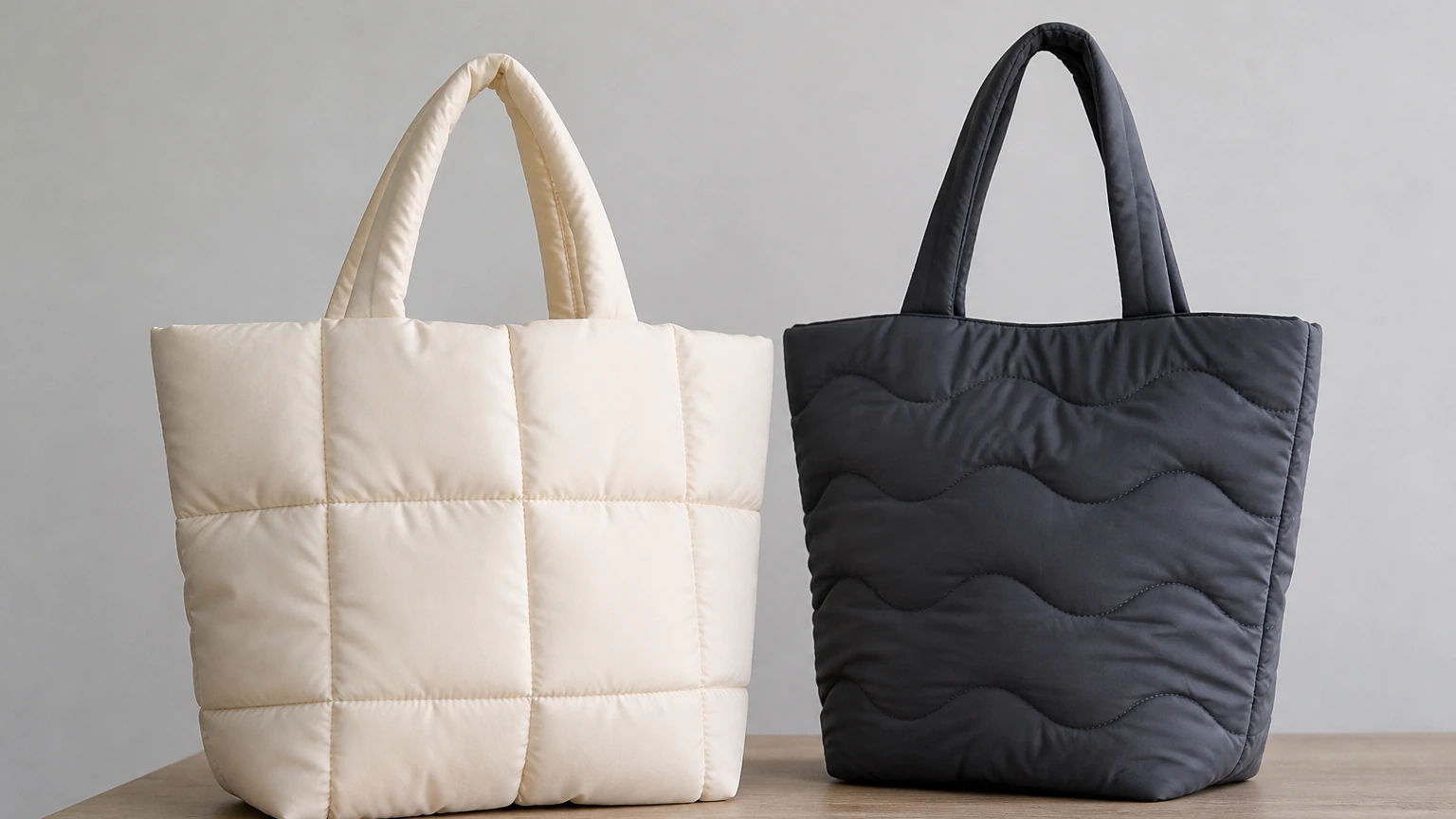
4. Quilting Pattern Controls Both Style and Volume
Quilting does more than decorate the bag.
Stitch spacing determines how freely the padding can expand.
| Quilting Pattern |
Typical Effect |
OEM Consideration |
| Diamond |
Classic, detailed |
Dense layouts require more stitching |
| Small Grid |
Controlled and neat |
Keeps padding relatively flat |
| Large Grid |
Fuller, modern |
Allows more visible loft |
| Horizontal Channels |
Casual puffer look |
Works well on broad tote panels |
| Vertical Channels |
Elongated appearance |
Pattern direction affects proportions |
| Wave |
Soft and decorative |
Alignment must remain consistent |
| Bubble / Oversized Sections |
Strong puffer effect |
Filling distribution is more critical |
| Custom Geometry |
Brand-specific |
Usually requires additional sampling |
Smaller Quilting Sections
Closer stitch lines generally create:
- Less visible puff
- Better control
- More detailed texture
But more stitch lines also mean more production time.
Larger Quilting Sections
Larger sections allow the filling to expand more visibly.
They are useful for:
- Oversized puffer totes
- Soft fashion bags
- Contemporary retail collections
However, uneven filling becomes more noticeable.
5. Custom Quilting Must Be Designed Around the Finished Bag
A pattern that looks clean on a flat drawing may change once it crosses:
- Side seams
- Pockets
- Handles
- Zippers
- Bottom panels
For custom quilting, confirm:
- Pattern direction
- Repeat scale
- Stitch position
- Pocket interruption
- Front/back alignment
- Seam transition
If a logo or geometric motif is integrated into the quilting itself, test it at actual bag size.
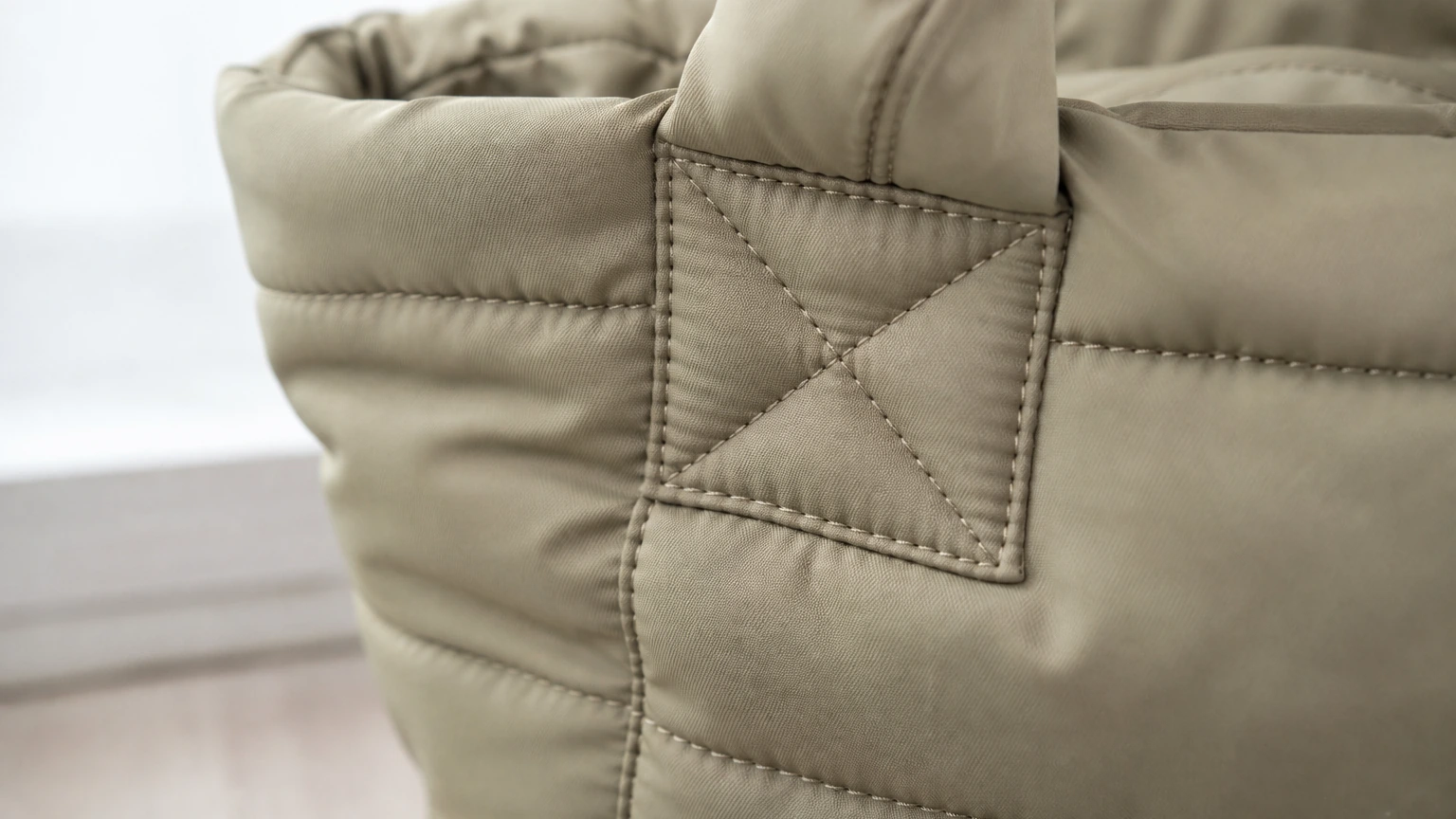
6. Handle Strength Is a Separate Engineering Issue
Padded fabric feels substantial, but softness does not automatically create load strength.
The most highly stressed area of many totes is the handle attachment.
For heavier contents, reinforcement may include:
- Internal webbing
- Backing patches
- Interlining
- Larger attachment areas
- Additional stitching
The correct solution depends on the bag design.
A thick puffer body with a weak handle connection can still fail quickly.
7. The Bottom Often Needs More Attention Than the Side Panels
Large quilted totes can look excellent when empty but deform after loading.
Common problems include:
- Bottom sag
- Side panels pulling inward
- Contents collecting in the center
- Uneven silhouette
Possible solutions include:
- Reinforced bottom panel
- Additional interlining
- Removable base insert
- Firmer bottom padding
- Adjusted bag proportions
It is often more efficient to reinforce the problem area than to make every panel thicker.
8. Branding and Quilting Sequence Should Be Planned Together
Deep quilting creates an uneven surface.
That affects how logos should be applied.
Printing
Large or detailed printed graphics are usually easier to control on the shell fabric before quilting.
This helps avoid distortion across padded sections.
Embroidery
Embroidery can be applied before or after quilting depending on:
- Logo size
- Position
- Stabilizer
- Puff level
- Desired appearance
The correct sequence should be confirmed during sampling.
Woven Labels and Patches
These are often practical options because they create a defined branding area without requiring the artwork to follow the quilted surface.
Possible options include:
- Woven labels
- Fabric patches
- PU patches
- Rubber patches
The important point is to decide the branding method before the production sequence is finalized.
9. What Should an OEM Buyer Send Before Sampling?
A useful brief can be simple.
| Specification |
What to Define |
| Bag Type |
Tote / shopper / work tote / travel tote |
| Dimensions |
Width × height × depth |
| Shell Fabric |
Polyester / nylon / RPET / cotton / other |
| Puff Level |
Light / medium / strong |
| Padding |
Wadding / foam / supplier recommendation |
| Quilting Pattern |
Diamond / grid / channel / wave / custom |
| Pattern Scale |
Small / medium / oversized |
| Lining |
Material / color |
| Closure |
Open / zipper / snap |
| Handles |
Length, width and material |
| Pockets |
Interior / exterior |
| Contents |
What the bag will carry |
| Branding |
Print / embroidery / label / patch |
| Quantity |
Estimated order volume |
| Packaging |
Bulk / individual / retail-ready |
Reference images are particularly useful because “soft,” “puffy” and “thick” can mean very different things to different buyers.
10. What Should You Check on the First Sample?
A front-view photo is not enough.
Quilting Consistency
Check for:
- Uneven section sizes
- Misaligned quilting
- Skipped stitches
- Irregular stitch tension
- Filling bunching
Loft Consistency
Compare:
- Center panels
- Edges
- Corners
- Pocket areas
- Areas near seams
The volume should remain reasonably consistent.
Handle Performance
Load the bag with its intended contents and check:
- Distortion around handle roots
- Stitch opening
- Panel pulling
- Handle twisting
Bottom Stability
Evaluate the tote when loaded, not only when empty.
Packing Recovery
Pack the sample using the proposed export method and evaluate what happens after unpacking.
This is especially important for puffer products.
11. CBM, Compression and Loft Recovery
This is one of the most important commercial issues in puffer-bag sourcing.
A puffer tote contains a large amount of volume created by air trapped in the filling.
If it is packed too loosely:
- Carton CBM increases
- Container utilization falls
- Freight cost per bag increases
If it is compressed too aggressively:
- Filling may remain flattened
- Creases can become difficult to remove
- Puff level may recover unevenly
- The bag may arrive looking different from the approved sample
So the correct goal is not:
Compress as much as possible.
It is:
Find the lowest practical shipping volume that still allows acceptable shape and loft recovery after unpacking.
Filling Type Matters
Different waddings can recover very differently after long compression.
Higher-resilience polyester fillings may recover better than some softer or lower-resilience waddings, but this should be confirmed on the actual material and finished bag.
Do not approve compression performance based only on:
- Filling thickness
- GSM
- Supplier description
Test the finished construction.
Vacuum Packing Is Not Always the Best Option
Vacuum compression can reduce volume substantially, but it also increases compression stress.
For products with a strong puffer appearance, an alternative may be:
flat packing with controlled compression
rather than maximum vacuum compression.
The correct solution depends on:
- Filling resilience
- Puff level
- Transit time
- Carton size
- Target freight cost
Run a Compression-and-Recovery Test Before Bulk Shipment
If compressed packing is planned, define a simple approval procedure.
For example:
- Pack the sample using the intended bulk method.
- Keep it compressed for a period that reflects the expected logistics cycle.
- Unpack it and inspect immediately.
- Recheck after an agreed recovery period.
- Compare it with the approved uncompressed sample.
Possible evaluation points include:
- Overall dimensions
- Panel loft
- Permanent creases
- Uneven filling
- Handle deformation
- Appearance after reshaping
Some projects may also record recovery again after 24–72 hours.
That timeframe should be treated as a project-specific evaluation method, not a universal industry standard.
Balance CBM Against Product Appearance
For bulk orders, packing approval should compare both:
carton efficiency
and
finished appearance after recovery
Saving freight cost is useful only if the bag still reaches the buyer in an acceptable condition.
12. What Drives Wholesale Cost?
The main cost drivers are more useful than asking for a generic “price per quilted tote.”
Shell Fabric
Cost changes with:
- Fabric type
- Weight
- Finish
- Custom color
- Recycled-content requirements
Padding
More filling may increase:
- Material cost
- Product volume
- Shipping CBM
Quilting Complexity
A dense or highly customized pattern usually requires more stitching and alignment control than a simple large grid.
Bag Structure
Cost increases with features such as:
- Pockets
- Zippers
- Laptop compartments
- Structured bottoms
- Special handles
- Hardware
Branding
A woven label, embroidery and custom patch all have different production requirements.
Color Split
A large quantity divided across many colors can reduce production efficiency.
Packaging
Carton configuration, hangtags, individual packing and compression method should be included in the costing discussion from the beginning.
13. A Better Bulk Approval Process
For repeat OEM production, approve more than the visual appearance.
Keep a final reference for:
- Shell fabric
- Color
- Padding feel
- Puff level
- Quilting pattern
- Quilting scale
- Dimensions
- Handles
- Pockets
- Logo
- Hardware
- Packing method
For puffer products, the physical sample is particularly important because qualities such as:
- Loft
- Softness
- Compression
- Recovery
cannot be fully represented in a technical drawing.
Common OEM Mistakes to Avoid
Choosing the Quilting Pattern Before the Filling
The same quilting pattern can look completely different with different padding.
Approve them together.
Making the Bag Puffier Than Necessary
More loft may strengthen the fashion effect but also increases bulk and packing difficulty.
Ignoring Handle Reinforcement
A padded body is not a substitute for a properly engineered load path.
Applying Fine Graphics Without Planning the Quilting Sequence
Deep quilting can distort detailed artwork.
Approving the Bag but Not the Packing
A bag can look excellent before packing and very different after several weeks of compression.
For puffer products, packing is part of the product specification.
FAQ
Can custom quilting patterns be made for OEM orders?
Yes. Pattern scale, direction and geometry can be customized for suitable projects, but complex designs usually require additional sampling to confirm alignment.
Which material is best for a puffer tote?
There is no single best material. Polyester and nylon work well for many lightweight puffer styles, RPET can support recycled-material programs, while cotton creates a more textile-oriented look.
Is thicker padding always better?
No. More padding creates more volume but also increases bulk and shipping space. The correct amount depends on the required look and function.
Can puffer totes be vacuum packed?
They can be, but vacuum packing should be tested first. Some fillings recover well after compression while others may retain flattening or permanent creases.
What should be approved before bulk production?
Approve the actual shell fabric, filling, puff level, quilting pattern, dimensions, handles, logo and packing method on the physical sample.
Conclusion
A successful puffer or quilted tote is not defined by one material specification.
Start with:
shell fabric + filling + quilting pattern + bag structure
Then confirm:
handle reinforcement + branding sequence + packing recovery
For wholesale projects, the last point is easy to overlook.
The bag must not only look correct when it leaves the sewing line. It also needs to retain an acceptable shape after being packed, shipped and unpacked.
That is why CBM efficiency and loft recovery should be approved together before bulk production.
Inquiry Support
For a custom puffer or quilted tote project, you can provide:
- Reference image or existing sample
- Estimated quantity
- Preferred dimensions
- Outer material
- Desired puff level
- Preferred quilting pattern
- Intended contents
- Handle requirements
- Pocket layout
- Required colors
- Logo artwork
- Packaging requirements
Need quilted fabric swatches or want to compare different padding levels?
Email [email protected] or WhatsApp us with your target dimensions, intended use and reference images. We can review suitable material, quilting and construction directions before sampling.
Related Products
Related Blog Articles


 Hot News