What Is a Mesh Bag: Types, Materials and Common Uses
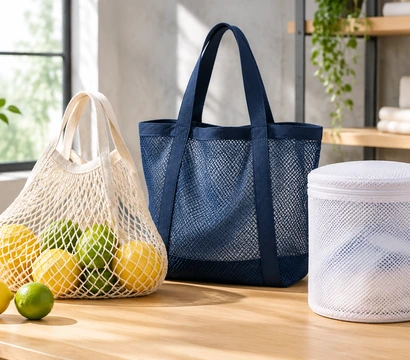
A mesh bag is a bag made partly or entirely from an open-structured fabric. Depending on its construction, the openings allow air, water and light to pass through the material.
Mesh bags are used for grocery shopping, fresh produce, beach equipment, laundry, sports gear and travel organization. Some are lightweight drawstring pouches, while others are large totes designed to carry bulky items.
But two mesh bags that look almost identical can perform very differently.
One may retain its shape after repeated carrying, while another stretches excessively, develops damaged seams or tears around the handles.
The difference is not simply the thickness of the fabric. It depends on the mesh material, opening size, fabric construction, reinforcement and manufacturing quality.
For buyers sourcing custom mesh bags, the important questions are:
- Which mesh bag type suits the intended use?
- What material and opening size should be specified?
- What makes a good-quality mesh bag?
- Which tests actually apply to an open-mesh construction?
- How can a manufacturer maintain consistent quality across bulk orders?
1. What Is a Mesh Bag Made Of?
Mesh describes an open textile structure, not one particular fiber.
A mesh bag may be made from polyester, nylon, cotton, recycled polyester or another suitable material.
The openings vary in size, shape and distribution. These characteristics affect ventilation, visibility, drainage, flexibility and the ability to retain smaller contents.
How Mesh Fabrics Are Constructed
Mesh fabrics can be produced through knitting, weaving and other textile processes.
Warp-knitted constructions, including Raschel and Tricot, are commonly used to manufacture open-mesh fabrics with controlled flexibility and structural stability.
Woven mesh is formed from interlaced yarns, while other net structures use different methods to create and stabilize their openings.
No single construction is suitable for every bag application.
Yarn type, fabric structure, mesh opening and finishing all affect performance. Even relatively stable knitted mesh may require edge binding or reinforcement after cutting and sewing.
Common Mesh Bag Materials
| Material |
Main Characteristics |
Typical Applications |
Buyer Considerations |
| Polyester mesh |
Versatile, available in many weights and constructions |
Shopping totes, beach bags, laundry bags, sports storage |
Stretch, abrasion, yarn strength and dimensional stability |
| Nylon mesh |
Can combine flexibility and toughness in suitable constructions |
Travel organizers, selected wash bags and sports accessories |
Snagging, abrasion, deformation and care conditions |
| Cotton mesh |
Soft hand feel and moisture absorption |
Produce bags, lightweight shopping bags, lifestyle products |
Shrinkage, colorfastness, moisture retention and food-contact suitability |
| RPET polyester mesh |
Polyester made with verified recycled PET content |
Retail bags, promotional programs and organizers |
Recycled-content evidence and finished performance |
| Coated synthetic mesh |
Surface characteristics depend on the coating system |
Selected outdoor, sports and utility bags |
Coating durability, flexibility and chemical requirements |
GSM, mesh opening size and tensile performance are different specifications.
GSM measures fabric mass per unit area. Opening size describes the gaps between yarns. Two mesh fabrics with similar weights may behave differently when stretched, rubbed or loaded.
For more detailed material specifications, see Mesh Fabric for Custom Bags: Material, Hole Size, Reinforcement and Airflow.
2. Main Types of Mesh Bags and Their Common Uses
Mesh bags are not one fixed product category. Each application requires a different balance of openness, carrying strength, protection and convenience.
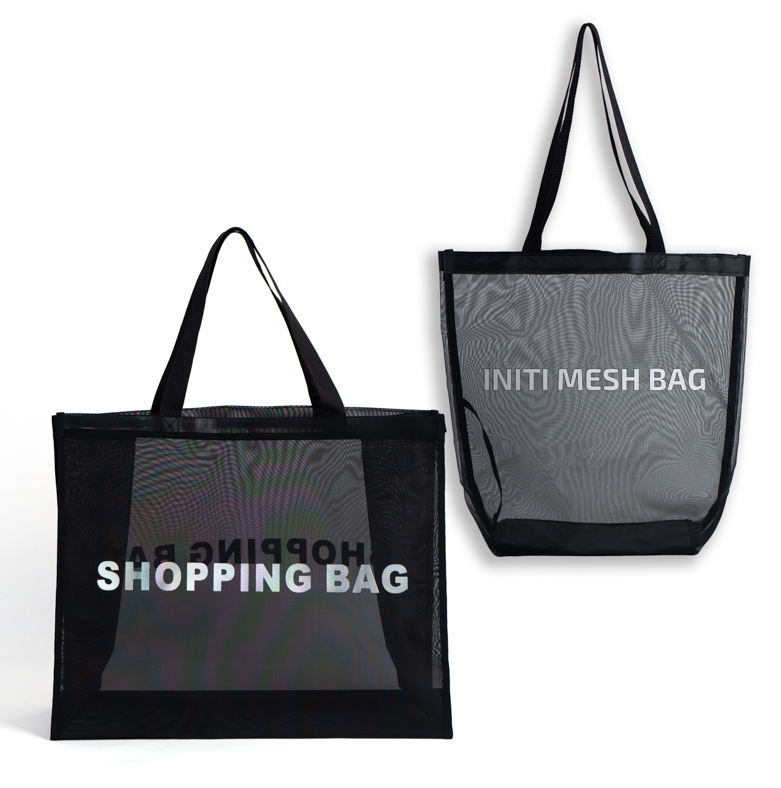
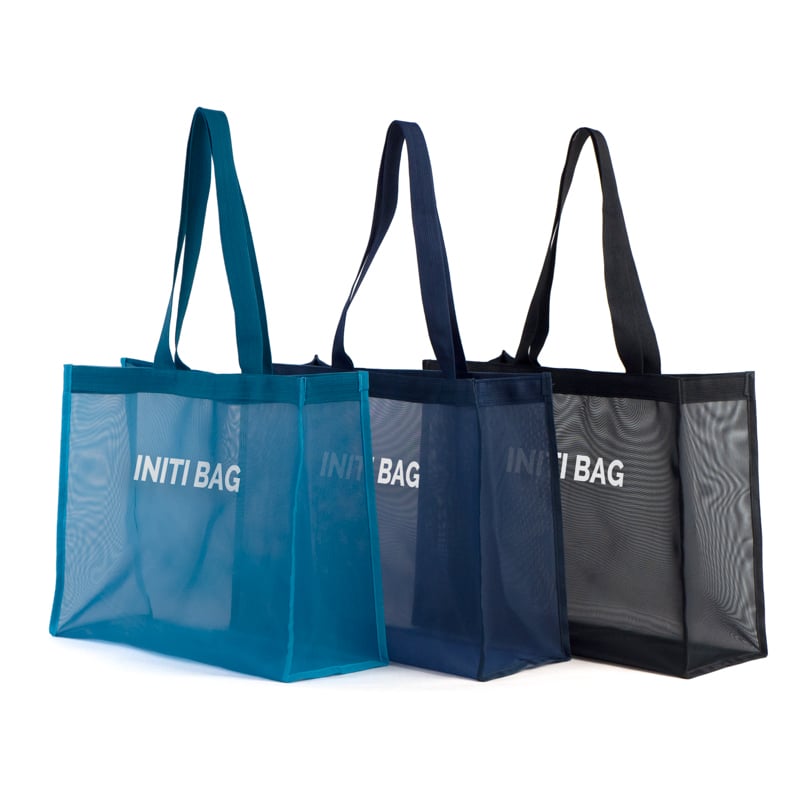
Mesh shopping bags are commonly used for grocery shopping, retail promotions, farmers' markets and everyday carrying.
They may feature:
- Open-top access
- Long or short handles
- Bottom gussets
- Reinforced bindings
- Solid panels or webbing for branding
For reusable mesh shopping bags, the main quality considerations are effective capacity, loaded shape, handle attachment and seam durability.
A lightweight promotional mesh tote does not need the same construction as a large shopping bag intended for repeated carrying of relatively heavy goods.
INITI's Transparent Mesh Shopping Tote Bag is an example of a lightweight, gusseted mesh shopping tote with webbing shoulder handles and bound edges.
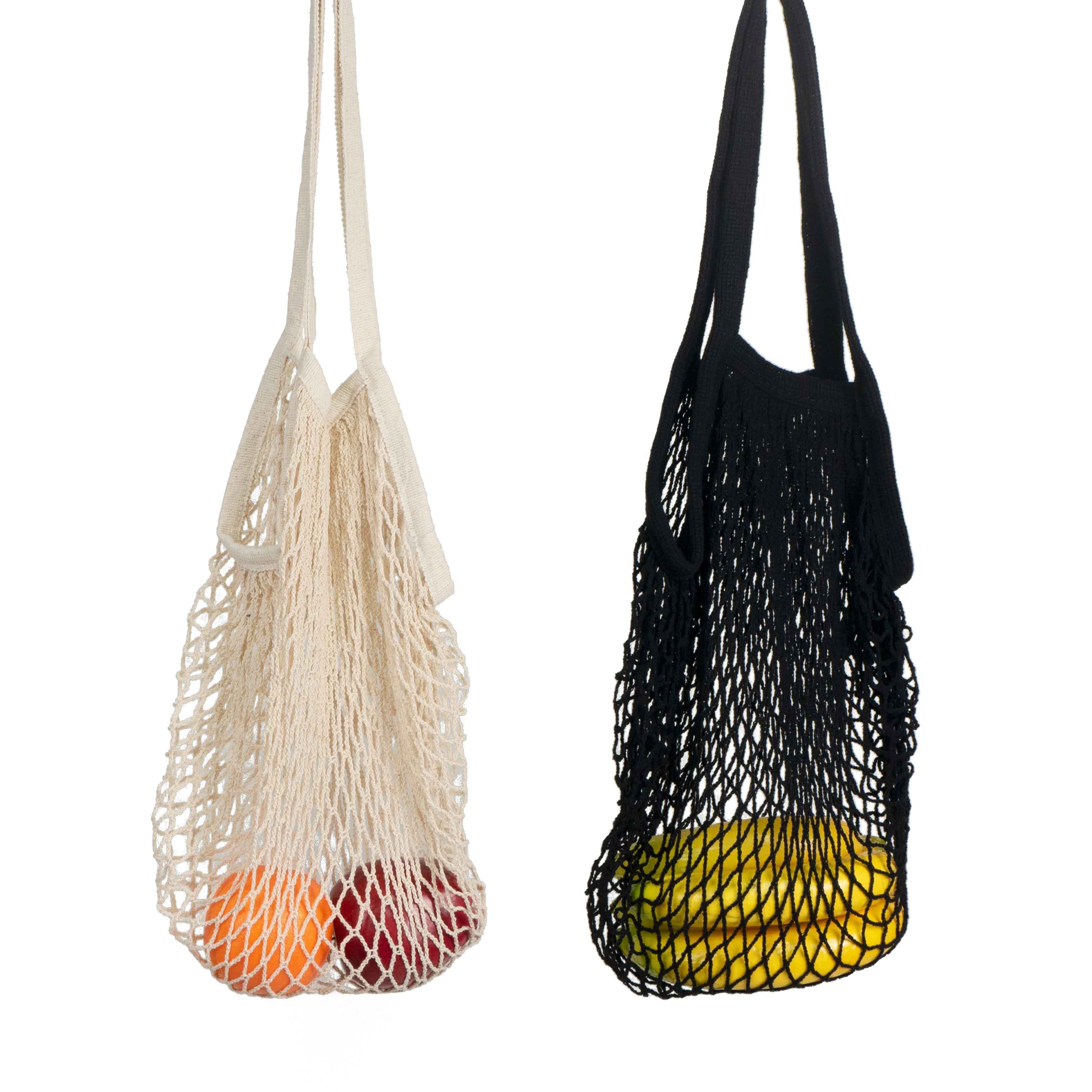
Reusable Mesh Produce Bags
Mesh produce bags hold fruits and vegetables while allowing some airflow around their contents.
Smaller versions commonly use drawstring closures. Larger designs may incorporate handles or additional solid-fabric areas.
A suitable produce bag should have openings small enough to retain the intended items, smooth finishing, a practical closure and materials appropriate for the intended use.
Food-Contact Requirements
For supermarket programs involving direct contact with unpackaged produce, material safety must be evaluated against the destination market's food-contact requirements.
In the United States, the FDA evaluates food-contact substances according to the relevant substance, authorization and intended conditions of use. Applicable requirements may involve 21 CFR Parts 174–178 or other recognized authorization pathways.
21 CFR Part 177 alone is not a universal certification for an entire produce bag.
In the EU, Regulation (EC) No 1935/2004 establishes the general food-contact framework, and Regulation (EC) No 2023/2006 addresses good manufacturing practice. Regulation (EU) No 10/2011 is relevant where the product or component falls within the scope of plastic food-contact materials.
Buyers should consider the actual fiber, dyes, finishes, printing and accessories. Natural or reusable materials are not automatically suitable for every direct-food-contact use.
Tare Weight and Checkout
When produce is sold by weight, the bag's tare weight needs to be correctly handled by the retailer's weighing system.
For certain supermarket programs, a sewn-in label showing the bag's nominal weight in grams and ounces can make identification easier.
However, the weighing procedure and label format should be confirmed with the retailer. A sewn-in tare label is not a universal legal requirement for every produce bag.
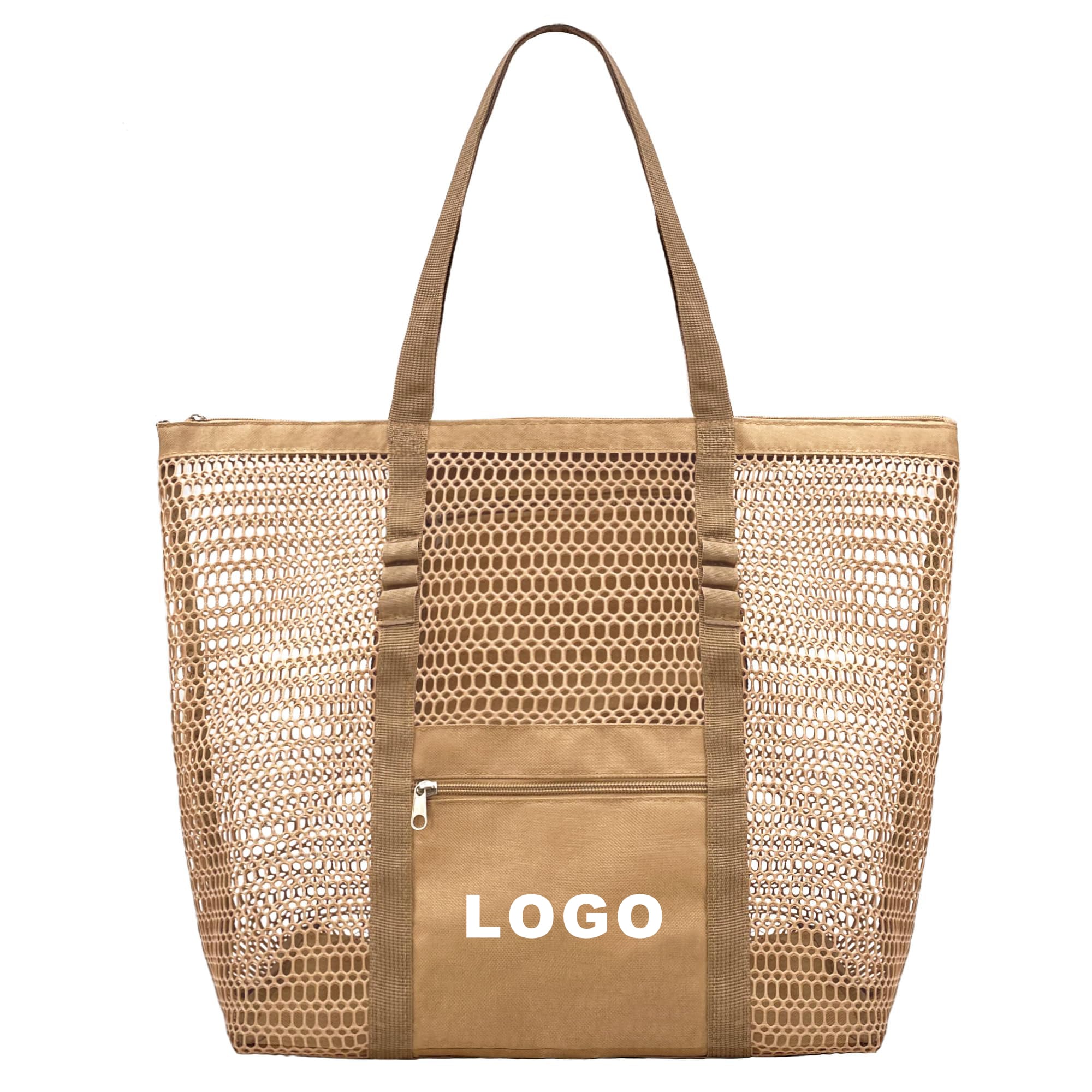
Mesh beach bags are designed for towels, swimwear, beach toys, footwear and other leisure accessories.
Openings in the bag can allow water and sand to pass through, reducing the amount retained inside.
For larger mesh beach bags, buyers should pay attention to:
- Gusset depth and useful carrying capacity
- Reinforced bottom and side seams
- Shoulder-handle length
- Webbing and edge binding
- Pockets for smaller accessories
- Stretch and deformation under load
An open-mesh beach tote is not waterproof. Water-sensitive contents still require separate protection.
INITI's Large Mesh Beach Shopping Bag provides a reference for larger gusseted constructions with reinforced areas and webbing handles.
Mesh Laundry Bags and Shoe Washing Bags
Mesh laundry bags are used to contain garments during washing or to organize clothing during travel and storage.
Their main functions may include keeping smaller items together, reducing tangling and limiting direct contact between certain garments and other laundry.
Fine mesh may be suitable for delicate clothing, while specialized shoe washing bags may require protective panels, a different mesh structure and secure closures.
Buyers should check mesh softness, seam strength, closure security and compatibility with the intended washing procedure.
A storage bag made from mesh is not automatically suitable for machine washing.
For example, the Drawstring Mesh Laundry Wash Bag uses a drawstring and stopper system for laundry and travel organization.
For footwear-specific considerations, see How to Use a Shoe Wash Bag.
Can Mesh Laundry Bags Reduce Microfiber Pollution?
Conventional mesh laundry bags are primarily intended for garment containment and protection. They should not automatically be marketed as microfiber-filtering products.
Specialized washing bags may be designed to reduce the release of synthetic microfibers into wastewater.
Their effectiveness depends on the fabric construction, pore characteristics, washing conditions and how the product reduces fiber shedding or retains released fibers.
A published study comparing washing-related microfiber reduction devices found that certain purpose-designed washing bags reduced microfiber release under controlled conditions. The researchers also observed that reduced fiber shedding could contribute to the result, rather than filtration alone.
See the research paper: The Efficiency of Devices Intended to Reduce Microfibre Release During Clothes Washing.
Those findings cannot be applied automatically to ordinary mesh laundry bags.
For brands developing microfiber-reduction laundry products, relevant evidence should include:
- Fabric construction and the intended filtration or shedding-reduction mechanism
- Test garments and washing conditions
- Number and type of wash cycles
- Microfiber measurement method
- Comparison against washing without the bag
- Repeatability and test limitations
Claims such as “captures microplastics” or “reduces microfiber release by a specified percentage” require evidence for the actual product and its stated conditions of use.
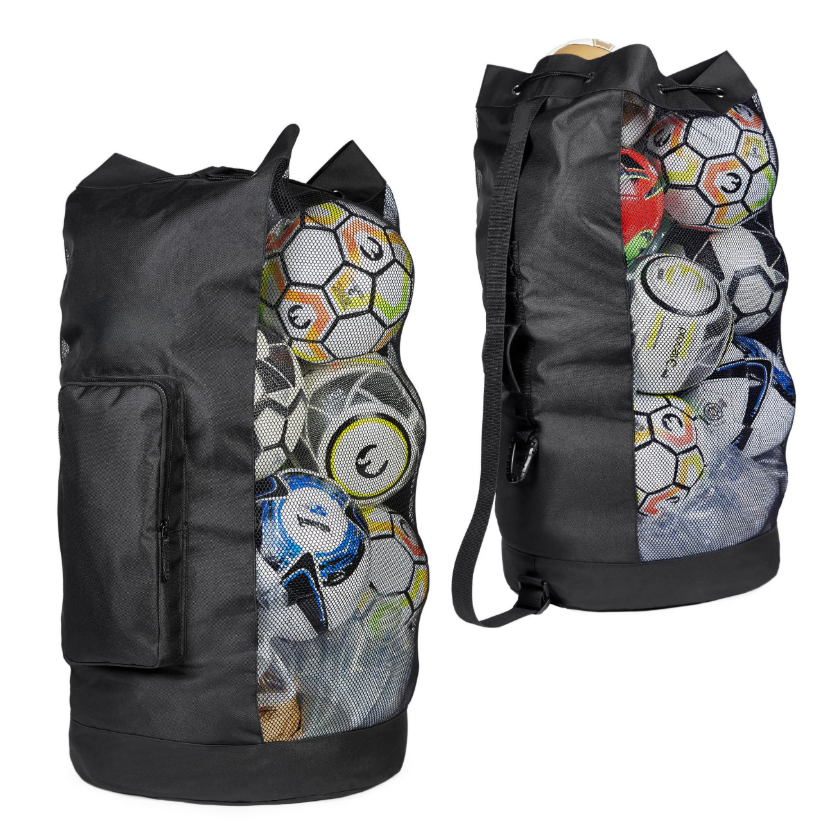
Mesh sports bags are commonly used for footballs, training equipment, swimming accessories and club storage.
They may be designed as drawstring sacks, shoulder bags or equipment carriers with reinforced fabric sections.
The mesh opening should suit the size of the equipment. A large opening appropriate for sports balls may be unsuitable for small accessories.
For bulk sports programs, buyers should verify capacity, drawstring or zipper operation, shoulder-strap reinforcement and wear resistance.
The Mesh Sports Ball Bag with Shoulder Strap provides an example of a mesh equipment bag developed around larger sports items.
Mesh Storage and Travel Organizer Bags
Travel organizers, shoe pouches and storage bags use mesh primarily for visibility, ventilation or separation.
For these products, very high carrying strength may be less important than smooth edges, secure closures and suitable opening size.
Solid panels or pockets can be added where privacy or extra protection is necessary.
3. What Makes a Good-Quality Mesh Bag?
A good mesh bag should perform reliably under its expected use conditions.
It does not necessarily need the heaviest material or the largest amount of reinforcement.
The essential requirements depend on what it carries, how it is handled and how often it will be used.
Mesh Opening Size Must Match the Contents
The mesh should provide the required ventilation or drainage while keeping the intended contents inside.
Fine mesh can help retain smaller items. Larger openings may improve visibility, ventilation and drainage, but they can also increase snagging exposure or allow small objects to escape.
A produce bag, beach tote and laundry wash bag should not automatically use the same mesh.
The material should be assessed using the actual products it will carry.
The Bag Must Control Stretch and Deformation
Some flexibility is useful, particularly in foldable mesh bags.
However, excessive stretch can make the bag difficult to carry or cause unacceptable sagging.
Important checks include:
- Dimensions under the specified load
- Deformation after unloading
- Yarn or opening distortion
- Seam movement
- Local damage around handles or binding
Buyers should distinguish normal flexibility from permanent structural deformation.
Handles and Load-Bearing Areas Must Be Reinforced Appropriately
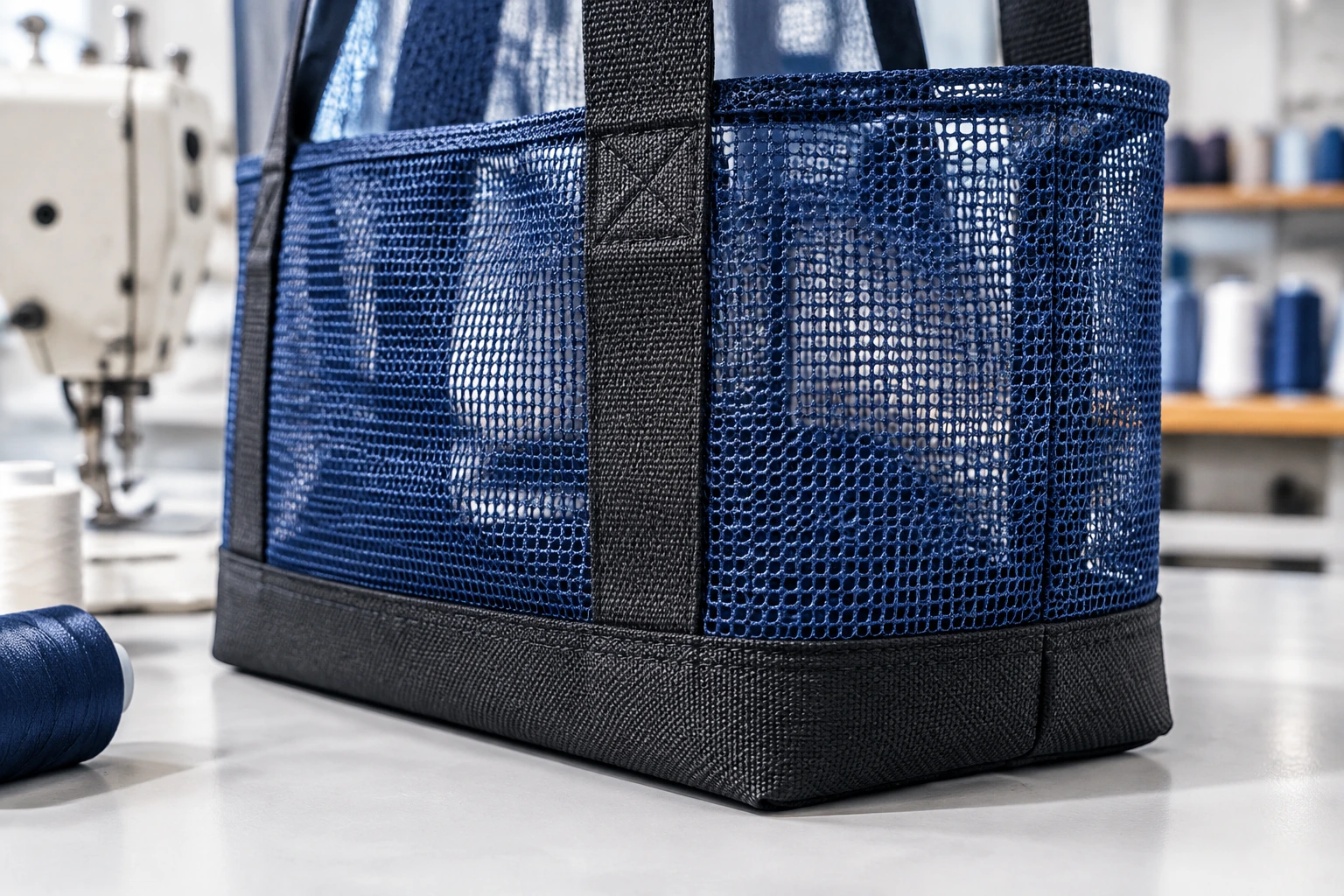
For large mesh shopping bags and beach totes, local stress around the handle attachments can be a major durability risk.
Possible solutions include:
- Reinforced fabric panels
- Bound seams
- Suitable webbing handles
- Box-X stitching with adequate backing
- Bar-tacks where appropriate
- Bottom-wrapping webbing in selected heavy-duty designs
Bottom-wrapping webbing extends beneath or around the bag base and helps distribute the carrying load through the strap structure instead of relying entirely on localized mesh attachments.
Not every mesh bag requires this construction.
A lightweight produce bag and a large equipment tote have different load paths and production requirements.
The appropriate reinforcement must be verified by testing the complete bag under agreed carrying conditions.
Edge Binding and Stitching Must Remain Stable
Mesh fabric can be vulnerable around cut edges, stitched openings and stress concentrations.
Quality finishing should avoid:
- Loose yarns
- Exposed rough edges
- Inconsistent binding width
- Excessive needle damage
- Unstable seam allowances
- Excessive distortion around stitching
Neat appearance alone does not prove sufficient seam strength.
Closures Must Suit the Application
Different mesh bags require different access and closure arrangements.
An open top may be practical for checkout bags. A drawstring may suit produce or sports equipment. A secure zipper or properly controlled drawstring may be needed for certain laundry products.
Closures should be checked for repeated operation and potential snagging against the mesh or contents.
Logos Must Be Readable and Durable
Open mesh is not always a suitable surface for detailed artwork.
Direct printing on coarse mesh can produce interrupted images, uneven ink coverage and poor readability.
Ink cracking or peeling may occur if the printing system is incompatible with the substrate or expected fabric deformation.
Practical OEM branding options include:
| Branding Method |
Suitable Application |
Main Quality Check |
| Sewn-on canvas or polyester patch |
Shopping bags and beach totes |
Attachment, edges and print appearance |
| Woven or printed label |
Laundry, produce and storage bags |
Legibility and positioning |
| Solid-fabric branding panel |
Large promotional graphics |
Print adhesion and panel stability |
| Printed webbing handles |
Shopping totes and reinforced bags |
Alignment and durability |
| Heat transfer on compatible solid fabric |
Selected multicolor branding |
Temperature compatibility and adhesion |
A 210D polyester patch is one possible branding material, not a required specification for all mesh bags.
Buyers should approve a physical branded sample before bulk production.
Choose Test Methods That Actually Suit the Mesh
Not every textile test is appropriate for an open-mesh construction.
ASTM D3939/D3939M-26 — Standard Test Method for Snagging Resistance of Fabrics (Mace) specifically excludes open constructions such as nets.
The pointed test elements can pass through the openings and catch the felt backing rather than properly evaluating the specimen.
Therefore, this method should not be specified automatically for open-net shopping bags or sports bags.
ASTM also notes limitations in its use for commercial shipment acceptance testing because of between-laboratory precision.
Where snagging resistance matters, buyers should ask a qualified laboratory whether another method, such as AATCC TM65, is suitable for the particular mesh. Practical handling and snagging checks may also be agreed around the intended contents.
For air permeability, ASTM D737-18(2023) provides a method for measuring textile air permeability and is relevant to many woven and knitted fabrics.
For very open mesh, the laboratory should confirm that specimen mounting and the equipment's measuring range are suitable. Test pressure, units and conditions should be reported.
Air permeability is not the same as water drainage, drying time or finished-bag durability.
Where airflow is not a critical purchasing requirement, testing the actual use—such as drainage, loading or garment protection—may provide more useful information than requesting an unnecessary laboratory number.
4. Common Mesh Bag Quality Problems and How to Prevent Them
| Quality Problem |
Possible Cause |
Recommended Control |
| Mesh tears or develops holes |
Unsuitable construction, abrasion or snagging |
Qualify the mesh against intended contents |
| Bag stretches too much |
Excessive extension under load |
Check loaded dimensions and recovery |
| Handles pull away |
Weak attachment or concentrated load |
Improve reinforcement and test the finished bag |
| Binding becomes loose |
Inadequate seam allowance or sewing control |
Check cutting, binding and stitch consistency |
| Logo is unclear |
Artwork printed directly across large openings |
Use a solid patch, panel or label |
| Closure fails |
Inappropriate zipper, cord or attachment |
Test repeated use and handling |
| Produce bag lacks required documentation |
Material suitability not established |
Verify the applicable food-contact requirements |
| Microfiber-reduction claim is unsupported |
No product-specific washing evidence |
Require suitable controlled test data |
| Test result does not reflect actual use |
Inapplicable test method |
Confirm method suitability before testing |
| Bulk batches vary |
Fabric or construction changes |
Maintain approved materials and samples |
For a mesh shopping tote or beach bag, inspection should cover more than whether the handles break.
A bag may remain intact but develop excessive permanent sagging or distorted openings after carrying its intended load.
These functional problems should be considered when approving the product.
5. What Kind of Factory Can Make a Good Mesh Bag?
A capable mesh bag manufacturer does more than cut net fabric and sew it into a bag.
The factory needs to understand mesh behavior, design the necessary reinforcement and maintain consistent specifications throughout production.
Material Knowledge and Supplier Management
A reliable manufacturer should be able to discuss:
- Fiber composition
- Knitted or woven construction
- Yarn thickness and fabric weight
- Opening dimensions and geometry
- Stretch direction
- Edge stability
- Surface wear and snagging
- Color and finishing requirements
The factory does not necessarily need its own mesh-knitting machinery.
What matters is whether it can source appropriate material, check supplier specifications and control incoming fabric quality.
For demanding OEM projects, identifying the actual mesh structure is more useful than offering a material simply described as “high-quality net fabric.”
Pattern and Reinforcement Development
The factory should understand how the mesh, seams, bindings, webbing and any solid panels carry the expected load.
For a large shopping tote, it may need to adjust:
- Bottom shape and gusset depth
- Handle position and drop
- Webbing width and length
- Binding and seam allowances
- Bottom reinforcement
- Box-X stitching or other suitable attachments
For a produce bag, it may instead prioritize low weight, appropriate openings and a clean drawstring channel.
A competent manufacturer should not apply the same heavy-duty construction to every product.
Sample Development and Finished-Bag Testing
Samples should use materials representative of the planned production order.
A practical sample evaluation includes:
- Fill the bag with its actual intended contents.
- Confirm usable dimensions and opening clearance.
- Apply the agreed carrying load.
- Check handles, seams and reinforced areas.
- Assess distortion after unloading.
- Operate the closure repeatedly where applicable.
- Review artwork, labels and overall workmanship.
For specific performance requirements, buyers and suppliers should agree on test loads, cycle counts, acceptable deformation and pass/fail criteria.
A good factory should also recognize when a requested laboratory method is inappropriate.
For example, rather than sending an open-net fabric to an unsuitable ASTM D3939 test, the supplier should clarify the test objective with a qualified laboratory and agree on a suitable alternative with the buyer.
Similarly, a factory should not promise microfiber-filtration performance for an ordinary laundry mesh bag without evidence from the actual product.
Knowing which claims and tests require verification is part of manufacturing competence.
Production Control and Inspection
A manufacturer should be able to reproduce the approved sample across the full order.
| Production Stage |
Important Controls |
| Incoming mesh |
Material identity, openings, color, defects and specified properties |
| Cutting |
Dimensions, direction, component identification |
| Sewing |
Edge binding, seams, handles and reinforcement |
| Branding |
Logo placement, patch or label attachment |
| In-process inspection |
First-piece approval and recurring construction checks |
| Final inspection |
Dimensions, workmanship, closures, agreed performance checks and packing |
For bulk orders, an attribute-based inspection plan may reference ISO 2859-1:2026, with the inspection level, defect categories and acceptance criteria agreed between buyer and supplier.
An AQL-based sampling plan does not guarantee that every bag is defect-free, and it does not replace specific performance testing.
Documentation and Repeat-Order Consistency
For chain retailers, distributors and private-label brands, a reliable supplier should maintain:
- Approved material and color references
- Sample and drawing revisions
- Artwork and label versions
- Agreed quality requirements
- Records of material substitutions
- Required compliance documents
- SKU allocation and carton quantities
A large order with multiple colors or designs can fail commercially because of incorrect materials or packing, even if individual bags appear acceptable.
Consistent repeat production is as important as producing one attractive sample.
6. How to Evaluate a Mesh Bag Manufacturer Before a Bulk Order
Before ordering, buyers should ask questions that reveal practical production capability.
Can the supplier identify the mesh specification?
A useful answer covers more than polyester or nylon. It should address construction, hole size, stretch and expected use.
Can it modify the structure for the intended load?
The supplier should be able to discuss webbing, bottom panels, handle reinforcement and seam construction.
Does the sample represent bulk production?
If substitute materials are used, they should be clearly identified and resolved before final approval.
Can the manufacturer explain how it will test the bag?
Look for a meaningful inspection plan rather than automatic claims that the bag meets every ASTM or ISO standard.
Can it handle compliance documentation?
For produce bags, assess food-contact requirements. For RPET, examine the recycled-content evidence. For microfiber-reduction products, require product-specific evidence.
Can it manage multiple SKUs and repeat orders?
Check material identification, artwork approval, quantities, carton labeling and change control.
A factory's equipment and certifications can support a supplier assessment, but they do not replace material expertise, sample performance or consistent manufacturing controls.
7. INITI Custom Mesh Bag Product Options
INITI supports custom mesh bag development for retail, promotional, travel, laundry and sports applications.
Existing products provide references for different constructions.
Different applications require different quality specifications.
A produce bag should not be developed using the same construction as a heavy-duty beach tote. A conventional laundry bag should not be promoted as a microfiber-reduction device unless the specific product has been validated.
Explore other designs in the Mesh Tote Bag Collection.
8. Custom Mesh Bag RFQ Checklist
For efficient quotation and product development, provide:
| RFQ Item |
Buyer Information |
| Application |
Shopping, produce, beach, laundry, sports or travel |
| Contents |
Item dimensions, quantity and expected load |
| Bag size |
Width, height, gusset, opening and handle drop |
| Mesh specification |
Fiber, fabric construction, opening size, GSM and stretch |
| Carrying structure |
Handles, shoulder straps, webbing and reinforcement |
| Closure |
Open top, drawstring, zipper or another system |
| Branding |
Logo artwork, solid patch, label or printed panel |
| Performance |
Load, deformation, abrasion, snagging, washing or airflow where relevant |
| Test requirements |
Applicable methods, acceptance criteria and reporting needs |
| Compliance |
Food contact, recycled-content or other destination-specific requirements |
| Order quantity |
Total pieces, colors, sizes and SKU allocation |
| Packing |
Bundles, retail presentation, carton labels and shipment destination |
INITI's general MOQ for custom mesh bags starts from 500 pieces. Certain fabrics, colors, constructions or individual artwork versions may require higher quantities.
Providing the actual contents and expected carrying conditions will usually help the manufacturer recommend a more appropriate solution than requesting a bag described only as “strong” or “premium.”
Why Choose INITI for Custom Mesh Bags?
Hangzhou INITI Imp&Exp Co., Ltd. has over 16 years of experience in custom bags and packaging, supported by two production facilities and OEM/ODM development capabilities.
Our mesh bag range includes shopping totes, beach bags, laundry bags and sports-equipment bags. Depending on the application, we can support mesh selection, bag dimensions, reinforced panels, edge binding, webbing handles, closures, logo presentation and retail packing.
For wholesale projects, INITI supports sample development, specification approval, production quality inspection and export packaging. Material documentation, compliance requirements and relevant testing can be coordinated according to the actual project.
We provide fast quotations and free design support for custom bag buyers.
The objective is to develop a mesh bag that meets its intended use and can be manufactured consistently—not to add unnecessary features or make unverified performance claims.
FAQ
What is a mesh bag used for?
Mesh bags are used for shopping, fresh produce, beach accessories, laundry, sports equipment and travel storage. The appropriate mesh structure depends on the contents and required function.
Which material is best for a mesh bag?
There is no universal best material. Polyester, nylon, cotton and RPET mesh can suit different applications. Buyers should compare the actual fabric construction, opening size, stretch, finishing and quality requirements.
What makes a mesh bag durable?
Durability depends on yarn and mesh construction, controlled deformation, seam finishing, suitable reinforcement and handle attachment. Finished-bag testing is important where carrying performance is specified.
Can mesh laundry bags filter microplastics?
Not necessarily. Conventional mesh laundry bags mainly contain and protect garments. A microfiber-reduction claim needs controlled testing of the specific bag and its intended washing conditions.
How do I choose a reliable mesh bag manufacturer?
Look for material knowledge, structural development, representative samples, appropriate testing, production quality control and repeat-order consistency. INITI's general starting MOQ for custom mesh bags is 500 pieces.
Conclusion
Mesh bags are used across retail, household, travel and sports markets, but their quality requirements are not interchangeable.
A well-designed mesh bag should retain its contents, provide the required ventilation or drainage, maintain acceptable shape under use and withstand handling at seams and load-bearing areas.
Buyers also need to understand the limitations of testing methods. An unsuitable laboratory test can produce misleading results, while an unsupported microfiber-filtration claim can create unnecessary compliance and credibility risks.
For bulk sourcing, choosing a reliable manufacturer means evaluating material knowledge, structural design, realistic testing and consistent production—not just the appearance of a sample.
Inquiry Support
Planning a custom mesh bag project?
Send your bag application, intended contents, size, carrying load, mesh preferences, branding requirements, estimated quantity and destination market.
Email us at [email protected] for fast quotations, free design support and OEM/ODM mesh bag development.
Related Products
Transparent Mesh Shopping Tote Bag
Large Mesh Beach Shopping Bag
Foldable Mesh Beach Bag with Shoulder Strap
Drawstring Mesh Laundry Wash Bag
Mesh Sports Ball Bag with Shoulder Strap
Mesh Tote Bag Collection
Related Blog & Application Articles
Mesh Fabric for Custom Bags: Material, Hole Size, Reinforcement and Airflow
Mesh Laundry Bag vs Fabric Laundry Bag: Which Is Better?
How to Use a Shoe Wash Bag
What Is the Best Material for Beach Bags?
Mesh Tote Bags for Beach & Travel Brands
Technical and Regulatory Sources
ASTM D3939/D3939M-26 — Standard Test Method for Snagging Resistance of Fabrics (Mace)
ASTM D737-18(2023) — Standard Test Method for Air Permeability of Textile Fabrics
Microfiber Reduction During Clothes Washing — Published Research
US FDA — Determining the Regulatory Status of Food Contact Material Components
European Commission — Food Contact Materials Legislation



 Hot News