Felt Bags: Pros, Cons and Applications
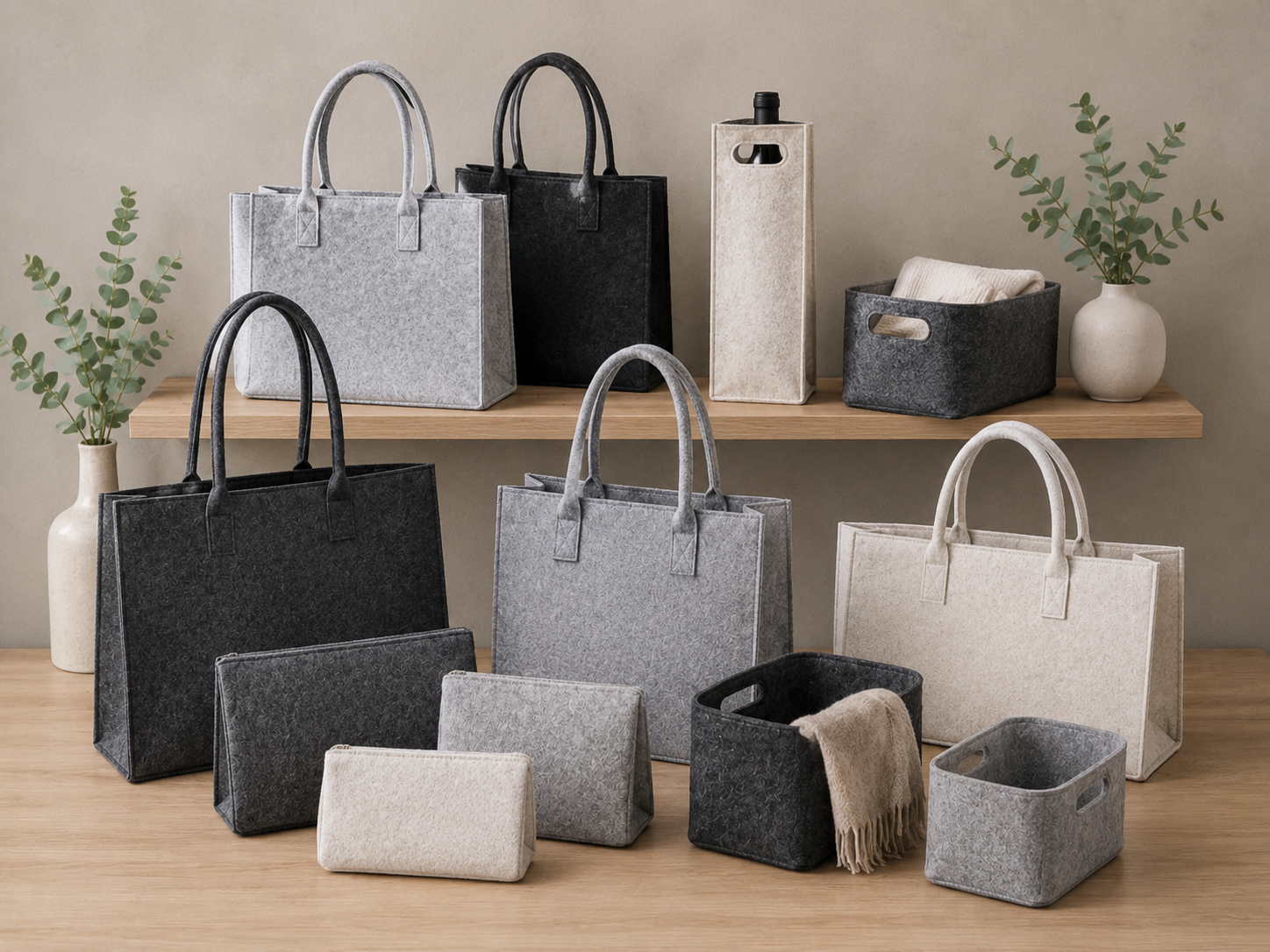
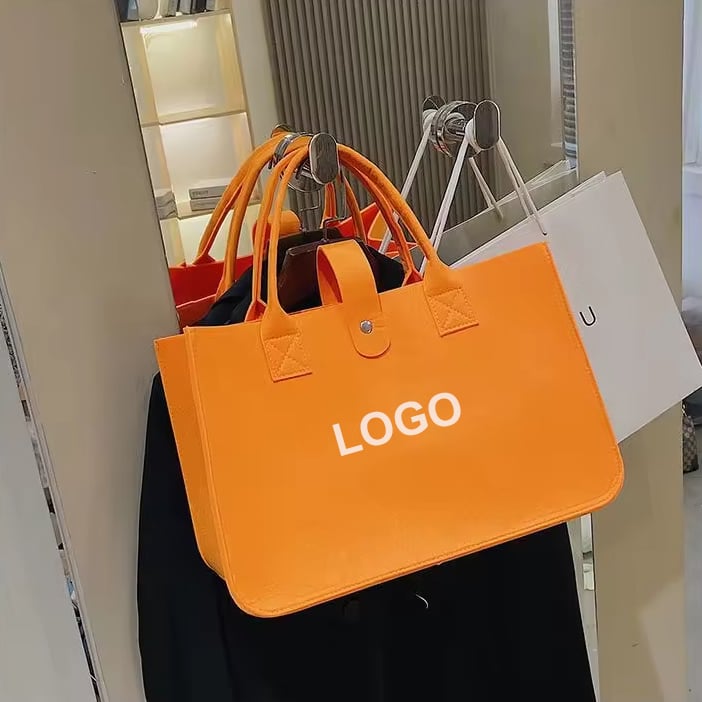
Felt bags are widely used for retail shopping, home organization, office storage, gift packaging, promotional programs and private-label lifestyle collections.
Their appeal comes from a distinctive combination of properties. Felt can provide a soft surface while maintaining more structure than many lightweight woven fabrics. It can be cut into clean shapes, produced in different thicknesses and customized with handles, closures, dividers, pockets and logo decoration.
However, the word felt does not describe one standardized material.
A felt bag may be made from:
- Polyester felt
- Recycled polyester felt
- Wool felt
- Wool-blend felt
- Acrylic felt
- Mixed-fiber felt
- Laminated felt
- Reinforced felt composites
These materials can differ in stiffness, thickness, strength, moisture behavior, surface appearance, price and environmental positioning.
For B2B buyers, selecting a felt bag should therefore involve more than choosing a color and adding a logo. The specification should match the intended load, product type, usage frequency, retail position and cleaning requirements.
What Is Felt?
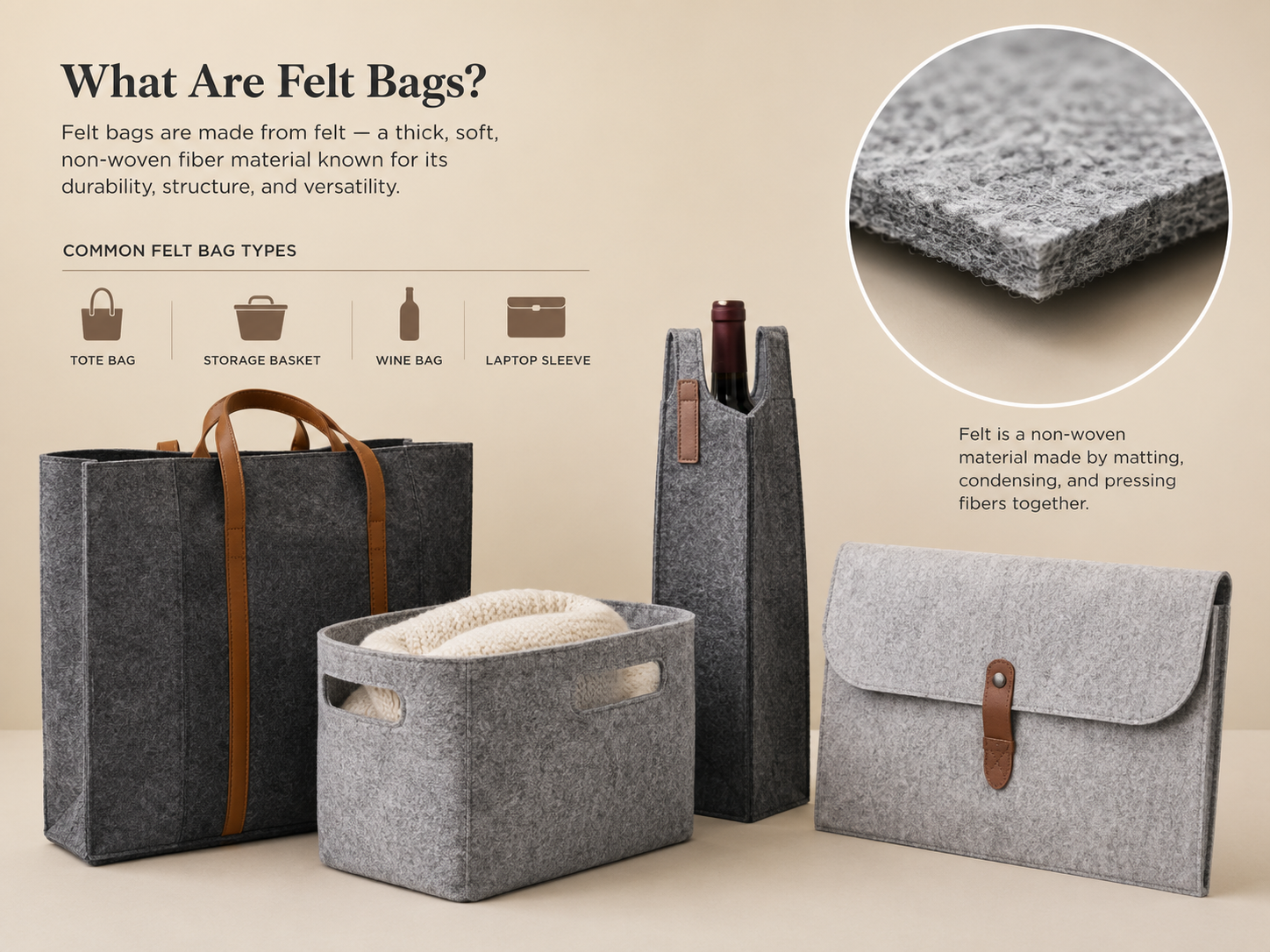
Felt is a textile material made by forming and bonding fibers into a sheet rather than constructing the material through conventional weaving or knitting.
The fibers may be joined through:
- Mechanical entanglement
- Needle punching
- Heat bonding
- Chemical bonding
- Moisture, heat and pressure
- A combination of several processes
EDANA defines a nonwoven as an engineered fibrous assembly given structural integrity through physical or chemical means, excluding weaving and knitting. Its textile glossary describes felt as a sheet of matted fibers bonded through moisture, heat, pressure or related processes.
This fiber-based structure gives felt several characteristics that are useful for bag production:
- It can be produced in different thicknesses.
- It generally does not unravel like a conventional woven fabric.
- It can provide cushioning and surface protection.
- It can be soft, firm or semi-rigid.
- It can be sewn, cut, embossed, printed or laminated.
- It can retain a defined shape better than some thin woven fabrics.
The actual performance depends on the fiber composition, density, bonding method and finishing.
Felt Is Not the Same as Non-Woven Polypropylene
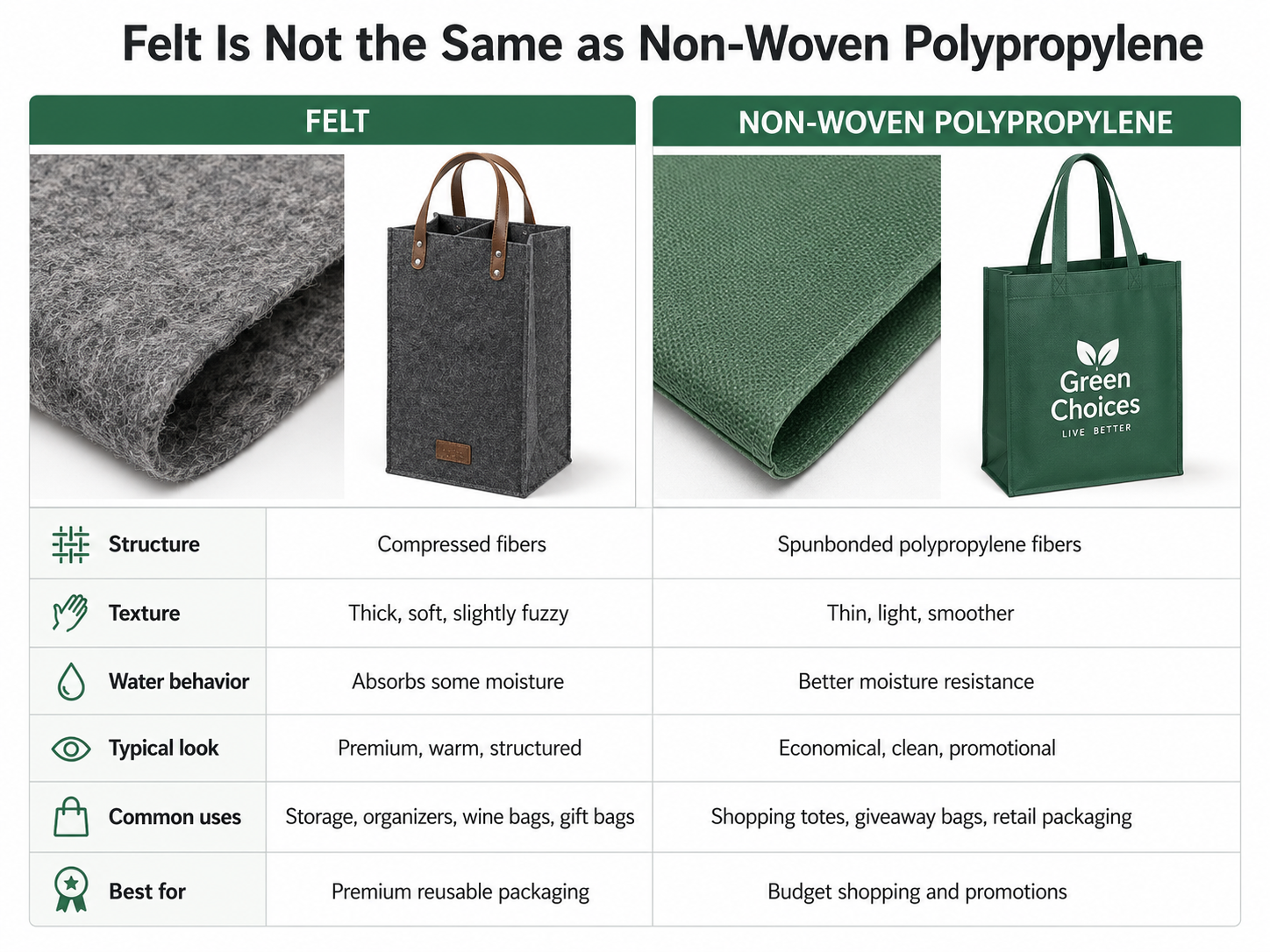
Felt is frequently described as a nonwoven material, but it should not automatically be treated as the same product as standard non-woven polypropylene shopping-bag fabric.
Both materials may be produced without conventional weaving, but their appearance, thickness and construction can be very different.
| Comparison Point |
Felt |
Standard Non-Woven Polypropylene |
| Surface |
Soft, dense and textile-like |
Smooth or slightly patterned |
| Typical structure |
Matted, needle-punched or bonded fibers |
Spunbond polypropylene web |
| Common thickness |
Often visibly thick |
Usually relatively thin |
| Shape retention |
Medium to high depending on density |
Low to medium |
| Edge behavior |
Usually does not unravel |
Usually does not unravel |
| Typical appearance |
Warm, structured and lifestyle-oriented |
Economical and promotional |
| Common bag use |
Storage, retail, office and gift bags |
Shopping, takeaway and promotional bags |
| Folding volume |
Higher |
Lower |
| Custom positioning |
Mid-range to premium |
Economical to mid-range |
Buyers should not request “non-woven felt” without also specifying the required appearance and performance. The term can otherwise be interpreted differently by different suppliers.
Common Felt Materials Used for Bags
Polyester Felt
Polyester felt is one of the most common materials used for commercial felt bags.
It can provide:
- Consistent color
- Controlled thickness
- Relatively stable dimensions
- Moderate moisture resistance
- Good cutting performance
- Broad availability
- Competitive production cost
- Compatibility with several logo methods
Polyester felt is commonly used for:
- Shopping totes
- Storage baskets
- Office bags
- Laptop sleeves
- Bottle carriers
- Promotional products
- Gift packaging
The material can be manufactured in different densities. A soft, low-density felt may bend easily, while a denser felt can support a more structured bag shape.
Polyester felt should not automatically be described as an environmentally friendly material solely because the finished bag is reusable. Fiber origin, recycled content, product life, accessories and end-of-life conditions should all be considered.
Recycled Polyester Felt
Recycled polyester felt is commonly produced using recycled polyester fibers, including material derived from recycled plastic feedstock.
It can be considered when buyers require:
- Recycled-material positioning
- RPET product collections
- Corporate sustainability programs
- Retail products with recycled-content documentation
- Coordination with other RPET bags
However, the term recycled felt is not sufficient for a formal material claim.
Buyers should confirm:
- Recycled fiber percentage
- Virgin fiber percentage
- Binder or adhesive content
- Material certification
- Chain-of-custody requirements
- Color limitations
- Surface consistency
- Testing requirements
A felt bag may contain recycled polyester in the main body but still use virgin polyester thread, synthetic webbing, plastic reinforcement, metal accessories or mixed-material decorations.
Environmental statements should reflect the complete product rather than only the main panel.
Wool Felt
Traditional felt is often associated with wool because wool fibers can naturally interlock through moisture, heat, friction and pressure.
Wool felt may provide:
- Soft tactile quality
- Dense structure
- Premium material positioning
- Natural fiber content
- Good cushioning
- Warm visual character
It may be suitable for:
- Premium lifestyle products
- Fashion accessories
- Laptop sleeves
- Small organizers
- Gift packaging
- Specialty retail collections
Potential limitations include:
- Higher material cost
- Greater natural variation
- More complex care requirements
- Possible shrinkage
- Sensitivity to moisture and heat
- Odor or fiber concerns for some buyers
- Additional sourcing requirements
A buyer requesting wool felt should specify whether the material is:
- 100% wool
- Wool blend
- Wool-polyester felt
- Recycled wool blend
- Surface wool with synthetic backing
A product described visually as wool felt may not necessarily contain 100% wool.
Acrylic and Mixed-Fiber Felt
Acrylic and mixed-fiber felts may be used when buyers need:
- Bright colors
- Lower cost
- Decorative surfaces
- Craft-style products
- Seasonal gift packaging
- Lightweight accessories
Mixed-fiber felt can combine several materials to adjust:
- Strength
- Softness
- stiffness
- thickness
- price
- color consistency
- bonding performance
Because the composition can vary considerably, buyers should request a written fiber declaration where material content affects labeling, compliance or environmental claims.
Laminated or Reinforced Felt
Felt can be combined with other materials to improve shape or function.
Possible additions include:
- Fabric backing
- Foam
- PE board
- Cardboard
- Non-woven reinforcement
- Woven lining
- Waterproof film
- Adhesive layers
- Thermal insulation
- Stiffening sheets
These structures may improve:
- Shape retention
- Bottom stability
- Moisture protection
- Product cushioning
- Load distribution
- Internal cleanliness
They can also increase:
- Material complexity
- Sewing difficulty
- Product weight
- packing volume
- production cost
- end-of-life separation challenges
A reinforced felt bag should be described as a composite structure rather than simply as a felt bag.
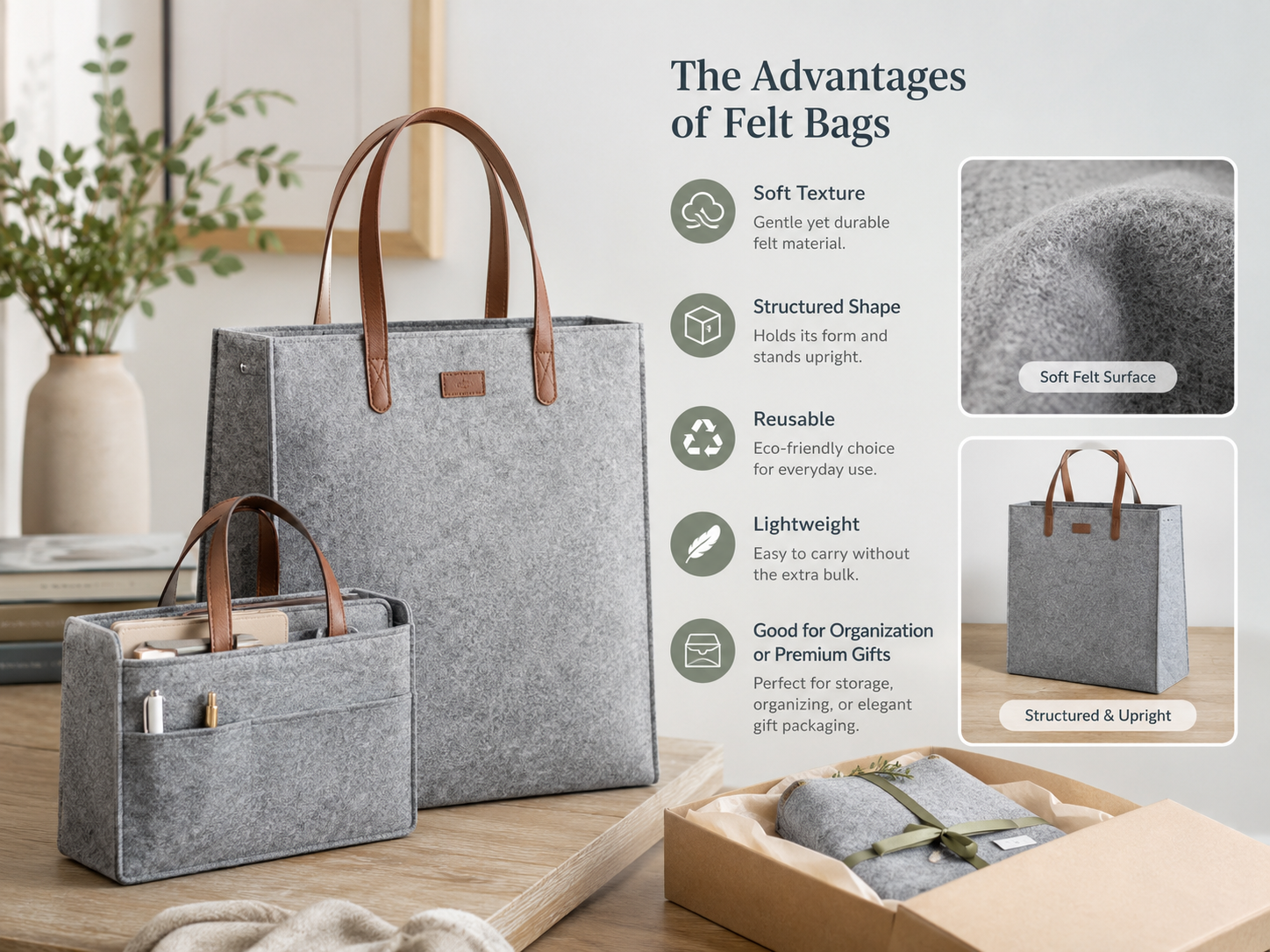
Key Advantages of Felt Bags
1. Structured Appearance Without a Rigid Shell
One of the main advantages of felt is its ability to create a semi-structured bag without requiring a fully rigid box construction.
Depending on thickness and density, felt can help a bag:
- Stand more upright
- Maintain a rectangular shape
- Support wide side gussets
- Present products neatly
- Create a clean retail appearance
- Hold internal dividers
This makes felt suitable for shopping, storage and gift bags that need more structure than a thin cotton or polyester tote.
INITIGIFT’s felt category includes shopping totes, organizer totes, gift bags, storage bags, laptop bags and bottle carriers, with customization available for thickness, handles, dividers and branding.
2. Soft Surface and Cushioning
Felt provides a softer contact surface than many rigid packaging materials.
It can help reduce:
- Surface scratching
- Light impact
- Movement between products
- Contact noise
- Friction against delicate items
This makes it useful for:
- Electronics accessories
- Glass bottles
- Office equipment
- Gift products
- Home-storage items
- Small furniture accessories
However, ordinary felt should not be treated as certified protective packaging unless the complete product has been tested for the expected impact and load.
3. Clean-Cut Edges
Because felt is formed from bonded or entangled fibers rather than conventional warp and weft yarns, cut edges generally do not unravel in the same manner as woven fabrics.
This allows manufacturers to use:
- Exposed cut edges
- Decorative cutouts
- Laser-cut patterns
- Simple folded structures
- Die-cut handles
- Layered panels
- Minimal edge finishing
Clean-cut construction can reduce sewing operations in some designs.
However, lower-density felt may still show:
- Fiber shedding
- Fuzzy edges
- Surface damage
- Elongation around cut handles
Cut edges should therefore be evaluated during sampling rather than assumed to be maintenance-free.
4. Wide Range of Thicknesses and Densities
Felt can be produced in several thicknesses and densities.
A thinner felt may be suitable for:
- Gift pouches
- Small promotional bags
- Decorative sleeves
- Simple document holders
A thicker or denser felt may be more suitable for:
- Shopping totes
- Storage baskets
- Bottle carriers
- Laptop bags
- Office organizers
- Structured gift packaging
Thickness and density should be considered together.
A thick but low-density felt can feel soft and bulky without offering strong structural support. A thinner, highly compressed felt may feel firmer and more stable.
5. Large Branding Area
Felt bags often include broad front and back panels that can support:
- Screen printing
- Heat transfer
- Embroidery
- Woven labels
- Rubber patches
- Leather-style patches
- Metal logo plates
- Debossed patches
- Hangtags
A structured rectangular felt tote can offer a clean logo area for retail and promotional projects. INITIGIFT’s current felt products support printing, embroidery, woven labels, patches, custom handles and retail packaging.
The correct branding process depends on surface texture, fiber type and thickness.
6. Flexible Shape Development
Felt can be used to create:
- Flat tote bags
- Box-shaped shopping bags
- Foldable storage baskets
- Briefcase-style bags
- Laptop sleeves
- Bottle carriers
- File organizers
- Gift bags
- Drawstring pouches
- Handled storage bins
It can also be combined with:
- Wooden handles
- Cotton webbing
- PU handles
- Zippers
- Snap buttons
- Hook-and-loop closures
- Metal accessories
- Internal dividers
This flexibility allows one material family to support several retail and organizational products.
7. Good Color and Seasonal Design Potential
Synthetic felt can be produced in a wide range of colors.
Brands can develop:
- Neutral grey and black office collections
- Warm beige and brown home products
- Bright promotional colors
- Color-block retail bags
- Holiday gift packaging
- Children’s storage products
- Seasonal lifestyle collections
Because felt has a visually warm surface, it is frequently used in autumn, winter and holiday product ranges.
Color matching should still be confirmed through physical swatches because the felt surface can make colors appear different from smooth printed materials.
8. Foldable for Storage and Shipping
Many felt bags can be folded or packed flat.
This can reduce storage volume compared with rigid gift boxes or molded organizers.
However, thicker felt can retain fold lines, especially after:
- Long-term compression
- Tight carton packing
- High stacking pressure
- Exposure to heat
- Extended warehouse storage
The export packing method should balance carton efficiency with acceptable product appearance.
Main Disadvantages of Felt Bags
1. Carrying Strength Depends on Construction
Felt thickness alone does not determine the finished bag’s carrying capacity.
A felt bag can fail through:
- Handle tearing
- Stitch holes enlarging
- Seam opening
- Bottom deformation
- Excessive stretching
- Fastener failure
- Reinforcement separation
Cut-out handles can concentrate force around the opening. Sewn handles can fail if the attachment area is too small or insufficiently reinforced.
For shopping or storage bags, buyers should confirm:
- Target working load
- Handle material
- Handle width
- Stitch pattern
- Reinforcement panel
- Bottom construction
- Static-load test
- Repeated lifting test
A thick-looking bag should not be marketed as heavy-duty without a defined test.
2. Surface Pilling and Fiber Shedding
Some felt materials can develop:
- Pilling
- Surface fuzz
- Loose fibers
- Abrasion marks
- Uneven texture
This may occur through:
- Repeated rubbing
- Low fiber quality
- Low-density construction
- Rough cutting
- Contact with hook-and-loop fasteners
- Friction during transport
Pilling risk should be evaluated when the bag is intended for:
- Fashion retail
- Premium gift packaging
- Laptop storage
- Light-colored products
- Long-term daily use
A denser material and better surface finishing may improve appearance, but they can also increase cost.
3. Limited Resistance to Water and Stains
Felt is not automatically waterproof.
Moisture behavior depends on:
- Fiber composition
- Density
- Surface treatment
- Lamination
- Backing
- Coating
Untreated felt may absorb or retain moisture. Spilled liquids can create:
- Water marks
- Stains
- Odor
- Slow drying
- Shape changes
- Mold risk under poor storage conditions
A water-repellent treatment or internal lining may improve practical performance, but the supplier should not describe the product as waterproof unless the construction supports that claim.
4. Cleaning Can Be More Difficult Than Smooth Fabrics
Felt surfaces can trap:
- Dust
- Hair
- Lint
- Small particles
- Dry dirt
Dark felt may show light-colored lint, while pale felt may show stains.
Cleaning recommendations often include:
- Spot cleaning
- Gentle wiping
- Soft brushing
- Air drying
- Avoiding aggressive rubbing
Machine washing may cause deformation, shrinkage, pilling, lamination separation or damage to handles and hardware.
Washability should be confirmed through testing on the finished bag.
5. Creasing and Shape Distortion
Felt can maintain structure, but it can also develop:
- Packing creases
- Compression marks
- Bent corners
- Distorted gussets
- Uneven panels
This is especially relevant for:
- Thick rectangular totes
- Storage baskets
- Briefcase-style bags
- Gift presentation bags
Possible control methods include:
- Improved carton size
- Reduced compression
- Internal paper supports
- Bottom boards
- Pre-shipment reshaping
- Appropriate stacking height
The buyer should establish whether minor fold lines are acceptable after unpacking.
6. Heat Sensitivity
Synthetic felt can be affected by excessive heat.
High temperatures may cause:
- Surface glazing
- Shrinkage
- Hardening
- Warping
- Color change
- Adhesive failure
This matters during:
- Heat-transfer printing
- Hot pressing
- Ironing
- Drying
- Storage near heat sources
The decoration method should be tested on the exact production material before bulk approval.
7. Thickness Increases Packing Volume
Felt is often thicker than ordinary cotton, nylon or spunbond shopping-bag material.
This can increase:
- Carton volume
- Freight cost
- Warehouse space
- Retail shelf space
- Individual packing size
A felt bag may remain lightweight, but international shipping is often influenced by volumetric size rather than product weight alone.
Carton data should be reviewed before the order is confirmed.
8. Sustainability Depends on the Exact Material
Felt should not automatically be marketed as natural, biodegradable or environmentally friendly.
Its composition may include:
- Virgin polyester
- Recycled polyester
- Acrylic
- Wool
- Cotton
- Adhesive binders
- Mixed fibers
- Lamination
- Reinforcement boards
The environmental profile depends on:
- Fiber source
- Recycled content
- Product durability
- Production method
- Additional components
- Packaging
- End-of-life options
EDANA notes that nonwoven properties are engineered through raw-material selection, formation, bonding and finishing. This means two visually similar felt materials can have substantially different compositions and performance.
Buyers should use precise claims such as:
- Made with recycled polyester felt
- Contains a specified percentage of recycled fiber
- Reusable felt storage bag
- Designed for repeated retail use
Broad claims should be supported with appropriate documentation.
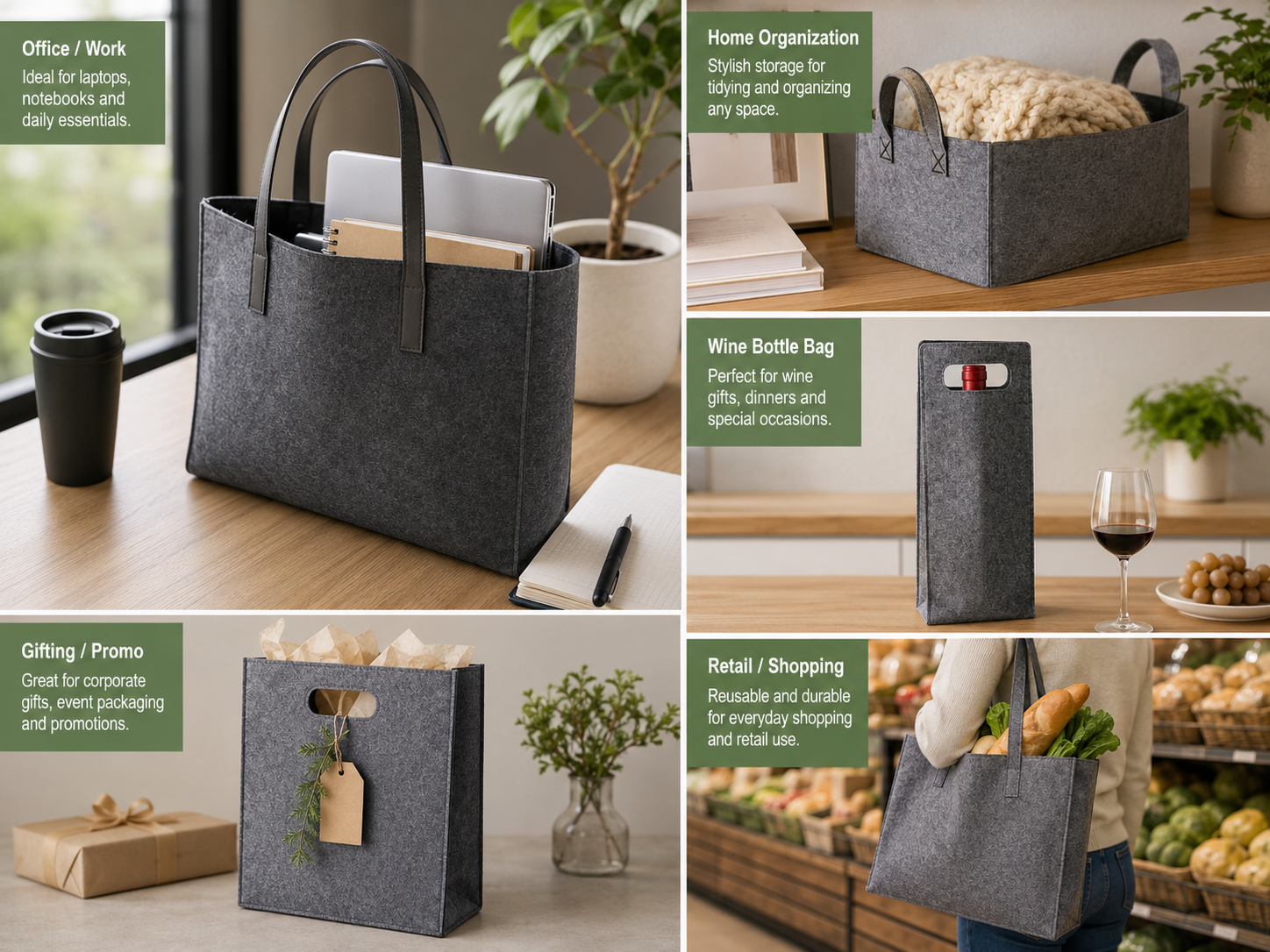
Main Applications of Felt Bags
Retail Shopping Bags
Structured felt shopping bags can be used for:
- Fashion stores
- Lifestyle retailers
- Gift shops
- Department stores
- Bookstores
- Beauty brands
- Homeware retailers
Important design features may include:
- Wide gussets
- Reinforced handles
- Snap or zipper closure
- Large logo area
- Bottom reinforcement
- Retail-ready packaging
Felt is most suitable when the buyer wants the bag to function as both packaging and a reusable retail item.
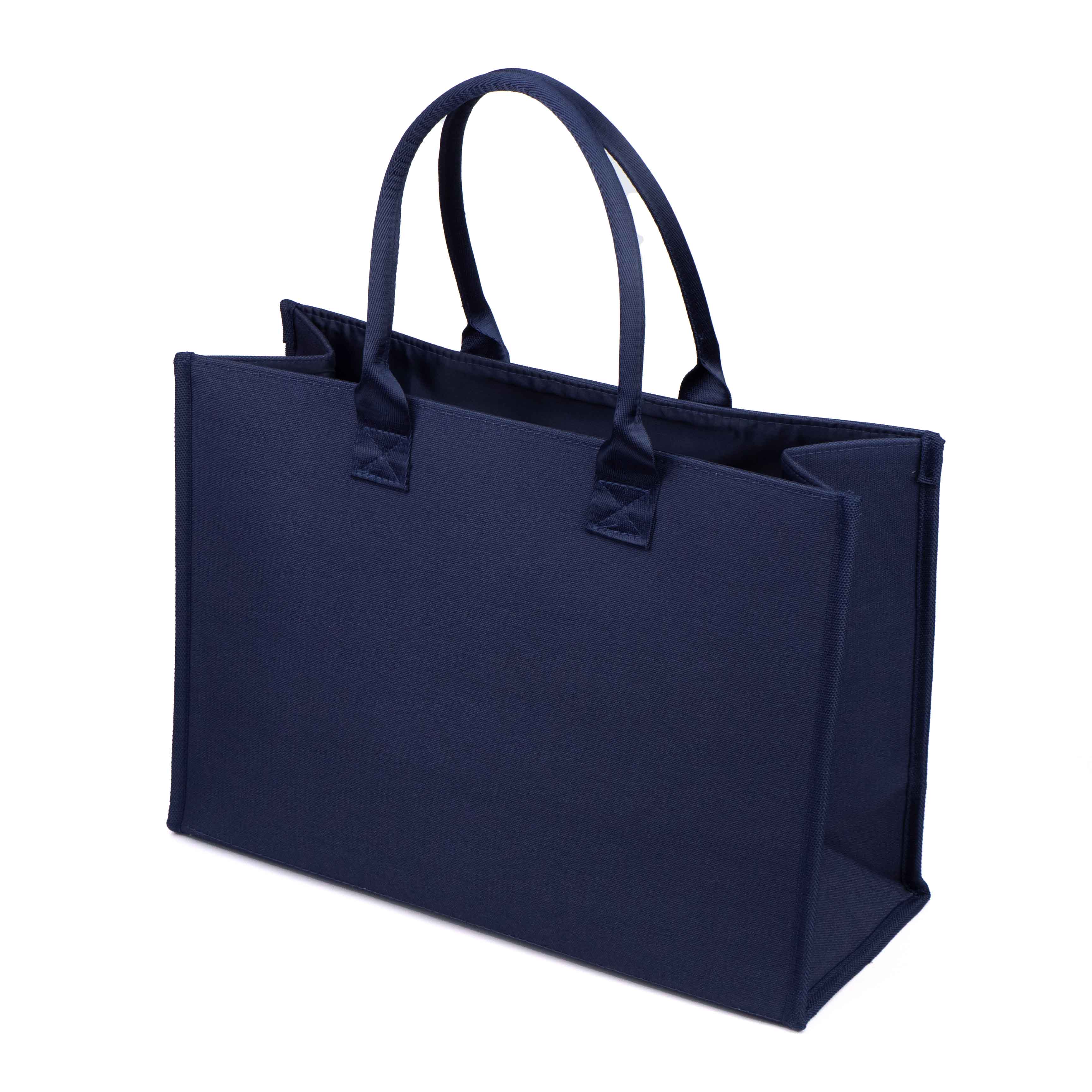
Home Storage Bags
Felt is commonly used for:
- Toy storage
- Blanket storage
- Laundry organization
- Wardrobe storage
- Shelf baskets
- Nursery products
- Magazine holders
- General household organization
For home-storage products, buyers should evaluate:
- Shape retention
- Handle strength
- Interior cleanliness
- Collapsibility
- Load distribution
- Fold recovery
- Surface pilling
A storage basket carrying soft textiles requires a different specification from one carrying books, bottles or household tools.
Office and Document Bags
Felt can create a clean, professional appearance for:
- Document carriers
- File bags
- Briefcase-style totes
- Meeting bags
- Conference materials
- Employee gift sets
- Laptop sleeves
- Office organizers
Possible features include:
- Wooden handles
- Snap closures
- Zipper closures
- Dividers
- Inner pockets
- Pen loops
- Document compartments
A felt briefcase-style bag can be developed with wooden handles, internal lining, snap fasteners and custom branding for office and lifestyle programs.
For laptop applications, the buyer should specify the required device dimensions and cushioning performance. Felt alone should not be assumed to provide protection against major drops or impacts.
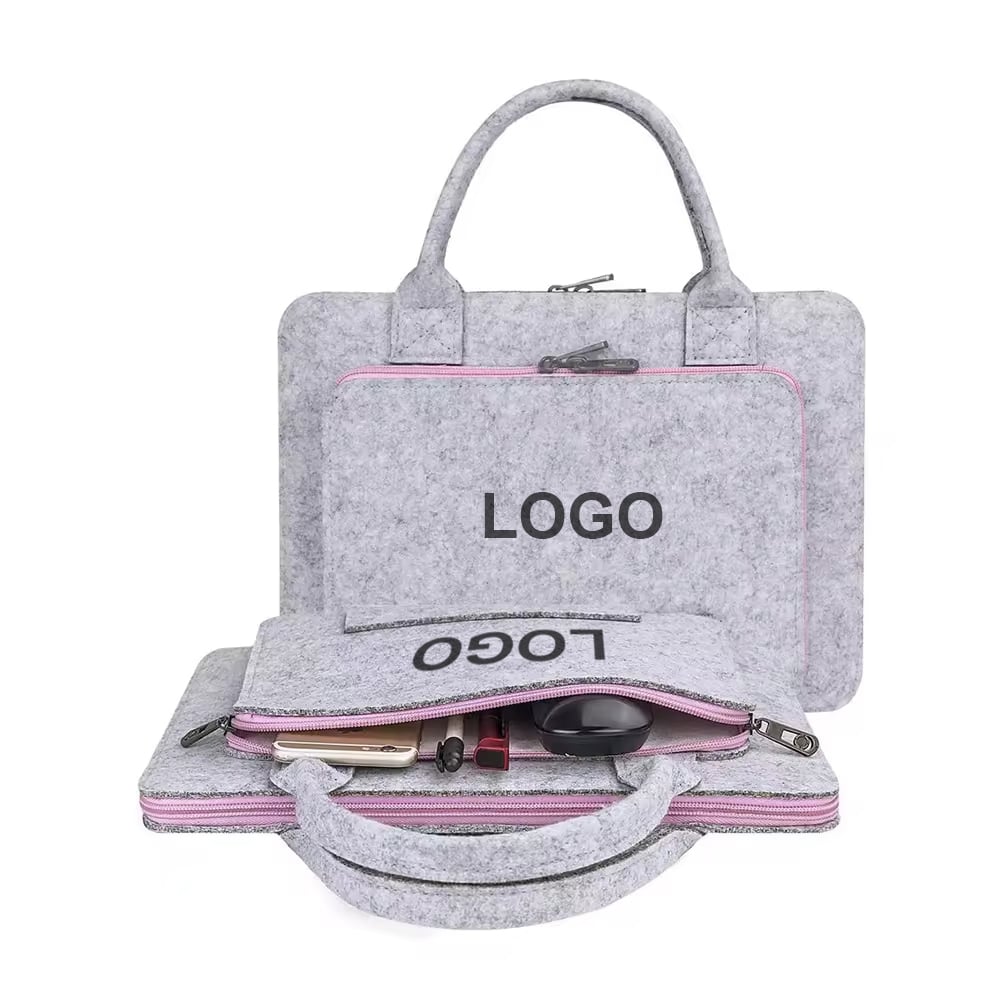
Gift Packaging
Felt bags can replace or complement:
- Paper gift bags
- Rigid boxes
- Fabric pouches
- Promotional packaging
- Holiday wrapping
They are suitable for:
- Corporate gifts
- Seasonal gift sets
- Cosmetics
- Food gift sets
- Wine accessories
- Employee benefits
- Event merchandise
A felt gift bag can provide longer secondary use than disposable packaging, but it may occupy more freight and storage space than flat paper packaging.
Bottle and Wine Carriers
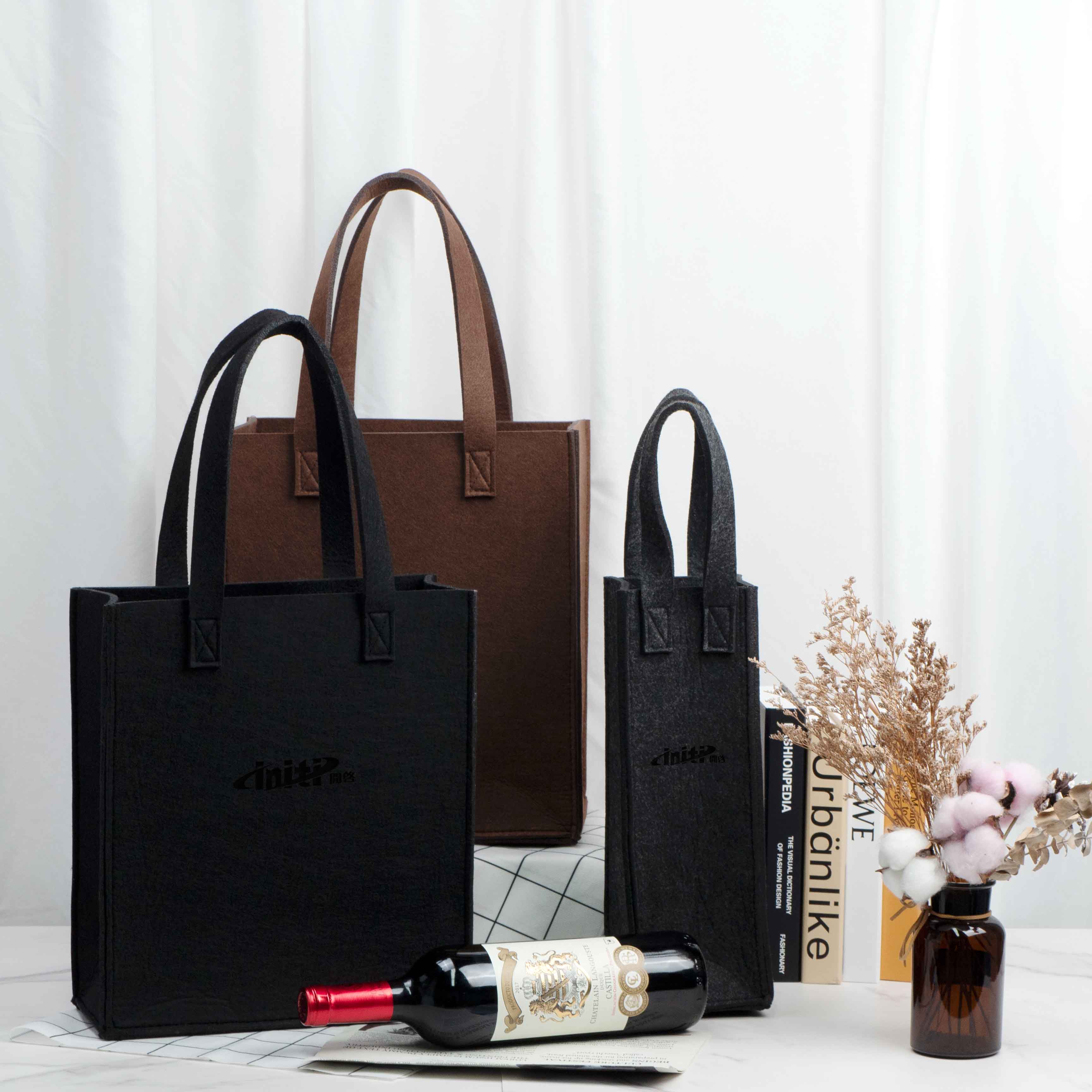
Thick felt can be used for:
- Single-bottle wine bags
- Multi-bottle carriers
- Beverage gift packaging
- Reusable bottle organizers
Useful features may include:
- Internal dividers
- Reinforced bottom
- Wide handles
- Snap closure
- Printed or embroidered branding
The divider should prevent bottles from contacting each other during normal carrying.
Buyers should test:
- Divider position
- Bottom strength
- Handle attachment
- Bottle fit
- Loaded stability
Felt can provide cushioning, but it does not replace protective shipping packaging for fragile glass bottles.
Promotional and Corporate Bags
Felt bags can be used for:
- Trade shows
- Corporate gifts
- Staff programs
- Product launches
- Conferences
- Membership programs
- Client gift sets
Compared with basic non-woven polypropylene bags, felt can create a more substantial and lifestyle-oriented appearance.
However, it may not be the most economical choice for very high-volume, one-time giveaways.
Felt is more suitable when the buyer values:
- Reuse
- Structure
- Product presentation
- Perceived value
- Long-term brand visibility
Storage and Packaging for Delicate Products
Felt may be used to store or separate:
- Electronics accessories
- Jewelry boxes
- Eyewear
- Tableware
- Small furniture parts
- Decorative products
- Premium footwear accessories
For delicate products, buyers should check:
- Color transfer
- Fiber shedding
- Surface softness
- Odor
- Hardware contact
- Interior seams
A soft-looking material can still scratch a sensitive surface if loose fibers, rough seams or metal components are present.
Felt Bag Material Comparison
| Material |
Main Advantages |
Main Limitations |
Suitable Direction |
| Polyester felt |
Consistent, structured, widely available |
Synthetic composition, possible pilling |
Retail, storage and promotional bags |
| Recycled polyester felt |
Recycled-content positioning |
Requires documentation and composition control |
RPET collections and corporate programs |
| Wool felt |
Premium texture and natural fiber content |
Higher cost and more complex care |
Fashion, office and premium gift products |
| Acrylic felt |
Bright colors and economical decoration |
Lower premium perception and variable durability |
Craft, seasonal and lightweight gift products |
| Laminated felt |
Better structure and moisture control |
Multi-material construction and higher cost |
Shopping and storage bags |
| Felt with lining |
Cleaner interior and better product protection |
Additional sewing, weight and cost |
Premium retail, office and gift bags |
Felt Bags Compared with Other Bag Materials
| Buyer Requirement |
Felt |
Canvas |
Non-Woven PP |
Jute |
| Structured appearance |
Good |
Medium |
Limited |
Good with lamination |
| Soft cushioning |
Good |
Limited |
Limited |
Limited |
| Fine-detail printing |
Medium |
Good |
Good |
Limited to medium |
| Folding compactness |
Medium |
Good |
Very good |
Medium |
| Moisture resistance |
Depends on finish |
Limited unless treated |
Generally better |
Limited unless laminated |
| Premium lifestyle appearance |
Good |
Good |
Limited |
Good for natural positioning |
| Heavy-load potential |
Depends heavily on reinforcement |
Good with suitable construction |
Limited to medium |
Good with suitable construction |
| Natural fiber option |
Wool felt only |
Cotton canvas |
No |
Yes |
| Recycled-content option |
RPET felt |
Recycled cotton or blends |
Recycled PP options |
Recycled jute blends may vary |
| Typical price positioning |
Medium |
Medium |
Low |
Medium |
The correct material depends on the target market and product specification. Felt should not be selected only because it appears more structured in photographs.
How Felt Thickness Affects the Bag
Thickness influences:
- Hand feel
- Shape retention
- Cutting performance
- Sewing difficulty
- Handle support
- Product cushioning
- Foldability
- Packing volume
A thin felt can reduce cost and carton volume but may collapse easily.
A thick felt can improve structure but may:
- Require stronger sewing equipment
- Increase edge bulk
- Create larger cartons
- Retain packing creases
- Increase unit cost
Thickness should be evaluated together with density.
A physical sample should be used to assess whether the material is:
- Too soft
- Too stiff
- Too bulky
- Too thin
- Appropriate for the intended bag dimensions
Handle Options for Felt Bags
Common handle constructions include:
Integrated Cut-Out Handles
Advantages:
- Simple appearance
- Fewer separate components
- Efficient construction
- Suitable for small organizers
Risks:
- Stress concentration around the opening
- Stretching
- Tearing
- Uncomfortable grip under heavy load
Felt Handles
Advantages:
- Consistent material appearance
- Soft hand feel
- Easy color matching
Risks:
- Elongation
- Edge fuzzing
- Weak attachment if not reinforced
Webbing Handles
Possible materials include:
- Cotton webbing
- Polyester webbing
- RPET webbing
- Nylon webbing
Webbing can provide better load distribution than narrow felt straps.
Wooden Handles
Wooden handles can create a distinctive lifestyle or office appearance.
Buyers should inspect:
- Surface smoothness
- Edge finishing
- Attachment method
- Color consistency
- Cracking
- Moisture content
- Loaded comfort
PU or Leather-Style Handles
These may create a premium appearance but introduce another material into the product.
The buyer should confirm:
- Surface durability
- Color transfer
- Flex cracking
- Attachment strength
- Compliance requirements
Closure Options
Felt bags can use:
- Open top
- Snap button
- Magnetic button
- Zipper
- Hook-and-loop closure
- Drawstring
- Fold-over flap
The closure should match the intended use.
An open-top storage basket may not require additional hardware.
A retail shopping bag may benefit from a snap or zipper.
A laptop bag may require a more secure closure, internal divider and protective construction.
Each closure can affect:
- MOQ
- unit price
- production time
- packaging thickness
- testing requirements
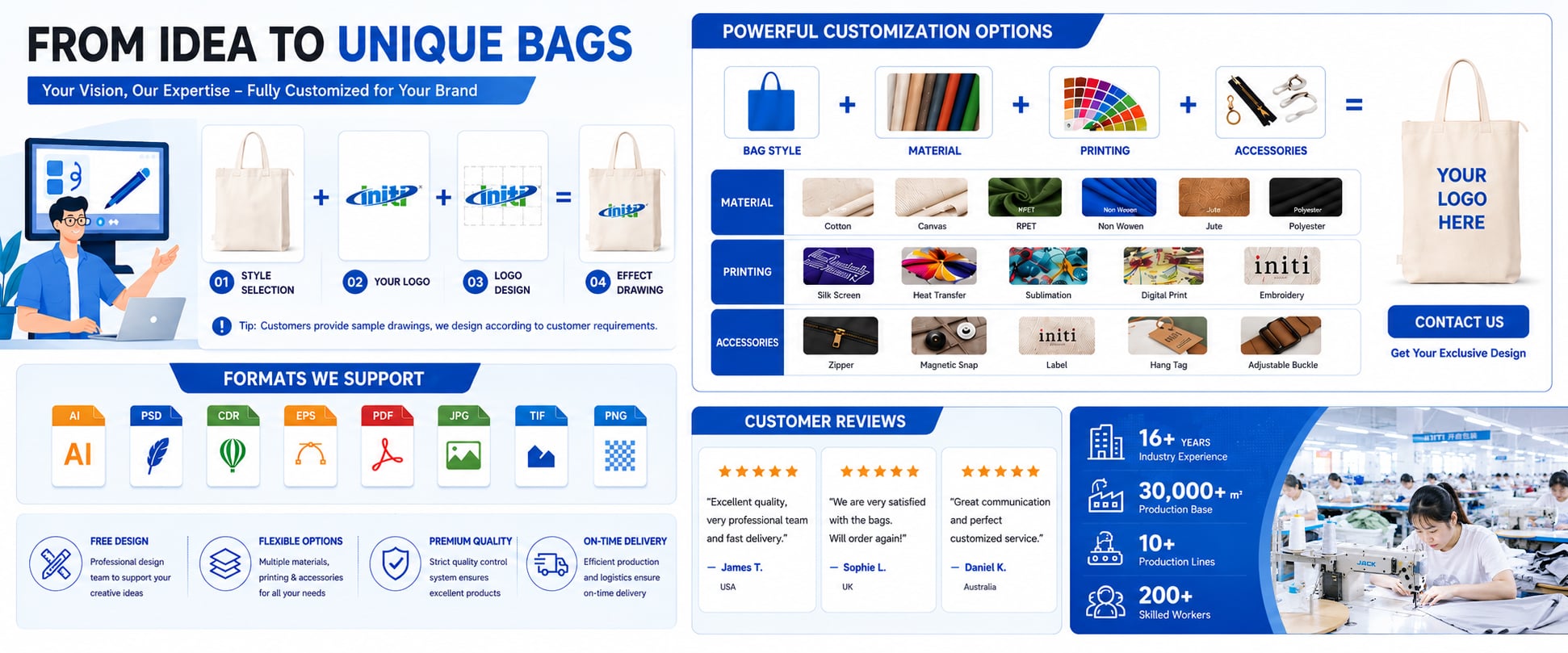
Logo Options for Felt Bags
Screen Printing
Suitable for:
- Simple logos
- Bold text
- Limited colors
- Economical bulk orders
The uneven surface may reduce very fine detail.
Heat Transfer
Suitable for:
- Multi-color artwork
- Detailed graphics
- Smaller production runs
The transfer temperature and adhesion should be tested on the actual felt.
Embroidery
Suitable for:
- Premium logos
- Corporate gifts
- Fashion retail
- Small branding areas
Dense embroidery can cause puckering or stiffness.
Woven Labels
Suitable for:
- Private-label collections
- Small logos
- Clean brand identification
- Repeat production
Patches
Options include:
- Rubber patch
- PU patch
- Embroidered patch
- Woven patch
- Metal plate
Patch weight and attachment should not distort the felt panel.
Quality Checks for Custom Felt Bags
Material Inspection
Check:
- Fiber composition
- Thickness
- GSM or material weight
- Density
- Color
- Surface consistency
- Odor
- Pilling
- Fiber shedding
- Stains
- Creases
Cutting Inspection
Check:
- Panel dimensions
- Edge quality
- Cut-handle position
- Hole shape
- Pattern accuracy
- Layer alignment
Sewing Inspection
Check:
- Stitch density
- Seam allowance
- Handle reinforcement
- Corner construction
- Skipped stitches
- Thread tension
- Lining alignment
- Binding quality
Accessory Inspection
Check:
- Zipper operation
- Snap alignment
- Magnetic closure strength
- Wooden-handle surface
- Hardware attachment
- Hook-and-loop positioning
Logo Inspection
Check:
- Size
- Position
- Color
- adhesion
- embroidery tension
- patch alignment
- edge lifting
- heat marks
Finished-Bag Inspection
Check:
- Dimensions
- Shape
- standing stability
- handle symmetry
- load performance
- closure function
- packing creases
- interior cleanliness
- packaging
Recommended Testing by Application
| Application |
Main Testing Focus |
| Retail shopping bag |
Handle strength, repeated lifting and logo durability |
| Home storage basket |
Shape recovery, bottom stability and carrying load |
| Laptop or document bag |
Dimensions, closure, cushioning and handle attachment |
| Bottle carrier |
Divider position, bottom strength and loaded stability |
| Gift bag |
Appearance, color consistency and packing recovery |
| Promotional tote |
Logo adhesion, seam strength and unit consistency |
| Foldable organizer |
Fold recovery, crease resistance and handle strength |
The test load and cycle count should be defined according to the intended product rather than copied from an unrelated bag type.
Common Buyer Mistakes
Mistake 1: Treating All Felt as the Same Material
Polyester, RPET, wool and blended felt can differ significantly.
Mistake 2: Selecting Only by Thickness
Density and bonding method may be as important as thickness.
Mistake 3: Assuming Thick Felt Means High Load Capacity
The bag may still fail at handles, seams or cut openings.
Mistake 4: Claiming the Bag Is Eco-Friendly Without Confirming Composition
Synthetic felt may contain virgin plastic fibers, binders and mixed reinforcements.
Mistake 5: Ignoring Packing Creases
Highly compressed felt bags may arrive with visible deformation.
Mistake 6: Using Fine Artwork Without a Print Test
The textured surface can reduce small text and fine-line clarity.
Mistake 7: Assuming Felt Is Waterproof
Water performance depends on the material and finishing.
Mistake 8: Giving Machine-Wash Instructions Without Testing
Washing may affect shape, surface, logo and hardware.
Mistake 9: Using Cut-Out Handles for Heavy Products
The handle opening may stretch or tear without suitable reinforcement.
Mistake 10: Comparing Quotations Without Matching Material Density
Two suppliers may offer the same thickness but substantially different material quality and stiffness.
Questions Buyers Should Ask Suppliers
Before confirming a felt bag order, ask:
- What is the exact fiber composition?
- Is the material polyester, RPET, wool or a blend?
- What is the recycled fiber percentage?
- What are the felt thickness and GSM?
- How is the felt bonded?
- Is the material soft, firm or semi-rigid?
- Does the felt contain backing or lamination?
- What load is the finished bag designed to carry?
- How are the handles reinforced?
- Is the bag intended to stand upright?
- Will the material retain packing creases?
- What logo methods are suitable?
- Has the logo been tested on the actual felt?
- Is the product washable or spot-clean only?
- Is the material water-repellent?
- What color tolerance applies?
- Is pilling or fiber shedding tested?
- What packaging method protects the bag shape?
- Can the same material be used for repeat orders?
- Which certifications or material documents are available?
How INITI Supports Custom Felt Bag Projects
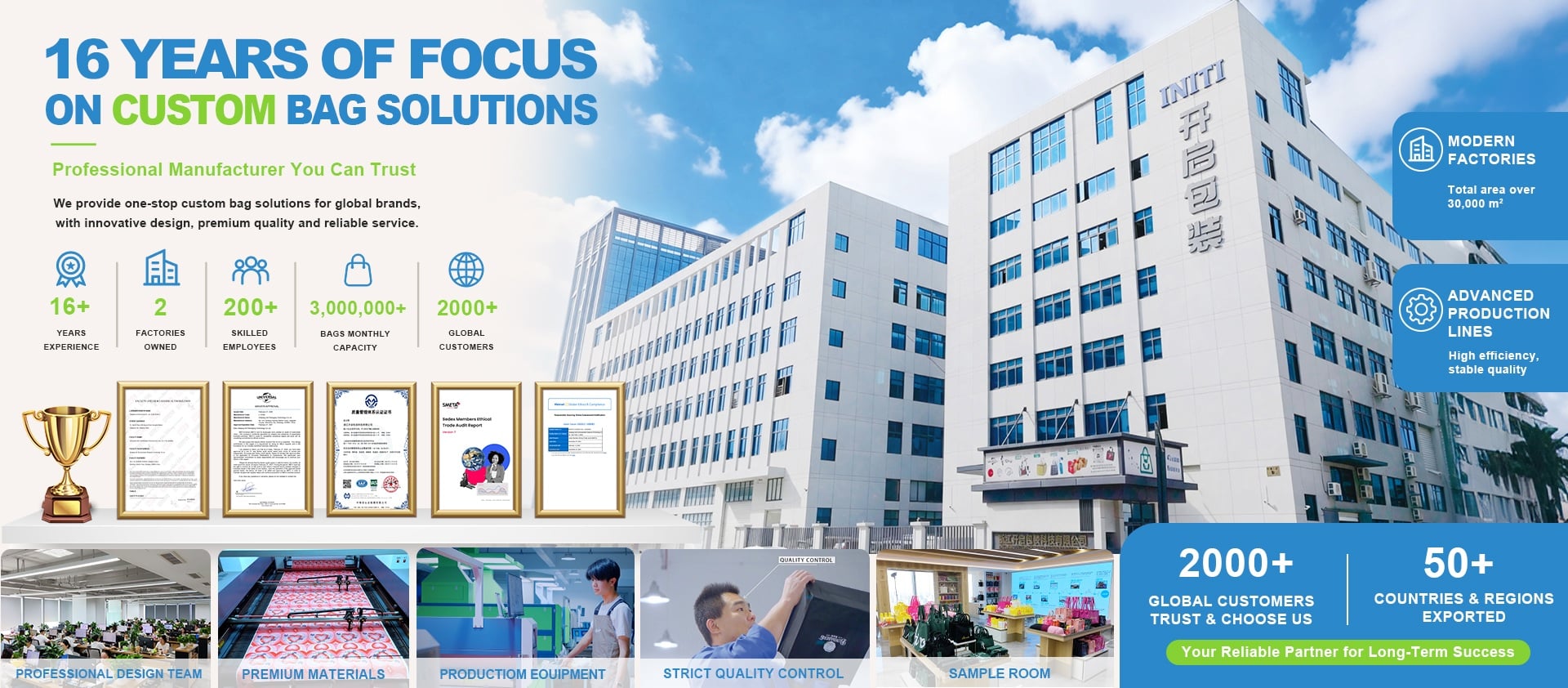
INITI develops custom felt bags for retailers, supermarkets, gift suppliers, promotional companies, corporate clients, importers, distributors and private-label brands.
Our OEM and ODM development process can support:
- Polyester and RPET felt options
- Custom felt thickness and density
- Custom colors
- Shopping and storage structures
- Side and bottom gussets
- Internal dividers
- Lining and reinforcement
- Zipper and snap closures
- Felt, webbing, wooden and PU handles
- Screen printing
- Heat transfer
- Embroidery
- Woven labels
- Custom patches
- Retail packaging
- Sample development
- Load testing
- Bulk production inspection
The appropriate material and construction should be selected according to the intended product load, retail positioning, usage frequency and destination market.
INITIGIFT’s existing felt range includes structured shopping totes, snap-closure bags, color-block retail bags and briefcase-style felt totes.
FAQ
What are felt bags made from?
Felt bags may be made from polyester, recycled polyester, wool, acrylic or blended fibers. The composition should be confirmed with the supplier.
Is felt a woven fabric?
Most commercial felt is formed by matting, entangling or bonding fibers rather than conventional weaving or knitting.
Are felt bags durable?
They can be durable when the correct density, thickness, seams, handles and reinforcements are used. Felt thickness alone does not determine durability.
Can felt bags carry heavy items?
Some felt bags can carry moderate or heavy products, but load capacity must be confirmed through the complete construction and finished-product testing.
Are felt bags waterproof?
Not automatically. Polyester felt may resist light moisture better than wool felt, but waterproof performance normally requires a coating, backing or additional structure.
Can felt bags be machine washed?
Many structured felt bags are better suited to spot cleaning. Machine washing should only be recommended after testing the complete product.
Does felt fray when cut?
Felt generally does not unravel like woven fabric, but low-density material may show loose fibers or fuzzy cut edges.
Can felt bags be printed with a logo?
Yes. Common options include screen printing, heat transfer, embroidery, woven labels and patches.
Is recycled felt available?
Yes. Recycled polyester felt may be available, but buyers should confirm recycled content, certification and the composition of the complete product.
Is felt suitable for laptop bags?
Felt can provide surface protection and light cushioning. Additional padding, lining and structural testing may be required for stronger impact protection.
Are felt bags suitable for retail packaging?
Yes. Their structured appearance and reusable function can make them suitable for lifestyle, gift, office and home-product packaging.
What thickness should a felt bag use?
The correct thickness depends on the bag size, structure, target load and desired stiffness. Buyers should compare physical samples instead of selecting only from a nominal number.
Can felt bags be folded for shipping?
Many can be packed flat, but excessive compression may create creases or deformation. The carton arrangement should be approved before production.
Is polyester felt environmentally friendly?
Polyester felt is a synthetic material. Reusability and recycled content may improve its environmental positioning, but claims should reflect the full composition and product lifecycle.
Conclusion
Felt bags provide a useful balance between softness, structure, customization and product presentation.
Their main advantages include:
- Semi-rigid shape
- Soft surface
- Clean-cut construction
- Multiple thickness options
- Large branding areas
- Flexible bag structures
- Broad color selection
- Foldable packing
Their main limitations include:
- Variable carrying strength
- Pilling and fiber shedding
- Moisture sensitivity
- Cleaning restrictions
- Packing creases
- Heat sensitivity
- Higher shipping volume
- Complex sustainability claims
The word felt is not a complete specification.
Buyers should define:
- Fiber composition
- Recycled content
- Thickness
- Density
- Surface finish
- Reinforcement
- Handle construction
- Closure
- Logo method
- Cleaning requirements
- Load testing
- Packaging
A correctly specified felt bag can work well for retail shopping, home organization, office storage, gift packaging, bottle carrying and promotional programs.
The best result comes from matching the felt material and bag structure to the intended application rather than choosing the product only by its appearance.
Inquiry Support
For a suitable felt bag recommendation, provide the intended application, finished dimensions, expected load, preferred fiber composition, felt thickness, required stiffness, handle style, closure, internal structure, logo artwork, order quantity, packaging method and destination market.
INITI can compare different felt densities, structures, handle constructions and branding methods during sample development before bulk production.
Related Products
Related Blog Articles


 Hot News