Non-Woven Bag Specifications: GSM, Handle Strength, Seams and Lamination
Non-woven polypropylene bags are widely used for retail promotions, trade shows, takeaway packaging, supermarkets and high-volume branded campaigns.
However, a specification such as “80 GSM non-woven bag” does not fully describe the product.
Two bags using the same nominal GSM can perform differently because of their:
- Material density
- Bag dimensions
- Handle construction
- Seam method
- Gusset structure
- Lamination
- Printing coverage
- Reinforcement
For B2B buyers, four specifications require particular attention:
- Fabric GSM
- Handle strength
- Seam construction
- Lamination
These factors should be evaluated as one complete bag structure rather than separately.
What Is Non-Woven PP Fabric?
A nonwoven is an engineered fibrous sheet that receives structural integrity through physical or chemical bonding rather than conventional weaving or knitting. Its properties can be adjusted through raw-material selection, web formation, bonding and finishing processes such as printing, embossing and lamination.
For reusable shopping bags, the material is commonly spunbond polypropylene, often abbreviated as:
- PP non-woven
- Spunbond non-woven
- Non-woven polypropylene
- NWPP
The material is lightweight, available in many colors and suitable for die cutting, ultrasonic bonding, sewing and logo printing.
It should not be confused with PP woven fabric, which is made from interlaced polypropylene tapes and normally provides a different surface, structure and strength level.
1. What Does GSM Mean?
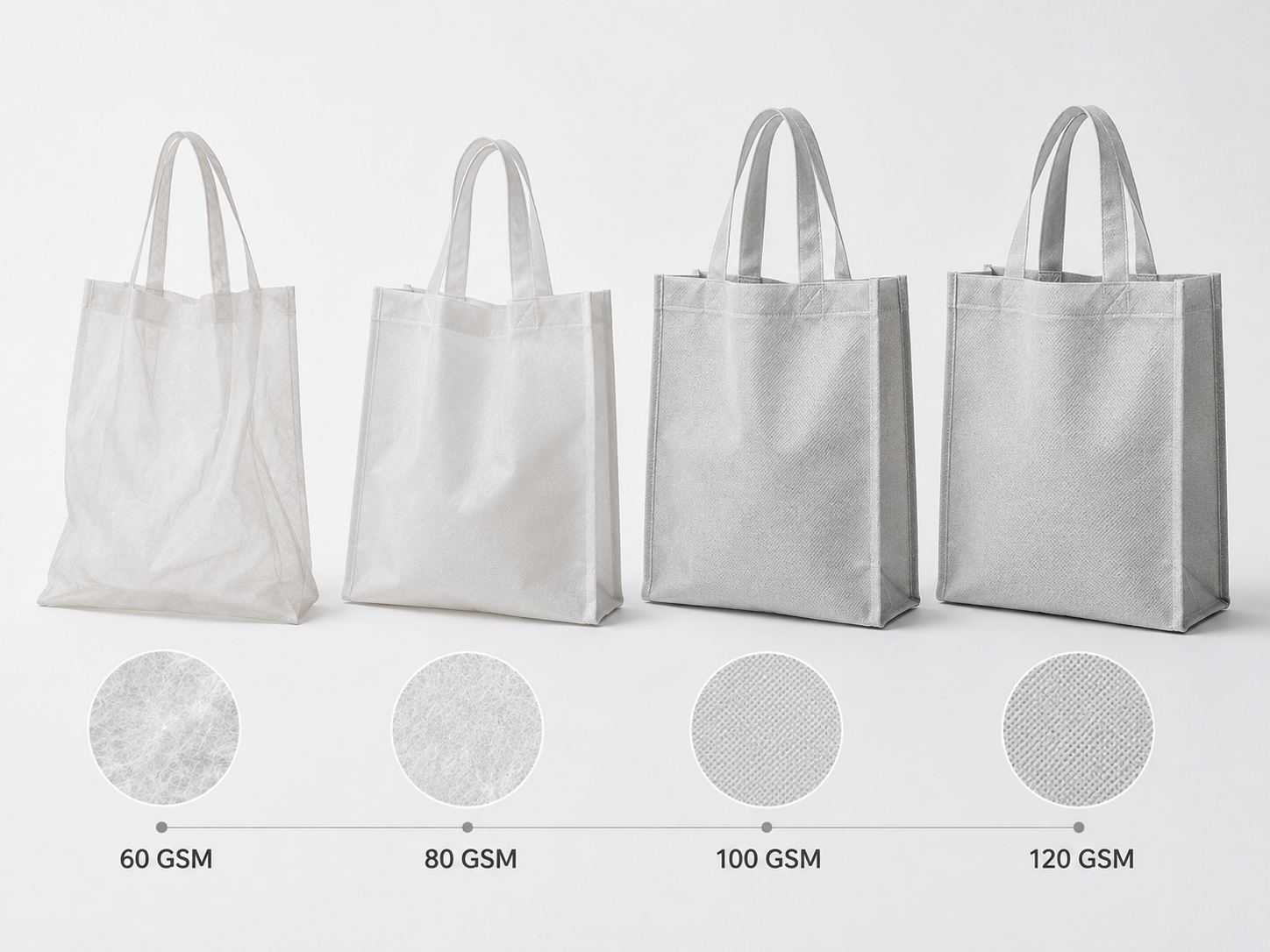
GSM means grams per square meter. It measures the mass of one square meter of fabric.
ASTM D3776/D3776M covers methods for measuring fabric mass per unit area.
A higher GSM generally means that more material is used per square meter, but it does not independently determine the bag’s carrying capacity.
Practical Non-Woven Bag GSM Ranges
| GSM Range |
General Characteristics |
Common Applications |
| 40–60 GSM |
Lightweight and flexible |
Short-term promotions, lightweight packaging and simple giveaways |
| 70–90 GSM |
Standard commercial weight |
Trade shows, retail promotions and light shopping |
| 100–120 GSM |
Firmer and more substantial |
Supermarket bags, takeaway bags and repeated retail use |
| Above 120 GSM |
Heavier and more structured |
Larger bags, reinforced constructions and premium promotional programs |
These ranges are general commercial references, not universal load standards.
The required GSM depends on:
- Bag width and height
- Gusset depth
- Expected contents
- Handle type
- Seam construction
- Number of reuse cycles
- Target cost
- Required appearance
A small 80 GSM flat bag may perform adequately for lightweight products. A large 80 GSM grocery bag with a wide gusset may place much greater stress on the handles and seams.
Why Higher GSM Does Not Automatically Mean a Stronger Bag
A heavier material can provide:
- Better opacity
- Firmer hand feel
- More support around stitch holes
- Improved shape retention
- A more substantial appearance
But a bag can still fail if it has:
- Weak handle attachments
- Narrow seams
- Poor ultrasonic bonding
- Insufficient stitching
- Oversized dimensions
- Excessive load concentration
- Weak bottom corners
Buyers should therefore avoid using GSM as the only quality requirement.
A complete specification should include both the material weight and the finished-bag performance standard.
2. Handle Strength
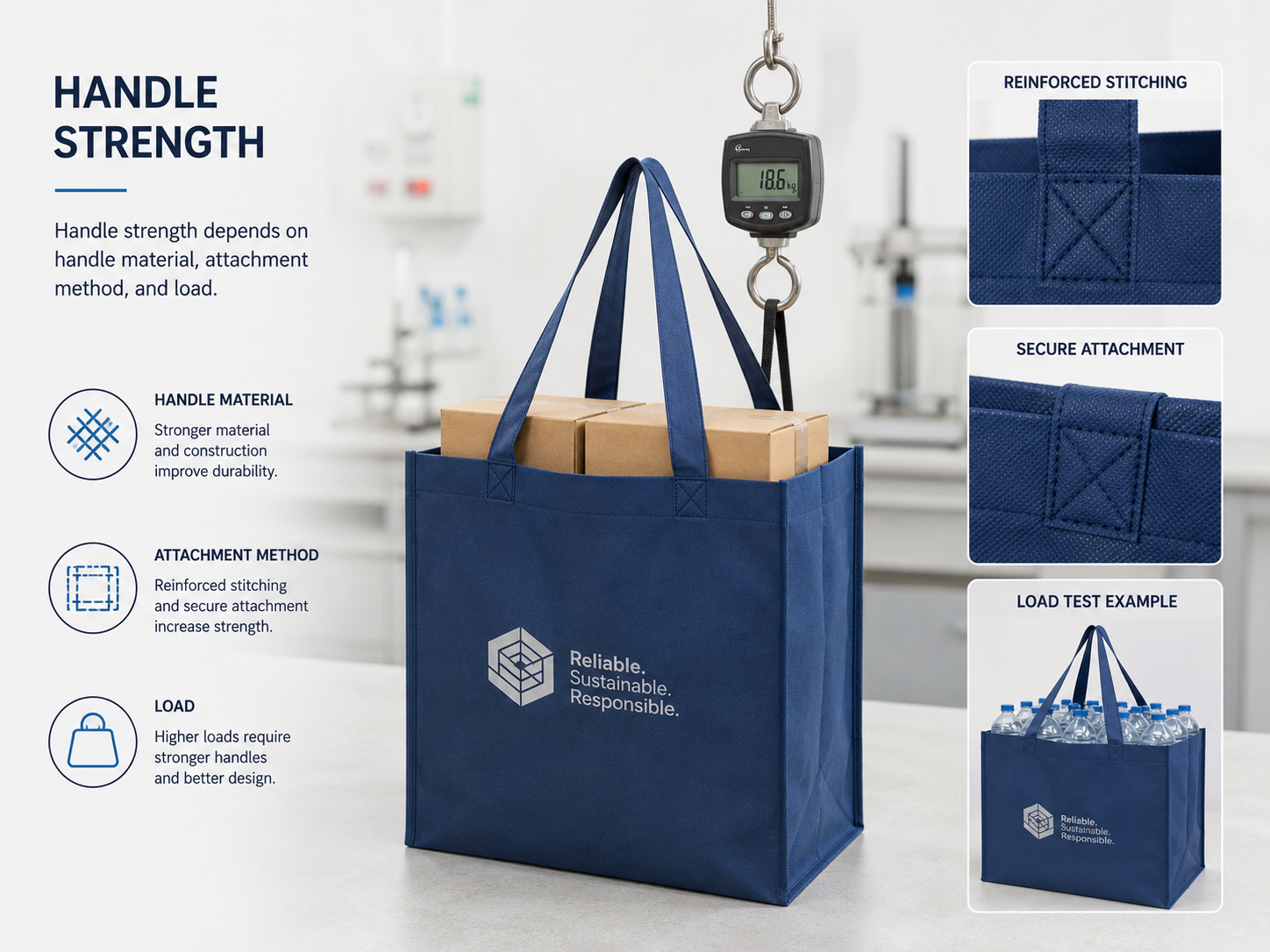
Handle attachment points are often the highest-stress areas of a non-woven bag.
The bag may fail through:
- Handle material tearing
- Stitching breaking
- Ultrasonic weld separation
- Body fabric tearing around the attachment
- Excessive handle elongation
Handle strength depends on four main variables.
Handle Material
Common options include:
- Non-woven fabric handles
- PP webbing
- Polyester webbing
- Die-cut handles
- Reinforced cut-out handles
Non-woven handles are economical and visually consistent with the bag body.
Webbing handles normally provide a stronger and more comfortable structure for larger or heavier bags, although they increase cost.
Handle Width
A wider handle distributes pressure over a larger area and may improve carrying comfort.
However, width alone does not guarantee strength. The attachment area and reinforcement must also be suitable.
Attachment Depth
Handles attached only near the upper edge concentrate force in a small area.
For higher-load applications, possible improvements include:
- Longer attachment areas
- Multiple stitch rows
- Cross stitching
- Box stitching
- Reinforcement patches
- Webbing extending further down the bag body
Handle Testing
A useful finished-product test should define:
- Test load
- Test duration
- Static or repeated lifting
- Number of cycles
- Load distribution
- Acceptable deformation
- Pass and fail criteria
A claim such as “holds 10 kg” is incomplete unless the test method and duration are defined.
3. Ultrasonic Seams vs Sewn Seams
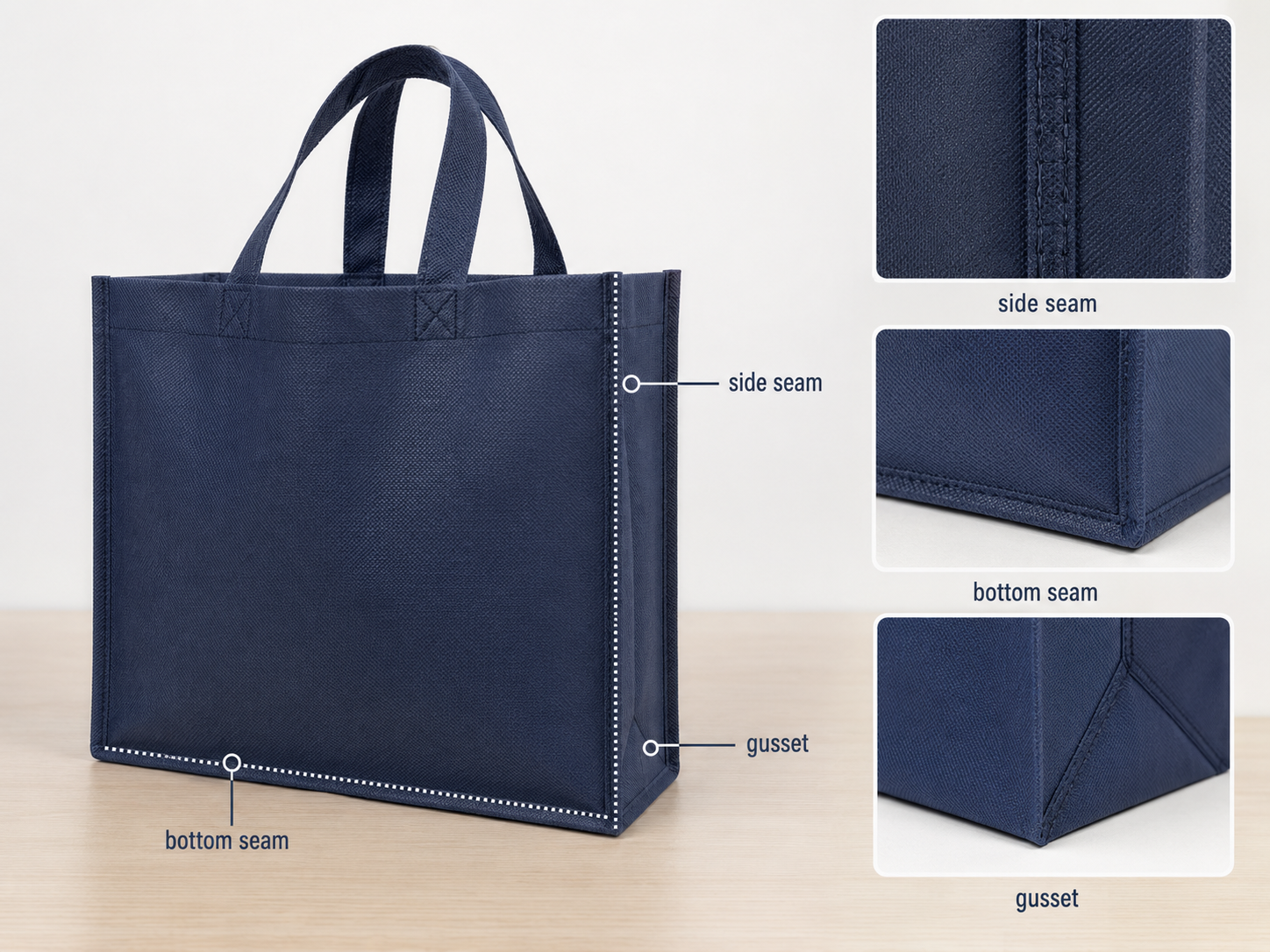
Non-woven bags are commonly assembled using either ultrasonic bonding or conventional sewing.
Ultrasonic Bonding
Ultrasonic equipment uses heat generated through high-frequency vibration to bond compatible thermoplastic materials.
Advantages
- Fast production
- Clean appearance
- No sewing thread
- Suitable for high-volume orders
- Competitive unit cost
- Consistent seam placement
Limitations
- Strength depends on material weight and bonding settings
- Narrow welds may separate under load
- Thick multi-layer areas can be difficult to bond consistently
- Repair options are limited
- Not suitable for every structure or accessory
Ultrasonic bonding is commonly used for simple promotional bags and lightweight shopping bags.
Sewn Construction
Sewn bags use thread to connect the body, gussets, handles and reinforcement components.
Advantages
- Suitable for more complex structures
- Supports webbing handles and reinforcement
- Easier to use with zippers, lining and pockets
- Often preferable for higher-load bags
- Provides more flexibility during product development
Limitations
- Higher labor cost
- More production time
- Risk of skipped stitches or thread tension problems
- Needle holes may weaken lightweight material
- Poor seam allowance can cause tearing
Seam performance depends on the seam type, thread, stitch density and base material. ISO 13935-2:2026 provides a method for measuring maximum force to seam rupture when force is applied perpendicular to a sewn seam.
Which Seam Should Buyers Choose?
| Requirement |
More Suitable Direction |
| Low-cost event giveaway |
Ultrasonic bonding |
| Simple flat shopping bag |
Ultrasonic or sewn |
| Large takeaway bag |
Reinforced ultrasonic or sewn |
| Webbing-handle grocery bag |
Sewn construction |
| Zipper or internal pocket |
Sewn construction |
| Higher repeated load |
Reinforced sewn construction |
| Very high-volume promotion |
Ultrasonic bonding where performance permits |
The correct seam should be selected according to the intended load and bag structure, not only the lowest production cost.
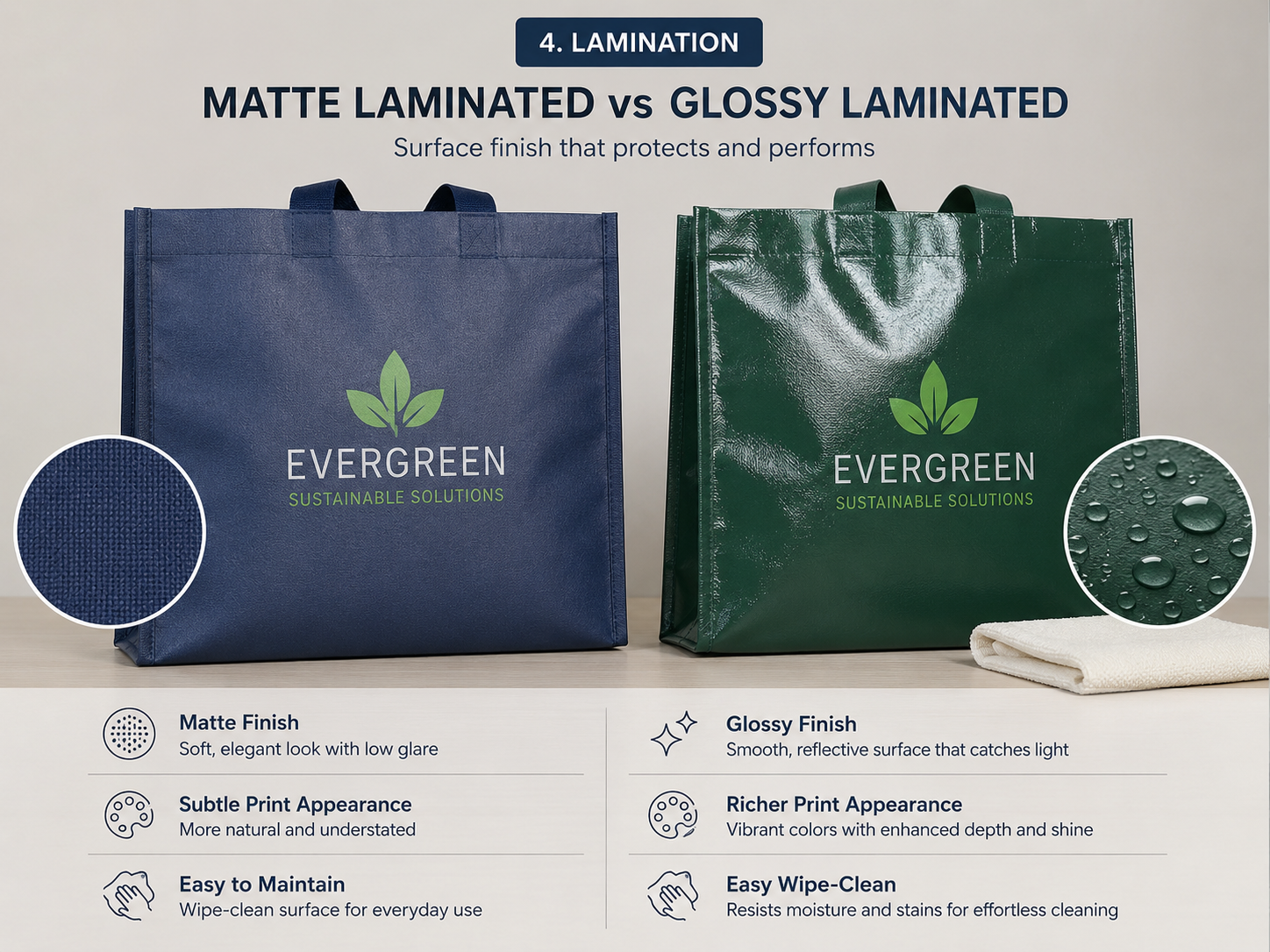
4. Lamination
Lamination adds a film or printed layer to the non-woven base material.
Common options include:
- Glossy lamination
- Matte lamination
- Printed OPP or BOPP film
- Metallic film
- Holographic film
- Full-surface printed lamination
INITIGIFT’s current non-woven and PP woven range includes standard non-woven bags, laminated non-woven bags, metallic laminated bags and full-color retail structures.
Main Benefits of Lamination
Lamination can improve:
- Surface smoothness
- Full-color printing
- Graphic detail
- Brand presentation
- Resistance to light moisture
- Surface cleaning
- Material stiffness
- Shape retention
It is especially useful for:
- Supermarket campaigns
- Retail product launches
- Full-panel artwork
- Food takeaway packaging
- Promotional programs requiring stronger visual impact
Main Limitations
Lamination can also:
- Increase material cost
- Increase total bag weight
- Reduce breathability
- Make folding less compact
- Crack at repeated fold points
- Separate if bonding quality is poor
- Complicate recycling because of the multi-layer structure
A laminated bag should not automatically be described as waterproof. Water can still enter through:
- Open tops
- Seams
- Stitch holes
- Handle attachments
- Unsealed corners
“Moisture-resistant” or “easy-clean surface” may be more accurate unless the complete bag has been tested for water penetration.
Lamination Quality Checks
Buyers should inspect:
- Film adhesion
- Bubbles
- Wrinkles
- Delamination
- Print alignment
- Color consistency
- Surface scratches
- Edge lifting
- Fold cracking
- Odor
The sample should be folded and handled in the same way as the bulk product will be packed and used.
A visually acceptable flat sheet may develop cracking or separation after sewing, folding or carton compression.
Recommended Specifications by Application
| Application |
Suggested Development Direction |
| Trade show giveaway |
Lightweight to standard GSM, simple handles and ultrasonic seams |
| Retail promotional bag |
Standard GSM, controlled printing and reinforced handles |
| Supermarket shopping bag |
Medium-to-heavy GSM, gusseted body and reinforced sewn handles |
| Takeaway food bag |
Stable rectangular structure, reinforced base and suitable moisture resistance |
| Full-color campaign bag |
Laminated non-woven with artwork and fold testing |
| Large-capacity bag |
Higher GSM, webbing handles, sewn seams and load testing |
These are development directions rather than fixed technical standards.
Specification Checklist for Buyers
A practical non-woven bag request should include:
| Specification |
Information to Confirm |
| Material |
PP spunbond non-woven |
| Fabric weight |
Target GSM and acceptable tolerance |
| Bag size |
Width × height × gusset |
| Handle |
Material, width, length and attachment |
| Seam |
Ultrasonic or sewn |
| Reinforcement |
Handle patches, bottom board or extra layers |
| Lamination |
None, matte, glossy, metallic or printed film |
| Printing |
Method, colors, coverage and artwork position |
| Load requirement |
Static load, duration and repeated cycles |
| Packing |
Flat packing, individual packing or bulk carton |
| Quantity |
Total quantity and quantity per color/design |
This information is more useful than requesting only “a strong 100 GSM non-woven bag.”
Common Purchasing Mistakes
Selecting GSM Without Considering Bag Size
A material suitable for a small flat bag may not be sufficient for a large gusseted bag.
Using Standard Non-Woven Handles for Heavy Loads
Large grocery or takeaway bags may require webbing handles or reinforced attachment areas.
Assuming Ultrasonic Seams Are Always Weak
A correctly designed ultrasonic seam can be suitable for lightweight and medium-duty applications. Performance depends on material, weld width and machine settings.
Assuming Sewn Seams Are Always Stronger
Poor thread, insufficient seam allowance or weak handle reinforcement can still cause failure.
Treating Lamination as Waterproofing
Lamination protects the surface but does not seal the complete bag.
Comparing Quotations by GSM Alone
Suppliers may quote different handle structures, seam methods, dimensions and lamination quality using the same nominal GSM.
How INITI Supports Custom Non-Woven Bag Projects
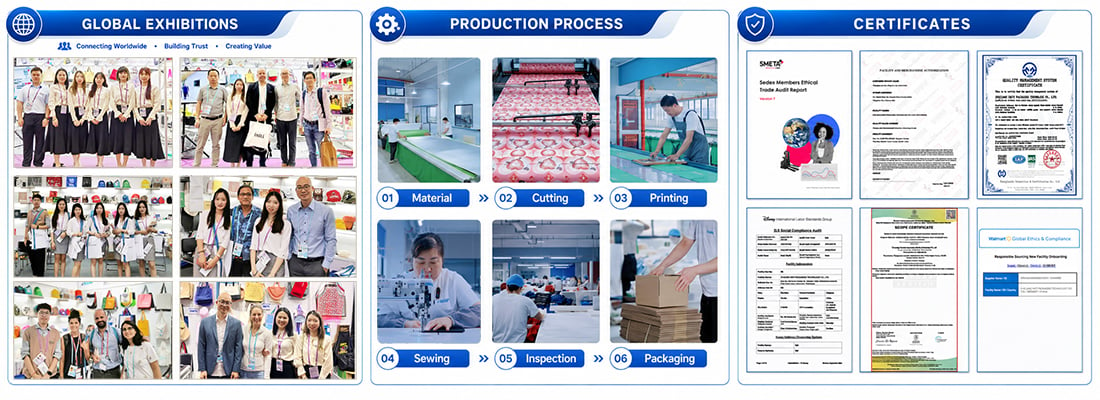
INITI develops non-woven and PP woven bags for supermarkets, retail promotions, food takeaway, exhibitions, giveaways and packaging programs.
Customization can include:
- Material GSM
- Bag dimensions
- Side and bottom gussets
- Non-woven or webbing handles
- Ultrasonic or sewn construction
- Handle reinforcement
- Matte or glossy lamination
- Full-color artwork
- Logo printing
- Retail and export packaging
Current product structures include lightweight takeaway bags, laminated retail bags and large PP woven shopping bags with reinforced handles.
FAQ
Light promotional bags may use lower GSM materials, while supermarket, takeaway and repeated-use bags normally require a firmer specification. The correct GSM depends on bag size, gusset, handle and intended load.
Are sewn non-woven bags stronger than ultrasonic bags?
Not automatically. Sewn structures generally provide more reinforcement options, but both methods must be evaluated using the actual material and bag design.
Which handle is best for heavier products?
Wide PP or polyester webbing handles with reinforced sewn attachments are generally more suitable than basic non-woven handles for higher-load applications.
Does lamination increase bag strength?
Lamination can increase stiffness and surface stability, but it does not replace strong handles, seams or reinforcement.
How should buyers verify carrying capacity?
Request a finished-bag test that defines the load, duration, lifting cycles and pass criteria. Do not rely only on GSM or a one-time manual demonstration.
Conclusion
The performance of a non-woven bag cannot be judged by GSM alone.
Buyers should evaluate four connected specifications:
- GSM determines material mass and general hand feel.
- Handle construction controls how carrying force enters the bag.
- Seams determine whether panels and handles remain connected.
- Lamination affects printing, stiffness, moisture resistance and recyclability.
A reliable specification should define the complete bag structure and include finished-product load testing.
Inquiry Support
For an accurate non-woven bag recommendation, provide the bag dimensions, intended contents, target load, preferred GSM, handle type, seam method, lamination, logo artwork, order quantity, packaging and destination market.
Related Products
Related Blog Articles


 Hot News