How to Reduce Packaging Costs Without Reducing Quality
Packaging costs can become a significant part of the total product budget, especially for retailers, gift suppliers, promotional companies, importers, and brands ordering customized bags or boxes in large quantities.
However, reducing packaging costs does not have to mean using weaker materials, removing essential functions, or accepting inconsistent production. In many cases, the biggest savings come from eliminating unnecessary specifications, simplifying structures, improving logistics, and making better decisions before mass production begins.
The most effective packaging cost reduction strategy is not to ask, “How can we make this packaging cheaper?” It is to ask:
Which packaging features create real value, and which features add cost without improving performance, customer experience, or brand presentation?
By separating essential quality requirements from optional decorative elements, buyers can reduce the total cost of custom packaging while maintaining durability, appearance, and reliability.
Focus on Total Packaging Cost, Not Only Unit Price
A low quotation does not always produce the lowest overall purchasing cost.
The true cost of a packaging order may include:
- Product unit price
- Artwork and design preparation
- Sampling and tooling
- Printing plates or molds
- Product testing
- Quality inspection
- Export packing
- Freight and customs costs
- Warehousing
- Defective product replacement
- Repacking or rework
- Delays caused by production problems
A supplier offering a lower unit price may use thinner materials, weaker handles, less accurate printing, simpler quality control, or inefficient export packing. These compromises can lead to product failures, complaints, replacements, and higher logistics costs.
For this reason, B2B buyers should evaluate the total landed cost per usable unit, rather than comparing quotations only by factory price.
A more accurate calculation is:
Total Packaging Cost = Unit Cost + Development Cost + Quality Cost + Logistics Cost + Defect Risk
Reducing any of these cost components can improve the final budget without weakening the packaging itself.
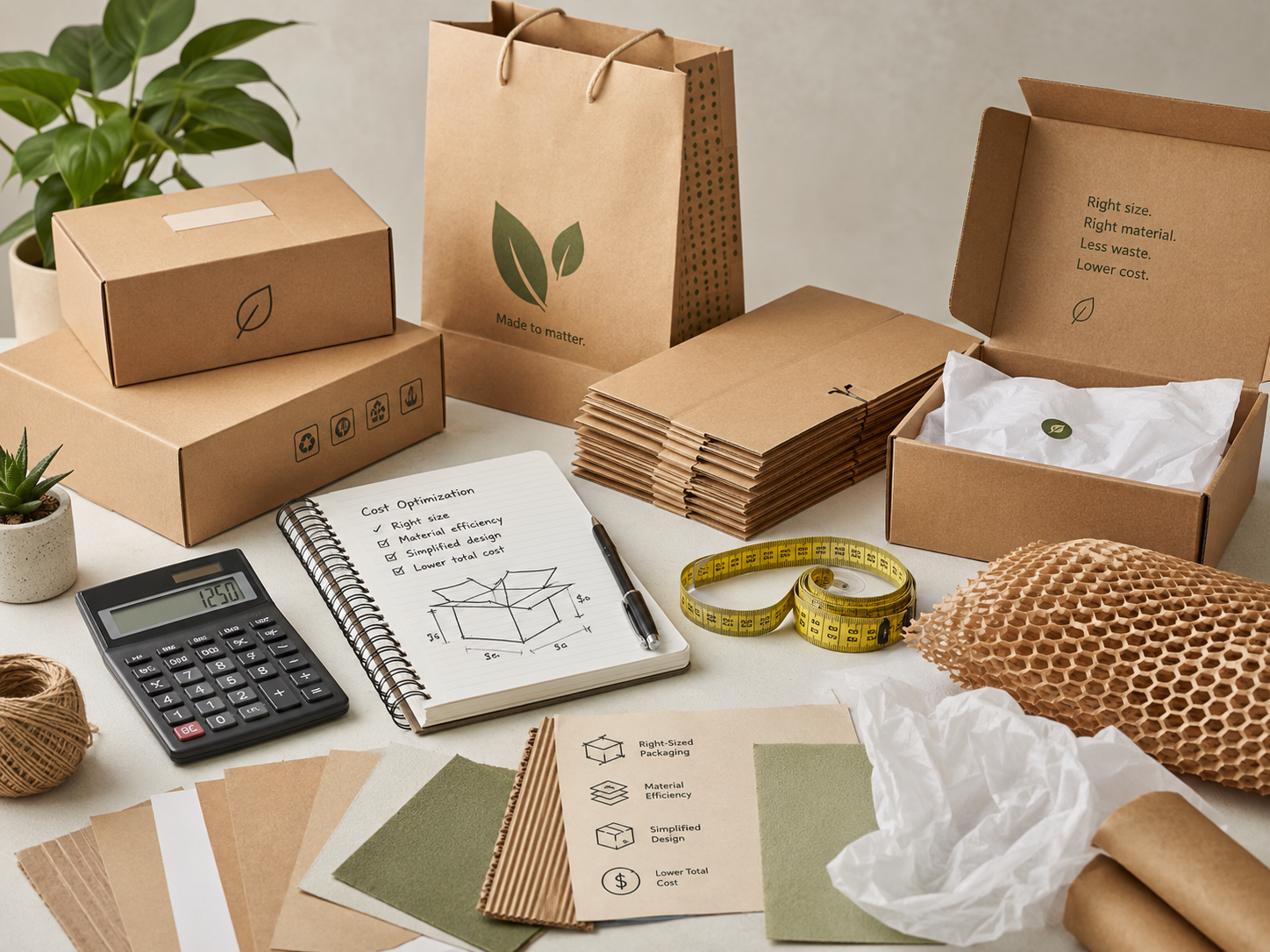
1. Define the Packaging’s Essential Performance Requirements
Many packaging projects become unnecessarily expensive because the specifications are not clearly connected to the product’s actual use.
Before selecting materials or finishes, buyers should define:
- What product will be placed inside?
- How much weight must the packaging carry?
- Is the packaging used once or repeatedly?
- Does it need moisture resistance?
- Will it be displayed in a retail store?
- Is it intended for shipping, gifting, promotion, or daily reuse?
- How long must it maintain its appearance?
- Does the packaging need to support premium brand positioning?
A paper bag carrying lightweight cosmetics does not require the same construction as a shopping bag carrying glass bottles. A promotional tote distributed at an event may not require the same fabric weight as a reusable grocery bag designed for repeated heavy loads.
Clear performance requirements allow the supplier to recommend a suitable specification instead of automatically using the strongest or most expensive option.
Quality Areas That Should Not Be Reduced
Cost reduction should never compromise the parts responsible for safety, load capacity, or basic product function.
For paper bags, these areas may include:
- Handle attachment
- Bottom construction
- Adhesive strength
- Paper tear resistance
- Reinforced top folds
- Printing adhesion
For textile bags, important areas include:
- Fabric strength
- Handle stitching
- Seam reinforcement
- Zipper quality
- Lining stability
- Load-bearing connection points
For paper boxes, buyers should protect:
- Board rigidity
- Die-cut accuracy
- Corner strength
- Insert fit
- Adhesive performance
- Closure reliability
Decorative features can often be simplified. Structural performance should remain stable.
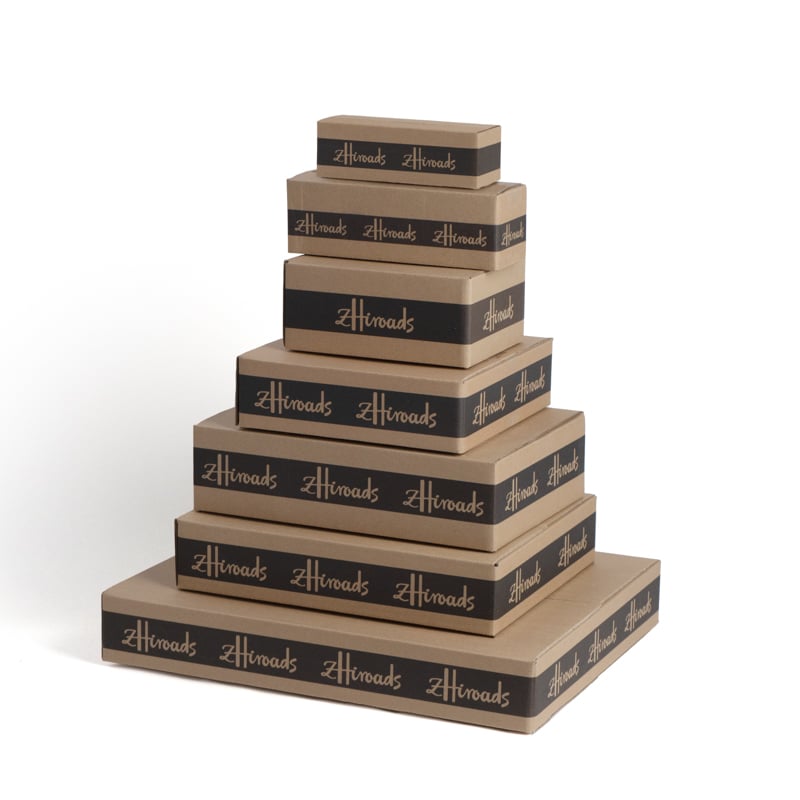
2. Right-Size the Packaging
Oversized packaging increases costs at nearly every stage of the supply chain.
A bag or box that is larger than necessary uses more:
- Paper or fabric
- Printing ink
- Lamination film
- Accessories
- Inner wrapping material
- Carton space
- Warehouse space
- Freight capacity
Even a small reduction in width, height, or gusset depth can create meaningful savings across a large bulk order.
The packaging should provide enough space for the product, protective inserts, and practical handling, but it should not contain large amounts of unused space.
How to Determine the Correct Size
Provide the supplier with:
- Exact product dimensions
- Product weight
- Number of products packed per unit
- Required protective space
- Inner wrapping or insert dimensions
- Preferred product orientation
- Shipping carton requirements
For rigid boxes or gift boxes, the supplier can adjust the internal structure around the product rather than starting with a standard oversized box.
For shopping bags, buyers should consider whether the same bag size can accommodate several related product SKUs. This can reduce the number of packaging sizes that need to be produced and stored.
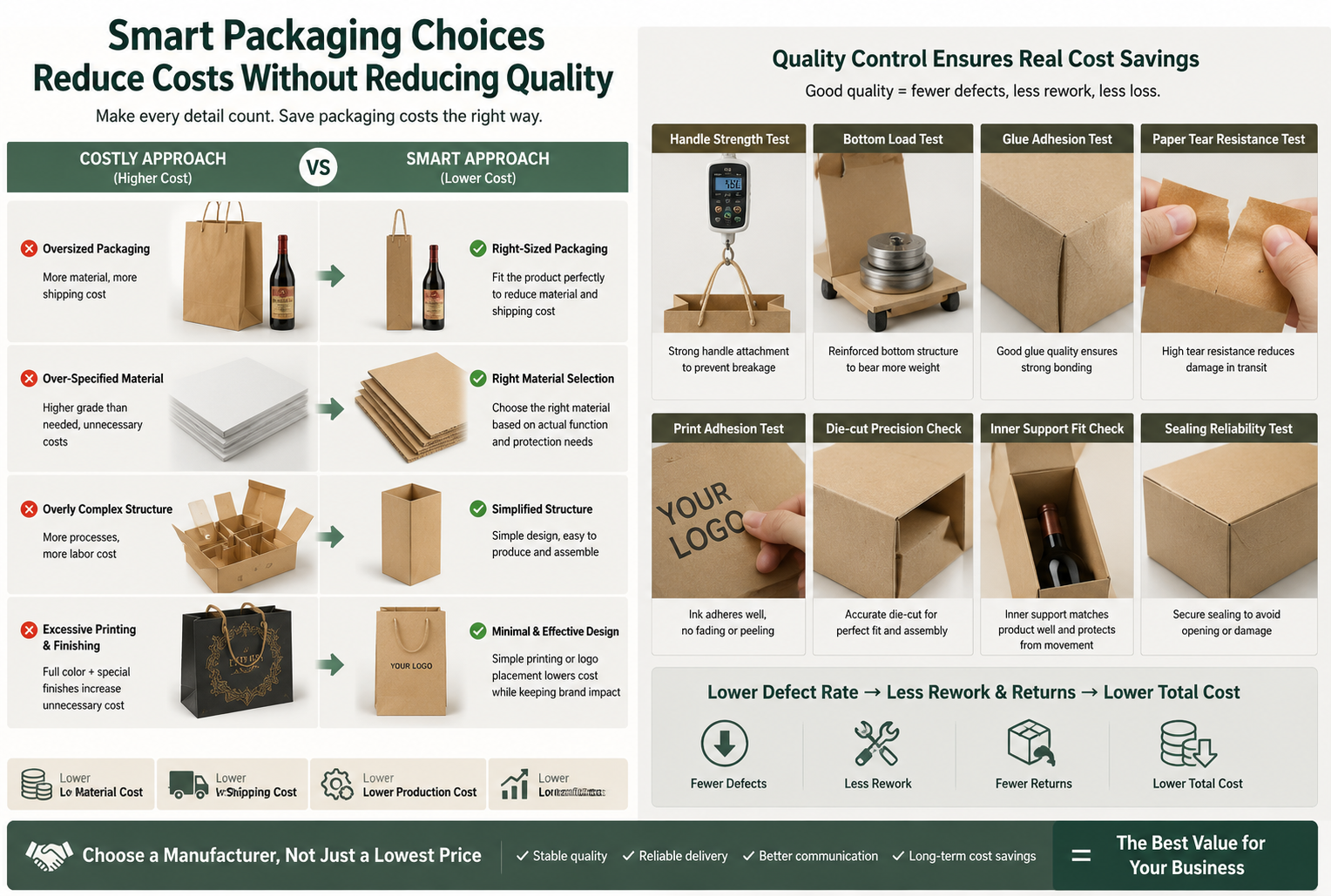
3. Choose Materials According to Function, Not Assumption
Using the cheapest material may reduce the quotation but create quality problems. Using an unnecessarily premium material can also waste the packaging budget.
The goal is to select the most cost-effective material that satisfies the intended use.
Paper Packaging
Possible paper options include:
- Natural kraft paper
- White kraft paper
- Coated paper
- Card paper
- Corrugated paperboard
- Greyboard
- Specialty textured paper
- Recycled paper
A premium coated paper with full lamination may be appropriate for luxury cosmetics or jewelry packaging. It may be unnecessary for supermarket promotions, takeaway products, or short-term event packaging.
Natural kraft paper can provide a strong, recognizable appearance without requiring heavy printing or complex finishing. For suitable projects, the material itself becomes part of the visual design.
Textile Bags
Common options include:
- Cotton
- Canvas
- RPET
- Polyester
- Nylon
- Non-woven polypropylene
- PP woven fabric
- Jute
- Felt
A heavier canvas is not automatically better for every project. Fabric density, weave, bag size, stitching, and load requirements should be evaluated together.
For high-volume promotional orders, a lighter fabric with reinforced seams may perform better economically than a heavier fabric with unnecessary material consumption.
For reusable retail programs, a stronger fabric may create better value because the bag remains useful for longer and provides greater brand exposure.
Ask for Material Alternatives
Instead of requesting only one fixed specification, ask the manufacturer to quote:
- The original specification
- A cost-optimized specification
- A premium specification
This allows procurement teams to compare the effect of different materials, thicknesses, and structures before making a final decision.
4. Simplify the Packaging Structure
Complex packaging usually requires more materials, production steps, labor, tooling, and quality control.
Common cost-increasing features include:
- Multiple layers
- Unnecessary compartments
- Complicated folds
- Custom metal accessories
- Special closures
- Additional internal pockets
- Decorative panels
- Non-standard handles
- Separate component assembly
- Difficult manual finishing
Each feature should have a clear purpose.
For example, a magnetic rigid box creates a premium unboxing experience, but a foldable paper box may provide a similar visual result with lower shipping and storage costs.
A tote bag with several internal pockets may be useful as a retail product. The same structure may be excessive for a short-term promotional campaign.
Simplification Does Not Mean Poor Design
A clean, simple structure can often appear more premium than an over-designed package.
Cost-efficient packaging can still use:
- Balanced proportions
- Accurate color matching
- Clean typography
- One well-positioned logo
- Carefully selected materials
- Consistent construction
- Strong surface texture
Good packaging design depends on visual control and appropriate specifications, not on the number of decorative elements.
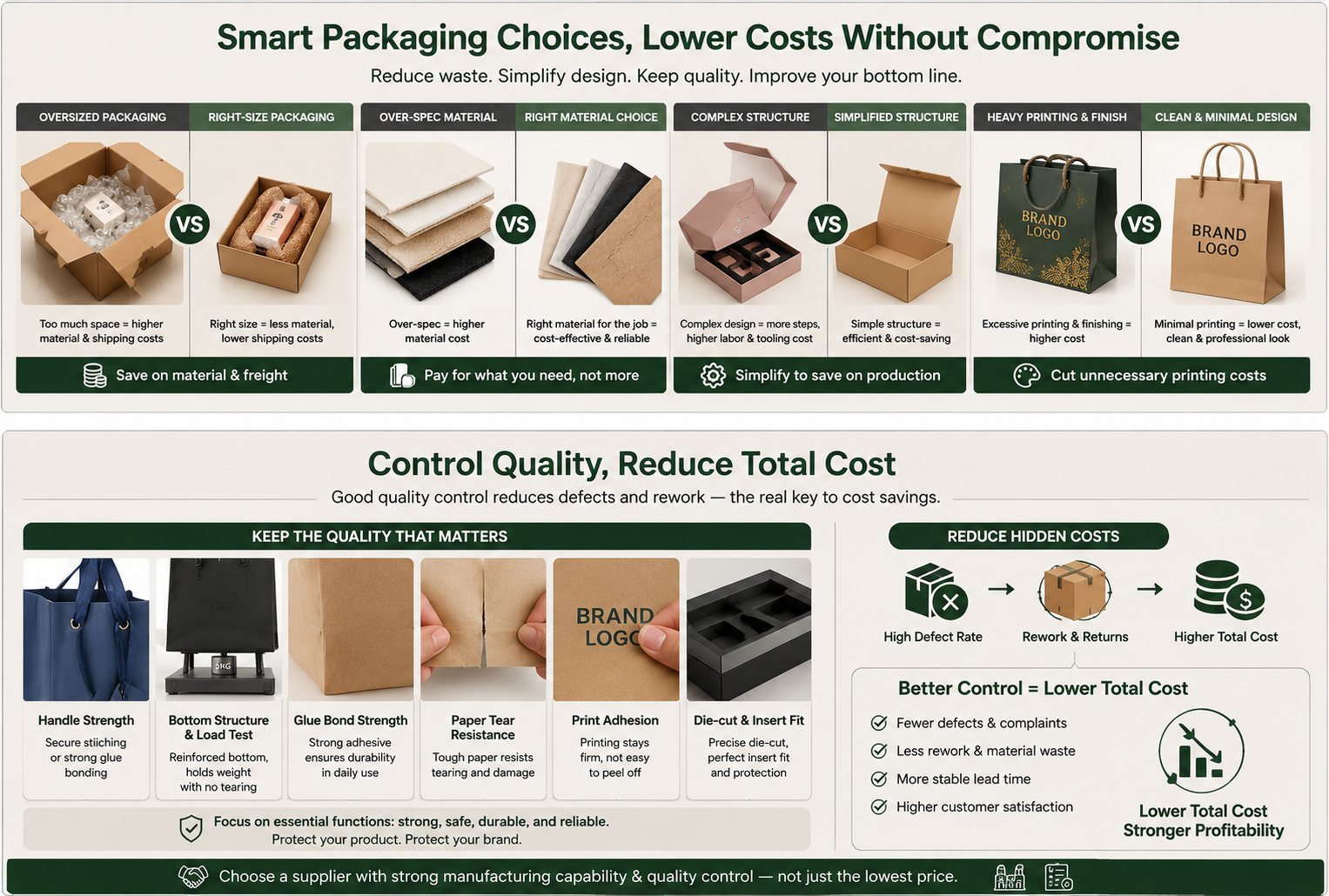
5. Reduce Unnecessary Printing and Surface Finishes
Printing and finishing can account for a substantial part of custom packaging costs.
Common processes include:
- Screen printing
- Offset printing
- Digital printing
- Heat transfer printing
- Sublimation printing
- Embroidery
- Foil stamping
- UV printing
- Embossing
- Debossing
- Matte lamination
- Glossy lamination
- Soft-touch lamination
Using several processes on one package increases setup costs, production complexity, and defect risk.
Use One Strong Branding Element
A simple logo applied correctly can be more effective than several decorative techniques competing for attention.
Possible cost-saving approaches include:
- Reduce the number of print colors
- Use one-color printing instead of full-color artwork
- Reduce total print coverage
- Print on one side instead of both sides
- Use the natural material color as part of the design
- Select one premium finish instead of combining several
- Replace a custom metal logo with a woven or printed label
- Use embossing without additional foil where suitable
For paper packaging, large areas of solid ink can require more precise printing and create greater color consistency challenges. Smaller, strategically positioned artwork may lower costs and improve production stability.
6. Standardize Packaging Across Multiple Products
Brands with several product lines often order different packaging dimensions, colors, materials, and structures for every SKU.
This creates:
- More samples
- More tooling
- Smaller order quantities per design
- Higher inventory complexity
- More packaging waste
- Greater risk of stock imbalance
A standardized packaging system can reduce these costs.
For example, a brand may use:
- One paper bag structure in three sizes
- One box structure with different printed sleeves
- One tote bag body with different logo designs
- One packaging color across several product ranges
- One standard handle and accessory system
The core structure remains consistent while variable elements communicate the individual product or campaign.
Standardize the Expensive Parts
The largest savings usually come from standardizing:
- Dimensions
- Material
- Handle type
- Box construction
- Accessories
- Printing method
- Export packing
Artwork, labels, inserts, and sleeves can then be changed with less impact on production cost.
7. Plan Order Quantity More Carefully
Custom packaging pricing is strongly affected by order quantity because many production costs are fixed.
These may include:
- Sampling
- Printing setup
- Material preparation
- Die cutting
- Color matching
- Tooling
- Machine adjustment
- Quality control preparation
When these costs are divided across a small order, the cost per unit becomes higher.
However, ordering the largest possible quantity is not always the best solution. Excess packaging can create storage costs, outdated designs, damaged inventory, and wasted cash flow.
Find the Economic Order Quantity
Buyers should consider:
- Annual packaging usage
- Campaign duration
- Product sales forecast
- Warehouse capacity
- Design update frequency
- Seasonal demand
- Reorder lead time
- Freight strategy
A better approach may be to agree on a larger annual production plan while arranging several scheduled deliveries, subject to supplier capacity and commercial terms.
This can improve material planning and pricing without requiring all inventory to arrive at once.
8. Optimize Carton Packing and Freight Efficiency
Packaging products are often lightweight but occupy substantial space. This means freight costs may be affected more by volume than by weight.
Boxes, paper bags, tote bags, and gift packaging should be designed with export packing in mind.
Cost-Saving Logistics Options
Depending on the product, buyers can consider:
- Flat-packing paper bags
- Foldable paper boxes
- Collapsible gift packaging
- Folding textile bags
- Removing unnecessary individual boxes
- Optimizing the number of units per carton
- Adjusting carton dimensions for container loading
- Using protective packing only where required
- Combining compatible items into one shipment
A rigid box may look economical at the factory level but become expensive after freight and warehousing are included. A foldable box may have a slightly higher assembly requirement but produce a much lower total landed cost.
Always request:
- Product packing dimensions
- Units per carton
- Carton dimensions
- Gross and net weight
- Estimated shipment volume
These figures should be reviewed before the order is confirmed, not after production has finished.
9. Reduce Defects Through Sampling and Quality Control
Removing sampling or inspection may appear to save money, but it can increase the risk of a costly production failure.
A properly approved sample helps confirm:
- Material
- Dimensions
- Structure
- Color
- Logo position
- Printing effect
- Handle strength
- Closure function
- Packing method
The approved sample should become the reference standard for mass production.
Important Pre-Production Confirmations
Before production begins, confirm:
- Final artwork files
- Pantone or approved color references
- Material composition
- Paper or fabric thickness
- Product tolerances
- Handle and accessory specifications
- Logo size and position
- Surface finishing
- Packing requirements
- Inspection criteria
Late specification changes are one of the most common causes of additional cost. Clear confirmation before production reduces rework, waste, and delays.
Quality Control Is a Cost-Control Tool
Consistent quality control helps prevent:
- Incorrect dimensions
- Weak handles
- Loose stitching
- Poorly bonded boxes
- Color variation
- Misaligned printing
- Scratched surfaces
- Damaged accessories
- Incorrect packing quantities
The objective is not to add unnecessary inspection steps. It is to detect problems before defective products reach the buyer’s warehouse or customers.
10. Compare Suppliers Based on Manufacturing Capability
A supplier should not be evaluated only by the lowest initial quotation.
A suitable custom packaging supplier should be able to explain:
- Why a particular material is recommended
- Which specifications are increasing the cost
- Which features can be simplified safely
- How the packaging will be packed for export
- What quality points will be inspected
- Whether alternative structures are available
- How samples will be approved
- How production consistency will be maintained
Experienced suppliers can often identify cost-saving opportunities that are not visible in the original design.
For example, they may recommend:
- A different paper grade
- A more efficient bag dimension
- A simpler handle attachment
- A foldable box structure
- Reduced print coverage
- A standard accessory
- A better carton packing arrangement
This type of design-for-manufacturing support can reduce costs before they become fixed in the final specification.
Where You Can Save and Where You Should Not
| Packaging Area |
Possible Cost Reduction |
Quality Risk to Avoid |
| Packaging size |
Remove unnecessary space |
Packaging too small for the product |
| Material thickness |
Match thickness to actual load |
Tearing, deformation, or weak protection |
| Printing |
Reduce colors or print area |
Poor logo clarity or inconsistent color |
| Surface finishing |
Select one essential finish |
Unprotected surfaces where protection is required |
| Handles |
Use a standard handle style |
Weak attachment or uncomfortable carrying |
| Accessories |
Remove decorative components |
Removing functional closures or reinforcement |
| Box structure |
Use foldable or simplified construction |
Weak corners or poor product fit |
| Order quantity |
Consolidate volume |
Excess inventory or outdated packaging |
| Export packing |
Improve carton utilization |
Damage during transportation |
| Inspection |
Use focused quality checks |
Skipping approval and production controls |
Example: Reducing the Cost of a Custom Paper Gift Bag
Consider a brand ordering a premium paper gift bag with:
- Thick coated paper
- Full-color printing
- Matte lamination
- Foil stamping
- Embossed logo
- Ribbon handles
- Reinforced top and bottom
- Individual protective packing
Instead of reducing the paper strength or handle reinforcement, the buyer could:
- Keep the structural paper specification.
- Reduce full-color printing to one or two brand colors.
- Use foil stamping without additional embossing.
- Print only the front and back panels.
- Use a standard ribbon width.
- Adjust the bag dimensions to fit the product more closely.
- Flat-pack the bags in optimized export cartons.
- Replace individual protective packing with grouped packing where appropriate.
The final bag can maintain its premium appearance and load capacity while using fewer production processes and less shipping volume.
This is the difference between removing quality and removing unnecessary cost.
Questions to Ask Before Confirming a Packaging Order
Before placing a bulk order, buyers should ask the supplier:
- Which part of the specification has the greatest effect on price?
- Is there a lower-cost material with similar performance?
- Can the dimensions be optimized?
- Can the structure be simplified without affecting function?
- What is the price difference between printing options?
- Which finishes are necessary for protection, and which are decorative?
- Can the same structure be used for several product lines?
- How many units will be packed in each export carton?
- What quality standards will be checked during production?
- Can the supplier provide a cost-optimized alternative quotation?
- What changes would reduce freight volume?
- Which specifications should not be reduced?
These questions encourage transparent cost analysis instead of simple price negotiation.
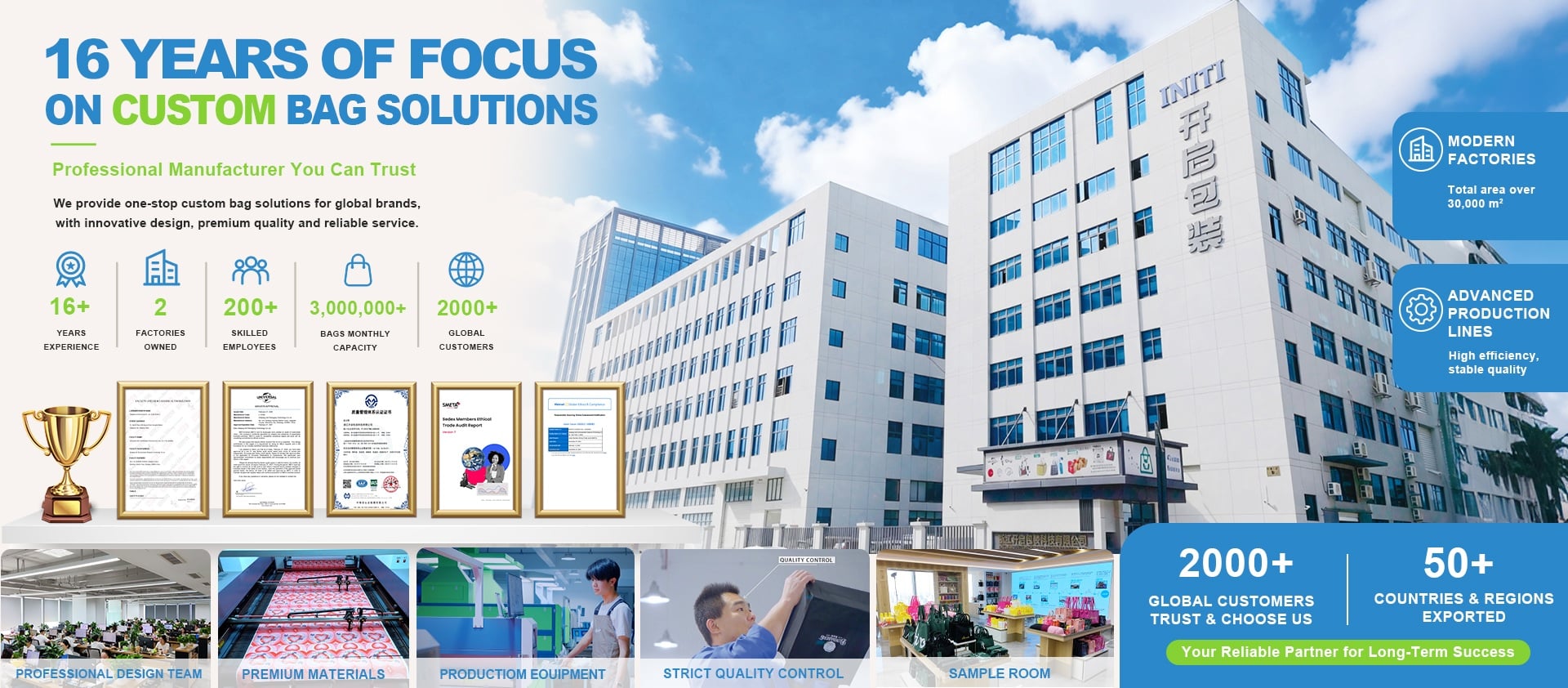
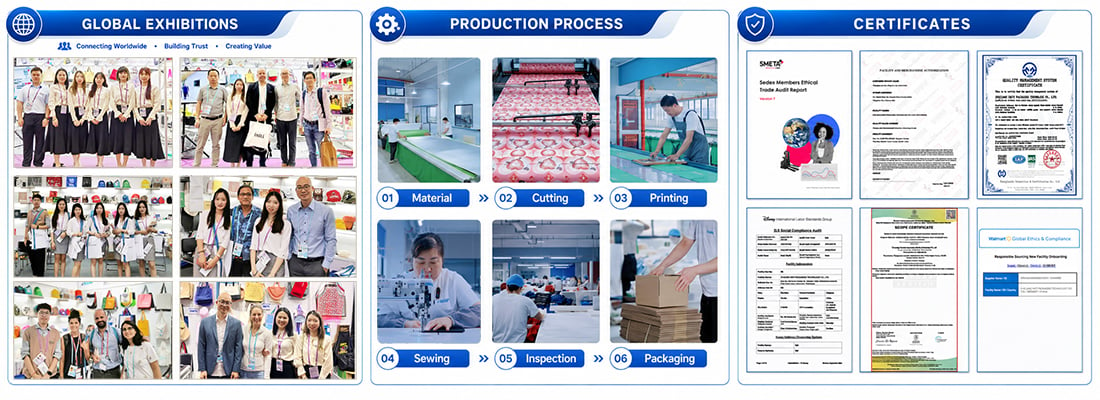
How INITI Supports Cost-Effective Custom Packaging Projects
INITI provides custom development for bags, paper packaging, gift boxes, storage products, and promotional products for global B2B buyers.
Our OEM and ODM process can support:
- Material and structure recommendations
- Custom size development
- Logo and printing selection
- Sample preparation
- Cost comparison between specifications
- Bulk production planning
- Quality inspection
- Export packing optimization
Rather than reducing essential quality, we help buyers review the full packaging specification and identify where materials, dimensions, printing, accessories, or packing methods can be adjusted.
This approach is suitable for retailers, supermarkets, brand owners, importers, distributors, promotional companies, gift suppliers, corporate clients, and private-label buyers that need to balance product quality with commercial budget requirements.
FAQ
Can packaging costs be reduced without changing the material?
Yes. Costs may be reduced by optimizing dimensions, reducing print coverage, simplifying finishes, standardizing accessories, improving carton packing, or increasing production efficiency. Material changes are only one possible option.
Is thinner packaging always less expensive?
Thinner material may reduce the initial unit price, but it can also create tearing, deformation, weak load capacity, or shipping damage. Material thickness should be selected according to the product weight and intended use.
Which packaging features usually increase costs the most?
The main cost drivers often include material grade, product dimensions, complex structures, full-color printing, large print coverage, premium surface finishes, custom accessories, low order quantities, and inefficient export packing.
How can small businesses reduce custom packaging costs?
Small businesses can use standard structures, limit the number of sizes, choose simple printing, avoid unnecessary accessories, combine several SKUs into one packaging system, and work with a supplier that offers cost-optimized alternatives.
Does ordering more packaging always reduce the total cost?
A larger quantity usually lowers the cost per unit, but it may increase inventory, storage, and design-obsolescence risks. Buyers should compare unit savings against expected usage and warehouse capacity.
Should buyers remove lamination to reduce costs?
Not automatically. Lamination may improve moisture resistance, surface protection, and appearance. It can be removed when the material and intended use do not require it, but functional protection should be evaluated first.
How can buyers compare packaging quotations accurately?
Make sure each supplier is quoting the same material, dimensions, printing, accessories, packing method, quality requirements, and delivery terms. A lower quotation is not meaningful when the specifications are different.
Conclusion
Reducing packaging costs without reducing quality requires more than negotiating a lower unit price.
The strongest savings usually come from:
- Defining the correct performance requirements
- Right-sizing the packaging
- Selecting materials according to actual use
- Simplifying structures
- Controlling printing and finishing
- Standardizing packaging across product lines
- Planning order quantities
- Improving freight efficiency
- Preventing defects
- Working with a supplier during the design stage
Good cost optimization removes features that do not create sufficient value while protecting the materials, construction, and production controls that determine packaging performance.
For a cost review of your custom packaging project, provide your product dimensions, packaging type, quantity, logo requirements, preferred material, and target market. INITI can develop a tailored specification and quotation for sampling and bulk production.
Related Products
Luxury Paper Gift Bag with Gold Chain Handle
Custom Kraft Paper Gift Bags
Ribbon Gift Packing Box
Related Blog Articles


 Hot News