| Dimensions in Inches |
Approximate Dimensions in Centimeters |
| 8 × 10 × 4 in |
20 × 25 × 10 cm |
| 10 × 13 × 4 in |
25 × 33 × 10 cm |
| 10 × 15 × 5 in |
25 × 38 × 13 cm |
| 12 × 15 × 4 in |
30 × 38 × 10 cm |
| 14 × 16 × 5 in |
36 × 41 × 13 cm |
| 16 × 20 × 6 in |
41 × 51 × 15 cm |
| 18 × 22 × 7 in |
46 × 56 × 18 cm |
| 20 × 22 × 8 in |
51 × 56 × 20 cm |
These measurements are general references rather than universal standards.
Actual shopping bag dimensions may vary depending on the bag construction, manufacturing requirements, product application, and customization.
Standard Shopping Bag Sizes
There is no single universal standard shopping bag size.
Different retailers and businesses use different dimensions based on the products they sell. However, shopping bags can generally be grouped into small, medium, large, and extra-large sizes.
Small Shopping Bags
Small shopping bags are suitable when the products being carried are compact and relatively lightweight.
Typical dimensions may include:
8 × 10 × 4 inches
or similar proportions.
Small shopping bags can be suitable for:
- Small retail purchases
- Gifts
- Accessories
- Small packaged products
- Specialty retail items
The main advantage of a small shopping bag is that it provides enough space without creating excessive unused capacity.
For businesses selling small products, a smaller bag can also create a more proportionate and polished presentation.
Medium Shopping Bags
Medium shopping bags are among the most versatile options for everyday retail applications.
A typical medium shopping bag may be around:
12 × 15 × 4 inches
although the actual dimensions can vary depending on the products being carried.
Medium shopping bags can be suitable for:
- Clothing
- Shoes
- Books
- General retail products
- Multiple smaller products
For many retail applications, medium bags provide a practical balance between capacity and portability.
If products are thicker or several items are packed together, increasing the gusset can provide additional capacity without dramatically increasing the width and height.
Large Shopping Bags
Large shopping bags provide more room for larger products or multiple items.
Typical dimensions may include:
16 × 20 × 6 inches
or similar proportions.
Large shopping bags can be suitable for:
- Larger retail purchases
- Multiple clothing items
- Larger packaged products
- Bulkier purchases
- Promotional materials
When selecting a large shopping bag, capacity is only one consideration.
The expected product weight should also be evaluated. The handles, bag construction, and overall design should be appropriate for the intended load.
Extra-Large Shopping Bags
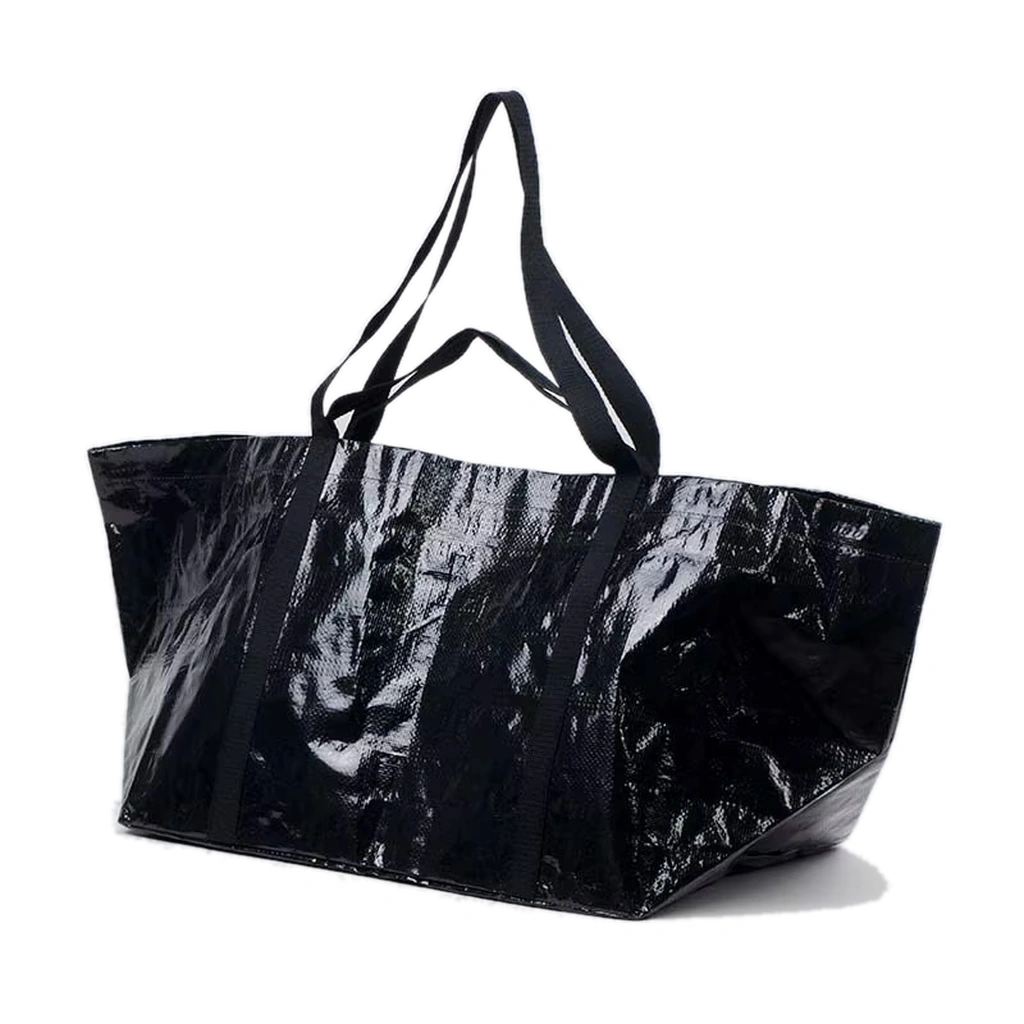
Extra-large shopping bags are designed for products or purchases that require substantial internal space.
They may measure approximately:
20 × 22 × 8 inches or larger
depending on the application.
Extra-large shopping bags may be useful when:
- Several products need to be carried together
- Products have large packaging
- Customers make larger purchases
- Additional internal capacity is required
Suitable for home relocation, luggage sorting, and miscellaneous packing and handling
Shopping Bag Capacity
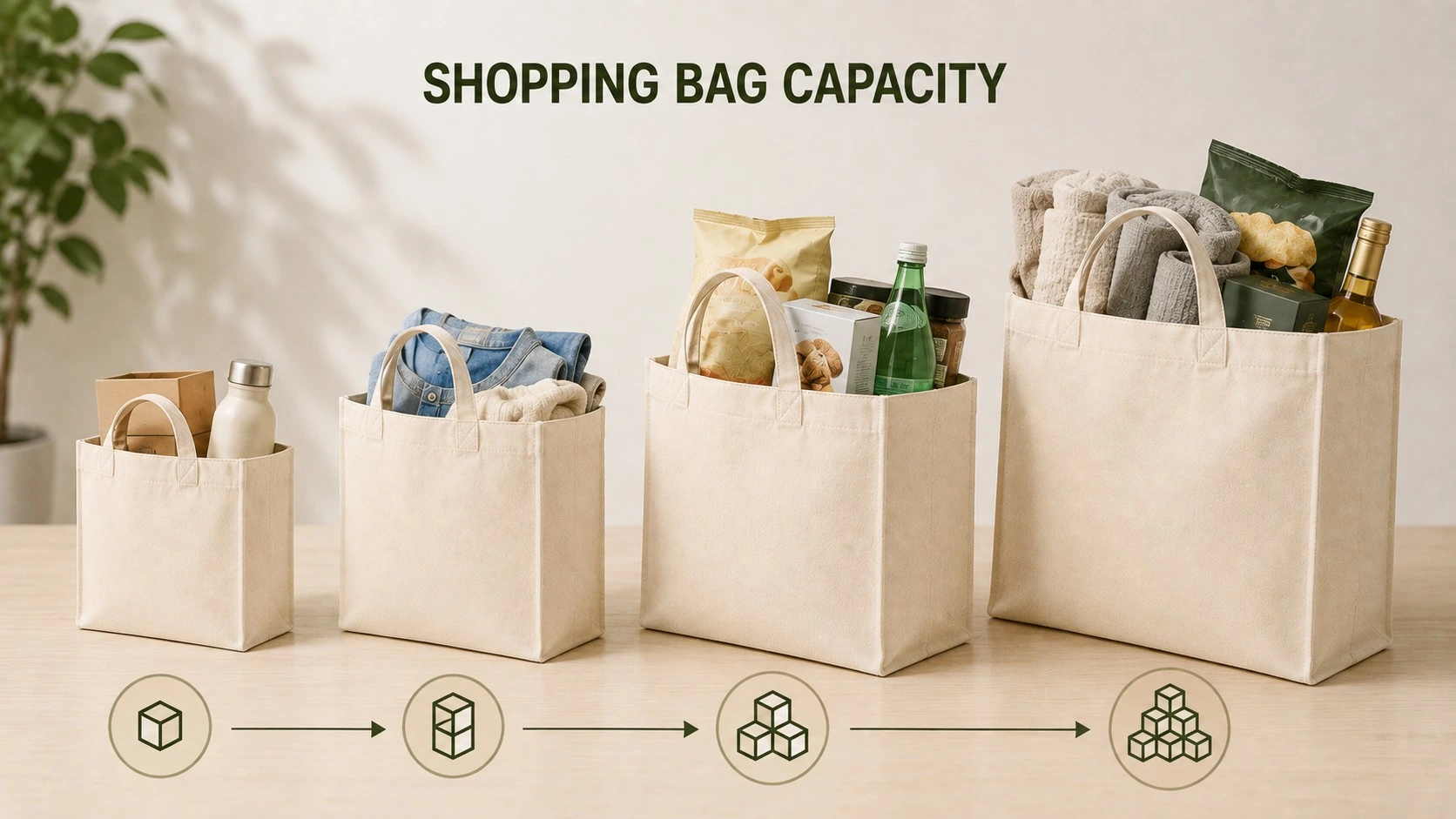
Shopping bag capacity determines how much a bag can hold in terms of both volume and weight. When choosing the right shopping bag, dimensions alone are not enough. Width, height, gusset depth, bag construction, and the type of products being carried all affect the actual usable capacity.
A larger shopping bag generally provides more volume, but the relationship between size and capacity is not always linear. A deeper gusset can significantly increase the amount of space available without requiring a major increase in the bag's width or height.
For businesses choosing shopping bags for retail products, it is useful to consider both volume capacity and weight capacity before selecting a size.
How Many Gallons or Liters Can a Shopping Bag Hold?
Shopping bag volume can be estimated from the bag's width, height, and gusset dimensions. A simple way to understand the approximate internal volume is to consider the three-dimensional space created by these measurements.
However, the calculated volume should not be treated as the exact usable capacity. Seams, folds, handles, reinforcement areas, and the shape of the products inside the bag can reduce the amount of practical space available.
As a general reference:
| Shopping Bag Size |
Approximate Capacity |
| Small Shopping Bag |
3–4 gallons / 11–15 liters |
| Medium Shopping Bag |
5–6 gallons / 19–23 liters |
| Large Shopping Bag |
7–8 gallons / 26–30 liters |
| Extra Large Shopping Bag |
9–10+ gallons / 34–38+ liters |
Shopping Bag Size and Capacity Comparison Chart
The following chart can be used as a general starting point when evaluating shopping bag sizes.
| Shopping Bag Size |
Typical Dimensions |
Approximate Use |
Suitable Applications |
| Small |
8 × 10 × 4 in |
Compact capacity |
Small retail products |
| Medium |
12 × 15 × 4 in |
Moderate capacity |
Clothing, books, shoes |
| Large |
16 × 20 × 6 in |
High capacity |
Multiple products |
| Extra Large |
20 × 22 × 8 in+ |
Very high capacity |
Large or bulky purchases |
These are general guidelines rather than fixed industry standards.
For custom shopping bags, the dimensions should be based on the actual products and packaging requirements.
How to Choose the Right Shopping Bag Size
Selecting the right shopping bag size begins with understanding what the bag needs to carry.
Instead of choosing a size based only on what looks attractive, consider the following factors.
Step 1: Measure the Product
Measure the product's:
- Length
- Width
- Height
- Weight
If the product has an unusual shape, measure the maximum dimensions rather than only the smallest areas.
Step 2: Measure the Final Packaging
If the product is sold inside a box, sleeve, carton, or other packaging, measure the final packaged product.
The shopping bag needs to accommodate the packaged dimensions, not simply the dimensions of the product itself.
For example, a product may be relatively compact, but its retail box could require considerably more space.
Step 3: Consider How Many Products Go Into One Bag
Think about the typical customer purchase.
Will the shopping bag carry:
- One product?
- Two or three products?
- Several products?
- A mixture of products with different sizes?
If several products will be packed together, the bag may need additional width or gusset depth.
Step 4: Consider Product Weight
A shopping bag should not only be large enough—it should also be appropriate for the expected load.
A bag intended to carry several heavy products requires suitable construction and handle attachment.
When ordering custom shopping bags, provide the expected maximum weight whenever possible.
Step 5: Select the Right Gusset
The gusset becomes particularly important when products are thick, boxed, or packed in multiple layers.
If your product has significant depth, a flat bag may not provide sufficient capacity even if the width and height appear adequate.
A larger gusset can provide additional internal space while maintaining practical front dimensions.
Step 6: Allow Enough Room for Packing
Avoid designing a shopping bag that fits the product so tightly that packing becomes difficult.
A reasonable amount of additional space can make it easier for employees to pack products and for customers to remove them.
At the same time, excessive empty space should be avoided.
The ideal shopping bag creates a balance between:
Product fit + Capacity + Convenience + Appearance + Cost
Shopping Bag Dimensions and Handle Length
Shopping bag size should also be considered together with handle dimensions.
A larger bag may require an appropriate handle length so that customers can comfortably carry it by hand or over the shoulder, depending on the design.
When developing custom shopping bags, businesses can consider:
- Handle length
- Handle width
- Handle attachment position
- Distance between handles
- Carrying method
The handle should complement the overall bag dimensions rather than being treated as a separate element.
Shopping Bag Sizes for Different Retail Businesses
Different businesses may require different shopping bag sizes depending on their typical products:
- Fashion & Apparel: Medium to Large bags for clothing, shoes, and accessories.
- Grocery & Food Retail: Medium to Extra Large bags for multiple or heavier purchases.
- Gift & Specialty Retail: Small to Medium bags for gifts and packaged products.
- Events & Promotions: Medium to Large bags when carrying promotional materials or multiple items.
There is no single best shopping bag size for every business. The ideal size should match your products, expected load, and customer usage.
How to Order Custom Shopping Bags
When requesting custom shopping bags, providing accurate information can help the manufacturer recommend suitable dimensions.
Consider preparing the following details.
Product Dimensions
Provide the length, width, and height of the final packaged products.
Product Weight
Provide the approximate weight of the products that will be carried in one bag.
Quantity per Bag
Explain how many products are normally placed into one shopping bag.
Preferred Dimensions
If you already have target dimensions, provide the width, height, and gusset.
Explain whether the bags will be used for retail stores, clothing purchases, grocery shopping, gifts, promotional events, or another shopping application.
Artwork and Branding
If the bags will include your brand logo or artwork, provide the relevant printing requirements.
If you are unsure about the ideal dimensions, a custom shopping bag manufacturer can evaluate your product information and help recommend a suitable size.
Custom Shopping Bag Size Solutions from INITI
At INITI, shopping bags can be customized according to your product dimensions, packaging requirements, and branding needs.
Instead of limiting your business to a fixed standard size, you can develop shopping bags with dimensions suited to your actual application.
Custom options can include:
- Custom width
- Custom height
- Custom gusset
- Custom handle length
- Custom handle placement
- Custom colors
- Custom printing
- Custom branding
For bulk orders, choosing the right dimensions before production can help create a more consistent packaging solution for your brand.
If you already know your product dimensions, share the product measurements and expected bag capacity with INITI. If you are unsure which size is most appropriate, you can provide your product dimensions and requirements for a customized recommendation.
FAQ
What are the standard shopping bag sizes?
There is no single universal standard shopping bag size. Common shopping bags are generally categorized as small, medium, large, and extra large, but the exact dimensions vary depending on the product and application.
What is the most common shopping bag size?
Medium shopping bags are often a versatile choice for general retail applications because they can accommodate a wide range of everyday products. However, the best size depends on the products being carried.
How do you measure a shopping bag?
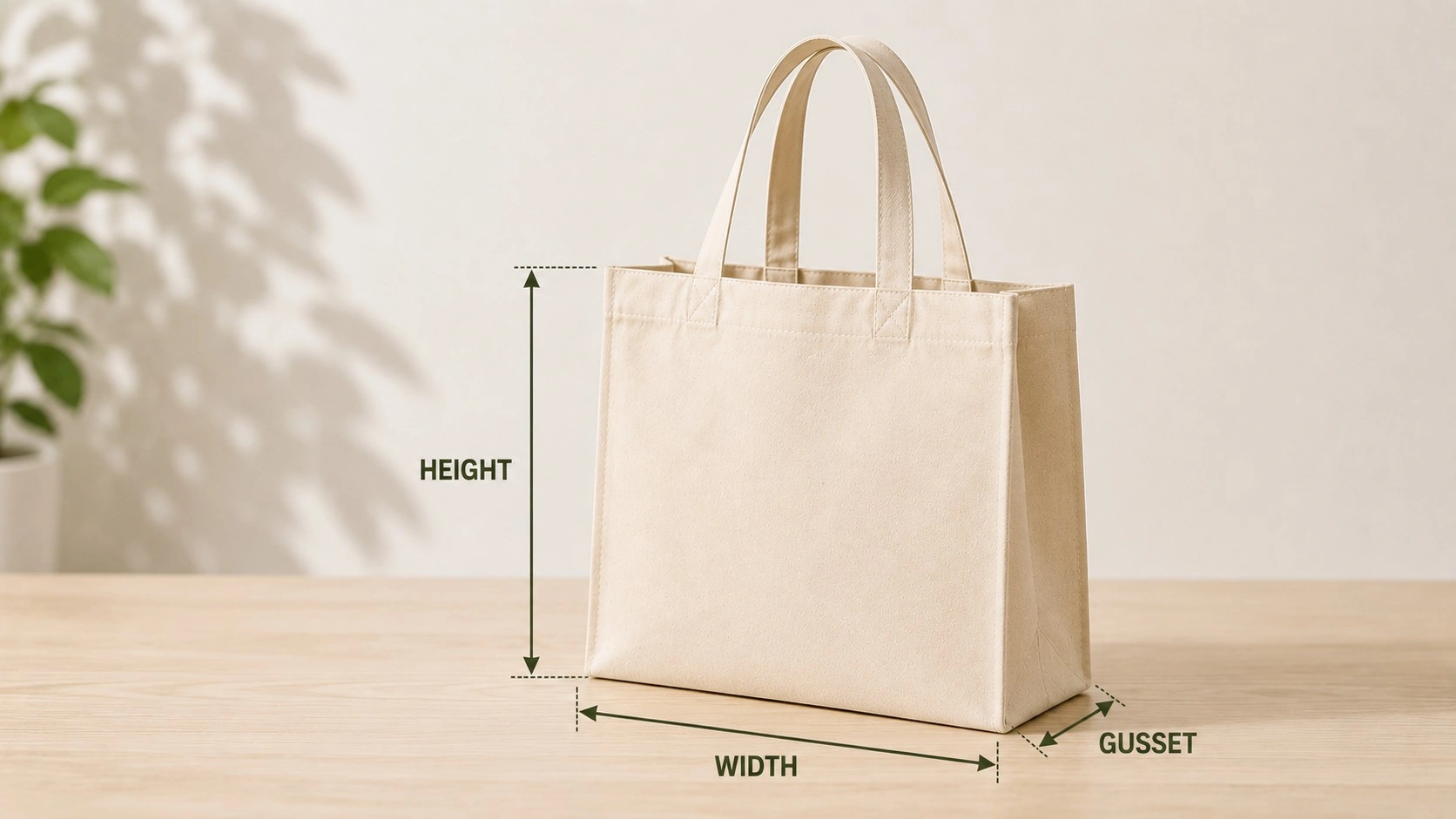
Shopping bag dimensions are commonly expressed as Width × Height × Gusset. Measure the width and height of the bag and include the gusset depth when the bag has a side or bottom gusset.
What does W × H × G mean?
W means width, H means height, and G means gusset. For example, 12 × 15 × 4 inches means a bag that is 12 inches wide, 15 inches high, and has a 4-inch gusset.
What is a gusset on a shopping bag?
A gusset is the additional depth created on the side or bottom of a shopping bag. It allows the bag to accommodate thicker and bulkier products.
How do I calculate the right shopping bag size?
Start by measuring the final packaged product. Then consider the number of products per bag, product weight, required capacity, and additional space needed for convenient packing.
What size shopping bag is best for clothing?
Medium and large shopping bags are commonly suitable for clothing. The appropriate size depends on the number of garments, garment thickness, packaging, and total weight.
What size shopping bag is best for groceries?
Grocery shopping bags generally need sufficient capacity and appropriate load-bearing performance. The ideal size depends on the number, shape, and weight of the products typically carried.
Can shopping bags be made in custom sizes?
Yes. Custom shopping bags can be manufactured according to specific width, height, gusset, handle, and branding requirements.
Should I choose a larger shopping bag to provide more capacity?
Not always. An oversized bag may create unnecessary empty space, increase material usage, and be less convenient to carry. It is generally better to select dimensions based on the actual products and packaging.
Can a shopping bag be designed around my product dimensions?
Yes. Providing your product dimensions, packaging size, weight, and expected quantity per bag can help a manufacturer develop shopping bag dimensions suited to your application.
Conclusion
The right shopping bag size depends on much more than whether you need a small, medium, or large bag.
When selecting shopping bag dimensions, consider:
- Width
- Height
- Gusset
- Product dimensions
- Packaging dimensions
- Number of products
- Product weight
- Required capacity
- Handle requirements
- Customer convenience
There is no single shopping bag size that is ideal for every business. A small bag may be perfect for compact purchases, while a larger bag may be necessary for multiple or bulky products.
For businesses with specific product requirements, custom shopping bag dimensions can provide a better fit than standard sizes.
By choosing the right combination of width, height, and gusset, you can create shopping bags that are practical, comfortable to carry, and appropriately sized for your products.
Related Article


 Hot News