What Is a Takeout Bag: Insulated, Non-Woven and Paper Options Explained
A takeout bag is a carrying bag used by restaurants, cafés, bakeries and food delivery businesses to transport packaged meals, drinks and other takeaway products.
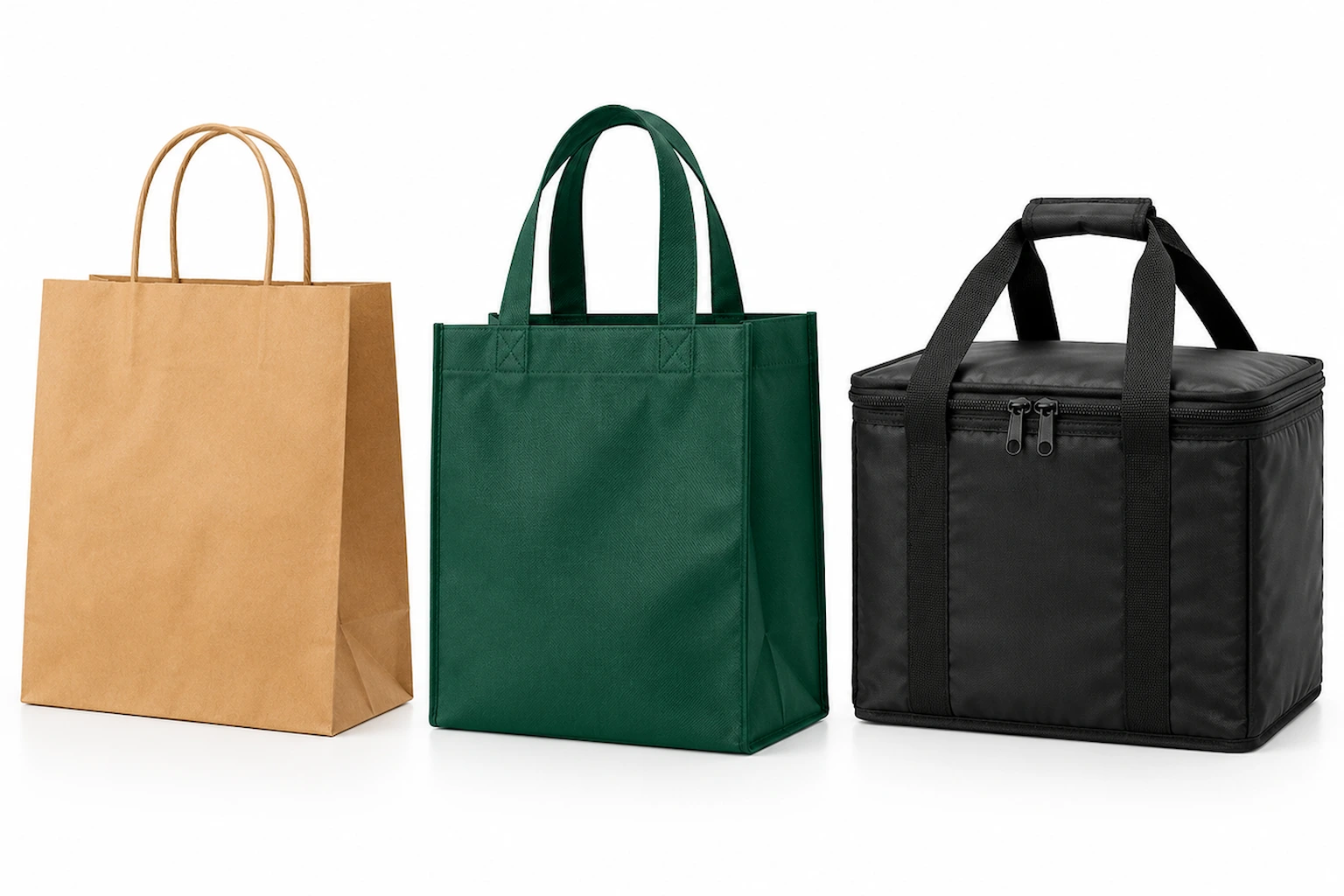
Common options include kraft paper bags, PP non-woven carriers and insulated food delivery bags. They may serve similar purposes, but their materials, costs and performance can differ significantly.
A small takeaway counter may prioritize inexpensive paper bags for everyday orders. A premium café may invest in illustrated packaging that customers recognize and keep. A professional delivery operator may need reusable insulated carriers with secure closures and separate compartments for hot and cold food.
The right takeout bag depends on what it carries, who uses it, how it is delivered and what the business can afford to spend.
This guide compares paper, non-woven and insulated takeaway bags, with practical advice on packaging costs, food-container fit, delivery security, temperature separation, custom branding and wholesale sourcing.
1. What Is a Takeout Bag Used For?
A takeout bag is normally the outer carrier used to group and transport packaged food from a restaurant or retailer to the customer.
Typical applications include restaurant takeaway orders, café drinks, bakery products, meal delivery, catering, prepared-food programs and promotional gift sets.
The bag is not necessarily the packaging that directly touches the food.
For example, a restaurant may place a sealed meal tray and a lidded drink inside a branded paper bag. The tray and cup are the primary food containers, while the bag provides carrying support, organization and brand presentation.
Different takeaway operations require different functions:
- Customer pickup: Convenient loading, stable carrying and controlled unit cost.
- Third-party delivery: Secure closures, stable containers and visible evidence of possible opening.
- Longer delivery routes: Suitable insulated carriers and temperature-management procedures.
- Premium retail: Distinctive artwork, materials and brand presentation.
- Repeat-use programs: Durable handles, suitable dimensions and cleaning practicality.
One bag does not need to perform all these functions.
For many businesses, selecting the appropriate combination of primary food packaging, outer takeaway bag and delivery carrier is more effective than adding every feature to a single product.
2. Insulated vs Non-Woven vs Paper Takeout Bags
The three main options have different cost structures and practical applications.
| Feature |
Kraft Paper Bag |
PP Non-Woven Bag |
Insulated Takeout Bag |
| Main purpose |
Everyday takeaway carrying |
Branded carrying and selected repeat-use programs |
Slowing temperature changes during transport |
| Typical construction |
Folded paper, gussets and optional handles |
Non-woven panels, handles and seams |
Outer shell, insulation, lining and closure |
| Thermal performance |
Limited without added insulation |
Limited without added insulation |
Depends on insulation, size and closure |
| Printing options |
Logos, typography, illustrations |
Logos, printed panels and selected laminated graphics |
Branding on the outer shell |
| Repeat use |
Depends on durability and handling |
Can be designed for repeated carrying |
Common for professional delivery operations |
| Empty-bag storage |
Usually flat and compact |
Often foldable |
Generally bulkier |
| Main cost drivers |
Paper grade, size, handles, printing |
Fabric weight, handles, stitching, printing |
Foam, lining, closure, reinforcement |
| Typical application |
Restaurant counter and bakery pickup |
Branded food retail and merchandise |
Delivery fleets, catering and meal programs |
Paper may be a cost-effective starting point for large-volume everyday packaging. However, a premium printed paper bag with specialty finishes may cost more than a basic non-woven carrier.
Likewise, a lightweight foil-lined takeaway tote and a professional insulated pizza carrier should not be treated as equivalent products.
The correct comparison is based on finished specifications and intended use, not material names alone.
3. Paper Takeout Bags: Everyday Packaging and Premium Presentation
Kraft paper takeaway bags are widely used by fast-food restaurants, cafés, bakeries and food retailers.
Common designs include flat-bottom bags without handles, twisted-paper-handle bags, flat-handle carriers and wide-gusset bags for boxed meals.
Why Flat Bottoms and Gussets Matter
Food containers are often rectangular, relatively wide and designed to remain level.
A flat bottom provides a more stable base for loading, while side gussets create usable space for meal boxes.
A narrow paper bag may work for a sandwich but perform poorly with two large lunch boxes.
Buyers should therefore select the bag dimensions around their actual containers rather than relying only on a general small, medium or large designation.
Paper Weight Is Not the Whole Specification
Paper is commonly specified by basis weight in grams per square meter (gsm).
However, the finished bag's carrying strength also depends on the paper grade, handle attachment, bottom construction, adhesives and bag dimensions.
For a lightweight pickup order, a simple flat-bottom paper bag may be sufficient.
For several heavy meal boxes, reinforced handles and a stronger bottom structure may justify the additional material cost.
Moisture and Grease Risks
Paper can lose strength when exposed to moisture.
Condensation, leaking drink cups, oily food containers and wet countertops can affect the bag, particularly around the base.
The most effective starting point is secure primary food packaging.
Additional bottom reinforcement, suitable coatings or other paper specifications may then be considered according to the application.
Ordinary kraft paper is not automatically greaseproof, waterproof or suitable for all direct food-contact uses.
Paper Can Also Be a Premium Material
A paper bag does not have to look inexpensive.
Original illustrations, coordinated typography, special paper finishes and decorative handles can turn a standard takeaway carrier into a recognizable part of a premium brand.
For example, a bakery may use basic branded paper bags for everyday bread while reserving more elaborate illustrated versions for gift sets or seasonal collections.
The material remains paper, but the purpose and budget are different.
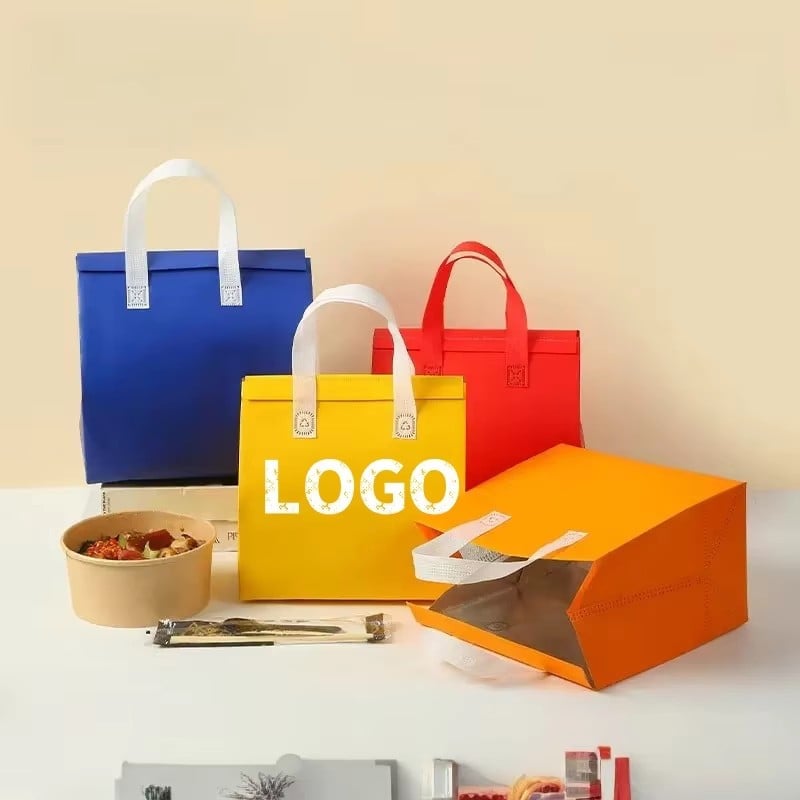
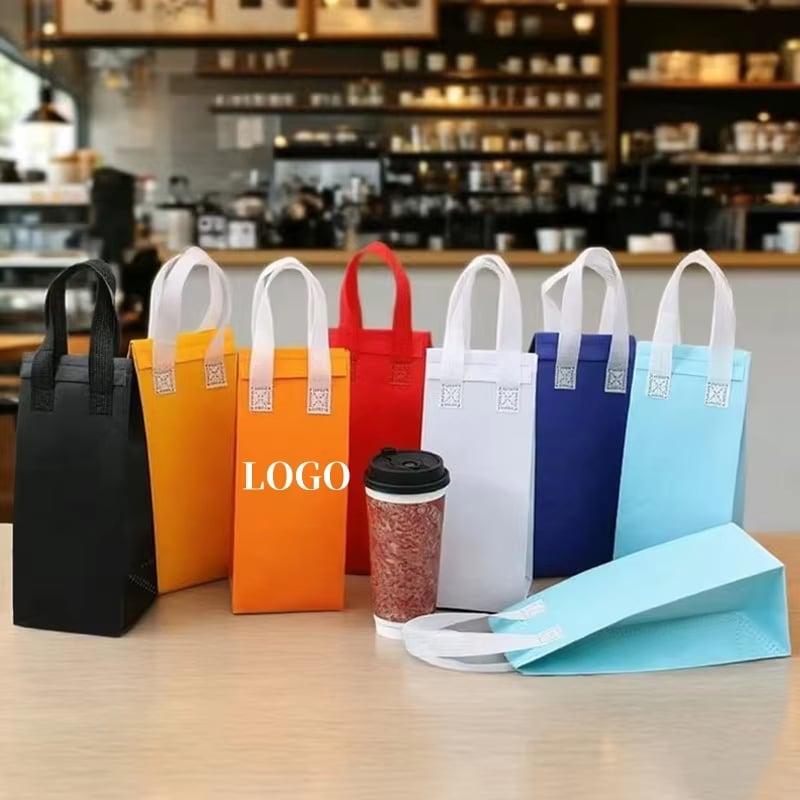
4. Non-Woven Takeout Bags: Branded and Reusable Carrying
Many non-woven takeaway bags use polypropylene (PP) non-woven fabric.
A common construction combines a rectangular body, side and bottom gussets, short handles and large printable panels.
These bags are suitable for certain supermarket food programs, branded promotional packaging and takeaway concepts where customers may use the bag again.
Plain vs Laminated Non-Woven
| Construction |
Practical Characteristics |
Buyer Considerations |
| Plain PP non-woven |
Lightweight, flexible and fabric-like |
Material weight, handle strength, suitable printing |
| Laminated non-woven |
Smoother surface and additional print options |
Lamination, ink quality, folding and recycling implications |
| Reinforced non-woven |
Stronger carrying structure |
Seams, handles, bottom construction and expected load |
| Insulated non-woven |
Non-woven shell with separate thermal layers |
Foam, lining, closure and cleaning |
Laminating the surface does not automatically make the finished bag waterproof. Stitched seams and openings may still allow water to enter.
A standard PP non-woven bag also provides little temperature control unless appropriate insulation is added.
When Does Non-Woven Make Commercial Sense?
Non-woven bags are worth considering when the bag itself is expected to provide value beyond a single takeaway transaction.
Examples include branded reusable meal carriers, supermarket prepared-food programs, customer loyalty campaigns and promotional merchandise.
For these projects, useful dimensions and comfortable handles often matter more than simply increasing the fabric weight.
Reusability Depends on Construction
A non-woven bag should not be considered durable solely because its material looks similar to textile.
Handle attachment, seams and bottom reinforcement determine how it performs under repeated loading.
For a repeat-use program, the buyer should establish expected carrying conditions, suitable cleaning procedures and sample acceptance requirements.
5. Insulated Takeout Bags: Temperature Control and Food Quality
Insulated takeaway bags are designed to reduce heat transfer between the contents and the surrounding environment.
They do not actively heat or refrigerate food.
A typical insulated delivery bag combines several functional components.
| Component |
Common Options |
Main Function |
| Outer shell |
Polyester, Oxford fabric, non-woven PP or RPET |
Appearance and carrying structure |
| Insulation core |
EPE/PE foam or other suitable insulation |
Slows heat transfer through the panels |
| Interior lining |
Aluminum-film laminate, PEVA or other specified material |
Interior surface and part of the thermal system |
| Closure |
Zipper, overlapping flap, hook-and-loop |
Reduces air exchange through the opening |
| Reinforcement |
Webbing, reinforced handles and seams |
Supports carrying and repeated use |
Does Aluminum Foil Lining Guarantee Insulation?
No.
A shiny silver lining alone does not establish the bag's temperature-retention performance.
Insulation thickness, panel construction, closure design, food quantity, initial food temperature and outdoor conditions all matter.
A thin promotional foil-lined bag may perform differently from a professional carrier with thicker foam and a well-designed closure.
For more detail, see PEVA vs Aluminum Foil Lining for Insulated Bags.
How Long Can an Insulated Takeout Bag Keep Food Warm?
There is no universal duration.
An insulated bag carrying one small meal may lose heat differently from the same bag carrying several large food containers.
Performance also changes with delivery time, outdoor temperature and how often the bag is opened.
For commercial purchasing, buyers should evaluate the actual meals, containers and intended route rather than choosing solely from an advertised number of hours.
Why Condensation Matters
Hot meals release steam.
If steam becomes trapped inside primary food packaging, it can condense and affect the texture of pizza, fried foods and pastries.
An insulated outer bag may help retain heat, but it does not replace the need for suitable food-container ventilation where the product requires it.
Soups, sauces and drinks have different priorities. These require suitable lids, stable placement and appropriate spill-management procedures.
Separating Hot Meals and Cold Drinks
Many takeaway orders combine hot burgers, warm meal boxes or pizza with iced coffee, cold soda or chilled desserts.
Placing these items in the same unpartitioned insulated compartment can cause unwanted heat exchange between them.
Restaurants have several practical options:
| Packing Arrangement |
Best Use |
Main Limitation |
| Separate hot and cold bags |
Longer routes and temperature-sensitive orders |
More bags and handling |
| Separate insulated compartments |
Delivery fleets carrying mixed orders |
More complex bag structure |
| Removable insulated divider |
Flexible delivery loads and changing order sizes |
Effectiveness depends on fit and insulation |
| Ordinary fabric or cardboard divider |
Basic organization and short-distance carrying |
Limited thermal separation |
A properly fitted thermal barrier divider can reduce heat transfer between compartments, particularly when it extends across the relevant contact area and reduces air exchange.
However, an insulated divider does not completely prevent temperature changes.
It also does not stop liquid from moving between compartments unless the construction includes a suitable liquid barrier.
For demanding hot-and-cold delivery requirements, separate carriers or genuinely isolated compartments are generally a more reliable starting point.
For a custom insulated takeaway bag, buyers should confirm whether the divider needs to be fixed or removable, how it attaches, whether air can circulate around it and how the lining will be cleaned.
FoodSafety.gov recommends keeping hot and cold foods separate during delivery.
FoodSafety.gov — Tips for Meal Kit and Food Delivery Safety
6. Tamper-Evident Seals for Third-Party Food Delivery
Delivery security is another important factor in takeout bag design.
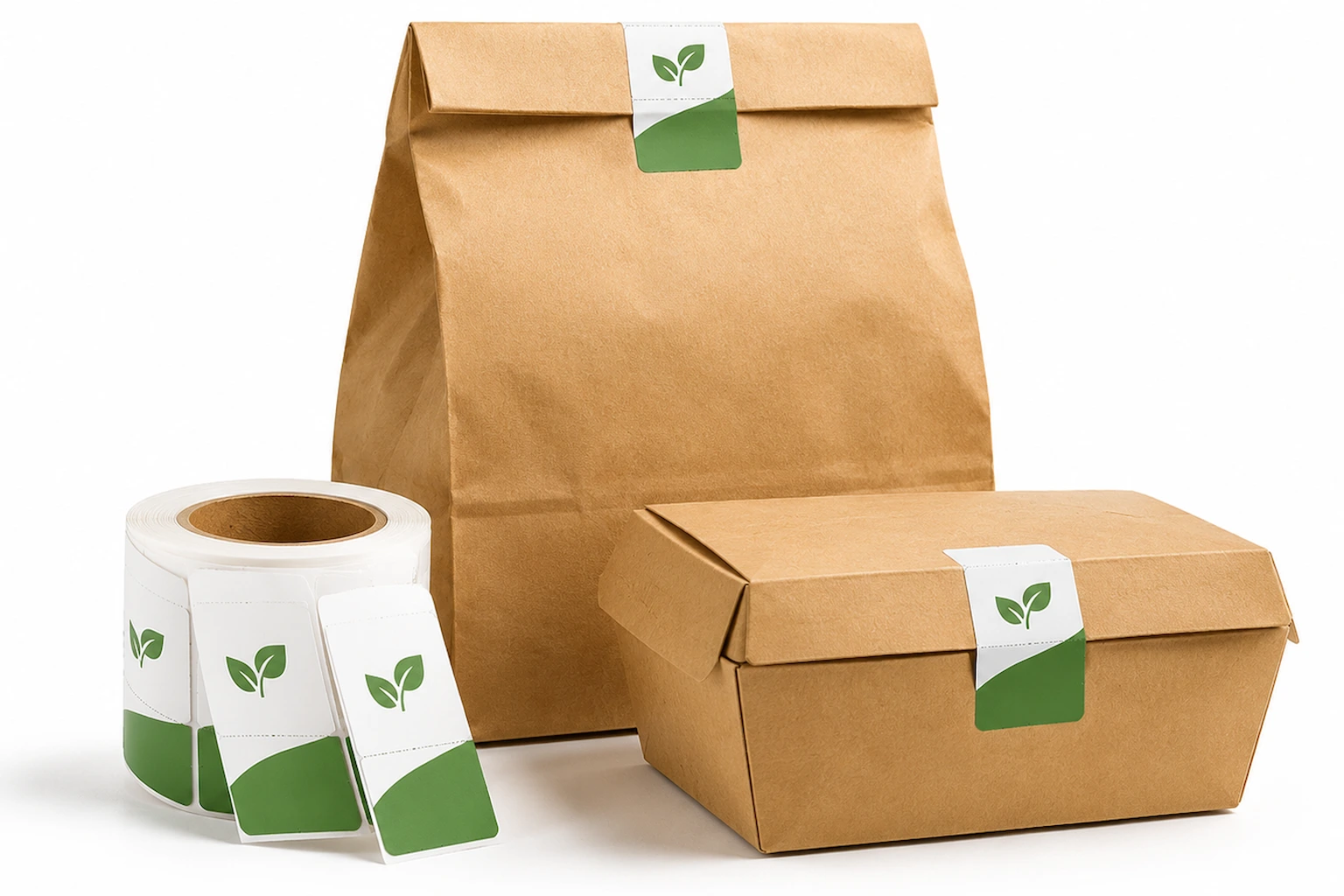
For orders handed to third-party couriers, restaurants often use tamper-evident labels, adhesive closure strips or other sealing arrangements that make opening more noticeable.
A tamper-evident seal is intended to reveal possible interference. It does not make a bag impossible to open.
Uber Eats encourages merchants to seal orders using tamper-evident packaging. DoorDash offers dedicated sealed-bag stickers, while Deliveroo provides guidance on securely sealing orders.
Platform practices and legal requirements vary by market and operation.
Common Security Sealing Options
| Sealing Method |
Suitable Packaging |
Practical Considerations |
| Branded security sticker |
Folded paper bags and food boxes |
Adhesion, visible tearing and application speed |
| Integrated peel-and-seal strip |
Purpose-designed paper delivery bags |
Surface compatibility, closure alignment and opening method |
| Tear-off top or perforated closure |
Specially designed disposable bags |
Clear opening instructions and reliable tear behavior |
| Sealed inner package |
Reusable non-woven or insulated outer carriers |
Keeps the reusable outer bag independent of the single-use seal |
Where Should the Seal Be Placed?
For a paper takeaway bag, the top may be folded and secured with a sticker that bridges the opening.
The seal should cover the intended access point so opening the bag normally leaves visible evidence.
If the bag has side openings or can be accessed without disturbing the seal, the closure design may need improvement.
For reusable non-woven or insulated delivery bags, sealing the inner disposable food package may be more practical than permanently sealing the reusable carrier itself.
What Makes a Security Seal Work?
Buyers should check:
- Whether the label bonds to the actual paper or coated surface
- Whether opening causes visible tearing, splitting or another clear indication
- Whether steam, grease or condensation weakens adhesion
- Whether the seal stays attached during normal carrying
- Whether restaurant staff can apply it quickly
- Whether customers can open the package without overturning the contents
A normal decorative sticker is not necessarily tamper-evident.
The intended visible-opening mechanism must be confirmed with the actual label and bag materials.
For examples of commercial applications, see:
7. Which Takeout Bag Fits Different Businesses and Customer Budgets?
Different food businesses make different purchasing decisions.
A low-priced lunch counter may need thousands of economical bags. A premium beverage brand may treat special packaging as part of its marketing budget. A delivery company may invest in reusable equipment instead of buying a new insulated carrier for every order.
| Buyer Segment |
Main Priority |
Suitable Starting Option |
Cost Strategy |
| Small takeaway shop |
Low cost and fast packing |
Basic kraft paper bag |
Avoid unnecessary finishes and special structures |
| High-volume fast-food chain |
Consistency and supply efficiency |
Standardized printed paper bags |
Control unit cost, sizes and inventory |
| Everyday café or bakery |
Brand presentation at manageable cost |
Printed paper bag |
Focus on recognizable design |
| Premium café or dessert brand |
Customer experience and visual identity |
Illustrated paper bag |
Allow targeted artwork and finishing costs |
| Lifestyle or beverage brand |
Distinctive branding and potential reuse |
Illustrated paper or selected non-woven bag |
Treat part of the budget as marketing |
| IP collaboration program |
Limited-edition appeal and approved artwork |
Custom illustrated packaging or merchandise |
Include licensing, artwork and approval costs |
| Third-party delivery restaurant |
Order integrity and operational efficiency |
Paper bag with suitable tamper-evident closure |
Include seal cost and application time |
| Professional delivery fleet |
Repeated use and food temperature management |
Reinforced insulated carrier |
Evaluate cost per delivery cycle |
| Catering and mixed-temperature delivery |
Stable loading and temperature separation |
Insulated carrier with compartments or separate bags |
Prioritize practical performance and cleaning |
These are starting recommendations rather than fixed rules.
A premium restaurant may use simple paper bags for everyday orders and more elaborate packaging only for limited campaigns.
Low-Cost Everyday Takeaway
For a business operating on a small packaging budget, the first priority is a bag that works reliably without unnecessary features.
The preferred specification may include a flat bottom, suitable dimensions, straightforward printing and sufficient carrying strength.
If a bag does not require a handle, decorative lamination or complicated finishing, removing those features may reduce cost.
High-Volume Restaurant Chains
Chain restaurants often need consistent packaging across many outlets.
A limited range of standardized sizes can simplify inventory, quality control and distribution.
However, if the chain sells several distinct meal formats, using one oversized bag for everything may increase waste and reduce container stability.
Premium Cafés and Bakeries
For premium brands, the takeout bag may reinforce the presentation of the products inside.
A well-designed bag can remain visible as customers move through offices, shopping areas and public transport.
Distinctive illustrations, typography, paper texture and handle details may therefore justify a higher packaging budget.
Professional Delivery Operators
For delivery fleets, appearance is useful, but practical operation is usually more important.
A durable insulated carrier should be evaluated for loading speed, handle construction, temperature performance, cleaning and replacement frequency.
For mixed-temperature routes, compartment design may be a higher priority than decorative finishing.
8. How Much Should Restaurants Spend on Takeout Bags?
There is no universally correct unit price.
The appropriate budget depends on order value, quantity, required performance and whether the bag is intended for one use or repeated use.
Packaging Cost Relative to Order Value
Consider two hypothetical examples.
| Item |
Everyday Takeaway |
Premium Gift Order |
| Order value |
$6.00 |
$30.00 |
| Example outer bag cost |
$0.12 |
$0.60 |
| Bag cost as a share of order value |
2.0% |
2.0% |
Both examples spend 2% of order value on the outer bag.
These are illustrative calculations, not market quotations. They exclude food containers, freight and other packaging costs.
The point is that a premium bag may be commercially reasonable for one product category but unnecessarily expensive for another.
Small Unit-Cost Differences Add Up
Suppose a restaurant compares:
- Basic bag: hypothetical cost of $0.12
- Upgraded illustrated bag: hypothetical cost of $0.42
- Additional cost: $0.30 per bag
At 20,000 units, the additional purchase cost is:
20,000 × $0.30 = $6,000.
The upgraded design should therefore serve a defined purpose, such as a premium presentation, planned promotional activity or additional functionality.
Include the Cost of Security Seals
For third-party delivery, the cost calculation should include the actual sealing method.
A low-cost paper bag may require a separate security sticker, while an integrated adhesive closure may involve a different bag specification and production cost.
Compare the total sealed-package cost, including:
- Bag cost
- Security label or integrated sealing material
- Application labor
- Packaging damage or sealing failures
- Any additional packing steps
A slightly more expensive packaging format may still be more efficient if it reduces handling or errors, but that benefit should be checked in the restaurant's real workflow.
Cost per Use for Reusable Carriers
For reusable insulated or non-woven carriers, cost per actual use is more relevant than the initial purchase price.
For example, if a reusable delivery bag has a hypothetical purchase cost of $3.00 and completes 60 delivery cycles:
$3.00 ÷ 60 = $0.05 per use.
This excludes cleaning, storage, damage, loss and handling costs.
If the same bag is used only ten times, its purchase cost rises to $0.30 per use.
Reusable bags become economically attractive only when the operation supports sufficient actual reuse.
9. Branded, Illustrated and Collectible Takeout Bags
For some food and beverage brands, takeaway packaging has become part of lifestyle and collectible culture.
Original illustrations, distinctive typography, seasonal graphics and licensed IP collaborations can make a takeout bag recognizable beyond its practical function.
Some customers photograph, collect or repurpose attractive beverage bags and cup sleeves.
This is particularly relevant to certain beverage, dessert and lifestyle-oriented brands, but it should not be treated as universal consumer behavior.
Real Examples of Collectible Packaging
In November 2024, McDonald's Hong Kong introduced a Dragon Ball DAIMA collaboration that included character-themed takeaway paper bags.
The artwork formed part of the food packaging itself.
McDonald's Hong Kong × Dragon Ball DAIMA
In May 2026, RADII documented Chinese consumers collecting illustrated takeaway bags and beverage packaging from brands such as HEYTEA, Luckin Coffee and CHAGEE.
The report also described customers turning packaging materials into personal craft projects and display collections.
China's Gen Z Is Turning Bubble Tea Packaging Into Collectibles — RADII
These examples demonstrate how packaging design can create additional brand engagement beyond the original food purchase.
Different Levels of Custom Branding
| Design Approach |
Common Format |
Main Budget Consideration |
| Basic branded packaging |
Standard paper bag with logo |
Printing efficiency |
| Signature illustration |
Standard bag with custom artwork |
Artwork and print quality |
| Seasonal limited edition |
Existing bag format with updated graphics |
Multiple versions and inventory |
| Licensed IP collaboration |
Approved characters and co-branding |
Authorization and approval process |
| Reusable branded merchandise |
Reinforced non-woven or textile bag |
Construction and repeat-use value |
Collectible Does Not Always Mean Reusable
A paper bag can have collectible value because of its artwork even if it is not strong enough for repeated shopping use.
A bag intended for regular secondary use needs more attention to handles, dimensions, base strength and surface durability.
The distinction should be made before selecting materials and printing methods.
Artwork Placement and Production
For illustration-led projects, the final layout should be checked on the complete bag structure.
Important characters and text should not be unintentionally hidden by handles, interrupted by seams or distorted across gussets.
Printed material swatches and completed samples should be approved before bulk production.
For licensed artwork, the buyer should confirm the permitted product categories, markets, campaign dates and final approved designs.
10. How to Balance Everyday Packaging and Premium Campaigns
A food brand does not need to provide an expensive bag with every order.
A more practical approach is to use different packaging levels for different customer needs.
Standard everyday packaging: Use a reliable, cost-controlled bag for normal transactions.
Signature brand packaging: Use recognizable colors, typography and illustrations while maintaining a standardized bag structure.
Limited-edition or reusable packaging: Reserve more elaborate graphics, licensed artwork or stronger materials for selected campaigns and merchandise programs.
A chain may use standard paper bags for routine meals, signature packaging for premium beverage products and limited-edition bags for collaborations.
This approach allows the company to control ordinary packaging costs while investing selectively in brand experience.
11. How to Choose the Right Takeout Bag Size
Takeout bag dimensions should follow the actual food containers.
Start by recording the container length, width, height, quantity and combined filled weight.
Also consider whether containers are stacked or placed side by side.
Example: Two Stacked Meal Boxes
Suppose each meal box measures:
220 × 160 × 65 mm.
Two stacked boxes have a combined height of:
65 + 65 = 130 mm.
An initial sample bag with usable internal space of approximately:
240 × 180 × 150 mm
would provide 20 mm of total clearance in each dimension.
This is an illustrative trial configuration, not a universal sizing standard.
The final sample must be checked with the actual lids, gussets and carrying arrangement.
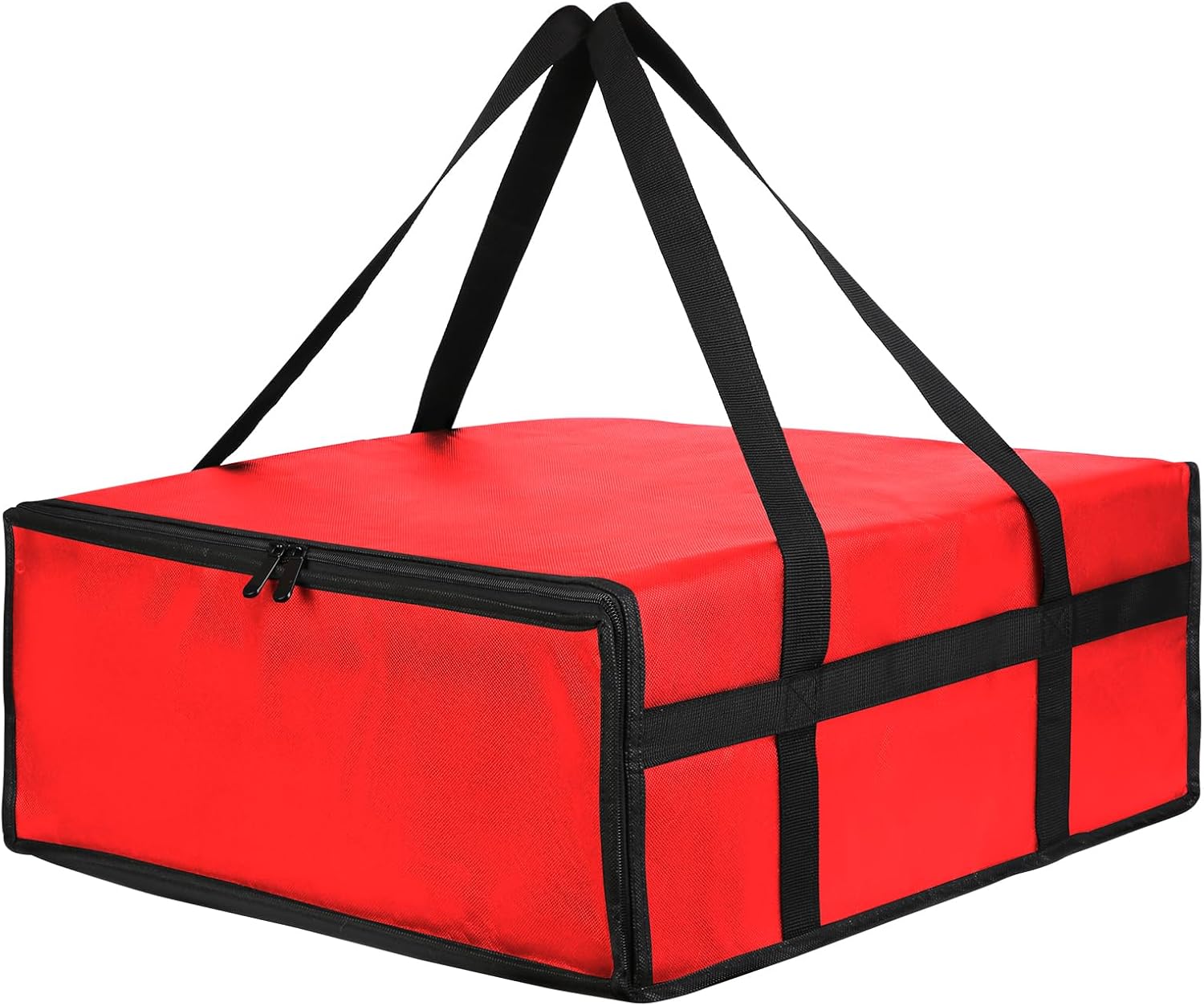
Pizza Bags Need a Flat Format
Pizza cartons should generally stay horizontal during delivery.
A wide, front-loading insulated carrier is often more suitable than a tall, narrow bag.
For example, INITI's Pizza Carrier Delivery Insulated Bag has a reference size of approximately 50 × 50 × 15 cm.
Drinks Need Their Own Support
Tall drinks may shift inside a wide bag.
Depending on the order, a cup holder, internal divider or separate drink compartment may be more useful than increasing the overall bag dimensions.
If hot meals and chilled drinks are transported together, the buyer should also determine whether a thermal divider or separate bags are needed.
12. Common Problems and Practical Solutions
| Problem |
Possible Cause |
Practical Improvement |
| Paper bag bottom weakens |
Moisture or unsuitable base construction |
Improve primary containers, paper choice and bottom reinforcement |
| Meal boxes tilt |
Poor bag dimensions or unstable loading |
Adjust gussets and handle placement |
| Non-woven handles tear |
Weak attachment or seam construction |
Reinforce handles and test loaded samples |
| Hot food becomes soggy |
Steam trapped in the primary container |
Review container ventilation and packing |
| Insulated bag loses heat quickly |
Air leakage, insufficient insulation or unsuitable capacity |
Improve closure and verify under delivery conditions |
| Hot food warms chilled drinks |
Shared unpartitioned compartment |
Separate bags or suitable thermal dividers |
| Security sticker peels off |
Incompatible adhesive, steam or unsuitable placement |
Test seal material and location on actual bags |
| Seal can be bypassed |
Opening remains accessible around the label |
Redesign the closure and seal coverage |
| Printed characters look distorted |
Artwork crosses folds or gussets |
Adjust artwork using the finished bag template |
| Premium packaging costs too much |
Unnecessary upgrades or too many design variations |
Standardize bag construction and control artwork versions |
| Reusable bag is rarely reused |
Inconvenient design or weak carrying structure |
Redesign around practical secondary uses |
These problems should be considered during sample development rather than discovered after a large order has been distributed.
13. Food Contact and Delivery Safety
The outer takeout bag and the primary food container may have different material requirements.
A paper bag carrying a sealed meal box is not necessarily intended for direct food contact.
A wrapper or bag touching unwrapped food requires appropriate material assessment for that use.
The US FDA provides guidance on determining the regulatory status of food-contact material components.
US FDA — Food-Contact Materials
Food temperature management depends on the complete preparation, holding and delivery process.
The FDA Food Code 2026 provides model food-service provisions for US regulatory authorities. Local requirements and operating procedures still need to be followed.
Insulated bags and tamper-evident closures can support delivery operations, but neither replaces appropriate food-handling procedures.
14. What Should Buyers Specify for Custom Takeout Bags?
A useful OEM brief should describe the intended product, customer group and operating conditions.
| Specification Area |
Buyer Information |
| Business application |
Restaurant pickup, café, delivery, catering or promotion |
| Target customer |
Everyday buyer, premium customer, repeat-use audience or collector |
| Packaging objective |
Low cost, branding, insulation, delivery security or merchandise |
| Target budget |
Desired unit cost or packaging cost per order |
| Food containers |
Dimensions, number, filled weight and stacking arrangement |
| Bag material |
Kraft paper, PP non-woven, insulated fabric or other |
| Bag structure |
Gussets, base, handles, closures and reinforcement |
| Security sealing |
Sticker, peel-and-seal closure or sealed inner package |
| Hot/cold separation |
Separate carriers, fixed compartments or removable thermal dividers |
| Artwork |
Logo, illustrations, print colors and approved files |
| IP collaboration |
Applicable permissions and artwork approvals |
| Performance |
Carrying load, moisture exposure, insulation and cleaning |
| Packing |
Individual packing, carton quantity and storage requirements |
| Delivery |
Estimated order quantity, destination and launch schedule |
Sample Approval Checklist
Use actual food containers and the expected packing arrangement during sample review.
Check:
- Loading efficiency: Can staff pack the standard order quickly?
- Carrying stability: Do meal boxes remain level when lifted?
- Handle strength: Are attachment points suitable for the filled weight?
- Security seal: Does opening leave visible evidence, and does the seal remain attached during normal delivery?
- Thermal separation: Are hot and cold products arranged as intended, without obvious gaps around the divider?
- Temperature and food quality: Does the packed meal perform acceptably on a representative route?
- Printing: Are illustrations and logos correctly positioned after folding and assembly?
- Packing condition: Does the completed bag maintain acceptable appearance after transport and storage?
For large-scale restaurant programs, approvals should be based on the finished product, not only material swatches or graphic mockups.
15. Frequently Asked Questions
Q1. Which takeout bag is best for a small restaurant with a limited budget?
A properly sized flat-bottom kraft paper bag is often a practical starting point. Keep the structure simple and add handles, reinforcement or printing only where the intended order requires them.
Q2. Are non-woven takeaway bags better than paper bags?
Not universally. Non-woven bags can work well for branded repeat-use programs, while paper bags suit many everyday takeaway transactions. Cost and actual customer use should guide the choice.
Q3. How can restaurants keep hot food and cold drinks separate?
Use separate carriers or suitable insulated compartments. A removable thermal divider can reduce some heat exchange, but it should not be assumed to provide complete temperature isolation or prevent leaks.
Q4. Do takeaway bags need tamper-evident seals?
Many third-party delivery operations use them, and some platforms or jurisdictions have specific requirements. Buyers should confirm applicable rules and select a seal that shows visible evidence of opening.
Q5. Can takeout bags be customized with illustrations and licensed characters?
Yes. Materials, dimensions, logos, original artwork and authorized collaboration graphics can be customized. The artwork, permissions, printing process and finished sample should be approved before production.
Conclusion
Takeout bags serve different functions for different food businesses.
A small restaurant may prioritize cost-efficient paper packaging. A café may use custom illustrations to strengthen its identity. A delivery operator may focus on reusable insulated carriers, while an IP collaboration may require a more distinctive collectible design.
Delivery security and temperature separation add further requirements.
Tamper-evident seals can help indicate possible opening during courier delivery. Separate thermal compartments or removable insulated dividers can help manage mixed hot-and-cold orders.
The best choice balances carrying performance, food quality, security, customer experience, branding and total cost.
For wholesale buyers, the starting point should be the actual food containers, customer group, delivery method and commercial objective.
Recommended Products: INITI Takeout Bag Options
1. Brown Kraft Paper Shopping Bag
A kraft paper carrier with twisted-paper handles, side gussets, a flat bottom and reinforced handle areas.
Suitable for: Café takeaway, bakeries, packaged food retail and branded restaurant packaging.
Buyer considerations: Paper grade, dimensions, bottom strength, print coverage and optional security-seal placement.
View Brown Kraft Paper Shopping Bag
2. Non-Woven Tote Bag
A lightweight gusseted non-woven tote with short handles and large surfaces for branding.
Suitable for: Promotional food programs, packaged-product giveaways and selected reusable branded carriers.
Buyer considerations: The displayed design is a general retail tote. For food-service use, dimensions, material composition, load requirements and any necessary inner packaging or closures should be developed separately.
View Non-Woven Tote Bag
3. Custom Insulated Takeout Bag
An upright insulated carrier with a gusseted body, aluminum-film lining and reinforced handles.
Suitable for: Restaurant promotions, takeaway meals, cafés and selected delivery programs.
Buyer considerations: Container fit, insulation, closure, filled weight and custom branding.
View Custom Insulated Takeout Bag
4. Pizza Carrier Delivery Insulated Bag
A flat insulated carrier with a wide front zipper opening, EPE foam insulation and reinforced webbing handles.
The reference size is approximately 50 × 50 × 15 cm.
Suitable for: Pizza restaurants, catering programs and delivery operations using broad, flat cartons.
Buyer considerations: Box footprint, stack height, thermal construction, loading access and repeated carrying.
View Pizza Carrier Delivery Insulated Bag
Explore more options in the INITI Takeout Bag Collection.
Inquiry Support
INITI has over 16 years of experience in OEM and ODM bag manufacturing, supporting restaurants, food-service businesses, café and beverage brands, importers and promotional product buyers.
With two manufacturing facilities, INITI can assist with paper, non-woven and insulated bag development, including material selection, bag construction, custom artwork, sample approval and bulk production.
For projects requiring tamper-evident closures or thermal compartment designs, our team can review the intended structure and coordinate appropriate sample development according to the project requirements.
We also provide free design support, custom sampling assistance and fast quotations.
Email [email protected] with your food container dimensions, preferred material, intended use, design files, target budget, estimated quantity and destination market.
Related Blog Articles


 Hot News