What Is Tyvek Material and Why It Is Used in Bags
Tyvek® is often mistaken for paper because of its matte surface, lightweight construction and characteristic creased appearance.
However, it is not paper and it is not a conventional woven fabric.
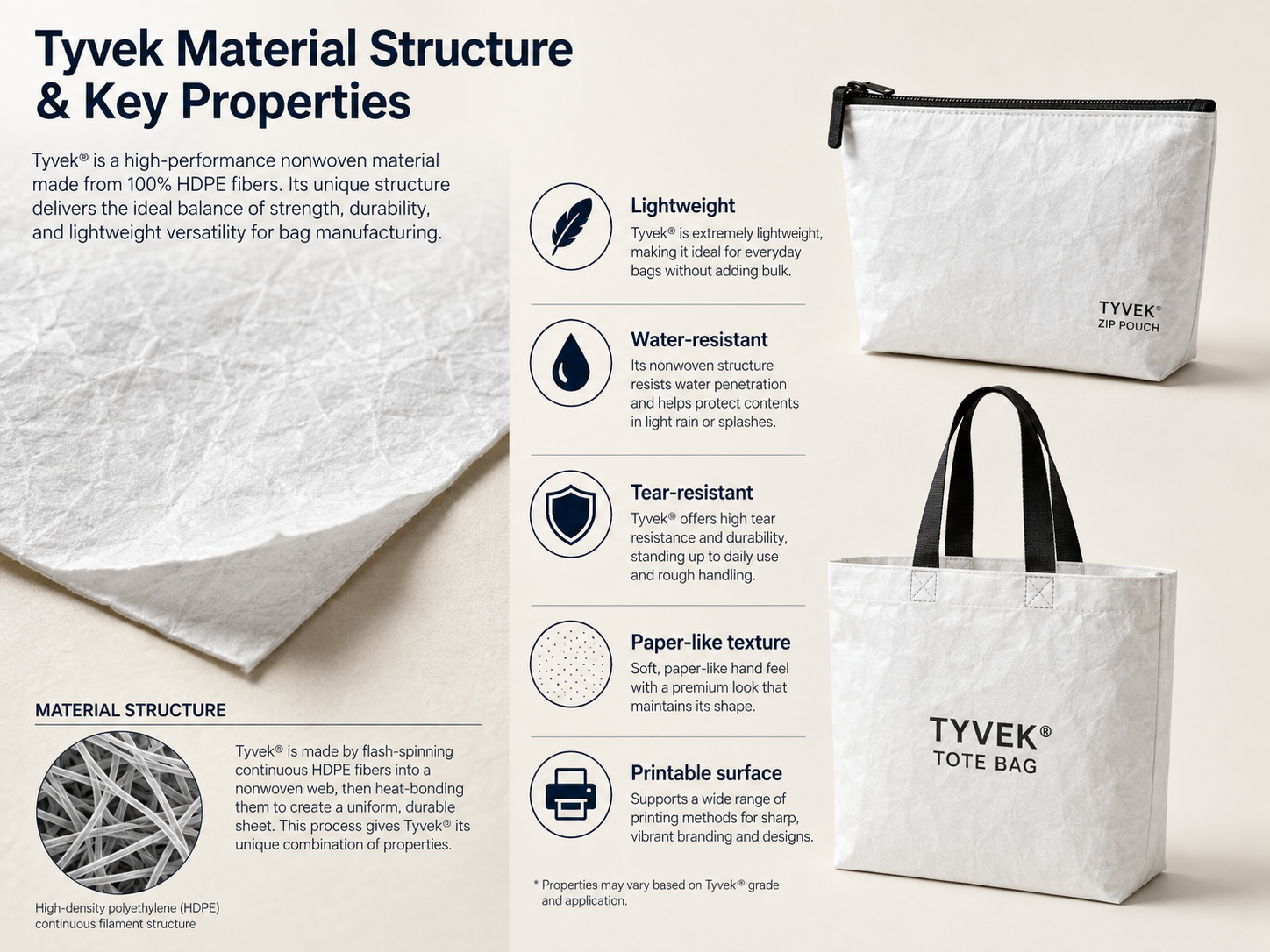
Tyvek® is a DuPont trademark for a family of nonwoven sheet materials made from continuous high-density polyethylene, or HDPE, filaments. The fibers are randomly arranged and bonded together using heat and pressure without conventional weaving.
This construction gives Tyvek® a combination of properties that is unusual in bag materials:
- Lightweight
- Tear-resistant
- Water-resistant
- Printable
- Foldable
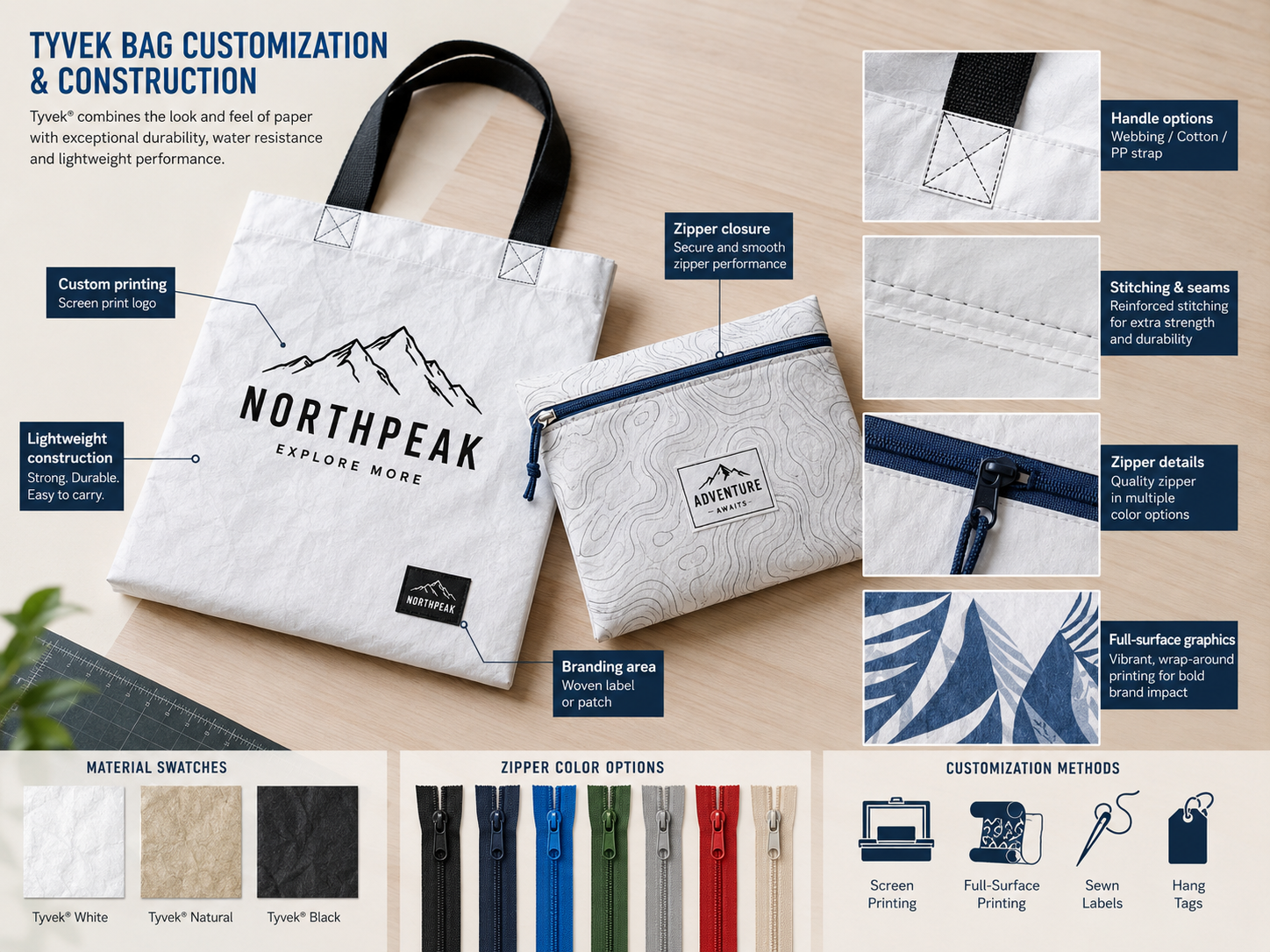
- Sewable
- Suitable for distinctive paper-like designs
For bags, Tyvek® is mainly selected when buyers want the appearance of paper together with better resistance to tearing, folding and light moisture.
Is Tyvek Paper, Fabric or Plastic?
Tyvek® combines characteristics associated with paper, film and fabric, but its base material is HDPE.
It can:
- Be printed like paper
- Be cut, folded and creased
- Be sewn like a textile
- Resist water better than ordinary paper
- Maintain a low finished-product weight
DuPont supplies Tyvek® in two broad structural directions:
| Structure |
Main Characteristics |
Suitable Bag Direction |
| Hard structure |
Paper-like, smooth, firm and suitable for defined folds |
Shopping bags, packaging bags, structured pouches and design-led accessories |
| Soft structure |
Softer, more flexible and textile-like |
Drawstring bags, flexible totes, covers and sewn accessories |
Both structures can be printed, glued and sewn, but they differ in hand feel, stiffness and final appearance.
The exact Tyvek® grade should therefore be confirmed before sampling. The material name alone does not define the required structure or performance.
Why Is Tyvek Used in Bags?
1. High Strength at a Low Weight
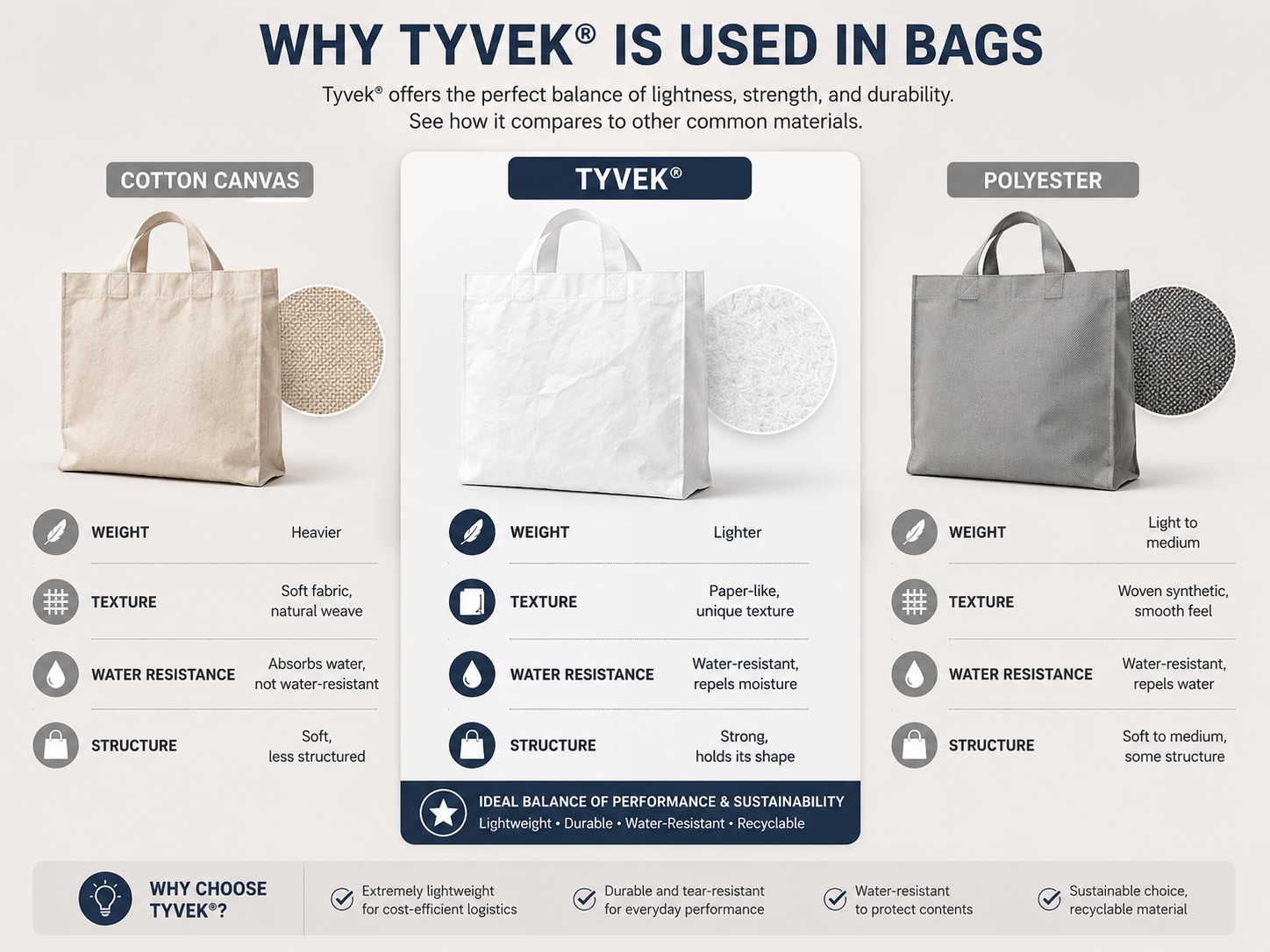
Tyvek® provides a strong sheet structure without the weight of heavy canvas, coated paperboard or thick synthetic fabric.
This makes it suitable for bags that need to be:
- Easy to carry
- Lightweight for shipping
- Foldable
- Resistant to ordinary handling
- Visually different from conventional textile bags
Its continuous HDPE filaments help resist tearing and repeated flexing more effectively than ordinary paper.
However, the finished bag’s load capacity still depends on:
- Material grade
- Bag dimensions
- Seams
- Handle construction
- Reinforcement
- Closure
- Intended contents
Tyvek® should not be described as heavy-duty based only on the base material.
2. Paper-Like Appearance
One of the main commercial reasons for choosing Tyvek® is its distinctive appearance.
It can provide:
- A matte surface
- Natural creasing
- A lightweight paper-style feel
- A modern minimalist appearance
- A surface suitable for full-panel graphics
This makes it useful for brands that want packaging or accessories to look more unusual than standard polyester, cotton or non-woven polypropylene bags.
Creases are often part of the intended design rather than a defect. Buyers should decide during sampling whether they want:
- A clean and relatively flat surface
- A naturally crinkled finish
- A heavily washed-paper appearance
- A structured folded shape
Packing and transportation can add further creases, so the acceptable finished appearance should be agreed before production.
3. Water Resistance
Tyvek® is water-resistant and non-absorbent, giving it an advantage over ordinary kraft paper when exposed to light rain, splashes or damp handling.
However, a Tyvek® bag should not automatically be described as waterproof.
Water may still enter through:
- The bag opening
- Sewing holes
- Zippers
- Unsealed seams
- Handle attachments
- Corners
The correct claim depends on the complete construction.
For most sewn bags, more accurate descriptions include:
- Water-resistant exterior
- Splash-resistant surface
- Moisture-resistant material
- Wipe-clean surface
A waterproof claim requires testing of the finished bag, not only the material sheet.
4. Good Printing Potential
Tyvek® can be used with several traditional and digital printing processes.
Depending on the selected grade and surface treatment, suitable methods may include:
- Screen printing
- Flexographic printing
- Offset printing
- Gravure printing
- UV printing
- Selected digital printing methods
Some digital or water-based inkjet processes require a suitable surface coating or primer. The material grade, ink system and drying temperature should therefore be tested together.
Tyvek® is particularly suitable for:
- Full-panel artwork
- Repeating patterns
- Brand graphics
- Illustrations
- Typography-led designs
- Variable or limited-edition printing
A physical printed sample should be approved for:
- Color
- Ink adhesion
- Fine details
- Surface rubbing
- Fold cracking
- Heat deformation
- Odor
5. Flexible Converting Options
Tyvek® can be:
- Cut
- Die cut
- Folded
- Creased
- Sewn
- Glued
- Laminated
- Perforated
- Heat sealed under suitable conditions
This allows it to be developed into different bag structures, from simple folded pouches to sewn totes and insulated lunch bags.
The processing method must still match the specific grade.
For example, a rigid paper-like grade may be suitable for folded packaging, while a softer grade may perform better in a sewn tote or drawstring structure.
Common Tyvek Bag Applications
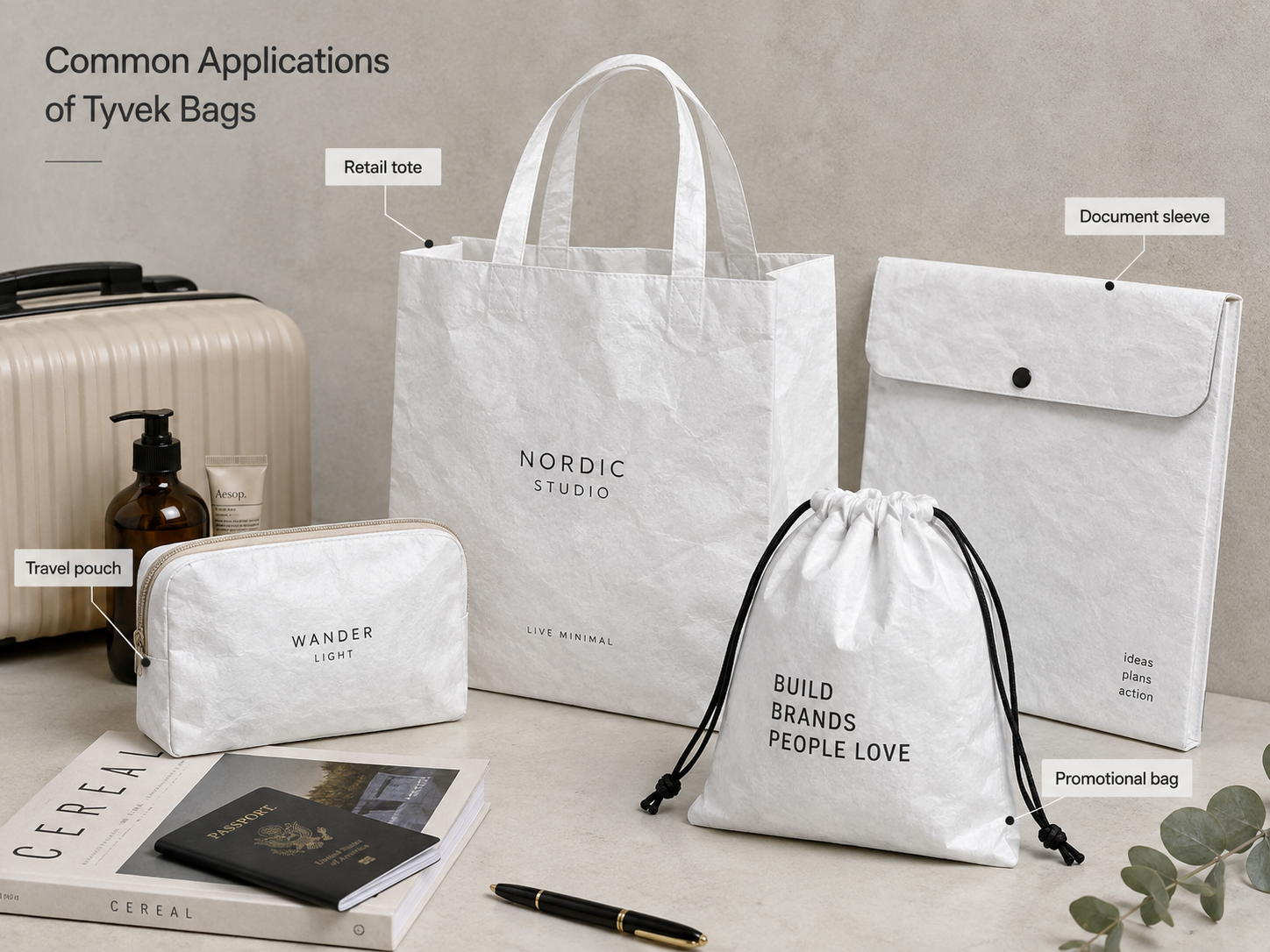
| Bag Type |
Why Tyvek May Be Suitable |
| Retail shopping bag |
Lightweight, printable and visually distinctive |
| Promotional tote |
Large branding surface and easy carrying |
| Cosmetic pouch |
Paper-like style with better tear resistance than ordinary paper |
| Drawstring bag |
Flexible construction and low product weight |
| Lunch bag exterior |
Moisture-resistant outer surface and distinctive material appearance |
| Gift packaging bag |
Reusable appearance with strong print potential |
| Document bag |
Lightweight, foldable and suitable for graphic printing |
| Fashion accessory |
Unusual texture, creasing and contemporary appearance |
Tyvek® is most suitable when the material appearance contributes directly to the product concept.
For a basic low-cost giveaway, non-woven PP may be more economical. For repeated heavy loads, canvas, nylon or polyester may provide a more appropriate woven structure.
Sewing Tyvek Bags
Tyvek® can be sewn using conventional equipment, but it should not be treated exactly like woven fabric.
Needle holes remain visible and do not close after sewing. Excessively dense stitching can create a line of perforations and reduce seam strength. DuPont recommends using a small practical needle and avoiding unnecessarily high stitch density.
Important sewing controls include:
- Appropriate needle size
- Controlled stitch density
- Sufficient seam allowance
- Low thread tension
- Handle reinforcement
- Avoiding repeated sewing over the same line
- Testing the actual production structure
For bags carrying more than lightweight contents, reinforcement may include:
- Woven fabric patches
- Webbing
- Internal support layers
- Extended handle attachments
- Box or cross stitching
DuPont notes that woven material can be added around sewn areas to improve seam strength.
Handle Construction
The body material may resist tearing, but the bag can still fail around the handles.
Common handle options include:
- Tyvek® handles
- Cotton webbing
- Polyester webbing
- Nylon webbing
- Die-cut handles
- Rope handles
- PU handles
For larger shopping bags, webbing handles normally provide better load distribution than narrow handles cut directly from the sheet.
Buyers should define:
- Handle width
- Handle length
- Attachment depth
- Reinforcement
- Intended carrying method
- Target load
- Static and repeated-load testing
A one-time manual carrying demonstration is not sufficient to establish long-term carrying capacity.
Lamination and Coating
Tyvek® can be laminated with materials such as:
- Film
- Paper
- Woven fabric
- Nonwoven fabric
- Foam
- Insulation layers
Lamination may improve:
- Structure
- Print performance
- Thermal function
- Interior cleanliness
- Moisture protection
- Product cushioning
It can also change:
- Breathability
- Flexibility
- Hand feel
- Recyclability
- Finished-product weight
DuPont specifically notes that lamination can alter the original breathability and water-resistance characteristics of Tyvek®.
The full composite structure should therefore be stated in the product specification.
Main Limitations of Tyvek Bags
Heat Sensitivity
Tyvek® is made from HDPE and can deform under excessive heat.
DuPont’s printing guidance identifies a melting point of approximately 135°C and recommends significantly lower temperatures when the material is under tension during printing or coating.
Heat-transfer printing, ironing and high-temperature drying should be tested carefully.
Abrasion
Tyvek® is tear-resistant, but its abrasion behavior should not be assumed to match heavy woven fabrics.
Repeated rubbing may create:
- Surface fuzzing
- Print wear
- Softening
- Visible marks
- Localized damage
DuPont states that Tyvek® abrasion performance is not directly comparable with woven fabric.
Permanent Needle Holes
Sewing holes remain in the material.
Incorrect needle size or dense stitching can weaken seams and reduce moisture resistance.
Creasing
Tyvek® naturally develops fold and crease marks.
This can support the product’s visual identity, but buyers seeking a completely smooth and formal appearance may prefer another material.
Not Biodegradable
Tyvek® is made from HDPE. It should therefore not be marketed as biodegradable or compostable.
DuPont states that products made entirely from Tyvek® can be mechanically recycled where suitable flexible-HDPE recycling facilities are available. Actual recyclability depends on local infrastructure and the additional inks, linings, handles and accessories used in the finished bag.
Tyvek Compared with Other Bag Materials
| Material |
Main Advantage |
Main Limitation |
| Tyvek |
Lightweight, tear-resistant and paper-like |
Heat sensitivity and permanent sewing holes |
| Kraft paper |
Natural paper appearance and easy printing |
Lower moisture and tear resistance |
| Non-woven PP |
Economical for high-volume promotions |
Less distinctive and usually less durable |
| Polyester |
Durable, flexible and widely available |
Conventional synthetic-fabric appearance |
| Canvas |
Strong, natural-feeling and suitable for repeated use |
Heavier and more absorbent |
| RPET polyester |
Durable with recycled-content options |
Requires clear recycled-content documentation |
Tyvek® should be selected because its specific balance of appearance, weight and performance supports the intended product—not simply because it is an unusual material.
Buyer Specification Checklist
Before requesting a quotation, confirm:
| Specification |
Information Required |
| Material |
Genuine Tyvek® or another paper-like material |
| Structure |
Hard or soft structure |
| Grade |
Specific Tyvek® style or approved supplier reference |
| Weight |
Basis weight or material thickness |
| Bag size |
Width × height × gusset |
| Finish |
Smooth, crinkled, coated or laminated |
| Printing |
Method, coverage and color requirements |
| Handles |
Material, dimensions and reinforcement |
| Assembly |
Sewing, gluing or heat sealing |
| Lining |
None, polyester, foil, foam or other material |
| Load |
Intended contents and required testing |
| Packaging |
Flat packing and acceptable crease level |
| Sustainability |
Material composition and recycling claim |
Buyers should also confirm that the quoted material is genuine DuPont™ Tyvek® when the trademark is used in product descriptions.
Quality Checks for Tyvek Bags
Important inspection points include:
- Material grade
- Color and surface consistency
- Finished dimensions
- Print adhesion
- Print alignment
- Fold cracking
- Sewing-hole damage
- Seam strength
- Handle reinforcement
- Loaded shape
- Lamination adhesion
- Surface abrasion
- Packing creases
- Odor
- Carton condition
The final sample should be tested with the actual intended contents.
FAQ
Is Tyvek a type of paper?
No. Tyvek® is a nonwoven HDPE material. It looks and prints like paper but has a different fiber structure and better resistance to tearing and moisture.
Are Tyvek bags waterproof?
The base material is water-resistant and non-absorbent, but a sewn bag may allow water through openings, seams and needle holes. Most Tyvek® bags should be described as water-resistant rather than waterproof.
Can Tyvek bags be printed?
Yes. Tyvek® supports several traditional and digital printing methods. The selected ink, grade, coating and drying temperature should be tested before mass production.
Can Tyvek bags carry heavy products?
The material has a high strength-to-weight ratio, but finished carrying capacity depends on seams, handles, reinforcement and bag dimensions. Load testing is required.
Is Tyvek an environmentally friendly material?
Tyvek® is durable and can be mechanically recycled where suitable flexible-HDPE recycling is available. It is not biodegradable, and the environmental profile of the finished bag also depends on printing, lining, lamination, handles and actual reuse.
Conclusion
Tyvek® is a lightweight nonwoven HDPE material that combines a paper-like appearance with tear resistance, water resistance and flexible processing.
It is used in bags because it offers:
- Distinctive visual texture
- Low product weight
- Strong print potential
- Better tear resistance than ordinary paper
- Compatibility with sewing, folding and lamination
Its main limitations are:
- Heat sensitivity
- Permanent needle holes
- Surface abrasion
- Natural creasing
- Conditional recycling
- Lack of biodegradability
For B2B buyers, the key is to specify the exact material grade, structure, printing method, seams, handles, reinforcement and intended load rather than requesting only a “Tyvek bag.”
Inquiry Support
For a custom Tyvek-style bag quotation, provide:
- Intended bag type
- Estimated quantity
- Preferred dimensions or reference sample
- Required colors
- Logo artwork
- Printing coverage
- Handle and closure requirements
- Lining or lamination
- Intended contents and target load
- Packaging requirements
If you have not finalized all details, you can first send your intended use and target quantity, and we can recommend a suitable specification.
Related Products
Related Blog Articles


 Hot News