Bag Handle and Shoulder Strap Strength: Webbing, Stitching and Pull Testing
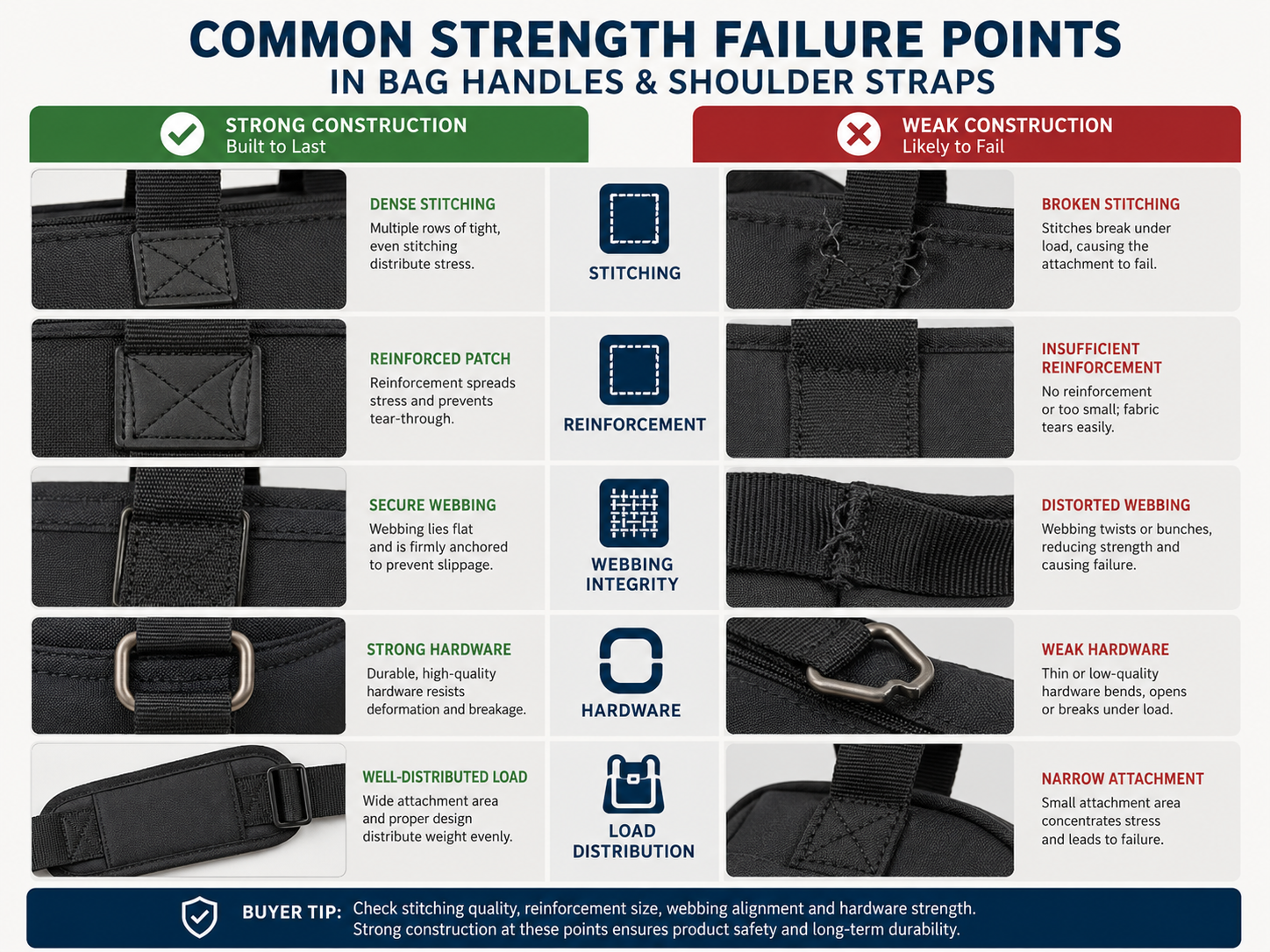
Handles and shoulder straps are among the most common failure points in custom bags.
A bag may use strong body fabric but still fail because:
- The webbing is unsuitable for the intended load
- The strap is too narrow
- The attachment area is too small
- Stitching cuts or damages the body fabric
- Reinforcement is missing
- Hardware fails before the webbing
- The test method does not represent actual use
For B2B buyers, strap strength should be evaluated as a complete assembly:
Webbing + stitching + reinforcement + bag body + hardware
Testing only the webbing does not confirm the strength of the finished bag.
Quick Specification Overview
| Area |
Information to Confirm |
| Webbing |
Fiber, width, thickness, weave and elongation |
| Handle dimensions |
Length, drop height and carrying position |
| Attachment |
Stitch pattern, attachment depth and seam allowance |
| Reinforcement |
Backing patch, folded layers or extended webbing |
| Hardware |
Buckle, hook, D-ring and adjuster strength |
| Test method |
Pull direction, load, duration and cycle count |
| Pass criteria |
No rupture, seam opening, excessive stretching or hardware failure |
1. Selecting Bag Webbing
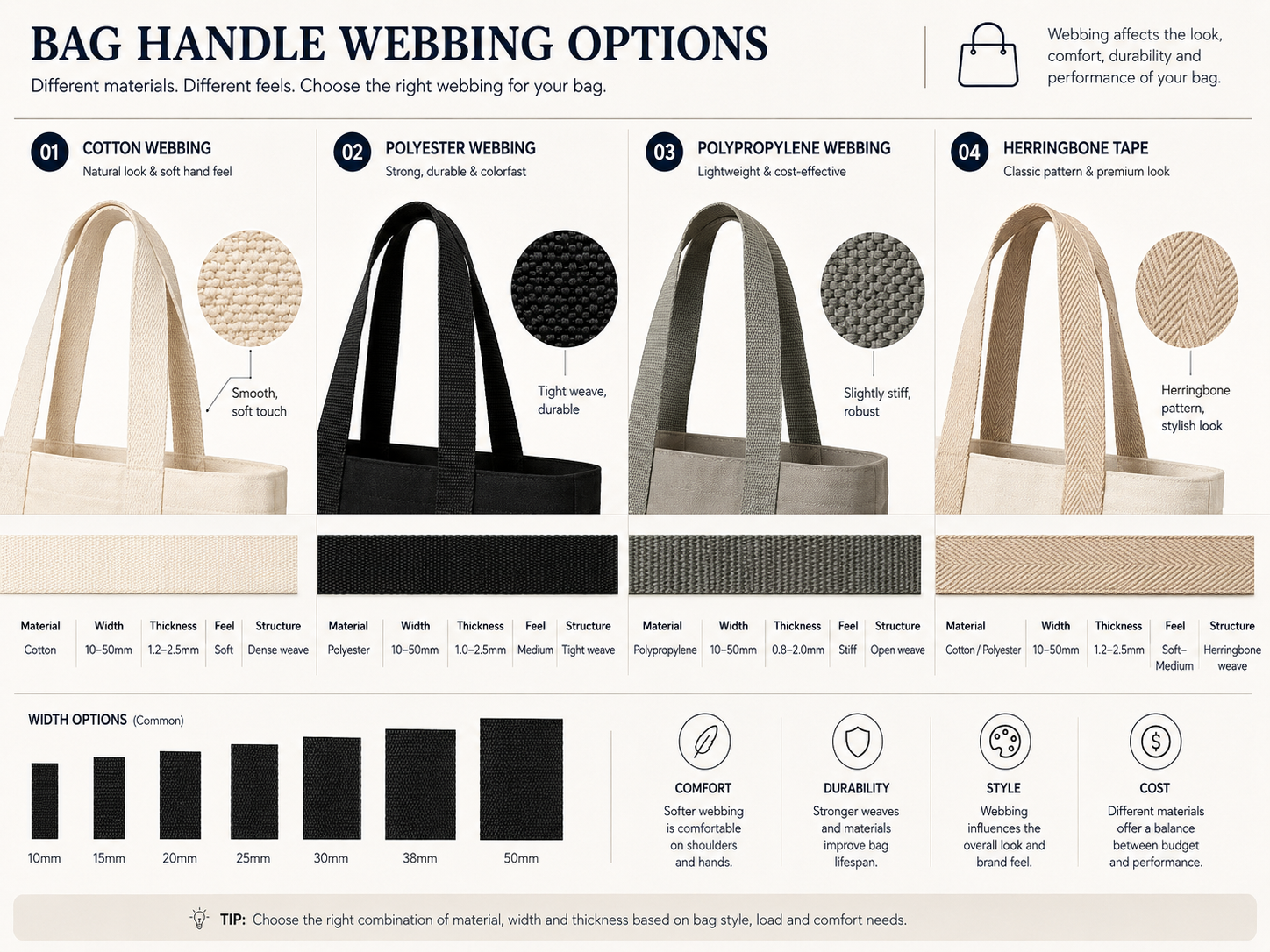
Common webbing materials include:
- Polyester
- Nylon
- Polypropylene
- Cotton
- RPET polyester
- Blended constructions
The fiber name alone does not define strength.
Two polyester webbings can perform differently because of their:
- Yarn size
- Weave density
- Width
- Thickness
- Edge construction
- Surface finish
- Elongation
- Heat treatment
Buyers should approve a physical webbing sample and include measurable specifications in the quotation.
Webbing Width
Wider webbing generally distributes carrying pressure over a larger area and may improve comfort.
Typical applications include:
| Webbing Direction |
Common Use |
| Narrow webbing |
Small pouches, lightweight gift bags and accessory straps |
| Medium-width webbing |
Tote bags, lunch bags and casual shoulder bags |
| Wide webbing |
Duffel bags, backpacks, travel bags and higher-capacity totes |
| Padded strap |
Travel, sports and computer bags carried for longer periods |
Width should be selected according to the expected load and carrying time rather than appearance alone.
Webbing Thickness and Flexibility
Thicker webbing can feel more substantial, but excessive stiffness may:
- Reduce shoulder comfort
- Make adjustment difficult
- Increase folded packing volume
- Create bulky attachment points
Very soft webbing may twist or stretch under load.
The correct specification should balance strength, comfort and production requirements.
2. Handle Length and Strap Geometry
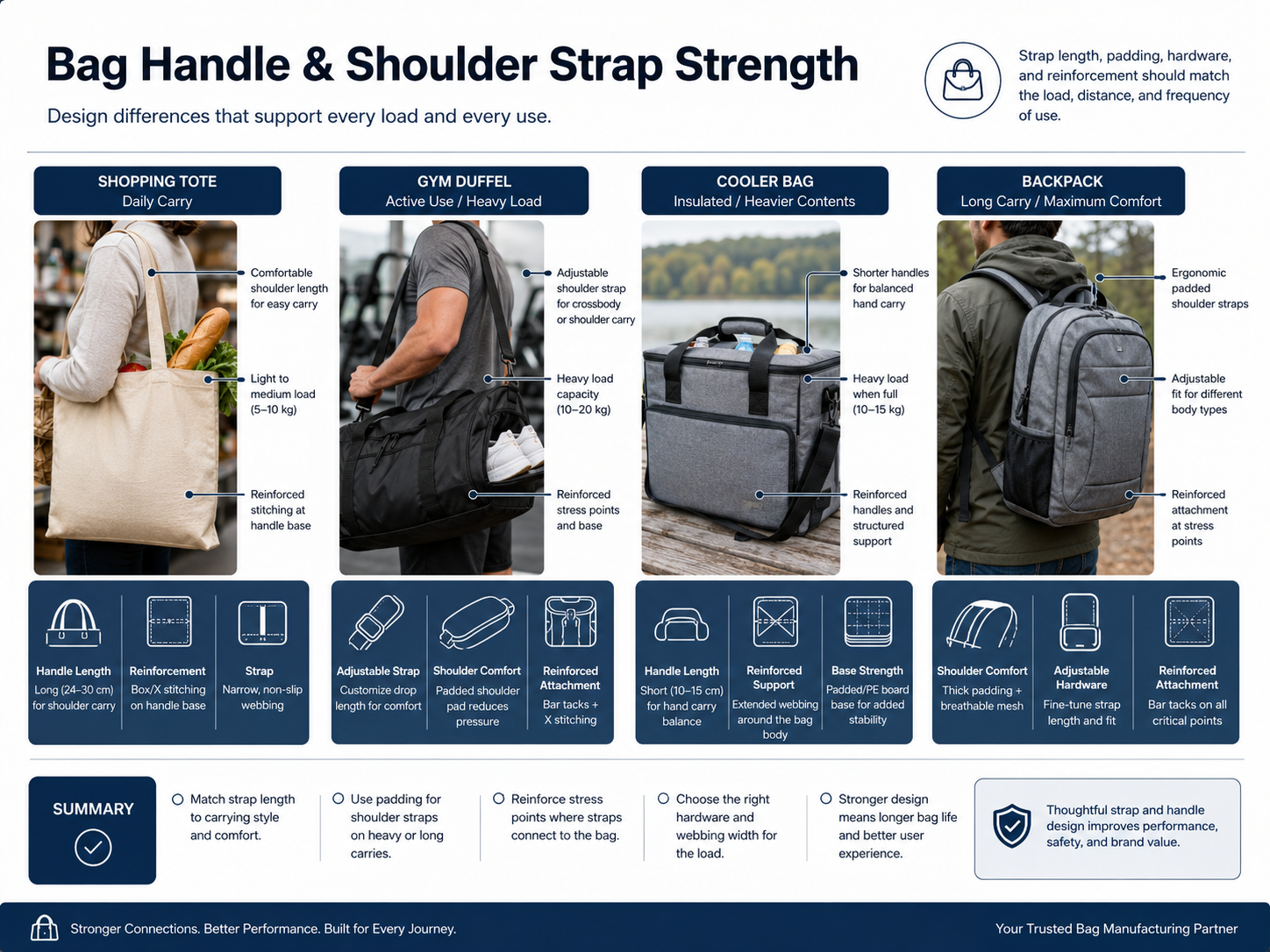
Handle dimensions affect both comfort and structural performance.
Short Carry Handles
Short handles keep the bag close to the hand and generally reduce swinging movement.
They are commonly used for:
- Lunch bags
- Gift bags
- Small cooler bags
- Structured shopping bags
Shoulder Handles
Longer handles allow the bag to be carried over the shoulder but may create more movement at the attachment points.
Buyers should define:
- Total handle length
- Handle drop
- Distance between attachment points
- Intended winter-clothing allowance
- Whether the bag is carried by hand or shoulder
Adjustable Shoulder Straps
Adjustable straps usually include:
- Webbing
- Slider or tri-glide
- Hooks or fixed attachment
- D-rings
- Optional shoulder padding
The specification should state whether the strap length includes the hooks and whether the strap is removable.
Large duffel and cooler bags may require both reinforced top handles and an adjustable shoulder strap. INITIGIFT’s current travel and cooler products use these dual carrying structures, with webbing, attachment and hardware available for customization.
3. Handle Attachment Depth
The strength of a handle depends heavily on how far it extends into the bag body.
A short attachment concentrates the load in a small area.
A longer attachment can distribute the force across more fabric and stitching.
Possible constructions include:
- Handle sewn into the upper hem
- Webbing extending down the front and back panels
- Webbing inserted into a side seam
- Full-length webbing running under the bag bottom
- Internal reinforcement patches behind the attachment
For higher-load bags, extending the webbing further down the body can be more effective than simply increasing stitch density around a small attachment area.
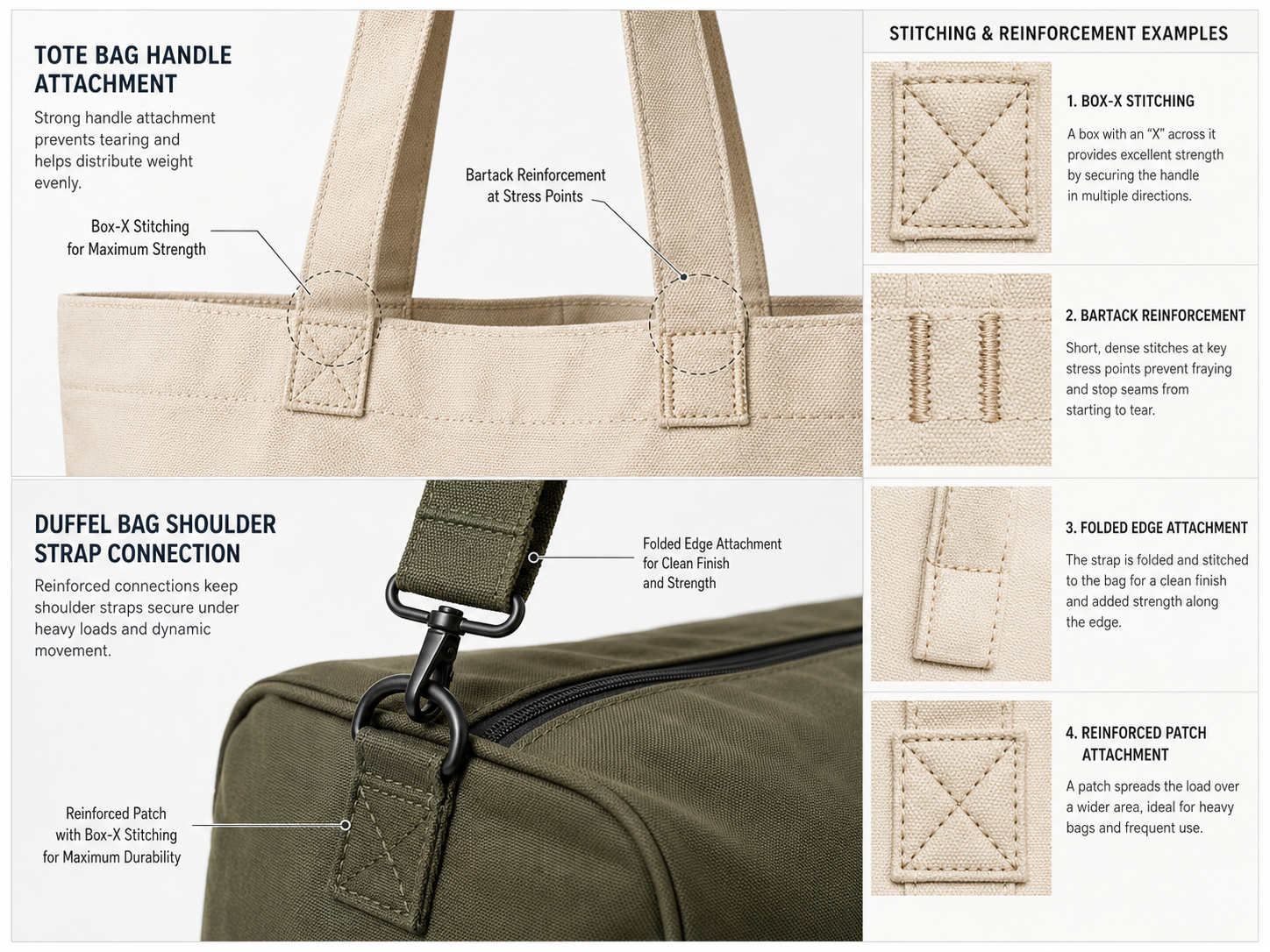
4. Common Stitching Structures
No single stitch pattern is best for every bag.
The correct construction depends on:
- Body material
- Webbing type
- Target load
- Bag size
- Number of fabric layers
- Available sewing equipment
Multiple Straight Stitch Rows
Parallel stitch rows are common for tote handles and simple webbing attachments.
Advantages include:
- Efficient production
- Easy visual inspection
- Suitable load distribution when the attachment area is long enough
The rows should not be placed too close to the material edge.
Box Stitching
A rectangular stitch pattern provides attachment around the perimeter of the webbing area.
It is commonly used for:
- Tote handles
- Shoulder-strap tabs
- Webbing loops
- D-ring attachments
Box-and-Cross Stitching
A diagonal cross is added inside the rectangular pattern.
This increases the amount of stitching across the attachment area, but it should not automatically be assumed to be stronger in every material.
On lightweight or perforation-sensitive materials, excessive needle holes can weaken the body panel.
Bartack Reinforcement
Bartacks use dense stitching over a short distance.
They are often applied at:
- Strap ends
- Pocket corners
- Handle connection points
- Webbing loops
- Zipper ends
Bartacks should reinforce an appropriate base construction rather than replace sufficient attachment depth and seam allowance.
ASTM D1683/D1683M identifies sewing thread, stitch type, seam type and stitch density as important seam-engineering variables. It also recognizes that failure may occur through fabric rupture, thread rupture or seam slippage.
5. Reinforcement Behind the Strap
Strong webbing can tear through a weak bag panel.
Reinforcement may be required when the bag uses:
- Lightweight fabric
- Coated fabric
- Non-woven material
- Mesh
- PVC or TPU film
- Quilted panels
- High-load shoulder straps
Possible reinforcement materials include:
- Additional body-fabric layers
- Woven backing patches
- Internal webbing
- Non-woven reinforcement
- Flexible plastic sheets
- Foam-backed panels
The reinforcement should be large enough to distribute force beyond the immediate stitch line.
It should not create an excessively rigid edge that causes the surrounding fabric to tear.
6. Body Material Affects Strap Strength
The same webbing and stitch pattern can produce different results on different materials.
Woven materials can provide good support for sewing, but loose weaves may experience yarn movement or seam slippage.
Performance depends on fabric weight, coating, weave and reinforcement. Lightweight coated fabrics may require backing patches around strap connections.
Non-woven PP can tear around concentrated stitch holes. Reinforced sewn attachments or properly designed ultrasonic structures may be required according to the load.
Film materials can stretch or tear around stitching. Webbing handles and reinforced attachment patches are generally more practical than narrow handles made only from flexible film for higher-load products. INITIGIFT’s transparent PVC tote uses webbing handles and offers reinforced handle-patch options.
The outer fabric, padding and lining may compress differently during sewing. The strap should normally connect to a structural layer rather than only the soft outer material.
7. Hardware Is Part of the Strength System
For detachable or adjustable shoulder straps, the complete load path may include:
- Shoulder webbing
- Slider
- Swivel hook
- D-ring
- D-ring webbing tab
- Bag-body reinforcement
Failure can occur at any one of these points.
Hardware inspection should cover:
- Cracking
- Deformation
- Hook opening
- Slider movement
- Surface corrosion
- Sharp edges
- Poor closure
- Webbing slipping through the adjuster
A high-strength strap does not compensate for an undersized plastic hook or weak D-ring attachment.
8. Component Testing vs Finished-Bag Testing
Bag-strength evaluation should be divided into different levels.
Webbing Tensile Test
This measures the force required to stretch or break the webbing itself.
It is useful for comparing strap materials, but it does not evaluate:
- Stitching
- Hardware
- Reinforcement
- Body fabric
- Finished-bag balance
Seam Strength Test
A seam-strength test applies force to a sewn assembly.
ISO 13935-2:2026 specifies a grab method for determining the maximum force of a sewn seam when force is applied perpendicular to the seam. Its scope is mainly woven textile fabrics and straight seams; it is not normally applicable to several other structures, including nonwovens and coated fabrics.
ASTM D1683/D1683M similarly evaluates sewn-seam failure in woven fabrics. The standard also states that laboratory seam results do not by themselves predict actual wear performance.
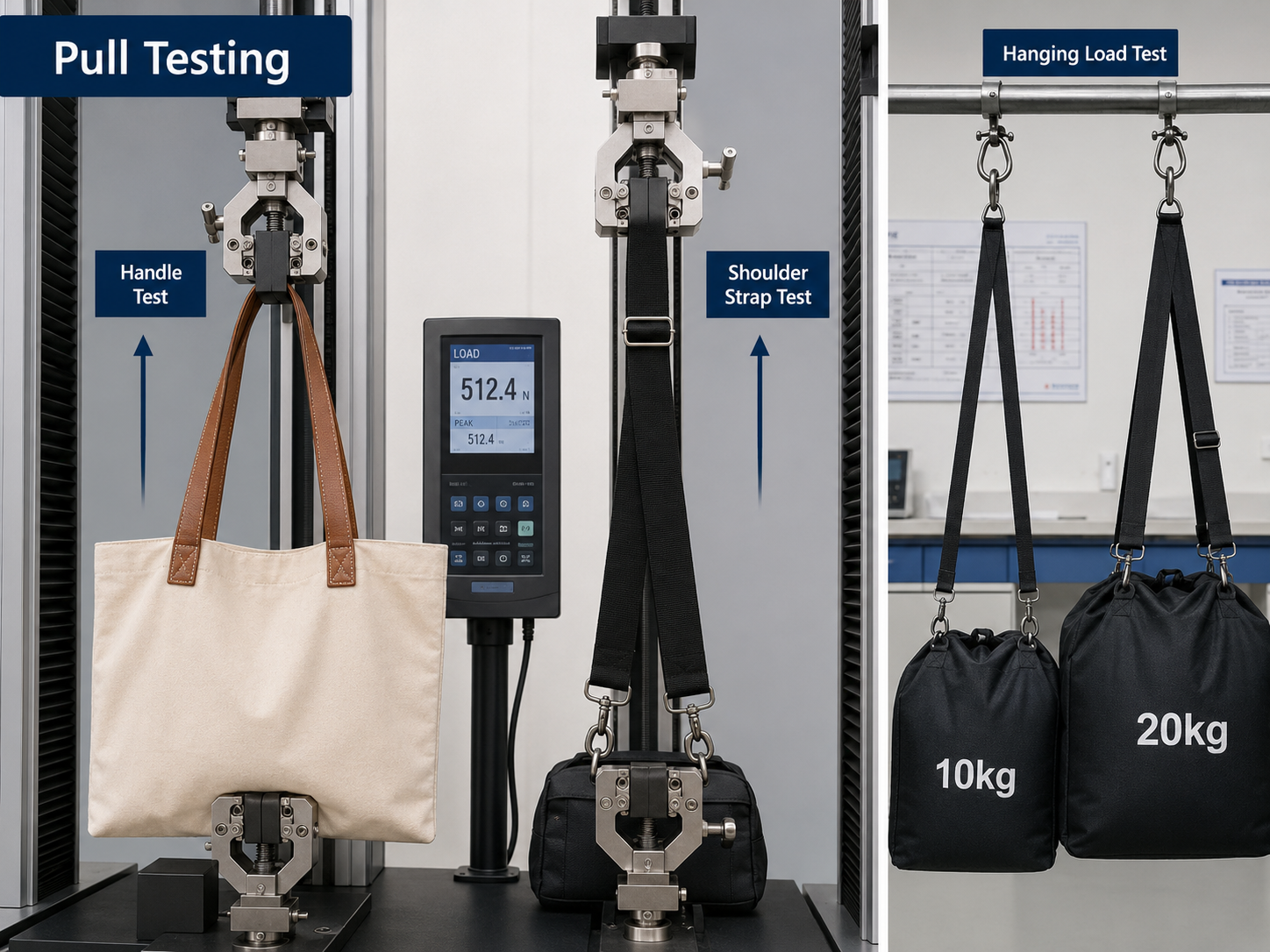
Handle Pull Test
A handle pull test evaluates the complete attachment assembly.
The test fixture pulls the handle away from the bag body and can identify:
- Stitch rupture
- Webbing breakage
- Body-fabric tearing
- Seam slippage
- Reinforcement separation
- Hardware deformation
Finished-Bag Load Test
A complete bag is packed with a defined load and lifted or suspended.
This evaluates how the handles, seams, bottom and bag body work together.
9. Static and Repeated Pull Testing
Static Load Test
A defined weight is placed inside the bag for a fixed period.
The test should state:
- Load weight
- Load distribution
- Suspension method
- Test duration
- Bag orientation
- Pass criteria
After testing, inspect for:
- Broken stitching
- Fabric tearing
- Handle elongation
- Seam opening
- Hardware movement
- Permanent deformation
Repeated Lifting Test
The bag is lifted and lowered repeatedly with a defined load.
This can reveal gradual problems such as:
- Stitch loosening
- Webbing movement
- Needle-hole enlargement
- Progressive seam slippage
- Handle stretching
- Hardware fatigue
Directional Pull Test
Shoulder straps may experience forces in several directions.
Testing may include:
- Vertical pull
- Angled pull
- Outward pull
- Individual attachment-point pull
- Combined two-handle pull
The test direction should reflect how the bag will actually be carried.
Example Pull-Test Specification
| Test Item |
Specification to Define |
| Test sample |
Finished production-equivalent bag |
| Load |
Based on intended working contents |
| Static duration |
Agreed by buyer and supplier |
| Repeated cycles |
Agreed according to use frequency |
| Pull direction |
Vertical, angled or perpendicular |
| Test speed |
Controlled and documented |
| Inspection |
Webbing, stitches, fabric, reinforcement and hardware |
| Pass criteria |
No rupture, opening, excessive elongation or functional failure |
A claim such as “the bag holds 15 kg” is incomplete unless the test conditions are documented.
Holding 15 kg once does not prove that the bag is suitable for repeated use at that load.
Recommended Construction by Bag Type
| Bag Type |
Main Strap Requirement |
| Promotional tote |
Sufficient attachment depth and basic carrying test |
| Grocery bag |
Wide handles, reinforced attachment and repeated lifting |
| Travel duffel |
Reinforced top handles, shoulder strap and hardware testing |
| Backpack |
Padded shoulder straps and reinforced upper connection points |
| Cooler bag |
Webbing handles suitable for concentrated food and bottle weight |
| Laptop bag |
Shoulder pad, strong hooks and reinforced side attachments |
| Large storage bag |
Extended webbing and reinforced side or bottom construction |
School backpacks require particular attention at the upper shoulder-strap connections, where reinforcement patches, webbing extension, stitch density and padding may be adjusted according to the intended contents.
Buyer Specification Checklist
A practical handle and shoulder-strap specification should include:
- Webbing fiber
- Webbing width
- Webbing thickness
- Webbing color
- Handle length and drop
- Adjustable strap range
- Shoulder-pad dimensions
- Hook and buckle material
- Attachment depth
- Stitch pattern
- Stitch density
- Thread specification
- Reinforcement material
- Target working load
- Static-load requirement
- Repeated-lifting requirement
- Pass and fail criteria
The approved production sample should use the same body fabric, webbing, thread, hardware and reinforcement as bulk production.
Common Buyer Mistakes
Selecting Straps Only by Width
Width affects comfort and load distribution, but webbing construction and attachment strength remain essential.
Testing the Webbing but Not the Attachment
The finished bag often fails at the stitch line or body fabric before the webbing breaks.
Adding More Stitches Without Considering the Material
Excessive needle holes can weaken lightweight, coated or non-woven materials.
Ignoring Hardware
Hooks, adjusters and D-rings are part of the load path.
Using a One-Time Carrying Demonstration
A single lift does not represent repeated use.
Stating a Load Capacity Without Test Conditions
The claimed weight should be linked to a defined load, duration, direction and cycle count.

How INITI Supports Handle and Strap Development
INITI develops custom handles and shoulder straps for tote bags, backpacks, cooler bags, travel bags, PVC bags and other functional bag projects.
Available customization can include:
- Cotton, polyester, PP and RPET webbing
- Handle width and length
- Fixed or adjustable straps
- Detachable shoulder straps
- Shoulder padding
- Plastic or metal hardware
- Attachment depth
- Reinforcement patches
- Box, cross and bartack stitching
- Static and repeated load testing
- Production inspection
The final construction should be developed around the bag dimensions, body material, intended contents and target working load.
FAQ
Is wider webbing always stronger?
Not necessarily. Width can improve pressure distribution, but strength also depends on the yarn, weave, thickness, stitching and attachment structure.
Is box-and-cross stitching always the strongest option?
No. It is widely used, but performance depends on the body material and attachment area. Excessive stitching may damage lightweight materials.
Should handle strength be tested separately from the bag?
Component testing is useful, but the finished bag must also be tested because the weakest point may be the body fabric, seam, reinforcement or hardware.
What is the difference between a pull test and a load test?
A pull test applies controlled force to a handle or attachment. A load test places weight inside the completed bag and evaluates the whole structure.
How should a bag’s load capacity be stated?
The claim should identify the tested load and relevant conditions, including duration or repeated cycles. Avoid making a capacity claim based only on one manual lift.
Conclusion
Bag handle strength is determined by the complete load path, not by webbing alone.
Buyers should evaluate:
- Webbing construction
- Strap dimensions
- Attachment depth
- Stitch pattern
- Body-fabric strength
- Reinforcement
- Hardware
- Finished-product testing
The most reliable specification combines material requirements with a clearly defined pull or load test.
Inquiry Support
To review a custom handle or shoulder-strap structure, provide:
- Bag type and dimensions
- Estimated quantity
- Intended contents and target load
- Preferred webbing material
- Handle or strap dimensions
- Required colors
- Hardware requirements
- Packaging requirements
If you have not finalized all details, you can first send your intended use and target quantity, and we can recommend a suitable specification.
Related Products
Related Blog Articles


 Hot News