Custom Suit Cover Bags for Hotels & Dry Cleaning
When a hotel returns a freshly pressed suit to a guest, the garment should be clean, correctly identified and ready to wear. A suitable suit cover helps protect the finished clothing during handling and delivery while presenting the hotel's service professionally.
Dry cleaning businesses face similar requirements, but their daily volume and packaging costs can be very different. A basic protective cover may be sufficient for routine orders, while premium garment-care services may benefit from branded, reusable suit bags.
For hotels and dry cleaners, the right garment bag depends on where it will be used, who handles it, whether it needs to be returned and what garments it must accommodate.
Below are practical suit cover solutions for different hospitality and garment-care operations, with existing INITI product designs that can be adapted for custom orders.
1. Why Hotels and Dry Cleaners Need Suit Covers
Suit covers are used for more than keeping dust away from clothing. In a professional garment-care operation, they can support several activities.
| Business Requirement |
Why It Matters |
What the Suit Cover Should Do |
| Guest laundry return |
Freshly pressed suits need protection during delivery |
Cover the garment and support neat handover |
| Correct garment identification |
Orders must be matched to the right guest or customer |
Accommodate a removable ID label or ticket |
| VIP service presentation |
Packaging contributes to the perceived service quality |
Provide a clean, branded appearance |
| Uniform organization |
Departments, sizes and sets may be stored together |
Support identification and suitable garment capacity |
| Premium dry cleaning |
Selected customers may value a reusable cover |
Combine clothing protection with convenient handling |
| Repeat use and cost control |
Purchasing costs accumulate across orders and properties |
Match durability and replacement needs to actual use |
The first decision is whether the cover is a temporary consumable, a hotel-owned reusable item or a bag the customer is allowed to keep. These applications require different designs and cost assumptions.
2. Suit Cover Solutions for Hotel Operations
Hotel garment-care operations are not limited to one type of guest or one type of clothing. The following four scenarios require different solutions.
A. Guest Laundry and Valet Return: A Clean, Practical Cover
The situation
A guest sends a business suit or jacket for laundry, dry cleaning or pressing. Once finished, the clothing needs to be checked, identified and returned in good condition.
Common problems
Staff may struggle with covers that are too short, difficult to zip or incompatible with the hotel's hangers. Garment labels can become separated from orders, and handling may expose freshly pressed clothing to dust or contact with surrounding surfaces.
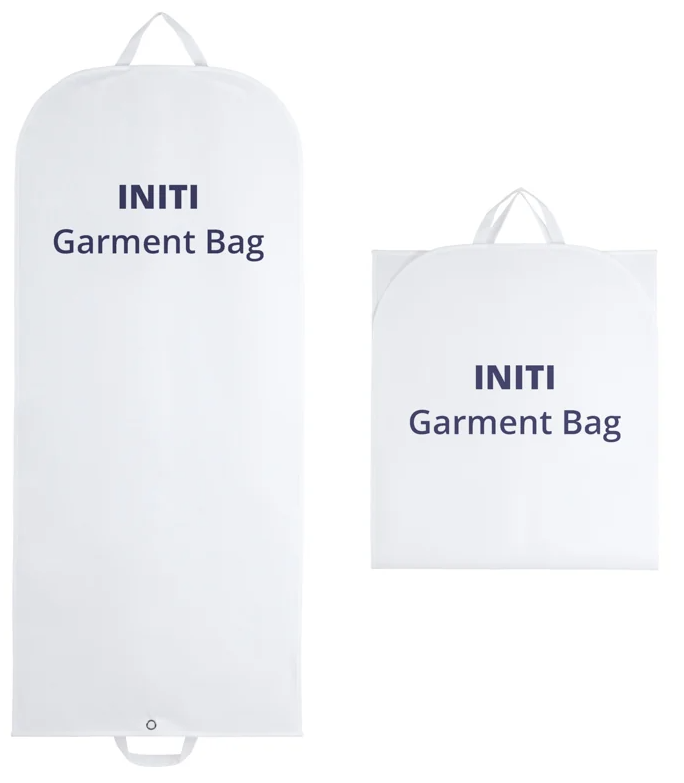
Recommended INITI product: Custom Non-Woven Garment Bag
This existing design has an approximate size of 60 × 140 cm, a full-length zipper and handle loops at the top and bottom.
Why this style fits
Its straightforward hanging structure is suitable as a starting point for routine suit and jacket protection. The large fabric panel also provides space for discreet hotel branding.
For an OEM hotel program, buyers can consider:
Custom dimensions based on the property's garments and hangers
A hotel logo or property label
An optional removable service-ticket holder
Suitable reinforcement around the hanger opening
A folding and carrying arrangement if required by the delivery workflow
The hotel should confirm whether the covers remain within its operations or are given to guests. This determines how much to invest in durability and branding.
The hotel guest laundry training guidance published through TESDA emphasizes checking the room number and delivering garments according to property procedures. Packaging should support that process, not replace order verification.
B. VIP and Executive Guest Service: A Cover Guests Can Carry
The situation
A premium hotel or serviced residence may provide garment handling for business travelers, wedding guests or guests attending formal events.
Some properties may wish to supply a garment bag that customers can carry between the hotel, event venue and home.
Common problems
A simple hanging dust cover does not necessarily provide convenient carrying handles. When a long suit cover is folded without suitable support, the hanger or clothing may shift and create unwanted creasing.
Recommended INITI product: Custom Foldable Canvas Garment Bag
The existing reference design measures approximately 56 × 180 × 8 cm and features a full-length zipper, carrying handles, a bottom handle loop and a foldable structure.
Why this style fits
The combination of full-length coverage and folding capability makes it more suitable for projects where the garment bag itself is part of the guest's carrying experience.
Potential customizations include a subtle logo, fabric color, garment length and optional internal hanger-retention features.
This is not necessary for every hotel laundry order. It makes more sense when the property deliberately offers a higher-service garment presentation or a take-home accessory.
C. Hotel Uniform Management: Identify Garments by Department and Size
The situation
Hotel departments may maintain multiple uniforms for front desk, concierge, restaurant, housekeeping and other staff.
Uniforms may be stored, issued, collected and returned through an internal laundry process or an outsourced service.
Common problems
Similar garments can be difficult to distinguish, while thicker jackets or multiple uniform pieces may not fit well inside a flat cover. Frequent handling also requires convenient access.
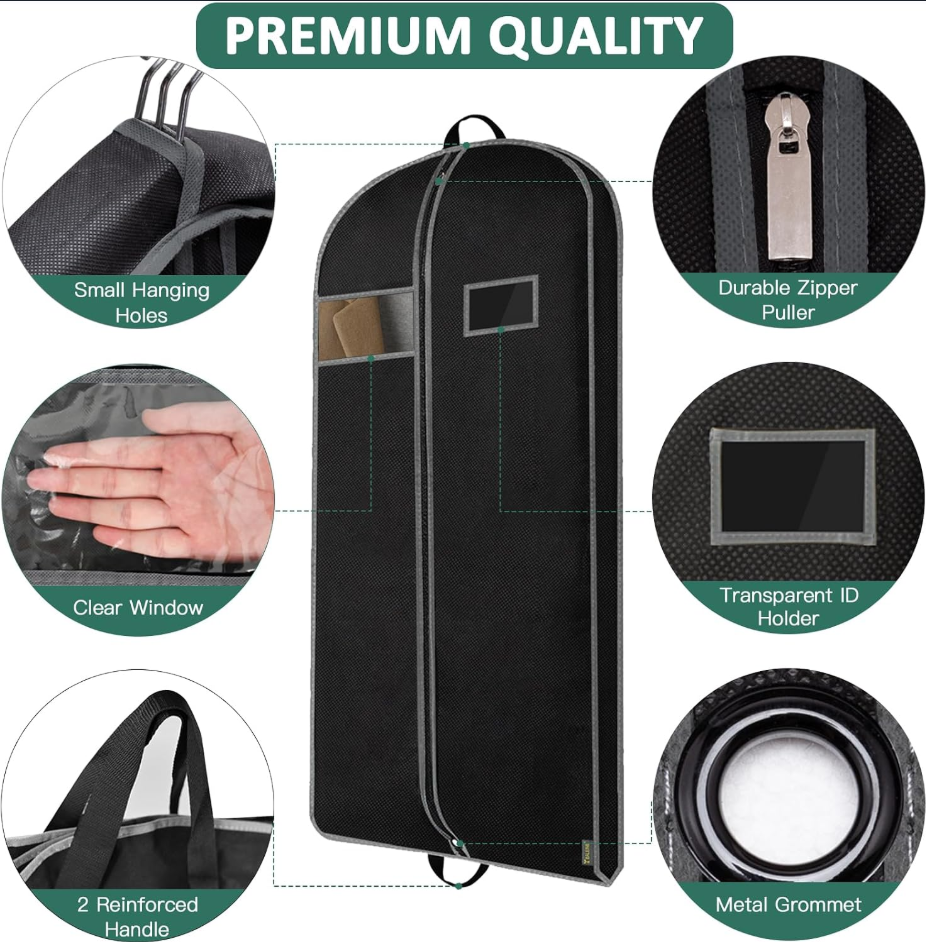
Recommended INITI product: Polyester Gusseted Garment Bag
This polyester garment cover offers approximately 4 inches of side gusset, existing 43-, 54- and 60-inch length options, a full-length zipper, a clear viewing window, an ID holder and reinforced handles.
Why this style fits
The side gusset provides additional internal space, while the identification features can help staff distinguish garment sets or inventory references.
A hotel can consider custom labels or coded inserts indicating department, garment size or internal inventory number.
The final capacity should be confirmed using actual uniforms and hangers. A wider cover does not automatically support a fixed number of garments.
D. Long-Stay Suites and Wardrobe Organization: See What's Inside
The situation
Serviced apartments, long-stay properties or hospitality programs offering wardrobe organization may need to store several garments together.
Common problems
Staff or guests may have difficulty identifying clothing inside opaque covers. Repeatedly opening multiple bags adds handling, while a flat cover may not accommodate thicker garments.
Recommended INITI product: Breathable Clear-Front Multi-Garment Cover
This design combines a transparent PEVA or PVC front, a non-woven back, a full-length zipper and approximately 4 inches of side gusset.
Why this style fits
The clear panel allows garments to be identified without opening the cover, and the expanded structure can accommodate multiple items depending on clothing thickness.
For sensitive fabrics, the transparent film and any direct-contact surfaces should be assessed for material compatibility under the intended storage conditions.
3. Suit Cover Solutions for Dry Cleaning Businesses
Dry cleaning businesses should distinguish between the packaging needed for daily high-volume orders and the packaging used for premium services.
Routine Dry Cleaning: Keep the Process Efficient
For routine garment handover, many dry cleaners use lightweight protective covers, including roll-fed plastic film.
These products are designed for rapid dispensing and controlled consumable costs. They are different from sewn, zippered garment bags.
Recommended approach: If a business only needs inexpensive roll-fed protective film, source that specific consumable format rather than assuming a custom textile suit cover is a direct substitute.
INITI's existing garment bag range is more relevant to projects requiring custom sewn covers, branding or additional structure.
Premium Dry Cleaning and Membership Programs
Some dry cleaners provide additional garment-care or delivery services for suits, formalwear, coats and business clothing.
Common problems
Customers may carry the finished garments home, store them for later use or bring them back for repeat cleaning. A basic temporary cover may not suit the desired customer experience.
Recommended INITI products:
Custom Non-Woven Garment Bag — A relatively simple branded hanging-cover starting point for premium handover.
Polyester Gusseted Garment Bag — A more substantial option where extra depth, handles and an ID holder are useful.
Why these styles fit
They allow the business to develop a consistent, branded garment presentation and choose appropriate identification, carrying and storage features.
For collection-and-delivery or membership projects, confirm whether the cover belongs to the customer or circulates back through the business. The packaging and return process should be designed accordingly.
4. Cost per Use: Disposable vs. Reusable Suit Covers
A branded reusable suit cover generally involves a different upfront cost from lightweight disposable packaging.
The relevant question is not simply which unit costs less, but how each format is used and what the complete operating cost looks like.
| Consideration |
Disposable Protective Cover |
Reusable Suit Cover |
| Purchasing model |
Repeated consumable purchases |
Initial purchase and replacement stock |
| Typical handling |
Fast covering and handover |
May require closing, sorting and return |
| Branding |
Depends on the available film specification |
Fabric printing, labels or other branding |
| Repeated use |
Usually not part of the operating model |
Possible if the construction and workflow support it |
| Extra operating costs |
Replenishment and disposal |
Cleaning, handling, loss and replacement where applicable |
| Best fit |
High-volume routine orders |
Selected hotel programs or premium garment-care services |
How to Calculate Cost per Use
For a cover that remains in a hotel's or dry cleaner's controlled reusable inventory:
Cost per Use = (Purchase Cost + Applicable Cleaning, Handling and Replacement Costs) ÷ Actual Completed Uses
Use real operating data rather than assuming a fixed number of cycles.
A cover that is given to a guest and never returned should be evaluated as a per-handover packaging cost, not as a 20- or 30-cycle reusable asset for the hotel.
In practice, hotels may benefit from offering different packaging levels for routine laundry, VIP services and staff uniforms instead of adopting one expensive specification for every garment.
5. Recommended INITI Suit Cover Configurations
Hotels and dry cleaning companies can use the following configurations as starting points for OEM development.
| Recommended Configuration |
Main Application |
Existing Product Reference |
Custom Features to Consider |
| Hotel Guest Valet Cover |
Routine guest suit return |
Custom Non-Woven Garment Bag |
Hotel logo, size adjustment, removable ticket holder |
| VIP Foldable Garment Carrier |
Executive guests and event clothing |
Custom Foldable Canvas Garment Bag |
Logo, folding arrangement, optional hanger retention |
| Hotel Uniform Organizer |
Department and employee uniform management |
Polyester Gusseted Garment Bag |
Coded ID labels, size variations, hanger fit |
| Clear-Front Wardrobe Cover |
Long-stay wardrobe and multiple garments |
Breathable Clear-Front Multi-Garment Cover |
Window material, gusset depth, length |
| Premium Dry Cleaning Cover |
Membership and higher-service garment handover |
Non-Woven or Polyester Garment Bag |
Brand print, identification, handle specification |
These are recommended configurations, not fixed products or claimed hotel-industry standards. The final details should be defined through the buyer's operating needs and approved samples.
Hotel-Specific Details to Confirm
Hanger compatibility: Some hotels use conventional hooks, while others have ball-top security hangers or captive-ring systems. The cover opening must be checked against the property's actual hanger hardware.
Garment delivery and floor clearance: When a folded carrying format is needed, confirm that the garment remains supported and clear of floors and trolley wheels. A bottom handle loop can be useful, but suitability must be checked on a loaded sample.
Guest identification: Use an identification method compatible with the hotel's existing service tracking process. Avoid permanently printing personal guest details on covers intended for reuse.
Cleaning and reuse: If the cover will be cleaned between uses, the approved cleaning method and the durability of the fabric, print and hardware must be established before production.
6. What to Confirm Before Bulk Ordering
A hotel or dry cleaning buyer does not need to start with a complex technical specification. Begin with the actual use case.
| Purchasing Question |
Information to Confirm |
| Where will the cover be used? |
Guest return, VIP program, uniforms, wardrobe storage or dry cleaning |
| Which garments must it fit? |
Suit, jacket, coat, dress, uniform set and actual dimensions |
| What hanger system is used? |
Standard hook, security hanger or other hardware |
| Is the cover disposable, given away or reused? |
Ownership, cleaning and replacement plan |
| Is garment identification required? |
Removable ticket, ID pocket or coded label |
| Does the cover need carrying features? |
Handles, folding or internal hanger retention |
| What branding is needed? |
Logo, color and label placement |
| What quantity is required? |
Pieces by property, size, design or color |
Before mass production, test a finished sample with actual garments and hangers. Check the zipper, seams, handles, identification features and any folded carrying format in the intended workflow.
For specialized construction details, refer to Garment Bag Structure Explained: Window, Zipper, and Hanger Design. For broader OEM specifications, see Custom Garment Bags for Clothing Brands: OEM Guide.
INITI custom garment bag orders start from 500 pieces. Separate sizes, materials and property-specific branding may have their own minimum requirements.
Why Choose INITI for Hotel and Dry Cleaning Garment Bags?
Hangzhou INITI Imp&Exp Co., Ltd. has over 16 years of experience in custom bags and packaging, supported by two production facilities and OEM/ODM development capabilities.
Our existing garment bag range includes non-woven hanging covers, foldable canvas garment bags, gusseted polyester covers and clear-front organizers. These designs provide practical development references for hotel suppliers, housekeeping procurement teams, dry cleaning businesses and uniform distributors.
INITI supports custom sizing, material selection, logo application, sample development, quality inspection and export packing. Buyers can review hanger compatibility, garment fit, identification features, branding and packing requirements before bulk production.
Our supplier audit, material certification and quality management experience includes SEDEX, Disney-related requirements, GRS, Higg assessments and ISO 9001. Relevant documentation is reviewed according to the specific product, material and destination market.
FAQ
What type of garment bag is best for hotel guest laundry?
A full-length hanging cover with suitable garment dimensions, easy opening and reliable hanger access is a practical starting point. An optional removable identification pocket can help support the hotel's existing service process.
Are foldable garment bags necessary for every hotel?
No. They are most relevant when guests or staff need to carry garments in a folded format. A simpler hanging cover may be sufficient for routine guest laundry return.
Can suit covers fit hotel anti-theft hangers?
They can be developed around a specific hanger system. Buyers should provide the actual hotel hanger or measurements because security hangers vary in design.
Should dry cleaners use disposable or reusable covers?
Routine high-volume services may favor disposable protective covers. Premium handover, membership or controlled return programs may justify reusable branded covers. Compare actual operating costs and handling requirements.
What is the minimum order quantity for custom hotel suit covers?
INITI custom garment bag orders start from 500 pieces. The final MOQ depends on material, structure, branding and variations.
Inquiry Support
For a hotel, hospitality supply or dry cleaning project, please share the intended application, garment dimensions, hanger type, preferred cover structure, branding artwork, estimated quantity and destination.
If you have an existing cover or hotel hanger sample, photographs and measurements can help confirm the right design.
Email: [email protected]
Related Products
Custom Non-Woven Garment Bag
Custom Foldable Canvas Garment Bag
Polyester Gusseted Garment Bag
Breathable Clear-Front Multi-Garment Cover
Garment Bag
Related Blog Articles
Custom Garment Bags for Clothing Brands: OEM Guide
Garment Bag Structure Explained: Window, Zipper, and Hanger Design
Retail Packaging for Apparel: Garment Bag vs Box vs Dust Cover
Where to Buy Garment Bags




 Hot News