Custom Garment Bags for Clothing Brands: OEM Guide
A garment bag designed for a tailored suit may require a different structure from one intended for bulky winter coats or multiple bridal garments.
For apparel sourcing teams, the most important risks often lie in the construction details: color transfer from bag materials, zipper or hanger contact with delicate fabrics, inadequate garment retention in foldable designs, and creasing caused by unsuitable folding and packing. These issues deserve particular attention when developing covers for wool suits, silk garments, light-colored apparel and premium clothing collections.
This guide explains how to specify garment bag dimensions, materials, protective details, branding, packing and quality requirements before OEM bulk production.
1. Choose the Right Garment Bag Structure
The first decision is whether the garment bag will be used for retail presentation, hanging storage, travel or carrying multiple garments.
| Garment Bag Type |
Main Structure |
Suitable Applications |
| Flat Hanging Garment Cover |
Full-length cover with hanger opening and zipper |
Suits, shirts, jackets, retail clothing |
| Foldable Garment Bag |
Full cover with folding system and handles |
Formalwear, business travel, customer delivery |
| Gusseted Garment Bag |
Expanded side depth |
Coats, bulky garments, multiple clothing items |
| Clear-Front Garment Cover |
Transparent front with fabric or non-woven construction |
Garment identification, wardrobe and inventory storage |
Flat Garment Covers
A basic hanging garment cover is suitable when the main purpose is dust protection, garment organization and branded presentation. Typical components include front and back panels, a hanger opening, zipper closure, edge finishing and optional carrying handles.
INITI's Custom Non-Woven Garment Bag provides a reference size of approximately 60 × 140 cm, with a full-length zipper and top and bottom handle loops. The dimensions and construction can be adjusted for suits, jackets, coats, uniforms and retail garment packaging.
Foldable Garment Bags
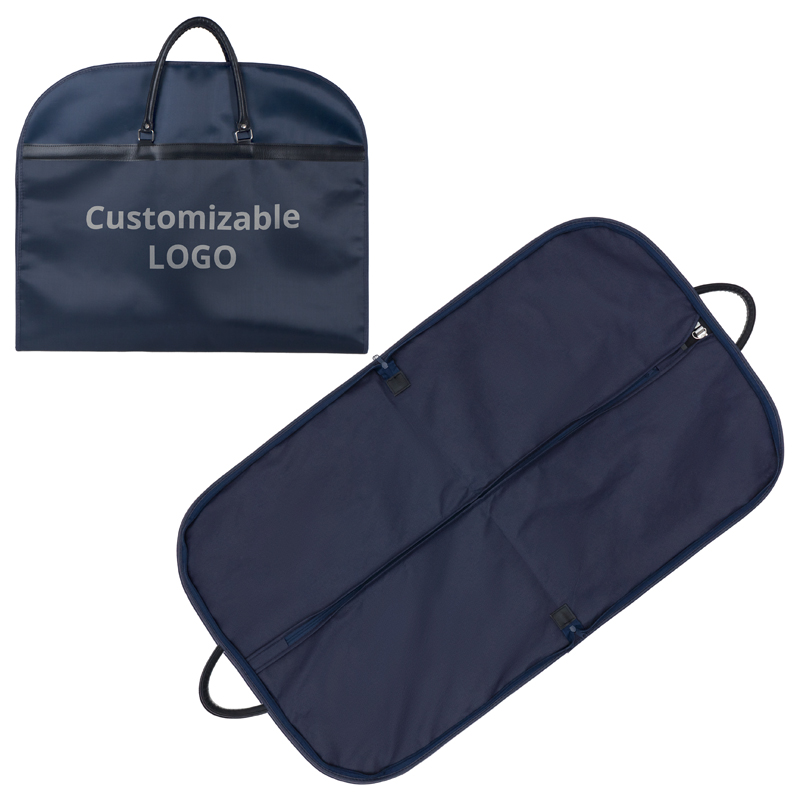
Foldable garment bags combine hanging protection with a more compact carrying format. Depending on the design, structural options include:
- Carry handles and reinforced attachment points
- Folding fasteners or snap closures
- Suitable zipper positioning
- Internal hanger loops or retainers
- Optional webbing tie-down straps
- Additional gusset depth
Internal hanger retention is particularly useful when the bag is folded and carried. Without suitable retention, the hanger or garment may shift downward, causing bunching and reducing the effectiveness of the folding arrangement.
An internal hanger loop helps secure the hanger, while tie-down straps can provide additional garment stabilization where required. These features should be selected according to the garment and carrying requirements rather than treated as standard components.
For example, INITI's Custom Foldable Canvas Garment Bag provides an existing reference construction of approximately 56 × 180 × 8 cm, with a full-length zipper, carrying handles and foldable structure. Additional internal retention features can be evaluated during OEM development.
Gusseted Garment Bags
Side gussets provide additional depth for bulky coats, layered garments or several clothing items.
INITI's Polyester Gusseted Garment Bag offers the following reference specifications:
- Approximately 24-inch width
- Approximately 4-inch gusset
- 43-, 54- and 60-inch length options
- Full-length zipper
- Clear viewing window and ID holder
- Reinforced handles
These are actual product reference specifications, not universal garment bag standards. The correct gusset depth should be determined by the number, thickness and arrangement of garments.
2. Determine the Correct Size and Hanger Fit
A garment bag should be developed around the actual garment and hanger rather than selected only from a standard size chart.
Before sampling, buyers should confirm:
- Garment length when hanging
- Maximum shoulder width
- Garment thickness and volume
- Hanger width and hook shape
- Number of garments per bag
- Required clearance around the clothing
A thick wool coat may require more depth than a lightweight suit of similar length. A bridal gown may require additional space around the skirt even when its shoulder dimensions are relatively narrow.
Hanger Opening Design
The hanger opening should provide sufficient clearance for the intended hook without leaving unnecessary gaps.
Important considerations include opening position, width, reinforcement and compatibility with the selected hanger. Buyers should also consider potential contact between exposed hooks or hardware and delicate garments.
An oversized opening may allow more dust to enter, while an opening that is too tight may create unnecessary pulling or damage during use. The final opening should therefore be tested with the actual hanger and garment.
For a broader explanation of garment bag functions and sizing considerations, see What Is a Garment Bag Used For?.
3. Select Materials for Garment Protection and Presentation
Material selection affects appearance, flexibility, abrasion behavior, moisture response and production cost.
| Material |
Main Characteristics |
Suitable OEM Direction |
| PP Non-Woven |
Lightweight and cost-efficient |
Retail garment covers and standard suit packaging |
| Polyester |
Flexible, available in different constructions |
Reusable covers and travel garment bags |
| Cotton / Canvas |
Textile appearance and hand feel |
Premium apparel packaging and indoor storage |
| PEVA |
Flexible, smooth film material |
Transparent garment covers |
| Mixed-Material Construction |
Combines fabric and transparent panels |
Garment identification and multi-item storage |
PP Non-Woven Garment Bags
PP non-woven is often chosen for economical retail covers. Buyers should specify fabric weight, color, surface finish and seam construction.
For covers used with delicate or light-colored garments, the contact surface should also be evaluated for friction, loose fibers and possible color transfer.
Polyester Garment Bags
Polyester is suitable for garment covers intended for repeated handling, carrying or folding. However, polyester fabrics differ in weave, coating, surface texture and weight.
A stiff or rough contact surface may be unsuitable for certain delicate fabrics, even if the outer material offers good durability.
Cotton and Canvas Covers
Cotton and canvas provide a textile appearance that may suit premium garment presentation. Their moisture absorption and surface characteristics should be considered when choosing them for storage or shipment.
They should not be described as waterproof without suitable construction and supporting testing.
Transparent and Mixed-Material Covers
Transparent panels allow users to identify garments without opening the bag.
INITI's Breathable Clear-Front Multi-Garment Cover combines a transparent PEVA or PVC front panel, a non-woven back and approximately 4-inch side gusset.
For long-term storage, buyers should consider ventilation, storage conditions and the condition of garments before packing.
For a more detailed material comparison, see What's the Difference Between PEVA and Cotton Garment Bags?.
Color Fastness and Fabric Contact
For dark-colored or printed garment covers used with light-colored or delicate apparel, buyers should assess the risk of dye transfer.
Where applicable to the selected material, dry and wet rubbing colorfastness can be evaluated using methods such as ISO 105-X12:2016 or AATCC TM8.
The appropriate test method and acceptance criteria should be agreed according to the bag material, target garment and buyer requirements. Additional material compatibility checks may be needed for prolonged contact or moisture exposure.
For wool, silk, fine knitwear and other sensitive garments, buyers can also consider:
- Smooth, low-abrasion internal contact surfaces
- Protective fabric bindings
- Carefully finished seams
- Separation between exposed hardware and clothing
- Material contact testing with representative garments
A soft-feeling material is not automatically non-abrasive or colorfast. Material selection should be based on actual contact performance rather than appearance alone.
4. OEM Construction Details That Matter
Small structural components can determine whether a garment bag protects clothing effectively or creates an avoidable risk.
Full-Length Zipper and Protective Guard
The zipper should allow convenient access without catching or scraping the garment.
Buyers should review:
- Zipper type and length
- Opening direction
- Zipper tape attachment
- Slider movement
- Reinforcement at zipper ends
- Inner fabric zipper guard or protective flap where required
For delicate suits, silk garments or fine knitwear, a protective fabric flap can reduce direct contact between zipper components and the clothing. Its effectiveness depends on the flap width, position, softness and construction.
During sampling, buyers should insert and remove the actual garment, operate the zipper and check whether any zipper component can snag the fabric.
Hanger Retention and Internal Support
For foldable travel garment bags, internal hanger loops, retainers or straps can help keep the hanger and clothing in position.
A hanger retainer mainly secures the hanger, while a separate tie-down strap may help limit movement of the garment itself. The correct arrangement depends on the folding direction, hanger configuration and garment weight.
Handles and Reinforcement
If the garment bag will be carried rather than only hung, handle construction becomes important.
Possible options include top carrying loops, bottom handles, webbing handles, reinforced attachment points and additional carrying straps.
Handle strength should be evaluated with the garment bag loaded as intended.
Windows and ID Holders
Clear windows and identification holders are useful for clothing retailers, uniform suppliers and garment distribution programs.
They allow staff to identify garments, sizes and inventory references without repeatedly opening the cover. Their positions should avoid interfering with zippers, folding points and reinforcement areas.
5. Branding Options for Clothing Brands
A garment cover can form part of the brand's retail presentation while remaining practical for storage and carrying.
Common customization options include:
- Screen printing
- Heat-transfer printing
- Embroidery on suitable fabrics
- Woven labels
- Printed fabric labels
- Custom zipper pullers
- Branded packaging inserts
Logo Placement
The front panel usually provides a large branding area, but buyers should confirm how the logo appears when the garment bag is hanging, folded for carrying, displayed in retail or packed individually.
For premium apparel brands, restrained logo placement and clean finishing may be more appropriate than large promotional graphics.
Printing and labels should not interfere with zippers, hanger openings, windows or fold lines.
6. Folding, Packing and Export Protection
For garment bags used during export distribution, the complete packing system matters as much as the garment cover itself.
Folding Geometry and Garment Movement
A foldable design should be evaluated with the target clothing inside.
Buyers should check:
- Position of folding points
- Whether the garment shifts or bunches
- Whether hanger retention remains effective
- Pressure around shoulders, sleeves and hems
- Finished packed dimensions
The goal is to reduce unnecessary compression and movement, although no folding construction can guarantee completely wrinkle-free garments under all transport conditions.
Moisture and Shipping Conditions
Garment covers can provide dust protection and help organize clothing, but they should not be relied upon as the only barrier against shipping damage.
For export projects, evaluate the garment condition before packing, outer protective packaging, folding arrangement, moisture control requirements and expected handling conditions.
Mold risk during prolonged storage or sea transport depends on the overall moisture conditions, not only whether the garment cover is made from breathable fabric.
Carton Volume and Packing Consistency
Garment covers with gussets, reinforced handles or folding hardware may occupy more carton space than basic flat garment covers.
For bulk export orders, buyers should evaluate:
- Folded dimensions
- Pieces per carton
- Carton dimensions
- Carton CBM
- Gross weight
- Individual packing method
- Total shipment volume
Compact flat packing can improve container utilization and reduce freight cost per unit, provided excessive compression does not damage the bag structure or affect its intended appearance.
The most relevant measurements are the actual packed carton dimensions and the number of units per carton.
For reference:
Carton CBM = Length (m) × Width (m) × Height (m)
Different transport modes should be evaluated separately:
- FCL sea freight: Container space utilization affects how freight cost is distributed across the shipped units.
- LCL sea freight: Chargeable freight depends on the applicable volume and weight rules.
- Air freight and courier: Volumetric weight may affect the chargeable weight, depending on the carrier.
Individual polybags, vented packaging or other protective packing methods should be selected according to the material, storage conditions and transportation requirements rather than applied as a standard solution.
Buyers should avoid excessive compression or vacuum packing unless the product and packing method have been specifically tested for it.
7. What Affects Custom Garment Bag Manufacturing Cost?
OEM pricing depends on the complete specification rather than material alone.
| Cost Factor |
Main Impact |
| Material Type and Weight |
Fabric cost, appearance and finished weight |
| Bag Length and Width |
Material consumption |
| Gusset Depth |
Additional fabric and assembly |
| Zipper and Hardware |
Component and installation cost |
| Internal Protection |
Guards, bindings, retainers and straps |
| Branding |
Printing, embroidery, labels and accessories |
| Folding Construction |
Reinforcement and assembly complexity |
| Packaging |
Labor, packing materials and shipment volume |
| Quantity |
Setup allocation and production efficiency |
A basic non-woven hanging cover generally requires fewer components than a foldable travel garment bag with reinforced handles, internal retention and additional protection.
However, a higher-cost structure is justified only when those features meet an actual requirement. For bulk orders, buyers should compare quotations based on matching specifications, approved samples and equivalent packing requirements.
8. OEM Specification Checklist
Before requesting a quotation, prepare the following information.
| Specification |
Required Information |
| Garment Type |
Suit, coat, dress, uniform or mixed garments |
| Intended Use |
Retail presentation, storage, travel or distribution |
| Bag Dimensions |
Width × length × gusset |
| Garment Capacity |
Number and approximate thickness of items |
| Material |
Type, weight, color and finish |
| Contact Requirements |
Colorfastness, friction or protective binding |
| Hanger Opening |
Position, size and reinforcement |
| Zipper |
Type, length, opening direction and optional guard |
| Folding Structure |
Fold points, retainers, straps and handles |
| Additional Features |
Viewing window, ID holder and pockets |
| Branding |
Artwork, size, position and method |
| Quantity |
Total order and quantity by variation |
| Packing |
Folding method, inner pack and carton requirements |
The most useful initial documents are garment measurements, reference samples or images, logo artwork and a quantity breakdown by size and color.
9. Sampling and Quality Control Before Bulk Production
A garment bag should be approved with representative clothing and hangers, not only as an empty sample.
Functional Sample Testing
Garment Fit
Does the garment hang naturally without excessive compression at the shoulders, sleeves or hem?
Color Transfer and Surface Contact
Could the garment cover, labels, bindings or hardware transfer color, shed fibers or create unwanted friction? Where required, perform agreed material or contact tests.
Zipper Protection
Does the zipper operate smoothly, and are delicate fabrics separated from exposed zipper components where necessary?
Hanger and Folding Stability
Does the hanger remain correctly positioned when the garment bag is carried or folded? Do garments shift or bunch excessively?
Branding and Appearance
Are logos, labels and windows positioned correctly in both hanging and folded configurations?
Packing Performance
Can the bag be packed using the approved method without excessive distortion or damage to the intended clothing?
Bulk Production Inspection
Inspection criteria should include:
- Material and color consistency
- Finished dimensions and gusset
- Seam strength and edge finishing
- Zipper installation and operation
- Protective flap and hanger retention, where specified
- Handle attachment
- Printing and label placement
- Folding and loaded performance
- Carton quantities and markings
The approved sample, inspection method and acceptance criteria should be documented before production.
10. MOQ and Multi-Size Order Planning
INITI custom garment bag orders start from 500 pieces. Special materials, colors, structural details, printing or hardware may require higher minimum quantities.
For clothing brands requiring several garment bag lengths or colors, it is important to provide a quantity breakdown for each version.
Whether variations can be combined within one order depends on shared materials, fabric color, cutting setup, printing, construction differences and production scheduling.
Using consistent fabric, zipper specifications, labels and packing methods across several styles can simplify manufacturing. However, different garments should not be forced into the same bag size if that compromises fit or protection.
Why Choose INITI for Custom Garment Bags?
Hangzhou INITI Imp&Exp Co., Ltd. has over 16 years of experience in custom bags and packaging, supported by two production facilities and OEM/ODM development capabilities.
Our garment bag range includes non-woven suit covers, foldable canvas garment bags, gusseted polyester covers and clear-front storage bags. These existing constructions provide practical starting points for clothing brands, apparel retailers, uniform suppliers and private-label programs.
INITI supports material selection, custom dimensions, zipper and handle construction, protective details, logo application, sample development, quality inspection and export packing. For multi-size or multi-color orders, specifications and packing requirements can be reviewed before bulk production.
Our supplier audit, material certification and quality management experience includes SEDEX, Disney-related requirements, GRS, Higg assessments and ISO 9001. Applicable documentation and testing are confirmed according to the specific product, material and destination market.
FAQ
Can the 500-piece MOQ be split across different garment bag sizes or colors?
INITI custom garment bag orders start from 500 pieces. Whether different sizes or colors can be combined within one order depends on the materials, construction and production setup. Separate minimum quantities may apply to individual variations, so buyers should provide a quantity breakdown for quotation.
Can garment bags be customized for delicate wool or silk garments?
Yes. Material selection, smooth contact surfaces, protective bindings, zipper guards and other details can be evaluated for delicate clothing. Specific colorfastness or surface-contact testing should be agreed according to the garment and project requirements.
Do foldable garment bags need internal hanger retainers?
Not every design requires them. However, hanger loops, retainers or straps can help reduce garment movement in foldable travel bags. The appropriate structure should be confirmed through loaded sample testing.
Can we add a logo, clear window and protective zipper flap?
Yes. These options can be developed according to the material and structure. Their positions and compatibility should be checked during sampling.
Can a garment bag replace outer shipping packaging?
Not necessarily. Garment covers mainly provide dust protection, organization and branded presentation. Suitable outer packaging may still be required to protect against compression, punctures, moisture exposure and shipping damage.
Conclusion
A successful OEM garment bag specification begins with the clothing it needs to protect.
For apparel buyers, the key decisions include garment dimensions, hanger compatibility, material suitability, colorfastness, low-abrasion contact surfaces, zipper protection, folding stability, gusset depth, branding, packing and sample approval.
Defining these details before production helps reduce the risk of poor garment fit, avoidable contact damage, unnecessary material costs, inefficient shipping volume and inconsistent bulk quality.
Inquiry Support
For a custom garment bag project, please provide:
- Garment type and reference dimensions
- Intended use
- Preferred bag size or reference sample
- Material and color requirements
- Hanger and zipper specifications
- Protective lining, flap or retention requirements
- Logo artwork
- Estimated quantity by size and color
- Packing requirements
- Destination market and delivery requirements
If the design is not finalized, you can first share your garment type, intended use and target quantity so we can recommend a suitable structure.
Email [email protected] to discuss custom garment bag development, request samples or obtain a bulk quotation.
Related Products
Custom Non-Woven Garment Bag
Custom Foldable Canvas Garment Bag
Polyester Gusseted Garment Bag
Breathable Clear-Front Multi-Garment Cover
Garment Bag
Related Blog Articles
What Is a Garment Bag Used For?
What's the Difference Between PEVA and Cotton Garment Bags?
Garment Bag vs Suitcase: Which Is Better for Clothing Storage and Travel?



 Hot News