D-Cut, W-Cut, Loop-Handle and Box Non-Woven Bags: Which Style Fits Your Order?
When sourcing custom non-woven bags, buyers may encounter several names for similar structures:
D-Cut / Die-Cut Handle / Punch Handle Bag
W-Cut / Vest / T-Shirt Style Bag
Loop-Handle / Soft Loop Non-Woven Bag
Box / 3D Gusseted Non-Woven Bag
These names are useful, but they do not tell the whole story.
A D-cut and loop-handle bag mainly differ in how the bag is carried.
A box bag mainly describes how the body is constructed.
A box-style bag, for example, can still use loop handles.
For a 5,000-piece promotional order or a 100,000-piece supermarket program, the right choice should therefore be based on:
product size + target load + handle structure + gusset + fabric weight + production method + printing + packing
not the bag name alone.
Quick Comparison of Common Non-Woven Bag Styles
| Bag Style |
Common Alternative Names |
Typical Applications |
Main Advantage |
Main Limitation |
| D-Cut |
Die-Cut Handle, Punch Handle |
Promotions, pharmacies, exhibitions, lightweight retail |
Simple and cost-efficient |
Handle area carries concentrated stress |
| W-Cut |
Vest Bag, T-Shirt Style Bag |
Supermarkets, grocery, checkout programs |
Fast loading and practical volume |
Supplier terminology varies |
| Loop Handle |
Soft Loop Handle Bag |
Apparel, boutiques, branded retail, gifts |
Better carrying comfort |
Extra handle attachment adds cost |
| Box Bag |
Gusseted Bag, 3D Non-Woven Bag |
Gift boxes, apparel, retail merchandise |
More usable depth |
More material and folded volume |
Note: Terminology varies between suppliers and regions. For large orders, always confirm the final drawing, dimensions and physical sample instead of relying on the style name alone.
A D-cut non-woven bag uses an opening punched directly into the upper part of the bag body.
You may also see this style described as:
Die-cut handle bag
Punch handle bag
Punch-hole non-woven bag
There is no separate handle sewn or welded onto the body.
That keeps the structure simple.
Where D-Cut Bags Work Well
Common applications include:
For example, a company handing out brochures, samples and a small gift at an exhibition may not need a separate loop handle.
A D-cut bag can provide enough carrying function while keeping the construction simple.
The Main Weak Point Is Around the Handle Opening
Because the handle is cut from the body material itself, the area around the opening carries the load.
The buyer should check:
A higher GSM can help, but increasing GSM alone does not solve a poor handle design.
Example
A D-cut bag that works well for:
brochures + cosmetics samples
should not automatically be assumed suitable for:
several beverage bottles + boxed products.
The finished bag should be tested with representative contents.

A W-cut non-woven bag is commonly associated with integrated-handle shopping bags used in grocery and general retail.
Depending on the supplier and market, similar bags may also be described as:
Non-woven T-shirt bag
Vest bag
Vest carrier bag
W-cut carry bag
These terms can overlap, but they are not always used identically by every factory.
That matters when sending an RFQ.
Instead of writing only:
100,000 pcs W-cut bag
include:
Why This Style Works for Supermarkets
The integrated-handle structure can support quick opening and loading at retail checkout.
Typical contents may include:
If side gussets are included, the bag can also expand more easily around irregular products.
W-Cut Does Not Automatically Mean Higher Load Capacity
It is tempting to say:
W-cut is stronger than D-cut.
That is too simple.
Actual load performance depends on:
A narrow W-cut bag made from lightweight fabric may perform very differently from a larger bag made with a different construction.
For supermarket or retail programs, define the required test load instead of relying on the style name.

A loop-handle non-woven bag uses separate handles attached to the body.
This provides more freedom to customize:
Handle width
Handle length
Hand-carry drop
Shoulder-carry drop
Handle color
Handle material
Loop-handle bags are often used for:
Apparel
Fashion retail
Corporate gifts
Events
Beauty products
Branded merchandise
Why Buyers Choose Loop Handles
Separate handles generally provide a more conventional tote-bag feel.
For example, an apparel store carrying:
Two folded shirts
A sweater
Small accessories
may prefer a loop-handle non-woven shopping bag because the buyer can hold the handles more comfortably than a die-cut opening.
Longer handles can also allow shoulder carrying.
Handle Attachment Becomes the Critical Quality Point
The key question changes from:
Will the die-cut opening tear?
to:
Will the attached handle pull away from the body?
Check:
A heavy fabric does not compensate for poor handle attachment.
For custom loop-handle non-woven bags, approve the finished structure under the intended load.
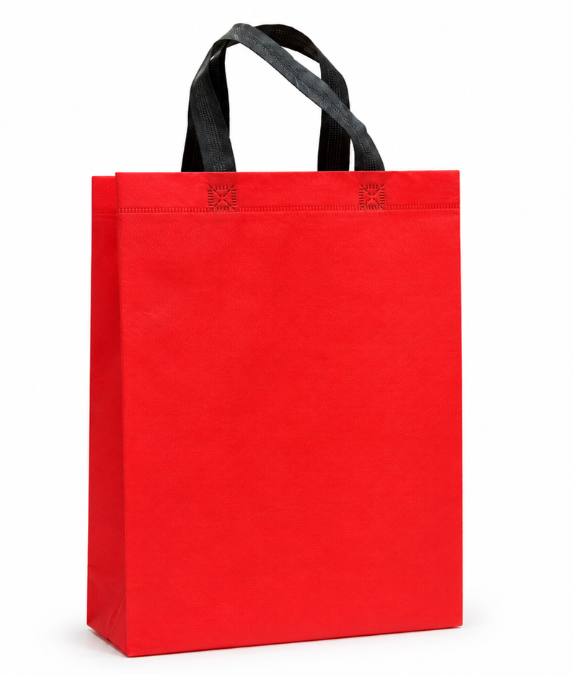
A box non-woven bag describes the bag body rather than one specific handle.
It usually includes:
This gives the bag dedicated depth.
Common applications include:
Gift boxes
Apparel
Shoes
Bakery boxes
Promotional kits
Retail merchandise
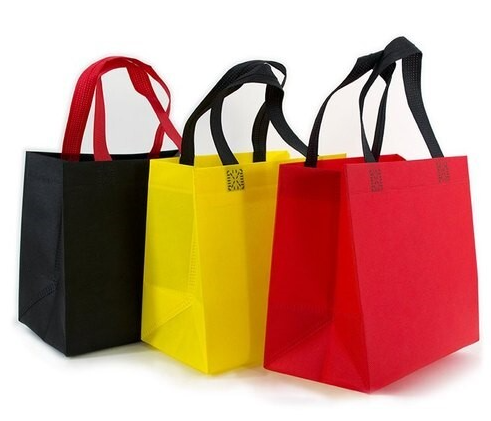
A Box Bag Can Still Use Loop Handles
This is important.
A buyer may order:
loop-handle box non-woven bag
That simply means:
loop handle = carrying structure
and
box / gusseted = body structure
These features can be combined.
Why Gusset Depth Matters
Imagine a gift box that measures:
25 cm wide × 20 cm high × 10 cm deep.
A flat 26 cm-wide non-woven bag may look large enough on paper.
Once the box goes inside, however, its 10 cm depth pulls the front and back panels around the product.
The result may be a distorted bag with a tight opening.
A correctly sized gusset creates dedicated depth and usually provides a cleaner fit.
Which Non-Woven Bag Style Fits Your Order?
| Purchasing Requirement |
Recommended Starting Direction |
| Low-cost promotional giveaway |
D-Cut |
| Exhibition brochures and samples |
D-Cut |
| Pharmacy or lightweight retail |
D-Cut / Vest Style |
| Grocery checkout |
W-Cut / T-Shirt / Vest Style |
| Apparel retail |
Loop Handle |
| Beauty or gift packaging |
Loop Handle |
| Boxed merchandise |
Box / Gusseted Bag |
| Large gift set |
Box + Loop Handle |
| Shoulder carrying |
Long Loop Handle |
| High-volume automatic production |
D-Cut / W-Cut / machine-compatible structures |
| More customized construction |
Cut-and-sewn Loop Handle / Box Bag |
This is a starting point rather than a fixed rule.
The actual contents should determine the final specification.
5. What Load Can a Non-Woven Bag Carry?
This is one of the most common questions buyers ask.
Unfortunately, there is no reliable universal rule such as:
80 GSM D-cut = X kg
100 GSM loop handle = Y kg.
Public supplier claims vary widely because test conditions and construction methods are different.
A more useful approach is to define the required load for your project.
Practical Load Direction by Application
| Bag Type |
Typical Load Direction |
Common Use |
| D-Cut |
Light-duty |
Brochures, samples, pharmacy items |
| W-Cut / Vest |
Light to medium retail load |
Grocery and checkout |
| Loop Handle |
Medium retail load |
Apparel, gifts, merchandise |
| Reinforced Box Bag |
Medium to heavier retail load |
Boxed goods and bulky products |
These are application directions, not guaranteed kg ratings.
How to Specify Load Properly
Instead of asking:
How many kilograms can this bag carry?
define:
For example:
Load the finished bag with the agreed test weight, carry or suspend it under the specified condition, and inspect handles, seams and bottom for tearing or separation.
This gives the factory and buyer the same acceptance standard.
6. GSM: Important, but Not a Finished-Bag Strength Rating
GSM means grams per square meter.
It helps define the weight of the non-woven material.
Increasing GSM generally changes:
Fabric body
Thickness
Material cost
Hand feel
Folded bulk
But the same GSM can perform differently in different bag structures.
A loop-handle bag and a D-cut bag made from similar material can fail at completely different points.
For purchasing, the better sequence is:
application → target load → bag structure → GSM → finished-bag test
rather than:
choose GSM → assume load capacity
7. Fully Automatic Machine-Made vs Cut-and-Sewn Non-Woven Bags
For large-volume orders, this can have a major impact on cost.
Two visually similar non-woven bags may use very different production routes.
Fully Automatic Machine-Made Bags
High-speed non-woven bag machines can integrate several operations into one production line, depending on the bag style.
These production routes are commonly used for:
Main Advantages
High production efficiency
Lower labor input per bag
Better suitability for very large quantities
Consistent repetitive structures
Main Limitation
The design needs to fit the machine's production capability.
The buyer may have less freedom with:
Certain dimensions
Unusual gussets
Special handles
Complex reinforcement
Multi-step structures
This does not mean machine-made bags cannot be customized.
It means the proposed design should be checked against the production equipment before the buyer finalizes the artwork and dimensions.
Cut-and-Sewn Non-Woven Bags
Cut-and-sewn production provides more flexibility.
It can be suitable for:
The trade-off is additional labor and production time.
Why This Matters for Large Buyers
Imagine two buyers both ordering 100,000 bags.
Buyer A needs:
a simple supermarket vest bag.
Buyer B needs:
a gusseted tote with custom long handles and reinforced bottom.
The bags should not automatically be produced through the same production route.
Choosing the correct manufacturing method can influence:
Unit cost
MOQ
Size feasibility
Production capacity
Lead time
Construction options
For large non-woven bag projects, the production route should be discussed before final specifications are frozen.
8. Ultrasonic Bonding vs Sewing
Production route and seam method are related, but they are not the same question.
Ultrasonic Bonding
Ultrasonic joining can be used for many non-woven constructions.
It is often suitable for:
Simple bags
Automated production
High-volume programs
Clean bonded seams
Sewing
Sewing provides more flexibility for:
Reinforced handles
Webbing
Complex gussets
Structural details
Customized construction
Neither method is automatically stronger.
The correct seam method depends on:
Material
Construction
Load
Handle
Bag size
The finished bag should be validated against the actual order requirement.
9. Printing Area Changes with Bag Style
A printed non-woven bag is often also an advertising surface.
Different handles affect how much of the front panel can be used.
D-Cut
The handle opening occupies the upper panel.
Keep important artwork away from the punched area.
W-Cut / Vest / T-Shirt Style
The integrated handles take up more of the upper body.
The main logo normally sits lower on the front panel.
Loop Handle
Separate handles leave a cleaner rectangular branding area.
This can be useful for:
Retail logos
Exhibition graphics
Promotional messages
Box Bag
Front, back and side gussets can all potentially become branding areas.
For retail projects, the side panel may carry:
Website
Campaign message
Product information
Always place the artwork on the final bag drawing rather than reusing artwork from another bag style.
10. Standard vs Laminated Non-Woven Bags
Handle style and surface finish are separate choices.
Standard Non-Woven Bag
Suitable for:
Simple logos
Promotional campaigns
Events
Basic retail packaging
Laminated Non-Woven Bag
A laminated surface can provide:
It can be useful for retail programs where visual presentation matters.
But lamination also affects:
Do not select lamination only because it looks more premium.
Use it when the artwork, application and retail positioning justify it.
11. Large Orders: Compare Total Cost, Not Only Unit Price
For 1,000 bags, a small structural difference may not materially affect freight.
For 100,000 bags, it can.
Compare:
Unit weight
Pieces per carton
Carton dimensions
Carton gross weight
Total cartons
Total shipping CBM
Simple Bags Pack More Efficiently
Flat D-cut and vest-style bags can often be packed compactly.
Handles Add Thickness
Loop handles can increase folded thickness depending on the design.
Gussets Add Material
A deep box bag uses more material and may occupy more carton volume.
That additional cost is justified if the depth is actually needed.
The better question is:
What is the smallest practical structure that still fits the merchandise and passes the required load test?
12. Common Mistakes in Non-Woven Bag RFQs
Mistake 1: “80 GSM, 10 kg capacity”
Why it fails:
GSM alone cannot guarantee load performance.
Better:
Define the structure and test condition.
Mistake 2: “W-Cut Bag”
Why it fails:
Supplier terminology can vary.
Better:
Add a drawing or reference image.
Mistake 3: Choosing D-Cut Only Because It Is Cheaper
Why it fails:
It may not suit the intended load or carrying experience.
Better:
Evaluate the actual contents.
Mistake 4: Ordering a Box Bag Without a Depth
Why it fails:
“Box bag” does not define usable capacity.
Better:
Specify width × height × gusset.
Mistake 5: Asking for Loop Handles Without Defining Length
Why it fails:
Hand-carry and shoulder-carry handles need different drops.
Better:
Define handle width, total length and drop.
Mistake 6: Finalizing Artwork Before Production Route
Why it fails:
Machine-made and cut-and-sewn structures may have different printable areas and construction limits.
Better:
Confirm structure first, artwork second.
Non-Woven Bag RFQ Checklist
| Requirement |
Information to Provide |
| Bag Style |
D-cut, die-cut handle, vest/T-shirt, loop handle, box or reference image |
| Application |
Supermarket, retail, promotion, apparel, gift, exhibition |
| Contents |
Products that will actually be carried |
| Size |
Width × height × gusset |
| Target Load |
Required finished-bag performance |
| Material |
PP non-woven or specified material |
| GSM |
If already defined |
| Handle |
Integrated, loop, hand-carry or shoulder |
| Production Route |
Machine-made or cut-and-sewn if already specified |
| Seam |
Ultrasonic or sewn if required |
| Printing |
Artwork, number of colors and coverage |
| Lamination |
Required or not required |
| Quantity |
Initial and repeat order volume |
| Packing |
Pieces/carton or carton restrictions |
If you are unsure which structure to use, the most useful information is:
product size + expected load + quantity + artwork + target cost
From there, the suitable bag structure can be evaluated before sampling.
FAQ
What is a D-cut non-woven bag?
A D-cut bag has a die-cut or punch-handle opening directly in the bag body. It is commonly used for promotions, retail and lightweight carrying.
Is a W-cut bag the same as a non-woven T-shirt or vest bag?
The terms are often used for similar integrated-handle retail bags, but terminology varies between suppliers. A drawing or sample should be used to confirm the exact construction.
Are loop-handle non-woven bags stronger than D-cut bags?
Not automatically. Loop handles allow separate handle construction and reinforcement, but finished strength still depends on the body material, handle attachment, seams and bag size.
What GSM is best for a non-woven shopping bag?
There is no single best GSM. Select fabric weight together with the bag size, handle style, gusset, intended contents and required load test.
Are machine-made non-woven bags cheaper than sewn bags?
For large quantities and machine-compatible structures, fully automatic production can reduce labor and unit cost. More customized sewn structures offer greater design flexibility but normally involve more manual production.
Conclusion
Choosing between D-cut, W-cut, T-shirt, vest, loop-handle and box non-woven bags is not simply a style decision.
The structure affects:
Carrying comfort
Load performance
Product fit
Printing area
Production method
Unit cost
Carton volume
A useful starting point is:
D-Cut / Die-Cut Handle
→ Simple promotions and lightweight retail
W-Cut / T-Shirt / Vest Style
→ Grocery, supermarkets and high-volume checkout
Loop Handle
→ Apparel, branded retail and more comfortable carrying
Box / 3D Gusseted Bag
→ Boxed, bulky or multi-item products
For larger orders, confirm the complete specification:
bag style + dimensions + gusset + target load + GSM + handle + production route + printing + packing
before comparing quotations.
Planning a Custom Non-Woven Bag Order?
For a project review, send:
If the style is not finalized, the intended contents and order quantity are enough to start comparing suitable structures.
Email [email protected] for a custom non-woven bag quotation or sample discussion.
Related Products
Non-Woven Tote Bag
Non-Woven Drawstring Dust Bag
Holographic Laminated Non-Woven Tote Bag
Large Gusseted RPET Stitch-Bond Shopping Bag
Related Blog Articles
Non-Woven Bag Specifications: GSM, Handle Strength, Seams and Lamination
Bag Handle and Shoulder Strap Strength: Webbing, Stitching and Pull Testing
Complete Guide to Custom Bag Printing Methods
Heavy-Duty Reusable Grocery Bags: Specifications Required by Major Supermarket Chains


 Hot News