Canvas and duck canvas are two terms frequently used when sourcing durable fabric for tote bags, shopping bags, promotional products, and other reusable accessories. Although the names are sometimes used interchangeably, they can refer to different fabric specifications.
For buyers comparing cotton canvas suppliers, the distinction is worth understanding. Two fabrics may both be described as canvas, yet differ in yarn construction, weave density, surface appearance, flexibility, and overall performance. Duck canvas is generally associated with a more compact and closely constructed plain weave, while general canvas covers a wider range of fabric constructions and specifications.
However, choosing between them is not simply a matter of selecting the stronger or heavier option. A tightly woven duck fabric may provide a smoother and firmer surface, but a lighter conventional canvas may be more appropriate for a promotional tote that needs to remain flexible, economical, and easy to fold.
For procurement teams, retailers, promotional products companies, and private-label brands, the important question is how these differences affect the finished product.
This guide explains the relationship between canvas and duck canvas, their construction characteristics, weight classifications, performance differences, and suitability for different bag applications.
What Is the Difference Between Canvas and Duck Canvas?
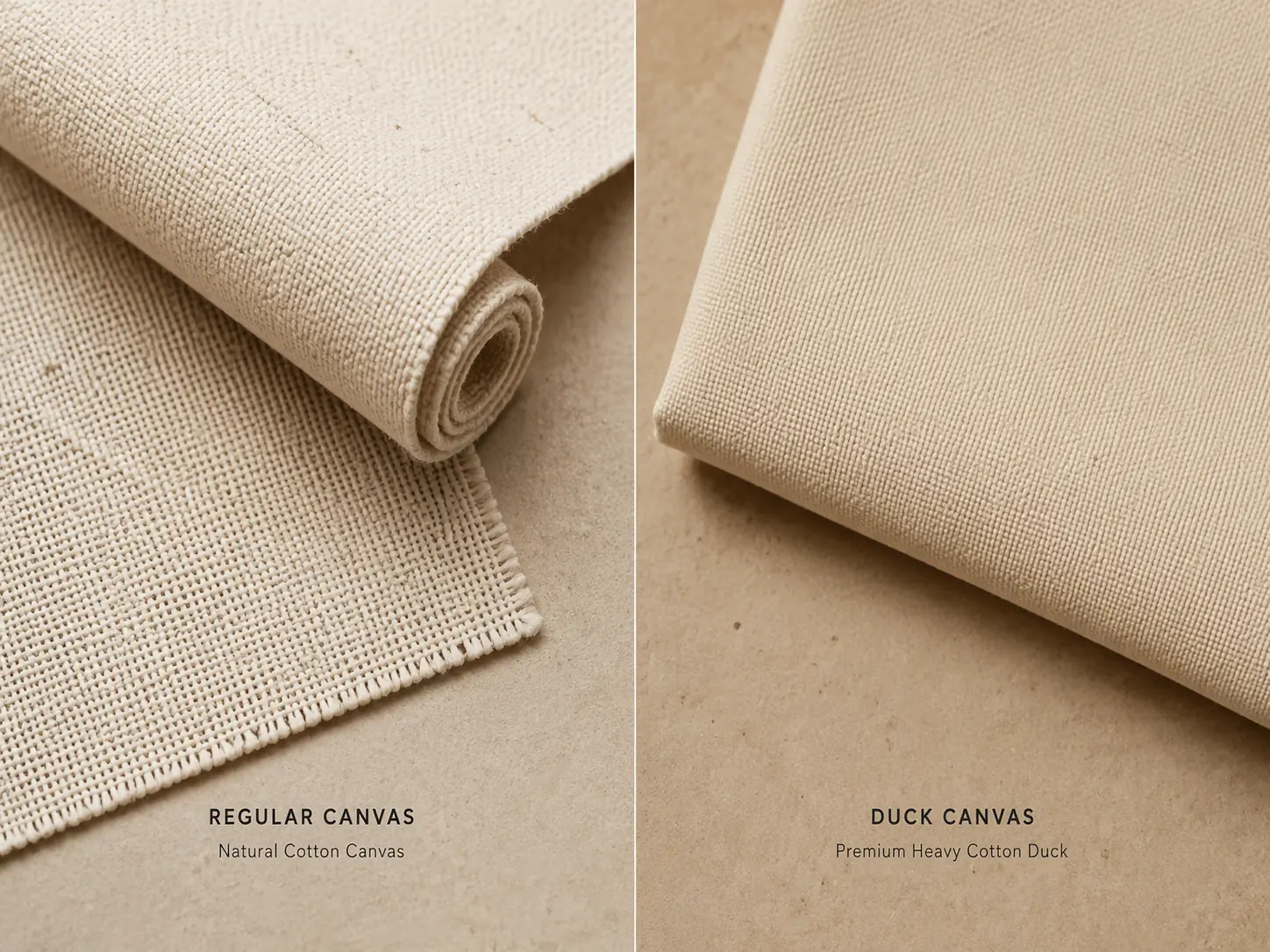
The main difference between canvas and duck canvas is that canvas is a broad fabric category, whereas duck canvas generally refers to a more specifically classified type of closely woven canvas.
Both are commonly associated with plain-weave construction, particularly in cotton fabrics. However, the term canvas covers a wider range of fibers, yarn constructions, fabric weights, and surface characteristics.
Duck canvas is traditionally associated with compact weaving, closely packed yarns, and a relatively even surface. Depending on its classification, it may also use particular yarn arrangements, including single-fill or plied-yarn constructions.
This distinction becomes important when suppliers describe fabrics using terms such as regular cotton canvas, heavy canvas, cotton duck, single-fill duck, or numbered duck.
Quick Comparison: Canvas vs Duck Canvas
| Comparison Factor |
General Canvas |
Duck Canvas |
| Definition |
Broad category of durable woven fabrics |
A more specific category of closely woven canvas |
| Typical weave |
Commonly plain weave; other canvas constructions exist |
Traditionally a compact plain weave |
| Yarn construction |
Varies according to specification |
May use single yarns or plied yarns, depending on the duck classification |
| Weave density |
Varies from relatively open to compact |
Generally associated with closely packed yarns |
| Surface appearance |
Can be textured, slightly irregular, or smooth |
Often more uniform and compact |
| Hand feel |
Ranges from soft and flexible to firm |
Often feels firmer at comparable specifications |
| Weight |
Available in a broad range |
Available in different light, medium, and heavy classifications |
| Flexibility |
Depends on yarn, density, and finishing |
Often less flexible when constructed at higher densities or weights |
| Fabric structure |
Depends on the particular construction |
Generally provides a compact and stable woven structure |
| Common applications |
Tote bags, shopping bags, pouches, covers, and accessories |
Heavy-duty totes, utility bags, workwear, and protective covers |
The table describes general characteristics rather than fixed technical rules. A lightweight duck fabric can be more flexible than a very heavy conventional canvas, and a high-density conventional canvas can be more compact than a loosely constructed duck fabric offered under a different commercial specification.
For this reason, buyers should not make purchasing decisions based on the fabric name alone.
Is Duck Canvas a Type of Canvas?
Yes. In traditional textile terminology, cotton duck belongs to the broader family of canvas fabrics.
The relationship can be understood through a simple example:
- Canvas is the broader category.
- Cotton canvas describes a canvas fabric made primarily from cotton.
- Cotton duck is a more specifically classified cotton canvas.
- Army duck and numbered duck are particular commercial classifications within the duck family.
This means that all traditional cotton duck fabrics can be considered canvas, but not every fabric sold as canvas is necessarily duck canvas.
The terminology can vary between manufacturers, fabric markets, and countries. Some suppliers use canvas and duck almost interchangeably, while others distinguish them according to yarn construction, density, and traditional weight classifications.
For international sourcing, this is an important detail. A quotation that simply states "12 oz cotton canvas" may not describe the same fabric construction as another supplier's "12 oz cotton duck."
The actual specifications should always be compared before the buyer approves a material.
Historical & Commercial Context: Why the Naming Distinction Matters Today
To understand modern textile specifications, it helps to understand why international trade developed two separate naming systems.
The Heritage of Canvas
The word Canvas traces its etymology back to the Greek kannabis and Latin cannabis, referring to early bast fibers made from industrial hemp and flax. Historically, canvas was the universal term for any sturdy, coarse, plain-woven utility fabric used for ship sails, field tents, and military wagons. With the rise of automated cotton spinning in the 18th and 19th centuries, cotton became the dominant fiber. Today, in global trade, "canvas" serves as a broad umbrella category encompassing any plain-woven heavy textile made from cotton, linen, hemp, polyester, or poly-cotton blends.
The Origins of Duck Cloth
The word Duck has no connection to birds. It derives from the traditional Dutch word doek, which meant linen cloth or woven canvas. During the 17th and 18th centuries, Dutch mills were the undisputed global leaders in manufacturing heavy, tightly woven canvas for naval sails and durable sailors' smocks.
When British and American textile mills in New England began weaving competing cotton sailcloth, they differentiated fabric grades using stencil marks on fabric bolts. The most popular heavy-duty grade featured the pictorial trademark of a duck. Over generations of naval contracts, merchant shipping orders, and industrial workwear manufacturing, "Cotton Duck" became the definitive commercial trade name for dense, heavy, plied-yarn cotton canvas.
Fabric Architecture: How Plain Canvas and Duck Canvas Are Built
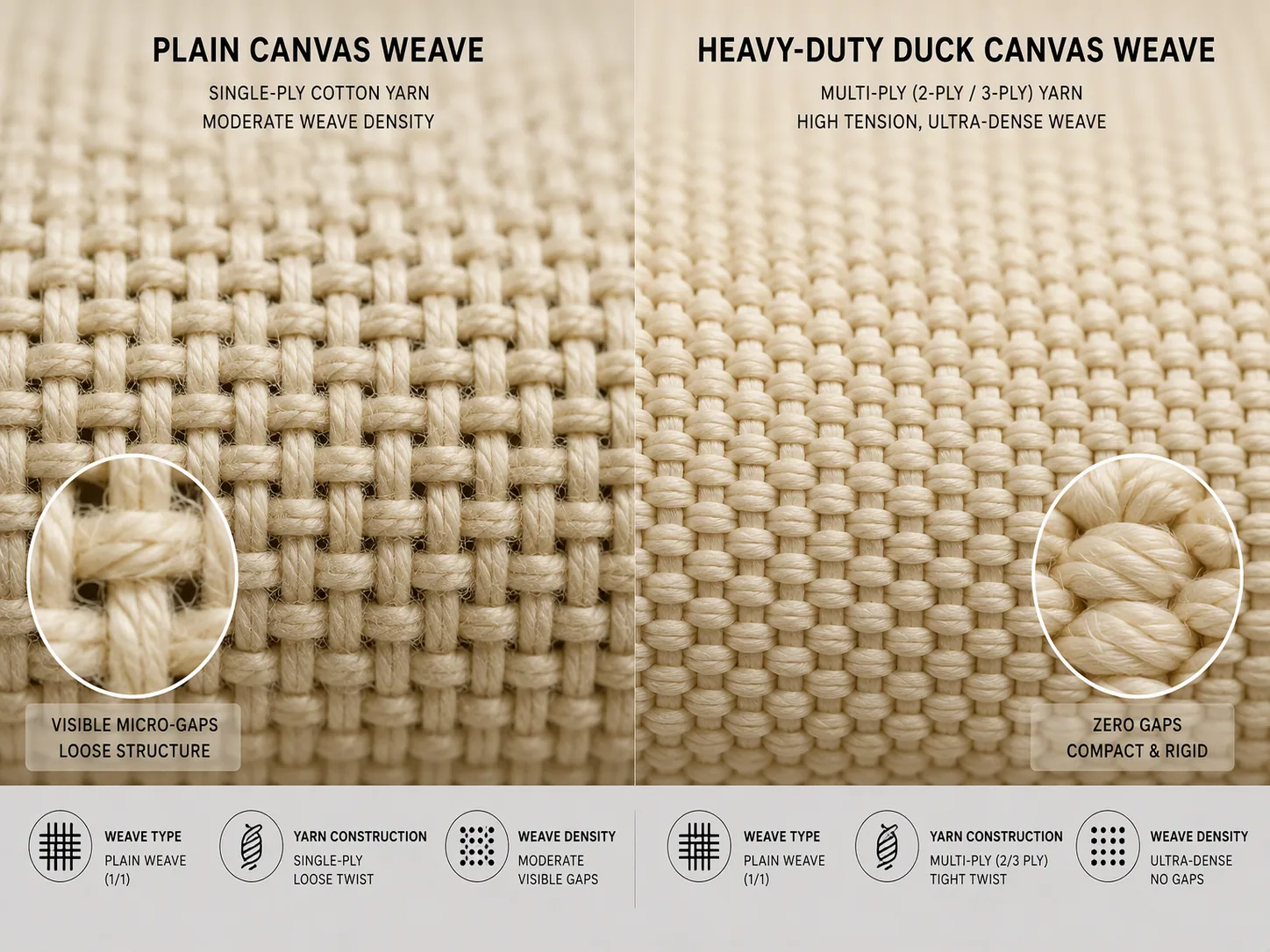
Understanding the basic differences in yarn construction and weave density allows sourcing teams to communicate effectively with factory technicians and verify that delivered goods match sample approvals.
Single-Ply vs. Multi-Ply Yarn Construction
The core structural difference between plain canvas and duck canvas lies in the yarn:
- Single-Ply Yarns in Plain Canvas: Standard plain canvas is typically woven from single-ply cotton yarns (such as 10s/1 or 12s/1 cotton count). A single strand of spun fiber is run in the lengthwise direction (warp) and crosswise direction (weft or filling). Single yarns are faster and more economical to spin, but they have lower tensile strength and allow individual fibers to shift when pulled under dynamic load.
- Plied Yarns in Duck Canvas: True duck canvas uses multi-ply yarns (such as 10s/2, 10s/3, or 7s/2). Two or more single yarns are twisted together in the opposite direction of their initial spin before weaving. This twisting process balances internal tension, makes the yarn rounder and smoother, and increases overall breaking strength by 40% to 65% compared to single yarns of equal weight.
Weave Density and Thread Packing (Sett)
Weave density refers to how tightly the warp and weft yarns are packed across every square inch of fabric:
- Plain Canvas Sett: Standard canvas has a moderate thread count (typically 40 to 52 warp threads by 28 to 36 weft threads per inch). There are tiny micro-gaps between intersecting threads. This allows air to circulate, gives the fabric a relaxed drape, and produces a slightly textured, coarse surface.
- Duck Canvas Sett: Duck canvas is woven under high tension on heavy industrial looms with powerful reed beat-up force. The yarns are compressed tightly against one another, creating a dense, interlocking surface with virtually zero visible space between threads. This compact construction blocks light, repels wind and light rain, and gives duck canvas its signature rigidity and structural memory.
Common Canvas Fiber Types
Although this article focuses on cotton canvas and duck canvas, buyers may encounter several fiber options when sourcing canvas bags.
| Canvas Type |
Main Characteristics |
Potential Bag Applications |
| 100% Cotton Canvas |
Natural hand feel, breathable, traditional textile appearance |
Tote bags, shopping bags, promotional bags |
| Cotton-Polyester Canvas |
Combines cotton characteristics with polyester dimensional stability |
Retail bags, reusable shopping bags |
| Polyester Canvas |
Synthetic fiber construction, generally good color stability and moisture management |
Outdoor-style bags, promotional products |
| Recycled Cotton Canvas |
Uses recycled cotton fibers, with properties depending on fiber quality and blend |
Sustainable promotional and retail bags |
| Recycled Polyester Canvas |
Uses recycled polyester yarns, with performance depending on yarn and fabric construction |
Branded bags and reusable accessories |
One important distinction is that duck is primarily a traditional cotton fabric classification. A supplier may market a synthetic fabric as duck-style canvas, but buyers should confirm whether it is genuine cotton duck or simply a fabric with a similar appearance and construction.
The Three Commercial Categories of Duck Canvas
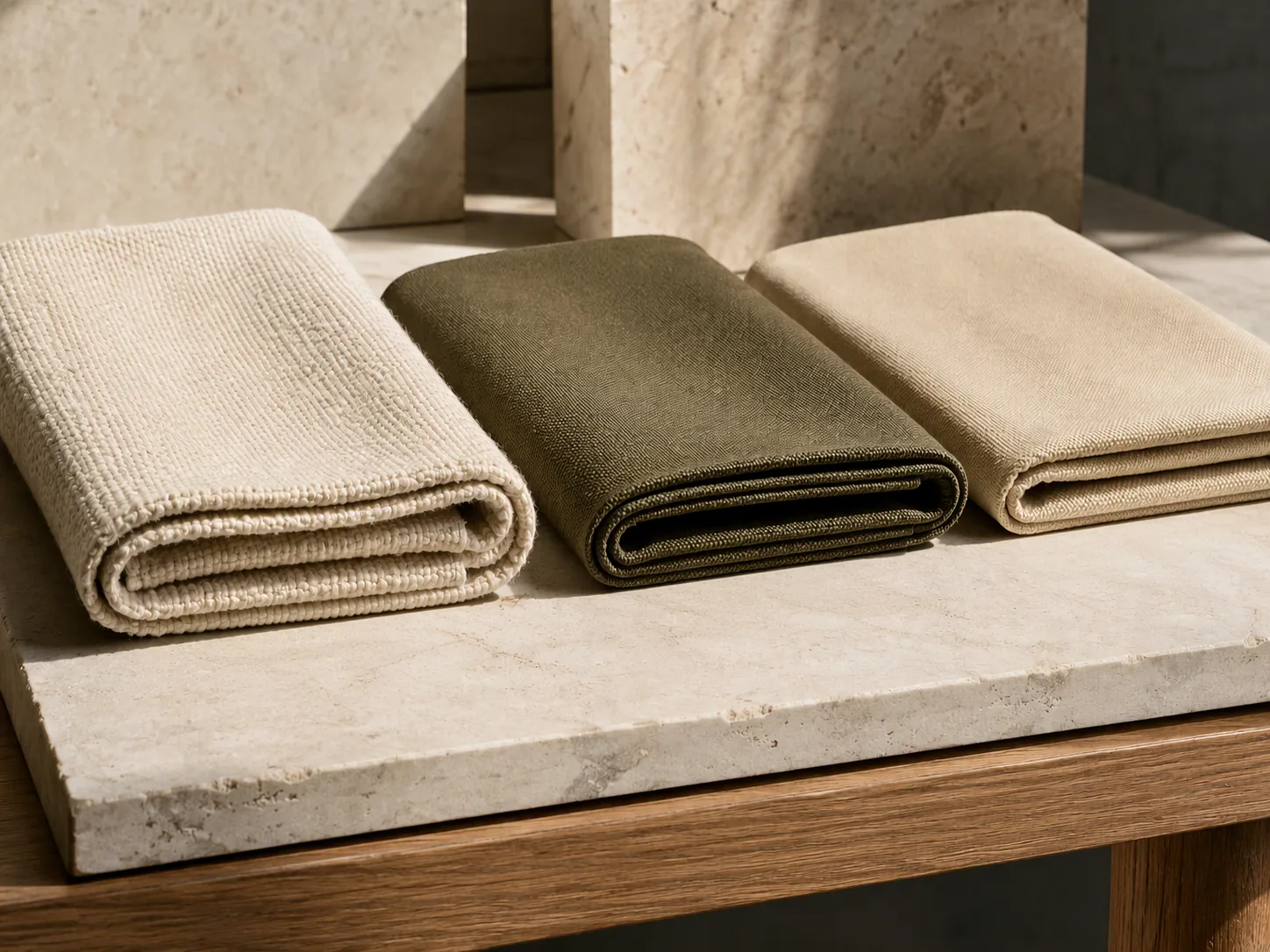
When ordering duck canvas from an OEM factory or textile mill, you will typically choose among three primary commercial categories:
1. Numbered Cotton Duck (ASTM D230 / Heavy-Duty Industrial Standard)
Numbered duck is the gold standard for rugged, high-durability bag manufacturing. It features plied yarns in both the warp and weft directions and is graded on a scale from #1 (the thickest, heaviest grade) down to #12 (the lightest numbered grade).
- Hard Duck (Grades #1 through #6): Extremely thick, dense, and board-like. Used for heavy contractor tool totes, industrial equipment bags, sea-bag bases, and log carriers.
- Soft / Sail Duck (Grades #7 through #12): Woven with balanced two-ply yarns. It offers excellent self-standing structure while remaining pliable enough to sew smoothly on standard walking-foot bag assembly lines. Used for premium boat totes, structured duffels, and retail fashion bags.
2. Army Duck Canvas (Military Specification / Tight-Weave Outdoor Grade)
Originally engineered for military field tents, vehicle tarpaulins, and tactical packs, Army Duck utilizes finer, tightly twisted two-ply yarns (such as 12s/2 or 14s/2) woven at an exceptionally high thread count.
- Key Characteristics: Very smooth surface finish, outstanding wind resistance, and excellent natural water-shedding performance. Because the yarns are fine and closely packed, the cotton fibers swell quickly when exposed to moisture, naturally sealing the fabric pores.
- Best-Fit Products: Luxury outdoor packs, expedition duffels, waxed bushcraft bags, and high-end glamping gear.
3. Single Fill Duck (Commercial / Flat Duck)
Single Fill Duck is an economy-oriented fabric designed for cost-sensitive retail and promotional programs. It uses pairs of single warp yarns woven side-by-side against a coarse single weft yarn.
- Key Characteristics: Mimics the visual thickness, weight, and hand feel of a 10 oz or 12 oz numbered duck canvas at a 20% to 35% lower fabric cost. However, because it uses single yarns, its long-term tear resistance and seam holding strength are lower than true plied duck.
- Best-Fit Products: High-volume branded shopping totes, laundry bags, craft accessories, and promotional gift bags.
Master Weight & Conversion Reference: oz/yd² vs. GSM vs. Duck Numbers
International buyers constantly navigate between Imperial measurements (ounces per square yard, or oz/yd²), Metric standards (Grams per Square Meter, or GSM), and traditional Duck Grade Numbers.
Essential Weight Conversion Formulas
To convert between systems:
- GSM (g/m2)=oz/yd2×33.906
- oz/yd2=33.906GSM≈GSM×0.02949
For Numbered Duck grades #1 through #12, the historical numbering system follows an inverse calculation based on a 22-inch wide bolt:
- Linear Ounce Weight (at 22-inch width) = 19 minus Duck Grade Number
-
For example, for #10 Duck: 19−10=9 oz per linear yard at 22” width, which converts to approximately 12.5 to 13.0 oz/yd² (420 to 440 GSM) on a full square yard basis.
Complete B2B Sourcing Specification Table
| Fabric Grade & Name |
Nominal oz/yd² |
Metric GSM |
Yarn Construction |
Thread Density (EPI x PPI) |
Relative Price Index |
Primary Commercial Bag Applications |
| #1 Duck |
29.5 - 30.0 oz |
1,000 - 1,020 g |
7s/4 warp x 7s/4 fill |
26 x 16 |
Premium ($$$$) |
Heavy ballast bags, industrial rigging containers, marine bumpers |
| #2 Duck |
26.0 - 27.0 oz |
880 - 915 g |
7s/3 warp x 7s/4 fill |
28 x 17 |
Premium ($$$$) |
Extreme-duty military equipment bags, chute liners |
| #3 Duck |
24.0 - 24.5 oz |
810 - 830 g |
7s/3 warp x 7s/3 fill |
30 x 18 |
High ($$$) |
Commercial contractor tool bags, heavy utility totes |
| #4 Duck |
21.0 - 21.5 oz |
710 - 730 g |
7s/3 warp x 7s/2 fill |
32 x 20 |
High ($$$) |
Heavy tool carriers, lineman pouches, fire log bags |
| #6 Duck |
18.0 - 18.5 oz |
610 - 630 g |
7s/2 warp x 7s/2 fill |
36 x 24 |
High ($$$) |
Premium heavy-duty log totes, heritage luggage bases |
| #8 Duck |
15.5 - 16.0 oz |
525 - 545 g |
10s/3 warp x 10s/3 fill |
42 x 28 |
Upper Mid ($$$) |
Self-standing luxury boat totes, ice carriers, saddlebags |
| #10 Duck |
12.5 - 13.0 oz |
420 - 440 g |
10s/2 warp x 10s/2 fill |
46 x 30 |
Mid-Range ($$) |
Standard retail boat totes, heavy duffels, utility aprons |
| #12 Duck |
11.0 - 11.5 oz |
370 - 390 g |
12s/2 warp x 12s/2 fill |
50 x 36 |
Mid-Range ($$) |
Retail merchandise totes, structured bookstore bags |
| Army Duck |
10.0 - 10.5 oz |
340 - 360 g |
12s/2 warp x 14s/2 fill |
58 x 44 |
Upper Mid ($$$) |
Waxed expedition packs, luxury outdoor glamping bags |
| Single Fill Duck |
10.0 - 10.5 oz |
340 - 360 g |
10s/1 (pair) x 5s/1 fill |
68 x 30 |
Economy ($) |
Promotional shopping totes, laundry bags, craft accessories |
| Standard 12 oz Canvas |
12.0 oz |
410 g |
10s/1 warp x 8s/1 fill |
44 x 30 |
Economy-Mid ($) |
Soft retail tote bags, grocery bags, soft duffels |
| Standard 10 oz Canvas |
10.0 oz |
340 g |
10s/1 warp x 10s/1 fill |
46 x 32 |
Economy ($) |
Trade show tote bags, branded event bags, book bags |
| Standard 8 oz Canvas |
8.0 oz |
270 g |
12s/1 warp x 12s/1 fill |
48 x 34 |
Budget ($) |
Lightweight giveaway bags, cosmetic pouches, shoe bags |
| Standard 6 oz Canvas |
6.0 oz |
200 g |
16s/1 warp x 16s/1 fill |
52 x 36 |
Budget ($) |
High-volume promo grocery bags, dust covers, packaging bags |
These ranges are useful for preliminary sourcing discussions, but they should not be treated as a universal classification of regular canvas and duck canvas.
Canvas vs Duck Canvas: Strength and Durability
Strength is another major reason buyers compare canvas and duck canvas.
Both can be used for durable products, but their actual performance depends on the material specification and how the finished bag is designed.
Duck canvas is often selected for applications requiring a compact fabric surface and a firm hand feel. Nevertheless, the name duck does not guarantee a particular tensile strength, tear strength, or abrasion resistance.
Tensile Strength
Tensile strength describes a material's ability to withstand pulling forces before breaking.
For a woven fabric, the result can differ between the warp and weft directions.
This is important because a bag may experience pulling forces in different directions during use.
For example, the body of a shopping tote may experience downward forces from its contents, while the upper area around the handles experiences concentrated tension.
A tightly woven fabric may provide a stable structure, but the actual tensile result still depends on yarn strength, yarn arrangement, and fabric construction.
- Standard 12 oz Plain Canvas: Typically achieves a tensile breaking strength of approximately 95 to 110 pounds-force (lbf) in the lengthwise warp and 70 to 85 lbf in the crosswise weft. This is more than sufficient for everyday shopping bags carrying 10 to 15 pounds of light goods.
- #10 Duck Canvas (12.5 oz): Delivers 160 to 185 lbf in the warp and 115 to 130 lbf in the weft. Despite having virtually the same weight as 12 oz plain canvas, #10 duck provides over 55% greater breaking strength. This allows heavy boat totes and work duffels to carry 40 to 60 pounds of books, hardware, or travel gear without structural failure.
Tear Resistance
Tear strength measures how easily an existing puncture or cut will rip across the fabric under tension.
- In standard plain canvas, single-ply yarns snap individually when torn, allowing a small puncture to quickly expand into a long rip.
- In duck canvas, the high thread count and interlocking plied yarns bunch together against the tearing force, stopping punctures from spreading. This is why heavy tool bags and contractor utility pouches exclusively specify #4 or #6 duck canvas to withstand sharp screwdrivers, nails, and metal edges.
Abrasion Resistance
Abrasion resistance determines how quickly the bottom corners and edges of a bag will wear through from being dragged across asphalt, truck beds, or concrete floors.
Under standardized Wyzenbeek rub testing (ASTM D4157):
- Standard 10 oz and 12 oz canvas typically shows thread breakage between 5,000 and 7,500 double rubs.
- #10 Duck withstands 15,000 to 20,000 double rubs before showing thread wear.
- Heavy #4 Duck routinely exceeds 35,000 double rubs, providing wear resistance comparable to heavy synthetic ballistic nylon while maintaining a traditional natural cotton look.
Seam Performance
For a finished bag, fabric strength is only one part of durability.The sewing construction also matters.
- When heavy carrying loads pull on the handle of a loosely woven canvas bag, the warp threads shift laterally over the weft threads. This causes the needle holes to stretch into visible oval gaps (seam slippage), eventually allowing the handle stitching to pull free.
- The dense, high-friction weave of duck canvas locks yarns firmly in place. The needle holes hold their shape under dynamic bouncing loads, ensuring that heavy bar-tack stitching and Box-X reinforcements stay firmly anchored.
Durability Is a Combination of Factors
| Performance Factor |
What Influences It |
Buyer Evaluation |
| Tensile strength |
Yarn strength, fiber, weave, density |
Warp and weft tensile testing |
| Tear resistance |
Yarn arrangement, fabric structure, damage propagation |
Tear testing |
| Abrasion resistance |
Fiber, yarn, surface, finishing |
Abrasion testing |
| Seam strength |
Stitch type, thread, seam design, fabric |
Seam strength testing |
| Handle durability |
Attachment method, reinforcement, stitching |
Finished-bag load testing |
| Dimensional stability |
Fiber, yarn tension, finishing, washing |
Shrinkage testing |
| Surface appearance |
Yarn quality, dyeing, finishing, abrasion |
Visual inspection and color assessment |
For procurement teams, the best approach is to evaluate the finished bag under its expected use conditions instead of using fabric weight or category as the only measure of quality.
Surface Texture, Flexibility, and Appearance
The visual and tactile differences between canvas and duck canvas can influence the positioning of a finished bag.
This is particularly important for retailers and private-label brands, where the fabric surface contributes to the perceived quality of the product.
Surface Texture
General canvas can have a range of surface appearances.
Depending on the yarn and construction, it may look:
- Relatively smooth
- Slightly coarse
- Textured
- Natural and irregular
- Firm and compact
Duck canvas is often associated with a more even and closely woven surface.
This can make it suitable for products that need a clean, consistent textile appearance.
However, a supplier's finishing process can significantly affect the final result.
A washed cotton duck, for example, may look softer and more relaxed than an unfinished duck fabric of similar construction.
Flexibility and Drape
Flexibility describes how easily a fabric bends or folds.
Drape refers to how the fabric hangs or falls under its own weight.
These properties are important when developing bags that need to be folded, packed, or handled frequently.
A lighter conventional canvas may provide a more flexible feel.
A heavier or more compact duck canvas may hold its shape more firmly.
However, the relationship is not absolute.
A lightweight duck fabric can still be flexible, while a heavyweight conventional canvas can feel rigid.
For buyers, the best way to assess flexibility is to compare physical swatches and finished samples.
Fabric Appearance and Product Positioning
| Appearance Factor |
General Canvas |
Duck Canvas |
| Surface texture |
Can range from natural to coarse |
Often more uniform |
| Visual structure |
Depends on yarn and density |
Often compact and defined |
| Flexibility |
Highly variable |
Often firmer in comparable medium-heavy weights |
| Natural cotton appearance |
Available |
Commonly available |
| Premium presentation |
Depends on quality and finishing |
Can provide a substantial, compact appearance |
| Relaxed appearance |
Suitable with washed or softer finishes |
Also possible with suitable finishing |
The choice should reflect the intended product positioning rather than a general assumption that duck canvas always looks more premium.
Which Is Better for Different Types of Bags?
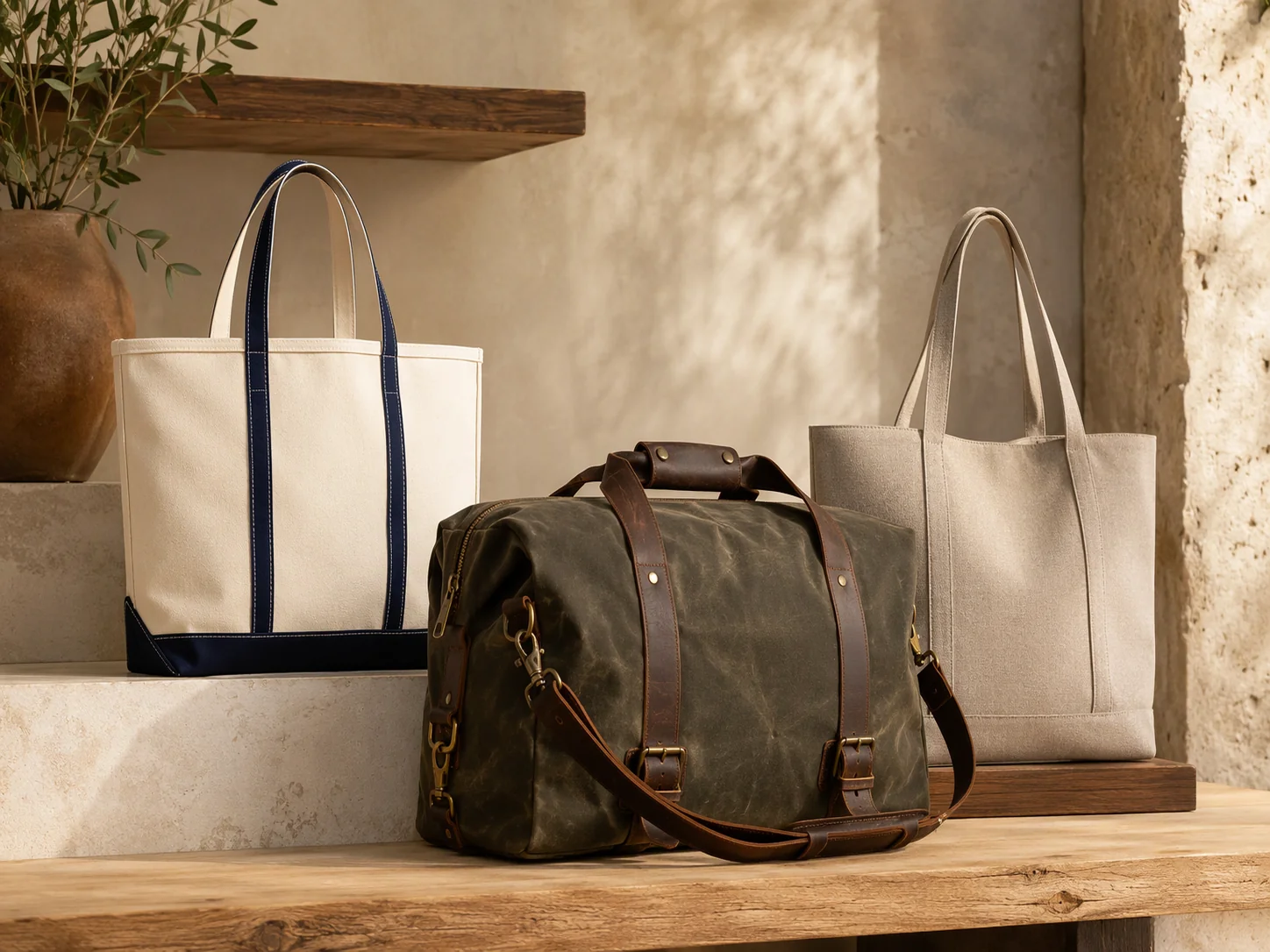
There is no universal winner between canvas and duck canvas.
The more suitable fabric depends on the bag's purpose, expected handling, target price, appearance, and construction requirements.
For custom bag projects, the following comparisons can help buyers make an initial selection.
Promotional & Trade Show Giveaway Bags
- Recommended Fabric: 6 oz to 8 oz Standard Plain Canvas or 7 oz Single Fill Duck.
- Commercial Priorities: Lowest possible unit cost, lightweight shipping profiles to minimize ocean and air freight, easy foldability, and a clean, smooth surface for 1-to-2 color promotional corporate logos.
- Recommended Construction: Single-needle lockstitch with 3-thread overlocked interior seams; 1-inch self-fabric handles with cross-stitch box reinforcement.
Retail Lifestyle, Bookstore & Museum Merchandise Totes
- Recommended Fabric: 10 oz to 12 oz Standard Plain Canvas or #12 Duck Canvas (11.5 oz).
- Commercial Priorities: Substantial, high-quality hand feel; minimal fabric pilling over months of daily use; structured silhouette that folds neatly flat for store display.
- Recommended Construction: Clean-finish interior bound seams (using cotton bias tape to prevent raw edge fraying); reinforced double-layer handles; optional interior hanging zipper pocket for keys and phone.
Heavy-Duty "Boat and Tote" Heritage Bags
- Recommended Fabric: #10 Duck (13 oz) for body with #8 Duck (16 oz) or dual-layer base gusset.
- Commercial Priorities: Must stand upright on a retail counter or floor without slumping; high load capacity (30 to 50 lbs); classic contrast-color handle webbing and rugged aesthetic that gains character over years of use.
- Recommended Construction: Heavy-duty walking-foot construction; high-tenacity bonded polyester thread (Tex 70 to Tex 90); continuous 1.5-inch cotton webbing handles that run down the front, wrap completely under the bottom, and run up the back to cradle the entire load.
Contractor Tool Totes, Utility Pouches & Rugged Duffels
- Recommended Fabric: #6 Duck (18 oz) or #4 Duck (21 oz) with Water-Resistant Coating.
- Commercial Priorities: Puncture-proof against sharp tools; tear-proof and grease-resistant; heavy hardware support; designed for multi-year industrial use.
- Recommended Construction: Heavy-gauge #10 YKK brass or molded vislon zippers; solid steel or brass rivets at all primary stress points; internal wire-frame top opening for quick tool access; reinforced molded or double-duck base.
Outdoor Adventure, Bushcraft & Expedition Luggage
- Recommended Fabric: 10.5 oz Army Duck Canvas with Paraffin Wax Finish.
- Commercial Priorities: High water repellency; windproof barrier; rich pull-up wax patina that develops unique markings with use; premium heritage outdoor brand appeal.
- Recommended Construction: Bound interior seams with waterproof seam-sealing tape; genuine full-grain leather handle wraps and strap anchors; solid antique brass buckles and D-rings.
Printing and Customization: Does Duck Canvas Perform Differently?
Printing and branding are important considerations when sourcing customized canvas bags.
Both conventional canvas and duck canvas can support different decoration methods, but the actual results depend on the fabric surface, fiber composition, color, finishing, and printing process.
Screen Printing
Screen printing is widely used for canvas bags because it can be suitable for relatively large logos and repeat production.
The fabric surface affects ink coverage and print appearance.
A more uniform surface can help create consistent visual results, although the actual print quality also depends on:
- Fabric texture
- Ink formulation
- Mesh selection
- Printing pressure
- Curing conditions
- Artwork complexity
Duck canvas may offer a relatively compact surface, but this does not guarantee better printing results in every case.
Buyers should request a print sample using the actual bulk fabric.
Digital Printing
Digital printing may be considered when the artwork includes multiple colors, gradients, or detailed images.
The suitability of a particular canvas depends on the printing technology and pretreatment requirements.
Cotton and polyester fabrics may require different printing processes and inks.
For this reason, buyers should confirm the fiber composition before selecting a printing method.
Embroidery
Embroidery adds texture and dimension to a branded bag.
A stable fabric surface can help support embroidery, but very dense or heavy materials may require adjustments to the embroidery process.
For example, thick fabric layers may require different needle specifications and stabilizing materials.
A sample should be checked for:
- Logo definition
- Fabric puckering
- Thread tension
- Stitch density
- Backside appearance
Water Resistance: Is Duck Canvas More Waterproof?
Duck canvas is sometimes described as more resistant to water than conventional canvas because of its compact weave.
However, buyers should distinguish between reduced water penetration and actual waterproof performance.
Neither conventional untreated cotton canvas nor untreated cotton duck should automatically be considered waterproof.
How Weave Density Affects Water Penetration
A more compact weave can reduce the size of the spaces between yarns.
This may slow the initial penetration of water under certain conditions.
However, cotton fibers can absorb moisture, and water can eventually pass through an untreated fabric.
The result depends on:
- Fiber composition
- Yarn construction
- Weave density
- Fabric thickness
- Water pressure
- Exposure time
- Finishing treatment
A denser duck canvas may provide a different level of initial water resistance from a more open canvas, but the difference should be measured rather than assumed.
What Finishing Treatments Can Do
Different treatments can change the water-related performance of canvas fabrics.
| Treatment |
Main Function |
Buyer Consideration |
| Water-repellent finish |
Helps water form droplets on the surface |
Confirm durability after handling or washing |
| Wax finish |
Creates a water-resistant surface layer |
May change color, texture, and hand feel |
| PU coating |
Adds a functional coating layer |
Can affect flexibility and surface appearance |
| PVC coating |
Creates a more substantial protective barrier |
May increase weight and reduce textile-like feel |
| No special treatment |
Retains the untreated textile surface |
Not suitable when significant water protection is required |
The required treatment should depend on the intended product.
For a standard promotional tote, untreated cotton canvas may be sufficient.
For an outdoor utility bag, a water-repellent finish or coated construction may be more appropriate.
Cost Comparison: Is Duck Canvas More Expensive?
Duck canvas is not automatically more expensive than all conventional canvas.
Pricing depends on the fabric specification, fiber quality, yarn construction, weight, finishing, color, order quantity, and supplier's production process.
A heavy conventional canvas can cost more than a lightweight duck fabric.
Likewise, a specially constructed or finished duck fabric may cost more than a basic cotton canvas of similar weight.
Main Factors Affecting Fabric Cost
| Cost Factor |
How It Can Affect Pricing |
| Fiber composition |
Cotton quality and fiber source influence material cost |
| Yarn specification |
Yarn size, quality, and ply affect production requirements |
| Fabric weight |
Higher weight generally requires more material per square meter |
| Weave density |
Specific density requirements may influence weaving efficiency |
| Dyeing |
Special colors and color consistency requirements can increase cost |
| Finishing |
Washing, coating, waxing, and other treatments add processing |
| Order quantity |
Larger orders may improve production efficiency |
| Width and yield |
Fabric width affects cutting layout and material consumption |
Why the Cheapest Fabric May Not Be the Most Economical
Fabric price should not be evaluated separately from the finished product.
A lower-priced fabric may require additional reinforcement, special finishing, or more complicated sewing.
A heavier material may also increase shipping weight and packaging costs.
For large-volume orders, buyers should compare the total project cost rather than focusing only on the price per meter or yard.
A practical comparison should include:
- Fabric cost
- Cutting and material consumption
- Sewing efficiency
- Additional reinforcement
- Printing and finishing
- Finished-unit weight
- Packaging and transportation
The best specification is the one that meets the product requirements without introducing unnecessary material or production costs.
How to Choose Between Canvas and Duck Canvas for Bulk Orders
Choosing the right material starts with defining the intended product.
Rather than asking a supplier which fabric is better, buyers should explain what the finished bag needs to achieve.
The following steps provide a practical selection process.
Step 1: Define the Product Application
Start by identifying the bag type.
For example:
- Promotional tote
- Retail shopping bag
- Premium branded tote
- Utility bag
- Cosmetic pouch
- Storage bag
Each application has different requirements for flexibility, structure, weight, and appearance.
Step 2: Determine the Expected Use Conditions
Consider how the bag will be used.
Important questions include:
- Will it carry lightweight or heavy items?
- Will it be used occasionally or frequently?
- Will it be folded and stored?
- Will it experience repeated friction?
- Will it be exposed to moisture?
- Does it need to maintain a defined shape?
These answers help determine whether a conventional canvas or a compact duck fabric is more appropriate.
Step 3: Set the Fabric Weight Range
Establish an initial GSM or oz/yd² range.
For example, a buyer developing a standard retail tote may begin by comparing medium-weight cotton canvas samples.
A premium utility tote may require a heavier specification.
The initial range should be treated as a development target, not a final approval.
Step 4: Confirm Fiber and Yarn Construction
Do not stop at the word cotton.
Confirm whether the fabric is:
- 100% cotton
- Cotton-polyester blend
- Recycled cotton blend
- Another specified fiber composition
For duck canvas, ask whether the fabric is single-fill, army duck, numbered duck, or another commercial construction.
Step 5: Compare Physical Samples
Physical samples are essential because technical descriptions cannot fully communicate hand feel and surface appearance.
Compare:
- Surface uniformity
- Flexibility
- Thickness
- Stiffness
- Color
- Opacity
- Folding behavior
- Sewing performance
If the bag will be printed or embroidered, request a decorated sample.
Step 6: Evaluate the Finished Bag
The finished sample should be checked under conditions that reflect the actual application.
For example, a shopping tote should be assessed with representative contents rather than only when empty.
Check the handle attachments, bottom area, seams, and overall appearance.
Step 7: Confirm the Specification Before Bulk Production
Once the material has been approved, record the specification in writing.
The purchase specification should identify the fabric composition, weight, construction, finishing, color, and acceptable tolerances.
This helps reduce the risk of material substitution or unexpected differences between sample approval and bulk production.
Fabric Inspection and Testing
For B2B buyers, fabric evaluation should go beyond appearance.
The testing requirements should reflect the actual performance needs of the finished product.
Not every project needs every possible textile test. However, buyers should understand which properties matter and when additional verification is necessary.
Fabric Weight & Composition Verification
- GSM / Ounce Audit: Use a 100 cm² circular fabric cutter and digital scale to verify that bulk fabric weight matches the approved pre-production sample within an industry tolerance of ±5%.
- Yarn Plying Check: Unravel a small swatch of warp and weft yarns. Confirm that specified duck canvas uses true 2-ply or 3-ply ring-spun yarns rather than substituted single-ply open-end yarns.
Stitching & Structural Reinforcement Audit
- Stitch Density Calibration: On heavy duck canvas (#8 to #12), verify that the stitch density is locked between 6 and 8 stitches per inch (SPI). Excessive stitch density (10+ SPI) punches too many close holes, weakening the seam.
- Handle Pull Strength Test: Verify that all handle attachment points feature Box-X cross-stitching or reinforced bar-tacks capable of supporting your required weight rating (e.g., 30 lbs for retail totes, 50+ lbs for heavy tool bags).
- Interior Seam Finishing: Inspect inside seams to ensure edges are cleanly bound with cotton tape or tightly overlocked with no raw, unraveling thread ends.
Dyeing & Color Fastness Inspection
- Rubbing Fastness (Crocking): Perform dry and wet crocking tests using a white cotton cloth. Ensure that dyed canvas (especially dark navy, black, and red) does not transfer color onto clothing.
- Color Matching: Confirm that bulk fabric matches the approved Pantone solid coated reference under standard D65 daylight viewing lamps.
Cleanliness & Export Packaging
- Needle & Metal Detection: Ensure every finished bag passes through an industrial conveyor metal detector to verify that no broken sewing needle fragments remain inside seams.
- Moisture Protection: Canvas is a natural cellulose fiber that readily absorbs ambient humidity. Confirm that export cartons are lined with sealed inner polybags and include sufficient silica gel desiccant packs to prevent mildew during multi-week ocean transit.
FAQ
Is duck canvas the same as regular canvas?
Duck canvas is a type of canvas, but the two terms are not always interchangeable in technical sourcing.Canvas is a broad category of durable woven fabrics, while duck canvas traditionally refers to a more specifically classified cotton fabric with a compact plain-weave construction.
What is the difference between Single Fill Duck and Numbered Duck?
Numbered Duck uses heavy multi-ply yarns in both the warp and weft, giving it maximum tensile strength, tear resistance, and long-term durability. Single Fill Duck pairs single warp yarns against a single weft yarn, simulating the look and thickness of duck canvas at a lower price point. Single fill duck is ideal for budget-conscious promotional programs, while numbered duck is essential for heavy-duty, self-standing retail and industrial bags.
What does No. 10 duck canvas mean?
No. 10 duck is a traditional numbered classification. In the conventional numbered-duck system, a higher number generally indicates a lighter fabric than a lower number.However, the exact weight should be confirmed with the supplier because commercial descriptions and historical classification conventions may differ.
Is duck canvas waterproof?
Untreated cotton duck is not waterproof.Its compact weave may slow water penetration under certain conditions, but additional treatments are necessary when stronger water protection is required.
Can duck canvas be printed?
Yes. Duck canvas can support different printing and decoration methods, depending on its fiber composition, surface finish, and fabric construction.The actual material should be tested before bulk printing.
Conclusion
Canvas and duck canvas are closely related, but their commercial descriptions can represent different fabric constructions.
Canvas is the broader category, while duck canvas generally refers to a more specifically classified and compact woven fabric. Duck may provide a firmer hand feel and a more uniform surface, but it is not automatically heavier, stronger, or more suitable for every bag project.
For buyers developing custom canvas bags, the most reliable selection process is to compare the actual fabric specifications.
Start with the fiber composition, GSM or oz/yd², yarn construction, weave density, and finishing. Then evaluate the material through physical samples and finished-bag testing.
For a lightweight promotional tote, a conventional canvas may offer a more practical balance of cost and flexibility. For a retail bag that needs a substantial feel or a utility product requiring a compact fabric structure, duck canvas may be worth evaluating.
At INITI, material selection should be considered together with the intended bag design, customization requirements, and production specifications. Whether a project calls for a conventional cotton canvas or a more compact duck-style fabric, the goal is to develop a finished bag that meets the buyer's expectations for appearance, handling, and practical performance.
Related Products
Related Blog & Application Articles

 Hot News