What Is a Crossbody Bag: Types, Sizes and Uses
A crossbody bag is worn with a strap running diagonally across the torso, usually from one shoulder to the opposite hip or side. Depending on its design and strap length, the bag can also sit higher against the chest or back.
This carrying method keeps both hands available and makes small personal belongings easier to carry without a backpack.
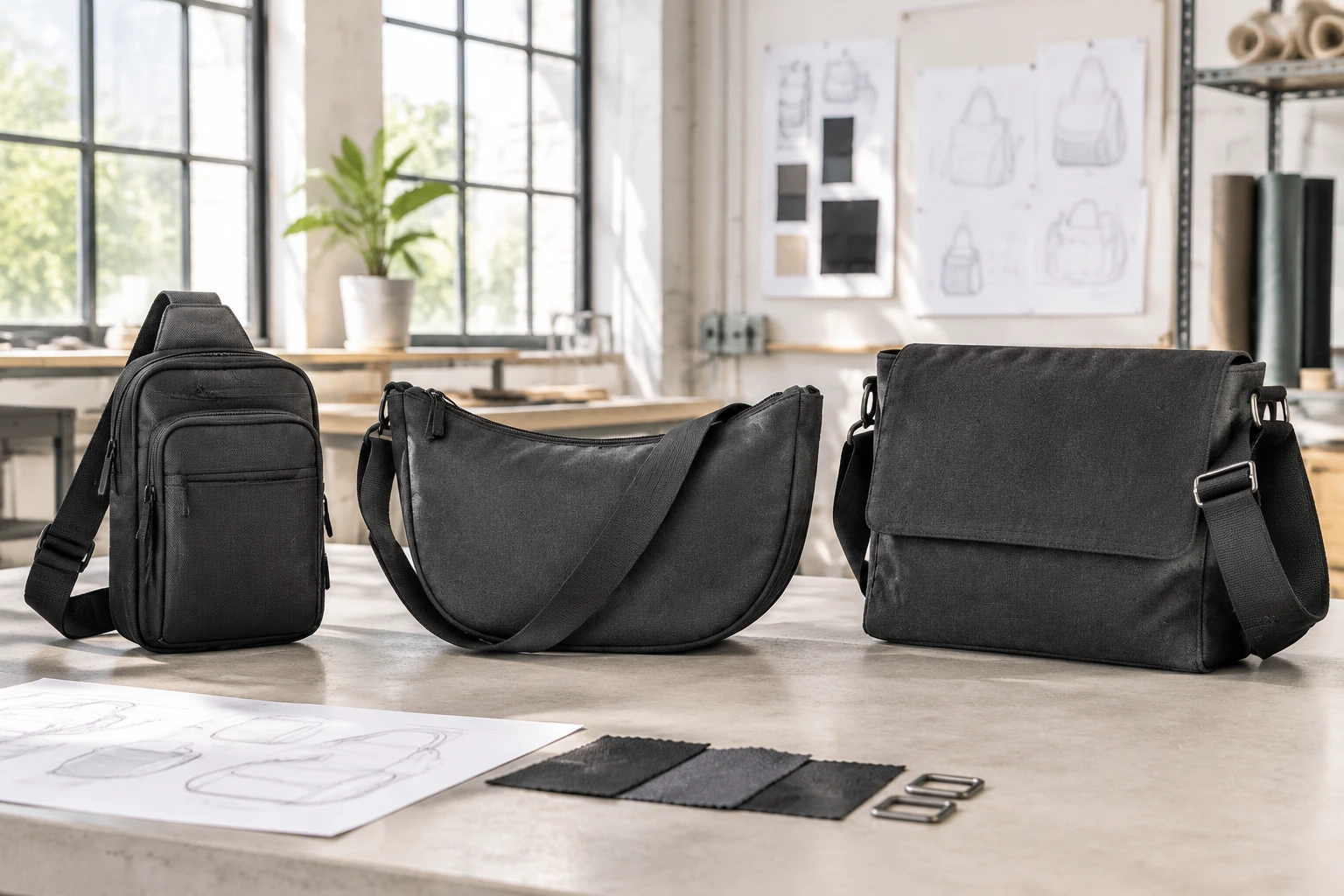
But a crossbody bag is not one fixed shape. A phone pouch, crescent bag, compact sling and large canvas messenger-style bag can all be worn crossbody. Their sizes, storage layouts and carrying comfort are quite different.
For everyday users, the right choice depends on what they need to carry and where they want the bag to sit.
For brands and wholesale buyers, those same decisions affect fabric selection, dimensions, strap construction, hardware, production cost and finished-bag quality.
1. What Defines a Crossbody Bag?
Crossbody describes a carrying method rather than a specific bag shape.
The strap crosses the body diagonally, while the bag hangs or rests on the opposite side.
Many crossbody bags have an adjustable strap, allowing the wearer to move the bag between the chest, side and hip.
The main reasons people choose this style are straightforward:
Both hands remain available while walking, shopping or commuting.
A phone, wallet and keys can stay within easy reach.
Adjustable straps accommodate different carrying positions.
Small essentials can be organized without carrying a larger bag.
The same carrying method works with casual, travel and fashion designs.
However, crossbody carrying does not automatically make a bag more secure or comfortable.
A heavy bag on one shoulder can still create concentrated pressure. A zippered closure helps keep contents enclosed but does not make the bag theft-proof.
Crossbody Bag vs Shoulder Bag, Sling Bag and Messenger Bag
These names overlap, but they describe different aspects of a bag.
| Bag Type |
Main Distinction |
| Crossbody bag |
Defined mainly by the diagonal carrying method |
| Shoulder bag |
Usually hangs from one shoulder; some designs also work crossbody |
| Sling bag |
Usually compact and worn closer to the chest or back |
| Messenger bag |
Often has a wider body and a large opening or flap; commonly worn crossbody |
| Belt bag |
Originally designed for waist carry, although many are also worn across the chest |
For example, shortening the strap on a small bag may turn a low hip-level crossbody into a higher, closer-fitting sling-style carry.
There is no need to treat these names as rigid technical classifications.
For a more detailed comparison, read Sling Bag vs Crossbody Bag: What's the Difference?.
2. What Are the Main Types of Crossbody Bags?
The most useful way to distinguish crossbody styles is by their shape, capacity and intended contents.
| Type |
Typical Design |
Common Use |
| Mini crossbody bag |
Small body, simple storage |
Phone, cards, keys and small wallet |
| Phone crossbody pouch |
Slim, often vertical construction |
Everyday phone access and events |
| Crescent crossbody bag |
Soft, curved half-moon silhouette |
Casual fashion and lifestyle retail |
| Crossbody sling bag |
Compact body, often worn high and close |
Travel, walking, commuting and events |
| Multi-pocket crossbody bag |
Several internal or external compartments |
Travel and organized daily carry |
| Messenger-style crossbody bag |
Wider body, often with a gusset |
Documents, notebooks and larger personal items |
| Convertible crossbody bag |
Adjustable or detachable strap |
Multiple wearing styles |
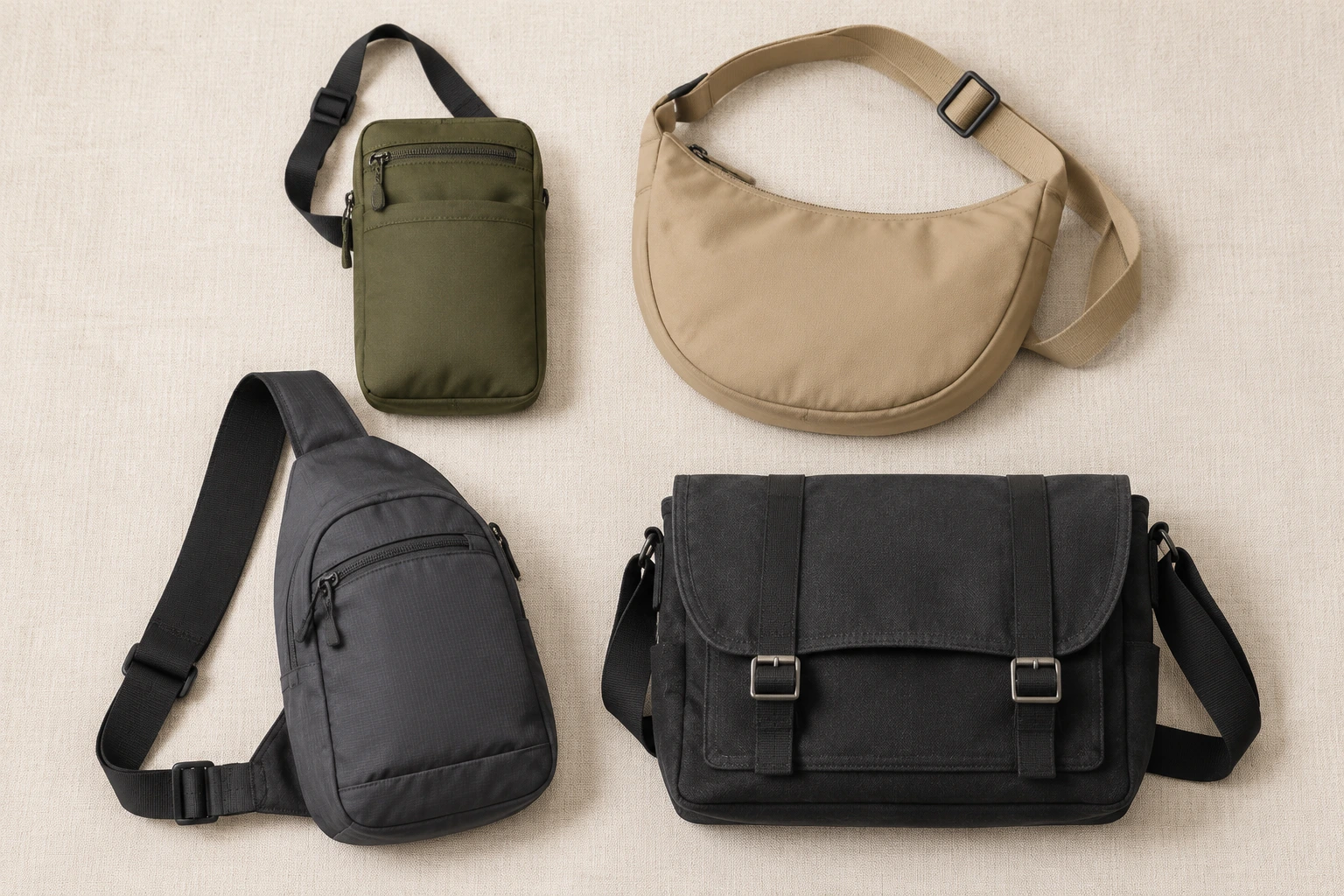
Mini Crossbody Bags and Phone Pouches
These are designed for users who carry only a few essentials.
The main concern is usable space. A pouch may have enough internal height for a phone but an opening too narrow to insert it easily, particularly when the phone has a protective case.
For phone-focused designs, buyers should test the actual device, opening width and zipper clearance.
Crescent Crossbody Bags
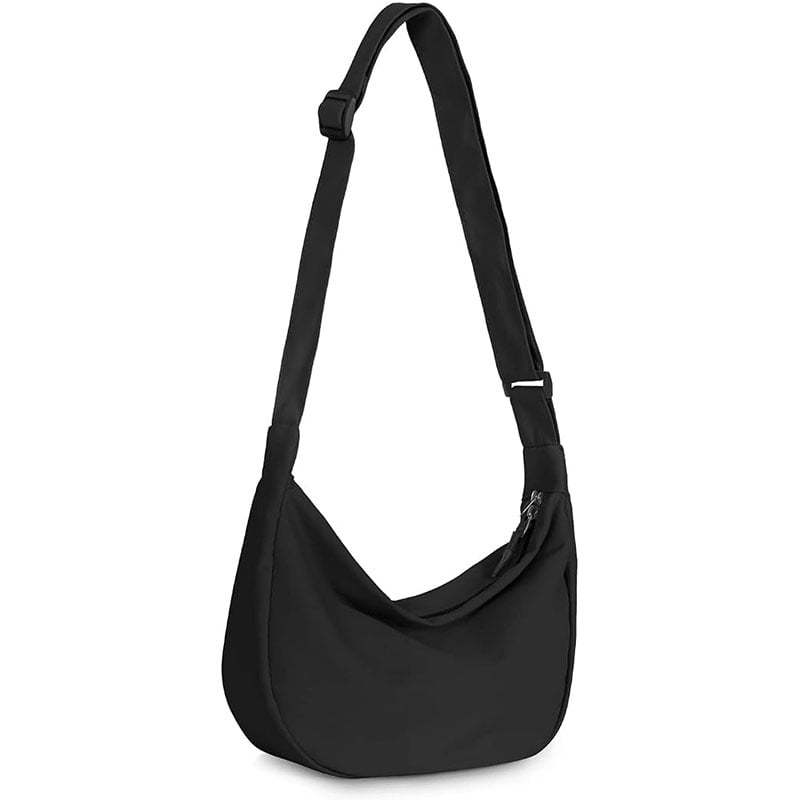
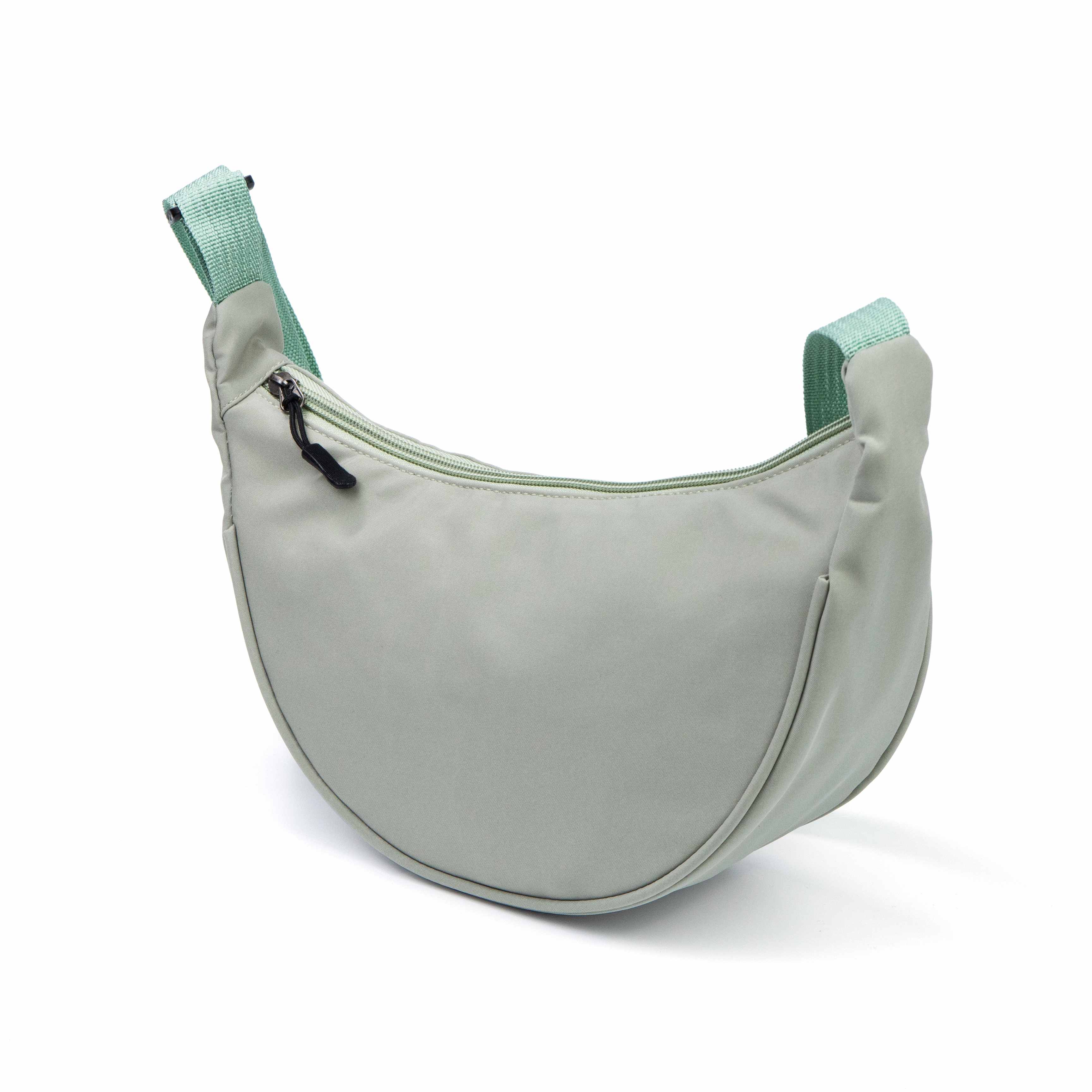
Crescent bags have a curved upper profile and a soft, rounded body.
Many use polyester or nylon fabric with a top zipper and adjustable strap. Depending on the strap setting, the same product may work as a shoulder bag or crossbody bag.
The silhouette is particularly relevant to casual fashion and private-label accessory collections.
Sling and Multi-Pocket Crossbody Bags
Compact slings are often worn against the chest or upper back, where the shorter carrying position can help limit movement.
Travel-oriented versions may include separate pockets for a phone, passport, cards and small accessories.
More pockets are not always better. Several narrow compartments can consume useful space or make frequently used items harder to retrieve.
The correct layout depends on the intended contents.
Large Canvas and Messenger-Style Bags
Larger crossbody bags can carry notebooks, documents, books and other daily items.
Their wider openings and deeper gussets may make bulky belongings easier to pack.
As size and intended load increase, shoulder-strap comfort and attachment strength become more important.
3. Crossbody Bag Sizes: How Big Should the Bag Be?
Crossbody bags range from phone-sized pouches to much larger casual shoulder bags.
There is no universal industry standard defining mini, small, medium and large crossbody dimensions.
The following widths are approximate design references, not fixed product classifications.
| Size |
Illustrative Body Width |
Typical Contents |
| Mini |
About 10–18 cm |
Phone, cards, keys and small wallet |
| Small |
About 18–26 cm |
Daily essentials and compact accessories |
| Medium |
About 26–36 cm |
Wallet, power bank, cosmetics, notebook or small umbrella, depending on height and depth |
| Large |
Above approximately 36 cm |
Books, documents, clothing layers or larger daily items |
The width alone is not enough to select a bag.
A vertical sling may be narrow but relatively tall. A crescent bag may have a wide outer body but a much smaller usable opening.
Check the Opening, Not Just the External Size
A bag described as 25 cm wide may not have a 25 cm zipper opening.
Curved panels, seams and zipper placement can reduce the available clearance.
The actual storage space also depends on the lining, padding, gusset and internal pockets.
Before approving a custom size, place the intended contents inside the sample and check whether they can be inserted and removed without forcing the opening.
Capacity Does Not Tell the Whole Story
A stated capacity in liters can be useful, but it does not guarantee that every item will fit.
A long power bank, sunglasses case or large phone may be difficult to place inside a compartment with an unsuitable shape.
For custom bag development, define the items first and determine the dimensions afterward.
4. Which Crossbody Bag Is Best for Different Uses?
The best crossbody bag depends on how it will be carried and what the user needs throughout the day.
| Use |
Suitable Style |
What Matters Most |
| Daily errands |
Mini or small crossbody |
Low weight, convenient opening and basic storage |
| Travel and sightseeing |
Compact sling or multi-pocket crossbody |
Zipper access, organization and carrying position |
| Commuting |
Medium crossbody or messenger-style bag |
Usable capacity, strap comfort and pocket layout |
| Festivals and events |
Small zippered crossbody or sling |
Compact size and accessible essentials |
| Fashion retail |
Crescent or structured crossbody |
Shape, material, color and finish |
| Promotional programs |
Simple branded crossbody |
Useful construction, logo placement and cost |
| Outdoor leisure |
Close-fitting sling |
Carrying stability and suitable materials |
| Books and documents |
Larger canvas crossbody |
Opening width, gusset and strap strength |
For someone carrying only a phone, keys and cards, a large bag creates unnecessary weight and bulk.
For someone carrying a notebook, bottle and other accessories, a small sling may become uncomfortable or difficult to organize.
The best size is the smallest one that accommodates the intended contents comfortably.
5. What Materials Are Used for Crossbody Bags?
The material affects the appearance, weight, cleaning requirements and durability of the finished bag.
| Material |
Main Characteristics |
Common Applications |
| Polyester |
Available in many fabric constructions, colors and finishes |
Casual crossbody bags, travel accessories and promotions |
| Nylon |
Can provide lightweight, flexible construction |
Crescent bags, slings and outdoor-inspired styles |
| Cotton canvas |
Textile appearance and a broad branding surface |
Lifestyle retail and larger casual bags |
| RPET polyester |
Recycled-polyester material option |
Collections with verified recycled-content requirements |
| PU or leather |
Can provide more structured fashion finishes |
Fashion accessories and selected retail products |
| Quilted fabrics |
Soft, padded appearance |
Casual and fashion collections |
Material weight alone does not determine bag quality.
A fabric specified as 600D polyester, for example, is not automatically stronger than every lower-denier fabric. Actual construction, coating, seam design and finishing must be considered.
Similarly, a water-resistant fabric does not make the finished crossbody bag waterproof. Zippers, seams and openings can still allow water to enter.
For RPET projects, recycled-content requirements and relevant certification documents should be confirmed for the specific material and order.
INITI owns a PET bottle recycling and processing facility that supports recycled-material sourcing for applicable polyester-based products.
6. Why Are Shoulder Straps and Hardware So Important?
A crossbody bag generally carries its load through one strap.
That makes the webbing, length adjuster, attachment tabs, stitching and body fabric important parts of the same load-bearing system.
Two problems deserve particular attention during sample development.
Strap Slippage: When the Bag Gradually Hangs Lower
A strap may stay in place when the sample is empty but gradually lengthen once the bag is loaded.
This can happen when the adjuster does not grip the selected webbing securely.
For example, smooth or thin webbing may slip through a poorly matched tri-glide slider. A worn or unsuitable adjustment buckle may also allow movement.
The solution is not simply to choose a thicker buckle.
Buyers should check the compatibility of:
Webbing width
Webbing thickness and surface texture
Adjuster dimensions and geometry
Webbing threading direction
Expected carrying load
Strap movement during use
High-friction adjusters or appropriately designed ladder-lock mechanisms may improve holding performance when matched to the correct webbing.
A practical check: Load the sample with the intended contents, mark the adjusted strap position, carry it through representative movements and measure whether the strap has slipped.
The test duration, movement and acceptable slippage should be agreed for the project.
Strap Attachment Failure: When the Root Starts to Tear
The strap attachment can fail even when the webbing itself is strong.
Common problems include loose stitching, torn attachment tabs, fabric deformation and damaged hardware connections.
Depending on the construction, reinforcement may use:
No single reinforcement pattern is mandatory for every crossbody bag.
For example, dense bar-tacking on a weak fabric without backing may concentrate stress instead of solving the problem.
The attachment should be tested as part of the complete bag, with the intended load and carrying direction.
What Load Test Should a Buyer Request?
There is no universal 15 kg or 20 kg static-load requirement for all crossbody bags.
A phone pouch, compact sling and large messenger-style bag carry very different loads.
The buyer and manufacturer should define:
Intended contents and normal carrying weight.
Static loading conditions.
Any required repeated lifting or movement.
Relevant attachment or sudden-load testing.
Acceptable deformation, slippage or damage.
Where appropriate, established luggage testing methods such as SATRA TM241 for static handle loading and SATRA TM244 for fitting attachment strength may help inform a product-specific test plan.
These methods should not be presented as mandatory certification for every crossbody bag.
7. Security Features for Travel Crossbody Bags
Travelers often choose crossbody bags because their belongings can remain accessible and close to the body.
For brands developing travel-focused products, several design details can make casual access more difficult.
However, no ordinary crossbody bag should be described as theft-proof simply because it has a zipper or a concealed pocket.
Hidden Back-Panel Zipper Pocket
A pocket on the body-facing panel can provide separate storage for a passport, wallet or other valuables.
When the bag is worn close to the body, the pocket opening is generally less exposed than a front-facing compartment.
Its usefulness depends on the position of the zipper, the fit of the bag and how the user wears it.
Lockable Zipper Pullers and Covered Openings
Selected travel designs may use zipper pullers that can be secured together or with compatible locking hardware.
This can make casual opening more difficult, although it does not prevent determined theft.
A zipper garage or covered zipper end serves a different function: it can conceal or protect part of the zipper arrangement. It should not automatically be described as a locking mechanism.
Reinforced and Slash-Resistant Straps
Some specialist travel bags use reinforced straps or purpose-designed cut-resistant components.
These constructions are different from ordinary thick polyester webbing.
For example, high-density seatbelt-style webbing may provide a substantial strap structure, but its density or thickness alone does not prove resistance to cutting.
A brand should claim slash-resistant performance only when the specified strap construction and appropriate testing support that claim.
Design Around Actual Travel Requirements
For a travel crossbody, useful details may include:
A body-side pocket for selected valuables
Secure main-compartment closure
Easy-to-operate zippers for the intended user
Comfortable adjustable strap
Reinforced attachments
An opening that works when the bag is filled
Security features add value only when they remain practical to use.
If a product is marketed for airline travel, its packed dimensions and permitted items should be checked separately against the applicable airline requirements.
8. How to Choose the Right Crossbody Bag for Retail or Wholesale
For a brand or importer, the starting point should be the target customer rather than the product name.
A lifestyle retailer may want a soft crescent shape with minimal pockets.
A travel brand may need separate compartments, body-side storage and stronger hardware.
A promotional buyer may prioritize a simple construction and a clear logo area.
These differences affect the finished specification and cost.
Main Cost Factors
| Component |
Purchasing Consideration |
| Main fabric |
Composition, weight, finish and availability |
| Bag body |
Pattern complexity, dimensions and gusset |
| Lining and pockets |
Number of panels, zippers and sewing operations |
| Shoulder strap |
Webbing, adjustment range, hardware and reinforcement |
| Closures |
Zipper specification, pullers and additional security details |
| Branding |
Printing, embroidery, patches and labels |
| Packaging |
Hangtags, individual packing and carton volume |
A smaller crossbody bag is not automatically cheaper to manufacture.
A compact sling with several zippers, multiple compartments and reinforced hardware may require more assembly operations than a larger bag with a simple opening.
Sample Approval Before Bulk Production
The sample should be assessed with real or representative contents.
Key checks include:
Whether the contents fit through the opening
Whether the strap adjusts across the intended wearer range
Whether the strap slips under load
Whether attachment points deform or tear
Whether zippers operate smoothly when the bag is filled
Whether pockets remain accessible while worn
Whether the bag retains its intended shape
Whether printing and color meet the approved specification
For production, the supplier should keep clear records of the approved fabric, webbing, adjusters, hardware and artwork.
Substituting an adjuster without checking its compatibility with the webbing can change how the finished product performs.
9. Crossbody Bag Design Examples from INITI
Different crossbody constructions illustrate how size, shape and organization affect the finished product.
Crescent Shape for Casual Retail
INITI's Polyester Crescent Crossbody Bag with Adjustable Strap uses a soft curved body, a wide adjustable strap and a top zipper.
Its shape works for casual accessory collections where appearance and flexible carrying positions matter more than extensive internal organization.
The main development decisions include the fabric hand feel, strap proportion, zipper opening and how the curved body sits when filled.
Compact Sling for Daily Essentials
The Compact Crossbody Sling Bag, approximately 14 × 20 cm, illustrates a small vertical format for a phone and other personal items.
Its compact body and adjustable strap make it relevant to travel, events and everyday carry.
For this type of bag, internal dimensions, zipper clearance and strap adjustment matter more than trying to maximize the number of compartments.
Canvas Crossbody for Organized Daily Carry
INITI's Canvas Crossbody Shoulder Bag with Zipper Pockets uses a wider canvas body, a full top zipper, exterior zipper storage and internal organizers.
This configuration suits buyers who want more organization than a basic single-compartment tote or pouch.
Development should focus on pocket accessibility, usable capacity, strap attachments and the finished bag's weight.
Large Crossbody with a Wide Gusset
The Large Canvas Crossbody Bag with Wide Gusset has an approximately 52 cm top width, 34 cm height and 18 cm depth.
It demonstrates how the crossbody format can extend beyond compact personal bags.
For a larger bag, the most important checks are the usable opening, the load-bearing structure, strap comfort and the behavior of the body when filled.
These four designs are starting points rather than fixed production specifications.
Buyers can also explore the INITI Crossbody Bag Collection for other structures and customization directions.
10. Custom Crossbody Bag RFQ Checklist
An accurate quotation should begin with clear product requirements.
| Item |
Information to Provide |
| Intended use |
Fashion, travel, commuting, event or promotion |
| Style |
Mini, crescent, sling, messenger or multi-pocket |
| Dimensions |
Width, height, depth and required opening clearance |
| Contents |
Phone size, accessories, documents and expected weight |
| Material |
Polyester, nylon, canvas, RPET or other fabric |
| Strap |
Width, adjustable range, material and attachment |
| Hardware |
Adjuster, buckle, rings and zipper requirements |
| Pockets |
Internal, front, rear or body-side storage |
| Security features |
Any required locking or cut-resistant components |
| Branding |
Artwork, position, colors and application method |
| Quality |
Load, slippage, attachment, zipper and other relevant tests |
| Order information |
Estimated quantity, colors, SKUs and packaging |
Minimum order quantities and production arrangements depend on the selected design, materials, components and customization requirements.
Why Choose INITI for Custom Crossbody Bags?
Hangzhou INITI Imp&Exp Co., Ltd. has over 16 years of experience in custom bags and packaging, supported by two production facilities and OEM/ODM development capabilities.
Our crossbody product range includes crescent bags, compact slings, canvas shoulder bags and larger multi-purpose designs.
INITI supports material selection, pattern development, strap and hardware specification, pocket design, custom branding, sampling, bulk production inspection and export packing.
For brands and wholesale buyers, we can develop coordinated products with consistent fabrics, colors, trims and packaging.
Sample development can also address practical requirements such as usable capacity, strap adjustment, connection strength and zipper operation.
We provide fast quotations and free design support, with product specifications and testing requirements confirmed for each project.
FAQ
1. What is a crossbody bag?
A crossbody bag is worn with a strap running diagonally across the torso, usually resting at the opposite side, hip, chest or back. The carrying method is its defining characteristic.
2. What is the difference between a crossbody bag and a sling bag?
A sling bag is generally smaller and designed to sit higher and closer to the body. Crossbody is the broader category and includes many shapes and sizes. The two terms often overlap.
3. What size crossbody bag is best for everyday use?
It depends on the intended contents. A small bag may be sufficient for a phone, keys and wallet, while a larger bag suits additional accessories. Always check internal dimensions and opening clearance.
4. What should buyers check in a travel crossbody bag?
Check zipper access, pocket placement, strap comfort, adjuster slippage and attachment strength. Lockable closures and specialist cut-resistant components may be considered where appropriate, but no bag should be assumed theft-proof.
5. Can INITI manufacture custom crossbody bags?
Yes. INITI supports OEM/ODM crossbody bag development, including custom materials, sizes, straps, compartments, hardware, logos and packaging. Production specifications and quantities are confirmed according to the project.
Conclusion
A crossbody bag is defined mainly by how it is carried, not by a single shape or size.
Mini pouches, crescent bags, compact slings and larger canvas designs can all fall within the category.
For users, the best choice depends on what they carry, where they want the bag to sit and how comfortably they can access their belongings.
For retail and wholesale buyers, dimensions, strap adjustment, hardware compatibility, attachment strength and finished-bag testing deserve particular attention.
A well-designed crossbody bag does not need the most pockets or the longest list of features. It needs the right construction for its intended use.
Related Blog Articles
Sling Bag vs Crossbody Bag: What's the Difference?
Inquiry Support
Developing custom crossbody bags for a fashion brand, travel collection, promotional program or wholesale distribution?
Send us your preferred style, dimensions, fabric, strap and pocket requirements, logo artwork, estimated quantity and packaging details.
Email us at [email protected] for a fast quotation, free design support and OEM/ODM crossbody bag development.



 Hot News