Felt Thickness: Enough Structure Without Making the Bag Too Bulky
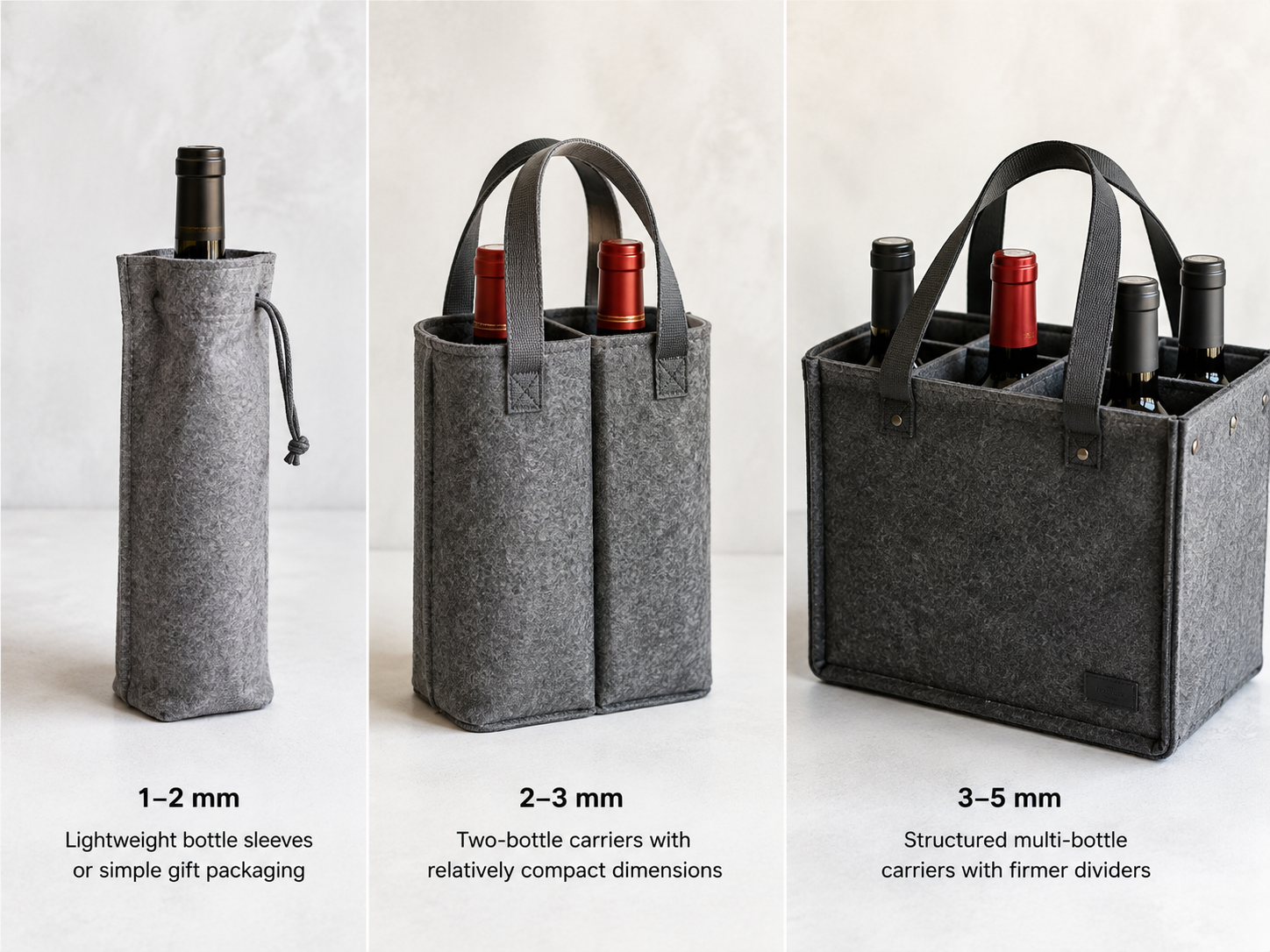
Polyester felt used for bags is available in a wide range of thicknesses, with 1 mm, 2 mm, 3 mm, 4 mm and 5 mm among common commercial options.
For a wine carrier, however, thickness should not be selected by appearance alone.
A thinner felt makes the carrier lighter and easier to fold, but the side panels may collapse once several bottles are loaded. A thicker felt gives the carrier a more structured shape and adds some cushioning, but also increases material consumption, carton volume and unit cost.
A practical starting point looks like this:
| Felt Thickness |
Typical Use Direction |
| 1–2 mm |
Lightweight bottle sleeves or simple gift packaging |
| 2–3 mm |
Two-bottle carriers with relatively compact dimensions |
| 3–5 mm |
More structured multi-bottle carriers or designs requiring firmer dividers |
These are development references rather than fixed load standards.
Two 3 mm felts can still behave differently if their density and stiffness are different. Buyers should therefore approve the actual material sample rather than specifying only “3 mm felt.”
For a multi-bottle carrier, check whether the loaded bag:
- Keeps its side walls upright
- Holds the bottom shape
- Prevents excessive bottle movement
- Recovers reasonably after being folded
- Feels stable when lifted by the handles
If these points are not satisfactory, simply adding another millimeter of felt may not solve the problem. The divider, bottom and handle construction may need to change as well.
Divider Design Matters More Than It First Appears
In a single-bottle bag, there is no need to control bottle-to-bottle contact.
In a four-bottle carrier, there is.
Glass bottles can knock against each other every time the bag is lifted, placed in a car or carried through a store. The divider therefore has two jobs:
- Keep each bottle in its own position.
- Reduce direct glass-to-glass contact.
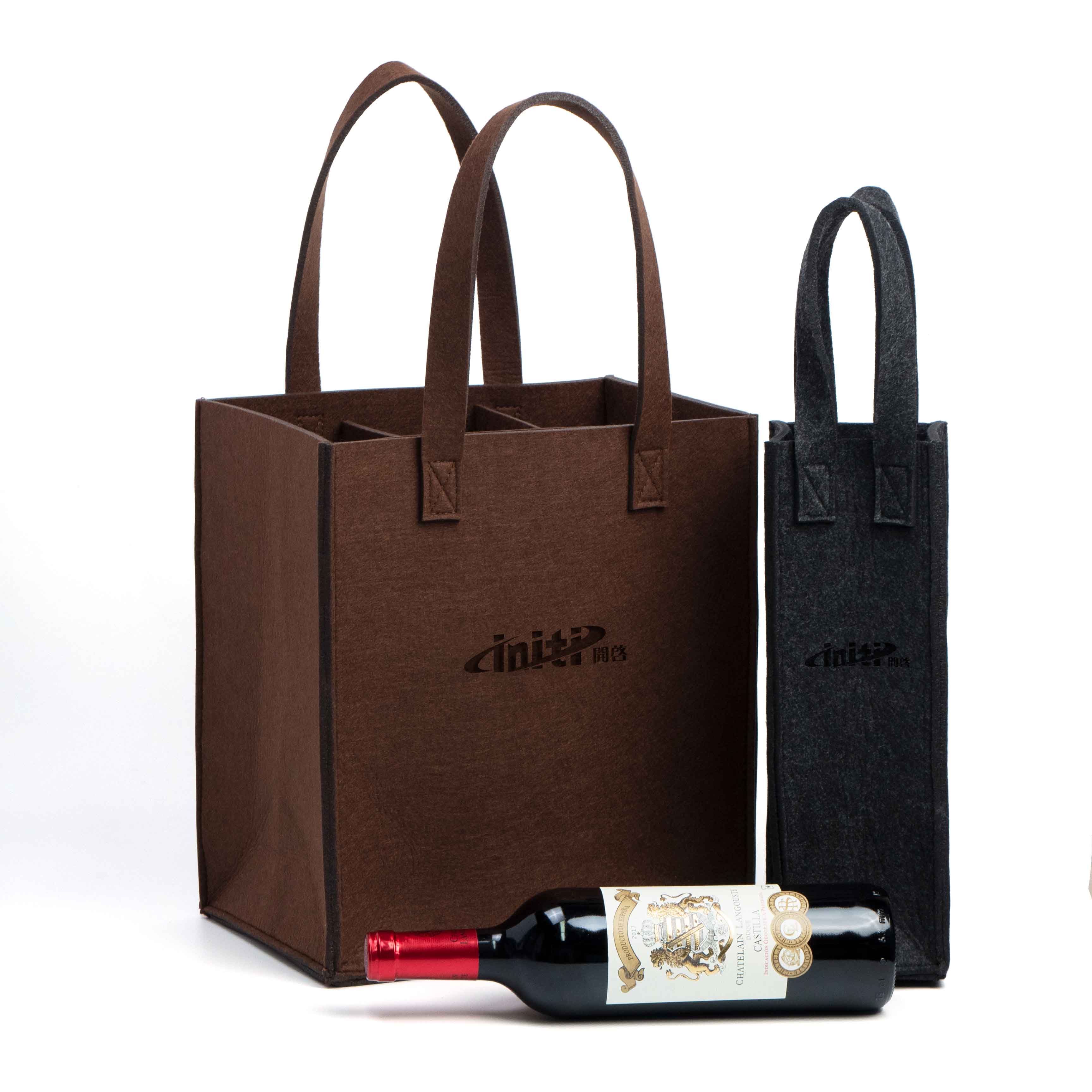
INITI already uses internal partition structures in multi-bottle wine packaging, including its current two-bottle jute wine carrier, where the divider is used specifically to separate the bottles during carrying.
The same principle becomes even more important as bottle count increases.
Simple Vertical Dividers
For a two-bottle bag, one central divider may be enough.
The divider can be:
- Sewn into the side walls
- Attached to the bottom
- Connected only at selected points
- Removable in some custom structures
For normal retail wine bottles, the divider should extend high enough to stop the main bottle bodies from hitting each other. A divider that only covers the bottom few centimeters may keep the bases apart but does little to control movement higher up.
Cross Dividers for Four or Six Bottles
Once the carrier holds four or more bottles, crossed partitions are usually more practical.
A four-bottle layout may use two intersecting divider panels to create four cells.
For six bottles, the structure may use longer longitudinal dividers combined with shorter cross pieces.
The important point is not how many divider pieces are used. It is whether the finished cells match the bottle diameter closely enough.
Too much empty space allows the bottles to swing.
Too little space makes loading difficult and may put excessive pressure on labels or irregular bottle shapes.
Bottle Size Should Be Confirmed Before Finalizing the Divider
“Wine bottle” is not a sufficiently precise size specification.
Bottle diameter, shoulder shape and height vary between Burgundy, Bordeaux, sparkling wine and specialty bottles.
INITI’s existing wine-bag specifications already treat bottle-fit testing as an important part of sample approval because bottle dimensions can vary by region and type.
For a custom felt carrier, buyers should provide either:
- Actual bottle samples, or
- Bottle height and maximum diameter
If several bottle types will use the same carrier, provide the largest expected bottle.
This allows the divider cell size to be developed around the actual product instead of relying on a generic wine-bottle assumption.
The Bottom Panel Carries More Load Than the Side Walls
A four-bottle carrier may easily hold several kilograms once loaded.
That weight is concentrated at the base.
This is why a bag can look perfectly strong when empty but sag badly when bottles are added.
For lightweight designs, the felt body itself may form the bottom. For higher-load designs, several reinforcement options can be considered:
- Double-layer felt
- Thicker felt bottom panel
- Sewn-in reinforcement layer
- Removable PP board
- Cardboard insert for gift-packaging applications
- Covered rigid board for more premium reusable carriers
The correct option depends on whether the carrier is intended primarily as gift packaging or as a reusable transport bag.
A gift carrier may prioritize appearance and cost.
A reusable carrier needs better resistance to repeated lifting and bottom deformation.
A rigid insert can improve standing stability, but it also changes folding and packing efficiency. That trade-off should be checked during sampling rather than added automatically.
Handles and Their Attachment Points Need to Match the Bottle Load
Another common mistake is using strong felt with relatively weak handles.
In practice, the handle attachment is often under more stress than the center of the side panel.
When the bag is lifted, the weight of all bottles transfers through a relatively small attachment area.
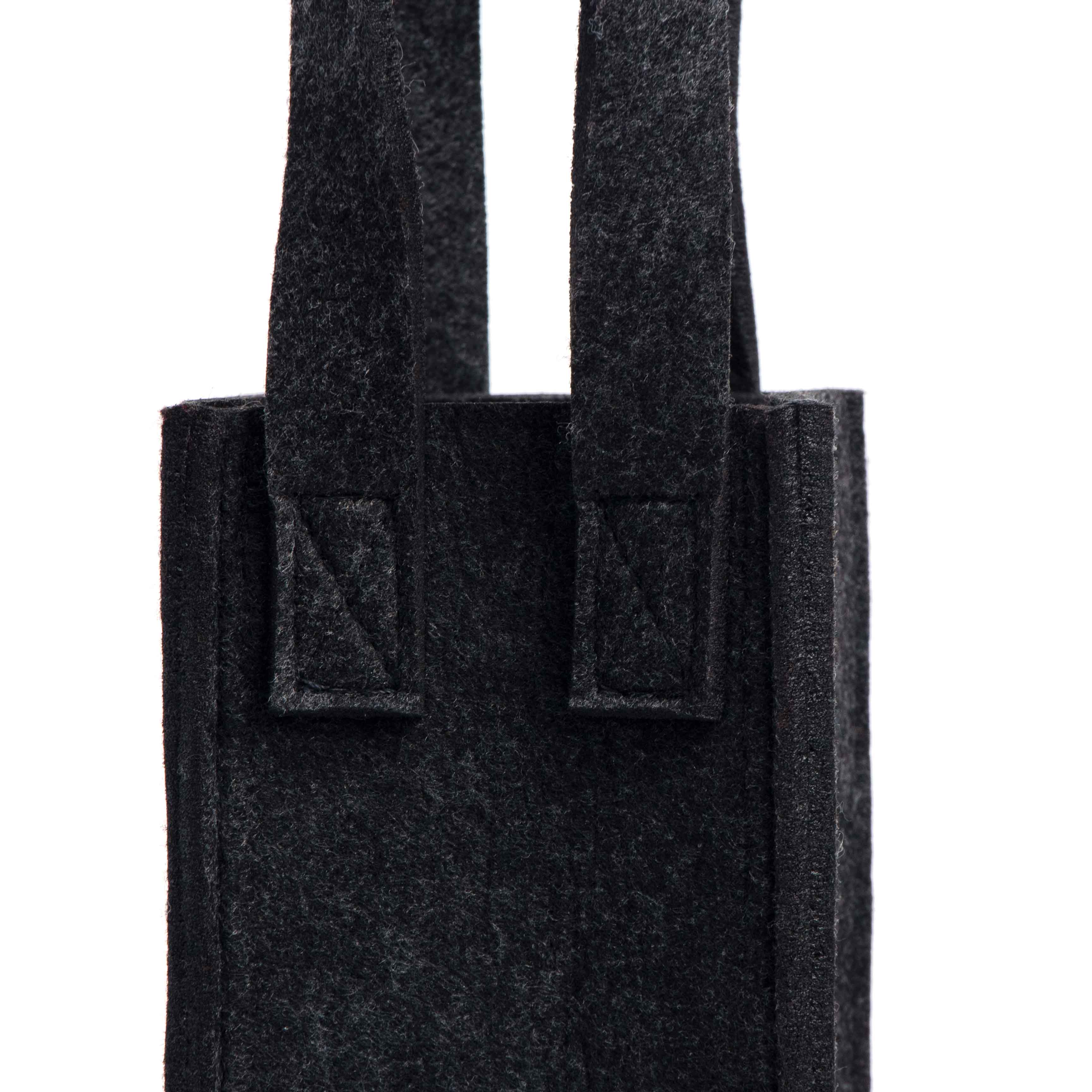
For two-bottle gift carriers, die-cut felt handles or sewn felt handles may work depending on the material.
For heavier four- or six-bottle carriers, buyers may want to evaluate:
- Polyester or PP webbing
- Cotton webbing
- Wider felt handles
- Extended handle attachments
- Reinforcement patches
- Box or cross stitching
The handle should also be wide enough to remain comfortable. A narrow handle carrying several glass bottles can feel uncomfortable even if it does not break.
INITI’s current bag material guidance also treats webbing width, stitching and reinforcement as separate factors in handle strength rather than relying on the body material alone.
Felt Provides Cushioning, but It Is Not Protective Packaging by Itself
Felt is useful for bottle carriers because it has a soft surface and provides some vibration and cushioning control. Polyester needlefelt is used in applications where cushioning is one of the desired material properties.
But buyers should be careful with the word “protection.”
A felt divider can reduce rubbing and direct bottle contact.
It does not turn a soft carrier into a shock-resistant shipping package.
If a bag is dropped, crushed or thrown during logistics, the bottles can still break.
The carrier should therefore be treated as:
- Retail packaging
- Gift packaging
- Hand-carry packaging
- Reusable bottle transport
rather than a replacement for certified protective shipping packaging.
For e-commerce or parcel delivery, additional protective packaging may still be required.
What Should Be Tested on the Sample?
The most useful tests are simple and directly related to how the bag will actually be used.
Fully Loaded Carry Test
Load the intended number of actual bottles and carry the bag by the handles.
Check:
- Handle stretching
- Stitch movement
- Side-wall distortion
- Bottom sagging
- Divider movement
Repeated Lift Test
One successful lift tells very little.
Lift and lower the loaded carrier repeatedly to see whether the handle attachment or seams begin to deform.
Bottle Contact Check
Walk with the loaded carrier and listen for bottle contact.
If the bottles repeatedly knock together, the divider cells may be too large or the divider may not extend high enough.
Standing Test
Place the fully loaded bag on a flat surface.
A well-designed base should remain reasonably stable rather than collapsing into the center.
Fit Test
Insert and remove each intended bottle type several times.
The bottles should fit securely without forcing the divider or damaging labels.
A Practical Specification for Buyers
Instead of sending a supplier a request such as:
“We need a thick felt wine bag for four bottles.”
A better specification would include:
| Item |
Information to Provide |
| Capacity |
2, 4 or 6 bottles |
| Bottle size |
Height and maximum diameter |
| Felt |
Polyester felt / RPET felt / other |
| Thickness |
Target thickness or sample reference |
| Divider |
Number of cells and preferred structure |
| Bottom |
Standard felt, double layer or rigid insert |
| Handles |
Felt, cotton webbing, PP/polyester webbing |
| Load |
Total expected loaded weight |
| Logo |
Printing, embroidery, label or patch |
| Quantity |
Estimated bulk-order quantity |
This gives the supplier enough information to develop the structure around the actual bottle load instead of choosing material thickness in isolation.
FAQ
Is 3 mm felt enough for a four-bottle wine carrier?
It can be, but thickness alone cannot confirm performance. Felt density, bag dimensions, divider structure, bottom reinforcement and handle attachment all affect the finished result.
Should the dividers use the same felt as the outer bag?
Often they can, but they do not have to. A slightly thinner divider may reduce bulk, while a firmer divider can improve bottle separation. The best option should be confirmed through sampling.
Does thicker felt provide better bottle protection?
It generally provides more cushioning and structure, but it does not guarantee better load performance or impact protection.
Should a multi-bottle carrier have a rigid bottom?
Not always. It becomes more useful when the carrier holds several heavy bottles and better standing stability is required.
Can RPET felt be used for wine carriers?
Yes. Recycled polyester felt can be considered when recycled-material positioning is part of the project, but composition, certification requirements, thickness and performance should be confirmed with the supplier.
Conclusion
For multi-bottle felt wine carriers, thickness is only one part of the structure.
A reliable carrier needs the right combination of:
- Felt thickness and density
- Correct bottle-cell dimensions
- Dividers that prevent bottle contact
- A bottom that controls sagging
- Handles and stitching matched to the total load
For most B2B projects, the best way to confirm the design is straightforward: make the sample around the actual bottle dimensions, load it with the intended number of bottles and test the complete carrier before bulk production.
Inquiry Support
For a custom multi-bottle felt wine carrier, send the intended bottle quantity, bottle dimensions, preferred felt thickness, total expected load, divider layout, handle preference, logo artwork and estimated order quantity.
If the structure has not yet been finalized, the bottle size and target quantity are enough to begin recommending a suitable specification.
Related Products
Related Blog Articles


 Hot News