How to Compare Custom Bag Quotations from China
When buyers request quotations from several custom bag suppliers in China, the lowest unit price can appear to be the best offer.
In practice, two quotations may describe very different products even when the product names and reference images look similar.
Differences may exist in:
- Fabric composition
- Fabric weight
- Finished dimensions
- Lining and reinforcement
- Zipper and handle quality
- Printing method
- Packaging
- Quality-control requirements
- Trade terms
- Freight assumptions
- Production tolerance
A quotation should therefore be evaluated as a complete specification and commercial offer—not as a single price per piece.
The first step is to make sure every supplier is quoting the same product.
1. Compare the Product Specification First
A price comparison is only meaningful when the technical specifications are aligned.
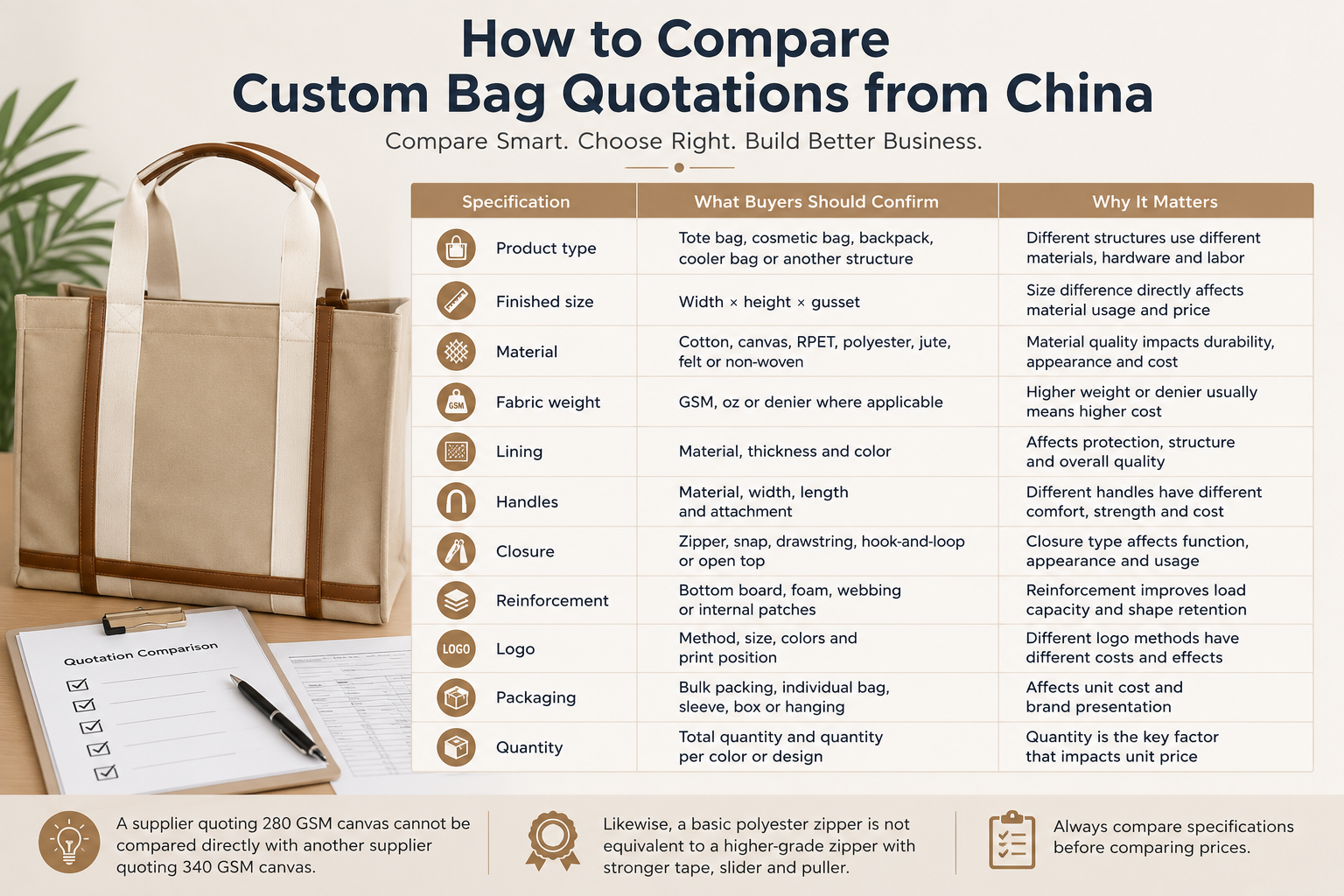
Before comparing quotations, confirm the following information for every supplier:
| Specification |
What Buyers Should Confirm |
| Product type |
Tote bag, cosmetic bag, backpack, cooler bag or another structure |
| Finished size |
Width × height × gusset |
| Material |
Cotton, canvas, RPET, polyester, jute, felt or non-woven |
| Fabric weight |
GSM, oz or denier where applicable |
| Lining |
Material, thickness and color |
| Handles |
Material, width, length and attachment |
| Closure |
Zipper, snap, drawstring, hook-and-loop or open top |
| Reinforcement |
Bottom board, foam, webbing or internal patches |
| Logo |
Method, size, colors and print position |
| Packaging |
Bulk packing, individual bag, sleeve, box or hangtag |
| Quantity |
Total quantity and quantity per color or design |
A supplier quoting 280 GSM canvas cannot be compared directly with another supplier quoting 340 GSM canvas.
Likewise, a basic polyester zipper is not equivalent to a higher-grade zipper with stronger tape, slider and puller.
2. Check Whether the Quotation Matches the Reference Image
Reference images are useful, but they do not define every construction detail.
A supplier may interpret the same image differently regarding:
- Fabric thickness
- Bag dimensions
- Handle length
- Lining
- Padding
- Internal pockets
- Hardware
- Stitching
- Bottom structure
Buyers should ask each supplier to list what is included in the quotation.
A clear quotation should not state only:
Custom canvas tote bag, US$2.20 per piece.
It should state something closer to:
Cotton canvas tote, 38 × 32 × 10 cm, 12 oz fabric, cotton webbing handles, one internal pocket, zipper closure, one-color screen print and individual polybag.
The more complete quotation is easier to compare and less likely to create disputes after sampling.
3. Compare Material Composition and Weight
Material names are often too broad.
For example, “canvas” may refer to:
- 100% cotton canvas
- Cotton-polyester canvas
- Recycled cotton blend
- Washed canvas
- Coated canvas
- Different GSM or oz weights
Similarly, “RPET fabric” does not explain:
- Recycled-content percentage
- Fabric construction
- Coating
- Lining
- Certification
- Finished weight
Buyers should confirm:
- Exact fiber composition
- Fabric weight
- Finished or unfinished weight
- Surface treatment
- Recycled-content percentage
- Certification requirements
- Color method
- Acceptable material tolerance
A lower-priced quotation may use a lighter fabric, lower recycled content or a different coating.
4. Compare Finished Dimensions, Not Approximate Size
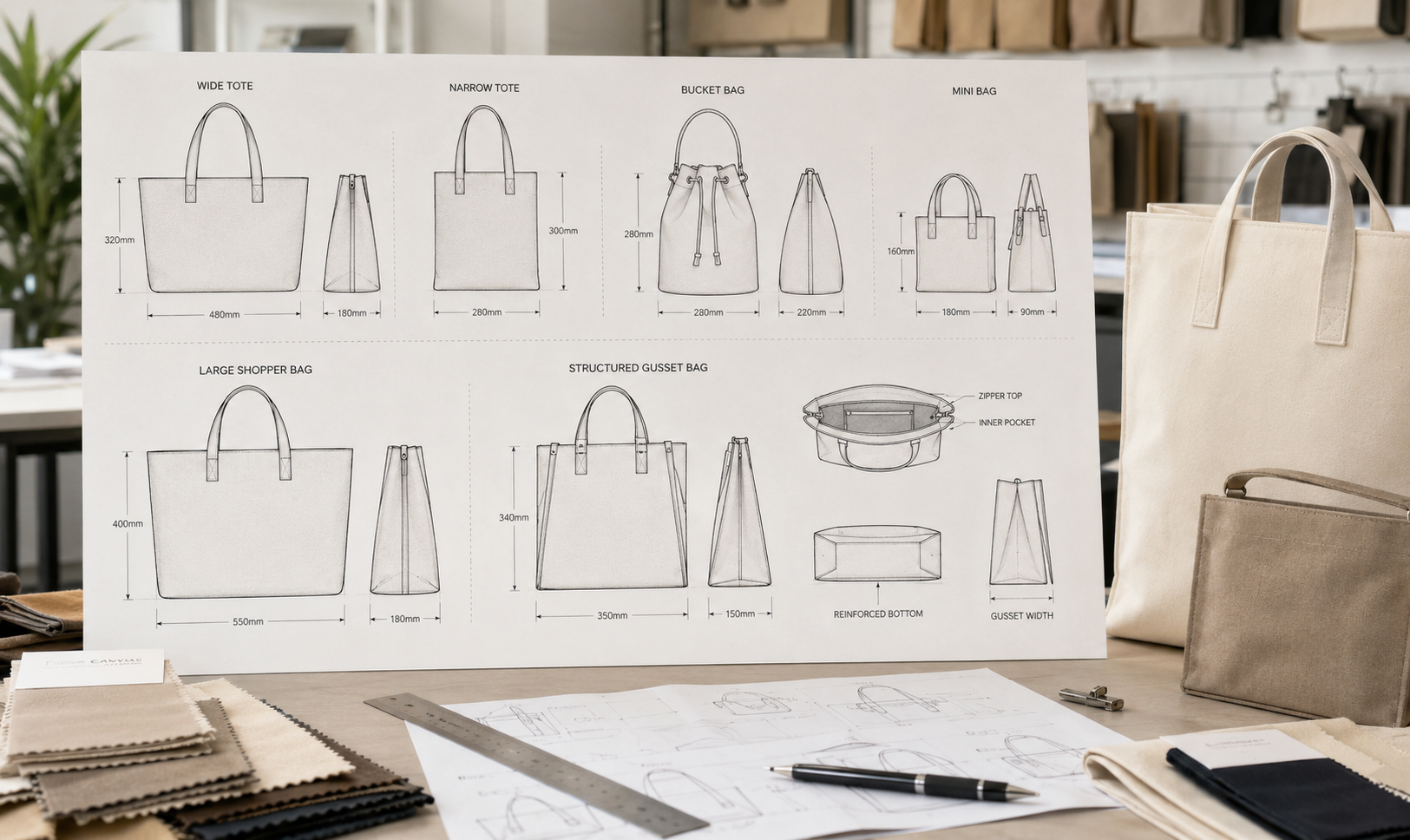
Small dimensional differences can affect both material cost and shipping volume.
For example, these bags may appear similar but use different amounts of fabric:
- 35 × 30 × 8 cm
- 38 × 32 × 10 cm
- 40 × 35 × 12 cm
The larger bag may also require:
- Longer handles
- Wider gussets
- More reinforcement
- Larger printing
- Larger cartons
Buyers should compare:
- Finished dimensions
- Measurement method
- Dimensional tolerance
- Usable internal capacity
- Handle drop
- Pocket dimensions
A quotation should clearly state whether the size is measured flat, externally or internally.
5. Review Handles, Seams and Reinforcement
Handle and seam construction can create major price and performance differences.
Important comparison points include:
Handles
- Body-fabric handles or separate webbing
- Cotton, polyester, nylon or PP webbing
- Handle width
- Handle length
- Attachment depth
- Reinforcement method
Stitching
- Single or double stitching
- Stitch density
- Box or cross stitching
- Bartacks
- Bound seams
- Seam allowance
Bottom Structure
- No reinforcement
- Additional fabric layer
- Foam
- PE board
- Cardboard
- Removable bottom insert
A bag with stronger webbing handles and reinforced stitching may cost more but provide better repeated-use performance.
The buyer should compare the finished construction rather than assuming that the same fabric means the same carrying strength.
6. Confirm the Logo Method
Different logo methods create different costs and results.
Common options include:
- Screen printing
- Heat transfer
- Sublimation
- Embroidery
- Woven labels
- Rubber patches
- Metal plates
- Foil printing
A quotation should specify:
- Logo method
- Number of colors
- Print size
- Print positions
- Artwork coverage
- Setup charges
- Printing tolerance
A one-color screen print should not be compared directly with a full-color heat-transfer print.
Buyers should also confirm whether the quotation includes:
- Printing screens
- Artwork setup
- Color matching
- Logo sample
- Additional print positions
Some suppliers include setup costs in the unit price, while others list them separately.
7. Understand MOQ and Price Breaks
A supplier may quote different prices for:
- 500 pieces
- 1,000 pieces
- 3,000 pieces
- 5,000 pieces
The price difference may come from:
- Fabric purchasing
- Printing setup
- Cutting efficiency
- Sewing-line preparation
- Packaging production
- Accessory MOQ
Buyers should confirm whether MOQ applies:
- Per order
- Per color
- Per size
- Per artwork
- Per SKU
A quotation for 2,000 pieces in one color may not remain valid if the order is divided into four colors.
When comparing suppliers, use the same quantity and color breakdown.
8. Separate Sample Costs from Bulk Prices
Sample pricing is usually higher than bulk unit pricing.
Sample costs may include:
- Pattern development
- Individual material preparation
- Manual cutting
- Printing setup
- Custom accessories
- Revision work
- Courier delivery
Buyers should compare:
- Sample charge
- Sample lead time
- Number of revisions included
- Whether the sample fee is refundable
- Whether the sample uses production material
- Whether bulk production will match the approved sample
A low sample fee is not necessarily an advantage if the sample uses substitute materials or simplified construction.
The approved sample should become the production reference.
9. Compare Packaging Requirements
Packaging can significantly affect the quotation.
Common options include:
- Bulk packing
- Individual polybag
- Recycled polybag
- Paper sleeve
- Hangtag
- Header card
- Retail box
- Printed carton
Buyers should confirm:
- Units per inner pack
- Units per export carton
- Carton dimensions
- Gross and net weight
- Individual packaging material
- Barcode or label requirements
- Carton marking
A lower-priced quotation may use bulk packing, while another supplier includes individual retail packaging.
These quotations are not directly comparable.
10. Check the Trade Term
The price must include a clear trade term.
Common terms include:
EXW
The buyer collects the goods from the supplier’s factory or warehouse.
The buyer normally handles:
- Domestic transport
- Export customs
- Port charges
- International freight
- Import customs
- Final delivery
FOB
The supplier normally delivers the goods to the agreed port and completes export customs clearance.
The buyer handles the main international freight and destination costs.
CIF
The supplier includes sea freight and insurance to the named destination port.
The buyer still needs to confirm destination charges, customs and local delivery.
DDP
The quotation may include transport, import clearance, duties and final delivery, depending on the exact arrangement.
Buyers should confirm what is included rather than relying only on the term.
An EXW price will usually appear lower than an FOB or DDP price.
Quotation comparisons should use the same trade term and destination.
11. Calculate Total Landed Cost
The lowest factory price may not produce the lowest final cost.
A practical comparison should include:
- Product cost
- Sample and tooling charges
- Printing setup
- Packaging
- Domestic transport
- Export charges
- International freight
- Insurance
- Import duty
- Taxes
- Customs clearance
- Destination delivery
- Inspection
- Banking fees
The relevant calculation is:
Total Landed Cost ÷ Usable Quantity
Defective, damaged or incorrect products reduce the usable quantity and increase the actual cost per bag.
For high-volume or bulky products, carton dimensions may affect the final cost as much as the unit price.
12. Review Production Lead Time
Lead time should be divided into separate stages:
- Material preparation
- Sample development
- Sample approval
- Bulk production
- Quality inspection
- Packing
- Transportation
A quotation stating “30 days” may mean:
- 30 days after deposit
- 30 days after sample approval
- 30 days after material arrival
- 30 working days rather than calendar days
Buyers should confirm the starting point and whether the lead time includes packaging.
Custom-dyed fabrics, special zippers and printed packaging may extend the schedule.
13. Compare Quality-Control Standards
A lower price may reflect fewer inspection steps.
Buyers should ask:
- Is incoming material inspected?
- Is a pre-production sample required?
- Are measurements checked during production?
- Are logo colors and positions inspected?
- Is handle strength tested?
- Is final inspection included?
- What inspection standard is used?
- Can a third-party inspection be arranged?
Important quality points may include:
- Finished dimensions
- Fabric weight
- Color variation
- Stitching
- Handle strength
- Zipper operation
- Logo position
- Printing adhesion
- Surface cleanliness
- Packing quantity
The inspection criteria should be agreed before production.
14. Check Payment Terms
Common payment structures may include:
- Deposit with balance before shipment
- Deposit with balance after inspection
- Letter of credit for larger orders
- Platform payment arrangements
- Other negotiated commercial terms
Buyers should compare:
- Deposit percentage
- Balance payment timing
- Bank charges
- Currency
- Payment method
- Conditions for sample approval
- Conditions for shipment release
A low quotation combined with unfavorable payment terms may create greater financial risk.
Payment arrangements should match the order size, supplier relationship and inspection plan.
15. Confirm What Is Not Included
A professional quotation should identify exclusions.
Common excluded costs include:
- Sample courier
- Printing plates
- Molds
- Testing
- Certification
- Barcode labels
- Retail packaging
- Third-party inspection
- Freight
- Duties
- Destination charges
Buyers should request a written list of included and excluded items.
This prevents additional charges from appearing after the order is approved.
Quotation Comparison Checklist
| Area |
Supplier A |
Supplier B |
Supplier C |
| Material composition |
|
|
|
| Fabric weight |
|
|
|
| Finished size |
|
|
|
| Handle construction |
|
|
|
| Seam and reinforcement |
|
|
|
| Lining and pockets |
|
|
|
| Logo method |
|
|
|
| MOQ per color |
|
|
|
| Sample cost |
|
|
|
| Unit price |
|
|
|
| Packaging |
|
|
|
| Trade term |
|
|
|
| Carton dimensions |
|
|
|
| Lead time |
|
|
|
| Inspection included |
|
|
|
| Payment terms |
|
|
|
| Additional charges |
|
|
|
A comparison table makes specification differences visible before supplier selection.
Common Quotation Comparison Mistakes
Comparing Only Unit Price
The unit price does not show material, packaging, trade terms or quality risk.
Using Different Specifications
Suppliers may quote different GSM, dimensions, zippers or printing methods.
Ignoring MOQ per Color
A total quantity may not satisfy the minimum for each color or design.
Ignoring Carton Volume
Bulky bags can create high freight and storage costs.
Accepting an Undefined Material
Terms such as “canvas,” “RPET” or “premium polyester” require further specification.
Skipping Sample Approval
Digital images cannot confirm hand feel, thickness, construction or printing quality.
Ignoring Additional Charges
Testing, tooling, packaging and freight may be excluded.
Selecting the Cheapest Supplier Automatically
The lowest initial quotation may create higher defect, delay or communication risk.
Questions to Ask Each Supplier
Before selecting a quotation, ask:
- What exact material and fabric weight are included?
- Does the price match the requested dimensions?
- What handle and reinforcement construction is used?
- What logo process and print size are included?
- Is MOQ calculated per color, size or artwork?
- What packaging is included?
- What is the trade term?
- What carton dimensions and quantities are expected?
- What additional charges are excluded?
- What is the sample lead time?
- Will the sample use the same material as bulk production?
- What quality checks are included?
- Can a third-party inspection be arranged?
- When does the production lead time begin?
- What are the payment terms?
How INITI Supports Quotation Comparison
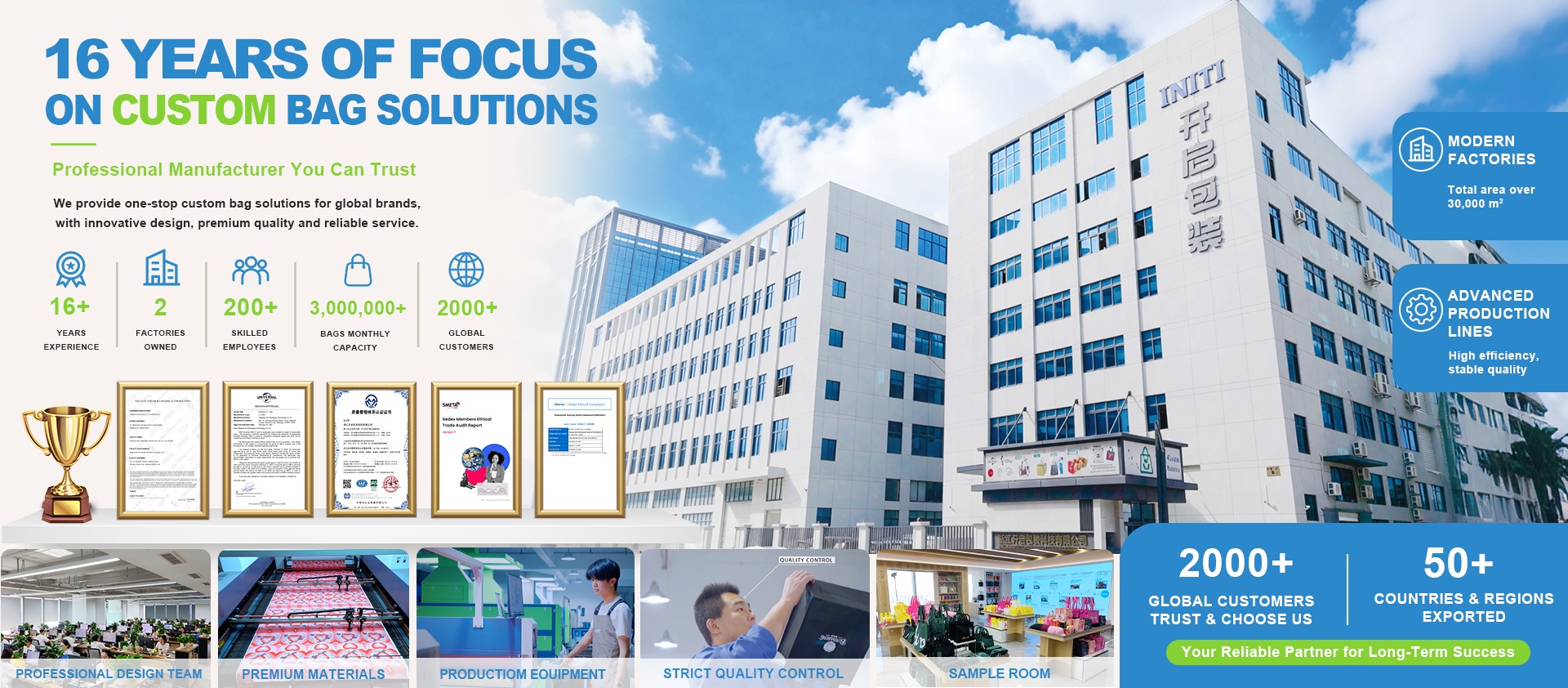
Hangzhou INITI Imp&Exp Co., Ltd. has 16 years of experience in custom bag and packaging development, supported by two production facilities and management or compliance systems including SEDEX, DISNEY, GRS, HIGG and ISO9001.
Our quotation process can include:
- Detailed material specifications
- Custom dimensions
- Fabric weight confirmation
- Handle and seam construction
- Printing and logo options
- Packaging requirements
- MOQ and price-break comparison
- Sample development
- Production inspection
- Export packing information
For buyers comparing several product options, INITI can provide a standard specification together with alternative material, structure or packaging options where appropriate.
This helps buyers understand which changes affect price, MOQ, performance and lead time.
FAQ
Why do quotations for the same bag vary significantly?
The suppliers may be quoting different materials, fabric weights, dimensions, accessories, printing methods, packaging or trade terms.
Should buyers always choose the lowest quotation?
No. Buyers should compare the complete specification, total landed cost, sample quality, production control and supplier reliability.
How can buyers make quotations easier to compare?
Send the same specification sheet, quantity, artwork, packaging requirement and trade term to every supplier.
Is FOB better than EXW for comparison?
Neither is automatically better, but all quotations should use the same term. FOB often makes export-cost comparison easier for international buyers managing their own freight.
What should be approved before placing an order?
Approve the material, dimensions, construction, logo, color, packaging, sample, quality standard, lead time, payment terms and trade term in writing.
Conclusion
Custom bag quotations from China should be compared line by line, not price by price.
A reliable comparison requires alignment of:
- Material
- Fabric weight
- Dimensions
- Handles
- Seams
- Accessories
- Printing
- Packaging
- MOQ
- Trade terms
- Lead time
- Quality control
The best quotation is not necessarily the cheapest. It is the offer that provides the required product, clear commercial conditions and acceptable total landed cost with controlled production risk.
Inquiry Support
To receive an accurate quotation, please provide:
- Logo artwork
- Estimated quantity
- Preferred size or reference dimensions
- Required colors
- Packaging requirements
If you have not finalized all details, you can first send your intended use and target quantity, and we can recommend a suitable specification.
Related Products
Related Blog Articles


 Hot News