Packaging Data Checklist for Custom Bag Importers: Materials, Weight, Recycled Content and Supplier Evidence
Packaging compliance is increasingly becoming a data-management issue as well as a product-design issue.
For importers buying RPET bags, cotton packaging bags, paper bags or other custom packaging, information such as “100% RPET” or “300 GSM cotton” may no longer be enough for internal compliance records.
Buyers increasingly need structured data covering:
- Material composition
- Individual component weights
- Total packaging weight
- Plastic polymer type
- Recycled-content percentage
- Reusable status
- Supplier identity
- Evidence supporting material claims
- Production batch or specification reference
This is particularly relevant for buyers selling into the EU and UK.
The EU Packaging and Packaging Waste Regulation (PPWR), Regulation (EU) 2025/40, applies from 12 August 2026. It introduces conformity, technical-documentation and supply-chain information requirements for packaging.
In the UK, Extended Producer Responsibility for packaging already requires affected organisations to collect packaging information by material and weight and retain the supporting evidence.
For importers, the practical response is simple:
Start collecting packaging data at the quotation and sampling stage instead of requesting it after the goods have shipped.
Step 1: First Confirm Whether the Bag Is Packaging
Not every bag is legally considered packaging.
A reusable tote sold as a standalone consumer product may be treated differently from a bag supplied to contain, protect, deliver or present another product.
Under the EU PPWR, classification depends primarily on the function and intended use of the item. The European Commission specifically confirms that textile dust bags used to contain, protect, handle, deliver or present shoes or garments can qualify as packaging.
This distinction matters for products such as:
Before collecting compliance data, record:
| Field |
Example |
| Product |
RPET shopping bag |
| Intended use |
Customer carries purchased retail goods |
| Sold separately? |
No |
| Supplied with another product? |
Yes |
| Packaging classification |
To be confirmed by importer |
| Target market |
EU / UK |
Do not ask the supplier to make the final legal classification unless this responsibility has been specifically assigned to them.
The Core Packaging Data Checklist
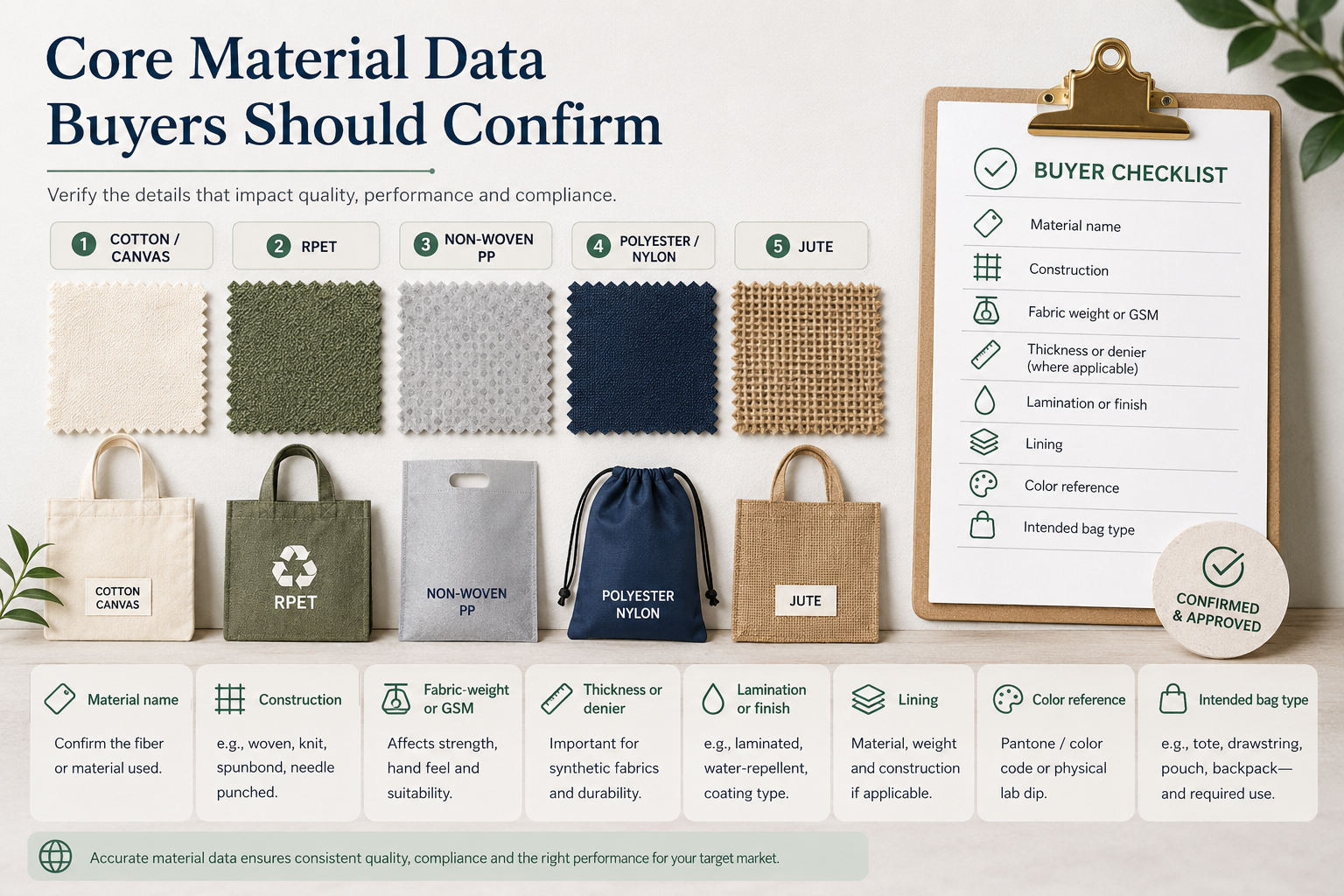
For every custom bag used as packaging, buyers should create one specification record containing the following fields.
1. Material Composition
Do not record only a general material name such as:
- RPET
- Canvas
- Paper
- Non-woven
- Polyester
Break the product into components.
| Component |
Material |
| Main body |
Recycled polyester |
| Lining |
Polyester |
| Handles |
Polyester webbing |
| Sewing thread |
Polyester |
| Zipper |
Polyester coil + metal slider |
| Bottom reinforcement |
PP board |
| Logo |
Screen-printing ink |

| Component |
Material |
| Main fabric |
100% cotton canvas |
| Handles |
Cotton webbing |
| Thread |
Polyester |
| Zipper |
Polyester + metal |
| Internal coating |
None |

| Component |
Material |
| Main body |
Paper |
| Lamination |
Plastic film |
| Handles |
Polyester rope |
| Reinforcement card |
Paperboard |
| Printing |
Ink |
The objective is to create a component-level bill of materials, not simply a marketing description.

2. Record Packaging Weight
Weight should be recorded as part of the product specification.
For UK EPR, affected producers report packaging material weight in kilograms, separated according to the relevant material categories. These currently include paper or cardboard, plastic, wood, aluminium, steel, glass, fibre-based composite and other materials.
For sourcing purposes, buyers should request both:
Finished Unit Weight
Example:
Finished bag weight: 96 g ± 5 g
Component Weight
Where practical:
| Component |
Weight |
| RPET body fabric |
70 g |
| Handles |
12 g |
| Zipper |
6 g |
| Bottom board |
5 g |
| Other components |
3 g |
| Total |
96 g |
Component-level weight becomes especially important for multi-material products.
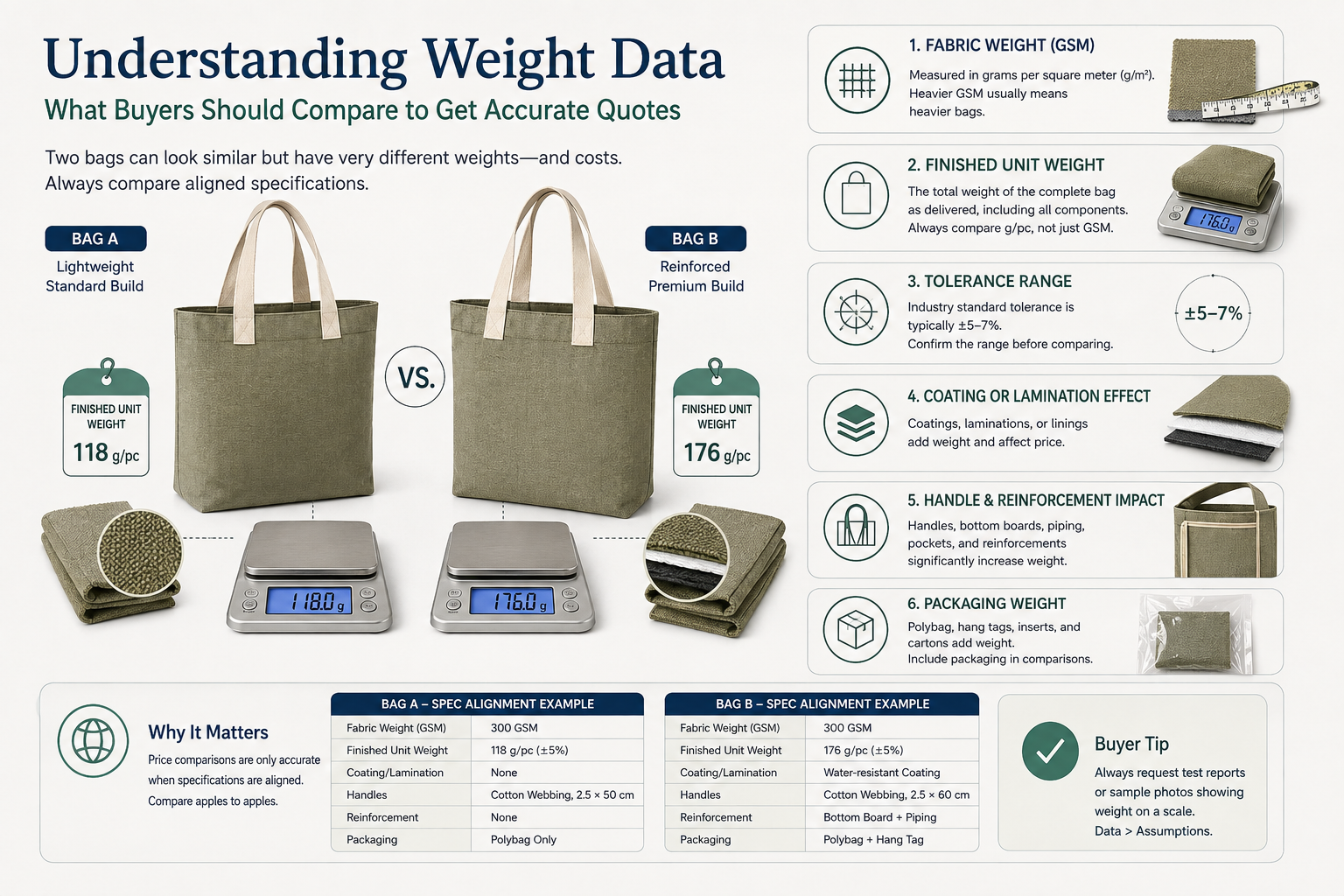
Avoid Using GSM as Packaging Weight
GSM and finished-product weight are different measurements.
For example:
300 GSM cotton canvas
describes the mass of one square metre of fabric.
It does not tell the buyer how much cotton is contained in one finished bag.
Packaging records should therefore contain both where relevant:
- Fabric GSM
- Finished-unit weight
3. Identify the Main Material Correctly
Multi-material packaging can require classification decisions.
Under current UK EPR guidance, composite packaging is generally reported by its full packaging weight under the material that represents the greatest weight, subject to specific rules for fibre-based composites.
From 1 January 2026, UK guidance treats fibre-based packaging containing more than 5% plastic by mass as fibre-based composite; at 5% or less plastic, it is classified as paper or cardboard for this reporting purpose.
This makes accurate component weights useful for products such as:
- Laminated paper bags
- Coated paper gift boxes
- Paper bags with plastic windows
- Multi-layer packaging
- Paper-plastic composite structures
A statement such as “paper bag with lamination” may therefore be insufficient for a UK buyer.
4. Record Recycled Content Separately
For recycled materials, record an actual percentage.
Avoid supplier statements such as:
- Eco material
- Recycled bag
- Sustainable polyester
- Made from recycled bottles
Instead record:
Main body: 100% recycled polyester fiber
or:
Plastic packaging component: 50% recycled plastic by weight
The percentage should specify what it applies to.
For example:
100% recycled polyester fabric
does not necessarily mean:
100% recycled finished bag
because the finished bag may also contain virgin:
- Thread
- Webbing
- Zippers
- Coatings
- Lamination
- Reinforcement
- Hardware
5. UK Plastic Packaging: Record the Recycled Percentage Carefully
The UK's Plastic Packaging Tax currently applies to relevant finished plastic packaging containing less than 30% recycled plastic, subject to the registration threshold and other rules.
HMRC requires businesses relying on recycled content to retain evidence showing:
- How the recycled percentage was calculated
- Which packaging component it applies to
- Which production line or production run it relates to
- The source of the recycled material
- Which dates the evidence covers
For importers, a useful supplier declaration should therefore contain:
| Field |
Example |
| Product code |
RB-105 |
| Plastic type |
PET |
| Total plastic weight |
82 g |
| Recycled plastic weight |
65.6 g |
| Recycled percentage |
80% |
| Recycled material source |
Supplier production record |
| Production batch |
2026-08-05-A |
| Evidence date |
5 August 2026 |
HMRC also states that imported plastic packaging containing at least the required recycled percentage should be supported either by evidence from the manufacturer or by a robust supply-chain audit capable of substantiating the claim.
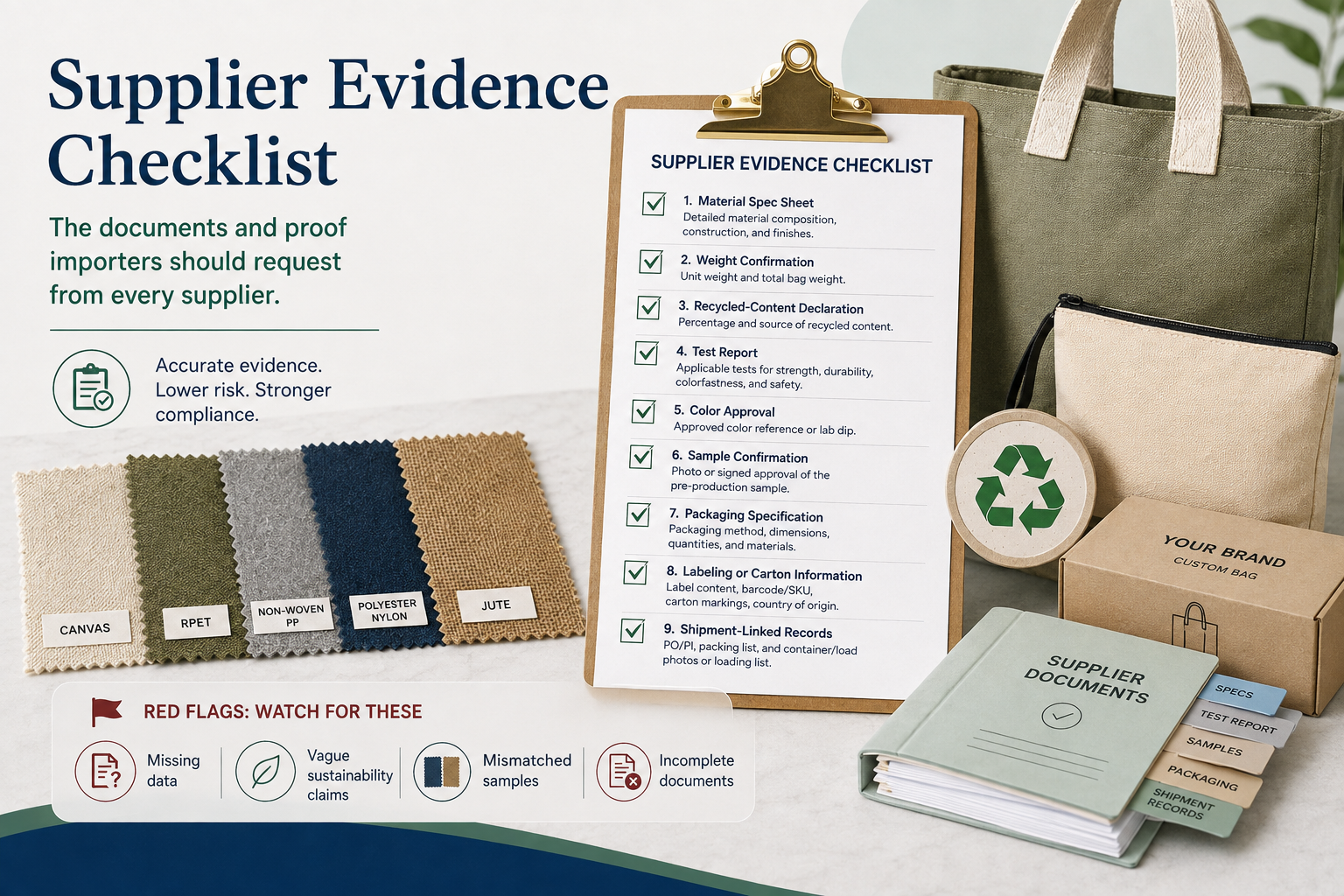
6. Ask for Evidence, Not Only a Certificate
One common procurement mistake is asking:
Do you have GRS?
and treating the answer as complete proof of the finished product.
A supplier certificate can be useful, but the buyer should match evidence to the specific claim being made.
A stronger evidence package may include:
Material Specification
Showing:
- Fiber or polymer
- GSM or thickness
- Recycled percentage
- Supplier
- Material code
Product Bill of Materials
Showing:
- Main fabric
- Handles
- Lining
- Zipper
- Reinforcement
- Lamination
- Packaging
Weight Record
Showing:
- Finished-unit weight
- Component weight where required
- Measurement method
- Weight tolerance
Supplier Declaration
Identifying:
- Product
- Specification
- Material composition
- Recycled percentage
- Production batch
- Date
Recycled-Material Certification
Where required by the buyer or claim:
- Current certificate
- Relevant material scope
- Appropriate transaction or shipment evidence where applicable
Purchase and Production Records
Such as:
- Raw-material purchase order
- Material invoice
- Batch record
- Production record
The key principle is:
The evidence should be traceable to the product being imported.
7. EU Buyers Should Build a Technical File, Not a Folder of Random Certificates
Under the PPWR, packaging manufacturers must ensure conformity with applicable requirements and prepare technical documentation and an EU declaration of conformity. Suppliers are also required to provide the information and documentation needed to support that process.
The European Commission's June 2026 guidance also clarifies that responsibility can depend on branding and supply-chain roles. A company having packaging manufactured under its own name or trademark can be considered the manufacturer under the PPWR in relevant circumstances.
For importers and brand owners, supplier data should therefore be organized by SKU or packaging specification.
A basic technical file can contain:
- Product drawing
- Material BOM
- Component weights
- Material specifications
- Recycled-content evidence
- Test reports where relevant
- Supplier declaration
- Approved production sample reference
- Production batch information
- Revision history
This is significantly more useful than keeping unrelated certificates in one generic supplier folder.
8. Reusable Bags Need Their Own Data
“Reusable” should not be treated as a substitute for material reporting.
Under UK EPR guidance, reusable packaging is reported the first time it is supplied and is additionally identified as reusable packaging under the relevant reporting structure.
Therefore, buyers sourcing reusable:
- RPET bags
- Transport bags
- Shopping bags
- Reusable packaging totes
should record both:
Material information
and
Reusable status
rather than assuming reusable packaging falls outside reporting requirements.
9. UK Buyers Should Keep Source Data Traceable
Current UK EPR guidance requires obligated organisations to retain packaging data and supporting evidence for at least seven years.
This makes supplier document control important.
Avoid receiving files named:
material.pdf
Instead use a traceable reference such as:
RB105_RPET80_MaterialDeclaration_Batch20260805.pdf
Each document should ideally identify:
- Supplier
- Product code
- Material code
- Specification revision
- Production batch
- Date
If the material changes, create a new record rather than overwriting the old specification.
For UK Plastic Packaging Tax purposes, HMRC likewise requires separate evidence when the specification or materials used for a packaging component change.
Packaging Data to Request at Each Purchasing Stage
RFQ Stage
Request:
- Main material
- Fiber/polymer composition
- GSM or thickness
- Estimated finished weight
- Recycled percentage
- Lamination/coating
- Main accessories
The purpose is to compare quotations on the same basis.
Sampling Stage
Confirm:
- Final material code
- Actual finished weight
- Component structure
- Recycled-content claim
- Printing
- Handles
- Lining
- Lamination
- Reinforcement
The approved sample should match the written specification.
Before Bulk Production
Collect:
- Final BOM
- Final material declaration
- Recycled-content evidence
- Relevant certificates
- Approved sample reference
- Production specification revision
Before Shipment
Confirm:
- Production batch
- Quantity
- Material has not changed
- Weight remains within specification
- Required transaction/batch evidence is available
- Final product declaration matches the actual goods
This reduces the risk of requesting compliance documentation after the container has already departed.
Supplier Packaging Data Template
Buyers can send the following table directly to suppliers.
| Required Field |
Supplier Information |
| Product name / SKU |
|
| Intended packaging use |
|
| Finished unit weight |
|
| Main material |
|
| Fiber or polymer |
|
| Main material weight |
|
| Recycled content % |
|
| Source of recycled content |
|
| Fabric GSM / thickness |
|
| Lining material |
|
| Handle material |
|
| Lamination / coating |
|
| Zipper / closure material |
|
| Reinforcement material |
|
| Total plastic weight |
|
| Total paper weight |
|
| Other material weight |
|
| Reusable packaging |
Yes / No |
| Material certificate |
|
| Recycled-content evidence |
|
| Production batch |
|
| Specification revision |
|
| Declaration date |
|
Not every buyer will legally need every field.
The purpose of the checklist is to collect enough upstream data so that the importer can determine which information is relevant to its own reporting obligations.
Three Common Data Problems
“100% RPET” Without Defining the Component
Ask whether this refers to:
- Fabric only
- All polyester components
- All plastic components
- Entire finished product
“Paper Bag” Without Lamination Weight
For laminated paper packaging, request the paper and plastic components separately.
This becomes particularly useful when determining reporting classification or recyclability.
Supplier Certificate Does Not Match the Product
Check:
- Supplier legal entity
- Certificate validity
- Material scope
- Product scope
- Batch or transaction evidence where required
A certificate showing that a factory can source recycled material is not automatically evidence that a specific shipment contains the claimed recycled percentage.
Why This Checklist Matters for Importers
EU and UK packaging rules increasingly depend on measurable product information rather than broad material descriptions.
For custom bag buyers, the most important change in purchasing practice is therefore not necessarily selecting a different material.
It is improving the quality of the data attached to that material.
A well-prepared purchasing file should allow the importer to answer four questions quickly:
- What is the bag made from?
- How much does each relevant material weigh?
- What recycled content is actually claimed?
- What evidence supports that claim?
When these questions are answered during product development, later EPR, tax, customer compliance and supplier-audit work becomes substantially easier.
FAQ
Does every custom bag count as packaging?
No. Classification depends on the bag's function and intended use. A bag used to contain, protect, deliver or present another product may be packaging, while a standalone bag sold as the product itself may be treated differently. EU PPWR guidance specifically emphasizes functional classification.
Is GSM enough for packaging reporting?
No. GSM describes material mass per area. Buyers should also record finished-unit weight and, where required, component material weights.
Is a recycled-material certificate enough to prove recycled content?
Not always. Evidence should be linked to the relevant material, product specification and production or shipment. UK HMRC guidance specifically requires supporting evidence for recycled-content calculations.
Should RPET fabric and the finished bag use the same recycled-content percentage?
Only if the evidence supports it. A 100% RPET main fabric does not mean zippers, handles, coatings and other components are also recycled.
When should importers request packaging data?
Start at RFQ stage, finalize it during sampling and confirm it again before production and shipment.
Conclusion
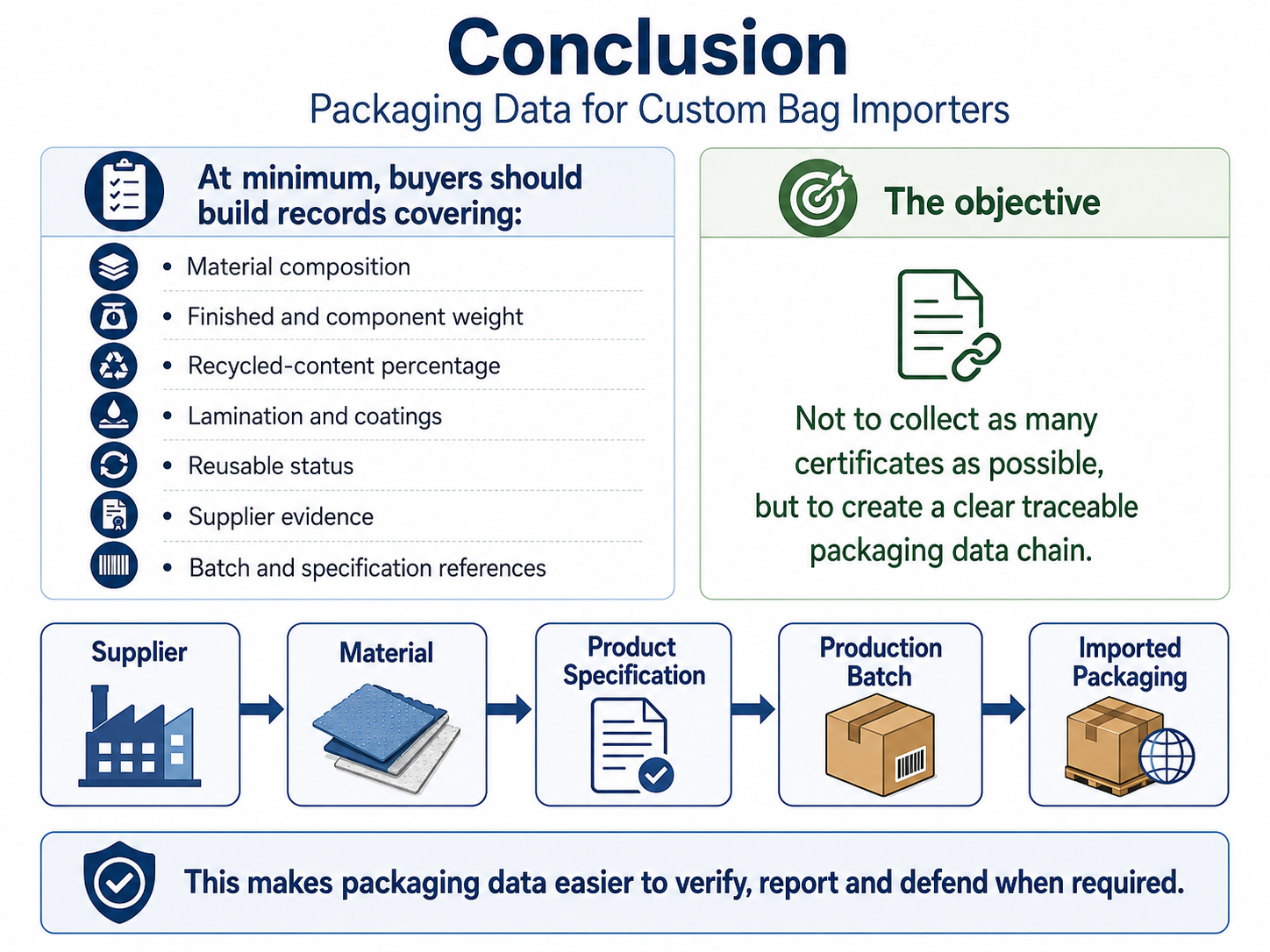
For custom bag importers, a good packaging specification now needs more than size, color and logo.
At minimum, buyers should build records covering:
- Material composition
- Finished and component weight
- Recycled-content percentage
- Lamination and coatings
- Reusable status
- Supplier evidence
- Batch and specification references
The objective is not to collect as many certificates as possible.
It is to create a clear chain from:
Supplier → Material → Product Specification → Production Batch → Imported Packaging
That makes packaging data easier to verify, report and defend when required.
Inquiry Support
For projects requiring detailed material documentation, provide:
- Bag type
- Estimated quantity
- Target market
- Preferred material
- Recycled-content requirements
- Required certifications
- Packaging use
- Logo and printing requirements
- Packaging requirements
If your documentation requirements have not been finalized, you can first provide the target market and intended packaging use so the required material and supplier-data fields can be identified during product development.
Related Products
Related Blog Articles





 Hot News