Eco-Friendly Packaging Trends in Retail Industry
Sustainable packaging has been discussed for years, but the current shift in retail packaging is no longer based only on environmental marketing.
The direction is increasingly visible in three places:
- consumer research,
- packaging and carrier-bag data,
- and new packaging regulations.
In 2023, the European Union generated 79.7 million tonnes of packaging waste, equal to 177.8 kg per person. Paper and cardboard represented 40.4% of that waste, while plastic accounted for 19.8%. At the same time, EU consumption of lightweight plastic carrier bags fell from 95 bags per person in 2018 to 65 in 2023.
The same change is visible in England. Government data shows that the number of single-use carrier bags sold by the main retailers in 2024–2025 was almost 98% lower than before the carrier-bag charge was introduced.
Consumer research points in the same general direction, although with an important qualification. McKinsey’s 2025 global packaging survey covered 11,136 consumers in 11 countries. Recyclability ranked as the most important sustainability characteristic across every surveyed country, while reusable packaging and recycled-content packaging also ranked highly.
The result is not simply a move from plastic to paper.
The stronger trend is a move from:
single-use, excessive and difficult-to-recycle packaging
toward:
recyclable, reusable, recycled-content and material-efficient packaging systems.
For retailers and packaging buyers, this distinction matters.
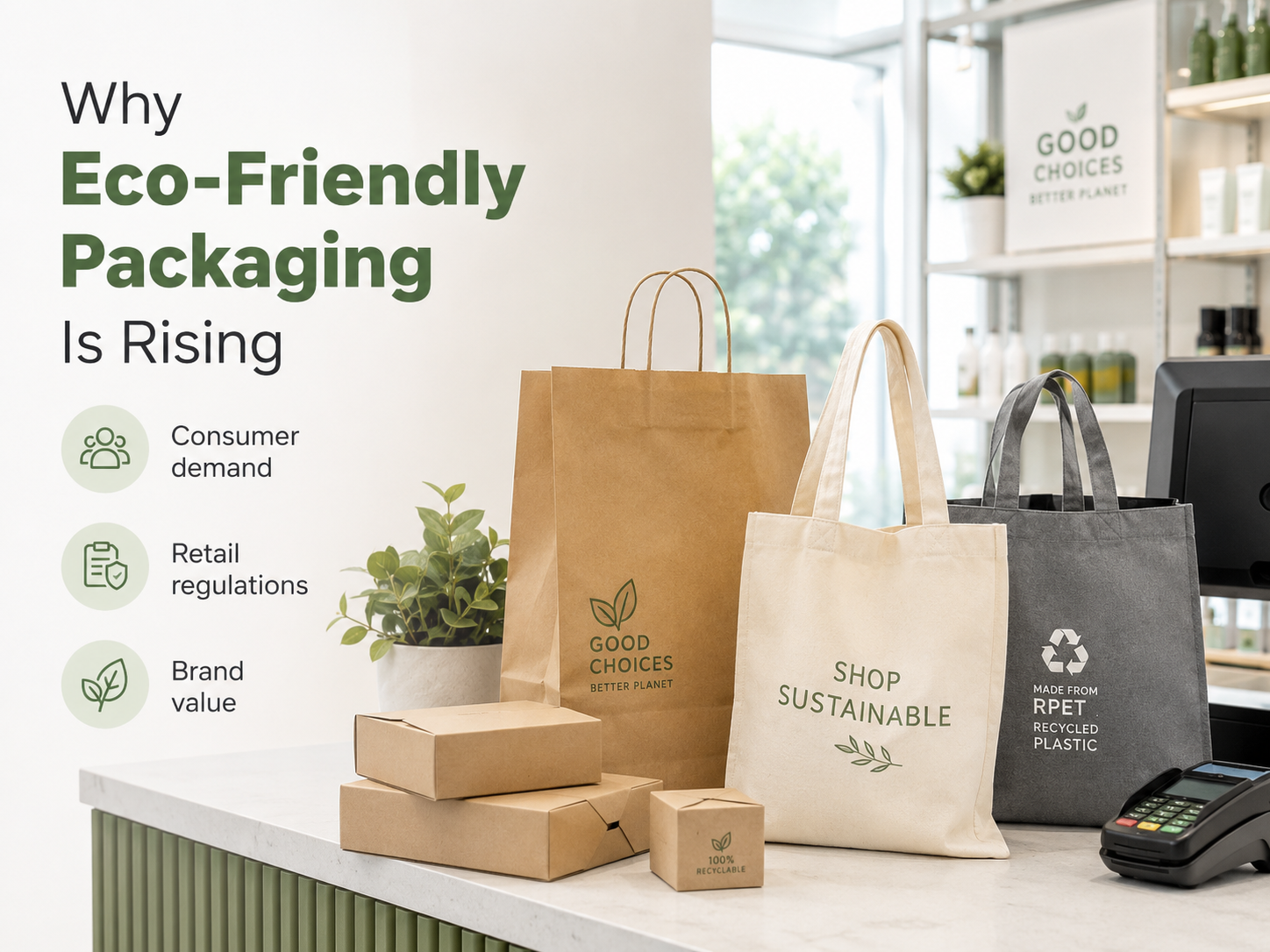
Why Is Eco-Friendly Packaging Becoming a Long-Term Retail Trend?
1. Packaging Waste Is Too Large to Ignore
Retail packaging is part of a much larger waste problem.
EU data shows that packaging waste reached 79.7 million tonnes in 2023. Paper and cardboard accounted for 32.3 million tonnes, while plastic packaging waste reached 15.8 million tonnes.
The size of this waste stream creates pressure on:
- governments,
- retailers,
- packaging manufacturers,
- brand owners,
- and recycling systems.
This is one reason why packaging strategy is shifting from the simple question:
What is the cheapest packaging?
toward a more complex question:
Can this packaging use less material, be reused, contain recycled material or enter an established recycling system?
2. Consumer Preference Is Moving Toward Circularity
Sustainable packaging does not automatically become a purchasing priority simply because it is described as environmentally friendly.
The data is more nuanced.
McKinsey’s 2025 research found that price and quality remain stronger purchasing factors than sustainability. In Europe, 42% of surveyed consumers still rated packaging environmental impact as extremely or very important, but food safety, shelf life and other practical factors ranked higher.
This means retailers should not interpret the sustainable packaging trend as:
Consumers will accept any product as long as it is eco-friendly.
A better interpretation is:
Consumers increasingly expect sustainability to be combined with price, quality and functionality.
When consumers were asked specifically about sustainability characteristics, the clearest preference was circularity. Recyclability ranked first globally, while reusability and recycled content also ranked strongly.
For custom bag buyers, this is an important signal.
The strongest product opportunities are not necessarily products that simply look natural. They are products with a clear and understandable value proposition such as:
- reusable,
- made with recycled content,
- recyclable in the target market,
- lightweight,
- or designed with less unnecessary material.
3. Regulation Is Moving in the Same Direction
The EU Packaging and Packaging Waste Regulation is pushing packaging design toward less waste, increased recycled content, recyclability and reuse.
The European Commission states that the regulation will begin to apply from mid-2026. Its direction includes recycled-content requirements for plastic packaging, recyclability requirements for packaging by 2030, reduced unnecessary packaging, and greater support for reuse and refill systems.
For retail buyers, this creates a structural shift.
Packaging projects increasingly need to consider:
- material composition,
- recycled content,
- end-of-life options,
- excessive empty space,
- unnecessary components,
- and packaging weight.
This makes sustainable packaging less of a temporary design trend and more of a long-term procurement issue.
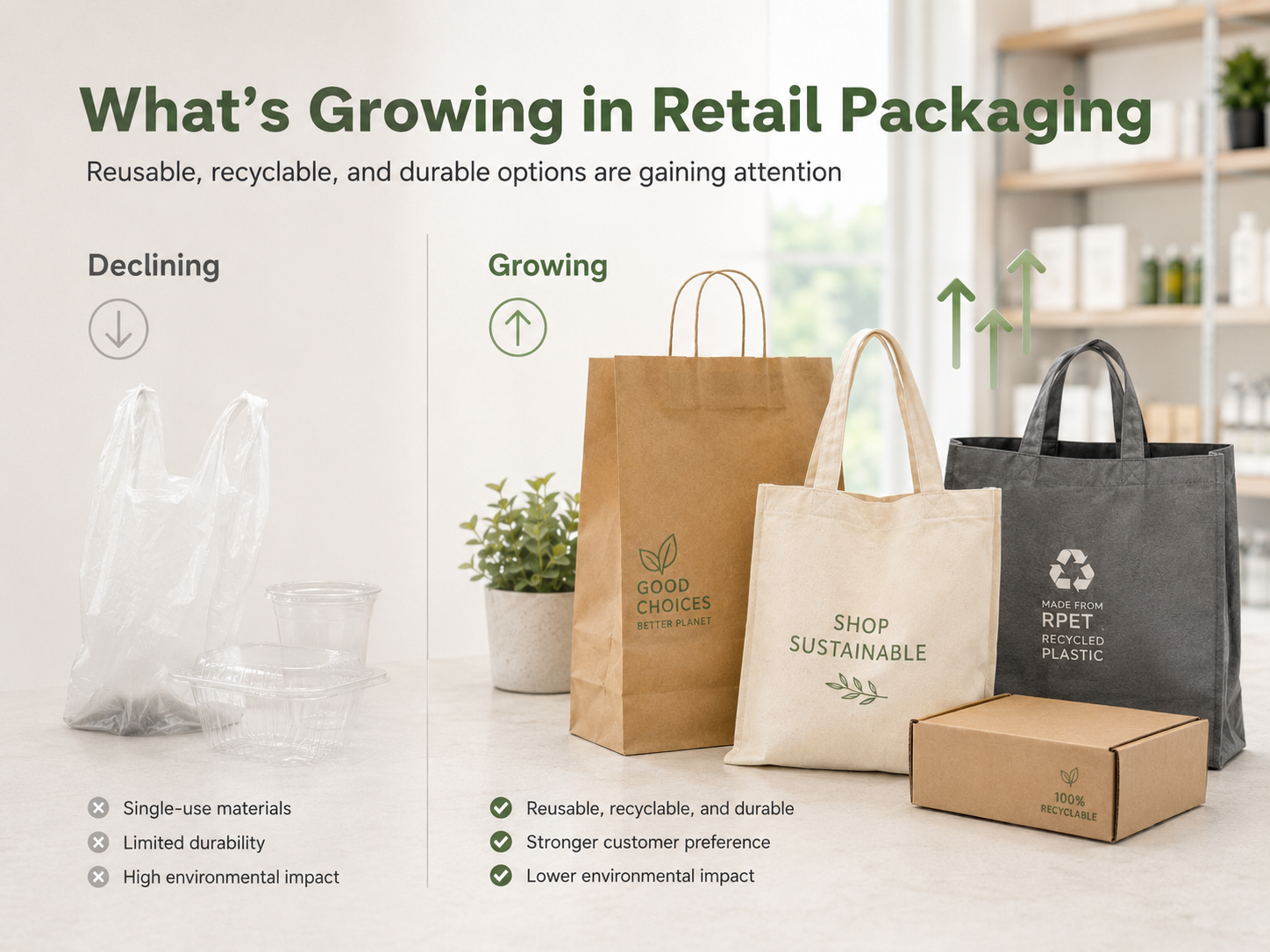
What Packaging Trends Are Clearly Growing Stronger?
The available data does not prove that every product labelled “eco-friendly” is growing.
The strongest evidence supports several more specific directions.
Trend 1: Reusable Shopping Bags Are Replacing Part of the Single-Use Bag Market
The decline of lightweight single-use carrier bags is one of the clearest measurable changes in retail packaging.
EU consumption decreased from 95 lightweight plastic carrier bags per person in 2018 to 65 in 2023.
In England, the main retailers sold almost 98% fewer single-use plastic carrier bags in 2024–2025 than before the carrier-bag charge was introduced.
This does not mean every reusable bag automatically becomes a successful product.
It does mean retailers need alternatives.
For custom bag projects, the most relevant formats include:
Suitable for retailers wanting a clear recycled-content story.
Suitable for supermarkets and grocery projects requiring larger capacity and repeated use.
Suitable for convenience, loyalty programs and travel use where portability matters.
Suitable for lifestyle retail, bookstores, fashion brands and premium promotional programs.
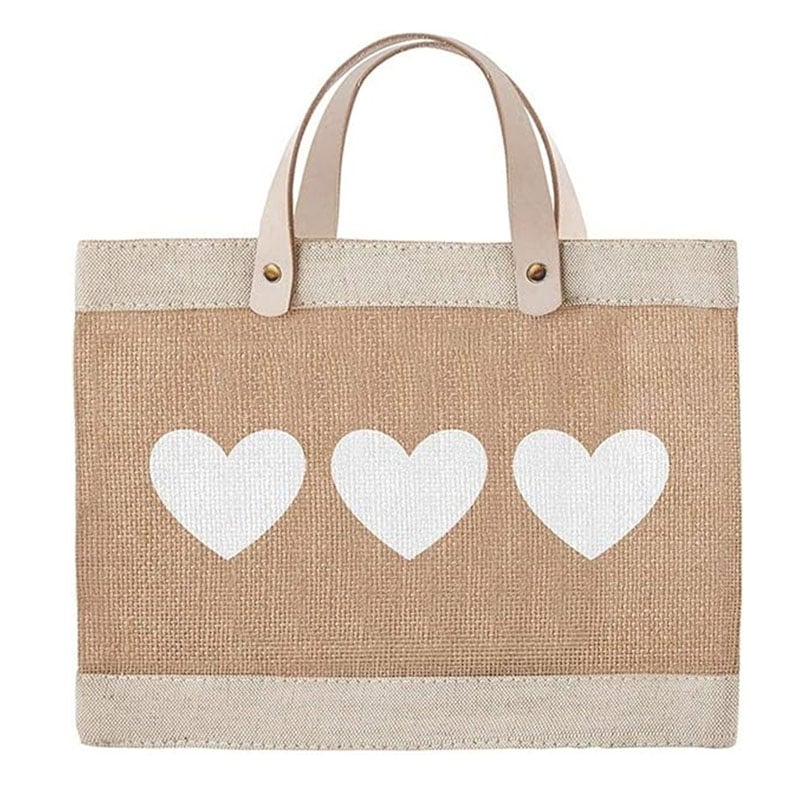
Suitable for gift, food, wine and natural-positioning retail projects.
The important change is not simply:
Plastic bag → another bag.
The real trend is:
disposable carrier bag → bag designed for repeated use.
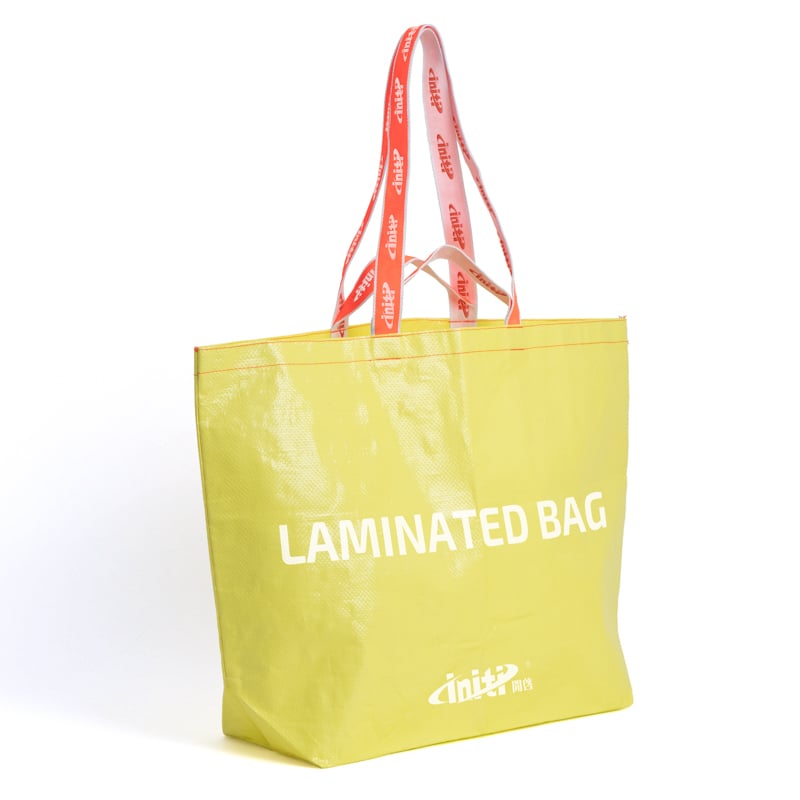
Trend 2: RPET and Recycled Polyester Are Growing in Absolute Volume, but the Data Needs Careful Interpretation
RPET is one of the most relevant materials for custom bag buyers, but the market data should be described accurately.
According to Textile Exchange, recycled polyester production increased from approximately 8.9 million tonnes in 2023 to 9.3 million tonnes in 2024.
However, its share of the total polyester market declined from 12.5% to 12%, because virgin polyester production grew even faster.
This is an important distinction.
What is rising?
The absolute volume of recycled polyester.
What is not rising?
Its share of total polyester production.
Therefore, it would be inaccurate to say:
Recycled polyester is rapidly replacing virgin polyester worldwide.
The data does not support that conclusion.
A more accurate commercial conclusion is:
Recycled polyester is becoming an important sourcing category, but virgin polyester still dominates global production.
For bag buyers, RPET is particularly suitable for:
- foldable shopping bags,
- reusable shopping bags,
- promotional bags,
- drawstring bags,
- cooler bags,
- travel organizers,
- sports bags.
The strongest advantage is not appearance. It is the ability to combine familiar polyester performance with a recycled-content sourcing story.
Trend 3: Paper-Based Retail Packaging Has Strong Structural Advantages
Paper and cardboard remain a major part of the packaging market.
Consumers across McKinsey’s 2025 global research generally ranked paper among the packaging materials perceived as more sustainable, while plastic films ranked among the least sustainable packaging formats.
Recycling infrastructure also supports paper-based packaging in many European markets. The European Paper Recycling Council reported that paper packaging achieved an 83.1% recycling rate in Europe.
This gives several packaging types strong relevance:
- paper shopping bags,
- kraft paper bags,
- folding cartons,
- paper gift boxes,
- paper sleeves,
- paper-based retail packaging.
However, paper is not automatically the best material for every product.
A paper bag may be suitable for:
- fashion retail,
- cosmetics,
- bakery packaging,
- gift packaging,
- light consumer products.
A reusable fabric bag may be better for:
- repeated grocery shopping,
- heavy products,
- outdoor use,
- long-term brand exposure.
The market direction is therefore not:
Paper will replace every plastic product.
It is:
Paper is becoming more attractive where existing collection and recycling systems make it practical.
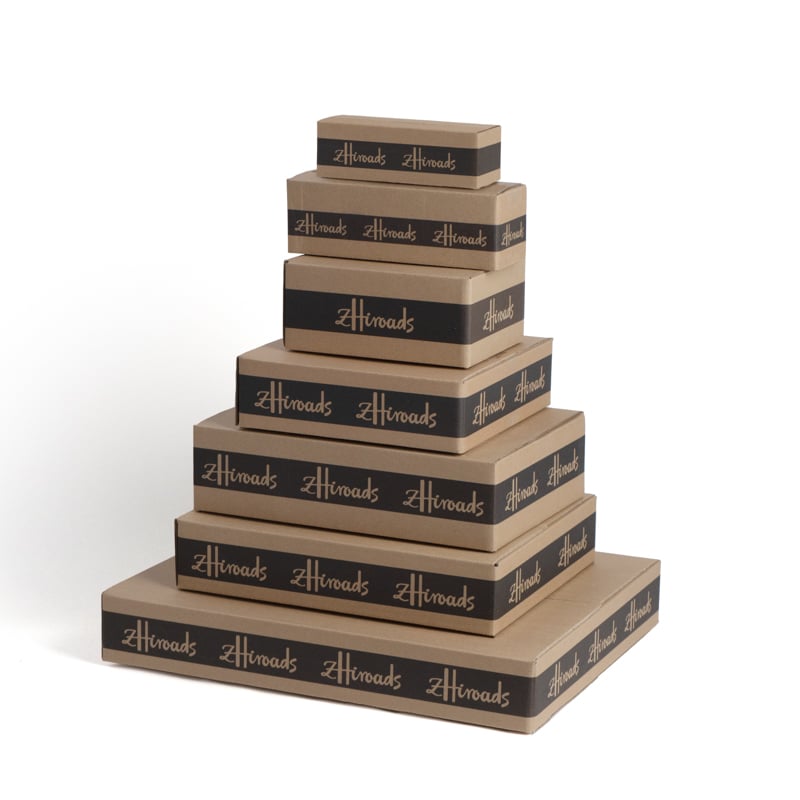
Trend 4: Lightweight and Right-Sized Packaging Is Becoming More Important
Sustainable packaging design is increasingly connected to material efficiency.
The EU’s new packaging direction specifically addresses unnecessary packaging, excessive empty space and unnecessary layers, while encouraging smaller and lighter packaging structures.
For retail bags, this creates opportunities for:
- lightweight foldable bags,
- compact reusable bags,
- better size segmentation,
- reduced packaging volume,
- more efficient carton packing.
For example, a retailer may no longer need one oversized shopping bag for every purchase.
A more efficient bag system can include:
| Bag Size |
Typical Use |
| Small |
Cosmetics, accessories, small gifts |
| Medium |
Apparel, books, general retail |
| Large |
Multiple items, grocery or larger products |
For custom bag development, a lightweight structure can be commercially attractive when it still provides sufficient:
- carrying strength,
- handle durability,
- seam performance,
- and repeat-use value.
Trend 5: Simple Material Structures Are Becoming More Attractive
Packaging that combines many different materials can be more difficult to process at end of life.
The regulatory direction toward recyclability and material efficiency therefore favors simpler structures where technically practical.
For custom bag projects, buyers are increasingly likely to evaluate questions such as:
- Is the main body recyclable in the target market?
- Are unnecessary accessories required?
- Can the material structure be simplified?
- Is a laminated structure necessary?
- Can a reusable design replace a short-life product?
This does not mean every bag must use only one material.
Zippers, handles, mesh, lining and reinforcement may still be necessary for function.
The direction is toward:
necessary complexity rather than decorative complexity.
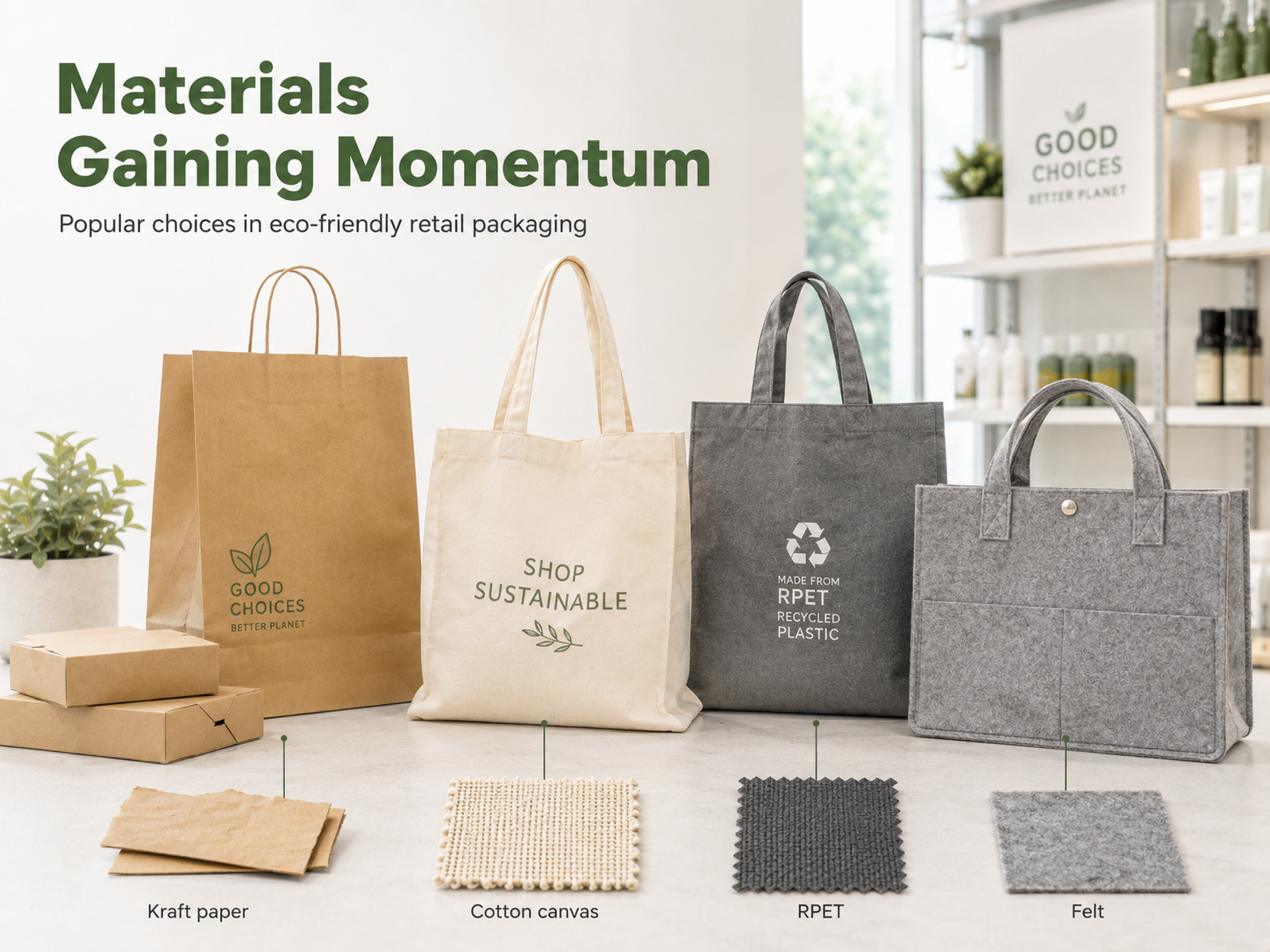
Which Bag Materials Best Match the Trend?
A useful material strategy should separate real market direction from marketing assumptions.
| Material |
Trend Position |
Best Applications |
Important Note |
| RPET Polyester |
Strong opportunity |
Shopping, foldable, promotional, travel bags |
Absolute recycled polyester volume is rising, although market share has recently declined |
| Paper & Cardboard |
Strong position |
Retail bags, gift boxes, sleeves |
Supported by high recycling rates in Europe and strong consumer perception |
| Cotton & Canvas |
Strong for reusable premium bags |
Fashion, bookstores, gifts, merchandise |
Best when the product is designed for genuine repeated use |
| Jute & Burlap |
Niche but relevant |
Wine, food, gift and lifestyle retail |
Strong natural positioning, but broad market growth should not be overstated without category-specific data |
| Reusable Polyester |
Practical |
Foldable and lightweight shopping bags |
Durability and repeated use are more important than generic eco claims |
| Non-Woven PP |
Value-driven |
Promotions and basic reusable shopping |
Should not automatically be described as environmentally superior |
| Virgin Plastic Single-Use Bags |
Under pressure |
Limited short-use applications |
Clear consumption declines in several regulated retail markets |
| Complex Multi-Material Packaging |
Increasing pressure |
Selected technical applications |
Difficult end-of-life processing can reduce sustainability value |
Which Types of Bags Are Most Likely to Benefit?
Based on the combination of consumer preference, regulation and material trends, several bag categories have the strongest strategic fit.
1. Reusable Grocery and Supermarket Bags
Strong fit because the decline of lightweight single-use bags creates demand for alternative carrying systems.
Suitable materials include:
- laminated RPET,
- recycled polyester,
- woven reusable structures,
- durable non-woven options.
The key is actual repeat use.
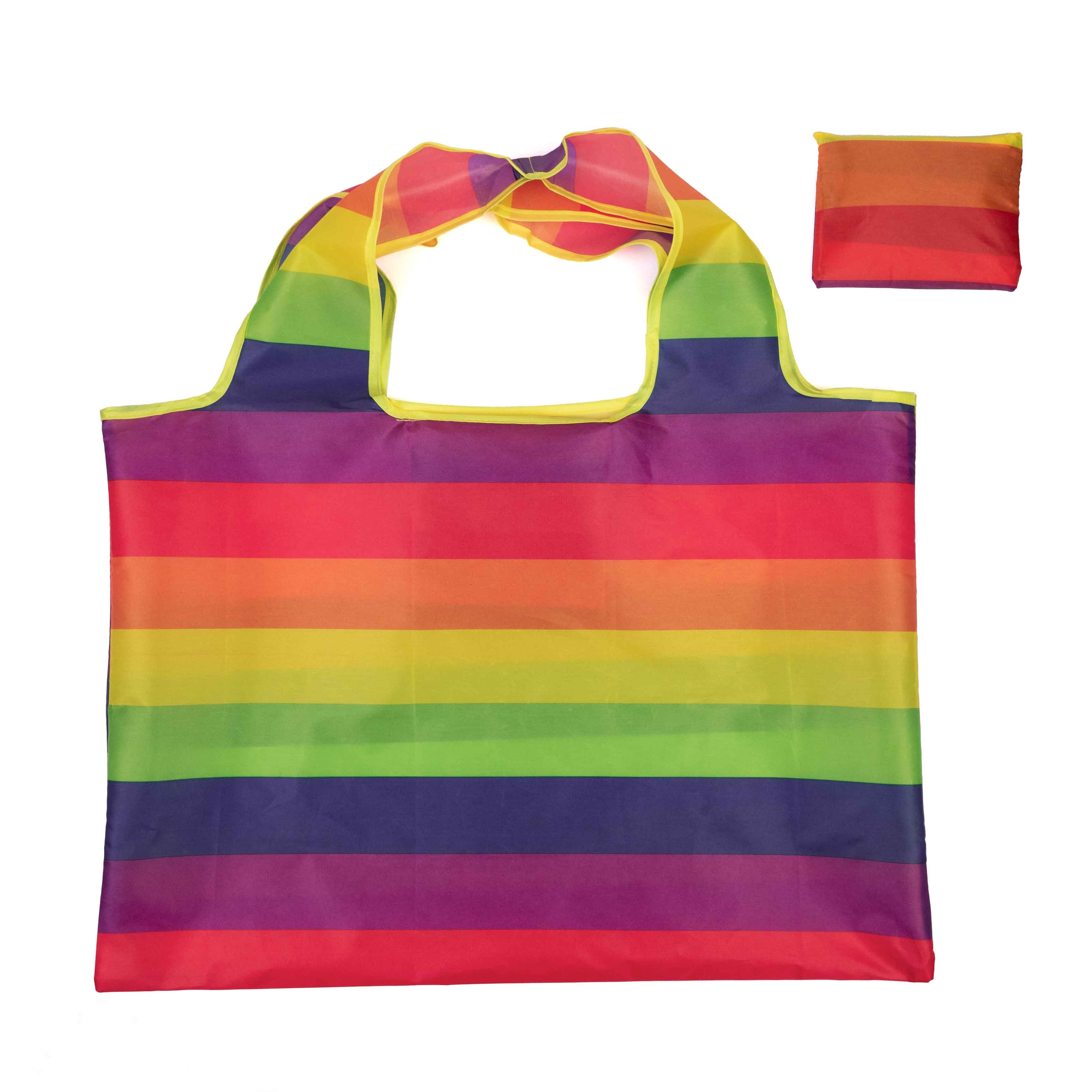
2. Foldable Shopping Bags
These products combine:
- lightweight design,
- small storage volume,
- repeated use,
- practical everyday function.
The category fits the broader movement toward reusable and material-efficient packaging.
Suitable materials include:
- polyester,
- recycled polyester,
- nylon where project performance requires it.
For sustainability positioning, RPET provides a clearer recycled-content story than virgin synthetic materials.
3. RPET Promotional and Retail Bags
These are likely to remain strategically relevant because recycled content ranks highly among consumer sustainability preferences, while recycled polyester production has increased in absolute volume.
Suitable products include:
- RPET tote bags,
- RPET drawstring bags,
- RPET foldable bags,
- RPET cooler bags,
- RPET travel bags.
The next stage of the market will likely require more accurate communication about recycled content and sourcing rather than simply adding the word “recycled” to product marketing. This is an inference based on the combined consumer, material and regulatory direction.
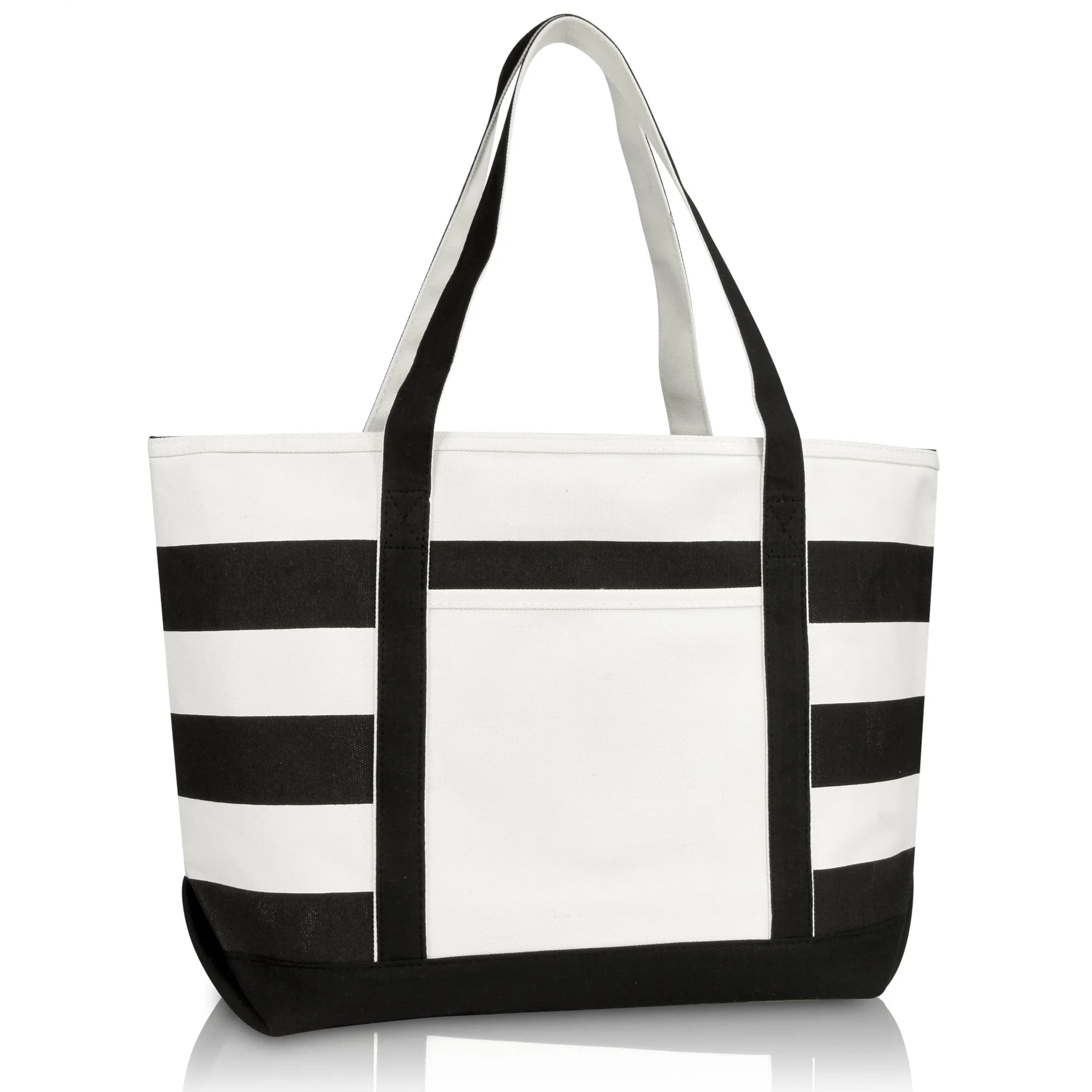
4. Durable Canvas Tote Bags
Canvas bags are well positioned for:
- fashion retail,
- bookstores,
- museums,
- lifestyle brands,
- corporate merchandise.
However, canvas should not be marketed simply as:
Natural material = automatically sustainable.
Textile Exchange reported that cotton’s share of global fiber production declined slightly to 19% in 2024, while total cotton production also fell slightly from 24.8 million tonnes to 24.5 million tonnes.
Therefore, the stronger positioning for canvas totes is:
durability, repeated use, repairability and long-term branding value
rather than making unsupported environmental superiority claims.
5. Paper Retail Bags and Gift Packaging
Paper shopping bags and paperboard gift packaging have strong relevance for:
- fashion,
- beauty,
- jewelry,
- bakery,
- gifts,
- premium retail.
Their advantage is strongest in markets with established paper collection and recycling infrastructure.
Europe’s paper packaging recycling rate of 83.1% provides a strong reason for paper-based retail packaging to remain important in relevant applications.
Which Packaging Types Are Declining or Facing More Pressure?
1. Lightweight Single-Use Plastic Carrier Bags
This is the clearest declining category in the available carrier-bag data.
EU lightweight carrier bag use fell from 95 units per person in 2018 to 65 in 2023.
England’s major-retailer data shows an almost 98% reduction compared with the period before the carrier-bag charge.
There can still be year-to-year fluctuations and market-specific exceptions. For example, England’s total reported bag sales increased by 7% from 2023–2024 to 2024–2025, even though the long-term direction remained sharply lower than the pre-charge baseline.
Therefore the correct conclusion is:
Long-term structural decline, but not a straight-line decline every year.
2. Over-Packaged Products
Packaging with:
- unnecessary empty space,
- multiple decorative layers,
- redundant inserts,
- excessive size,
is facing increasing regulatory pressure.
The EU’s packaging direction specifically targets unnecessary packaging and empty space.
For retailers, this creates more interest in:
- correct sizing,
- fewer unnecessary components,
- efficient packing,
- and better transport utilization.
3. Packaging Designed Around Vague “Green” Claims
Consumer data suggests that broad environmental language is less useful than clear concepts.
Across McKinsey’s 11-country survey, recyclability was the most important sustainability attribute, while reusable design and recycled content also performed strongly. In nine of the 11 countries, bio-based packaging ranked as the least important sustainability characteristic.
This does not mean bio-based materials have no future.
It means buyers should not assume that a vague label such as:
- green,
- natural,
- biodegradable,
- eco,
is automatically the strongest commercial message in every market.
Clearer claims are more understandable:
- reusable bag,
- recycled content,
- recyclable paper packaging,
- reduced packaging material,
- lightweight design.
An Important Reality: Sustainability Alone Does Not Sell the Product
One of the most useful findings from recent consumer research is that sustainability is important, but it does not replace the fundamentals of the product.
McKinsey found that price and quality remain the leading purchasing factors. In Europe, practical packaging factors such as food safety and shelf life remain more important than environmental impact.
Therefore, retail packaging should not sacrifice:
- strength,
- usability,
- capacity,
- appearance,
- price competitiveness,
- or product protection.
A reusable shopping bag that is uncomfortable to carry is unlikely to create meaningful repeat use.
An RPET bag with poor stitching does not become a good product because the fabric contains recycled material.
A paper bag that fails under the required load is not a suitable solution for heavy retail products.
The strongest direction is:
sustainability integrated into good product design.
A Practical Trend Map for Retail Buyers
Clearly Strengthening
Reusable Bags
Especially products designed for genuine repeated use.
Recycled-Content Bags
Particularly RPET and recycled polyester projects with clear sourcing requirements.
Recyclable Paper Packaging
Especially in markets with mature paper collection systems.
Lightweight Packaging
Where weight reduction does not damage product performance.
Right-Sized Packaging
Packaging designed around actual products rather than excessive empty space.
Simple Material Structures
Products that remove unnecessary components and complexity.
These directions align with both consumer circularity preferences and the direction of packaging regulation.
Under Pressure
Lightweight Single-Use Plastic Carrier Bags
Strong long-term decline in regulated markets.
Excessive Packaging
Increasingly inconsistent with packaging reduction objectives.
Hard-to-Recycle Mixed Structures
Facing pressure from the move toward packaging recyclability.
Generic Sustainability Claims
Less persuasive than specific, understandable attributes such as recyclability, reusability and recycled content.
Not Necessarily Declining, but Should Not Be Overstated
Cotton Bags
Strong for premium reusable products, but current global fiber data does not show rising cotton market share.
Jute Bags
Relevant for natural, gift, wine and food retail positioning, but should not be described as a universal high-growth packaging segment without specific market evidence.
Virgin Polyester Bags
Virgin polyester production is still increasing globally, so it would be incorrect to say that virgin synthetics are disappearing. Polyester remained 59% of global fiber production in 2024, and 88% of polyester output was fossil-based.
The more accurate conclusion is that commercial and regulatory pressure toward recycled alternatives is increasing even while virgin material production remains large.
What Should Retail Buyers Develop Next?
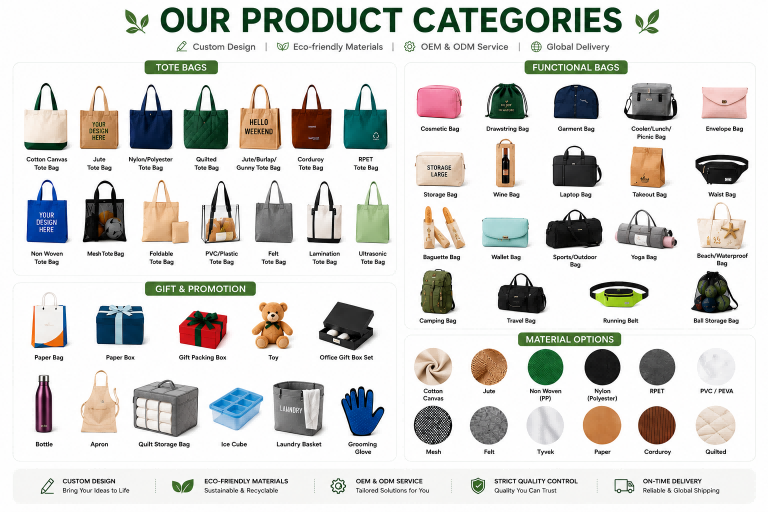
Based on the current direction, a retail packaging portfolio could prioritize several product groups.
For Supermarkets and Grocery Retail
- Laminated RPET shopping bags
- Large reusable grocery bags
- Foldable shopping bags
- Insulated cooler bags
For Fashion and Lifestyle Retail
- Canvas tote bags
- RPET tote bags
- Foldable bags
- Paper shopping bags
For Corporate Promotions
- RPET drawstring bags
- Recycled polyester backpacks
- Canvas totes
- Foldable shopping bags
For Gifts and Premium Retail
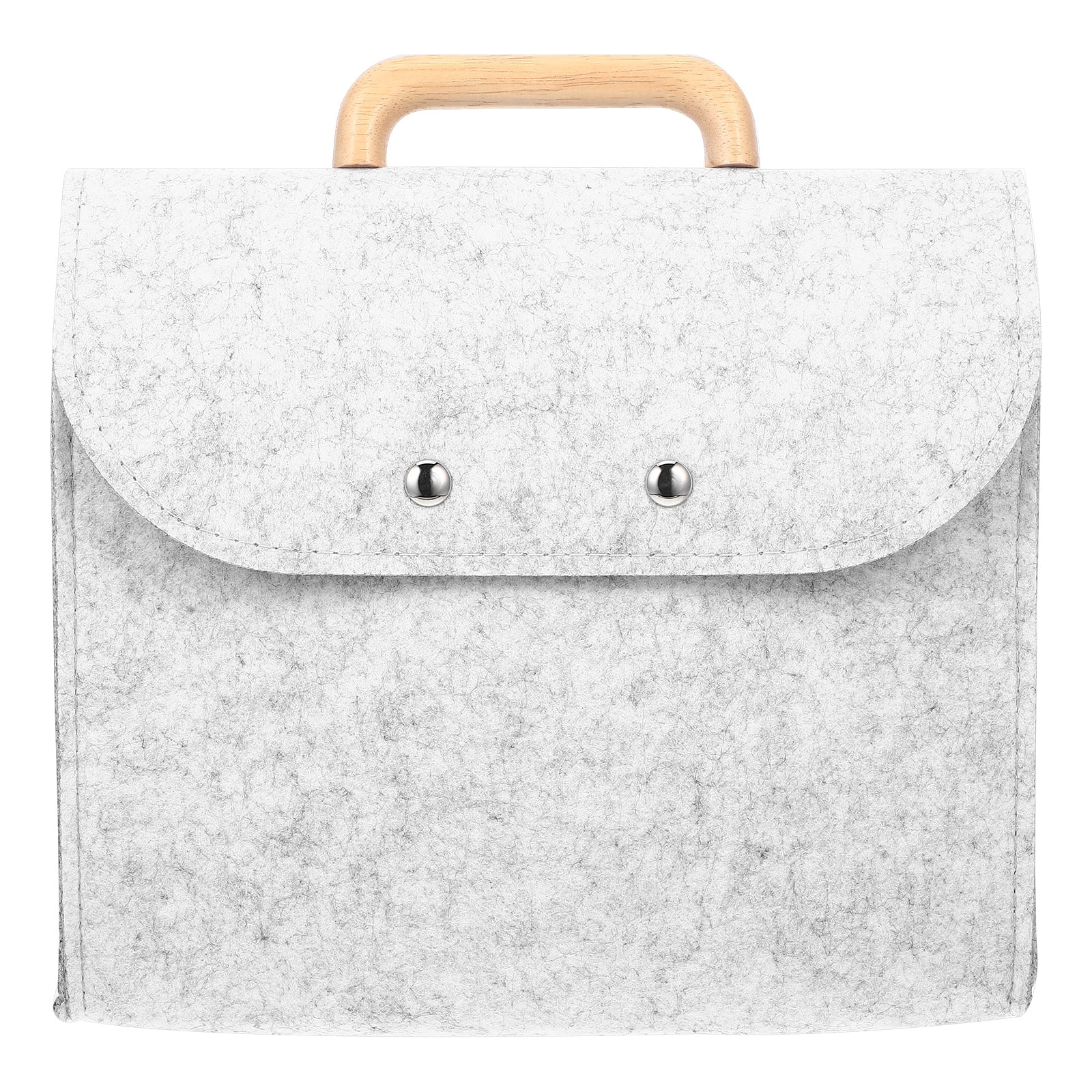
- Felt tote bags
- Jute bags
- Structured paper bags
- Reusable gift pouches
- Paperboard gift boxes
The correct product should be chosen according to:
- intended lifespan,
- target customer,
- carrying load,
- brand positioning,
- market recycling infrastructure,
- and expected order volume.
Conclusion: The Market Is Moving Toward Circularity, Not Simply “Green Packaging”
The data shows that the eco-friendly packaging trend is real, but it is more specific than simply replacing plastic with natural-looking materials.
The strongest signals are:
- lightweight single-use carrier bag consumption has declined significantly in regulated retail markets,
- consumers consistently rank recyclability first and also value reusability and recycled content,
- regulation is moving packaging toward recyclability, recycled content, less unnecessary material and greater reuse,
- recycled polyester production is increasing in absolute volume, although its global market share is not yet growing,
- and paper packaging benefits from established recycling systems in markets such as Europe.
For custom bag buyers, the most promising direction is therefore not to chase every product described as eco-friendly.
The better strategy is to develop packaging that combines:
real function + repeated use + clear material information + efficient structure + credible sustainability positioning.
For retailers, supermarkets and brand owners, products such as reusable shopping bags, RPET bags, foldable bags, durable canvas totes and recyclable paper packaging are strongly aligned with the direction of the market.
The packaging products facing the greatest long-term pressure are those built around short use cycles, unnecessary material, difficult-to-process structures and sustainability claims that customers cannot clearly understand.
What else do you want to know?


 Hot News